Motion Pictures in History Teaching

Chronicles of America

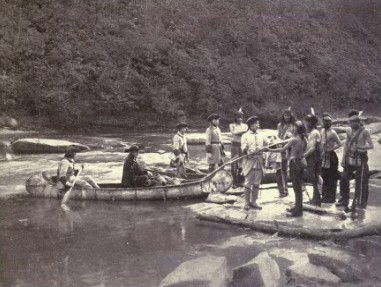
The Gateway to the West (1924), from Motion Pictures in History Teaching

Just added to the Bioscope Library is Daniel C. Knowlton and J. Warren Tilton’s Motion Pictures in History Teaching: A Study of the Chronicles of America Photoplays as a Aid in Seventh Grade Instruction (1929). The Chronicles of America was a 1923-24 series of educational film series produced by Yale University Press. The series included such earnest and traditionalist titles as Jamestown, Yorktown, Daniel Boone, The Declaration of Independence and The Gateway to the West. These three-reeler dramas were relatively lavishly produced, helping to pay their way by getting theatrical screenings. But their target audience was in the classrooms of America, and this study of the series examines its pedagogical value. It looks at how the series contributed to ‘the learning of fundamentals’, and the degree to which they contributed to enrichment, retention and creation of interest’, through a meticulous system of testing groups. The painstaking methodology is as fascinating as the underlying assumptions of the films’ photo-historical validity. It is also handsomely illustrated with stills from the films. It’s available from the Internet Archive in PDF (48MB), DjVu (5.4MB) and TXT (326KB) formats.

Paul Merton’s Silent Comedy

Paul Merton Silent Comedy

Amazon.co.uk

Well, as the Bioscope motors on past the 30,000-views figure, it’s hard to say which has been the most popular topic so far, but it’s probably either Albert Kahn or Paul Merton. Which is ironic, since Albert Kahn has been pursued for the Autochrome colour still photographs he organised rather than the films he commissioned, while Merton is anxious to take a back seat in promoting the work of the silent comedians he so admires.

The latest expression of this is his book, Silent Comedy, which has just been published. I’ve only thumbed through it in a bookshop so far, but what is immediately noticeable is what a wordy, conscientious and carefully-constructed work it is. Merton has paid his dues as a silent film buff, collecting 8mm copies from childhood, reading as well as watching all that he could, and he makes fulsome acknowledgment to Kevin Brownlow and David Gill for their television and restoration work, and to the works of Glenn Mitchell and Simon Louvish. Merton has clearly read a great deal, and the book goes into the personal histories of the silent comedy greats, as well as describing individual sequences in sharp detail. Anyone familiar with this territory will recognise much of the material, but it’s not meant for them. Merton is targetting his young audience, for whom Silent Comedy is a means of discovery, not confirmation of a well-known history. This is a subject that need discovering all over again.

This puts Merton in the awkward position of being the straight man, much as is going to be the case for his forthcoming Silent Clowns tour, where audiences may come to see Merton and his gags, but where Merton is anxious for them to see rather less of him and as much as possible of the films themselves. The book’s cover highlights the problem. Paul stands in the centre, his subjects in the background, but the book itself is organised the other way around.

Well, no matter, it’ll become a favourite Christmas present, and it’s a treasure trove of material that needs to be passed on to a new generation of enthusiasts. It’s also beautifully illustrated. It concentrates on the key names – Chaplin, Keaton, Lloyd, Laurel and Hardy – with little space given to the second tier of comics – Larry Semon, Charley Chase – and no mention at all of ‘minor’ figures like Max Davidson or any European comic except Max Linder (OK, you could argue that Chaplin and Laurel were European…). That’s a bit of a missed opportunity. But it serves a window on a lost world, which might just be that little bit less lost from now on.

Update: There’s a rather muddled (i.e. muddled in that it seems the reviewer can’t decide whether the book is good or not) but nonetheless intriguing review by James Christopher in The Times.

Freak shows and cinematographs

As initiatives such as the Crazy Cinematographe show and DVD are showing, the cinema came out of the fairground and its displays were seen by many as at one with freak shows, waxworks and performing animals. Just as many would probably say that this remains the case. Anyway, published this week is fascinating evidence of this parentage. The Society for Theatre Research has published The Journals of Sidney Race, 1892-1900: A Provincial View of Popular Entertainment. Sidney Race was a gas company clerk, living in Nottingham, who started writing down what he saw of life in the city, including its many public entertainments, notably the Nottingham Goose Fair.

From 1892 to 1900, Race recorded his impressions of bearded ladies, armless wonders, performing seals and dancing bears, with a keen eye for ordinary detail. And so, naturally enough, he took note of the cinematograph when it arrived in Nottingham. His first impression was one of scant glamour:

It was a dirty canvas tent with the sheet arranged by the entrance and the apparatus on an old box or two opposite it where it was worked by a grim looking individual as black as a stoker.

Later he recorded seeing a ‘Living Pictures’ in Long Row, Nottingham, where he recorded that:

an enormous number of photographs, taken consecutively, are whirled with the speed of lightning, before your eyes.

He saw films shown on the Edison Kinetoscope, trick films, dramatised scenes depicting the Greco-Turkish War (made by Georges Méliès), and numerous ‘exceedingly improper’ films’. He describes one film which evidently made a particular impression. It was called The Model’s Bath.

A woman – we could detected a large smile on her face – divested herself of her skirt and other outer objects of clothing and appeared in her white drawers and chemise … The girl was in a large white night dress which had fallen down from the breast disclosing a well developed ‘frontage’ … It was a dirty and suggestive exhibition though we really saw no indecency … I am very glad it was late at night when I saw the thing and that no lady was with me.

This remarkable find was made by theatre historian Ann Featherstone, University of Manchester, who came across the journal in the Nottingham Archives. It’s not unknown to film historians, as Vanessa Toulmin of the National Fairground Archive has used the journals, and cites several passages in her essay ‘The Cinematograph at the Nottingham Goose Fair, 1896-1911’, in Alan Burton and Laraine Porter (eds.), The Showman, the Spectacle & the Two-Minute Silence: Performing British Cinema Before 1930 (2001). She notes Race’s scepticism, indicating that early audiences were not always taken in by the trickery of some films as some have suggested, being able to tell a dramatised war scene from the likely reality, for instance.

I’ve not yet seen a copy of the publication, and it’s not easy to find information on it, not least because there’s nothing as yet on the Society for Theatre Research’s web site. There’s a citation for the original journal on the Nottinghamshire Heritage Gateway. I’ll put up more information when I find it.

Update (March 2008):
This message has come from the Journals’ editor:

Hello, I’m Ann Featherstone. I edited the Journals of Sydney Race, published by the Society for Theatre Research. I’ve been working on and around these fascinating journals for about 10 years (!), and I was really glad when the STR agreed to publish the selection. They are absolutely fascinating. Sadly, the book hasn’t appeared on the STR website – I don’t know why. But if anyone wants a copy, please email me. The cost is £11.50 (inc. p & p).

Email Ann at a.featherstone3 [at] ntlworld.com

Domitor on the periphery

Domitor

The 2008 Domitor conference has changed its title and varied somewhat its terms of reference. Previously it was going to be called ‘The Regional Dimension in Early Cinema’. Now it rejoices in the title ‘Peripheral Early Cinemas’. By which they seem to mean early cinema on the edges: geographically, industrially, culturally and temporally. But let them express it in their own words:

Call for Papers: Domitor 2008

The next biannual conference of Domitor will take place from Tuesday 17 June-Saturday 21 June in Catalonia, that is, Girona, Spain, and Perpignan, France. For the first time a Domitor conference will traverse national frontiers. The topic selected, appropriate for this unique setting, is:

PERIPHERAL EARLY CINEMAS

Rationale

The notion of “Peripheral cinemas” is geographical concept: cinema that is made or viewed far from the institutional center (for example, national capitals). But the designation is not only spatial. It also involves cinemas produced on the margins of developing industrial and cultural institutions.

“Peripheral” then, connotes “regional” or “provincial,” but these characterizations are relative to the specific historical period. It was Barcelona, for instance, that was the actual capital of Spanish filmmaking in 1900. Furthermore, the idea of “regional” or “provincial” is not relevant to numerous places (Italy, USA, not to mention non-Western countries).

As a result, the concept of “local cinema” becomes very problematic.

Issues and Questions envisioned

1. Institutional context. The operative conceptual tool of the Center-Periphery antinomy. To identify peripheral early cinemas reflects as well the institutional forms of centrality that were springing up. Where is the institutional “center” in early cinema?

2. Models and types of production. Can we speak of a “central model” —such as the cinema of attractions—and other “peripheral models,” such as travel films, tableaux vivants, publicity, etc…? Amateur films and military films are “peripheral” today in relation to commercial institutional production. Were they in the time of early cinema? Was women’s cinema, to the extent that it existed in the early period, peripheral?

3. The sociological level. Is there a sociological center —“bourgeois” film—for example, an English “working class” cinema? Is this distinction valid at the level of production? Reception? The two combined?

4. Industrial and peripheral exhibition systems. How did exhibition systems develop from a center? Were they aligned with specific ideas of a geographical center? Were there alternative forms of film exhibition not dependent on a center, for example in rural locations or the outskirts of large cities? Examples would be comparisons between Torino/Roma in Italy, Paris/Marseille or Paris/Nice in France or Madrid/Barcelona in Spain. Did this dichotomy function in cinematic environments everywhere, especially outside of Europe?

5. Historiography. Film history traditionally has been written from the center about the center. This is becoming less the case in recent years and relates to early cinema. Has historiography established a certain centrality in early films studies that we should consider revising? Furthermore, was it like that in the writing of the time? Is this centrality the norm in Western countries? At the same time, is the history of non-Western cinemas relegated to the periphery?

6. The study of representation: the “colonial” gaze. One puts in this category all the forms of viewing that emanate from the center to the periphery. How did that function in cinema at its origins? Peripheral and folkloric relationships? How did cinema take into account “minority” cultures at the turn of the 19th and 20th centuries? The relationship of periphery to center would accordingly by first and foremost defined in terms of the gaze.

Included in this examination are “peripheral” cinematographic practices that gaze upon peripheral” cultures from outside as subjects. This would include “tourist,” “ethnographic” and neighboring filmmaking.

In order to avoid over-extending and overflowing the topic, we are not counting scientific, advertising or instructional films. Certainly, this is another issue, since one could maintain that they were “peripheral” in relation to institutional cinema.

Sending Proposals

Those wishing to submit a proposal should send a proposal of no more than one page to the selection committee by 31 December 2007. (The e-mail addresses will be posted on the Domitor website when available.) The papers must be original unpublished research. Languages accepted are English, Catalan, Spanish and French. The papers should be no more than 10 pages (A4) or 12 pages (US letter). The final text must be submitted by 30 April 2008 to allow for translation. The presentation should last no more than 20 minutes.

A selection of papers from the conference will be published in a trilingual volume.

Membership in Domitor is not required to submit a proposal. However, in order to present a paper at the conference, membership in the organization is mandatory.

Why the prejudice against scientific, advertising or instructional films, eh? There’s always something that gets pushed to the margins. And if everything’s on the edge of something else, is there a mainstream or a centre at all? Further information (if not necessarily illumination) can be found on the Domitor website. For those who don’t know, Domitor is the leading international organisation for the study of early cinema, its main activities being a bi-annual conference followed by a volume of published papers. Details of past publications from conferences going back to 1990 can be found here.

Networks of Entertainment

Networks of Entertainment, from http://www.johnlibbey.com

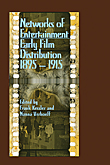
Not on the Domitor site as yet are details of the most recent publication, Networks of Entertainment: Early Film Distribution 1895-1915, edited by Frank Kessler and Nanna Verhoeff, and published by John Libbey, which derives from the 2004 conference. The publisher’s blurb describes the book thus:

This collection of essays explores the complex issue of film distribution from the invention of cinema into the 1910s. From regional distribution networks to international marketing strategies, from the analysis of distribution catalogues to case studies on individual distributors these essays written by well-known specialists in the field discuss the intriguing question of how films came to meet their audiences. As these essays show, distribution is in fact a major force structuring the field in which cinema emerges in the late 19th and early 20th century, a phenomenon with many facets and many dimensions having an impact on production and exhibition, on offer and demand, on film form as well as on film viewing. A phenomenon that continues to play a central role for early films even today, as digital media, the DVD as well as the internet, are but the latest channels of distribution through which they come to us. Among the authors are Richard Abel, André Gaudreault, Viva Paci, Gregory Waller, Wanda Strauven, Martin Loiperdinger, Joseph Garncarz, Charlie Keil, Marta Braun, and François Jost.

I thumbed through it at Pordenone, and it looks well worth getting hold of.
Hugo Cabret review

The Invention of Hugo Cabret

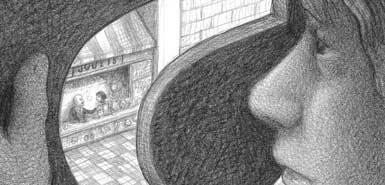
Illustration from The Invention of Hugo Cabret

Just time to give you this review by Ian Beck of Brian Selznick’s children’s book, The Invention of Hugo Cabret, already covered by an earlier post, in The Times. The inventively-illustrated book pays homage in its style to silent cinema, and Georges Méliès is a central character.

TO THE CASUAL EYE this is a daunting doorstop of a novel, a solid brick of 534 pages aimed squarely – and a little heavily – at the child reader.

Open the book, however, and something magical happens. Brian Selznick, who is well known in the US as an illustrator, has created a new and exciting hybrid, part novel, part picture book.

The narrative, written in simple, fable-like prose, is interrupted at crucial points by pages of eerie and heavily atmospheric, soft black-and-white tonal drawings. These move the story forward cinematically, then the words take over again, picking up exactly where the pictures have just stopped. It is like the exhilarating moment in a musical when a song seems to rise organically from the spoken drama; here the sequences of pictures suddenly rise like monochrome music. Instead of the action being described, we suddenly see it.

The early history of film is bound up, not to say embedded, in this moving story of Hugo Cabret, a 12-year-old orphan. The book opens with a wordless sequence of drawings. Beginning with a small image of the moon framed against a black page, exactly like an image from a silent film.

With each turn of the page, the images zoom out until the moon shines over the rooftops of Paris (deliberate echoes of René Clair and the golden age of French cinema), then the pictures widen further and our eye is taken into the city and among the crowds until we pick out young Hugo making his way through the caverns of the station that is his home.

It is 1931 and Hugo lives in a hidden chamber somewhere in the Gare du Nord. He spends his time caring for the clocks in the station, winding them and cleaning them. He feels an affinity with clockwork, and carries with him a mysterious notebook given to him by his father. The notebook has clues to the construction of a mechanical man, an automaton, which was damaged in a fire at the museum where Hugo’s father worked and perished.

Hugo believes that if he can repair the automaton, a seated figure holding a pen over a piece of paper, it will write him a message from his father.

He needs mechanical pieces to complete his work and attempts to steal them from a toyshop in the station. He is caught by the old man who runs it, and loses his notebook. But Hugo is helped in his task by Isabelle, the old man’s goddaughter. Through a combination of their abilities, they manage to make the figure work. It does indeed write a message, but it is not from Hugo’s father, and only deepens the mystery.

The substance of the story concerns the pioneering days of fantasy film-making, in particular that genius of the early silent cinema, Georges Méliès, who made the iconic 1902 film A Trip to the Moon, in which a rocket lands in the moon’s eye.

The story is an engaging meditation on fantasy, inventiveness, and a thrilling mystery in its own right. No knowledge of early cinema is necessary to enjoy it, but for those who do know just a little, the rewards are even greater.

Selznick should be applauded not only for extending the form of the illustrated book, but also for mining such a rich and neglected seam for his storytelling. If this book encourages a wider interest in the lost world of silent cinema, that would be a job well done. But it is also to be hoped that this new hybrid form will be developed in further ways by other authors and artists.

The Film Industry

British film studio

Unidentified British film studio, from The Film Industry

Just arrived in The Bioscope Library is The Film Industry (1921), by Davidson Boughey. This British publication is a relatively short but knowledgeable and helpful account of film production techonology and techniques, from a British perspective. It was much used by Rachael Low in her classic work, The History of the British Film 1918-1929. Boughey covers the history of film production (with an emphasis on British legislation), the manufacture and use of cinematograph film, the cinematograph camera, developing film, printing, tinting and toning, titling, the set-up of a motion-picture studio (particularly useful for the picture of British conditions, which were somewhat behind Hollywood), the production of films (again very informative on British practice), fiction films, travel, topical and scientific films, distribution, publicity, projection and exhibition. Boughey also provides useful figures on cinema attendance, the numbers employed by the cinema industry, and investment in film. It’s available from the Internet Archive in DjVu (3.5MB), PDF (11MB) and TXT (179KB) formats.

Cowboys and Indians

The East End Years

http://www.amazon.co.uk

I’m a collector of memoirs (published and unpublished) of the film-going experience in the early years of cinema. One particular favourite from my work on London before the First World War is the memoirs of Fermin Rocker, The East End Years: A Stepney Childhood. I just came across a copy in Foyles today, and thought it worth sharing with you.

Rocker (1907-2004) led a somewhat unusual London childhood, in that his father was the German anarchist theorist Rudolf Rocker, while his mother was a Jewish-Ukranian anarchist-syndicalist, and their home was a focal point for revolutionaries. Kropotkin and Malatesta were family friends, and his childhood memories of life in Jewish Whitechapel are fascinatingly coloured by the radicalism that was all around him. This is evidenced by his memories of going to the cinema when very young (maybe six or seven), where his reactions to Westerns were at variance with most children:

High on my list of favourites were the Indians of North America, a people for whom I had an unusual degree of admiration and sympathy. Their picturesque appearance as well as their skill and bravery as hunters and warriors greatly impressed me. Coupled with this regard and affection was a strong feeling of outrage aroused by my father’s stories of the deceit and treachery practised upon them by the white man. I dearly wished that some day the redskins would be able to turn the tables on their white oppressors and drive them from the continent which their cunning and duplicity had helped them conquer …

… My partiality for the redskin was to have some unhappy consequences when I received my first exposure to the cinema. The Westerns, which featured rather prominently in the repertory of those days, invariably had the Indians getting the worst of it in their encounters with the white man, a headlong rout of the redskins being the usual outcome. I found it quite impossible to look on calmly while my friends were being massacred on the screen. Not being nearly so stoical as my Indian idols, I would raise a tremendous commotion and have to be taken out of the theatre to prevent things from getting completely out of hand. After a few experiences of this kind, it was decided not to take me to the “pictures” any more, a resolution I did not in the least regret.

Not every child liked going to the cinema in those days. Rocker much preferred Punch and Judy shows (“I sometimes wonder if the creator of the Punch scenarios was not an anarchist in disguise. His hero was forever running afoul of the law…”). He went on to become a noted artist and book illustrator, examples of which you can see find at www.ferminrocker.com.

Journal of Film Preservation

Journal of Film Preservation

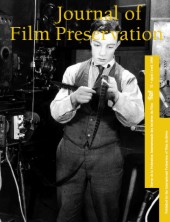
Journal of Film Preservation, from http://www.fiafnet.org

FIAF, the International Federation of Film Archives, “brings together institutions dedicated to rescuing films both as cultural heritage and as historical documents”. You can find details of the 120 or so institutions from sixty-five countries which belong to FIAF on its multilingual site, as well as standards documentation, news, projects and information on FIAF’s various specialised commissions.

The site also has details of FIAF publications, which include its Journal of Film Preservation. The journal covers theoretical and technical aspects of moving image archival activities, with plenty of information on silent film, which has always been a favoured area of the national film archives. It’s a very good publication, which is not much known about outside the film archiving profession. The journal is published twice a year, and one year after publication is made freely available on the FIAF site.

So there are currently twenty issues of the journal, from 1995 onwards, which can be downloaded from the site in PDF format. Here’s a guide to some of the articles worth looking out for:

  • No. 52 (Apr 1996) – Brian Taves on the work on undersea cinematography pioneer James Ernest Williamson, who made Twenty Thousand Leagues Under the Sea in 1916
  • No. 53 (Nov 1996) – Luke McKernan (yours truly) on programming a season of Victorian cinema (i.e. film to 1901) at the National Film Theatre
  • No. 54 (Apr 1997) – Richard Brown on the copyright records for early British films found in the then Public Record Office (now The National Archives)
  • No. 60/61 (Jul 2000) – Alfonso del Amo on the history of celluloid
  • No. 62 (Apr 2001) – Brian Taves on Michael (Jules) Verne, who both wrote novels in his famous father’s name, and then proceeded to film them
  • No. 64 (Apr 2002) – Sarah Ziebell Mann on the creation of the Treasures from the Film Archives database of early silent short fiction films around the world
  • No. 65 (Dec 2002) – Yoshiro Irie on the question of film speeds of Japanese silent films
  • No. 69 (May 2005) – Thomas C. Christensen on efforts to recover and restore the films of Asta Nielsen
  • No. 70 (Nov 2005) – Tiago Baptista on restoring the early surgical films of Eugène-Louis Doyen
  • No. 72 (Nov 2006) – Steven Higgins on avant garde cinema of the 1920s and 1930s

And much, much more. A fair bit of it is rather more technical than the general reader requires, but most articles combine the practical with the historical in engrossing fashion, and the illustrations are excellent (and rare). The Bioscope will be following up some of the themes above in future posts.

The Theatre of Science

The Theatre of Science – hard to imagine a general guide to the cinema having such a title nowadays. But Robert Grau’s The Theatre of Science: A Volume of Progress and Achievement in the Motion Picture Industry was published in 1914, when cinema was seen as a home of knowledge as much as place of entertainment (at least among commentators), a product of science and a technical achievement par excellence.

Grau’s book, published in a limited edition of 3,000, has become a standard reference source for the early cinema period. It provides an extraordinary amount of detail on the history and development of motion pictures in America to 1914 – their technological, economic, social and artistic changes, and the key events and personalities involved. Grau (a theatrical agent) was witness to much of the history he describes, and if his understanding of the development of the pictures towards the ideal of the theatre, he was a keen observer who provides hugely useful factual information on histories such as the rise of the nickelodeons and the emergence of a film trade press which scarcely exist elsewhere. He champions the names of pioneers of the industry who would otherwise be forgotten, the run-of-the-mill performers as well as the stars, and the book is rich in portrait photographs. It has much information on the leading and not so leading film companies of the period, and is at all points particularly interested in the business of making pictures. It is thrilled with how motion pictures were made, sold and exhibited, and for that enthusiasm alone it is strongly recommended.

It’s available from the Internet Archive in DjVu (21MB), PDF (66MB), b/w PDF (23MB) and TXT (711KB) formats, and it’s been added to the Bioscope Library.

The Invention of Hugo Cabret

Méliès shop

http://www.theinventionofhugocabret.com

The Invention of Hugo Cabret is a children’s book (designed for 9-12 year-olds), written and illustrated by Brian Selznick and published this year. Set in Paris in 1931, it tells of a young orphan boy, Hugo Cabret, who is reduced to stealing to find food to eat, but then rescues an automaton from a museum fire. Seeking pieces to repair the figure, he steals pieces from a toy store by a railway station. Then he is caught. Now read on…

Our interest is that the toy store keeper is Georges Méliès. The illustration above from the book echoes the famous photograph of Méliès at his kiosk on the Gare Montparnasse, years after he had lost his film business and disappeared into obscurity, and just at the point of his re-discovery by film historians. Méliès becomes a leading character in the story, introducing Hugo to the world of early film. The book is a graphic-novel-with-text, and incorporates images from Méliès’ films.

There’s a website, www.theinventionofhugocabret.com, which has information on the ideas behind the book, including a page on Méliès, and a Flash slide show of some of the book’s illustrations.

There’s a video interview with Selznick, emphasizing his fascination for the Méliès story, on the ExpandedBooks.com site. It shows many illustrations from the book, from which we learn that Selznick makes a particular point of depicting shoe-heels in his drawings (Méliès’ film library was notoriously melted down to make, amongst other things, shoe-heels).

Rumour has it that Martin Scorsese is considering making a film based on the novel, or at least that John Logan, scriptwriter for The Aviator, is writing a screenplay.