Alas, poor Bunny

John Bunny

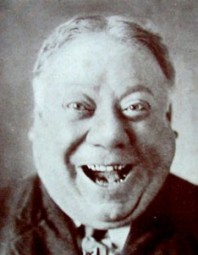
A few years ago, I was sent a catalogue by the photographic agency, Corbis. Among its many images denoting emotions, there was one of a portly, middle-aged man with bright beaming face, categorised under something like ‘surprise’ or ‘happiness’. The person had no further identification. The photograph was of John Bunny, once arguably the most popular and recognised person worldwide, now reduced to complete anonymity.

I can’t find the photograph now on the Corbis web site (which does have one picture of Bunny identified as him). So maybe someone discovered the injustice. I hope so. For John Bunny really was the most popular of silent stars in his day, and the way in which his popularity has so dramatically faded ought to be a lesson to anyone whose head gets turned by the notion of celebrity.

John Bunny (1863?-1915) was the son of a British naval officer who settled in New York, where his son ran away from home to join a minstrel show and then became a stage actor and director. In 1910 he turned to the movies, joining the Vitagraph Company, and almost instantly became a star. He portrayed a rotund, merry, earthy figure, whose genial manner and aptitude for comic characterisation, sometimes touched with pathos, endeared him to millions. He appeared in over 200 shorts between 1910-1914, with such titles as Bunny Buys a Harem, And His Wife Came Back and Bunny’s Honeymoon. He was often teamed with the comically angular Flora Finch. He made some films in Britain in 1913, including Pickwick Papers (he was a natural Mr Pickwick), scenes from which were filmed just around the corner from where I am typing this now. His death in 1915 made headlines around the world.

Why mention Bunny now? Simply because of yesterday’s post with the Vachel Lindsay poems, for there is one last poem by Lindsay on the film stars of the early cinema period which I haven’t given you as yet. It’s the second part of a two-part sequence, the first of which commememorates the actor Edwin Booth, renowned for his performance as Hamlet. For the second part, Lindsay laments the death of John Bunny as if he were Yorick, Hamlet’s fool:

John Bunny, Motion Picture Comedian

In which he is remembered in similitude, by reference to Yorick, the king’s jester, who died when Hamlet and Ophelia were children

Yorick is dead. Boy Hamlet walks forlorn
Beneath the battlements of Elsinore.
Where are those oddities and capers now
That used to “set the table on a roar”?

And do his bauble-bells beyond the clouds
Ring out, and shake with mirth the planets bright?
No doubt he brings the blessed dead good cheer,
But silence broods on Elsinore tonight.

That little elf, Ophelia, eight years old,
Upon her battered doll’s staunch bosom weeps.
(“O best of men, that wove glad fairy-tales.”)
With tear-burned face, at last the darling sleeps.

Hamlet himself could not give cheer or help,
Though firm and brave, with his boy-face controlled.
For every game they started out to play
Yorick invented, in the days of old.

The times are out of joint! O cursed spite!
The noble jester Yorick comes no more.
And Hamlet hides his tears in boyish pride
By some lone turret-stair of Elsinore.

Bunny died of liver failure on 26 April 1915. Today, only a handful of his films survive: A Cure for Pokeritis, Bunny at the Derby, The Pickwick Papers, Bunny all at Sea, Her Crowning Glory, The Wooing of Winifred, and a few more. In truth, his real comic appeal died with him, and it is worth seeing Bunny at Sea for its scenes taken on board a ship where real life passengers laugh delightedly at Bunny’s antics, giving us some indications of the roots of his popular appeal.

Vachel Lindsay wrote evocatively of the first Bunny picture that he saw:

It is a story of high life below stairs. The hero is the butler at a governor’s reception. John Bunny’s work as this man is a delightful piece of acting. The servants are growing tipsier downstairs, but the more afraid of the chief functionary every time he appears, frozen into sobriety by his glance. At the last moment this god of the basement catches them at their worst and gives them a condescending but forgiving smile. The lid comes off completely. He himself has been imbibing. His surviving dignity in waiting on the governor’s guests is worthy of Goldsmith and Sheridan. The film should be reissued in time as a Bunny memoiral.

Whichever title it might be, it’s a lost film now…

Poems by Vachel Lindsay

It’s been a while since we had poetry on The Bioscope. So, to make up, here are three poems by Vachel Lindsay (1879-1931), who if not quite the poet laureate of the silent cinema was undoubtedly the poet at the time most drawn to the medium. For film historians, he may be best known as the author of The Art of the Motion Picture, a somewhat high-flown early stab at film theory, published in 1915 and still in print.

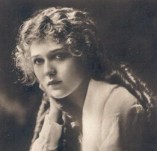
But Lindsay is best known for his poetry, with its jazz-inflected rhythms and contemporary themes. He wrote three poems on actresses who appeared in Biograph films before the First World War: Blanche Sweet, Mae Marsh and Mary Pickford. “I am the one poet”, he wrote, “who wrote them songs when they were Biograph heroines, before their names were put on the screen, or the name of their director”. That’s probably not strictly true, since he had to know their names to be able to put them in the titles of the poems, but nevertheless the poems are at one with his treatment of the moving picture as an art form.

Anyway, here they are: one interesting, one quite good, and one a little nauseating.

Blanche Sweet

Blanche Sweet: Moving-Picture Actress
(After seeing the reel called “Oil and Water”)

Beauty has a throne-room
In our humorous town,
Spoiling its hob-goblins,
Laughing shadows down.
Rank musicians torture
Ragtime ballads vile,
But we walk serenely
Down the odorous aisle.
We forgive the squalor
And the boom and squeal
For the Great Queen flashes
From the moving reel.

Just a prim blonde stranger
In her early day,
Hiding brilliant weapons,
Too averse to play,
Then she burst upon us
Dancing through the night.
Oh, her maiden radiance,
Veils and roses white.
With new powers, yet cautious,
Not too smart or skilled,
That first flash of dancing
Wrought the thing she willed:-
Mobs of us made noble
By her strong desire,
By her white, uplifting,
Royal romance-fire.

Though the tin piano
Snarls its tango rude,
Though the chairs are shaky
And the dramas crude,
Solemn are her motions,
Stately are her wiles,
Filling oafs with wisdom,
Saving souls with smiles;
‘Mid the restless actors
She is rich and slow.
She will stand like marble,
She will pause and glow,
Though the film is twitching,
Keep a peaceful reign,
Ruler of her passion,
Ruler of our pain!

Mae Marsh

Mae Marsh, Motion Picture Actress

I

The arts are old, old as the stones
From which man carved the sphinx austere.
Deep are the days the old arts bring:
Ten thousand years of yesteryear.

II

She is madonna in an art
As wild and young as her sweet eyes:
A frail dew flower from this hot lamp
That is today’s divine surprise.

Despite raw lights and gloating mobs
She is not seared: a picture still:
Rare silk the fine director’s hand
May weave for magic if he will.

When ancient films have crumbled like
Papyrus rolls of Egypt’s day,
Let the dust speak: “Her pride was high,
All but the artist hid away:

“Kin to the myriad artist clan
Since time began, whose work is dear.”
The deep new ages come with her,
Tomorrow’s years of yesteryear.

Mary Pickford

To Mary Pickford: Moving-Picture Actress
(On hearing she was leaving the moving-pictures for the stage)

Mary Pickford, doll divine,
Year by year, and every day
At the moving-picture play,
You have been my valentine.

Once a free-limbed page in hose,
Baby-Rosalind in flower,
Cloakless, shrinking, in that hour
How our reverent passion rose,
How our fine desire you won.
Kitchen-wench another day,
Shapeless, wooden every way.
Next, a fairy from the sun.

Once you walked a grown-up strand
Fish-wife siren, full of lure,
Snaring with devices sure
Lads who murdered on the sand.
But on most days just a child
Dimpled as no grown-folk are,
Cold of kiss as some north star,
Violet from the valleys wild.
Snared as innocence must be,
Fleeing, prisoned, chained, half-dead –
At the end of tortures dread
Roaring Cowboys set you free.

Fly, O song, to her to-day,
Like a cowboy cross the land.
Snatch her from Belasco’s hand
And that prison called Broadway.

All the village swains await
One dear lily-girl demure,
Saucy, dancing, cold and pure,
Elf who must return in state.

To Mary Pickford and Blanche Sweet were first published in The Congo and Other Poems (1914). Mae Marsh was first published in The Chinese Nightingale and Other Poems (1917). The film Oil and Water was made in 1913. David Belasco was the theatre impresario who discovered Gladys Smith and gave her the stage name Mary Pickford.

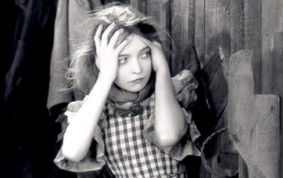
Lillian Gish Film Festival

Lillian Gish

Doubtless making up a little for having missed out on hosting The Simpson Movie premiere, Springfield, Ohio plays host to The Lillian Gish Film Festival over 5-8 September. Films to be featured include Broken Blossoms, The Wind (with the Springfield Symphony Orchestra), The Night of the Hunter and The Whales of August. There are lectures, a Gish Wine Tasting (!) with Roundtable discussion, and a Gish Sisters Walking Tour. The Gish family came from Springfield: the father, James Leigh Gish, ran a confectionery business there, though they moved away soon after Lillian was born (1896), to Dayton, where Dorothy was born (1898). And then, of course, they experienced a peripatetic life as child stage performers.

More details from the festival site.

Carl Davis and the Chaplin Mutuals

The Cadogan Hall in London is presenting all twelve of Charlie Chaplin’s Mutual films over four programmes, with scores composed and conducted by Carl Davis and performed live by the Royal Philharmonic Orchestra. The screenings are taking place 15-18 August, and will be introduced by Paul Ross, Richard Briers, David Robinson (Chaplin’s biographer), and Michael Chaplin (Chaplin’s son). The Cadogan Hall site has an excellently designed Chaplin section, with photographs and clips, well worth visiting. And it has all the booking information, of course.

Programmes
Wednesday 15 August, 7.30pm
Easy Street, One A.M., The Immigrant (introduced by Paul Ross)

Thursday 16 August, 7.30pm
Behind the Screen, The Fireman, The Rink (introduced by Richard Briers)

Friday 17 August, 7.30pm
The Pawn Shop, The Vagabond, The Cure (introduced by David Robinson)

Saturday 18 August, 7.30pm
The Count, The Floor Walker, The Adventurer (introduced by Michael Chaplin, with question and answer session with Carl Davis)

When the Movies Began…

Kinetoscope

The latest feature to be added to the Who’s Who of Victorian Cinema web site is When the Movies Began. This is a chronology of the world’s film productions and film shows before May 1896. It was originally compiled by Stephen Herbert and published as a booklet by The Projection Box in 1994. This updated and redesigned version incorporates new research, in particular the work of Deac Rossell, and it will be regularly revised and updated. There is also a full introduction and list of references.

Who’s Who of Victorian Cinema is a biographical reference guide to 300 or so people involved in the production of motion pictures before 1901, both behind and in front of the camera. It includes a wealth of supporting resources on the subject of Victorian film (i.e. film during the time of Queen Victoria’s reign), with a growing number of special features, such as When the Movies Began.

Keystone revisited

Keystone live

The Bioscope has been taking a short break while I’ve been holidaying in Ireland, but one of the reasons for going was to see Dave Douglas and his Keystone sextet play at the Bray Jazz festival. As reported in an earlier post, jazz musician and composer Dave Douglas was inspired by the films of Fatty Arbuckle to release a CD (with accompanying DVD) in 2005 entitled Keystone, which is perhaps rather more his response to the happy anarchy of Arbuckle’s films and his sad fate rather than music to accompany the films. As it is, the concert – which was utterly superb, exuberant modern jazz of the highest order – didn’t feature Arbuckle’s films at all, as had been trailed, so whether it all works in a live setting I cannot say (the DVD that goes with the CD suggests not). Some of the set was inspired by Arbuckle and Keaton’s The Rough House (1917), though the bit with just trumpet and turntables intercutting between an Iraqi woman singing and George Bush uttering the word ‘terrorist’ suggests that Douglas takes his interpretation of Arbuckle’s work quite broadly.

Anyway, the set will eventually be recorded for a follow-up Keystone CD, but in the meanwhile there’s a live CD now available of his previous Keystone set, recorded in Sweden in 2005. Here’s the blurb from the CD site:

In a brilliant stroke of tour routing, this gig at the Umea Jazz Festival in northern Sweden was immediately preceded by the San Francisco jazz festival in California and followed by one in Cormons, Italy. Nonetheless everyone came ready to play. The Keystone sound really came together here: sloppy and wild, but also focused, lyrical, delicate, and at times simply bizarre. Also, like the films it was written to, it was a lot of fun. The concert began with a showing of Fatty and Mabel Adrift, Roscoe Arbuckle’s 1915 three-reeler, probably the first (and finest?) surreal comico-psychological thriller drama. Next, we played the three main themes from my score for Mabel and Fatty’s Wash Day (in which the perennial slapstick potential of the laundry line is used to address some semi-serious marital issues) without accompanying the film. Finally, as an encore, we played Luke the Dog, written to the heroic canine suspense vehicle, Fatty’s Plucky Pup. Though we edited the chit chat and whatnot, this is the way the gig was played.

The man certainly knows and loves his Arbuckle. See you back in Blighty very soon.

Tom Fletcher remembers

Posting that item on Norman Studios and the black cinema of the silent era reminded me of a passage in a book that I’ve been waiting for the opportunity to tell someone about. Tom Fletcher’s The Tom Fletcher Story: 100 Years of the Negro in Show Business (1954) is a classic memoir that has been much-plundered by musical theatre historians, but I don’t know how many film historians know of this passage which records the experience of two black actors at the Edison film company in the early 1900s:

When the flickers, or moving pictures, were developed along around 1900, my partner, Al Bailey, and I got leading comedy parts. The studio was on 22nd Street, between Broadway and Fourth Avenue. I was the talent scout for the colored people. There were no “types,” just colored men, women and children. Bailey and I did parts in the pictures that today would pay no less than four figures weekly, but we didn’t take it seriously. To us it was just something that would never get any place.

You never heard the words “lights,” “action,” “camera,” “roll ’em,” or “cut” which are so common today. There were no script writers, no make-up artists, just one man, everybody called him Mr. Porter, and I never took time to find out his first name, who placed you in your positions and gave you your actions, lit the scene and then turned the camera. His assistant was a fellow named Gilroy whom everyone called Gil. When we went on location it was to North Asbury Park, about the best place around New York for the purpose. The trees, gardens and farms gave just the right atmosphere.

At the end of each day Gilroy would hand me the money to pay off. I am not quite sure but I think it was three dollars a day for each of the people. Bailey and I got eight dollars each. We all considered it a lot of fun with pay. Vaudeville, private parties, music and show business kept me too busy to pay any real attention to the moving picture business.

Porter is of course Edwin S. Porter; Gilroy is his assistant William J. Gilroy. Fletcher’s less than awe-struck view of the early film business is illuminating, and shows how for most stage performers the new medium was a minor curiosity with little bearing on their professional lives except that the extra money was welcome. Is this a unique memoir for black performers in film at such an early date? I don’t know.

I first found the passage in Thomas L. Riis, Just Before Jazz: Black Musical Theater in New York, 1890 to 1915 (1989), which is an excellent, instructive history in itself, with wonderful illustrations.

It doesn’t show Edison films such as Tom Fletcher appeared in, but the Black Film Center/Archive site has some QuickTime clips of African-American performers (and some white actors in blackface) from the 1890s. The Uncle Tom Cabin’s & American Culture site has a huge range of information about the many expressions of Harriet Beecher Stowe’s novel, including the history behind the 1903 Edison film Uncle Tom’s Cabin, with QuickTime video clips of this and subsequent film versions from the silent era. The lead parts in the 1903 film are played by white actors in black face; the black performers are all extras.

Paul Merton on tour

Paul Merton

[Note: This is the 2008 tour – for the 2009 tour dates, click here]

These are the dates I’ve traced for Paul Merton’s Silent Clowns show, which will be touring the country later this year when his book Silent Comedy is published. The links are to booking details at each of the venues. I’ll add more if I find them (there are 22 dates in all). Neil Brand will be providing the piano accompaniment.

10 November – Warwick Arts Centre
11 November – The Anvil, Basingstoke
13 November – Cambridge Corn Exchange
14 November – St David’s Hall, Cardiff
16 November – Assembly Hall, Tunbridge Wells
17 November – Cheltenham Town Hall
18 November – Hackney Empire, London
20 November – The Royal Centre, Nottingham
21 November – Bournemouth International Centre
23 November – St George’s Hall, Bradford
24 November – Buxton Opera House
25 November – The Hexagon, Reading
27 November – Plymouth Pavilions
28 November – Royal and Derngate, Northampton
30 November – De Montfort Hall, Loughborough
1 December – The Lowry, Salford
2 December – Royal Liverpool Philharmonic
3 December – Villa Marina, Douglas, Isle of Man
5 December – Portsmouth Guidhall
7 December – Perth Theatre and Concert Hall
8 December – Caird Hall, Dundee
9 December – Aberdeen Music Hall

As the blurb says, “The funniest silent comedians of the 1920’s on a big, big screen with live accompaniment from the wonderful Neil Brand. Paul introduces a selection of clips from stars such as Charlie Chaplin, Buster Keaton, Harold Lloyd, Roscoe Arbuckle and Charley Chase. Finishing fantastically with a complete showing of a silent comedy masterpiece. Guaranteed to rock the house with laughter.”

Update: The list of dates above is now complete. Download the promo leaflet here (PDF).

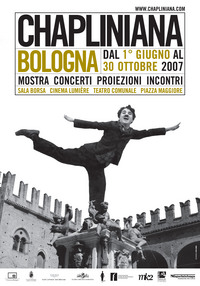
Chapliniana

Chapliniana

The Cineteca di Bologna in Italy is hosting Chapliniana between 1 June and 30 October 2007. This major celebration of Chaplin’s life and work will comprise an exhibition, Chaplin e l’Immagine (Chaplin in Pictures), at the Sala Borsa, Bologna; live orchestral screenings of The Chaplin Revue, City Lights, The Kid, Modern Times, The Gold Rush, The Circus and A Woman of Paris to be performed in Piazza Maggiore and the Teatro Communale during the summer evenings; and the majority of Chaplin’s films will be screened during this period, particularly during the Cinema Ritrovato film festival June 30-7 July 2007. The Cineteca is also working on the Chaplin Archive Database, which is logging the cataloguing, digitisation and preservation of the huge Charlie Chaplin paper archive.

There’s a Chapliniana site registered but nothing is on it as yet. 2007 is the thirtieth anniversary of Chaplin’s death, and a major revival of interest in his work and socio-cultural significance seems to be underway.

Update: The Chapliniana site is now active, and full of details, all of it in Italian.

The work of an early cinema actress

I’ve just stumbled across a Project Gutenberg ebook of Edith J. Morley’s Women Workers in Seven Professions (1914), produced for the Fabian’s Women’s Group. The Fabian Society was a socialist group committed to gradualist reform which helped form the Labour Party in 1900, and which of course continues to this day. Its Women’s Group was founded in 1908 and was active in producing reports and pamphlets on work and social conditions for women. Morley’s book looks at women’s work in teaching, medicine, nursing, health visitors and sanitary inspection, the civil service, clerks and secretaries, and the acting profession. The latter section is mostly about the stage, but it does include this intriguing snippet about the cinematograph work that the actress might occasionally find:

It is only possible for me to touch very lightly on employment by the cinematograph firms; but from the enquiries I have made, the usual payment seems to be roughly from 5s. to 7s. 6d. a day, the workers finding their own clothes: 10s. 6d. if the workers can ride and swim: 3s. a day for walking on, when light meals are provided. There is a form of application to be filled in, which demands the following particulars:-

Height.
Bust measurement.
Waist measurement.
Skirt length.
Age.
Line of work.
Remarks.
Ride horseback. Cycle. Swim.

The pictures take about ten days to prepare, and as a supplementary trade, undoubtedly this work is of value to the actress.

I think that the ability to cycle is something that has not been considered when researchers have looked at the work of women in early British film. Clearly a topic for further investigation. An ability to swim, however, we already know about. There’s a celebrated story of Will Barker selecting an Ophelia for his film of Hamlet (1908) purely because she was able to swim (see Robert Hamilton Ball’s Shakespeare on Silent Film, pp. 77-78).