Everybody loves Sessue

Sessue Hayakawa

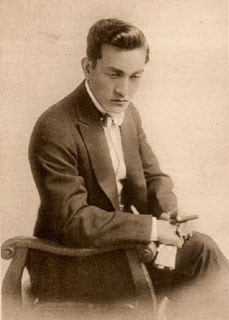
Sessue Hayakawa, from The Evening Class

The silent star of the moment is Sessue Hayakawa. The Japanese-born star of American silents has been the subject of a critical study, film season and DVD releases, while an archive has announced that it has recently preserved a number of his films. This is a round-up of Hayakawamania.

The critical study is Daisuke Miyao’s Sessue Hayakawa: Silent Cinema and Transnational Stardom (Duke University Press), which has already been the subject of a post on the Bioscope. There’s an online interview with Miyao on The Evening Class blog. Miyao’s work inspired a Museum of Modern Art exhibition, Sessue Hayakawa: East and West, When the Twain Met, which ran September 5–16, 2007 – details of the films shown are on the web page.

The Dragon Painter

The Dragon Painter, from http://www.milestonefilms.com

The new DVD release is The Dragon Painter (1919), issued by Milestone. This is the blurb from their site:

Remembered mostly for his magnificent performance as the Japanese officer in The Bridge over the River Kwai, few filmgoers realize that Sessue Hayakawa was one of the great stars of the silent cinema. In many films he played a dashing, romantic lead — a rarity for Asian actors in Hollywood, even today. Hayakawa became so popular and powerful that he was able to start Haworth Pictures to control his own destiny. The Dragon Painter was the finest of the Haworth productions. Beautifully acted, gorgeously shot (with Yosemite Valley filling in for the Japanese landscape), and lovingly directed, the film is an absolute marvel.

Hayakawa plays Tatsu, an artist living as a hermit in the wilds of Japan. Thought mad by the local villagers, he believes that his princess fiancée has been captured by a dragon. His obsession leads to artistic inspiration. It isn’t until a surveyor comes across Tatsu in the mountains that his genius is discovered. The surveyor informs the famed artist Kano Indara about his discovery. Kano is desperate to find a male heir to teach his art, but when Tatsu meets Kano’s daughter (played by Hayakawa’s wife, Tsuru Aoki) and sees only his lost princess, a clash of wills brings the household to the brink of disaster.

Long considered lost, The Dragon Painter was rediscovered in a French distribution print and brought to the George Eastman House for restoration with the original tints. The film survives today as a tribute to Hayakawa’s great artistry and a shining example of Asian-American cinema.

The DVD comes with a remarkable set of extras, including the full-length feature, Thomas Ince’s The Wrath of the Gods (1914), starring Hayakawa, Tsuru Aoki and Frank Borzage; a copy of the script for The Wrath of the Gods; a 1921 short subject, Screen Snapshots (1921) with Hayakawa, Roscoe “Fatty” Arbuckle and Charles Murray; the original novel by Mary McNeil Fenollosa in PDF format; and the stills gallery includes Herbert Ponting’s exquisite images for his 1910 book In Lotus-Land Japan: Japan at the Turn of the Century (Ponting went on to be cinematopgrapher to the Scott Antarctic expedition).

You can download a presskit for the DVD from www.milestonefilms.com/presskits.php.

Other Sessue Hayakawa films available on DVD are The Cheat (1915) (from Kino in American and Bach Films in France) and The Secret Game (1917) (from Image Entertainment).
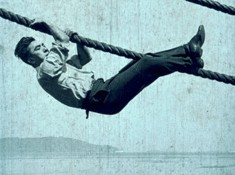
His Birthright

His Birthright, from http://www.filmmuseum.nl

Three Hayakawa films, or what remains of them, have recently been restored by the Nederlands Filmmuseum: The Man Beneath (1919), His Birthright (1918) and The Courageous Coward (1919): only The Man Beneath survives as a complete film. There is background information on the films, their restoration and Hayakawa’s career on the Filmmuseum site.

Finally, there’s information on The Cheat and Forbidden Paths (1917), shown recently at the Pacific Film Archive.
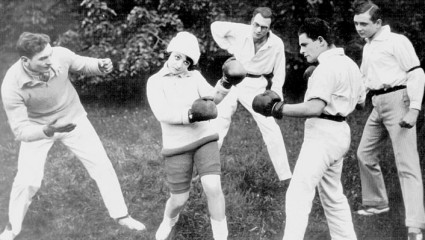
When the Barbican put on Molly

Molly Picon

Molly Picon in East and West (Ost und west), from Barbican Film

The home for silent film in London is now the Barbican centre, whose Silent Film and Live Music continues to demonstrate imaginative programming in the titles selected and the music chosen to accompany them.

Apart from highlighting the current series, I wanted to draw particular attention to the film showing on Sunday February 17, Ost und West (East and West) (Austria 1923). This features Molly Picon, the great star of Yiddish stage and screen, and gives me the opportunity of reproducing the splendid still above. The diminutive, round-eyed Molly Picon (1898-1992) was a New York Yiddish theatre star, on the stage from the age of six, and massively popular among Jewish and on-Jewish audiences in the 1920s. She made made a handful of films in the 1920s and 30s, before returning to the screen more regularly in the 1970s (she’s most familiar to general audiences for playing the matchmaker in Fiddler on the Roof). Ost und West is the earliest of her films that survives. I’ve not see the film (yet), so here’s the Barbican’s blurb for it:

Featuring Molly Picon, one of the great stars of Yiddish cinema, it tells the story of streetwise New York flapper Mollie, who travels to her cousin’s wedding in a traditional Polish shtetl. Contrasting sophisticated city values against those of simple village life, the film contains classic scenes of the irrepressible Picon lifting weights, boxing and teaching young villagers to shimmy, and eventually meeting her match in a young yeshiva scholar.

The music comes from Lemez Lovas of Oi Va Voi and guest musicians Moshikop and Rohan Kriwaczek, taking in “traditional klezmer to contemporary electronica, from liturgical melancholy to party pop kitsch and from vaudeville to breakbeat.” Directed by Sidney M. Goldin and Ivan Abramson, the film is screening at 16.00 and runs for 85mins.

Bridge of Light

http://www.amazon.co.uk

For anyone interested in the history of Yiddish film, the essential source is J. Hoberman’s Bridge of Light: Yiddish Film Between Two Wars (1991), which apart from its commendable written content, is just one of the most beautifully-produced books on film history that I know. Check out also Sylvia Plaskin, When Joseph Met Molly: A Reader on Yiddish Film (1999) (Joseph being the Polish director Joseph Green), Judith N. Goldberg, Laughter Through Tears: The Yiddish Cinema (1983), or Eric A. Goldman, Visions, Images and Dreams: Yiddish Film Past and Present (1984).

Other titles being screened in the Barbican series are:

9 MarchOn Our Selection (Australia 1920) – homely, landmark Australian comedy-drama about the pioneering Rudd family. With piano accompaniment by Neil Brand.

3 AprilChang: A Drama of the Wilderness (USA 1927) – King Kong creators Merian C. Cooper and Ernest B Shoedsack’s classic dramatised documentary set in the jungles of Thailand (and producing background footage that went on to pad out a number of Tarzan movies). With live accompaniment by Italian group Yo Yo Mundi.

20 AprilThe St Kilda Tapes – a collection of silent films from the Scottish Screen Archive, including the topical St. Kilda – Britain’s Loneliest Isle (1923-28), Da Makkin O’ A Keshie (1932), and A New Way to a New World (1936), all set to music by acoustic guitarist David Allison.

4 MayNanook of the North (USA 1922) – the so-called first documentary film (if you’ve got a couple of hours I’ll give you chapter and verse on how wrong all the text books are), directed by poet of cinema Robert Flaherty. Music from the Shrine Synchrosystem, featuring Max Reinhardt, DJ Rita Ray, world music kora master Tunde Jegede and Ben Mandelson on guitars, which ought to steer us away from the siren temptations of too much authenticity (like Flaherty?).

17 MayThe Wind (USA 1928) – one of the cast-iron classics of silent cinema, Victor Sjöström’s visual masterpiece stars Lillian Gish living a hard life in dust-bowl Texas, and is guaranteed to convert even the stoniest-hearted sceptic into acclaming silent cinema. With the Carl Davis symphonic score (sadly, not with actual orchestra).

1 JuneThe Passion of Joan of Arc (Denmark 1928) – somehow not convinced even by The Wind? Carl Theodore Dreyer’s astonishing, overpowering work, with Falconetti as Joan, will do the trick. With music by In the Nursery.

15 JuneStella Dallas (USA 1925) – classic weepie from Henry King, starring Ronald Colman, Douglas Fairbanks Jr. and Belle Bennett. Remade with Barbara Stanwyck in 1937, but this is the version to see. With piano accompaniment by Stephen Horne.

The Sea Gull

The Sea Gull

http://ednapurviance.com

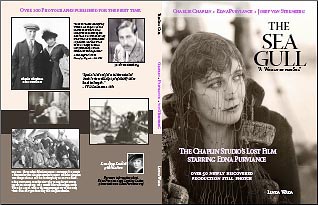
On the eve of the Bioscope Festival of Lost Films, congratulations go out to Linda Wada of the esteemed Edna’s Place blog and www.ednapurviance.org website, for today publishing her long-awaited book The Sea Gull, on this mysterious lost Chaplin film. The film, originally known as Sea Gulls or The Sea Gull, and later as The Woman of the Sea was produced by Chaplin but written and directed by Joseph von Sternberg, in 1926. The film was a melodrama set among the fishermen on the coast of California, and starred Edna Purviance, Chaplin’s great leading lady. According to von Sternberg, the film had just one screening, before Chaplin withdrew it for reasons that remain unclear, though he did say at one point that it simply wasn’t good enough for release.

The book explores the history of one of the most renowned of lost films, with over 100 photographs published for the first time, including over fifty recently discovered production stills from Purviance’s grand nieces, the Hill family. Here are Kevin Brownlow’s words on the publication:

The Sea Gull is an important contribution to film history, and worth buying for the stills alone. The look of the film, revealed in these marvellous photographs, makes it all the more tragic that it was destroyed. This book provides the nearest experience we will have to seeing it.

Details of how to order the book can be found at http://ednapurviance.com. It is being published as print-on-demand by Leading Ladies, price $39.95 plus shipping, and can be bought using PayPal.

A bulbous nose, an overbite and a definite squint

Theda Bara

Theda Bara, from http://film.guardian.co.uk

This excellent piece by Kira Cochrane in The Guardian has been doing the rounds, but no reason why it shouldn’t turn up here as well. Its subject is the mysterious allure of some silent screen stars, and why you really have to see them on a screen for their undying magic to work…

If looks could kill

It’s mean to say it, but here goes: one of the things that has always fascinated me about the actors of the silent era, especially the sex symbols, is just how plain, ordinary, even ugly, many of them are. Francis X Bushman, for instance, star of the original 1925 Ben-Hur, may have gloried in publicity pegging him as “The Handsomest Man in the World”, but photographs suggest he was in fact a baggy-eyed bloke with bushy eyebrows and an improbably long nose. Rudolph Valentino, the man whose untimely death from peritonitis in 1926 caused mass hysteria and fainting among his female fans, wasn’t actually all that much of a looker. I’m not saying he was ugly. But gorgeous enough to cause two women to commit suicide on news of his death, as was alleged? It’s debatable.

The silent star who fascinates me the most in this respect, though, is Theda Bara. In a short career, largely played out between 1914-19, Bara became a massive star, her popularity at one stage second only to Mary Pickford and Charlie Chaplin. But unlike Pickford (America’s fresh-faced sweetheart), Bara’s success was based on her reputation as a “vamp”, a woman so cruelly attractive that she could ensnare any man, exploit him, trample him, and walk away with an enormous grin on her face. Bara became so synonymous with the term that she is now referred to as the original on-screen vamp, the woman who made performances such as that of Louise Brooks in Pandora’s Box, Barbara Stanwyck in Double Indemnity and Linda Fiorentino in The Last Seduction possible.

I have read biographies of Bara and pored over her still photographs, and found it hard to fathom her appeal. Her figure isn’t bad, though it could most accurately be described as “matronly”. She has a bulbous nose, an overbite and a definite squint (she was extremely short-sighted). Just what was it that so enraptured audiences?

I found out this week, while watching one of Bara’s only surviving films, A Fool There Was. Released in the US in 1915, this was the first major screen outing for the woman who, until then, had been a minor stage actor. A Fool There Was is based on a variety of sources, including an 1897 painting by Philip Burne-Jones, which shows a woman looming over a man who is either dead, passed out or really very sleepy; and a hokey poem of the same title that Burne-Jones’s cousin, Rudyard Kipling, wrote for the exhibition catalogue. The film tells the story of a wealthy, married diplomat who sinks in horrific decline after submitting to the attentions of “The Vampire”, played by Bara.

The minute Bara arrives on screen, it becomes obvious why she was so popular – why she went on to have songs written about her, children named after her, a perfume and even a sandwich (minced ham, mayonnaise, sliced pimento and sweet pickles on toast – served warm) created in her honour. The first scene shows the diplomat smelling a couple of roses and smiling wistfully. The second scene is Bara, glancing around shiftily, picking up those same roses, smelling them, smirking, ripping off the petals, crushing them in her hands, and laughing. On screen, that face comes into its own – so much so that when you learn that her character’s malevolence has led one man to jail, another to beggary, and her most recent victim to a very public suicide, you believe it. Rudolph, eat your heart out.

Another major factor in the film’s huge success was the groundbreaking publicity machine that whirred around it. A Fool There Was was made by William Fox’s fledgling studio, which employed two wily PR men – Al Selig and John Goldfrap – both determined to ensure this latest film was a hit. In Vamp, Eve Golden’s punchy biography of Bara, there is a description of the outlandish press conference set up by the men to showcase Fox’s newest star. The fact that Bara (real name Theodosia Goodman) was the daughter of immigrants from Cincinnati, was irrelevant. Instead, they claimed she was the child of a French actress and an Italian sculptor, raised in the shadow of the Pyramids, who had gone on to become a huge stage success in Paris, before escaping to America on the brink of war. The story was ridiculous, and the journalists who gathered in the Egyptian-themed room where Bara was presented to them, amid choking clouds of scent, knew it. But it worked. While the end of 1914 had seen Fox Studios in debt, in 1915 Bara’s huge popularity helped them rake in $3m.

Thus, Bara was put to work, cranking out 40 films for Fox over the next four years. Like many ambitious actors, she was anxious not to be typecast, always pushing for a range of roles and occasionally rewarded. In her 30s, she was cast, for instance, as the young, virginal female lead in Romeo and Juliet, a well-received production now most notable for its key innovation: Juliet briefly rising from the dead to share the final scene with Romeo. Bara also played Cleopatra in a series of raunchy costumes, including a bra fashioned out of a coiled snake, ruby-red eyes placed suggestively in the centre of each breast. But most of the time she played a vamp, in films such as The Devil’s Daughter, the publicity material for which described Bara as “The Wickedest Woman in the World”.

But by 1919, Bara’s career was on the rocks. This wasn’t due to the advent of the talkies: there is no suggestion that her voice was especially reedy or ridiculous or wretched. Fox had another star on its books, however – cowboy hero Tom Mix – and a new kind of skinny, youthful sex symbol was growing popular in the shape of the flapper. Then there was the scandal prompted by one of Bara’s late films, Kathleen Mavourneen, in which she played a poor Irish girl. As Golden describes it: “The Friends of Irish Freedom and the Central Council of Irish Associations violently objected to the depiction of poverty in Ireland (although castles and middle-class towns were also shown). Other groups … objected to a ‘Jewess’ portraying a beloved Irish heroine. Stink bombs were rolled down the aisles.”

Abruptly, Bara’s career was all but over. Over the next decade, she appeared in a few films, but never regained her star status. She must have taken some comfort from the fact that she had fallen for the writer/director of Kathleen Mavourneen, Charles Brabin, who often styled himself as a knight and a lord but who was actually a Liverpudlian butcher’s son. The pair married, and Bara saw out her days as a popular Hollywood matron.

Watching A Fool There Was – seeing just how magnetic Bara was in motion – makes you realise how ill-served those early silent stars have been. Around 80%, or even 90%, of silent films have now been lost, partly through neglect, partly due to the recycling of nitrate film, and partly because nitrate is more flammable than a matchstick. Only four of Bara’s films survive, after a Fox storage facility exploded in 1937. Martin Scorsese has been banging on for years now about the need to preserve silent films, to ensure we have something to go on in the future other than still photos. And he’s right. After all, as Bara has made me realise, when it comes to understanding the allure of silent film stars, photos only count for so much. It’s all about the movies, stupid.

A Fool There Was is screening at the Barbican in London this Sunday, live piano accompaniment by Neil Brand.

The Chaplin heritage

The future Chaplin Museum

The future Chaplin Museum, from http://afp.google.com

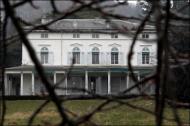
How long do you have to be deceased before you start generating a heritage? In Charlie Chaplin’s case, it would seem to be thirty years, pretty much to the day (he died Christmas day, 1977). Rumours of a Chaplin museum have been confirmed. The mansion at Corsier-sur-Vevey, Switzlerland, where Chaplin spent the last twenty-four years of his life, is to become a museum commemorating his life – or, to be precise, a Charlie Chaplin Heritage Site. A Charlie Chaplin Museum Foundation has sold the Manoir de Ban to some Luxembourg investors. The project is costed at 30 million dollars (21 million euros).

Remarkably, there is already a Chaplin Museum website. This coldly fascinating document promises a “unique, must-see cultural attraction for those seeking a profound experience of discernment and variety”, featuring the following:

  • a MANOR, beckoning visitors to enter the very private world of Chaplin the man (“Private Encounter”);
  • OUTBUILDINGS converted into exhibit halls dedicated to the humorous and moving works of the artist and filmmaker (“From Laughter to Tears”) and to the heyday of silent movies ( “The Spectacular Beauty of Silence”);
  • the MAGIC ZONE, a tribute to the earliest forms of cinematic expression (“The Magic Labyrinth”);
  • the Charlie Chaplin MOVIE THEATER highlighting repertory films and film offerings from the emerging generation;
  • an OUTDOOR STAGE under a marquee that provides the setting for an annual line-up of pantomime and cinematic activities and festivals;
  • a SHOPPING AREA where visitors can obtain exquisite souvenirs related to the artist and his adopted domicile;
  • TRAINING activities and gatherings targeting young people worldwide that will be organized with the same attention to perfection and human elements for which Chaplin was renowned, as well as his passion for pantomime, image and film;
  • its DINING AREAS and vantage points nestled among the luxuriant garden-park and pathways that offer unparalleled views of the Swiss landscape.

A news report states that “visitors to the museum will have access to the most intimate rooms occupied by the Chaplin family, including the first floor room where he died on Christmas Day 1977”, while “in the vast vaulted cellars the museum’s designers plan to install a “Hollywood street” complete with street lamps to recreate the atmosphere of the 1920s.”

Is it too cruel to suggest that ‘heritage’ is what phenomena attain when they have lost all real popular appeal or social meaning, and that as Chaplin’s films retreat to little more than a certain archaeological fascination, so a heritage site represents the ultimate embalming of his artistic reputation? Or, just as heritage masks history, is all this corporatising of the Chaplin legend (e.g. charliechaplin.com, discoverchaplin.com, simplychaplin.com, chaplinmuseum.com) only hiding the genius of films whose time must return one day, when we have need of their real insight once again?

The museum is expected to open at the end of 2009.

Truus Van Aalten

Truus Van Aalten

Truus Van Aalten, from http://truusvanaalten.com

Truus Van Aalten was an obscure Dutch actress who appeared in a number of German silent and early sound films after winning a competition in 1926, the prize being a small part in an Ufa film. I have to confess that I had never heard of Truus Van Alten, but one Roger Mitchell has constructed a richly-illustrated website dedicated to her career. She acted for directors such as Max Mack, Joe May, George Jacoby and Robert Weine, usually way down the cast list; she sported a Colleen Moore-style bob; and she was the subject of a lot of postcards. And now she is the subject of http://truusvanaalten.com. She seems to have been the epitome of the minor performer, but everyone deserves to have their own website – and now she has hers.

Mary Pickford used to eat roses

Of all the subjects that might have been chosen as the theme for a contemporary popular song, the formation of the United Artists film company must come as one of the least expected. But such is the theme of ‘Mary Pickford’, the new single by Katie Melua. I shall not pass judgement on its musical or lyrical merits – simply to say that it is written by Mike Batt, and tell us in simple words that Mary Pickford, her husband Douglas Fairbanks, Charlie Chaplin and D.W. Griffith got together to form the United Artists Corporation, which indeed they did in 1919. It was the first film company to be formed by film artists, rather than businessmen, and was of course intended to produce and distribute the films of the quartet (as well as others) and retain power and profits for themselves. Famously, Richard A. Rowland of Metro Pictures Corporation, on hearing the news, pronounced that “the lunatics have taken over the asylum”.

The video is constructed as a silent film, and features numerous clips, including newsreel footage of the four founders, The Gaucho, The Black Pirate, The Taming of the Shrew, and even Rescued from an Eagle’s Nest, Griffith’s undistinguished 1907 film acting debut. Chaplin film clips are noticeable by their absence. The video features faux silent titles, including (a nice touch) “Guitar solo”.

Cue an upsurge of interest in Mary Pickford, no doubt. Apparently Pickford did indeed use to eat roses (presumably just the petals) to make herself look more beautiful, as the song tells us. Cue an upsurge in visits to garden centres…

Electric Salome

Electric Salome

Princeton University Press

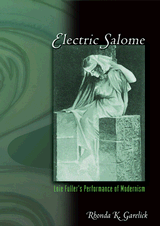
Electric Salome is the title of a recent book by Rhonda K. Garelick, which is her term to describe Loïe Fuller (1862-1928), one of the key performance artists of the late-19th/early 20th centuries. Fuller was a pioneer of modern dance, who made use of modern stage technologies of lighting and colour to create startling visual effects, particularly through her Serpentine Dance, where her swirling dresses combined with changing colour lighting to create haunting, phantasmagorical effects. She was beloved by artists and poets – Mallarmé, Toulouse-Lautrec, Rodin – and became the subject of early filmmakers.

Loïe Fuller

Loïe Fuller, a 1902 portrait by Frederick Glasier, from http://www.shorpy.com

Garelick’s book is strong on Fuller’s position as a figure of modernism and as a key figure in modern dance. It is, however, disappointingly weak on her early film appearances, reducing mention of these to a misleading footnote. There is much confusion over Fuller’s early film work, as she had many imitators – on stage and on film – and early films of skirt dancers are often mistakenly identified as her (see, for example, the site www.edisonfilm.com, which erroneously claims to show Fuller in a Edison film, though she never made a film for Edison).

For the record, these are the known films that were made of (or by) ‘La Loïe’:

Danse Serpentine (Lumière cat. no. 765, 1896) [extant]
La Loïe Fuller (Pathé, 1901) [extant]
Loïe Fuller (Pathé, 1905, coloured) [extant]
Le Lys de la vie (The Lily of Life) (1920) [extant]
Vision des rêves (1924)
Les Incertitudes de Coppelius (1927)

Le Lys de la vie

Le Lys de la vie (1921), from Bibliothèque nationale de France

Garelick has a little more to say about the later titles (only Le Lys de la vie survives among them). They were made by Fuller and her lover Gabrielle Bloch. The feature-length Le Lys de la vie sounds to be an extraordinary work – based on a story by Queen Marie of Romania, a combination of fairy tale and dance themes telling the story of two princesses competing for the love of a prince, played by René Clair, no less. Fuller herself directed but did not appear in the film, which seems to have been characterised by innovative cinematographic effects (such as incorporating negatives for some ghostly effects) mixed with conventional fairy tale elements.

Garelick tells us less about the other two, lost films. Apparently they were not completed, and were presumably semi-professional productions. It is likely that Fuller did not appear in them either (certainly not as a dancer – she was in her mid-60s, and died in 1928).

Loïe (not Loie as Garelick’s book has it throughout) Fuller was an iconic figure who continues to attract much scholarly interest. There’s a useful set of links about her on the Great Dance Weblog. As indicated above, films exists of her many imitators. She refused to be filmed by Edison, but the Edison studios did make films of other dancers in the 1890s, such as Ruth St Denis, Amy Muller and especially Annabelle, whose several Kinetoscope skirt dance films were clearly in imitation of Fuller and were often mistakenly (deliberately or otherwise) promoted as being films of Fuller herself.

Loie Fuller is a gorgeous-looking site which accompanies the book Traces of Light: Absence and Presence in the Work of Loïe Fuller, by modern Fuller imitator/acolyte Ann Cooper Albright.

Garelick’s book is a fine, insightful study with a strong theoretical basis, but as ever the facts about films are not just scanty but are not recognised as having any importance. The confusion that Fuller’s supposed film appearances created at the time persists, and she exists in those skirt films that survive more often as a guiding spirit than the woman herself.

God kicks our backsides

It’s been a while since we had any poetry on The Bioscope. While browsing through the fine Old Poetry site, I came across by A.S.J. Tessimond (1902-1962), a British Imagist poet whose name, I’m ashamed to say, I’d not come across before now. This poem of his, entitled ‘Chaplin’, dates from 1934. It rather appeals to me:

The sun, a heavy spider, spins in the thirsty sky.
The wind hides under cactus leaves, in doorway corners. Only the wry

Small shadow accompanies Hamlet-Petrouchka’s march – the slight
Wry sniggering shadow in front of the morning, turning at noon, behind towards night.

The plumed cavalcade has passed to tomorrow, is lost again;
But the wisecrack-mask, the quick-flick-fanfare of the cane remain.

Diminuendo of footsteps even is done:
Only remain, Don Quixote, hat, cane, smile and sun.

Goliaths fall to our sling, but craftier fates than these
Lie ambushed – malice of open manholes, strings in the dark and falling trees.

God kicks our backsides, scatters peel on the smoothest stair;
And towering centaurs steal the tulip lips, the aureoled hair,

While we, craned from the gallery, throw our cardboard flowers
And our feet jerk to tunes not played for ours.

Not just Chaplin as beleaguered everyman, but Chaplin as Don Quixote, the person we all might actually be but would never want to be. Now that I like (though it’s a conceit that has occured to others). There are more of Tessimond’s poems on The Filter^ blog.

All at Sea

All at Sea

Frame still from All at Sea, http://film.guardian.co.uk/video

The Guardian has published a short section from the 1993 Alistair Cooke home movie All at Sea, of Charlie Chaplin clowing around on a yacht. The film was featured as a long-lost discovery at this year’s Pordenone silent film festival. Curiously, the Guardian makes no mention of the film’s notable provenance. The thirty-second sequence shows Chaplin impersonating Janet Gaynor, Greta Garbo, and the Prince of Wales. Above shows Janet Gaynor, by the way.