Retour de flamme

This short piece on the remarkable Lobster Films of Paris is doing the rounds. Here it is (taken from www.france24.com):

Frenchman Serge Bromberg, saviour of more than 100,000 reels of old films, this week marked the 15th anniversary of a world-touring show with a difference – where he accompanies rescued silent movies on the piano.

A twice yearly Paris event, Retour de Flamme (Return of the Flame) has played New York’s MoMA and travels to India next February before going to Italy and the US for shows in San Francisco and New York.

“I like to say I ‘restore’ the spectator,” he said in an interview. “I bring old movies up-to-date with a presentation and a specially-written musical score, to bring the films alive.

Bromberg’s company Lobster Films, set up two decades ago with fellow film addict Eric Lange, has saved from destruction movies dating as far back as 1895, including film’s first movie with sound – Charlie Chaplin’s first 1914 movie “Twenty Minutes of Love” – and the first movies shot in Palestine (1897) as well as the only Marx Brothers shot in colour.

In the first 50 years of cinema, films were recorded on nitrate stocks, which is inflammable and decays. As no-one had thought at the time of preserving film, much of movie history was lost.

“I pick up films all year, with 99 percent unviewable but there’s always one which is extraordinary and which I want to share,” said the 46-year-old film buff.

On DVD now is 1912 footage of the Titanic before it went down, and a 1931 burlesque titled Stolen Jools, featuring Laurel and Hardy, Buster Keaton, Joan Crawford, Gary Cooper and Douglas Fairbanks Jr.

“Fifty percent of the films shot before World War II have been lost,” he added.

Among recently saved treasures are 15 hours of rushes from a 1964 drama featuring the late Romy Schneider and directed by Henri-George Clouzot. The film was never completed and the rushes had been kept at home by Clouzot’s widow Ines.

Another of his 2007 finds is “Bardelys the magnificent” (1926) by King Vidor, starring John Gilbert.

So it’s true, Bardelys the Magnificent has been found, and of course it would be Lobster who found it. All power to them, and three cheers to all film archivists able to accompany their restorations of silent films on the piano. It ought to be a compulsory part of the job.

A Charlie Chaplin Christmas

Charlie Chaplin Christmas

http://www.myspace.com/silenttheatre

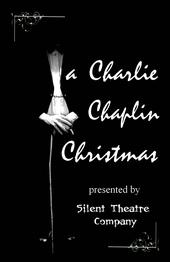
Talking of lost films, as we have been, today sees the opening in Chicago of A Charlie Chaplin Christmas, a play based around an imaginary lost Chaplin film, A Tramp’s Christmas. The play is a production of Chicago’s Silent Theatre Company, which has the brave and notable mission of creating stage productions inspired by silent movies. Its previous production was Lulu, based on G.W. Pabst’s Pandora’s Box.

A Charlie Chaplin Christmas tells of a production company in the silent era desperate to find production funding. It tells potential backers that is has Chaplin signed up to take part in the film, and then have to make good its promise with a convincing lookalike. One of the inspirations behind the production is the old story that Charlie Chaplin himself once entered a Chaplin lookalike content, and came third. As with Lulu, the Silent Theatre Company performs in monochrome. Sets, costumes and make-up all are in black-and-white (or black or white).

The production is running at the Studio Theater in the Chicago Cultural Center, and runs until January 6. More information, visit the Silent Theatre Company’s MySpace page.

Popping the question

Well, here’s a romantic little tale from the gossip columns involving Patricia Arquette (film actress) and Thomas Jane (I haven’t a clue), who proposed to her in the following manner as described in the Philadelphia Daily News:

Last week Thomas Jane told Tattle’s Baird Jones at the premiere party for “The Mist” at NYC’s Rosa Mexicano how he popped the question to wife Patricia Arquette.

“My marriage proposal was very simple,” he said. “I cut myself into a Charlie Chaplin film and rented out a silent movie theater in Los Angeles and invited my wife to be on a date to go see a silent film.

“… When we walked in, the theater was dark and you could not see that it was empty. Then I had the projectionist and the owner laughing and trying to make it sound like there were people there.

“About 20 minutes into it, I cut myself into the film with cards. Chaplin swallowed a whistle and in the movie there was a host of a party who gathered everyone around a piano to sing a song with cards. Then they cut to me with cards and each card said, ‘Will’ ‘You’ ‘Marry’ ‘Me’ ‘Patricia.’ I had dressed myself up like a waiter and Patricia (Arquette) was sitting there thinking to herself, ‘Who is this waiter?’

“… Finally it dawned on her what was going on. She shouted ‘Yes’ at the screen, over and over. Then we had the projectionist run it again just for fun. I kept a copy.”

The Chaplin film in question is City Lights, which features the whistle-swallowing gag which takes place during a party. So how did Mr Jane go about this? Did he really get a print of City Lights, then shoot extra scenes to correspond with those from the original film? Was it all digital trickery? How convincing was it? How much did it all cost? What might the Chaplin estate think?

Brian Coe 1930-2007

Brian Coe

Brian Coe

It is sad to have to report the death of Brian Coe on 18 October 2007. To anyone with an interest in the history of the technologies of cinematography or photography his work over four decades has been, and remains, indispensible. He joined Kodak in 1952, where he helped found its education service. He made a particular impact with his writings in the early 1960s which forensically overturned the romantic myths which had seen William Friese-Greene chauvinistically championed as a pioneer of cinematography.

He was Curator of the Kodak Museum from 1969 to 1984, building up the collection to be one of international renown, and curating many pioneering exhibitions. When the collection moved to the National Museum of Photography Film and Television in Bradford, Brian became Curator at the Royal Photographic Society’s collection in Bath. In 1989 he joined the Museum of the Moving Image as special events co-ordinator, organising shows, events and organisations on an extraordinary range of topics, all underpinned by exemplary research and presented with enthusiasm, finding a perfect balance between scholarship and entertainment.

At Kodak he built up not only a great collection but considerable personal expertise, which found lasting expression in his many publications. The remarkable thing about his books is that they have not dated. Twenty or thirty years on they are still relied upon as standard reference works, notable as much for their clarity of exposition as their steadfastly reliable content. They include The Birth of Photography (1976), Colour Photography (1978), Cameras: From daguerrotypes to instant pictures (1978), and the incomparable The History of Movie Photography (1981). This is still the best book on cinema technology that exists, and it is hard to see how it could be bettered. It is particularly strong on early cinema technologies – magic lanterns, the optical toys and chronophotographic experiments of the so-called ‘pre-cinema’ era, the first cameras and projectors, the development of colour cinematography, early widescreen systems, the birth of home movies. Its illustrations have been plundered by countless other sources. Film archivists swear by the book – it used to be (and I hope it still is) standard reading for anyone working at the National Film and Television Archive’s preservation centre. Another gem is Muybridge and the Chronophotographers (1992), a small exhibition book reportedly thrown together in a great hurry, but a handy reference guide that I turn back to again and again.

Sadly Brian suffered a serious stroke in 1995, and took no further active part in the worlds of film and photography to which he had contributed such invaluable knowledge. It was a sad curtailment to a varied and richly productive career, recognised through such honours as his Fellowship of the Royal Society Arts, but leaving him little known to the general film enthusiast. Check out one of his books – they’ll be in the local library or second-hand book store. They look beautiful, and they wisely and reliably inform. Thank you, Brian.

God’s soldiers

Joseph Perry

Joseph Perry, from http://www.salvationarmy.org.au

While at Pordenone I met with Tony Fletcher, early film researcher extraordinaire, who told me about a DVD made by the Salvation Army, William Booth – God’s Soldier. This includes a substantial amount of film of Booth, the founder of the Army, in the early years of the twentieth century. The Salvation Army site includes a clip from the film, showing Booth’s motor tour through Britain in 1904 (unfortunately with added-on crowd noises and sound effects). It just goes to show how it’s worth looking in odd places to find early film materials.

It’s also a reminder of the great importance played by the Salvation Army in early film history, and I thought I provide a quick survey with links to assorted online resources. Many social interest groups and charities took an interest in using moving pictures to support their work, almost as soon as films were first made widely available on screen in 1896. None was more active in this area than the Salvation Army, particularly in Australia.

Herbert Booth

Herbert Booth, from http://www.victorian-cinema.net

There in 1896 Herbert Booth, rebellious son of William, joined Joseph Perry, who ran the Army’s Limelight Department. Together they added film to the Limelight Department’s multi-media show of Bible stories and uplifting instruction, which combined magic lanterns, photography, choral singing and sermons to create powerful, and hugely popular, narrative spectaculars. One such show, Soldiers of the Cross, first created in 1900, is sometimes cited as being the world’s first feature film, though in fact it was not a single film but rather a combination of slides, film, scripture and song. Moreover, it was preceded by an earlier effort, the two-and-a-half-hour Social Salvation (1898).

Booth and Perry built a glass-walled film studio at 69 Bourke Street, Melbourne in 1898. The room still exists as a archive and museum maintained by the army, with exhibits on the Limelight Department’s work. Initially they filmed with a Lumière Cinématographe, but by 1901 the were using a Warwick Bioscope. Soldiers of the Cross was exhibited across Australia, but Herbert Booth clashed with Salvation Army command in London, and left the Army in 1902, moving to San Francisco and taking Soldiers of the Cross with him. Perry continued in the film industry, increasingly making secular films, and continued as a film distributor into the 1920s.

William Booth himself made good use of film to propagandise for his cause. He had a film cameraman assigned to the Army, Henry Howse, who went with him to the Holy Land in 1905, and filmed many, if not all, of the early films of Booth featured in the God’s Soldier DVD. The original films are now preserved in the BFI National Archive.

There is an excellent site, Limelight, telling the story of the Limelight Department in Australia, based on a 2001 Australian Broadcasting Commission programme and exhibition. This has extensive information on the people behind the Limelight Department, the films they made and used, their tours, and the broader context of Australian early film history.

The Salvation Army in Australia provides its own history of the Limelight Department and its filmmaking activities, plus a history of the making of Soldiers of the Cross.

The National Film and Sound Archive in Australia has a feature on Soldiers of the Cross, which includes selections of the magic lantern slides that were a part of the show (none of the original film is known to survive, but the show did include some Lumière life of Christ films, which do survive).

The Who’s Who of Victorian Cinema site has biographical entries on Herbert Booth and Joseph Perry.

Much research has been done into the Salvation Army and its use of film in these early years by the American scholar Dean Rapp. His essay, ‘The British Salvation Army, the Early Film Industry and Urban Working-Class Adolescents, 1897-1918’, in 20th Century British History 7:2 (1996), is well worth tracking down (it’s available online through some academic subscription services).

Finally, the Salvation Army continues to make use of moving images, and has an active video unit.

From 1896 to 1926 – part 5

Cinematograph show under the new L.C.C. rules

Cartoon parodying the alarm over the L.C.C.’s first regulations for film exhibition, from The Showman, 8 March 1901 (signed as being originally from The Photographic Dealer, 1898)

Back to the reminiscences of Edward G. Turner, the pioneer British film distributor. We’re still in the 1890s (we will move out of them eventually), and Turner and his partner J.D. Walker have their first encounter with the London County Council (L.C.C.), which had responsibility for the inner London area, including its public entertainments. The L.C.C. had become alarmed by the threat of fire presented by cinematograph exhibitions.

On November 8, 1897 I had an engagement at the Old Balham Baths, which I believe to-day is a permanent kinema. We had a notification from the L.C.C. that we could not show unless the apparatus and operator were enclosed in a fireproof enclosure.

This notification was delivered to us 48 hours befiore the show. So I worked all day and night in making a box out of corrugated iron. The dimensions were 4 ft. wide, 6 ft. long and 6 ft. high. The sizes were determined by the iron sheets.

This was the first operating-box ever made, and was used at Balham. This box again served as the model for practically every portable iron house, even to its dimensions, and the shutters which I originally made for this box became the standard article for this type of box.

Enter the L.C.C.

In those days the London County Council had no officers for dealing with kinematographic affairs. Somewhere about November they appointed a Mr. Vincent, who, I believe, was the head of the Chemistry Department in Villiers Street, Strand, as the officer responsbile for looking after these affairs. This gentleman inspected our box at Balham on the afternoon of the display, and told us that he would pass the box, subject to same being painted with asbestos paint inside and out.

Why this precaution I have never been able to understand, but the effects on Mr. Walker and myself were disastrous, as we had to work in this confined space, and before the end of the performance we had answered the riddle “Can a leopard change its spots?” We went in in black suits, and came out piebald, with most of the paint adhering to our clothes.

It was at Great Eastern Street that the first operating-box was made, and later improved by the addition of adjustable shutters.

The original box was fitted with a dead-man lever, i.e., the shutters had no means of being held up while the picture was being projected, except by a wire over a pulley, which was attached to a piece of wood about 15 in. long. One end of the wood rested on the floor, and the other, to which the wire was attached, would be about 6 in. off the floor.

The operator placed his foot upon the wood, which by its weight lay flat upon the floor, and the wire would automatically raise the shutter of the operating-box. If he took his foot off the lever, or fainted, or as soon as the pressure was removed from the lever down came the shutter. Later, we did away with the lever.

Soon we moved our offices to the second floor of Wrench’s premises at 50, Gray’s Inn Road, and after nine to twelve months we shifted our quarters to Nos. 77 and 78, High Holborn.

The Safety Shutter

When we had our office at 50, Gray’s Inn Road, we conceived the idea of automatic shutters to fall down between the light and the film. In those days we tested every machine that Wrench made, and, naturally, we took the idea to him, and in his workshop on the top floor, I believe, his mechanic worked out our idea and fitted the shutter, the opening and closing of same being worked by governor balls.

Wrench is Alfred Wrench. The long-established optical firm of J. Wrench & Sons became leading suppliers of cinematographic equipment at this time, and their offices at 50 Gray’s Inn Road housed a number of early film companies, including Will Barker’s Autoscope company, and later the Topical Film Company, as well as the eventual Wrench Film Company.

We then thought of covering in the space between the lensholder and the front of the film gate, working on the known law that combustion cannot take place without air, so that if the film fired in the gate, it went out, because there was not sufficient air left to support combustion, and thus was evolved the first fireproof gate, and we gave it to the world for nothing.

At this time we were doing business with Pat Collins (now an M.P.), Biddell Bros., the late George Green (of Glasgow), Haggar (of Wales), Dick Dooner, Jacob Studd and his sister, Hastings and Whyman, Ralph Pringle, Edison Thomas, Boscoe, all showmen; and, among lecturers, T.M. Paul, A.E. Pickard, A.H. Vidler, Waller Jeffs, Professor Wood, T.R. Woods, Baker (of Liverpool), and Lenton (of the Sherwood Film Agency), who bought his first outfit from me.

We, of course, had a number of competitors:- Joyce, of Oxford; McKenzie, of Edinburgh; Walker, of Edinburgh or Glasgow; Nobby Walker, of Bermondsey; F. Gent, of London; Jury, of Peckham (now Sir William); Brandon Medland; Matt Raymond and his lieutenant Rockett; Fowler and Ward, Ruffles Bioscope; Weisker, of Liverpool; Carter, of Leeds; Lens Bros., of Lancashire; Henderson, of Newcastle, and Gibbons (now Sir Walter). This list by no means exhausts the number.

Early Operators

Some of the operators I can remember who worked for us at this time are as follows:- Chas. Harper, C.H. Coles, W.M. Morgan, “Baby” Morgan, E.T. Williams, Jack Herbert, E. Mason (of Charrington’s, Mile End), J. Gardiner and his brother, George Palmer, W.W. Whitlock (now of gramophone fame), J. Nethercote (a school teacher), A. Malcolm, W. Walker, F. Hull, H. Luner, Joe Saw, Harry Last, F. Haward, Will Turner, T. Bosi (now of Herne Bay).

What an amazing list of names of those involved in the film business in the late 1890s. The showmen’s names are mostly familiar, being prominent fairground figures such as Ralph Pringle, Dick Dooner and William Haggar (soon to be a notable film producer). Edison Thomas is the notorious A.D. Thomas, a larger-than-life figure much associated with Mitchell and Kenyon. Waller Jeffs became a leading exhibitor in the Midlands, Matt Raymond, previously having worked for the Lumières, went on to become a prominent cinema owner (his assistant was Houghton Rockett), the Scottish Walker is William Walker, William Jury went on to become cinema’s first knight, while Walter Gibbons (also knighted) established the London Palladium. But many of those names are unknowns, and offer tantalising new avenues for research.

More from E.G. Turner in a few days’ time.

Pordenone diary – day five

Bible lands frame

One of the ‘Bible Lands’ films discovered by Lobster Films, from http://www.cinetecadelfriuli.org/gcm

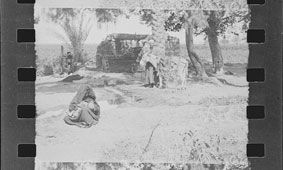
In March of this year, someone spotted a small can of film in an antique shop window. It had the words ‘Collection ELGE’ on the can, indicating a Gaumont film (from the letters L.G. for Léon Gaumont). The discovery came to the attention of film historian Sabine Lenk, who in turn alerted Lobster Films of Paris, specialists in early film and inspired discoverers of the extraordinary. What lay within the antique shop, however, hinted at being their most exceptional discovery yet. There were ninety-three cans in the shop, the owner apologising that they were only negatives (!). They were Edison-perforation 35mm, some in ELGE cans, some in Lumière cans, with some shrinkage but little decomposition. And they appeared to date from 1897.

Films very rarely turn up these days from the 1890s, and when they do they tend to be in ones and twos. For ninety-three to emerge in one go is practically unprecedented. And there there was their subject matter. Handwritten titles on the opening frames indicated films taken in Nazareth and Bethlehem, and dramatised scenes of the life of Christ. Before a single film had been printed or viewed, it was clear that here was a truly major discovery.

Seven months on, and amazingly the collection was ready for exhibition at Pordenone. Inevitably enough, this being a collection of early, non-fiction films, the Verdi was less than full for this historic premiere. So there were folks who preferred their cappuccino to witnessing the most remarkable discovery of the festival, but more fool them. The rest of us heard an introduction from Serge Blomberg of Lobster, who said that the rolls of film bore number 1 to 203, with many missing. The films we were to see came from Palestine and Egypt. Other titles showing scenes in Turkey would be shown at a later date.

Bible lands frame

One of the ‘Bible Lands’ films discovered by Lobster Films, showing a funfair with swings, from http://www.cinetecadelfriuli.org/gcm

And so to the films. They were one-minute or so each in length, actualities of life in the Bible lands (as Lobster have labelled the films), very much in the Lumière style. Indeed, the films showed the sort of studied composition and coherent action encompassed within the frame and completed within the film’s duration that characterises Lumière productions. Some had two shots, some featured camera movement. They were all in superb condition. We saw camel drivers, a snake charmer (whose cobras tried to escape into nearby bushes and were hauled back, not best pleased), children dancing in front of the ruins at Luxor, street vendors in Cairo, an Arab street funeral procession, a funfair with swings pulled by ropes and a mini ‘big’ wheel, women drummers, men dancing, men and women making bricks, women preparing food, a panning shot of the Kedron Valley, women sowing seeds on horse-drawn ‘carts’ (they looked like sleds) outside Nazareth, and many more such scenes. Perhaps most impressive were the two or three films showing the shadouf being operated, the human-powered (usually child-powered) irrigation system with a bucket and a counterweighted arm. These were scenes that had gone on from centuries, millennia even, and here was the motion picture capturing them – in 1897 (or thereabouts), when in truth they could have been scenes from any time.

Following the actualities, we had the dramatic films. There were scenes from two lives of Christ – or at least, filmed in different locations. The first was clearly filmed in Palestine, presumably in Nazareth and Bethlehem themselves. These were brief scenes from the birth and childhood of Christ, extraordinarily featuring an Arab (Christianised?) Joseph and Mary. The Adoration of the Shepherds and then the Magi (not much difference between the two) took place by some steps, with a rough authenticity unlike any Nativity film you ever saw. Mary wore a large white shawl that covered much of her face. We saw further scenes with this couple, Mary on a donkey, the rest on the flight to Egypt, Mary breastfeeding her child, the toddler Jesus’s first steps (not a scene I remember from the Bible).

And then the backgrounds changed. The scenery became wooded, without buildings, and Mary, Joseph and Jesus (a young girl) were now played by white performers, with attitudes and iconography far closer to the conventional. These scenes appear to have been filmed in France, but they continued to surprise. We had an Annunciation scene with an angel Gabriel suddenly appearing (a trick effect unlikely to be as early as 1897), Joseph working at his carpentry, someone dropping a pot which the child Jesus then magically mended, Joseph rowing Mary and Jesus across a river, young girls dressed as angels joining Mary and Jesus. Most astonishing was the film where the child Jesus carried a cross, placed it upon the ground, and then lay down upon it. There is some precedent for this sort of intimation of the future on the part of the child Jesus in the Western art tradition, but it was still a mind-boggling feat of the imagination.

Bible lands frame

One of the ‘Bible Lands’ films discovered by Lobster Films, from http://www.cinetecadelfriuli.org/gcm

So who made these films, and who saw them? Although there is not certain evidence as yet, the most likely candidate is Albert Kirchner, also known as Léar. Kirchner was a French photographer and likely producer of risqué postcards, who is first recorded as having made a striptease film, Le Coucher de la Marie, with Eugène Pirou in 1896. Unblushingly moving from pornography to religion, Kirchner teamed up with a Catholic priest and educationalist, Father Bazile, to make short comedy films. In Spring 1897 he set off with one Father Bailly to film in Egypt and Palestine, returning to France to film a twelve-scene Life of Christ with Michel Coissac (a future film historian who wrote about this episode). This was the first-ever Life of Christ to be filmed, and it enjoyed huge popularity – the Reverend Thomas Dixon, author of The Clansman on which D.W. Griffith’s The Birth of a Nation would be based, exhibited it in America in 1898 – and was much imitated. Kirchner’s films were bought up by Gaumont, and some can be found listed in Gaumont catalogues. He then disappears from the historical record, but he may have died soon afterwards.

There was much excited discussion among the early film enthusiasts after the screening (there aren’t many of us who get wildly enthused by 1890s films, but we’re a dedicated breed). It seems unlikely that all the films date from 1897, given some of the sophisticated techniques on view at times, and we may have seen films produced by different hands. And so many questions. Why the two lives of Christ? Were the ‘authentic’ scenes shown in France, rejected by audiences, and scenes more in keeping with Western taste shot in their place? Or were the two lives really one and meant to be shown together, despite the changes in performers and costumes? Were the actuality scenes meant to be integrated with the dramatised scenes? We know that the films – assuming they are Kirchner’s – were popular, but what exactly did audiences see? It is only a few months since this extraordinary collection was discovered, and there is still a huge amount to be discovered. What is certain is that a gap in the history books needs to be filled, and we have a collection of views of life in Palestine and Egypt at the end of the nineteenth century which will not only excite the historians but enrich generations to come.

[Update (October 2008: The films are now known to have been made by the Abbés Mulsant and Chevalier in 1904. See Back to the Bible Lands post]

There were other films in the day, which I’ll touch on briefly. Two delightful Starewitch animations, Les Grenouilles Qui Demandent Un Roi (1922) caught the stern spirit of Aesop and La Fontaine very well, with fine comic glosses on the tale of the frogs who ask an exasperated God for a new king, eventually getting a stork which eats them all. La Voix du Rossignol (1923) was charming in its meticulously observed depiction of bird life. Der Kampf der Tertia (1929) was a German’s children’s feature film, directed by Max Mack and with beautfilly composed coastal scenes, about a group of schoolchildren who prevent a cull of cats in a neighbouring town being organised by Max Schreck (of Nosferatu fame). Happy, inconsequential stuff, though you couldn’t help but wonder what would be the fate of those bright-eyed youngsters ten years thence. All at Sea (1933), shown in the evening, was a home movie shot by Alistair Cooke (the future broadcaster) of a yachting trip he spent with Charlie Chaplin and an impossibly beautiful Paulette Goddard. Chaplin is seen impersonating Jean Harlow, Greta Garbo and the Prince of Wales (rather good), as well as going through a Napoleon routine. We also saw unpleasant details of a shark being caught, and the usual dull shots of ships in the distance which invariably fail enliven the home movies of rich or humble.

Pordenone

Pordenone

And so farewell to Pordenone for 2007. I left on the Thursday morning, and so missed the last three days, including the Corrick Collection of early films recently discovered in Australia, my favourite René Clair film, Un Chapeau de Paille d’Italie (An Italian Straw Hat) (1927), and the late D.W. Griffith film that I most admire, Isn’t Life Wonderful (1924). Ah well. If you want to find out more about the films on show at this year’s Giornate, the full catalogue is downloadable as a PDF (2.9MB), with marvellous detail, expertly edited as always by Cathy Surowiec. If you were at Pordenone and saw the films I saw and would like to make comments – or if you saw films I didn’t see and would like to tell us about them – please do so. And if you’ve never been to the Pordenone Silent Film Festival and these posts have made you think that perhaps you ought to one day – well, you’re right.

Family history for film historians

The Kiss in the Tunnel

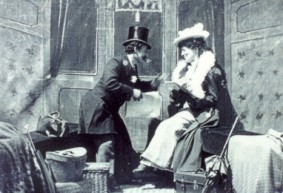
G.A. Smith (the filmmaker) and his wife Laura Bayley in A Kiss in the Tunnel (1899)

The huge growth in geneaology on the web in the past few years has also provided a wealth of resources for the film historian. This post is based on a talk I gave a couple of years ago at the British Silent Cinema festival, and provides a guide to the sorts of resources available (particularly but not exclusively British sources) and what the film historian may gain from them.

1901 census
There have been ten-yearly censuses in Britain since 1801, though until 1841 they did not record details of individuals. It was the launch of the 1901 census online in 2002 that helped generate the explosion of interest in family history, though the National Archives were not expecting the millions who tried to access the site on its publication, which led to its immediate crash and an awkward gap of several months before it was resilient enough to be published again.

The census is available at www.1901census.nationalarchives.gov.uk [update: the link is now www.1901censusonline.com]. The records will provide you with the name, age, place of birth, the county and parish where the census was taken, and the person’s occupation. Hence, type in ‘Cecil Hepworth’ and you will get two results:

Cecil Hepworth / 9 / Lancs Manchester / Chester / Macclesfield /
Cecil Hepworth / 27 / Lewisham / London / Streatham / Cinematographer

One is clearly a British film pioneer, the other a blameless child. You can then view the census record (image of the original form plus a transcription), which will give you all of those resident in Cecil Hepworth’s houshold on the day of the census. For this you need to pay, for which they have a credits system. 500 credits cost £5.00 and are valid for seven days. Viewing a single image takes up 75 credits.

If you are looking for an individual with an unusual name, locating them is easy. A more common name will require a bit more preparation – an idea of age, location etc. Typing in Alfred Hitchcock gets you 66 records (he’s the one aged 1, born in Leytonstone), while Charles Chaplin yields 151 records (he’s the one aged 12, living in Lambeth, occupation ‘Music Hall Artiste’). The full census record will tell you so much about who they lived with, their occupation, social status, and ultimately their ancestry.

Using the Advanced Search option is potentially very interesting, but also frustrating. It ought to be possible to search for everyone in 1901 who was working as a cinematographer, but to do so you have to enter at least two letters with wildcard (e.g. AB*) into the name field at the same time, so to trace everyone who might be a cinematographer in the 1901 census in theory would take 650 individual searches (in practice a lot of letter combinations could be rejected of course). Someone with the patience to do that is the film historian Stephen Bottomore, who conducted a search for profession beginning ‘cine*’, and found a remarkable list of names, most of whom are unknown to film history as yet. Here’s a selection (with transcription errors):

Name / Age / Where Born / Administrative County & Civil Parish / Occupation
Alvey, Harry / 19 / Notts Nottingham / Lancaster West Derby / Cinematograph Operater
Banford, George / 20 / London Hornsey / London Islington / Cinematic Image Maker
Barton, Benjamine / 40 / Warwick Birmingham / Birkenhead Birkenhead / Cinematographer Ethil
Bayliss, Thomas / 51 / Staffs Bradley / Leicestershire Measham / Cinematographic Artist
Brecksapp, Thomas / 27 / Brixton London / Sussex Hove / Cinematographer
Bromhead, Alfred / 24 / Hampshire Southsea / Surrey Kent / Penge London / Cinematograph Agent
Catlin, Edwin / 43 / London St Pancras / London Islington / Cinematograph Operator
Chadwick, Julia / 25 / Lanc Rochdale / Lancaster Rochdale / Cinematograph Operator
Clarke, Herbert / 27 / London St Pancras / London St Pancras / Cinematograph Proprietor
Cramer, Horace / 23 / Sussex Hastings / London Paddington / Cinematograph Operator
Croft, Emelina / 27 / Weybridge Surrey / Surrey Weybridge / Cinemelographer
Davey, Frederick / 20 / Surrey Croydon / Borough Of Oxford Cowley St John / Cinematsgraph Operator

Just the one well-known name there – Alfred Bromhead, who went on to run the Gaumont company in Britain. And astonishing to see two women cinematograph operators (which could be camera operators or projectionists or both). Stephen has kindly made his whole list available as a PDF. Do note that film people got described under a variety of terms – bioscope operator, photographer etc. – so Stephen’s list is just a start. The census gets released to the public one hundred years after it was made – 2011 is going to be quite a year for British film history research.

Update (January 2009): The 1911 census is now available online, published ahead of its centenary owing to an anomaly in the 1920 Census Act. Information on using it for film history research here.
Ancestry

http://www.ancestry.co.uk

Ancestry and FreeBMD

The 1901 census is a good place to start, but for a proper study of British, and international, records, you need FreeBMD and Ancestry. FreeBMD is one of those marvellous resources which the web has encouraged and pure human goodwill has sustained. It is a transcription of the Civil Registration index of births, marriages and deaths in the UK from 1837 to around 1900, and will eventually be complemented by free resources for census and parish register data. It’s all put together by volunteers, and though not quite finished yet it is an indispensible resource, which allows you to search across British births, marriages, deaths, or all three, assorted combinations of name, dates ranges, location etc. It won’t lead you to the documents themselves, and it helps to know a little about how civil registration data is organised to get the best out of it, but it is first-rate research tool.

And then there is Ancestry. Ancestry.co.uk and Ancestry.com are the big players in worldwide genealogy online. Here you will find births, marriages and deaths records for the UK 1837-c.1900, all UK census records 1841-1901 with digitised images of the census forms, local directories (including phone directories), US federal census data going back to 1820, some individual American states’ birth, marriage, divorce, death, military and census records, and much much more. Ancestry is continually adding new resources, and also links name searches to online family trees.

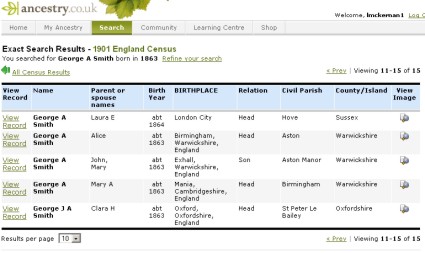
Most of this is not free. There is a variety of subscription options, on a pay-per-view basis, monthly, or annually, and either worldwide or restricted to your country. But for a few pounds a month (a monthly UK membership is £9.95) you can have access to every census record 1841-1901, and there are such marvellous things you can find. So, for example, I can trace Charles Urban – a particular interest of mine – aged 13, living in Cincinnati, in the 1880 US Federal census (freely available), through to the 1901 British census, where he is in London, aged 34, and described as ‘Manager Animated Pictures’. But beware! Ancestry’s transcriptions of census data are notoriously riddled with errors, and you have to be prepared to think laterally and to search under mispellings and the like. You won’t find Charles Urban in 1901 by searching on his name – it’s been mis-transcribed as Verban. As ever, it’s harder looking for common names. The frame grab from Ancestry above is the 1901 record for George Albert Smith, who I eventually found under George A. Smith, identifiable by his age, wife’s name (Laura) and location, Hove.

Other resources

Many people start out looking for family history information with the International Genealogical Index (IGI) or FamilySearch.org. This is the mind-boggling attempt by the Church of Jesus Christ of Latter-Day Saints (i.e. the Mormons) to create a register of all births, marriages and deaths, worldwide, as far as they possibly can, with the underlying intention of baptising anyone who might be their ancestors into their faith. The result is a directory of millions of names, taken from parish registers, census records, social sectority death records etc, plus information supplied by individual researchers. It is not primary source information, it is riddled with errors or dubious interpretations, and should only be used with caution, a pointer as to where to look next. For the film historian, it should not be the first point of call.

These are some other key genealogy resources not yet mentioned:

Genuki – a reference library of genealogical information for the UK and Ireland.

RootsWeb – a worldwide genealogical ‘community’ – a good place for posting questions about family names you may be researching.

Genes Reunited – family history based on the Friends Reunited principle, where the more people who join in and add data, the more comprehensive the resource.

ScotlandsPeople – the official source for Scottish genealogical information, including births/marriages/deaths, census records, parish registers and wills.

Findmypast.com – previously known as 1837online, this is a commercial site which as well census and civil registration records has migration and military records, and offers access to the index of birth, marriage and death records up to the 2002, including overseas records. This is less wonderful than it sounds, as they offer you page records, or groups of page records only, rather than individual name records, and searching for an individual takes ages, and becomes expensive.

General Register Office – from here you can order copies of birth, marriage and death certificates in the UK. There are national equivalents around the world, a growing number of which provide online ordering of certificates.

Ellis Island Records

http://www.ellisislandrecords.org

Passenger lists
And there’s more. Passenger list records are a key source for tracing film people sailing to different countries. Findmypast.com has co-operated with the National Archives to provide ancestorsonboard.com. This is a database of outward passenger lists for long-distance voyages leaving the British Isles from 1890 onwards. Eventually the resource will go up to 1960, and data up to the end of the 1930s has just been added. Name searching is free, but there is a charge for looking at the ships’ transcripts. As ever, it helps to be looking for a unusual name.

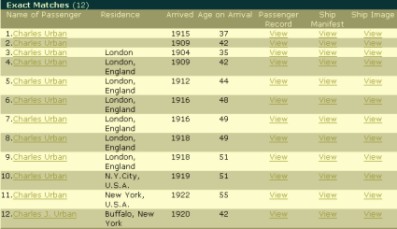
But the champion in this area is Ellis Island Records. This is a free resource free offering records of all those arriving at New York’s Ellis Island 1892-1924. This will give you the passenger details, where they came from and when they arrived in New York, plus the ship’s manifest (i.e. the full record of everyone travelling on that ship) as image or transcribed text. So you can not only get someone’s personal details, but who they were travelling with (family, friends, business associates), in what style (first class? steerage?), plus of course how often they travelled between Britain and America.

There is a whole lot more out there, and it can be a bit bewildering for the newcomer. As a guide through the maze of internet genealogy sources, the essential starting point is Cyndi’s List, which is the widely recognised leading sources of family history links, which is helpfully categorised by theme and country.

For reading, I recommend Peter Christian’s The Geneaologist’s Internet as a thorough and helpful guide through the thicket of online resources, what to expect from each one, their particular advantages and pitfalls.

There is a great deal that can be found in family history sources to benefit the film historian. Obviously if you are looking into the personal history of someone you are interested, these will be essential resources. But you can also learn about the social position of people in the film industry, their locality, mobility, business links, associates and self-image (Charles Urban calls himself ‘manager’ on some sources, on others he describes himself as ‘scientist’). Information from the records of one person will send you off researching other names that you hadn’t considered, and lateral use of the resources will open up new ways in which to examine film history. Who was Julia Chadwick, cinematograph operator from Rochdale, and Emelina Croft, cinematographer in Weybridge, Surrey? How did they get into the business? Who did they work with? What happened to them? The clues are there.
From 1896 to 1926 – part 1

E.G. Turner

Edward G. Turner, from http://www.victorian-cinema.net

It’s time for a new series. Edward G. Turner was a film exhibitor and distributor from the earliest years of British film, whose company Walturdaw continued for decades thereafter. In 1926 he wrote a series of articles for the Kinematograph Weekly (great rival to The Bioscope) on his memories of the industry. ‘From 1896 to 1926: Recollections of Thirty Years of Kinematography’ (originally published 17 & 24 June, 1 & 15 July 1926) is marvellous source of information on the first years of the British film business, particularly renting (distribution) where Walturdaw were undoubted pioneers. It’s an anecdotal stuff, occasionally homely stuff, but with revealing gems along the way. Anyway, let’s start…

The founders of the Walturdaw Co. Ltd., of whom the successors are the Walturdaw Cinema Supply Co. Ltd., were E.G. Turner and J.D. Walker, and the month of August in the year 1896 saw the beginning of their activities in the kinema industry when they purchased their first machine from John Wrench and Sons, of 50, Gray’s Inn Road.

At this time there were only two other makers of machines in the world’s market: R.W. Paul, of Hatton Garden, and Lumière, of Paris.

Within a short period, Beard, of old Kent Road, Haydon and Urry, of Islington, Hughes, of Kingsland Road, Levy Jones. of Hoxton, Reay, of Bradford, Thomassin, Ottway in St. John Street, Islington. Later the Edisonagraph, Mutoscope American Biograph and Pathé came into existence.

The First Posters
At this period our office was at my private address at 111, Great Eastern Street, E.C., and we started out under the grand title of The North American Animated Picture Company. Our entertainment consisted of animated pictures, and Edison’s phonograph.

Our first poster invited the public to view “The World’s Wonder – THE CINEMATOGRAPH, by which the Public would see Trains in Actual Motion coming to rest at Platforms and Passengers Alighting – Trees Gracefully bending in the Wind – Waves breaking on the Sea-shore, and the Fattest and Thinnest Wrestlers in the World would go through their Performance in Animated Photography – Also Edison’s marvellous invention, the giant Phonograph”. We invited the public to come, and not only hear this instrument, but have their voices recorded and reproduced before the audience.

Takings
For our first display we hired the hall adjoining the Constitutional Club, Guildford, from Monday, November 16, 1896, our takings that night being £8 1s 1d. the intervening days up to Friday, November 20, were used in posting our bills and distributing handbills from door to door at Godalming, ready for the show to be given there on that night.

The display was duly given, our receipts being £7 4s 6d. The show went well and we were told that if we stayed and gave another show on the following night, Saturday, we would do well. We returned to our diggings, and there I found a telegram awaiting me, telling me of the arrival that night of a new addition to my family – a bonny girl – born at 8.30, whilst I was actually showing our films in the Public Hall, Godalming.

I believe the name of Godalming means “The Gift of God,” and so this child of mine makes it impossible for me to forget my entry into the kinema world; and she can truly be described as a child of the kinema. All her life since leaving school has been spent in the industry, and she, with her husband, now are in charge of a very sucessful little kinema in the country.

“Exploitation”
So we thought our luck was in, and we decided to stay anoter night to celebrate the event – but how to let the public know? Mr. Walker, always a man of brains, and being handy with paper and scissors, cut out in white letters the necessary announcement, and I next morning made a frame 3 ft. wide and 12 ft. long, with handles at each end, covered it with turkey red, pasted on the white letters, and there was our advert. ready. I got two lads to carry it about the streets, telling them to go anywhere where people were to be found.

A 2 o’clock, while standing outside the hall, we heard strains of a band playing the “Dead March in Saul” – it was a military funeral; it passed by us – first the band, then the body, the mourners walking behind – and directly behind them as part of the procession were out two lads and out advertisement!

Nothing could be done without creating a scene, so we let them pass on. Later, in very cross tones, I asked them why they had done such a thing, and their reply was “you told us to go where people would see your notice, and everyone in Godalming has seen it now”.

Anyway, we took £7 that night!

Beard is Robert Royou Beard; Reay is Cecil Wray. For a rough equivalent of present day prices, multiply the figures Turner gives by 100. The baby girl’s name was Ethel. Next up, the films that they showed.

They said that

Kafka Goes to the Movies

OK, here are the answers to yesterday’s poser. The six people commenting on the experience of going to the cinema in the silent era were all notable authors, albeit four of them wrote the comments before they found fame.

Quotation no. 1 – “Nothing of my former mind seems to have remained except a heightened emotiveness which satisfies itself in the sixty-miles-an-hour pathos of some cinematograph or before some crude Italian gazette-picture” – This is James Joyce, writing to his brother Stanislaus while living in Rome in 1907. Joyce was twenty-five years old, working in a bank, and a long way from literary fame. He was to become a regular cinema-goer, despite failing eyesight, and of course managed a cinema in Dublin for a brief period 1909-1910 – though that had more to do with money (which did not come his way) than any love of early film.

Quotation no. 2 – “If I had my way, I would build a lethal chamber as big as the Crystal Palace, with a military band playing softly, and a Cinematograph working brightly” – This is D.H. Lawrence, writing to Blanche Jennings in 1908, imagining how he might dispose of society’s outcasts. It’s a familiar quotation, from its use in John Carey’s book The Intellectuals and the Masses: Pride and Prejudice Among the Literary Intelligentsia, 1880-1939 (1992). Lawrence was contemptuous of the cinema – elsewhere he describes it as the “triumph of the deaf and dumb”. His first novel was three years away.

Quotation no. 3 – “Was at the movies. Wept. Lolotte. The good pastor. The little bicycle. The reconciliation of the parents. Boundless entertainment” – This is Franz Kafka, aged thirty, writing short stories, and touring around Prague with his good friend Max Brod, with whom he went to the cinema. There is an extraordinary book by Hanns Zischler, Kafka Goes to the Movies (2003), which identifies the films the pair saw, from Kafka’s and Brod’s diaries, tracks them down in reviews and archives (where they survive), and writes a history of Kafka’s emotional life and cultural life through the films that he saw. There’s an extract from it here. Zischler is now working on a similar project on James Joyce.

Quotation no. 4 – “the encroachment of the cheap and rapid-breeding cinema” – This is T.S. Eliot, and it comes from one of his most celebrated essays, ‘Marie Lloyd’, published in 1922. Eliot praises one form of working-class entertainment, but expresses loathing for its successor, the cinema, the phrase ‘rapid-breeding’ unpleasantly melding the growth in cinema-building with his sense of an animalistic, proletarian audience that filled him with horror.

Quotation no. 5 – “In spite of my earnest resolution never again to waste time at a cinema I have spent both yesterday and this afternoon in that unprofitable way” – The man with the addiction for going to the cinema is Evelyn Waugh. It comes from his diary entry for 3 September 1924, the day after he had vowed not to go the cinema “promiscuously”. The entry for 4 September however records, “Last night I slept ill; I think through excess of cinemas. I went to two yesterday”. This clearly was an addicition of some kind, and visits to the cinema are regularly recorded in Waugh diaries. Around this time he made scurrilous amateur films with Terence Greenidge, Elsa Lanchester and others, but had yet to complete his first novel.

Quotation no. 6 – “They have never seen the savages of the twentieth century watching the pictures” – This is from Virginia Woolf’s celebrated 1926 essay, ‘The Cinema’. Woolf was intrigued by film of reality, which she found to be at a curious remove from reality. Woolf was genuinely interested in the possibilities of the cinema, the potential it offered for a new way of seeing. Her ‘savages’ metaphor, however, I find mysterious.

The reactions of the literary intelligensia to the early cinema is a subject that fascinates me, and we’ll have more on the Bioscope in future posts – particularly those writers who found that they could make money out of the movies, or who were inspired to take up the camera themselves.