Where the wild things are

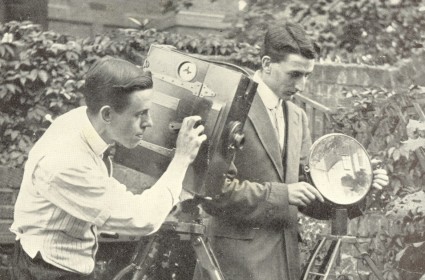
Percy Smith

Percy Smith (left), from F.A. Talbot’s Moving Pictures: How They are Made and Worked (1912)

It’s been a long time in coming, but it’s been well worth the wait. Today saw the launch of WildFilmHistory, a site dedicated to recognising 100 years (so they say) of wildlife filmmaking. Produced by the Wildscreen Trust and supported by Lottery funding, this is a multimedia guide to one hundred years of natural history filmmaking, from the pioneering days when stop-motion films of flowers opening wowed them in the music halls to the age of Attenborough and beyond.

The site is biographical in focus, and at its centre are ninety-one (so far) mini-biographies of wildlife filmmakers, twenty-nine of them with accompanying oral history recordings, which very usefully come with PDF transcripts. So you get interviews with the likes of David Attenborough, Hans and Lotte Haas, Desmond Morris, Tony Soper and the late Gerald Thompson, but also the academic Derek Bousé, whose excellent history Wildlife Films investigates our period – more of which below. There’s also a very useful timeline.

But of greatest value for our purposes are the film clips of early wildlife films. There are thirteen of them (many from the British Film Institute collection):

  • Das Boxende Känguruh (1895) – Max Skladanowsky’s film of a boxing kangaroo and its trainer Mr Delaware.
  • Rough Sea at Dover (1895) – Something of a surprise choice, Birt Acres’ self-explanatory film which they argue is “considered by some to be the first natural history orientated film”.
  • Pelicans at the Zoo (1898) – Pelicans at Regent’s Park Zoo, made by the British Mutoscope and Biograph Company, a breathtakingly beautiful film if seen on 35mm (it was originally shot on 70mm), a little more prosiac in Flash.
  • Spiders on a Web (1900) – A new one on me. This was apparently made by G.A. Smith and features two spiders in close-up, viewed through a circular mask (but no web to be seen). Clearly an extract from a longer film.
  • St. Kilda, Its People and Birds (1908) – Made by Oliver Pike, this shows both human and animal life on St kilda, off Scotland, at a time when it was still inhabited by people.
  • The Birth of a Flower (1910) – Exquisite stop-motion photography of flowers opening, complete with stencil colouring, made by the great Percy Smith for Charles Urban.
  • The History of a Butterfly – A Romance of Insect Life (1910) – A fully-fledged natural history film, made by James Williamson, with a fair bit of nitrate damage to remind us of the precious state in which some of these films survive.
  • The Strength and Agility of Insects (1911) – Eye-popping pyrotechnics performed by flies, who juggle corks, twirl matchsticks etc. This is actually a re-issue of an earlier film, The Balancing Bluebottle (1908), filmed by our hero of the era, Percy Smith, for Charles Urban once again. No animals was injured during the making of this film (honest).
  • Secrets of Nature: The Sparrow-Hawk (1922) – One of the famous British Instructional Films series of educational films from the 1920s/30s, this was made by Captain C.W. R. Knight (the site’s synopsis mistakenly says in one place that Percy Smith made the film, though he was associated with many Secrets of Nature productions) (Captain Knight turns up twenty years later as the eagle-tamer in Powell and Pressburger’s I Know Where I’m Going, trivia fans).
  • Secrets of Nature: The Cuckoo’s Secret (1922) – Another title from The Secrets of Nature, this time filmed by Oliver Pike and produced by ornithologist Edgar Chance
  • With Cherry Kearton in the Jungle (1926) – Cherry Kearton was the most celebrated naturalist of the era, and with his brother Richard more or less pioneered the art of wildlife photography and then cinematography. This is a ‘greatest hits’ compilation of some of his African natural history films.
  • Simba (1928) – An African travelogue (extracts only) made by the enterprising American couple Martin and Osa Johnson, blending actuality with staged scenes, and alarmingly also blending shooting with both camera and gun.
  • Dassan: An Adventure in Search of Laughter Featuring Nature’s Greatest Little Comedians (1930) – Cherry Kearton anticipates The March of the Penguins by several decades.

And so it continues up to the present day, with many marvellous clips which both amaze and cause a sigh of happy nostalgia (Zoo Quest, Jacques Cousteau). A little oddly, the site includes pages for films that they haven’t tracked down yet – these include Oliver Pike’s In Birdland (1907), which they argue was the first true wildlife film (hence the centenary), but unfortunately no copy is known to exist.

This is a very well produced site, on which a huge amount of effort has been expended on clearing and producing the clips, esearching the history, and presenting the interviews. The early film clips are wonderful to see, even if I miss one or two titles that I think should have been there (e.g. Herbert Ponting’s fine penguin footage from his films of Captain Scott’s Antarctic expedition). The site opens up the history of wildlife film, demonstrating an interconnected heritage, championing excellence, and encouraging us all to find out more.

Wildlife Films

So, if you are interested in finding out more, where should you go? Well, as mentioned, I strongly recomennd Derek Bousé’s Wildlife Films (2000). This is a first-rate history of wildlife filmmaking and television production, good not only on the plain history but on the mysteries of the genre, which ever since its earliest days has had to adopt assorted entertainment strategies, particularly storytelling, to make its work palatable to a mass public. It is thoughtful and informative. Also recommended is the similarly thought-provoking Animals in Film (2002) by Jonathan Burt. There’s also the recent BBC publication, Michael Bright’s 100 Years of Wildlife (2007), which is aimed at the popular end of the market, but does at least name check people such as Kearton, Smith and Urban.

WildFilmHistory is a wonderful resource, which promises to grow and welcomes any information on new material that they might use. In the spirit of the great filmmakers it champions, go explore.
Through Savage Europe

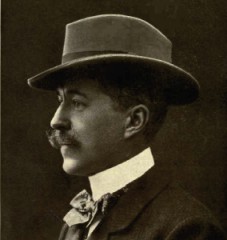
Harry de Windt

Harry de Windt

Just added to the Bioscope Library is Through Savage Europe: Being the narrative of a journey (undertaken as special correspondent of the “Westminster Gazette”), throughout the Balkan States and European Russia. This is an account of a journey through the states of Bosnia, Herzegovina, Montenegro, Servia (as the book has it), Bulgaria, Rumania and Russia in 1907. This was the area that was soon to experience conflict through the Balkan Wars of 1912-13, then to be the powder keg that helped start off the First World War.

Of interest to us is that the author, journalist and adventurer Harry de Windt, took a motion picture cameraman with him. This was John Mackenzie of the Charles Urban Trading Company, to whom De Windt refers throughout:

My sole companion was Mr. Mackenzie, of the Urban Bioscope Company, a canny Scotsman from Aberdeen, possessed of a keen sense of humour and of two qualities indispensable to a “bioscope” artist – assurance and activity. Nothing daunted my friend when he had once resolved to secure a “living” picture, and I trembled more than once for his safety in the vicinity of royal residences or military ground. For the bioscope was a novelty in the Balkans and might well have been mistaken for an infernal machine!

Relatively little is said of Mackenzie’s actual work (he left before de Windt went on to Russia), but the interest is in his very presence, in the tie-up with a British newspaper (the Westminster Gazette), and in the Balkans as a topic of sufficient interest to audiences at home to justify the expense of organising such a venture. Here is the motion picture medium as a news and documentary force, bound up with the other news media, reporting on a remote locality of pressing interest to British audiences (Urban had sent out a cameraman to the same area in 1903 to film a Macedonian uprising against the Turks) who could read it up in the papers and then, suitably briefed, see it all with interested eyes on the motion picture screen.

For the record, this a list of the films taken by Mackenzie (sadly, none is known to survive today):

Roumania: Its Citizens and its Soldiers (22 scenes, 420 feet)
Herzegovina, Bosnia and Dalmatia (22 scenes, 710 feet)
Montenegro and the Albania Alps (14 scenes, 350 feet)
Life and Scenes in Servia (17 scenes, 435 feet)
Bulgaria and its Citizens (18 scenes, 800 feet)
Bulgarian Infantry (18 scenes, 410 feet)
Bulgarian Cavalry and Artillery (17 scenes, 415 feet)

Mackenzie would go on to become a leading Kinemacolor cameraman, shooting many of the earlier productions demonstrating the colour process.

Through Savage Europe is available from the Internet Archive in DjVu (14MB), PDF (38MB), b/w PDF (17MB) and TXT (439KB) formats.

Blackpool and the North West on film

Notice of a couple of shows of rare actuality film of Blackpool and the North West of England taking place this weekend in Blackpool. Organised by the British Film Institute, the North West Film Archive and the National Fairground Archive as part of the latter’s ‘Admission all Classes’ project, the programme is as follows:

Saturday 12th January

Pavilion Theatre, Winter Gardens, Blackpool

11.30am – BFI presentation of historic Blackpool

Blackpool High Tide (1913)
The Open Road (c.1925) Blackpool extract
Blackpool: A Nation’s Playground (c.1935)
Mining Review 2nd Year No 12 (1949)
Holiday (1957)

Grand Edwardian Magic Lantern Show

Professor Heard and company take us on a musical, magical excursion from the age of Victorian magic lantern show to the birth of the cinema picture palace.

2.30pm – North West Film Archive presentation of historic Blackpool

Blackpool Seafront (1899)
Royal visit to Lancashire (1913)
Prince of Wales visit to Blackpool (1927)
Blackpool Kaleidoscope (1963)

Grand Edwardian Magic Lantern Show

7.00pm – Electric Edwardians: the Films of Mitchell & Kenyon
With piano accompaniment
commentary by Professor Vanessa Toulmin

Sunday 13th January

The Grand Theatre, Blackpool

1.30pm – Mitchell & Kenyon: North Lancashire and Cumbria
Including:
Employees Leaving Williamson’s Factory, Lancaster (1901)
The Return of the Lancaster Volunteers (1901)
His Worship the Mayor Leaving Lancaster Town Hall (1902)
Opening of the Blea Tarn Reservoir (1902)
Panoramic View of the Morecambe Sea Front (1901)
Parade on West End Pier Morecambe (1901)
Parade on Morecambe Central Pier (1902)
Douglas Harbour Paddle Steamer (1902)
The King’s Ride in the Isle of Man (1902)
Employees Leaving Furness Railway Works, Barrow (1901)
Employees Leaving Messrs Vickers and Maxim’s in Barrow (1901)
Royal Visit to Barrow & Launch of H.M.S. Dominion (1903)
Workers at Carr’s Biscuit Works, Carlisle (1901)
Scenes of Carlisle (1901)

7.30pm – Mitchell & Kenyon: Central Lancashire
including:
Workforce at Horrocks Miller & Co, Preston (c. 1901)
Preston North End v Wolverhampton Wanderers (1904)
Preston North End v Aston Villa (1905)
Turn out of the Preston Fire Brigade (c. 1901)
Return of the East Lancashire Regiment (1902)
Preston Street Scenes (1904)
Whitsuntide Fair at Preston (1906)
Leyland May Festival (1905)
Les Montagnes Russes, Blackpool’s Latest Attraction (1902)
Blackpool North Pier (1903)
Steamboats at Blackpool North Pier (1903)
Blackpool Victoria Pier (1904)
Blackpool Promenade Extension (1905)
Lytham Club Day Carnival (1902)
Lytham Trams and Views along the Route (1903)
Panaromic view of Southport Promenade (c. 1902)
Southport Carnival and Trades Procession (1902)
The ‘hands’ leaving work at North-street Mills, Chorley (1900)
Chorley Coronation Processions (1911)

For booking on Saturday, visit the Blackpool Live site. For booking on Sunday, visit the Blackpool Grand site.

And while we’re considering things Lancastrian, do take note of the North West Film Archive‘s excellent new DVD release, Liverpool on Film 1897-1967, which includes Lumière films of Liverpool taken in 1897, as well as other silent actuality material, handsomely presented. What better way to celebrate Liverpool as the 2008 City of Culture?

2008 Man with a Movie Camera

2008 Man with a Movie Camera

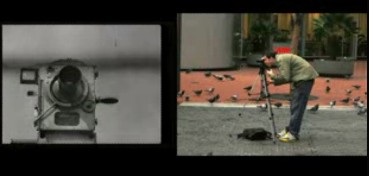
1929 and 2008 Man with a Movie Camera, from http://dziga.perrybard.net

You may remember the posts on video artist Perry Bard’s remarkable project in ‘database cinema’ to create a modern version of Dziga Vertov’s avant garde documentary classic, Man with a Movie Camera, by inviting anyone interested to upload modern equivalent shots to those in the original. You can find all about the ongoing project on Bard’s website, at http://dziga.perrybard.net, but she got in touch to correct an earlier post about the project with this information:

There was an initial deadline which may have led to some confusion however the project is open and ongoing.The reason for the deadline is that people tend to like the excitement of doing things at the zero hour and we wanted as much material as we could get for the launch in Manchester October 11. It continued screening there for two weeks, then screened in Norwich during the Aurora Festival, in Leeds during the Leeds Film Festival. There are links to photos of these events on the site.The site now contains a full length version of the remake which plays as a split screen with the original. We don’t have the server capacity to keep updating the remake but with each screening event it works through a daily download meaning that the film is different each time it screens as more than one person has uploaded entire scenes and shots. The possibilities are infinite. Please participate by logging on to http://dziga.perrybard.net.

There’s also a two-minute trailer available, and the full-length split-screen film (in its current version) is available from Google Video.

Before the earthquake

A Trip Down Market Street

A Trip Down Market Street Before the Fire, from http://memory.loc.gov

A regular Bioscopist is Joe Thompson, who runs both the engagingly-named The Pneumatic Rolling-Sphere Carrier Delusion blog (“rambling observations on books, history, movies, transit, obsolete technology, baseball, and anything else that crosses my mind”) and the Cable Car website. Which is, unsurprisingly, dedicated to cable cars – particularly those in San Francisco.

He has just published a fascinating piece on A Trip Down Market Street Before the Fire, a 1905 film shot from a travelling cable car, showing San Francisco before it was struck by the catastrophic earthquake and fire of 1906. The film is available to see on the Library of Congress’ American Memory site, where it is accompanied by a meticulously detailed shotlist and historical notes.

The Cable Car site complements this with the discovery of an article on the exhibition of the film, after the fire, on 20 April 1907 in The San Francisco Call, this time courtesy of the Library of Congress’ Chronicling America newspaper digitisation site. As the article reports:

The picture was presented during the intermission in the middle of the performance, and was intended merely as a special feature in recognition of the anniversary of the fire. But while hearty cheers greeted the familiar scenes as they followed one after the other, the pathos of the ravages of the great fire touched many hearts and there were tears in the eyes of scores of onlookers.

Every well known building and corner shown in the moving picture won applause, but the Palace hotel, the Sutter street horsecar seen crossing the city’s main artery at the Sutter junction and the final view up Market street were greeted with outbursts of hand clapping which broke the Orpheum record for plaudits.

There are frame stills to back up the observations from the shotlist. The film itself (the producer is not known) is a fine example of a ‘phantom ride’, the common film genre of the period, where a camera was placed to the front or rear of a train, automobile, omnibus or cable car, to present a travelling shot of the passing scenery, urban or rural. Here’s a well-known picture of Billy Bitzer, later D.W. Griffith’s camerman, filming for the American Mutoscope and Biograph Company around 1900:

Billy Bitzer

The picture is likely to be a publicity gimmick, however, as camera operators were never so foolhardy as to travel on a cow-catcher like this – they placed themselves on trucks to the front or rear of trains, if they weren’t positioned in the cab or carriages themselves. But it looks good.

See the earlier post on Patrick Keiller’s City of the Future exhibition for more phantom rides, and an old post on researching patents which includes an illustration of Hale’s Tours, the invention which gave mid-1900s audiences a virtual reality thrill by placing them in a railway carriage mock-up which rocked from side to side and showed ‘phantom ride’ films projected at the front of the car.

The American Memory site has a whole section devoted to San Francisco before and after the 1906 earthquake, with twenty-six films dating 1897-1916.

The City of the Future

Carrington Street, Nottingham with 1902 inset

Carrington Street, Nottingham in 2003, with inset from Tram Ride Through Nottingham, Carrington Street (Mitchell & Kenyon, 1902)

An exhibition, The City of the Future, has just opened at the BFI Southbank. It has been created by the psychogeographical filmmaker Patrick Keiller, director of London (1994) and Robinson in Space (1997). Keiller is currently a Research Fellow at the Royal College of Art, where he has been developing his City of the Future research project. His exploration of urban space through archival film has found varied expressions. This multi-screen installation creates a virtual landscape composed of sixty-eight early actuality films from the years 1896-1909, arranged in the BFI Southbank gallery on a network of maps from the period, and displayed over five screens.

Keiller casts a fascinated eye on the mysteries of the urban environment as expressed through archive film which is so much a part of its time and yet can connect with the here and now. Keiller makes particular use of that distinctive genre of the period, the ‘phantom ride’ (which must be such an evocative phrase for him) – journeys filmed at the front or back of moving vehicles. One haunting expression of his vision is Keiller’s simple idea of placing the original film image within a wider frame of the same location filmed today, as illustrated above. The exhibition (which I’ve not seen as yet), also promises visitor interaction:

Visitors are invited to explore this landscape, both by moving among its various screens, and by departing from the sequences displayed on them to create an individual journey using the ‘menu’ functions of a DVD.

The site of Queensbury station in 2004, with inset from Queensbury Tunnel (Riley Brothers, 1898)

The site of Queensbury station in 2004, with inset from Queensbury Tunnel (Riley Brothers, 1898)

The exhibition is open until 3 February 2008. For other expressions of Keiller’s research, a description of The City of the Future and a downloadable ‘database’ (Excel) of titles from the BFI National Archive that he has viewed and identified as relevant to his investigations is on the Visual Arts Data Service website. There is also an account of his project as a ‘case study’ demonstrating the academic use of archive film on the Moving History site.

There’s an interview with Keiller about the exhibition on the Time Out site.

A striking example of phantom ride, A Trip on the Metropolitan Railway (1910), is available from the BFI’s Creative Archive pages. This is a remarkable, prolonged journey filmed from the front of an Underground train on London’s Metropolitan Line, travelling from Baker Street outwards to Uxbridge and Aylesbury. (The original is seventeen minutes long, but the downloadable clip is just under five minutes)

21st Century Vertov

You may remember the report of a few months ago about video artist Perry Bard’s idea to recreate Dziga Vertov’s Man with a Movie Camera with uploaded contributions from volunteers around the world.

Man with a Movie Camera, scene 10

Man with a Movie Camera, scene 10, 1928 and 2007 versions, from http://dziga.perrybard.net

The initial deadline for this was 15 September, with the planned new, participatory version of the film being screened on Big Screen Manchester. However, as the project site demonstrates, the uploading continues, with people offering their modern video equivalents of scenes from Vertov’s original (which can be seen on her site in its entirety or scene by scene). You can view each of the sequences, original and remake, though not the new version in its entirety. I haven’t found evidence that it been screened anywhere as yet (does anyone know?), but the site is an extraordinary and thought-provoking work just by itself. Do explore.

Pordenone diary – day five

Bible lands frame

One of the ‘Bible Lands’ films discovered by Lobster Films, from http://www.cinetecadelfriuli.org/gcm

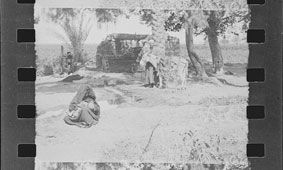
In March of this year, someone spotted a small can of film in an antique shop window. It had the words ‘Collection ELGE’ on the can, indicating a Gaumont film (from the letters L.G. for Léon Gaumont). The discovery came to the attention of film historian Sabine Lenk, who in turn alerted Lobster Films of Paris, specialists in early film and inspired discoverers of the extraordinary. What lay within the antique shop, however, hinted at being their most exceptional discovery yet. There were ninety-three cans in the shop, the owner apologising that they were only negatives (!). They were Edison-perforation 35mm, some in ELGE cans, some in Lumière cans, with some shrinkage but little decomposition. And they appeared to date from 1897.

Films very rarely turn up these days from the 1890s, and when they do they tend to be in ones and twos. For ninety-three to emerge in one go is practically unprecedented. And there there was their subject matter. Handwritten titles on the opening frames indicated films taken in Nazareth and Bethlehem, and dramatised scenes of the life of Christ. Before a single film had been printed or viewed, it was clear that here was a truly major discovery.

Seven months on, and amazingly the collection was ready for exhibition at Pordenone. Inevitably enough, this being a collection of early, non-fiction films, the Verdi was less than full for this historic premiere. So there were folks who preferred their cappuccino to witnessing the most remarkable discovery of the festival, but more fool them. The rest of us heard an introduction from Serge Blomberg of Lobster, who said that the rolls of film bore number 1 to 203, with many missing. The films we were to see came from Palestine and Egypt. Other titles showing scenes in Turkey would be shown at a later date.

Bible lands frame

One of the ‘Bible Lands’ films discovered by Lobster Films, showing a funfair with swings, from http://www.cinetecadelfriuli.org/gcm

And so to the films. They were one-minute or so each in length, actualities of life in the Bible lands (as Lobster have labelled the films), very much in the Lumière style. Indeed, the films showed the sort of studied composition and coherent action encompassed within the frame and completed within the film’s duration that characterises Lumière productions. Some had two shots, some featured camera movement. They were all in superb condition. We saw camel drivers, a snake charmer (whose cobras tried to escape into nearby bushes and were hauled back, not best pleased), children dancing in front of the ruins at Luxor, street vendors in Cairo, an Arab street funeral procession, a funfair with swings pulled by ropes and a mini ‘big’ wheel, women drummers, men dancing, men and women making bricks, women preparing food, a panning shot of the Kedron Valley, women sowing seeds on horse-drawn ‘carts’ (they looked like sleds) outside Nazareth, and many more such scenes. Perhaps most impressive were the two or three films showing the shadouf being operated, the human-powered (usually child-powered) irrigation system with a bucket and a counterweighted arm. These were scenes that had gone on from centuries, millennia even, and here was the motion picture capturing them – in 1897 (or thereabouts), when in truth they could have been scenes from any time.

Following the actualities, we had the dramatic films. There were scenes from two lives of Christ – or at least, filmed in different locations. The first was clearly filmed in Palestine, presumably in Nazareth and Bethlehem themselves. These were brief scenes from the birth and childhood of Christ, extraordinarily featuring an Arab (Christianised?) Joseph and Mary. The Adoration of the Shepherds and then the Magi (not much difference between the two) took place by some steps, with a rough authenticity unlike any Nativity film you ever saw. Mary wore a large white shawl that covered much of her face. We saw further scenes with this couple, Mary on a donkey, the rest on the flight to Egypt, Mary breastfeeding her child, the toddler Jesus’s first steps (not a scene I remember from the Bible).

And then the backgrounds changed. The scenery became wooded, without buildings, and Mary, Joseph and Jesus (a young girl) were now played by white performers, with attitudes and iconography far closer to the conventional. These scenes appear to have been filmed in France, but they continued to surprise. We had an Annunciation scene with an angel Gabriel suddenly appearing (a trick effect unlikely to be as early as 1897), Joseph working at his carpentry, someone dropping a pot which the child Jesus then magically mended, Joseph rowing Mary and Jesus across a river, young girls dressed as angels joining Mary and Jesus. Most astonishing was the film where the child Jesus carried a cross, placed it upon the ground, and then lay down upon it. There is some precedent for this sort of intimation of the future on the part of the child Jesus in the Western art tradition, but it was still a mind-boggling feat of the imagination.

Bible lands frame

One of the ‘Bible Lands’ films discovered by Lobster Films, from http://www.cinetecadelfriuli.org/gcm

So who made these films, and who saw them? Although there is not certain evidence as yet, the most likely candidate is Albert Kirchner, also known as Léar. Kirchner was a French photographer and likely producer of risqué postcards, who is first recorded as having made a striptease film, Le Coucher de la Marie, with Eugène Pirou in 1896. Unblushingly moving from pornography to religion, Kirchner teamed up with a Catholic priest and educationalist, Father Bazile, to make short comedy films. In Spring 1897 he set off with one Father Bailly to film in Egypt and Palestine, returning to France to film a twelve-scene Life of Christ with Michel Coissac (a future film historian who wrote about this episode). This was the first-ever Life of Christ to be filmed, and it enjoyed huge popularity – the Reverend Thomas Dixon, author of The Clansman on which D.W. Griffith’s The Birth of a Nation would be based, exhibited it in America in 1898 – and was much imitated. Kirchner’s films were bought up by Gaumont, and some can be found listed in Gaumont catalogues. He then disappears from the historical record, but he may have died soon afterwards.

There was much excited discussion among the early film enthusiasts after the screening (there aren’t many of us who get wildly enthused by 1890s films, but we’re a dedicated breed). It seems unlikely that all the films date from 1897, given some of the sophisticated techniques on view at times, and we may have seen films produced by different hands. And so many questions. Why the two lives of Christ? Were the ‘authentic’ scenes shown in France, rejected by audiences, and scenes more in keeping with Western taste shot in their place? Or were the two lives really one and meant to be shown together, despite the changes in performers and costumes? Were the actuality scenes meant to be integrated with the dramatised scenes? We know that the films – assuming they are Kirchner’s – were popular, but what exactly did audiences see? It is only a few months since this extraordinary collection was discovered, and there is still a huge amount to be discovered. What is certain is that a gap in the history books needs to be filled, and we have a collection of views of life in Palestine and Egypt at the end of the nineteenth century which will not only excite the historians but enrich generations to come.

[Update (October 2008: The films are now known to have been made by the Abbés Mulsant and Chevalier in 1904. See Back to the Bible Lands post]

There were other films in the day, which I’ll touch on briefly. Two delightful Starewitch animations, Les Grenouilles Qui Demandent Un Roi (1922) caught the stern spirit of Aesop and La Fontaine very well, with fine comic glosses on the tale of the frogs who ask an exasperated God for a new king, eventually getting a stork which eats them all. La Voix du Rossignol (1923) was charming in its meticulously observed depiction of bird life. Der Kampf der Tertia (1929) was a German’s children’s feature film, directed by Max Mack and with beautfilly composed coastal scenes, about a group of schoolchildren who prevent a cull of cats in a neighbouring town being organised by Max Schreck (of Nosferatu fame). Happy, inconsequential stuff, though you couldn’t help but wonder what would be the fate of those bright-eyed youngsters ten years thence. All at Sea (1933), shown in the evening, was a home movie shot by Alistair Cooke (the future broadcaster) of a yachting trip he spent with Charlie Chaplin and an impossibly beautiful Paulette Goddard. Chaplin is seen impersonating Jean Harlow, Greta Garbo and the Prince of Wales (rather good), as well as going through a Napoleon routine. We also saw unpleasant details of a shark being caught, and the usual dull shots of ships in the distance which invariably fail enliven the home movies of rich or humble.

Pordenone

Pordenone

And so farewell to Pordenone for 2007. I left on the Thursday morning, and so missed the last three days, including the Corrick Collection of early films recently discovered in Australia, my favourite René Clair film, Un Chapeau de Paille d’Italie (An Italian Straw Hat) (1927), and the late D.W. Griffith film that I most admire, Isn’t Life Wonderful (1924). Ah well. If you want to find out more about the films on show at this year’s Giornate, the full catalogue is downloadable as a PDF (2.9MB), with marvellous detail, expertly edited as always by Cathy Surowiec. If you were at Pordenone and saw the films I saw and would like to make comments – or if you saw films I didn’t see and would like to tell us about them – please do so. And if you’ve never been to the Pordenone Silent Film Festival and these posts have made you think that perhaps you ought to one day – well, you’re right.

Pordenone diary – day two

You could always go to the Pordenone Silent Film Festival, not see any films at all, and still have a marvellous and rewarding time. Some, it would appear, do just that. The weather is gorgeous, the restaurants inviting, every street is strewn with the chairs of pavement cafés, and much negotiating over the higher and lower politics of film archives goes on. It is the place where alliances are made, projects are hatched, and deals are done.

The Bioscope, however, rose with the lark (should they have such in Italy) on day two and headed for the Verdi. At Pordenone, screenings start at 9.00am in the main cinema and run til around 1.00pm, then resume 2.30pm, stop again around 6.00pm, then after supper it’s back for the final long haul from 8.30pm to midnight or so. There’s a second, smaller theatre, used for repeat showings and video screenings, the Ridotto. Had you seen everything at the Verdi on the Sunday, you would have seen seventeen titles. Many come with intertitles other than English, so earphone translation is provided. I have a stubborn belief that if a film is well-made enough, not knowing the language of the titles is not a problem – the pictures alone will suffice. This doesn’t entirely work, but I shunned the headphones, and just about got by.

First up was a selection of American shorts on social interest themes from the forthcoming Treasures from the American Film Archives III DVD. Regrettably, I missed The Black Hand (1906), the first Mafia-themed film and The Cost of Carelessness (1913), an educational film with a scene of children watching an educational film (OK, not everyone’s idea of a thrill, but I’d have been intrigued to see it). So, we kicked off with The Hazards of Helen: Episode 13 – The Escape on the Fast Frieght (1915). Not an obvious choice for a selection of films on social themes, but it was argued that Helen’s (Helen Holmes) position as a railroad telegraph operator assumed by her co-workers to be too feeble to do anything made an interesting social comment on the many women office workers of the time. Because, of course, Helen heroically fought villains across the top of the carriages of a speeding train, before returning to her job where no one was any the wiser about her. It’s not always realised that many of the early serials were not cliff-hangers, but rounded off the story neatly at the end of each episode, before resuming much the same narrative with the succeeding episode. Bud’s Recruit (1918) was a two-reel recruiting drama, where a group of neighbourhood kids form themselves into a ramshackle troop, led by all-American Bud, but it is his effete, bespectacled elder brother who by accident ends up joining the army – and of course discovering that it has made him into a true man. So a bit resistible in theme, but well-made – the director was King Vidor. Lastly in this set there was Labor’s Reward (1925), the one surviving reel of five from a dramatised history of unionism produced by the American Federation of Labor. It put particular emphasis on the exploitation of women workers, and begged audiences to buy only from shops which advertised union-made products. Quite fascinating, and a highly-polished production too.

The Cameraman's Revenge

The Cameraman’s Revenge, from Wikipedia

Pause for breath, then down go the lights for the first of the Ladislaw Starewitch strand. The reason for this seemes to have been a fine touring exhibition of artefacts and photographs of Starewitch’s work which was on display, but the films themselves were a mish-mash of old restorations. We saw Mest’ Kinematograficheskogo Operatora (The Cameraman’s Revenge) (1911), Prekrasaia Lukanida (The Beautiful Lucanid) (1910) and Rozhdestvo Obitatelei (The Insects’ Christmas) (1911), all products of Starewitch’s mindboggling idea to make stop-frame animation films using models of grasshoppers, stag beetles and such like. The Insects’ Christmas was a special delight, Santa Claus climbing down off a Christmas Tree to wake some insects out of hibernation and to treat them to their own festivities.

Pordenone Film Fair

Pordenone Film Fair

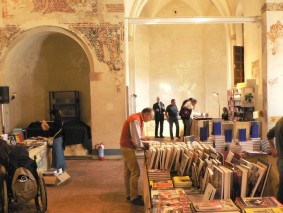
I missed the German film Rivalen (1923) as I had to go to my own crucial pavement café negotiation (the fruits of which you’ll have to wait until January 2009 to see), then to the Pordenone book fair, a fascinating mix of sturdy academic volumes on improbable themes in a multiplicity of languages, and posters, photographs and tattered memorablia for the cinema of the childhood of many of the older festival goers – but such is Pordenone.

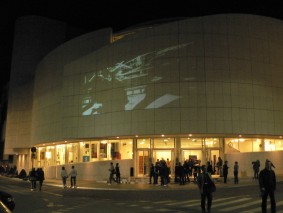
The afternoon kicked off with Entr’acte (1924), first off in the René Clair retrospective, with musical accompaniment of Erik Satie’s score by two pianists, Barbara Rizzi and Antonio Nimis. What more is there to say about one of the great jeu d’esprit of avant garde cinema, originally a filmed interlude shown between the two acts of the Dadaist Francis Picabia’s notorious ballet Relâche? The central action is a funeral procession, with the mourners initially lollopping along behind in mock-serious manner, before having to speed up to a manic rush as the hearse (pulled by a camel, naturally) gets faster and faster. A promo-reel for the festival was projected on the outside of the Verdi at night, which included this magical sequence, like so:

Teatro Verdi at night

Teatro Verdi at night, showing promotional video with scene from L’Entr’acte

Another strand was The Other Weimar. This initially puzzling title introduced the German cinema of the 1920s that we seldom see. Thanks to the studies of Kracauer and Eisner, much of the studies of German cinema at this time has focussed on Expressionism and the fevered productions whose themes seemed to anticipate the nightmares of Nazism. This strand showed the work of the directors who did not get round to making Caligari or Metropolis – those who tended to make the films that people actually went to see.

Wege Zu Kraft und Schönheit (The Way to Strength and Beauty) (1924-25) was a surprise inclusion, being a health, dance and sports documentary, albeit a popular one at the time – probably on account of its liberal displays of nudity. It was an example of the Ufa studio’s documentaries, or Kulturfilme, and most entertainingly had the festival-goers squirming in their seats as its theme of the need for us to get up off our backsides and start walking seemed all too relevant. Though it was a bit long and repetitive, it was made with mocking wit and some style, with plenty to fascinate fans of dance (including Mary Wigman and Tamara Karsavina) and sport (Babe Ruth, Helen Wills, Charley Paddock). And the keen-eyed would have spotted Leni Riefenstahl in her first film, no doubt picking up ideas for Olympia twelve years away, as a maid in a Roman bath sequence.

I cannot now remember what crucial meeting it can have been that led me to miss Fatty Arbuckle in The Cook (1918) and Max Davidson in the immortal Pass the Gravy (1928), but I hope it was really important.

In the evening, Jean Vigo’s A Propos de Nice (1930). We had been promised Michael Nyman playing his own piano score, but he was unwell, and was replaced by one of the Pordenone regulars, John Sweeney – who was magnificent. The films at Pordenone are accompanied by a small team of pianists, generally hidden from view beneath the stage, with a monitor showing them the action and headphones translating the titles. This year we had Neil Brand, Gabriel Thibaudeau, Günther Buchwald, John Sweeney, Stephen Horne, Donald Sosin, Phil Carli and Antonio Coppola. High praise to them all. A Propos de Nice is surprisingly amateurish in places (they didn’t know much about focus), but its cumulative vision of the human madness on display in Nice confirmed its greatness.

To mark the fiftieth anniversary of the Hungarian Film Archive, the evening’s feature film was Csak Egy Kislány Van a Világon (Only One Girl in the World) (1930), the first Hungarian sound film, though most of it was silent with sonorised score. This was the tale of two war veterans who love the same woman. She falls for the livelier, he falls for another woman when he travels to the city, his friend brings them together again, culminating in a sentimental rendition of the title song. It was a simple yet curiously appealing piece with the quality of a folk tale and a structure in movements that seemed to cry out for its expression as a nineteenth-century symphony. The heroine was played by the 18-year-old Márta Eggerth, now aged ninety-five, who remakably was not able to be at the screening because she is still working (as a teacher of singing). But David Robinson, the festival director, called her on the phone afterwards, and we were treated to the extraordinary experience of listening to this lively woman who sounded as spirited and lively as she had been in 1930, while she experienced the oddness of having her telephone conversation warmly applauded by an invisible audience.

And so to bed.

The Open Road

The Open Road

http://filmstore.bfi.org.uk

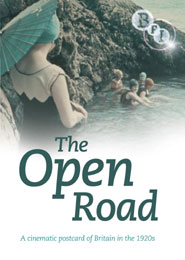
The BFI has just released its latest silent DVD, The Open Road. This is the colour footage of a road trip from Land’s End to John O’Groats filmed by Claude Friese-Greene 1924-25, which formed the basis of the 2006 BBC2 series, The Lost World of Friese-Greene, already released on DVD. The series was an attempt to emulate the success of The Lost World of Mitchell and Kenyon, with the same presenter, Dan Cruikshank, but without any of the social history or the great sense of revelation.

This BFI release presents the footage sans Cruikshank in what it calls a “special compilation of highlights”, which presumably means the extant footage from Friese-Greene’s footage minus the boring, repetitive bits, where he tests out the colour system and films rather too many rose bushes.

Claude Friese-Greene was the son of William Friese-Greene, the not-quite British film pioneer whose efforts to create motion pictures in the early 1890s were romantically but misleadingly portrayed in the film The Magic Box. Having failed to invent motion pictures, Friese-Greene tried to invent motion picture colour instead. It’s a convulted story that I’ll be telling you some other time, but essentially his experiments with a two-colour process (alternate frames stained red and green) were taken up by his son Claude, who improved the system signficantly and launched it as a 26-part travelogue in 1925. It made little impact at the time (the whole series was probably never released), and has been absent from practically all histories of colour cinematography. But restoration work by the BFI National Archive has demonstrated that, with a little bit of help from modern printing methods and digital technology, the results are really quite beautiful, and give a sweetly nostalgic view of Britain in the 1920s.

The 64mins DVD comes with a score by pianist Neil Brand and violinist Gunther Buchwald. It’s very interesting to see how the BFI is both getting documentaries made out of previously little-known archive film, and then following up with DVD releases of the original footage. It’s worked well with Mitchell and Kenyon, and I hope it works for them again.

Read here on the BFI’s site about The Open Road and the history of its restoration (which involved much re-editing of hat was originally very jumbled material.

Read this account of the Friese-Greene Colour process on the BBC History site.

Or read the shotlist of the pre-edited Friese-Greene footage (all 11,821 feet of it) in the BFI National Archive, diligently done by someone, somewhere, a long long time ago…