The balancing bluebottle

bluebottle

The Balancing Bluebottle (1908)

A delightful programme was broadcast today on BBC Radio 4, The Balancing Bluebottle. It’s a 30-minute documentary on the life and work of Percy Smith, pioneering naturalist filmmaker. It’s presented by Tim Boon, curator at the Science Museum, whose recent book Films of Fact is a history of science documentary on film and television.

Normally I would pen you a paragraph or three on Smith’s career, but it’s been a long week (it’s been a long month) and I’m going to take a short cut by giving you this section from my Charles Urban site:

F. Percy Smith (1880-1945) was a modest but brilliant pioneer of scientific filmmaking. He was a clerk with the Board of Education whose hobby was photographing nature, notably magnified pictures of insects. One of these, a photograph of a bluebottle’s tongue, came to Urban’s attention, and in 1907 he invited Smith to do similar work with a motion picture camera. Failing to persuade his employers of the value of film as an educational tool, Smith joined Urban full-time in 1910. Smith’s films soon gained considerable attention, notably The Balancing Bluebottle and The Birth of a Flower, showing plant growth through stop-motion cinematography in Kinemacolor. Smith’s films were made at his Southgate home and involved meticulous preparation over many months. When war broke out in 1914 he made a series of animated war maps for Urban’s Kineto company before becoming a photographer with the Navy. After the war he did a little more work for Urban before he found greater fame with the Secrets of Nature series of nature films, made for British Instructional Films, which gained wide acclaim and were popular for two decades. He is one of the great names in scientific filmmaking.

Smith’s films entrance and instruct to this day. The Balancing Bluebottle itself featured bluebottles performing seemingly extraordinary feats of strength. Tied down with silk (and released unharmed afterwards) the bluebottles juggle a cork, a ball and a stick. The film caused a sensation at the time and can still leave an audience open-mouthed today.

  • A 1910 re-edited and reissued version of the film, under the title The Acrobatic Fly, is available on YouTube, courtesy of the BFI
  • A further retitled and reissued version from 1911, under the title The Strength and Agility of Insects, is available on WildFilmHistory
  • Smith’s 1910 film The Birth of a Flower is available to view at WildFilmHistory

The programme features Sir David Attenborough, Bryony Dixon from the BFI, Jenny Hammerton from AP Archive, and (recorded in a windy side alley off Leicester Square), one Luke McKernan. It’s available for the next seven days on BBC iPlayer, and is warmly recommended for its charm and insight.

Ghosts

ghosts

Every film is an archive. The actuality to which it is witness is embedded in every frame. All we need is are the eyes to see it and the intelligence to express it. A model example that will hopefully become an inspiration to others is Alastair H. Fraser, Andrew Robertshaw and Steve Roberts’ Ghosts on the Somme, an archaeological study of the 1916 documentary The Battle of the Somme. It is as revelatory a piece of film scholarship as you are likely to find, and this has been achieved by the simple expedient of experts from another field examining the film with the same methodological principles as they would apply to any other historial artefact.

The story behind The Battle of the Somme was covered by a recent post on The Bioscope, coinciding with its release on DVD in a digital restoration by the Imperial War Museum with both original score and new orchestral score from Laura Rossi. In short, it is a feature-length documentary recording the build up to the opening day (1 July 1916) of the Battle of the Somme, the day itself, and its immediate aftermath (all from the British perspective).It was produced by the British Topical Committee for War Films, a film trade body working at the behest of the War Office. The two cameramen were Geoffrey Malins and J.B. McDowell.

Most histories which discuss the film have chiefly considered its production and reception. The authors of Ghosts on the Somme, all military historians, have instead viewed the film itself as a piece of hisorical evidence, examining it frame by frame (in some cases literally so) to determine precisely what it shows. There has long been controversy over the authenticity of parts of The Battle of the Somme. One of the book’s major accomplishments is to confirm that the greater part of the film is quite genuine – indeed, that some scenes previously believed to be faked, or rather shot away from the front line, are not so.

In analysing the film, the authors considered seven major elements of evidence:

  • The film itself, and not just for its photographic evidence – a lip reader helped identify some conversations;
  • The Imperial War Museum’s collection of stills, many of them taken by Ernest ‘Baby’ Brooks, who worked alongside Malins (though the captions are frequently inaccurate);
  • Malins’ autobiographical book How I Filmed the War, a somewhat boastful account whose evidence needs treating with care;
  • A ‘tie-in’ book, Sir Douglas Haig’s Great Push:The Battle of the Somme (1916/17) which has photographs taken from the original film, including sequences which no longer exist;
  • The ‘dope sheet’, compiled between 1918 and 1922, a record of each of the shots from the film in caption order – now known to be highly inaccurate;
  • Assorted war diaries for the identification of men and units, plus other original documents in The National Archives;
  • The present-day landscape of the Somme battlefield.

The result is extraordinary. The authors identify not only locations, units and dates, but people. The grey figures whose faces point at the camera as they march cheerily to war and return shaken are, in a few, precious cases, given names, ages, a past history and – for some of those who survived – a subsequent history. There is such power in being able to put a name to a face. Previously, perhaps we have been guilty at times of sentimentalizing the film when we see those ghostly faces; this book humanizes it.

somme5

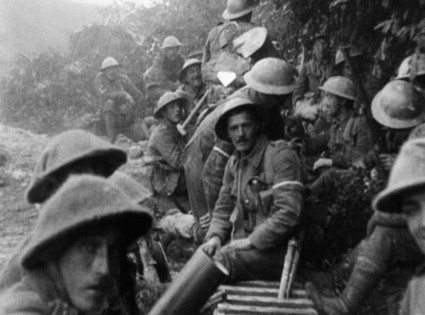
Men of B Company, 1 Lancashire Fusiliers, in a sunken lane in front of Beaumont Hamel, filmed by Geoffrey Malins, 1 July 1916 (frame grab from DVD)

This is a book chiefly for the military history enthusiast. The film historian will welcome the attention paid to the practicalities of the film’s production (there is a chapter on the cameras used and the limitations of orthochromatic film stock, which was not sensitive to the full spectrum, though more could have been said about lenses), while expressing surprise that the book refrains from saying anything about the film’s history once it had been released to an astonished British public (more than half the population saw it). It is pedantic in its dogged desire to identify and list every place, every unit, leaving no scene of the film unturned – a tabulation at the end of the book lists each shot (extant and lost) in order, with timing, date, camera operator, location, subject, date and caption. It is not a history for those who crave narrative.

So it may not find a place on any film studies shelf, but for the factual historian, it opens up a medium for study. As Roger Smither, Keeper of the Film and Photograph Archives at the IWM, says in his foreword, “Ghosts on the Somme sets a new standard for the examination of archive documentary film”. The convention has always been to distrust the record the actuality film provides, to emphasise film’s propensity for lying. Ghosts on the Somme shows that, ultimately, film records reality, and that we can uncover that reality, if we have eyes to see. Perhaps it really should be on a few film studies shelves.

Moving Pictures: How They are Made and Worked

edison_studio

Edison studio with battery of lights and electrically-driven camera, from Moving Pictures: How They are Made and Worked

There has been a rush of newly-available e-books on the Internet Archive following expansion of digitisation activity on Google Books, and we’ll be pointing out some of the key titles in coming weeks and placing them in the Bioscope Library. First up is one of the classic early texts on film, a reference work still cited today, F.A. Talbot’s Moving Pictures: How They are Made and Worked.

Frederick A. Talbot was a British writer of popular works on science and engineering subjects, but had a special interest in motion pictures, producing both Moving Pictures (1912) and Practical Cinematography and its Applications (previously written about here) in 1913. Moving Pictures: How They are Made and Worked was originally published in Britain in 1912, in a revised edition in America in Britain in 1914, and a second, completely re-written edition in 1923. The copy in the Internet Archive is the 1914 revision, though it seems to be largely the same as the 1912 original.

Talbot’s task was to explain the phenomenon of the new age. “A vast industry has been established”, he writes, “of which the great majority of picture-palace patrons have no idea, and he moment appears timely to describe the many branches of the art”. Talbot’s focus is on technology and industry, rather than art or entertainment, and his chief interest is in the motion picture as a medium of discovery. But unlike the many dry works from this period which explain the mechanics of motion picture production and exhibition for the benefit of the technician, Talbot’s book bubbles over with enthusiasm. Some of his judgements need to be challenged, but his keen eye and thorough research (including contact with many of the leading figures in the industry) have kept the book fresh and valuable to this day. It is easy to read, and a easy source for good quotations.

He begins by explaining how we are able to see “animated photography”, and it is this section that has probably had the most influence, as Talbot’s somewhat muddled explanation of the “persistence of vision” has been taken as lightly read by many writers. We now know that the persistence of vision is not the reason why we are able to perceive motion (whether motion pictures or any other kind of motion, which is the real matter in hand – see an earlier post on this for an attempt at an explanation). Michael Chanan’s The Dream that Kicks is recommended for its sympathetic analysis of what Talbot got wrong yet how he struggled for the right answer at a time when science (optics etc.) had not properly supplied the information needed.

automobile

Talbot find more solid ground when he traces the history of the medium, through experiments in sequence photography of Marey and Muybridge, the discovery of celluloid, the construction of the Edison Kinetoscope and other machines, before moving on to perforations, celluloid manufacture, the taking, developing and printing of films, and their exhibition. He covers the staging of fiction films, though his interest is more in the mechanics than the aesthetics, while his real passion is revealed to be the trick film. Talbot devotes a remarkable six chapters to the trick film, revealing an almost childish enthusiasm for the simple transposition, substitution and distortion effects which characterised early trick films (and which were mostly well out-of-date by the time he wrote the book). The photograph comes from The Automobile Accident (man is driven over by a car, severing his legs, which are then repaired by a passing doctor) which he illustrates and explains in minute detail.

Talbot’s other great enthusiasm is for the motion picture as a medium of education and science. There is some fascinating, well-observed material on microcinematography, electric cinematography and chronophotography, with information (and fine illustrations) gleaned from experimenters such as Percy Smith, Jean Comandon, E.J. Marey and Lucien Bull. Finally, Talbot speculates most interestingly on the possibility of the motion picture as a news medium (“the animated newspaper”, or newsreel, was in its infancy), films in colour (he is an observant Kinemacolor sceptic) and motion pictures in the home.

Though care needs to be taken over some of the evidence and its presentation, Moving Pictures: How They are Made and Worked still stands up as a fine illustration of what possibilities lay before a young medium whose rules had not yet been firmly established. In the 1923 edition Talbot expresses some disappointment that progress in the fields of education and science “has been less spectacular than in that devoted to pure entertainment”. In 1912 motion pictures might yet do anything.

Moving Pictures is available from the Internet Archive in Flip Book (25MB), PDF (6.9MB), full text (702KB) and DjVu (8MB) formats). Note that the PDF link takes you to a Google page which seem only to have sections of the book available – the full PDF version can be found by clicking on the Internet Archive’s “All files: http” link.

The dead

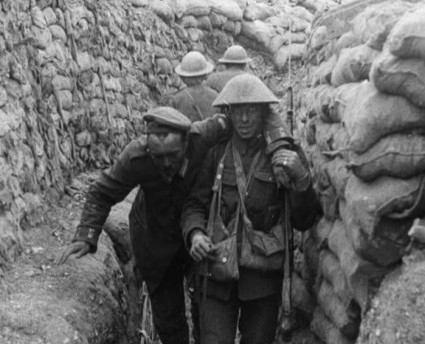
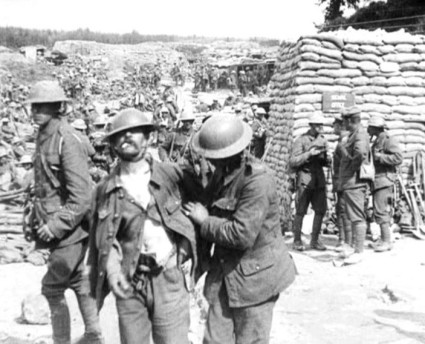
All images in this post are frame grabs from the DVD of The Battle of the Somme (1916)

Is it right to let us see men dying? Yes. Is it a sacrilege? No. If our spirit be purged of curiosity and purified with awe the sight is hallowed. There is no sacrilege if we are fit for the seeing … I say it is regenerative and resurrective for us to see war stripped bare. Heaven knows that we need the supreme katharsis, the ultimate cleansing. We grow indifferent too quickly … These are dreadful sights but their dreadfulness is as wholesome as Tolstoy’s ‘War and Peace’. It shakes the kaleidoscope of war into human reality … I say that these pictures are good for us.

Those words were written by James Douglas in The Star (25 September 1916, p. 2). He was reacting to a screening of the film The Battle of the Somme, a film whose impact upon audiences was unprecedented and – it could be argued – has never been repeated. Douglas, like many commentators, was trying to rationalise what he saw, to express the meaning and to find justification for a film whose stark images of the war that was still raging shocked audiences into a realisation of sacrifice and death. It was the images of death in the film that so disturbed many. If soldiers were not shown being killed (and some apparently were), then every face that stared at the camera was likewise facing death. The audience had been made witness to this, complicit in the soldiers’ fate.

While some called for the film not to be shown, for most it was justified, to the point of becoming almost a moral obligation. Through watching The Battle of the Somme, they gained a sense of the enormity of what troops in their name were undergoing, what the sacrifice (the optimum word) was that army and nation were making. Douglas’ evocation of religious feeling put the film in terms that many would understand. It is not a pure reaction to the film itself – that is not possible. Instead he saw the film through his own thoughts on the meaning of war. Any image, any film, is identified by us through expectations and understandings that are informed by time, place and culture. The Battle of the Somme in 1916 was a different film to The Battle of the Somme in 2008.

This we can now judge through the release of the film for the first time on DVD, produced by the Imperial War Museum, whose archive preserves the film. Alert to the complexities of authenticity, the IWM presents the film in a form that encourages us to question how we see what we see. Firstly, the film (for which no original negative survives) has undergone a digital restoration which has brought out details which were hitherto obscured. Even for those familiar with the film (and all of us must be familiar with it to some extent, given the widespread use of sequences from the film in television documentaries etc.), it is like seeing the film anew. But the major coup is the music. We are given two music tracks. One is a modern score by Laura Rossi, a symphonic work for full orchestra. The other is a recreation by Stephen Horne of a likely original score, taken from a contemporary cue sheet which suggested the sort of musical passages musicians might want to adopt in accompanying the film in 1916.

The latter will amaze many. Jaunty marches and popular airs accompany scenes of troops marching to the killing fields of the Somme, the scenes of battle and their aftermath. What were they thinking of in 1916? It is a complicated question to answer. Partly the musicians of the time were responding to what might have seemed just another war actuality film, which required patriotic accompaniment. But also the audience of the time saw heroism and uplift where we, after almost a century of awful contemplation of the futility of that war, bolstered by poems, novels and films, see something profoundly pitiable. It is with consciousness of such modern expectations, but equally with a sense of being true to the film’s original vision, that Rossi supplies a rich, subtle and binding score that connects 2008 to 1916. Which of these two very different scores will you prefer to listen to, and why? Or might your preferred option be to witness the film in silence?

The digital restoration, which allows us to see so much, is perhaps most striking when it comes to the famous ‘over the top’ sequence. This is the part of the film that will be most familiar. It is shown on television (at least in the UK) every time a shot is needed to evoke the First World War. Troops clamber over the top of a slope, then march slowly over barbed wire away from the camera, a couple of men falling down as they do so, shot dead.

Oh God, they’re dead!

a woman is reported to have exclaimed in a cinema showing the film, and it was this sequence that aroused the greatest comment at the time, the greatest need to explain the film’s significance. But they were not dead. As is now known, the sequence is a fake, set up in a trench mortar battery school some time afterwards, simply because the actual scenes taken of troops going over the top were deemed disappointing. At the time, no one knew of this subterfuge, and as far as reception is concerned, it did not matter. People believed they were witnessing death on screen; and producers and exhibitors felt this to be an acceptable thing to show. Which you may think is extraordinary.

What seldom gets shown on television is the shot that immediately follows the ‘over the top’ sequence in the film. This shows genuine footage of troops going over the top. But we see them only in the far distance. The cameramen (there were just two, J.B. McDowell and Geoffrey Malins, who shot both ‘over the top’ sequences) were greatly restricted in what they could shoot. Their hand-cranked cameras had single 50mm lenses with poor depth of field, they had no telephoto lenses, the orthochromatic film stock was slow, making filming action in the distance or in poor light difficult. But there was also military control and official censorship, each preventing them from filming anything other than officially-sanctioned images. And there was the danger. The most obvious indication of the ‘fake’ nature of the first sequence is that the cameraman would have been in absolute peril of his life had it been genuine. But for the above shot, Malins is a long way off, and far in the distance we can just pick out tiny figures on the horizon – British troops, coming over the top and marching into no-man’s land. Looking closer into the middle ground, the digital restoration now reveals to us a sight not previously detected in the film: a number of troops proceeding leftwards, one or two of whom fall down. Oh God, they’re dead.

Do we want to look that closely? Can they really seem dead when viewed at such a distance? Is the death we seek not in the falling bodies, or even in the corpses seen later in the film, but rather in the eyes of the still living, whose fate awaits them, and who are all dead now of course. That was a line the film historian Denis Gifford would sometimes come out with when we were in the basement theatre at the British Film Institute, watching some collection of British silent shorts. The figures would parade to and fro, some of whom he knew, having interviewed them in the 1960s, but then that sad moment of realisation:

They’re all dead now, of course.

This is a poignancy that seems particularly linked to the non-fiction film. Dramatic films, of whatever age, are attempting to entertain. Either they do or they don’t. But the film of actuality trades on the depiction of life, and then the distance created by time. This was recognised even in 1916. Sir Henry Newbolt wrote a poem inspired by the experience of watching the film, entitled ‘The War Films’, but made memorable by its opening line:

O living pictures of the dead,
O songs without a sound,
O fellowship whose phantom tread
Hallows a phantom ground —
How in a gleam have these revealed
The faith we had not found.

The Battle of the Somme captures the point of loss, the ghosts on the screen, the living pictures of the dead. Of course it is a deeply partial record. It shows no real fighting beyond shellfire, no serious injuries, no pain, little hatred (look for the shove that one British soldier gives to a captured German who stumbles past him). And of course it shows only the Allied point of view (the Germans would respond with their own film, Bei unseren Helden an der Somme, in 1917). But we recognise it for what it is able to show, not for what it leaves out. It is a profoundly memorably expression of the hopes and fears of its age.

The Battle of the Somme was filmed by Malins and McDowell, two experienced newsreel cameramen, who knew well how to capture plain packages of actuality. McDowell was the senior of the two, who ran his own film company (British & Colonial). Malins had been filming on the war front for longer, and is the better known, not least for his somewhat vainglorious memoir, How I Filmed the War (available from The Internet Archive). Malins co-edited the film with Charles Urban, to whom credit should be given for seeing that the footage Malins and McDowell has shot would work best at feature length, rather than as a series of ten-minute shorts which had been the practice up til then. His vision gave the film the presence it needed to capture the audience that it found. The producer was William Jury, and the film was made for the British Topical Committee for War Films, a trade body working under War Office sanction, which would be replaced by the War Office Cinematograph Committee once the film started to enjoy huge success. It has been estimated that it was seen by 20,000,000 people in the UK in six weeks – almost half the population.

The DVD comes with the alternative music scores, commentaries, interviews with archivists and musicians, and five ‘missing’ scenes and fragments. We do not know what the original The Battle of the Somme was like exactly; the version that survives was re-edited, and the footage used in multiple other films, during and after the war. Rather than insert these extra scenes where it is not quite certain they should go, the IWM has chosen to present these (without music) separately. There is a booklet as well, with information on the film’s production, reception, restoration and particularly its music. A website, www.iwm.org.uk/somme-film, will provide viewing notes, additional information, suggestions for further reading and teaching resources. It is a magnificent achievement, one whose influence on research, teaching and the appreciation of First World War history is likely to be considerable. The only possible disappointment is the menu, which simply divides the film into its five parts, where a more detailed use of chapters could have helpfully guided researchers to particular points of action, regiments, location etc.

More will follow. The booklet notes the publication next year of Alastair H. Fraser, Andrew Robertshaw, and Steve Roberts’ Ghosts on the Somme, a book which analyses the film in great detail, overturning some of the traditional understanding of who filmed what, which regiments are shown, and which locations are featured, while confirming that the vast majority of the film is genuine actuality. There is still more to be discovered about The Battle of the Somme. It is a film we will have to return to, again and again.

The DVD is available from the Imperial War Museum Shop (Region 0, PAL, duration 74 mins with 58 mins extras).

A CD of Laura Rossi’s score is available from Virtuosa Records.

On the weekend of 15/16 November 2008 there will be two screenings of the film at the IWM in London, the ‘original’ score on Saturday, the Rossi score (not played live) on the Sunday. Both screenings are free, and start at 14.00.

The Battle of the Somme has been recognised by UNESCO by being accepted for inscription on its Memory of the World register.

Pordenone diary 2008 – day seven

Alexander Shiryaev (1867-1941) is not a name that you will find in any film history. He was a member of the Russian Imperial Ballet at the Mariinsky Theatre, St Petersburg, a protégé of the great choreographer Marius Petipa, a character dancer of great skill (he was too small for the classic leading roles), and a gifted ballet teacher.

It was his teaching that seems to have led Shiryaev to film. Fascinated with human movement and the notation of ballet, Shiryaev began producing sequential drawings of dance steps that documented the minutiae of such movements, work that was inherently cinematic in construction. Shiryaev must have seen the connection, because in 1904 he applied to the theatre management to let him purchase a motion picture camera and film to record the dancers of the ballet. He was turned down – no films were allowed to be made of the dancers of the Imperial Ballet. Undaunted, Shiryaev purchased a camera anyway – a 17.5mm Biokam acquired in London, to be followed by an Ernemann Kino, also employing 17.5mm film. At some point he also had used of a 35mm camera.

Shiryaev took to filming as one who instinctively knew what the medium could do. He understood the camera as he understood dance. Between 1906 and 1909, Shiryaev produced an astonishing body of work – live records of dances, home movies, comedies, trick films, animations and puppet films. None of these was seen in public. They might have disappeared from history entirely, had they not first been narrowly saved from destruction in the 1960s by a friend of Shiryaev’s, Daniil Saveliev, and then discovered again in 1995 by filmmaker Victor Bocharov, who has been their custodian ever since. Bocharov produced a documentary on the collection in 2003, Zapazdavshaya Premiera (Belated Premiere), but the screenings at Pordenone were the true public premiere for the majority of these films, many of which came fresh from the specialist labs of PresTech in London.

The Shiryaev films were shown over a number of days, the programmes including A Belated Premiere and films related to his world, such as Anna Pavlova dancing. But the main programme came on Friday 10 October, and divided up his ouevre into four categories.

Dance films
These were films of Shiryaev and his dancer wife Natalia Matveeva dancing on a sunlit stage at their Ukraine home. As the only films of the Russian ballet greats at this time, they have plain historical value, but they are also a visual delight. The two dance singly or together in a selection of folk-based dances, performed with sparkling zest, and each ending delightfully with the dancer leaving the stage then returning for a bow. The most dazzling are those on 35mm, particularly Shiryaev’s party piece, ‘Fool’s Dance’ from Petipa’s Mlada.

Trick films
Shiryaev was evidently a film-goer himself, and decided to emulate some of the trick films common in the mid-1900s. All were again filmed at his summer home, in the open air. One film where a giant spider came down and settled on a sleeping man was clearly inspired by Georges Méliès’ Une nuit terrible. Another, given the title [Chairs], anticipated Norman McLaren’s Neighbours by some fifty years, with its stop-animation of humans seated on chairs and swapping positions.

Earlier in the week we had seen numerous fleeting home movies of Shiryaev and family (they are some of the earliest surviving home movies anywhere) and various staged comedies made by the family. The marvellous thing to behold was how the boundaries between home movies, comedies and then trick films blurred, all created in the same spirit of joyous performance. The family’s whole lives seemed to be some form of dance.

Paper films
For me, Shiryaev’s paper ‘films’ were his greatest achievement. Before he had a camera (or so it is assumed), he produced animations on paper (45mm wide) which have now been reconstituted on film. One such film with delicate line showed birds in flight, the observant results of which the festival catalogue rightly pointed out connected his quest for reconstituted movement with that of the chronophotographers Eadweard Muybridge and Etienne-Jules Marey. But finest I think was [Cakewalk], a trio of dancers in exquisite, gently swaying unison. Only a minute or so long, but I have never seen a finer piece of animation.

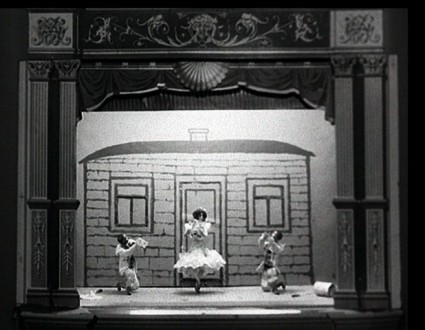
Shiryaev’s puppet animation P’ero-Khudozhniki (Artist Pierrots), from http://www.watershed.co.uk

Puppet films
For David Robinson, the festival’s director and a most enthusiastic advocate of Shiryaev’s work, the stop-frame puppet films he made were his greatest achievement. They were certainly the most astonishing. Years ahead of animation elsewhere in the world (and two or three years ahead of Starewitch), these films used puppet figures in a theatre set to recreate, in meticulous detail, actual ballet dancers. Some of the effects – such a water or paint being thrown, or balls being tossed in the air – were astonishingly accomplished, and simply the co-ordination of several puppets all dancing at the same time would have required prodigious patience and skill. One of the films indeed revealed the animator’s hands to the edge of the frame, moving manically into a mysterious blur.

The puppet films required some concentration on the part of the audience, particularly the 12-minute-long [Harlequin’s Jest], which was in five acts with long titles (supplied by Bocharov) explaining the action. What helped enormously was the music. We know that Shiryaev meant his films to be so accompanied, including the animations, but not what that music was. John Sweeney, one of the festival’s core band of pianists, took on the task of matching music (some from Petipa ballets, some his own) to the films, with Günter Buchwald joining him on violin for [Harlequin’s Jest]. The brilliant results were rightly given loud acclaim by the audience – the musical highlight of the festival.

We will certainly be hearing more about Alexander Shiryaev. The documentary A Belated Premiere gets its British premiere at the Watershed in Bristol on 19 November (nearby Aardman Animation has been involved in supporting the restoration of Shiryaev’s work), and with the restoration of the films as yet incomplete (some we saw only on DVD), it’s a certainty that there will be more on show at Pordenone.

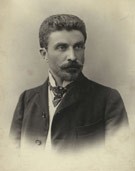
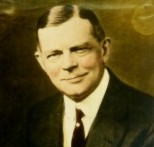
Friday was a day for superlatives. In the morning we had seen more of the Corrick collection of early films collected by a family of entertainers in 1900s Australia. Now, having written my thesis on Charles Urban (right), published a website about him, and taken my blog nom de plume from his company logo, it might be argued that I could be a little biased when it comes to praising his works, but – damn it all – Living London, made by the Charles Urban Trading Company, if it isn’t one of the greatest of all silent films, then it is undoubtedly the greatest film of 1904 [update: the film has now been identified as Urban’s The Streets of London (1906)]. The film is an eleven-minute section from an original forty-minute documentary (no other word will do) depicting London life. Moving approximately eastwards (from Westminster to the City, with a diversion along the Thames), the film shows the metropolis at its imperial zenith, vividly alive, with cameras picking out every detail, high and low (the trouble taken over camera positions was particularly noticeable) – traffic, roadworks, people dancing in the street, workers of every kind, buildings under construction, the river teeming with craft, even in one shot a row of men with sandwich boards advertising Urbanora film shows. The catalogue compared it to Vertov’s Man with a Movie Camera or Ruttmann’s Berlin: Symphony of a Great City, but this was a work of a different kind, a sort of missing link between the single-shot actualities of the early cinema period and the constructed documentary. I can think of few other films that can so thrill with a plain exposition of ‘reality’.

The Corrick collection yielded other gems. Particularly noteworthy were Bashful Mr Brown (1907), a chase comedy made by the Corrick’s themselves; Babylas vient d’hériter diune panthère (1911), pure surrealism from Alfred Machin as an inquisitive leopard is introduced into a bourgeois household; and The Miner’s Daughter (1907), an exercise in beautifully judged pathos from Britain’s James Williamson, in which the title character parts from her father when she marries an artist, and after much grief they are finally brought together by his granddaughter. And it’s a rare early film that combines a mine explosion with scenes inside the Royal Academy.

After the highs of Shiryaev we relaxed in front of Ihr Dunkler Punkt (1929), a typically professional vehicle for Germany’s favourite Briton, Lilian Harvey, who played two identical people, one an ordinary young woman about town, the other a jewel thief, whose lives and lovers get mixed up. A light but cleverly made concoction, in which I most liked the comic turn by the normally sombre Warwick Ward, another Briton who plied his trade in German films.

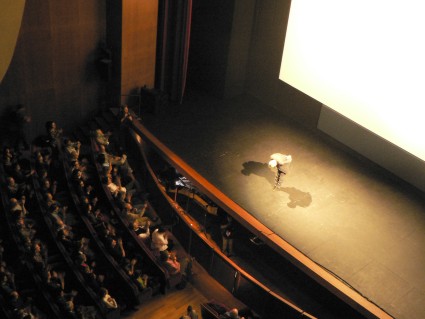
Michael Nyman takes his bow

I was tiring just a little of films by this stage, and chosen not to follow D.W. Griffith into the sound era with Abraham Lincoln (1930). Instead I concluded my Pordenone with the evening screenings of A Propos de Nice (1930) and Kino Pravda no. 21 (1925). A large crowd of Pordenone locals queued up for this, and the theatre was filled up to its third tier. How come? Because Michael Nyman was playing the piano, and Italians, it seems, love his music. Nyman had been due to play at the festival last year, but had to withdraw owing to illness, so did the honourable thing by turning up this year. Despite his star status, Nyman found himself in the pit the same as all the other musicians during the festival, with the result that no one saw him until he emerged for his bow at the end. A Propos de Nice came first, and Nyman’s complexly repetitive music provided the ideal match for Vigo’s cumulative montage of telling images. It was certainly quite different to anything else we heard during the week, a lesson in how we should always be encouraging different musical interpretations of silent films. Particularly striking were sequences with a single bass note pounded with a rapidity that seemed to be testing the piano’s stamina to the limit.

The Kino Pravda, a celebrated example of the series, on the death of Lenin, was less successful. The film itself, with its hectoring, fractured style, combining newsfilm with slogans and animation, probably defies most forms of musical accompaniment, and Nyman’s score churned out circular themes that didn’t much connect with the film. The score lacked the inspiration of A Propos de Nice, and the film ended a few bars before he did, so that he was being applauded while still trying to finish playing. Opinion afterwards was mixed, with some of the musicologists among the Giornate regulars in shock.

And that was it for me. I left early on the Saturday, the last day of the festival, and so missed Griffith’s final film The Struggle (1931) (touchingly paired with a re-showing of his first, The Adventures of Dollie) and the grand finale of Jacques Feyder’s Les Nouveaux Messieurs (1929). This was a fine festival. Few outstanding classics, but so much to interest, stimulate, challenge and excite the imagination. There were welcome innovations, such as the electronic subtitles, and encouraging signs of closer relations between town and festival. The Giornate del Cinema Muto never rests on its laurels, recognising the broad and knowledgable audience that it attracts, and that in a real way Pordenone is silent film today. It sets the agenda; it builds up the canon; it consistently reminds us of how various the silent film was (and continues to be – there were some examples of modern silent shorts, though none that I saw were terribly distinguished). Warm thanks to all who make the festival such a success year after year. We’re so lucky that it’s there.

‘Til next year.

Pordenone diary 2008 – day one
Pordenone diary 2008 – day two
Pordenone diary 2008 – day three
Pordenone diary 2008 – day four
Pordenone diary 2008 – day five
Pordenone diary 2008 – day six

London loves silents

Trafalgar Square screening, 2007

A reminder to anyone in London on 23 or 24 October of the free open-air evening screenings taking place in Trafalgar Square. On the 23rd, starting at 18.30, you can see the British science fiction silent High Treason (1929) – “the British Metropolis” – directed by Maurice Elvey and starring Basil Gill and Benita Hume, with live piano accompaniment by Neil Brand. A fun film to catch, showing a London where we were to be travelling about the city in helicopters, communicating by television, and wearing dodgy fashions. The accompanying short is Gaston Quiribet’s trick film vision of a future London, The Fugitive Futurist (1924).

On the 24th, also at 18.30, there’s a programme of fifteen archive films under the title ‘London Loves’. Among the silents in the programme are the bizarre The Smallest Car in the Largest City in the World (1913), a long-time favourite of those at the BFI National Archive, in which a miniature Cadillac drives sedately down London’s streets; news footage of Charlie Chaplin’s return to London in 1921, with esctatic greetings from the crowds; and an evocative travelogue, London’s Contrasts (1924). The star attraction, however, is going to be Living London (1904), Charles Urban’s truly dazzling documentary portrait of London life, a 10-minute epic only recently rediscovered by the National Film and Sound Archive of Australia and shown earlier this month at the Pordenone silent film festival. It returns to London after 104 years, and on the big screen, in that location, the impact should be tremendous. Among the sound films, look out especially for John Krish’s masterpiece of poignant regret, The Elephant Will Never Forget (1953), on the last trams in London – until they bring them back again, of course. Music will be provided by three musicians, names as yet unpublicised.

The screenings, organised by Film London and the London Film Festival, follow on from last year’s highly successful showing of Blackmail and a programme of archive shorts. It was a magical experience – not just seeing the films in such an extraordinary yet somehow rightful setting, but for the experience of audience watching. Some settled on the steps of the Square and took in every frame; some stopped by for a while to catch the experience before moving on; some paused briefly, on their way to catch a train, puzzled at what on earth was happening. Neil’s music pounded out, down the streets and over the rooftops, filling the evening air, drawing in people from all around to see what strange activity the capital was up to now. Film was bound up with the life of the city. An experience to savour.

Pordenone diary 2008 – day six

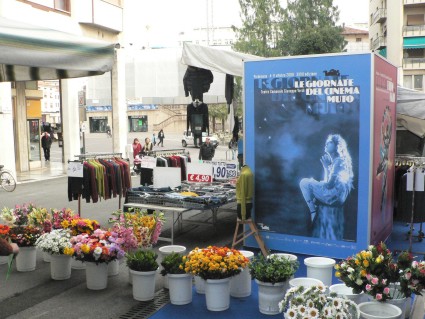
Market day in Pordenone

The 2008 Giornate del Cinema Muto was filled with many interesting and worthwhile titles across a wide range of what comprises silent film, but as day six dawned it felt like we had experienced little in the way of cast-iron classics. Plenty to intrigue and inform, few that would have made you want to rush out into the streets and drag in the nearest passer-by, telling them that they just had to see this. Sparrows (though it disappointed me) already enjoyed classic status; the Griffiths were a surprise, but they weren’t going to upset the pantheon; Ed’s Co-ed was very enjoyable, but it was an amateur college movie when you got down to it.
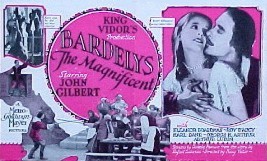
So it was on day six that we had the popular hit of the festival, and the first (but not the last) rediscovered classic of cast-iron certainty. The popular choice came at 9.00am, an odd slot for the silent film that had enjoyed the greatest publicity over the past year. It was only at the end of last year that it was announced that a print had been discovered of the long-lost Bardelys the Magnificent (1926), directed by King Vidor and staring John Gilbert, each fresh from their triumph with The Big Parade. Following some scepticism (a bogus announcement for the supposed rediscovery of Murnau’s The Four Devils occurred at about the same time), it transpired that a print had indeed been uncovered by the indefatigable Lobster Films of Paris. Just under a year later, it enjoyed its re-premiere at Pordenone, albeit in DigiBeta form. The tape copy may have been the reason for the less-than-prime-time slot, or it may have been a reflection of the disappointment reported by those few who had seen the film. Kevin Brownlow, in the festival catalogue, was less than enthusiastic, declaring:

It has a lush, gauzed look, but does not compare visually with Rosita or Dorothy Vernon, and the plot is so thin I found myself wondering why they made it at all.

All of which may be a warning not to judge films too much by how they appear on a monitor, without music or audience. On the big screen, slightly bothersome tape quality notwithstanding, with an audience out to enjoy itself and Neil Brand in commanding form on the piano, Bardelys the Magnificent was a triumph. It is an adaptation of a Rafael Sabatini novel, he of Scaramouche, The Sea Hawk and Captain Blood, set in seventeenth century France. Bardelys, played with rogueish aplomb by Gilbert, is a devil-may-care courtier notorious for his success with women. He takes on a bet that he can marry Roxalanne de Lavedan (Eleanor Boardman), daughter of a landowner believed to be inimical to the king. In a sequence of stills, representing the missing reel from the film, Bardelys comes across a dying rebel whose name he takes as a ruse to enable him to enter the castle, with plenty of attendant problems when he finds that he is now believed to be a notorious anti-royalist.

The centrepiece of the plot is Bardelys’ wooing of Roxalanne, which swiftly moves from challenge to real affection, leaving Bardelys and the film with the moral dilemma of how to negotiate the bet that underlies his actions. We won’t give the game away, as the film has yet to receive its American premiere and is going to be a treat for many audiences, but just to say that Gilbert and Boardman are both of top form, capturing the spirit of the text and the age in witty style. Wit is the optimum word; that sort of wit coming out of crisis that characterises the best of the Sabatini and Dumas school. The film climaxes with an escape from the scaffold sequence that spoofs Douglas Fairbanks, with assorted outlandish bounds to freedom, culminating in Gilbert leaping off battlements with a makeshift parachute. This sequence is the part of the film that has come for the highest praise, but I felt it veered on the facetious side – the film would have been better without it.

The film has some modest failings. The plot is a little thin, perhaps lacking a good sub-plot to add strength to the brew. There’s evidence of economies in some of the sets, which makes the film less of a visual treat than it ought to have been. But the audience relished every minute of it, through to its satisfying conclusion. Definitely a film to catch when you get the chance.

D.W. Griffith’s final silent film was Lady of the Pavements (1929), in which the old master achieved the near impossible in making Lupe Velez sympathetic. Mind you, it didn’t look that way early on in the film. The story is a take on Pygmalion, where a German diplomat Count Karl von Arnim (William Boyd) tells his cheating duchess fiancee (Jetta Goudal) that he would rather marry a woman of the streets than her. The rest of the plot you could probably come up with yourselves. The duchess gets one of her retinue to recruit a singer from the lowest dive in town, and to train her to appear to be a gently-born lady. Karl will then fall in love with her, which he duly does, and when the deception is revealed … well, of course, he marries her anyway. The singer they recruit is played by Lupe Velez, the Mexican bombshell whose film performances are invariably cranked up to eleven. It’s no different here, and for much of the early part of the film she is pretty much unbearable, an unexceedingly unlikely future mate for the fastidious Karl.

And then some modest magic occurs, and we start to care for her. Remarkably, Velez has a soft pedal and is able to do poignant. She reveals unexpected sensitivity of performance as her predicament worsens, and one feels for her. She is the best thing in the film, as most of the rest of the cast go through the motions, though I quite liked Goudal’s vindictive duchess. It’s not a great film, but it is a more than competent one, with some stylish camera movement, though with a sense that sheer studio power was carrying Griffith along. In the end, the film was another commercial flop for him, its greatest success coming from an Irving Berlin song Velez sings, ‘Where is the song of songs for me?’ (memorably recreated for us by Joanna Seaton), a recording of which was a hit for her (the film was released with synchronised orchestral score and songs from Velez). For the cognoscenti, the highlight was probably the scene towards the end where Velez, back in the restaurant where she started, sings a sad song and Karl appears to her in place of everyone in the room through progressive multiple exposures. So farewell then, D.W. Griffith the silent filmmaker.

Pordenone regularly dedicates a section of the festival to the work of one of the world’s film archives. This year it was the Slovenian Film Archive, or Slovenski Filmski Archiv, celebrating its fortieth aniversary. I only caught the first few titles in its programme of actualities ranging from 1905 to 1937, but there was some magic there. The first Solvenian films were shot by Karol Grossmann in 1905/06, and we saw a striking high-angle view of townsfolk coming out of church in 1905, which had a real sense of pulling back the curtains to reveal the past; and delightful film of Grossman’s children, which has been used as part of the archive’s animated logo. But the real treasure was Postojnska Jama (Postojna Cave) (1926). Postojna Cave is a spectacular cave system and a top Slovenian tourist site. The film showed us the interior of the caves (the catalogue claimed that it was the first film ever taken underground, which may well be the case), through which a train travelled, with the passengers carrying flares. The result was a phantasmagorical tour de force, as white lights and smoke lit up the fantastical shapes within the cave, looking for all the world like a tourist trip through Dante’s Inferno. The interpolation of some still photographs deadened the effect slightly, but this short film (five minutes) provided perhaps the most dazzling visual effect of any film shown at the festival.

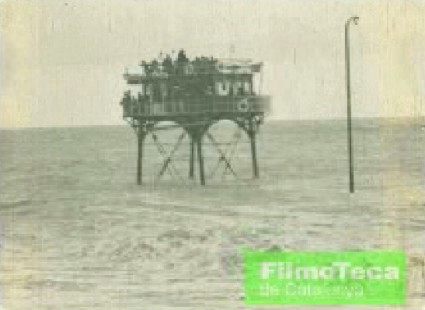
Brighton Sea-Going Electric Car (1897), from Filmoteca de Catalunya

Another anniversary marked by the festival was the thirtieth anniversary of the celebrated FIAF congress of 1978, held in Brighton in the UK, which held a symposium which examined films from around the world made 1900-1906. This epic undertaking (548 films were screened) effectively kick-started the serious study of early film, and had huge repercussions on scholarly understanding, publishing, video releases and some notable academic careers. To mark the occasion, the festival invited some of those who were at the original symposium to select two films each from the 1900-1906 period, and to say why they still excited their imaginations.

I was greatly looking forward to this part of the festival, and it’s sad to have to report that it was, in all honesty, a bit of a shambles. There was no sense of a governing idea, several of the prints were quite poor and appeared to be (and some certainly were) the prints shown at the original symposium, in some cases with quaint introductory titles. In at least one instance the wrong version of a film was shown, and there were some titles that weren’t in the catalogue at all but got shown because they were on the same reel as one of the scheduled films. I didn’t stay for the second half of what was a long session, but others reported similar disappointment. Of course, classic titles such as The Life of an American Fireman (1903) and The Great Train Robbery (1903) are never going to fail, but the highlight, ironically enough, was a new discovery. George Albert Smith’s Brighton Sea-going Electric Car (1897), discovered this year by the Filmoteca de Catalunya is a mysterious masterpiece in miniature. This was an elevated, sea-going platform, a sort of maritime tram, invented by Magnus Volk, which is seen to traverse the screen from right to left, like some bizarre vision of modernity drfiting into view then out again.
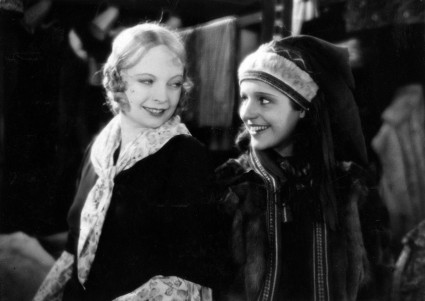
Alice O’Fredericks and Mona Mårtenson (right) in Laila, from http://www.nfi.no

The rediscovery that sent us out into the streets, if not with the intention of dragging in passers-by then certainly floating on air, was unexpected. Laila (1929) is a late Norwegian silent, a daunting 165 minutes long. Expectations were not high from those like me who knew little of this period of Norwegian cinema, though the presence of George Schnéevoigt, cinematographer on a number of Carl Th. Dreyer film, as director, had aroused curiosity.

So, we’re amid the snowy wastes of Norway, at some time in the past. It’s nighttime. Merchant Lind and his wife are being drawn by dog sleigh through the snow, taking their baby daughter Laila to her christening. A pack of wolves attackes them. In the frantic chase, the baby falls out of her sleigh. With the dawn, they seek desperately for the child, only to find an empty papoose. The child must have been devoured by the wolves. But the baby had been found by Jåmpa, the wild-looking servant of the wealthy Lapp Aslag Laagje, whose wife is childless. They decide to adopt the child, but then learn of her true identity. Sorrowfully, they return Laila to her true parents. But then her parents die of the plague…

We were gripped, and we stayed gripped throughout, as this immaculately-paced drama in the remotest of landscapes held you like only the best of silent films can. Exoticism was certainly part of the appeal – age-old, etched faces, rampaging wolves (running over the camera at one point), clashes between Lapps and Norwegians (disparagingly referred to by the former as ‘daros’), some fine ski-ing, and an awful lot of reindeer. Lying just underneath the narrative was a miscenegation theme, as the grown-up Laila (brightly played by Mona Mårtenson), kept in ignorance of her Norwegian parentage, is brought up to expect marriage to Laagje’s foster son Mellet. The film seeks to rescue her from this fate, preferring that she marry instead her first cousin, Anders Lind (Harald Schwenzen), who ends up rescuing her at the altar in a satisfyingly dramatic conclusion, thanks to an intervention from Jåmpa (Trygve Larssen), who puts Laila’s happiness above loyalty to his master (and gets savaged by a pack of wolves for his pains).

This was a work on both an intimate and an epic scale (it is based on a novel by J.A. Friis), excellently played in a fine naturalistic style by all concerned. It was good human drama. It’s hard to make a dull-looking film when you have so much snow to work with, and Schnéevoigt did not fluff a single scene. The only disappointment was the print, which was a TV print with rounded corners. This was something of a distraction. Presumably it is the only material that survives. We were told that the film had previously only been available in sound speed form, but has now been re-photographed at 16fps. Fresh, unusual and soundly executed throughout, Laila was the outstanding feature film of the Giornate.

Flagging a little by this stage, and with no desire to see the new documentary on Mary Pickford which was the main evening screening, that was the end of Thursday for me. Day seven, and the last of these reports, will follow, bringing us a poignant tale of class divisions, a paean to London at its imperial zenith, a ballet master turned puppet master, two Lillian Harveys, and one minimalist.

Pordenone diary 2008 – day one
Pordenone diary 2008 – day two
Pordenone diary 2008 – day three
Pordenone diary 2008 – day four
Pordenone diary 2008 – day five
Pordenone diary 2008 – day seven
Back to the Bible lands

Jesus’s first steps, Mulsant and Chevalier Bible lands films, from http://www.europafilmtreasures.eu

Regulars may remember that in the Bioscope report on the Pordenone 2007 festival, there was a detailed account of the remarkable find by Lobster Films of a cache of films from the earlier years of cinema taken in the ‘Bible lands’ i.e. Palestine. This collection of some eighty or so films included both actualities and dramatised scenes of the nativity. At the time, no one knew who had made these films, though a good guess was made that the filmmaker might have been the Frenchman Léar (real name, Albert Kirchner), known to have filmed nativity scenes in Palestine in 1897. Some of the films were believed to date from that period, but others stylisically suggested a slightly later date.

A year on, and the mystery has been solved. The films were not made by Léar but by the Abbés Mulsant and Chevalier in 1904, supported by the Roman Catholic promotional organisation, La Maison Bonne Presse. Mulsant and Chevalier visited Egypt, Palestine, Lebanon and later Turkey. They filmed the scenes about them, and created dramatised scenes inspired by the celebrated Bible paintings of James Tissot.

Research continues on their work, but Eric Lange of Lobster Films has kindly sent me a text on his discoveries. It’s in French, but that’s not going to present you with any problems (not in these post-Google Translate days). A selection of the films, concentrating on the nativity scenes, can be found on the European Film Treasures site (search under Mulsant or 1904), which has further information on the collection.

Au lendemain de la guerre de 1870, LA MAISON DE LA BONNE PRESSE voit le jour, sous les auspices des Augustins de l’Assomption. Son but est d’affirmer une présence catholique dynamique à travers des manifestations de masse : pèlerinages, enseignements, ou presse avec des organes comme le Pèlerin lancé en 1873 ou La Croix, 10 ans plus tard.

En 1895, le directeur de La Croix confie à Georges-Michel Coissac, futur historien du cinéma, la création et la responsabilité d’un service de projections lumineuses.

Des conférenciers projectionnistes sillonnent alors les paroisses et diffusent la bonne parole grâce aux séries de plaques de verre illustrant sous forme de tableaux vivants, la vie du Christ, des Saints et Martyrs ou les histoires édifiantes de Théodore Botrel.

En 1905, lorsque intervient la séparation de l’Eglise et de l’état, le cinématographe a depuis longtemps perdu son statut de curiosité scientifique pour n’être plus, pour beaucoup, qu’une vulgaire attraction de fête foraine.

Il commence toutefois à intéresser les esprits pieux de la maison de la Bonne Presse.

Lors du deuxième congrès général des oeuvres catholiques de conférences et de projections (19 – 22 février 1906) un conférencier défini ainsi ce point de vue :

« Il n’est personne qui nie l’intérêt des projections cinématographiques et le parti qu’en pourraient tirer les oeuvres catholiques de projections. Celles-ci ne doivent pas, sous peine de rester en retard et de se priver d’un puissant élément de succès, dédaigner cette nouvelle manifestation de l’art dans l’image lumineuse. Aussi semble-t-il tout naturel que le Congrès veuille étudier cette année les moyens de vulgariser le cinématographe et de le mettre à la portée d’un plus grand nombre. »

Ce rapport émane de l’abbé Mulsant qui a déjà mis en pratique sa théorie:

« On me permettra d’exposer ici l’oeuvre que j’ai entreprise en collaboration avec M. L’abbé Chevalier; heureux si notre petite expérience peut être de quelque utilité pour les conférences catholiques.
Ayant à chercher des ressources pour nos écoles du Liban très menacées par la diminution des aumônes venant de la France, et en face de l’impossibilité de quêter en ce moment dans notre pauvre patrie, nous avons songé à donner des conférences aussi intéressantes que possible, et en joignant aux projections lumineuses ordinaires les vues cinématographiques.

Pour cela nous avons fait un long voyage en Orient, pays qui du reste nous était déjà connu, et nous sommes arrivés à récolter en Egypte, en Palestine et au Liban de nombreux documents, clichés et bandes cinématographiques, avec lesquels ont été composées cinq conférences documentaires ou artistiques.

La première, Vers les cèdres du Liban, nous promène à travers les montagnes si pittoresques de la Syrie.

La deuxième et la troisième, s’attachant à la personne sacrée de Notre-Seigneur Enfant, essayent de le faire revivre, soit à la manière de Tissot dans la conférence documentaire Au pays de l’enfance du Christ, soit dans la Vierge et son fils, à la manière des artistes idéalistes qui, si nombreux à tous les ages, ont plus ou moins prêté à la Sainte Famille nos moeurs et nos goûts.

La quatrième conférence, Le Caire pittoresque, conduit dans la capitale de l’Egypte moderne, en fait ressortir les particularités et les contrastes et donne sur la religion musulmane et ses rites, de très curieux documents.

La cinquième, les Hébreux d’autrefois et les Fellahs d’aujourd’hui, transporte l’auditeur à plusieurs siècles de distance et fait revivre les moeurs au temps de Joseph et des Pharaons dans l’étude de la vie des champs et de la construction des temples.

Ces cinq conférences sont établies sur le même modèle, en ce sens que l’illustration lumineuse du texte est toujours composée de vues fixes alternant avec les vues cinématographiques. Un dispositif nouveau, inventé par les conférenciers eux-mêmes, permet la substitution instantanée du cliché à la vue mouvante. Cette méthode a le grand avantage de donner à la conférence plus de vie et de variété, les explications étant données sur les vues fixes qui ne sont que l’analyse du sujet cinématographique suivant.

Le spectateur jouit ainsi beaucoup mieux de la vue cinématographique déjà expliquée et n’est pas fatigue par une projection non interrompue de 600 mètres de bandes. Je puis dire que ces conférences, grâce à l’inédit des documents et à la perfection de l’appareil, ont pu être données en très grands nombres dans les milieux les plus différents, toujours avec le plus beau succès. En dix-huit mois, nous avons fait plus de 250 conférences dans des Grands et Petits Séminaires, des salons, des Sociétés de géographie, des Cercles artistiques, des collèges et couvents, des salles populaires où nous avons réuni plus de 2000 personnes. Nous comptons continuer notre oeuvre et poursuivre notre campagne de conférences, qui, comme nous l’ont dit bien des prêtres et des évêques nos auditeurs, font un bien réel aux âmes et permettent de parler de Notre-Seigneur dans tous les milieux. »

L ‘œuvre entreprise par Mulsant et Chevalier n’est certes pas une première. Dès 1897, Albert Kirchner, dit Léar, avait accompagné le père Bailly dans son pèlerinage aux pays du Christ et en avait ramené les premiers films tournés en Palestine et en Egypte ; des films malheureusement perdus aujourd’hui.

Toutefois, s’ils ont bien été tournés en 1904, comme le laissent à penser les déclarations de l’abbé Mulsant, ces films offrent un des plus anciens témoignages filmés de la vision chrétienne en terre Musulmane.

Tourné in situ, la vie de Jésus détonne par rapport aux nombreuses versions très théâtrales éditées alors par Pathé, Gaumont ou Lumière. Le but est ici de « remettre en scène, sur place, au jour le jour, les personnages bibliques, d’évoquer leurs figures, redire leurs paroles, dans le pays que la Providence avait donné pour cadre à leurs passions, à leur espoir, à leur apostolat. »

Les sujets des autres conférences sont complémentaires puisque l’observation des us et coutumes en Palestine, en Egypte ou au Liban permet de « mettre en évidence les vestiges des traditions antiques, commentaires vivant de l’Ecriture qui éclairent d’un jour nouveau telles pages obscures de la Bible ou de l’Evangile. »

Au delà de leur aspect ethnographique ou religieux, les films de Mulsant et Chevalier sont aujourd’hui le témoignage rare d’une pratique qui va pendant longtemps opposer laïcs et catholiques: celle du conférencier projectionniste.

Le Texte des conférences de Mulsant et Chevalier semble avoir disparu, mais on en trouve toutefois quelques extraits dans les séries de cartes postales illustrées, éditées à partir de 1907 et proposées aux abonnées du Fascinateur, revue consacrée à la projection par la Maison Bonne Presse.

1907 est également l’année de la consécration pour Mulsant et Chevalier. Leur Annonciation de la Vierge est présentée au Vatican devant le Pape Pie X, en vues fixes d’abord, puis en scène cinématographique, avec de brèves explications du P. Chevalier lui-même. Le film vient conclure un programme des plus variés où se succèdent des scènes de la vie militaire, des scènes champêtres ou maritimes sans oublier des portraits de Sa Sainteté et de splendides tableaux de la vie du Christ ou des films comiques tel Toto Aéronaute (Pathé 1906)!

Jusqu’alors, les films de Mulsant et Chevalier ne se trouvaient pas dans le commerce, ce que regrettaient certains congressistes lors du troisième congrès général des œuvres catholiques de conférence et de projection. Après la séance faite au Vatican, un accord est conclu avec Gaumont qui propose fièrement sous le numéro 1821 de son catalogue « A Nazareth », collection de MM. Mulsant et Chevalier, projections représentées devant le Souverain Pontife. Ce films de 70 mètres se divise en 5 parties: L’atelier, Fontaine de Nazareth, Retour de la Fontaine, Le puits, le soir qui tombe.

Curieusement le film n’est qu’en distribution ; les droits de représentation sont réservés pour la France et la Belgique et il faut s’adresser directement aux Auteurs, 14 rue Sainte-Hélène à Lyon.

Peut être Gaumont ne veut il pas faire trop de concurrence à sa Vie du Christ éditée en 1906 et dont certains tableaux s’inspirent également de la Passion du peintre James Tissot. Dans ces mémoires, Alice Guy, qui a réalisé le film, indique que Mulsant et Chevalier étaient présents sur le tournage et portaient un vif intérêt à son travail. On pourrait en déduire d’après ces propos que les deux prêtres se sont inspirés d’Alice Guy, alors que ceux-ci avaient tournés leur vie de Jésus 2 ans plus tôt.

La production cinématographique de la maison de la Bonne Presse ne débute réellement qu’en 1909, avec une version de la Passion de 1000 mètres réalisée par Honoré le Sablais qui dirigera la production jusqu’à la première guerre, avant que l’abbé Danion ne prenne le relai.

En 1909, Mulsant et Chevalier sont certainement en Turquie comme en témoignent une série films retrouvés en même temps que ceux d’Egypte et de Palestine. On y découvre le témoignage de la présence chrétienne dans un orphelinat ainsi que les ruines d’Adana après les premiers massacres d’Arméniens. Ces films n’ont sans doute pas encore révélé tous leurs secrets.

Puis nous perdons la trace de Mulsant et Chevalier après une dernière séance de projection à Moulins, mentionnée par le Fascinateur en 1910:

« M. L’abbé Mulsant, le conférencier bien connu, a organisé cette année à Moulins toute une série de conférences religieuses, pour dames et jeunes filles, sur la vie de Notre-Seigneur, dans le but d’aider à l’intelligence des Evangiles.

Les projections ont été exécutées par M. l’abbé Mulsant lui-même, avec un appareil de haute précision, à la lumière oxy-éthérique. Les vues projetées, dont un bon nombre en couleurs, sont en grande partie l’œuvre originale et personnelle de M. Mulsant. Prises directement sur les Lieux-Saints même ou empruntées aux plus grands peintres de toutes les époques, elles ont pour but constant et unique soit la reconstitution historique des faits évangéliques, soit la représentation la plus expressive des mystères sacrés, d’évoquer en un mot, sous les yeux de la vie même du Christ, telle qu’il la vécut parmi nous, il y a dix-neuf siècle. »

Les recherches continues. A suivre …

Eric has also drawn my attention to his Cinématographes site on early cinema technology. Written in French, it’s a fabulous collection of images and descriptions of cameras, projectors etc., company information, catalogues and more, which I’ll cover in greater detail in a later post.

Pordenone diary 2008 – day two

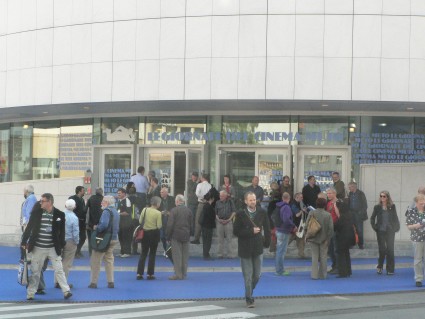
Outside the Teatro Comunale Giuseppe Verdi

Before launching into what we saw on Sunday 5 October at the Giornate del Cinema Muto, a word of praise for one particular innovation. Pordenone shows prints from around the world, which arrive in a multiplicity of languages featured on the intertitles. For years we have benefitted from the skills of translators viewing the prints as we did and providing instant translations through headphones. This year the headphones were gone. In their place we had computer-generated subtitles immediately below the screen. If the film was in English, the subtitles appeared in Italian, and vice versa; if it was in any other language, we got subtitles in both Italian and English. The amount of preparatory work must have been prodigious, but the result was a hugely improved viewing experience. Warm thanks are due to all those who made this possible, and everyone’s hearts went out to whoever had translated all of the 160 minutes of the Norwegian film Laila in English, only to discover that the print came with English titles…

This innovation went hand-in-hand with a welcome emphasis on bilingual presentation generally. In Giornates past it has felt as though English speakers were taking over, which must have been greatly trying for the Italians in the audience. Now most (if not all) spoken introductions were translated from one language or the other. One or two speakers need to know when to take a break to give the poor translator a chance to recap, while one speaker was perhaps unnerved by the translator and stopped speaking in mid-sentence, leaving the translator with an impossible task. But we’re getting there.

The day started for me (earlier risers had caught the French film Triplepatte) with two mindboggling Baby Peggy shorts, Such is Life (1924) and Carmen Junior (1923). Child star Baby Peggy (played by Diana Serra Carey, ninety years old next month) is beyond rational criticism. These bizarre films give every appearance of having been made up as they went along. A surreal sequence in Such is Life where an unexplained living snowman melted through a street grill was memorable, but had no logical connection with anything around it (the story was based on ‘The Little Match Girl’, though feisty Peggy wasn’t about to do pathos).

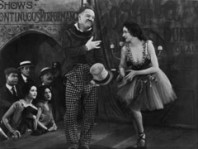
Ever since 1997 the Giornate has been working its way chronologically through the works of D.W. Griffith. This year we reached the end of the journey. The films of Griffith’s last working years are generally dismissed as the embarrassing efforts of an out-of-date man in his creative dotage – at least, those such as me who hadn’t actually seen them believed this. I wasn’t alone in such assumptions, and the astonished (well, pleasantly surprised) rediscovery of Griffith’s late films was one of the major points of the festival. We started with Sally of the Sawdust (1925). This is a comedy-drama of a circus performer (Carol Dempster), whose mother was thrown out by her parents when she married a man from the circus and who has fallen under the care of entertainer Eustace McGargle (W.C. Fields). What surprised about Sally of the Sawdust was its general competence. That sounds like a dreadful thing to say about the man who established the art of directing films, but by this period in his career one had sensed that he was wilfully opposed to the ways in which studio-dominated cinema was evolving. But for the most part Sawdust is pleasingly competent. It ticks along nicely. Fields is outstanding – in complete command of the screen from his very first shot. We even get to see him juggle. Dempster is, inevitably, annoying and she puts on all her girlish mannerisms (it’s an oddity of the film that she seems far too old for such faux-teenage mannersims, though she was only twenty-three when the film was made). Yet even she surprised in a house party scene where is dresses up glamorously and gives a hint of a quite different, and alluring presence, which she might more profitably have returned to. There was also a touching scene where she dances in the way her mother used to for the woman she does not realise is her grandmother. Unfortunately, Griffith’s control fails him towards the end of the film, with his taste for old glories taking over as we have two prolonged chases, one with Dempster, one with Fields, which are poorly executed and fail to intertwine as they should have done, ending with a casual resolution of the plot that lets the audience down. But there were signs of promise, and better was to come.

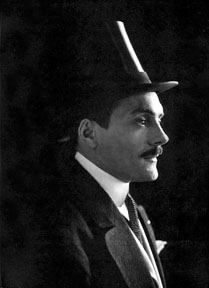
Included in the catch-all ‘Rediscoveries’ strand were four Max Linder films. Of these Max Toréador (1913) was remarkable for its prolonged scenes filmed in a bullring in Barcelona with Max himself in the middle with the other toreadors genuinely taking part in the bullfighting. It was no surprise to learn that different prints exist with scenes cut according to local sensibilities – the film did not shy from showing the ‘sport’ in all its bloody cruelty. Rather more enjoyable was The Three-Must-Get-Theres (1922), a goofy parody of Douglas Fairbanks in The Three Musketeers. The try-a-bit-of-everything humour was variable, but the film gleefully sent up the Fairbanks self-satisfaction and panache, laced with a string of anachronistic gags (motorbikes instead of horses, that sort of thing). Max remains one of the geniuses of the silent cinema, a poetic blending of opposites – graceful air with a penchant for pratfalls; debonair confidence with always just a touch of panic in his eyes.

One of the festivals themes was filmmaking in New York, tied in with Richard Koszarski’s new book, Hollywood on Hudson. The films chosen were an odd mish-mash, none odder nor mish-mashier than His Nibs (1920-21), directed by Gregory La Cava. Starring obscure comedian Chic Sale (whose gentle comic style suggests he might be worth investigating further, if more films exist), the film was made out of what was going to be a conventional drama, The Smart Aleck. At some point someone realised that the film wasn’t working, and decided to build another film around it. So we get a film about a cinema show, with Sale playing multiple parts, including a crusty projectionist. The audience settles down to watch the film-within-a-film, now called He Fooled ‘Em All (starring Sale and Colleen Moore), with commentary from the projectionist in the intertitles to prevent the audience from reading out the titles. The projectionist also tells us that he cut out a train journey from the film, because those scenes all look the same, plus some mushy stuff at the end. So some good laughs at the expense of cinema, and an intriguing portrait of a small town film show, but a minor oddity overall.

The highlight of the day – indeed one of the highlights of the week – was quite unexpected. On 28 December 1908 the Messina Straits off Sicily was at the epicentre of a huge earthquake. It was probably the biggest earthquake in Europe ever experienced; around 200,000 died in the region, with Messina itself having its population reduced to just a few hundred. We saw how film responded to this tragedy, through three actualities and two fiction films. The first actuality, from an unknown producer, had the greatest effect – aided by Stephen Horne’s eerie music (starting with solo flute before turning to piano). Each shot framed people within the ruins of the city to haunting effect. There was a profound sense of a shock, a dawning realisation of what had just happened. A Pathé news report showed us more, while a Cines film showed us the town being rebuilt in 1910. An Ambrosio drama, L’Orfanella di Messina (1909) depicted a couple who had lost their daughter to illness adopting an orphan girl from Messina, simple yet deeply touching. Finally, and oddly, there was a Coco comedy in which the comedian imagined himself caught up in the earthquake, with collapsing walls and floors in his bedroom. In this simple package of films, we saw how film was used to report on and to help people come to terms with what the country had been through. The sequence moved us all.

The Orchestra della Scuola Media Centro Storico di Pordenone, a school orchestra, was given the chance to show its mettle, accompanying Buster Keaton’s One Week (whose inventiveness greatness put the middling efforts of other comedies seen during the day into context) and three cartoons. Heavy on the recorders and percussion, but good accompaniment for all that, with spot-on sound effects. And further evidence of the growing bonds between community and festival.

The Golf Specialist, from criterioncollection.blogspot.com

The evening’s screening kicked off with a sound film: W.C. Fields in The Golf Specialist (1930). The Fields theme was a bit of an opportunisitc one, probably chosen because some of his silents turned up in the Griffith and New York strands. The film is a classic, of course, and it was good to have it as a point to which his silent films were pointing. It’s a variety sketch in which Fields chaotically fails to demonstrate his golf skills, which tangling with children, animals and sticky paper with progressive absurdity. Delicious cynicism is on view, though there could be more of Fields’ sardonic view of the world and a little less of the golfing calamities.

After a modern Romanian silent short on climate change, whose logic eluded me, we had The Show Off (1926), directed by Mal St Clair. Part of the New York strand (it was filmed at Paramount’s Astoria studios), it starred the ever unappealing Ford Sterling (the Keystone star that Chaplin famously supplanted) in a relatively straight role. This had some cultural-historical fascination in its picture of office life and suburban aspiration, with Sterling playing all too accurately a vain and selfish social failure. Somehow he becomes aware of the unhappiness of other people about him and implausibly saves the day. Had Fields been given the part, we might have had a film of note. As it was we had a minor work of academic interest, its most diverting feature being Louise Brooks as the girlfriend of Sterling’s brother-in-law, looking for all the world as though she had glided in from a different planet.

Look out for Day Three, where we will encounter hands, feet, Satan, puppets and a strongman on his holidays.

Pordenone diary 2008 – day one
Pordenone diary 2008 – day three
Pordenone diary 2008 – day four
Pordenone diary 2008 – day five
Pordenone diary 2008 – day six
Pordenone diary 2008 – day seven

Quebec and Québec

F. Guy Bradford (left), Joe Rosenthal (right) and the Living Canada travelling company, c.1903 (Cinémathèque québécoise)

Another day, another site goes up with unique silent film content, richly contextualised. Truly the online world is our archive. This time it is Le cinéma au Québec au temps du muet/Cinema in Quebec in Silent Era, an impeccably bilingual site giving us the history of early cinema in Quebec, Canada.

Quebec has a distinctive early film history. It is a tale coloured by its geography, its French heritage, local regulations, audiences and enthusiasms, and by snow. Particularly, it is a tale shaped by the dedicated efforts of a hardy band of pioneers, such as James Freer, Henry de Grandsaignes d’Hauterives and Léo-Ernest Ouimet. It is a tale of travelling cameramen (Joe Rosenthal, William Paley) and travelling exhibitors (F. Guy Bradford), an adventurous cinema with a spirit of newness and discovery about it.

The site has been put together with impressive thoroughness and local pride. There are extensive, knowledgable texts on such themes as the history of cinema in the area, biographies, audiences, film companies, sponsorship (the Canadian Pacific Railway made much use of film to promote its activites), censorship and travelling cinema. There are twenty or so films, available in low and high bandwidth, mostly non-fiction, including such titles as Skiing at Quebec (Edison 1902), Mes espérances en 1908 (Ouimet 1908), The Building of a Transcontinental Railway in Canada (Butcher 1909), Put Yourself in their Place (Vitagraph 1912 – fiction film set in Quebec) and the sobering Forty Thousand Feet of Rejected Film Destroyed by Ontario Censor Board (James and Sons 1916). All have musical accompaniment by Canada’s own Gabriel Thibaudeau.

There are also three lively ‘interactive journeys’ which you can take through the ‘Rural Milieu (1897-1905)’, ‘Working-Class Milieu (1906-1914)’ and ‘Middle-Class Milieu (1915-1930)’, which is an interesting way in which to divide up cinema history. Plus you will find documents, photographs, further background texts (some in French, some in English, some in both), and educational activities and a good, eclectic set of links (where you may learn that The Bioscope is ‘Plus qu’un blogue’ – merci beaucoup). An historical timeline is also offered, though I’ve not been able to make the link work. All in all, an exceptional piece of work, lovingly constructed, with discoveries a-plenty to be made.

The site is a collaborative effort between GRAFICS, the Bibliothèque et Archives nationales du Québec and the Cinémathèque québécoise. Acknowledgments to Bruce Calvert on the indispensible silent film forum Nitrateville for information on this site.