How I Filmed the War

Geoffrey Malins

The latest addition to the Bioscope Library is Geoffrey Malins’ How I Filmed the War: a record of the extraordinary experiences of the man who filmed the great Somme battles etc. (1920). Malins was one of two British Official cameramen who filmed the Battle of the Somme in the summer of 1916 (the other was J.B. McDowell). The film that they shot was considered so outstanding that it was compiled into a feature length documentary (earlier Official war films had been much shorter), entitled The Battle of The Somme. It was first shown in London in October 1916 and was unquestionably a sensation. It is estimated that half the British population saw its unprecedented scenes of life for British troops on the Western front, with scenes of battle, troops going over the top, and the wounded. Malins’ book is vainglorious but rich in detail, a unique document of the making of what Nicholas Hiley has called the most socially significant British film of the twentieth century.

It’s available for free download from the Internet Archive, in PDF (24MB), DjVu (6MB) or TXT (532KB) formats. The film itself has been recently digitally restored by the Imperial War Museum, with remarkable effect, and a DVD release with new score is promised.

Caligari, Urban and the Kelly Gang

bbk-01_400.jpg

I have just come from a special screening at the amazing new Centre for Research and Visual Media at Birbeck. The design is based on the renowned angular sets for The Cabinet of Dr Caligari (1919); ingeniously fitted into a limited space, yet strangely in harmony with the Georgian frontages of Bloomsbury that surround it. The reason for attending was the launch of the new London Screen Study Collection, a planned accessible reference library holding viewing copies of moving image material made about and in London, housed at Birkbeck.

To start the launch off we were shown the recently rediscovered Living London (1904), ten minutes of an original forty-minute film showing familiar sights and scenes from London. The film is sensational. So very little footage survives showing the London of 100 years ago, and suddenly here are sequences full of animation and character showing Covent Garden, the Strand, the City, Trafalgar Square, St James’s Park, and a Thames teeming with river craft, all in 1904. The film was made by the Charles Urban Trading Company, and includes a sequence showing sandwich board men advertising Charles Urban‘s ‘Urbanora’ film shows. It is a proto-documentary in Urban’s best style, alive with movement, sharply edited, and giving equal attention to monuments and people.

The film was discovered by Professor Ian Christie at the National Film and Sound Archive in Australia. How it got there is quite a story in itself. It was exhibited across Australia in 1904/05 by showmen John and Nevin Tait, who did so well out of presenting the film to Australians keen to see images of the old country, that it enabled them to go into film production themselves and to produce The Story of the Kelly Gang (1906): Australia’s, and indeed the world’s first feature film.

We were only shown a videotape. The film proper will undergo restoration as part of a larger collection, and should hopefully receive a proper ‘premiere’ at the Pordenone Silent Film Festival in 2008.

Edwardian hoodies

edwardians.jpg

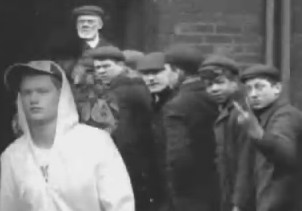
Anyone watching BBC television at the moment will have seen the trailer for the BBC4 Edwardians season. The trailer uses footage from the now renowned Mitchell and Kenyon collection of mostly actuality films of life in nothern England 1900-1914, digitially treated to mix the people of Edwardian times with such modern figures as a pizza delivery motorbike, a ‘golf sale’ signboard, rock concert fans, a policeman with a gun, and a hoodie. So of course they’re just like us and we’re just like them. You can see the trailer here (click on ‘Watch the season trail’).

Update – For all those who have been looking, the music that accompanies the trailer is Fashion Parade, by Misty’s Big Adventure. More details from the band’s MySpace site.

‘Tiger’ Sarll

Tiger Sarll

Strolling about the second-hand bookshops, on a beautiful warm Spring day, I chanced upon Adventurer Extraordinary: The Tiger Sarll Story (1961), by Godfrey Lias. His is a tall story well worth telling, if not always believing. Thomas Henry William Bang-fee Sarll (Bang-fee came courtesy of the Chinese minister to London, a family friend) was born in 1882, and originally trained as a doctor. In 1899 he enlisted with the South African Light Horse in the Anglo-Boer War, where he was wonded and lost the sight in his left eye. He next became a big game hunter in Africa (a curious choice for someone who was a life-long vegetarian), then joined the Royal Canadian Dragoons. He returned to London, where he became an actor, including films. He next dabbled in journalism, travelling to Morocco in 1907, and after further world travel (including Argentina and the Mexican revolution) became a cameraman for the British newsreels Warwick Bioscope Chronicle, Pathe’s Animated Gazette and Williamson’s Animated News. He seems not to have been very good as a cameraman (having just the one eye may not have helped), but nevertheless was sent off by Pathe to film the Balkan War in 1912. Reports suggest that his expedition cost £600 without obtaining any good footage, though the BFI database lists one film taken by him at this time of a Turkish retreat (the date of 1915 is an error). He was sacked by Pathe, but clearly had a persuasive gift as he was taken on by Williamson, for whom he filmed the 1913 Derby, then on the outbreak of the First World War he was taken on by Transatlantic and filmed scenes in Belgium, though his footage was never used.

Sarll was the archetypal English eccentric, dressing in spats and monocle, and dominating everyone with his 6′ 4″ height and powerful personality. After the war he returned to Morocco to report on the rebellion against the Spanish, then went Mexico to capture pythons and alligators for zoos. On his return, he started up a circus act, handling snakes and alligators. He was a fire-fighter during World War, and ended his extraordinary career as security officer at a nuclear power station. His biography was published after an appearance on the TV programme This is Your Life, where he notably failed to recognise some of his grown-up offspring (“You’re not one of mine, are you? Which one are you?”).

There’s more about him in his biography on the British Universities Newsreel Database. The picture above is from The Bioscope (5 December 1912) and shows him with his Pathé camera stationed with the Turkish army at Chorlu. [Update: The site is now called News on Screen and the link has been changed to http://bufvc.ac.uk/newsonscreen/search/staff/detail.php?id=33189]

Unknown Behind the Lens

Having recently spent a day digging through the historic motion picture records of the U.S. Department of Agriculture at the National Archives, I was constantly coming across the name of George R. Goergens. Mr. Goergens began his career as a still photographer and then transitioned into the position of motion picture cameraman when the Moton Picture Division began in 1914. I have found over 80 titles in existence that he lensed from 1914 through 1936. He shot every type of film: industrial, training, and educational films for the Department of Agriculture Federal Extension Service. With titles such as Cotton Manufacturing (1919), Last Days of the Prairie Dog (1920), Dynamite-Concentrated Power (1926), Highways of Peru (1930), his experience in the area of non-fiction film was unparalleled. He was severely injured at least twice in his career, once while filming an explosion at a grain elevator, and once in a biplane crash about the time of WWI. He was not only an accomplished cameraman, but he also held a patent for a high speed motion picture camera. He produced some animation sequences as well as developed time lapse work to show plant and germ growth. He retired in the mid 1940s, and passed away in 1952. George Goergens is another of the pioneering cameramen who while time has long since forgotten, shows us the film industry was developed in many ways, by many people, some famous, some not, but all left their mark.

American Memory

Among the very best resources on the web is the Library of Congress’ American Memory site. The purpose of American memory is to provide “free and open access through the Internet to written and spoken words, sound recordings, still and moving images, prints, maps, and sheet music that document the American experience”. Its Motion Pictures section is a marvellous example of this, offering users access to a wide range of predominantly early cinema subjects, all available for viewing and downloading, in MPEG, QuickTime and RealMedia formats.

Each collection is usefully contextualised and indexed, and there are impeccable cataloguing records. The collections with silent film material (both fiction and non-fiction, but chiefly the latter) are:

Needless to say, this is all non-copyright material, one of the consequences of which being that eBay is full of DVDs of early film materials which are simply repackaged downloads from this site.

British Pathe – part one

British Movietone (see 26 February post) is one British newsreel now available in its entirety online, but the most important British newsreel collection – and one which goes back to the silent era – to be found on the web is British Pathe. Pathé newsreels ran in Britain from 1910 to 1970, while the company also produced cinemagazines like Eve’s Film Review and Pathé Pictorial, as well documentaries and other shorts. 3,500 hours of this collection was made available online in free low resolution download form four years ago, thanks to funding from the Lottery-based New Opportunities Fund.

The British Pathe site is therefore a superb resource for discovering silent non-fiction film, and in future posts I’ll be providing a guide to some of the treasures to be found. However, I’m going to start with the unexpected – fiction films. Pathé somehow picked up assorted pre-First World War films, some though not all made by its French parent company, and these got digitised alongside the newsreels and are available on the site. There is no index to these fiction films, so below is a list of some of the ones that I have been able to find, with descriptions and some attempts at identifying them, as few are given correct titles or dates:

(the first title given is that on the British Pathe database – enter this in the search box to find the film)

THE FATAL SNEEZE = comedy in which a man suffers from an increasingly violent sneeze. This is That Fatal Sneeze (GB Hepworth 1907).

THE RUNAWAY HORSE = comedy in which a runaway horse causes chaos. This is a famous comedy of its time, Le Cheval Emballé (FR Pathé 1907).

FLYPAPER COMEDY = This is a French comedy with Max Linder, in which Max has flypaper sticking to him which he then finds sticks to everything else.

THE FANTASTIC DIVER = early trick film in which a man dives into a river fully clothed then returns by reverse action in a swimsuit.

THE RUNAWAY GLOBE = Italian? comedy in which a giant globe intended for a restaurant runs away down a street and is chased by a group of people before being sucked up by the sun, only to be spat out again.

THE MAGIC SAC [sic] = French trick film in which an old man hits people with a sack and makes them disappear.

MYSTERIOUS WRESTLERS = French trick film where two wrestlers pull one another to bits. This is a brilliant George Méliès trick film, Nouvelle Luttes Extravagantes (FR Star-Film 1900).

ATTEMPTED NOBBLING OF THE DERBY FAVOURITE = section from a British racing drama, made by Cricks and Sharp in 1905.

THE POCKET BOXERS = trick film in which two men place two miniature boxers on a table and watch them fight.

ESCAPED PRISONER RETURNS HOME = guards wait while prisoner bids a tearful farewell to his sick wife. This must be a James Williamson film, perhaps The Deserter (GB 1904).

LETTER TO HER PARENTS = extract from a drama at which elderly parents are upset at a message they receive.

ASKING FATHER FOR DAUGHTER’S HAND = scenes from a film where a fiancée has to prove himself to the father.

HAVING FUN WITH POLICEMEN = British comedy in which two legs stick out of a hole in an ice-covered pond, placed there by boys to trick a policeman.

POINT DUTY = a policeman is run over by a car and put back together again. This is How to Stop a Motor Car (GB Hepworth 1902).

THE MOTOR SKATER = comedy where man buys a pair of motorised skates and causes chaos.

RUNAWAY CYCLIST = comedy where man buys a bicycle and causes chaos (as can be seen, this was a common theme for comedies of the period).

FIRE = mixture of actuality film of a fire brigade and a dramatised fire rescue. This is Fire! (GB Williamson 1901).

HAMLET = scene with Hamlet and his father’s ghost, using trick photography, from Sir Johnston Forbes-Robertson’s production of Hamlet, a feature-length film (GB Hepworth 1913).

THE DECOY LETTER = early, rudimentary Western, where a soldier lures away an innkeeper with a decoy letter and attempts to assault his wife.

THE VILLAGE FIRE = comedy fire brigade film. This is The Village Fire Brigade (GB Williamson 1907).

THE RUNAWAY CAR = French comedy in which three men try to ride a bicycle and then a car.

RESCUED BY ROVER = a dog finds a kidnapped baby. This is of course the famous Rescued by Rover (GB Hepworth 1905).

Anyone who recognises the descriptions where the film has not been identified, or has the time to take a look at the films and identify them, or finds other fiction films on the site, do let me know.
Movietone and Henderson

There are two major British newsreel collections available online. The British Pathe collection is well known, having public money behind it and much publicity. However, the entire British Movietone News library is also available, at www.movietone.com. But for the early film enthusiast, this collection is worth an additional look because, although the newsreel ran 1929-1979, its library includes a substantial amount of pre-1929 material, much of it footage from the early 1890s and early 1900s from the Henderson Collection. George Henderson was a showman in Stockton, in the north of England, in the 1890s, and kept many of the films that he showed, a collection that was added to by his son James. The collection found its way to Movietone, though the nitrate originals ended up at the BFI and copies of the key titles can be found in several collections.

The films include Edison Kinetoscope titles such as Blacksmith Shop, Robert Paul‘s Blackfriars Bridge and The Launch of HMS Albion, the first film of Queen Victoria, taken at Balmoral in September 1896, the Prestwich film of W.G. Grace at Lords celebrating his 50th birthday, the English and Australian cricket teams in 1905, Anglo-Boer War film, and assorted processions and funerals for British royalty. There are early trick films, variety acts, comedies, and a lot of material that simply hasn’t been identified by scholars as yet. To find the films, just select “pre-1929” from the Decade option on the Search page (it is necessary to register with the site first). Do not trust the dates given for the films (most are guesses), nor the titles. The films are available as streams (modem / broadband), but cannot be downloaded. There are around 300 titles in the Henderson collection available here – a hidden treasure trove.

The camera as historian

More on Louis Stanley Jast and the proto-film archive at Croydon Public Library (see yesterday’s post). I dug out a copy of The Camera as Historian, by H.D. Gower, L. Stanley Jast and W.W. Topley (London: Sampson Low, Marston and Co. Ltd., 1916) in the British Library. The book is predominantly about the use of photography as a civic and social record, but it makes some comments about cinematography which reinforce what Jast told The Bioscope in 1914. There is further detail on the system for viewing films without projection, designed by Thomas H. Windibank, manager of the London Electric Hall cinema in Croydon, with diagrams and photographs. The text is most concerned with practical matters of taking, storing and making accessible photographic collections, but it has some fascinating general arguments. It asserts that photography’s power to record actuality “implies a corresponding responsibility” i.e. that local authorities had a duty to form photographic collections, by which the authors mean cinematographic records as well. The opening quotation boldly asserts the importance of the image for the study of history:

The means whereby the past, particularly in its elation to human activities and their results, may be reconstructed and visualized, can be roughly grouped under the four headings of material objects, oral tradition, written record, and lastly, graphic record, whether pictorial or sculptural. It is no part of our purpose to belittle the value of any of the first-named tools of the historian or scientist; but it will probably be conceded that in many respects the last named has a value greatly outweighing the others. It is obvious, moreover, that the lure of the graphic as of all other record rests entirely upon its accuracy. Now, not only is absolute fidelity to the original beyond attainment in the case of the artist, but the work even of the most painstaking draughtsman is often coloured by his individuality to such an extent that the detailed characteristics of the original he is reproducing assume in his work aspects quite foreign to their real nature.

Then comes the insistence that local authorities should be collecting film:

Hitherto little or no attention appears to have been paid to the enormous value of preserving, in such a way as to ensure their availability for the public of the future, the splendid photographic records of our national life contained in the cinematographic films daily taken for exhibition at “moving picture” theatres. This subject will be treated in a later chapter; but its importance warrants a reference to it here. Here the municipality – or whatever be the local governing body – surely has some interest, nay, the authors would urge, has a clear duty.

Jast does appear to suggest in this next extract that the value of film is as a series of photographs (though he does note elsewhere the importance of seeing films either as still images or in motion), but he explains how easy it should be to start up such a collection:

We have left to the last reference to what is perhaps the most valuable source of photographic records, at all events among those illustrating past events. We refer to the kinematograph films taken for display at the many “Picture Palaces” which have sprung up in such profusion amongst us during the last few years. Many of the noteworthy local happenings (at all events in towns of any size) are recorded in this manner. A few days after exhibition their commercial value has sunk to nothing, and they represent to the picture showman merely so many feet of waste celluloid. The value of a film containing over 4000 technically excellent photographic transparencies would, in this form, be about 3d.! It has been found that requests, by a suitable body (e.g. a Public Library) for the gift of these records are usually met by a most courteous acquiescence; while if a strictly commercial view of the matter be taken, the cost of acquiring the records – by way of purchase – need be so slight as to be negligible in comparison with their real value … That this source of material has been hitherto almost unrecognized is unfortunate. It would be deplorable if, henceforward, through apathy or lack of foresight, any opportunity should be missed of securing such invaluable records.

Jast would have been pleased to know about the regional film archive movement in Britain, but dismayed to learn that it was not instituted until the 1970s. How much local film was lost in the interim? I will now try and find out what happened to the Croydon film collection.

Croydon and film archives

Recently I was asked to find some historical quotations about the need for film archives. Calls for a museum for the preservation of films for all time are almost as old as film itself, even since Robert Paul tried to get the British Museum to take a number of his films in December 1896 (without success). The first true film archive is generally held to be the Imperial War Museum, effectively created in 1919, but there were several collections across the world in existence before them which could variously be described as film museums or libraries.

In my search through my papers, I was fascinated to come across an article by Langford Reed, ‘Films Museums: What Has Been Achieved’, The Bioscope, 30 July 1914, p. 471. In a survey of what was being done worldwide, Reed reported that “the national records office at Madrid” had a cinematograph section, while in Brussels the Congo Museum had a section devoted to “the preservation of films of wild animal life”. He says that films of religious interest were being held in the Vatican Museum. New York Public Library had a “cinematographic storehouse”, and the Indian state of Baroda had formed a library of “instructive films” which was being added to by the private cinematograph operator of the Gaekwar of Baroda. The Royal Library of Copenhagen had a collection of films taken of prominent men, together with phonograph records of their speeches (these films were taken by Denmark’s first filmmaker, Peter Elfelt).

Some of these are known about; some of these it would be intriguing to know if they ever existed in reality (and what happened to the films). But Reed’s real surprise is that in Britain he could find only one place preserving films “for the benefit of posterity” – Croydon Public Library. He went to meet the chief librarian, L. Stanley Jast, who told him:

The matter arose owing to the success which has attended a certain department, attached to the library, entitled, “The Photographic Survey and Record of Surrey.” It was suggested that section should be established to be devoted to the preservation of cinematograph films, and I accordingly wrote a letter on the subject to the chief local picturedrome proprietors. The result surprised me. I quite imagined I should be called upon to pay for any films required, but the gentlemen in question would not hear of it; they insisted on giving them to me. From the Amalgamated Cinematograph Theatres, Pyke’s Circuit, I received a film showing the distribution of prizes at the Upper Nrorwood Academy of Music, from Mr T.H. Windibank, of the London Electric Hall, pictures of the funeral of the late Town Clerk, and of the Croydon Horse Show, while from other sources I acquired about a dozen more. I am arranging with the picture theatre proprietors of the Borough to let me have other local films as soon as they have done with them – we shall keep entirely to subjects of local interest. In certain instances, too, it would be useful if we could engage an operator to take events especially for us. Practically, our only difficulties are concerned with storage, and in this connection I am now making enquiries as to fire insurance and as to the best means of permanently preserving films. I should welcome advice on these points.

The films will not be lent, as in the case of books. I have had a room – up to now devoted to the use of lantern lectures – so altered that cinematograph apparatus can be installed when required. The suggestion is to do without the usual projecting machine, and to view the pictures through the medium of an enclosed chamber, which has been especially designed for us by a local electrical engineer – himself the proprietor of a cinema – in which, in place of the projecting lens, a magnifying glass will be used. The movements will be induced by the hand, and this process will be quite efficient enough for the purpose of examining local records.

What happened to this collection? How long did it last? Was it ever used by the Croydon general public? Louis Stanley Jast appears to have been an interesting person himself: an important figure in the library world (he became President of the Library Association) and co-author of The Camera as Historian (1916). I will try and find out more.