Bioscope Newsreel no. 17

From http://www.ebk-ink.com/tsff/home.html

How can it be Friday again? Where are the days going to? Has there been any news? – I mean silent news of course, news of the inconsequential, non-life-threatening kind. Well, here’s some.

Sound of Silent Film Festival
Chicago’s Sound of Silent Film Festival describes itself “the only film festival that features modern silent films screened to live music, composed especially for the films by Chicago composers”. The festival includes works by Martin Scorsese (his bloody 1967 short film The Big Shave), Gus Van Sant, Manoel de Oliveira (the only living director to have made a silent film the first time around), Manga creator Osama Tezuka and a horror comedy created especially for the festival, which takes place April 1-3 at the Chopin Theatre. Read more.

Dante on DVD
Early Italian filmmakers loved the classics and loved spectacle. Both come together in L’inferno (1911), one of several bold attempts to put Dante on screen, notorious for its nudity, acclaimed for its Doré-inspired visual imagination and ingenious effects. It has been released on DVD by the Cineteca Bologna’s as part of its Cento anni fa series. An earlier DVD release had a score by Tangerine Dream which dividied opinion; this release comes with ambient sounds composed by Edison Studio and a piano score by Marco Dalpane. Read more.

Festival du film muet
Switzerland’s silent film festival (every country should have one) takes place in Servion, 24-27 March. Foolish Wives, Dr Jekyll & Mr Hyde, Swiss title Der Bergführer, and Seven Chances are the films on show. Read more.

Toronto goes to hell
And there’s another silent film festival, this time in Toronto, taking place 30 March-7 April. Now in its second year, festival highlights include another Italian vision of hell, Maciste all’Inferno (1926), King Vidor’s The Jack Knife Man (1920), Clara Bow in It (1927), and – from the infernal regions once more – F.W. Murnau’s Faust (1927). Read more.

‘Til next time!

Bioscope Newsreel no. 16

http://www.chaplinmuseum.com

Raymond Griffith: A Physiognomic Appreciation
David Cairns has been writing about comedian Raymond Griffith, “the most shamefully neglected performer in Hollywood history”, both on his Shadowplay blog and and his regular ‘The Forgotten’ column for the online cinematheque site MUBI. Read more (and more here).

Master of mise-en-scène
The Wall Street Journal writes in praise of Joseph Von Sternberg and the recent Criterion three-DVD set of his silent films Underworld, The Last Command and The Docks of New York. “With pristine prints and the welcome addition of Robert Israel’s newly composed but historically informed scores, film lovers can savor the work of a great director unhindered by expressive constraints”. Read more.

San Francisco 1906 in colour
Not colour film, unfortunately, but colour images taken by inventor Frederic Ives in 1906 of the city after the earthquake have been discovered by the Smithsonian Institution (actually a year ago, but the Internet is such a slow communicator of information at times). The Bioscope has previously written about the Kromskop, which helped inspire British inventors Edward Turner and G.A. Smith working on the first colour cinematography systems. Read more.

Dovzhenko on DVD
David Parkinson at the Oxford Times enthuses eloquently over the DVD releases of Alexander Dovzhenko’s Zvenigora (1928) and Arsenal (1929). “Anyone who considers modern sound cinema to be more sophisticated than the wordless pictures made between 1895-1930 should take a look at Alexander Dovzhenko’s Zvenigora … a dazzling array of artistic theories and screen techniques to explore such diverse topics as Ukrainian mythology, Soviet industrialisation, pacifism, the beauty of the landscape and the arrogance of the European bourgeoisie”. Read more.

Chaplin trouble
The long-promised Charlie Chaplin museum, converted out of the comedian’s home in Vevey, Switzerland, is in trouble. Art Info reports of Chaplin’s World: The Modern Times Museum that “financial difficulties have led to the purchase of the house and its surrounding land by two investors with shady connections, and supporters now wonder whether or not the museum — in planning for ten years — will ever see the light of day”. Read more.

The end of times
Happier Chaplin news from Leonard Maltin, who reports on the dedicated efforts by a group of film buffs and local history enthusiasts at William S. Hart Park in Newhall, California to mark the 75th anniversary of Modern Times, the film that called an end to the American silent film era. Read more.

‘Til next time!

Bioscope Newsreel no. 15

Photograph taken filming of Hide and Seek, Detectives (1918): (L-R) unknown, Tom Kennedy, Ben Turpin, Charles ‘Heinie’ Conklin, Eddie Cline, and Marie Prevost. From Steve Rydzewski (see http://www.flickr.com/photos/wiggleyears)

Behind the scenes the Bioscope is toiling away at two or three major posts, which always take a while to research, but in the meantime here’s your regular Friday round-up of some interesting (we hope) news snippets on silent film and such like.

Cinefest 31
Syracuse’s annual convention of silent and early sound film takes place 17-20 March. Among the auctions and dealers’ tables you can see Lonesome, What Price Glory? (1927), Happiness (1917), The Hushed Hour (1919), Mannequin (1926), and much more. Read more.

National Inventors Hall of Fame
Stephen Herbert’s estimable Muy Blog (on Eadweard Muybridge) reports on the National Inventors Hall of Fame inductees for 2011. They include some major names from the worlds of photography and early film: Thomas Armat (1866-1948), for his motion picture projector, Hannibal Goodwin (1822-1900), for discovering transparent flexible nitrocellulose film, Frederick Ives (1856-1937), for innovation in colour photography, Charles F. Jenkins (1867-1934), for the projector he developed with Armat, and Eadweard Muybridge (1830-1904), for stop action photography. Read more.

The Great White Blu-Ray
The British Film Institute much acclaimed restoration of Herbert Ponting’s The Great White Silence (1924), will get a Blu-Ray and DVD release in June. The film documents Captain Robert Falcon Scott’s failed attempt to be first to the South Pole. It’s also the first British silent film to make it to Blu-Ray. The dual-format package will include the 1933 re-edited sound version of Ponting’s film, Ninety Degrees South. Read more.

The Marie Prevost Project
Stacia Jones at the excellent and supremely well-named She Blogged by Night has been surveying the career of Marie Prevost in a series of posts. Her trawl through Prevost’s many lost films from the late teens brings up a marvellous array of photographs, posters, lobby cards and slides for the actress who went from Mack Sennett bathing beauty to 1920s stardom to a wretched end in the 1930s. Read more.

The hipster YouTube
Fortune magazine looks into the success story that is Vimeo, the online video site that just does everything right – and apparently invented the ‘like’ button. Proof that you can succeed in online video without recourse to theft, negativity or skateboarding dogs. Read more.

‘Til next time!

Bioscope Newsreel no. 14

Busy times continue, meaning that the Bioscope is rather just ticking over at the moment, but here are your Friday news snippets. Weighter posts will follow in good time, I promise.

Harold Lloyd in 3-D
The iconic clock-face sequence from Harold Lloyd’s Safety Last (1923) has been digitally remastered, colourised and converted to 3D, with the approval of his granddaughter Suzanne Lloyd. Says Suzanne,

The tasteful colorization and 3D conversion that Legend3D has performed on my grandfather’s Safety Last clip has given it new life. Harold Lloyd’s film masterpiece from 1923 has been updated for audiences old and new, preserving the magic and dignity of the original film.

Some may beg to differ. Read more.

Our Hospitality on Blu-Ray
New from Kino next month will be the Bioscope’s favourite Buster Keaton film, Our Hospitality (1923), on Blu-Ray and a special 2-disc DVD edition. It comes with a Carl Davis score performed by the Thames Silent Orchestra and a score compiled by Donald Hunsberger. It follows on the heels of Kino’s Blu-Ray releases of The General, Steamboat Bill Jr., Sherlock Jr. and The Three Ages. Read more.

Scotland’s first Hollywood star
A feature film is to be made of the life of Cissie Loftus, Scottish stage actress whose success in America led to the leading role in the film A Lady Of Quality (1913) and a long career on stage and occasionally on film (her last film was The Black Cat in 1941), though with a tragic personal life. Read more.

The death of 16mm
Filmmaker Tacia Dean in The Guardian bemoans the end of professional 16mm printing in the UK with the closure of Soho Film Lab’s printing services. “Many of us are exhausted from grieving over the dismantling of analogue technologies. Digital is not better than analogue, but different. What we are asking for is co-existence.” Read more.

‘Til next time!

Bioscope Newsreel no. 13

Sparrows

Well, here’s another end to the working week, and here’s another edition of the Bioscope newsreel, our weekly round-up of silent matters not otherwise covered by our main posts.

Gypsy Charlie
Charlie Chaplin’s biography has been investigated in immense detail (not least by himself) so one treats the new suggestion that he was born in a gypsy caravan near Birmingham with more than a little scepticism. But a letter in the Chaplin archive at Montreaux claims that this was so. Hmmm. Read more.

Bird’s Eye View
The full programme for London’s Bird’s Eye View film festival has been published, with the usual silent film component, this time around including Dr Jekyll and Mr Hyde, Sparrows and The Wind. The festival takes place 8-17 March. Read more.

Miriam Hansen
There’s a tribute to the late Miriam Hansen, early film theorist extraordinaire, written by her friend Tom Gunning, on the Society for Cinema and Media Studies. Read more.

Shot scales
At the dauntingly erudite Research into Film blog (subtitled “An empirical approach to film studies”), Nick Redfern applies the scientific method to studying films. His analysis of shot scales in 1920s French film includes such challenging observations as “The slope of the linear trendline in Figure 1 is -0.0456 (95% CI: -0.0682, -0.0231) and the intercept is 0.3254 (95% CI: 0.2245, 0.4263)”. Memo to self to write a Bioscope post on cinemetrics some time soon. Read more.

Lovesick on Sheppey
It may only be local news (i.e. local to North Kent), but to be honest not much of cultural interest tends to happen on the Isle of Sheppey, so it’s exciting to note that a modern silent film short has been partly shot there. The film is called Lovesick and it’s described as “a silent film about a couple forced to part after one of them develops gills”. Isn’t it always the way? Read more.

‘Til next time!

Bioscope Newsreel no. 12

People on Sunday (Menschen am Sonntag)

Killruddery Film Festival
Ireland’s Killruddery Film Festival, with its strong emphasis on silent film, returns 10-13 March 2011 and the programme has just been announced. Highlights include The O’Kalems in Ireland, La Roue, White Shadows in the South Seas, 7th Heaven, Early Masterpieces of the Avant Garde, The Garden of Eden, Regeneration, People on Sunday and Ireland’s Other Silent Film Heritage (the Irish in Early Hollywood), an illustrated lecture by Kevin Brownlow. Read more.

Kansas Silent Film Festival
The annual Kansas Silent Film Festival takes place 25-27 February 2011. Highlights include David Shepard speaking on Chaplin at Keystone, Speedy, Chang, The Circus, The Last Command, A Thief Catcher, 7th Heaven and Wings. Special guest will be Harold lloyd expert Annette D’Agonstino Llloyd. Read more.

Q&A with film scholar Frank Kessler
On Cinespect, there’s a thoughtful interview with Frank Kessler, early film historian, sometime Bioscope contributor, and all round good chap, discussing issues in media historiography and the trick film by way of Christian Metz and Georges Méliès. Read more.

How to be a motion picture director
Dan North’s rather fine Spectacular Attractions blog offers unusual advice from Marshall Neilan in 1925 on how to be a motion picture director. “How should a director act in public?” “Like a nut or like an owl. Both methods have proved successful. By no means act normal”. Read more.

BBC permanent
It hasn’t much to do with silent films, but the BBC’s quiet announcement of a change in the Service Licence for its TV channel BBC4 and radio channels Radio 3 and Radio 4 is highly significant for access to audio-visual archives online. All three will now all have the the ability to offer programming on-demand for an unlimited period after broadcast, instead of the limited period at present. This is the start of something big – the permanent online archive for broadcast content. Keep watching. Read more.

‘Til next time.

Bioscope Newsreel no. 11

The Ballet Russes at the Fêtes de Narcisses, Montreux in 1928, from British Pathé

Can we make the Bioscope Newsreel a weekly occurrence, say every Friday? We’ll have a go.

Ballet Russes on film
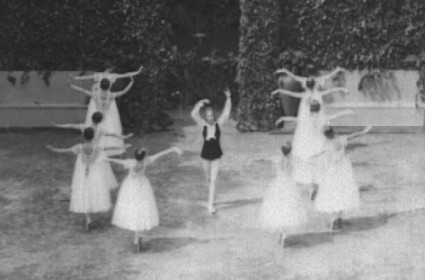
Jane Pritchard, co-curator of the Victorian & Albert Museum’s recent exhibition ‘Diaghilev and the Golden Age of the Ballets Russes, 1909-1929’ writes of the amazing discovery of the first known film of the Ballet Russes lurking in the British Pathé archive. Read more.

50 years of film studies
The Guardian film blog celebrates fifty years of film studies as an academic discipline. The pioneer lecturer was Thorold Dickinson (himself a filmaker of renown); the location was University College London; the pupils included Gavin Millar, Charles Barr, Raymond Durgnat and Lutz Becker. Read more.

Modern elephant taxidermy
Rich Remsberg unearths an extraordinary 1927 film from the American Museum of Natural History that shows you how to stuff an elephant. The taxidermist in question is the multi-talented Carl Akeley, also famed as a motion picture cameraman and inventor – the Akeley camera, with its gyroscopic head, was much used by wildlife filmmakers and newsreels. Read more.

Music for silents
An interesting interview with Ken Winokur of renowned silent film accompanists the Alloy Orchestra raises the issue of venues which insist on showing silent films silently, because André Bazin pronounced that any music accompaniment was mere nostalgia. Go to the Cinémathèque Française to watch your silents to the accompaniment of coughs and the occasional rumbling stomach, and I think most will vote for ‘nostalgia’. Read more.

Farewell to the Silent Movie Blog
For the past couple of years Christopher Snowden’s Silent Movie Blog has provided witty, well-researched and strikingly illustrated accounts of American silent film history. Sadly it is being closed down, and it is not clear whether the archive will remain online (all posts before July 2010 have been removed already). Read more.

And finally
The Bioscope is four years old today. Here’s the link to post number one – a single pithy sentence.

‘Til next time!

Bioscope Newsreel no. 10

I’m going to try and revive a neglected feature, the Bioscope Newsreel. It was an irregularly issued round-up of news stories on silent films that weren’t going to make it into fully-fledged posts, and in bringing it back to life I want to expand the brief a little to include interesting new pieces writing, blog posts etc. on our silent world (and its contexts). If I’m really good I’ll make it a weekly occurence, but I won’t commit myself to that just yet. Anyway, after a gap of just under two years, here’s issue number ten:

Films in concert
Films en Concert is a two-day silent film festival being held at the Salle André Malraux, Lambersart, France 4-5 February 2011. Featuring Chaplin biographer and Pordenone director David Robinson plus Pordenone pianists Neil Brand and Touve R. Ratovondrahety, the festival focusses on Chaplin with talks, screnings and a session for school children, plus Bébé and Bout-de-Zan comedies, Jacques Feyder’s Gribiche (1926) and Chaplin’s The Circus (1928). Read more.

Female Hamlet
John Wyver of the film and video production company Illuminations writes an excellent blog on film, art and culture. His latest post is on the Asta Nielsen Hamlet (1920), recently screened at the BFI Southbank, in which the great Danish actress plays the great Dane. An observant piece from a present-day producer of Shakespeare films (Hamlet, Macbeth). Read more.

Silent and white
Michael Hogan of The Daily Telegraph reviews the TV screening of The Great White Silence, Herbert Ponting’s 1924 documentary record of the doomed Scott Antarctic expedition. Interestingly the review doesn’t look upon the film as historically quaint but simply as a record of those events equivalent to any TV polar documentary. Read more.

Film and European copyright
The EYE Film Institute of the Netherlands has produced some Guidelines for Copyright Clearance and IPR Management for the European Film Gateway project. Viewing things from the European angle, the guidelines consider copyright basics, exploitation rights, moral rights, orphan works, clearing rights in related media (stills, posters), searching for rights holders and a summary of copyright law in various European countries (though not the UK). Read more.

Lost and significant
It’s hard to say what exactly is the appeal in describing films that no one living has seen, but the Shadowlocked site has an entertaining item on ’15 historically significant “lost” films’, most of which are silent, and include Saved from the Titanic (1912), The Werewolf (1913), A Study in Scarlet (1914) and that great Bioscope favourite, Drakula halála (1921). Read more.

‘Til next time!

Bioscope Newsreel nos. 8 and 9

newbooks

In a special double issue of the all too infrequently published Bioscope Newsreel, we bring you news of some of the books on silent cinema recently published or due for publication soon (publication dates are for the UK, please note). Some of these titles I’ll be writing on in greater detail later.

United Artists 1919-1950
Tino Balio’s United Artists: 1919-1950 – The Company Built by the Stars, to be published in April, recounts the history of the studio founded by Charlie Chaplin, Mary Pickford, Douglas Fairbanks and D.W. Griffith.

Shakespeare on Silent Film
At last a work to challenge Robert Hamilton Ball’s Shakespeare on Silent Film (1968), Judith Buchanan’s Shakespeare on Silent Film: An Excellent Dumb Discourse shows how the early cinema went about tackling high culture. It is published in May.

Weimar Cinema
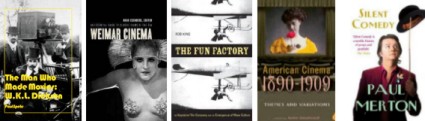
In Weimar Cinema: An Essential Guide to Classic Films of the Era Noah Eisenberg discusses sixteen iconic German films, silent and sound, made between the two world wars.

American Cinema
The Screen Decades is a series from Rutgers University Press, designed for course use and scholarly research. The first three volumes under American Cinema are André Gaudreault, American Cinema 1890-1909: Themes and Variations (yes, it does say 1890 as a start date); Charlie Kiel and Ben Singer, American Cinema of the 1910s: Themes and Variations; and Lucy Fisher, American Cinema of the 1920s: Themes and Variations.

Ghosts on the Somme
Alistair H. Fraser, Andrew Robertshaw and Steve Roberts have produced an intensive analysis of the classic 1916 documentary, The Battle of the Somme, investigating it in unprecedented depth and with many exciting discoveries. Ghosts on the Somme: Filming the Battle, June-July 1916 is published in March.

The Fun Factory
Academia takes on Keystone in Rob King’s The Fun Factory: The Keystone Film Company and the Emergence of Mass Culture, described as viewing “the changing politics of early film culture through the sociology of laughter”.

Film 1900
Klaus Kreimeier and Annemone Ligensa are the editors of Film 1900: Technology, Perception, Culture, a collection of essays which look at early cinema as media history, comparing its impact to that of the current digital revolution.

Stagestruck Filmmaker
The important connection between Griffith’s film career and his stage inheritace is dealt with in David Mayer’s Stagestruck Filmmaker: D.W. Griffith and the American Theatre, which explores early cinema’s theatrical roots. Published in March.

Silent Comedy
Paul Merton, the British comedian who is dedicated to introducing classic silent comedy to new audiences, has his book Silent Comedy published in paperbackin May to coincide with his new Silent Clowns tour.

The Man Who Made Movies
Paul Spehr’s magnum opus, The Man Who Made Movies: W.K.L. Dickson, is a enjoyable biography of the man who deserves more than anyone else the accolade of the inventor of cinema, and an exceptional technological history.

Picturing American Modernity
In Picturing American Modernity: Traffic, Technology, and the Silent Cinema Kristen Whissel takes an innovative look at early cinema in the context of turn-of-the-century American culture.

The Silent Cinema in Song
Ken Wlaschin’s The Silent Cinema in Song, 1896-1929: An Illustrated History and Catalog of Songs Inspired by the Movies and Stars, with a List of Recordings brings together songs about movies and moviegoing created between 1896 and 1929, biographies of the stars with the songs that were dedicated to them, and a discography with availability information.

‘Til next time!

Bioscope Newsreel no. 7

Bardelys on TV
Bardelys the Magnificent (1926), the recently-discovered King Vidor feature starring John Gilbert, will get its television premiere on France 3 on 12 October, as part of the Cinéma de Minuit strand. The film will also be appearing the same week on the big screen for the first time in eight decades at the Pordenone Silent Film Festival. Read more.

Conference call
The 30th Annual Meeting of the Southwest/Texas Popular and American Culture Association takes place 24-28 February 2009 at Hyatt Regency, Albuquerque, New Mexico. The meeting covers many aspects of cinema, and the Area Chair for Silent Film is seeking papers and presentations on any aspect of Silent Film. Suggested topics include D.W. Griffith’s art, Garbo, Modern Silent Films and Filmmakers, Bronco Billy and the Rise of the Western, Studios and companies during the silent age, The birth of Talkies, Al Jolson, Lillian Gish, Silent Documentaries, Silent Horror films, Hitchcock’s silent movies, Edison, Birth of Science Fiction and the Fantasy Film, Edwin Porter. Abstracts and titles should be sent by 15 November to Rob Weiner (Rweiner5 [at] sbcglobal.net). Read more.

Quasimodo rocks
Vox Lumiere, the enterprising troupe that puts on rock musical versions of silent film classics, is bringing its intepretation of Lon Chaney’s The Hunchback of Notre Dame to DPTV-Detroit Public TV in the USA. The production is scheduled to air in December as part of the PBS National Pledge Drive. Read more.

Memories of Lloyd
The Ghent Film Festival, which runs 7-18 October, is including a retrospective of Harold Lloyd comedies, under its ‘Memory of Film’ section. The films featured are Movie Crazy, Safety Last, Speedy, and the sound film Welcome Danger. Read more.

‘Til next time!