Looking back on 2010

Lillian Gish knows just what it’s like in north Kent, from Way Down East

The snows of winter are piling up in fantastic drifts about the portals of Bioscope Towers. Icy blasts find their way through every crack and cranny. Outside, civilization grinds to a glacial halt, and the end of the year now beckons. In the relative warmth of the Bioscope scriptorium, I’ve been thinking it would be a good idea to look back on what happened in the world of silent film over 2010. So here’s a recap of highlights from the past twelve months, as reported on the Bioscope (and in a few other places) – silent memories to warm us all.

There were three really big stories in 2010. For many of us, the most welcome news story of this or any other year was the honorary Oscar that went to Kevin Brownlow for a lifetime dedicated to the cause of silent films. The restored Metropolis had its premiere in a wintry Berlin in February. It has now been screened acround the world and issued on DVD and Blu-Ray. And there was the sensational discovery by Paul E. Gierucki of A Thief Catcher, a previously unknown appearance by Chaplin in a 1914 Keystone film, which was premiered at Slapsticon in June.

It was an important year for digitised documents in our field. David Pierce’s innovative Media History Digital Library project promises to digitise many key journals, having made a good start with some issues of Photoplay. The Bioscope marked this firstly by a post rounding up silent film journals online and then by creating a new section which documents all silent film journals now available in this way. A large number of film and equipment catalogues were made available on the Cinémathèque française’s Bibliothèque numérique du cinéma. Among the books which became newly-available for free online we had Kristin Thompson’s Exporting Entertainment, and the invaluable Kinematograph Year Book for 1914.

Among the year’s restorations, particularly notable were Bolivia’s only surviving silent drama, Wara Wara, in September, while in October the UK’s major silent restoration was The Great White Silence, documenting the doomed Scott Antarctic expedition.

We said goodbye to a number of silent film enthusiasts and performers. Particularly mourned in Britain was Dave Berry, the great historian of Welsh cinema and a friend to many. Those who also left us included Dorothy Janis (who starred in The Pagan opposite Ramon Novarro); film restorer and silent film technology expert Karl Malkames; the uncategorisable F. Gwynplaine Macintyre; and film archivist Sam Kula. One whose passing the Bioscope neglected to note was child star Baby Marie Osborne, who made her film debut aged three, saw her starring career end at the age of eight, then had a further ninety-one years to look back on it all.
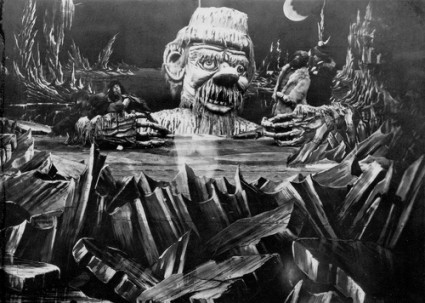
Arctic conditions in Rochester uncannily replicated in Georges Méliès’ A la Conquête du Pôle (1912)

On the DVD and Blu-Ray front, Flicker Alley followed up its 2008 5-disc DVD set of Georges Méliès with a sixth disc, Georges Méliès Encore, which added 26 titles not on the main set (plus two by Segundo de Chomón in the Méliès style). It then gave us the 4-DVD set Chaplin at Keystone. Criterion excelled itself by issuing a three-film set of Von Sternberg films: Underworld (1927), The Last Command (1928) and The Docks of New York (1928). Other notable releases (aside from Metropolis, already mentioned) were Flicker Alley’s Chicago (1927) and An Italian Straw Hat (1927), Kino’s Talmadge sisters set (Constance and Norma), the Norwegian Film Institute’s Roald Amundsen’s South Pole Expedition (1910-1912) and Il Cinema Ritrovato’s Cento anni fa: Attrici comiche e suffragette 1910-1914 / Comic Actresses and Suffragettes 1910-1914, while the Bioscope’s pick of the growing number of Blu-Ray releases is F.W. Murnau’s City Girl (1930), released by Eureka. But possibly the disc release of the year was the BFI’s Secrets of Nature, revealing the hypnotic marvels of natural history filmmaking in the 1920s and 30s – a bold and eye-opening release.

New websites turned up in 2010 that have enriched our understanding of the field. The Danish Film Institute at long last published its Carl Th. Dreyer site, which turned out to be well worth the wait. Pianist and film historian Neil Brand published archival materials relating to silent film music on his site The Originals; the Pordenone silent film festival produced a database of films shown in past festivals; the daughters of Naldi gave us the fine Nita Naldi, Silent Vamp site; while Kevin Brownlow’s Photoplay Productions finally took the plunge and published its first ever website.

The crew for Alfred Hitchcock’s The Mountain Eagle, ready for anything the elements can throw at them

Among film discoveries, in March we learned of the discovery of Australia’s earliest surviving film, the Lumière film Patineur Grotesque (possibly October 1896); in June we heard about a major collection of American silents discovered in New Zealand; and digital copies of ten American silents held in the Russian film archive were donated to the Library of Congress in October. That same month the Pordenone silent film festival unveiled the tantalising surviving frgament of F.W. Murnau’s Marizza, Genannt die Schmuggler-Madonna (1921-22). There was also time for films not yet discovered, as the BFI issued its Most Wanted list of lost films, most of them silents, while it also launched an appeal to ‘save the Hitchcock 9” (i.e. his nine surviving silents).

The online silent video hit of the year was quite unexpected: Cecil Hepworth’s Alice in Wonderland (1903) went viral after the release of the Tim Burton film of Lewis Carroll’s story. It has had nearly a million views since February and generated a fascinating discussion on this site. Notable online video publications included UCLA’s Silent Animation site; three Mexican feature films: Tepeyac (1917), El tren fantasma (1927) and El puño de hierro (1927); and the eye-opening Colonial Films, with dramas made in Africa, contentious documentaries and precious news footage.

2010 was undoubtedly the year of Eadweard Muybridge. There was a major exhibition of the photographer’s work at Tate Britain and another at Kingston Museum (both still running), publications including a new biography by Marta Braun, while Kingston produced a website dedicated to him. He also featured in the British Library’s Points of View photography exhibition. There was also controversy about the authorship of some of Muybridge’s earliest photographs, and a somewhat disappointing BBC documentary. In 2010 there was no avoiding Eadweard Muybridge. Now will the proposed feature film of his life get made?
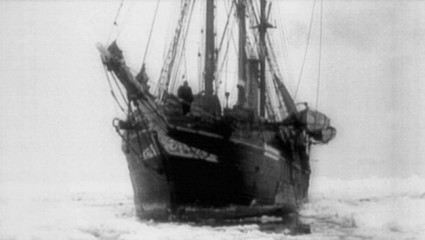
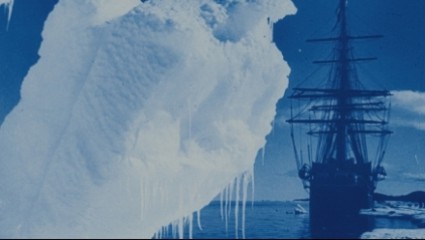
Ernest Shackleton’s ship Endurance trapped in the Medway ice, from South (1919)

It was an interesting year for novel musical accompaniment to silents: we had silent film with guitars at the New York Guitar Festival; and with accordions at Vienna’s Akkordeon festival. But musical event of the year had to be Neil Brand’s symphonic score for Alfred Hitchcock’s Blackmail (1929), given its UK premiere in November.

Noteworthy festivals (beyond the hardy annuals of Pordenone, Bologna, Cinecon etc) included the huge programme of early ‘short’ films at the International Short Film Festival at Oberhausen in April/May; and an equally epic survey of Suffragette films in Berlin in September; while the British Silent Film Festival soldierly on bravely despite the unexpected intervention of an Icelandic volcano.

On the conference side of things, major events were the Domitor conference, Beyond the Screen: Institutions, Networks and Publics of Early Cinema, held in Toronto in June; the Sixth International Women and Film History Conference, held in Bologna also in June; and Charlie in the Heartland: An International Charlie Chaplin Conference, held in Zanesville, Ohio in October.

It wasn’t a great year for silent films on British TV (when is it ever?), but the eccentric Paul Merton’s Weird and Wonderful World of Early Cinema at least generated a lot of debate, while in the US sound pioneer Eugene Lauste was the subject of PBS’s History Detectives. Paul Merton was also involved in an unfortunate spat with the Slapstick festival in Bristol in January over who did or did not invite Merton to headline the festival.

The art of the silent film carried on into today with the feature film Louis (about Louis Armstrong’s childhood), and the silent documentary feature How I Filmed the War. Of the various online modern silent shorts featured over the year, the Bioscope’s favourite was Aardman Animation’s microscopic stop-frame animation film Dot.
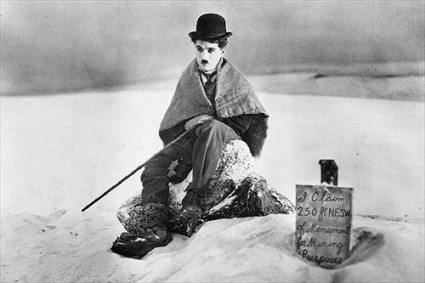
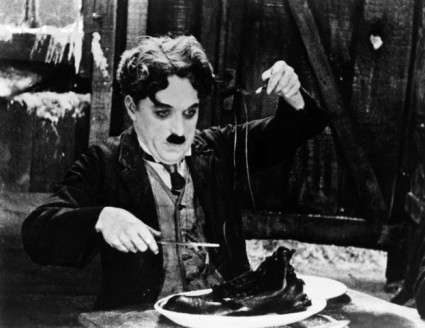
Charlie Chaplin contemplates the sad collapse of Southeastern railways, after just a few flakes of snow, from The Gold Rush

What else happened? Oscar Micheaux made it onto a stamp. We marked the centenary of the British newsreel in June. In October Louise Brooks’ journals were opened by George Eastman House, after twenty-five years under lock and key. Lobster Films discovered that it is possible to view some Georges Méliès films in 3D.

And, finally, there have been a few favourite Bioscope posts (i.e. favourites of mine) that I’ll give you the opportunity to visit again: a survey of lost films; an exhaustively researched three-part post on Alfred Dreyfus and film; the history of the first Japanese dramatic film told through a postcard; and Derek Mahon’s poetic tribute to Robert Flaherty.

It’s been quite a year, but what I haven’t covered here is books, largely because the Bioscope has been a bit neglectful when it comes to noting new publications. So that can be the subject of another post, timed for when you’ll be looking for just the right thing on which to spend those Christmas book tokens. Just as soon as we can clear the snow from our front doors.
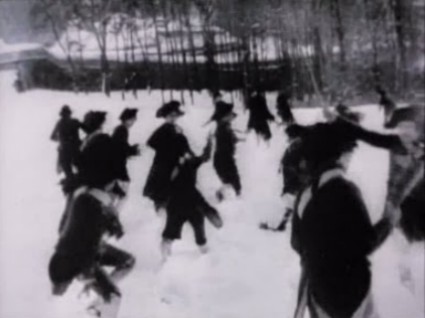
And one more snowy silent – Abel Gance’s Napoléon recreates the current scene outside Rochester castle, from http://annhardingstreasures.blogspot.com

Sounds of Britain – and beyond

Beau Geste (1926), from http://www.ronaldcolman.com

The 2011 British Silent Film Festival will be taking place 7-10 April 2011 at the Barbican Cinema, London. As was the case in 2009, the festival will run in conjunction with ‘The Sounds of Early Cinema in Britain’ conference, previously trailed on the Bioscope. The title of the festival will be Going to the Movies: Music, Sound and the British Silent Film. However, as one may judge from the programme highlights advertised so far, the festival is continuing the trend of the past few years of stretching beyond the confines of British silent cinema to look further afield – which I think is a good thing.

Here’s the descriptive blurb:

Music and sound in silent film will be our key themes during the four days of the 2011 British Silent Film Festival. A packed programme of rare silent films will explore how filmmakers communicated sound to cinema audiences through music and visual clues, what it was like to be in the audience of the ‘silent movies’ and how the British industry geared up for the talkies. Accompanied by the world’s best silent film musicians the programme will feature special events, presentations by special guests and unique archive film from the BFI, the Imperial War Museum and other collections.

Highlights will include

  • The Annual Rachael Low Lecture
    Delivered by Matthew Sweet, broadcaster and author of Shepperton Babylon, on stars, stardom and scandal in British silent cinema
  • Topical Budget is 100!
    Celebrating 100 years since the birth of the British newsreel with highlights from the Topical Budget series
  • ‘Only the Screen Was Silent’
    Luke McKernan, moving image archivist from the British Library, will talk about the experience of cinemagoers from the silent days using oral history material from the British Library and BFI
  • Cinema on the Fronts
    Toby Haggith will screen highlights from the Imperial War Museum collection showing how cinema addressed soldiers at the Front and their families back on the Home Front during the Great War
  • Radio on Film
    Bryony Dixon will present a selection of films looking at silent cinemas fascination with the birth of radio including radio Europa, Romance of the Postal Telegraphy, ‘I’ Got a Sweetie on the Radio’, Mr Smith Wakes Up, Bonzo Broadcasted and Wireless Whirl
  • In Sound and Silence
    Tony Fletcher presents a programme of popular classical music, opera and dance in the 1920’s and the various experiments in synchronous sound that recorded these performances
  • Transports of Delight
    A family programme of vehicular fun featuring trains, planes, automobiles and silent comedy
  • New Discoveries in British Silent Film
    Including Cecil Hepworth’s Helen of Four Gates (1921) starring Alma Taylor, rediscovered almost ninety years after it was believed destroyed and Walter Forde’s 1928 comedy What Next?
  • From Silent to Sound
    An illustrated presentation from Robert Murphy and Geoff Brown on the how British cinema made the transition from silent to sound cinema
  • Genre Film and Genre Music
    Neil Brand and Phil Carli discuss why high staccato strings means murder in cinema and how various musical themes developed during the silent period
  • Beau Geste (1926)
    Hollywood director Herbert Brenon’s adaptation of the best-selling British adventure story about the Foreign Legion starring the quintessentially English Ronald Colman
  • Twinkletoes (1926)
    US director Charles Brabin’s take on the British music hall starring Hollywood’s favourite flapper Colleen Moore
  • Lonesome (1928)
    Paul Fejos’s brilliant part-talkie where dialogue was introduced as a novelty in this story of two lonely people trying to find love in New York. The film features a fantastic jazz-fuelled parade in Coney Island
  • Morozko (1925)
    Yu Zhelyabuzhsky’s rarely seen Soviet fantasy about a stepdaughter who is driven out to face the spirit of winter is here presented with its original music score rediscovered and reconstructed for orchestra. Presented in conjunction with Sounds of Early Cinema Conference
  • I Was Born But … (1932)
    Ozu’s classic family comedy marks the very end of the silent period. As one of the greatest silent films ever made, it is screened here to celebrate the artistic excellence which the silent cinema had achieved

The Festival is organised in partnership with the British Film Institute. The conference is funded by the Arts and Humanities Research Council as part of its ‘Beyond Text’ programme, and organised in conjunction with Royal Holloway, University of London and the University of Edinburgh.

Well, that looks like an interesting mixture of usual suspects and unexpected suspects. Among the usuals, my contribution will hopefully be a bit more than just me talking about the experiences of filmgoers during the silent era – I plan to be putting together an entertainment of some sort. Anyway, riches a-plenty, and it’s always good news to learn that the festival has managed to survive another year – no mean feat in these straitened times.

More information will appear in due course on the British Silent Film Festival website.

Their films, our music

Gary Lucas playing to Dracula at the New York Film Festival, September 2010, with Carlos Villarias was Dracula, from http://www.garylucas.com

Will silent films survive? After the present generation of enthusiasts is gone, and now with almost no one left who remembers silent films the first time round, what impetus will there be in an age of HD, 3D, video games, home cinema, web video and mobile video to attract young audience to a silent, monochrome world filled with quaint manners, outdated narrative conventions and names that no longer hold the magic that once they had?

This issue was debated recently on the silent film discussion forum Nitrateville, and many interesting arguments were given for the survival of silent films. The great availability of silent films on DVD and Blu-Ray, the rude health (general global economic downturn notwithstanding) of some excellent festivals, the sheer fascination of viewing a past that recedes ever further away from us, scholarly investigation, the importance of book publications to inspire and intrigue, and the dedication of archives, all are cited as reasons for optimism.

I would add another, which is the silent film’s need for music. What is distinctive about the silent film as a medium is that it requires accompaniment by us. We have to add something of ourselves – our music, that is – to bring the films back to life. This performance imperative is not unique to silent films. Of course it applies to dramas, operas, indeed the music of the past. The playscript and the sheet music are the preserve of the expert until what they contain is given life through performance, is popularised. But what particularly distinguishes the silent film is that marrying of two forms of artistic expression – the film, and our music alongside it.

The Battle of the Ancre and the Advance of the Tanks (1917)

I experienced three illustrations of this last Sunday. It is surely strong evidence of the vitality of the medium that I was able to go to three very different screenings of silent films where the music was the real subject of interest in one city (London) on one day. I started off at Imperial War Museum to see The Battle of the Ancre and the Advance of the Tanks (1917). This documentary feature was made by the British goverment’s War Office Cinematograph Committee as the successor to the hugely successful The Battle of the Somme (1916), and the film – made by Geoffrey Malins, J.B. McDowell and Oscar Bovill – documents the later stages of the Somme conflict. While the film does not have the shock value or socio-historical resonances of the first film, it is more elegantly crafted and has shots of striking visual quality, in particular shellfire at night and iconic silhouetted figures against the sky.

The film depicts the routine of war in distinctively poetic terms. No other documentary medium can tell us so much about such engrossingly mundane details as soldiers donning thigh boots to fight off frost-bite, the wounded being given tea and sandwiches, and the ominpresent mud. It also features genuine footage (filmed at a distance with shaky camera) of troops going over the top and crossing no-man’s land. And of course it has tanks, which is what the public particularly came to see and which helped make the film a commercial success.

For the screening Toby Haggith of the IWM and pianist Stephen Horne had constructed the original ‘score’. As with their earlier project of The Battle of the Somme, there wasn’t a score as such, but rather a collection of musical suggestions for the different stages of the film, recommended in 1917 by musical director J. Morton Hutcheson. Horne has put together this pot pourri of popular tunes from the era, which was played by Horne himself (piano, flute and accordion), Geoffrey Lawrence (cornet), Sophie Langdon (violin) and Martin Pyne (percussion). The emphasis was on popular. Hutcheson had picked the pop hits of the day without much thought on their relevance to the film sequences they were to match, except for some association of names, though it was hard to fathom why a tune entitled ‘The Happy Frog’ had been chosen for a scene with a tank. As the film progressed so Hutcheson became more caught in the gravity of what was being shown and the music became of greater moment, but my abiding memory of the screening is of a line of howitzers shown to the sounds of a palm court orchestra with the occasional polite thud of the drum each time of of the guns fired. You did wonder what audiences made of such a musical mélange. Did it seem appropriate? Did it affect their view on what was on the screen? Did they hear differently to ourselves? Did they simply not pay it much attention?

This might seem to be the converse of adding our music to their films, but it is our modern taste to seek out authenticity in this way. Horne’s meticulous musical reconstruction took us that much closer to the past, while at the same time making the past seem all the more like the foreign country where things are done differently.

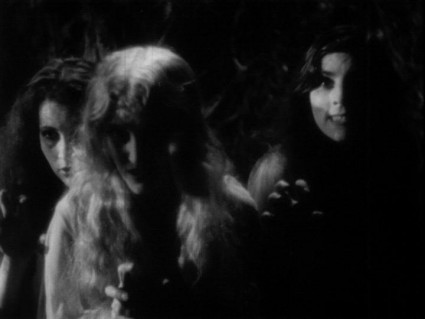
The brides of Dracula from the Spanish version of Dracula (1931), from http://www.garylucas.com

A few hours latter, and I was at the Queen Elizabeth Hall on the South Bank for two film screenings with live music that were part of the London Jazz Festival. This was something of a personal thrill as two of my favourite musicians were on the same bill. First up was guitarist Gary Lucas playing guitar to the Spanish version of Dracula (1931). This is the version of Tod Browning’s film that was shot on the same sets at night with a Spanish cast and director Geoge Melford. So yes it’s a sound film, albeit one with long stretches of silence and no background music except at the beginning and end. So why accompanying it with live music?

The effect certainly was jarring to begin with. Dialogue, translated titles and great swooping washes of electric guitar laden with effects pedals was a bit too much for the ears to take in all at once, but gradually you acommodated yourself to it, and Lucas’ wall of sound has proven itself an effective form of providing musical accompaniment to silents (notably his music for Der Golem) and now quasi-silents. He speaks through his guitar and his music is an expression of his enthusiasm for what is being shown on the screen. That’s the key point. It is not simply a rock musician doing his thing with a silent film (as others have done, often with painfully inapposite results). Enthusiasm for the film comes first, and with that an expression of that enthusiasm through his medium of choice – the electric guitar (two in fact). The result leaves the film still very much a 1931 film, but also one that connects through music with 2010.

The film itself is quaint, but while I wouldn’t say it was hugely superior to Browning’s original (as some have done), it shows invention and the sort of creepiness, except where adherence to the stage production drags it down. Carlos Villarias’s smiling Dracula drew laughter from the audience (I found him off-puttingly similar to Steve Carrell), but Pablo Alvarez Rubio (Renfield) played insanity as well as I’ve ever seen it done, and Lupita Tovar (Eva) was strikingly voluptuous.

Keystone, from http://www.davedouglas.com

The second film that evening was a silent film of sorts – a new work by experimental filmmaker Bill Morrison, who has enjoyed much acclaim for his work Decasia, composed out of found, distressed footage, which finds an otherworldly beauty in images in the process of decay. Morrison has continued to produced work in a similar vien, his latest effort being Spark of Being, inspired by the Frankenstein story, which he has developed with jazz trumpeter Dave Douglas. Douglas is building up a distinctive track record of silent film-inspired work with his band Keystone, though his modern jazz sound with strong beats behind it is better viewed as being inspired by the silents of Keaton and Arbuckle (subjects of earlier Keystone recordings) than ideal accompaniments to the films themselves.

The band came on stage – trumpet, saxophone, bass, drums, Rhodes and someone off-stage providing electronic noises – and played a punchy overture, then the film began. It was divided up into chapters (“The Captain’s Story”, “The Doctor’s Creation”, “The Creature Confronts His Creator” etc.) with the band accompanying what was shown on the screen. Morrison’s film is a mixture of distressed actuality footage and archive film, all of it silnet (or rather sound-less) including polar exploration (some of it Frank Hurley’s film of the Shackleton expedition), crowds (an amusing short sequence where people glower at the camera to signify public reaction to the Creature), two naked lovers running through woodland (““Observations of Romantic Love”) and a delightful sequence showing a Bavarian wedding projected at a slow speed that gave it a mesmeric quality). However, with the exception of the wedding, the archive film didn’t really convey the symbolic quality that was expected of it, and sometimes jarred with the bolder use of distressed footage. It was these sequences where the band seemed happiest, letting rip against a furious cavalcade of distorted images. On other occasions it seemed constrained by the need to follow the film, and one sensed that the audience would have been content just to have had the band play and never mind the film.

That’s a shame, because it was a bold coming together of experimental film and post-bop jazz, telling a familiar story in an imaginatively oblique fashion. And it was a modern silent film, given its own spark of being by Douglas’ music. I especially admire Douglas’ imaginative vision of the silent film as a springboard for musical invention, which has taken him from Keaton and Arbuckle’s Moonshine to Bill Morrison with the same band, Keystone. Certainly Sunday night would have comes as a surprise to Mack Sennett.

Silent films will survive for many reasons, but one of them is music. They are always going to sound new, to have a connection with our times, so long as we keep on re-imagining how we want to make them sound. It is a key to their enduring appeal to the imagination.

Spark of Being, from http://www.fest21.com

In a silent way

In our occasional discussions of jazz and silent film, particularly jazz / improvisatory guitar and silent film, we haven’t yet covered Marc Ribot. The guitarist whose edgy sounds are best known through his work with Tom Waits, recently released an album entitled Silent Movies. The album was inspired by his experience of playing live to Chaplin’s The Kid at Merkin Concert Hall in January 2010 as part of the New York Guitar Festival, though he has played to silent films before now (Giovanni Pastrone’s Il Fuoco in 2007, for example). Only one track on the album comes from that score, but all are about the experience of putting music to film. As it says on the record company’s website:

The album reflects Ribot’s fascination with movies and contains pieces intended to function as music for films: some are adaptations of music he has actually written for films, others for classic silent movies that he scored for his personal amusement, still others for films of his own imagination. His goal is to explore, as he says “the strange area between language and spatiality that exists partly in between music and visual image, and partly as a common property of both.”

Contrary to other solo guitar forays by Ribot, where “bracing atonality or studies in texture” prevail, Silent Movies is – we are promised – “replete with beautiful melodies and quietly wistful playing”, with Ribot commenting on the CD liner notes that the project ““did indeed have the feeling of having walked backwards into the beautiful frame of a silent movie.”

All of which sounds rather pleasant, and is still further evidence of the new interest some in the jazz world are finding in silent films. Of course, we who attend silent film shows are used to improvised music where the musician works as much to the themes on the screen as the musical themes. It’s seldom what you would call jazz if you listened to it without watching the screen, but the same spirit – exploratory yet disciplined – pervades.

There’s an article in the current Jazz Times (available online) which rounds up some of the recent comings-together of jazz and silent films, each of which has been covered by the Bioscope. Apart from Marc Ribot, there’s Dave Douglas’ Keystone project (covered here, plus his new work Spark of Being with filmmaker Bill Morrison here), guitarist Bill Frisell’s tributes to Buster Keaton (covered here), and billionaire filmmaker Dan Pritzker’s film Louis, made as a silent film and performed live with a Wynton Marsalis score (covered here). Not covered in the article is the work of Gary Lucas, a guitarist whose works hovers between jazz and the avant garde (covered here).

Trailer for Dan Pritzker’s Louis, with Wyonton Marsalis’ music

What other examples are out there? Trombonist Wycliffe Gordon played his part-composed, part-improvsed score for 16-piece big band for Oscar Micheaux’s Body and Soul (1925) at the National Black Arts Festival in July. Guitarist Alex de Grassi has been playing to Yasujiro Ozu’s A Story of Floating Weeds (1934), while last month saxophonist Javon Jackson premiered his score for Alfred Hitchcock’s The Lodger at the Syracuse International Film Festival. Saxophonist Courtney Pine produced a score for the BFI DVD release of Kenneth Macpherson’s experimental feature Borderline (1930). Clarinettist Louis Sclavis scored Charles Vanel’s Dans la nuit (1929). Another clarinettist Don Byron has scored for another silent film designed for black audiences, Frank Peregini’s The Scar of Shame (1927). And another guitarist, Henry Kaiser, has played to Kinugasa Teinosuke’s A Page of Madness (1926). Finally, avant jazz musician Jan Kopinski has scored and played for a number of silent films, including Nosferatu, Safety Last and The Seashell and the Clergyman.

Any more examples?

Carl Davis and The Gold Rush

Here’s news of a special screening of Charlie Chaplin’s The Gold Rush on 3 January 2011 at the Royal Festival Hall in London, with Carl Davis conducting the Philharmonia Orchestra in his reconstruction of Chaplin’s own score:

The Philharmonia Orchestra, conducted by Carl Davis, plays a live accompaniment to Charlie Chaplin’s silent film The Gold Rush in this special performance at The Royal Festival Hall on 3 January 2011, as part of the Southbank Centre’s Christmas season.

Featuring Chaplin in his quintessential Little Tramp role, the film was described by The New York Times upon its 1925 release as ‘a comedy with streaks of poetry, pathos, tenderness, linked with brusqueness and boisterousness … the outstanding gem of all Chaplin’s pictures’. The Gold Rush is one of Chaplin’s most perfectly accomplished films. Though he was often changeable in his affections for his own work, he would often declare that of all his films, this was the one by which he would most wish to be remembered.

Chaplin reconstructed the film in 1942 upon the advent of sound to the cinema, removing scenes (most famously eliminating a kiss with the leading lady at the end so as not to upset his wife!) and recording a musical score, which was nominated for Academy Awards.

This concert revisits the original 1925 comic masterpiece, with a score reconstructed and conducted by Carl Davis, who accessed archives of Chaplin’s meticulous notes and found sketches of music for the removed scenes.
It is ten years since The Gold Rush was last performed in London, also at the Royal Festival Hall.

Carl Davis (CBE) was born in New York in 1936 and came to the UK in 1960. Davis is a true music-maker and all-round musician, as both conductor and composer. He has changed the face of concerts as we know them, making classical music both accessible and varied and is a consummate showman and a first rate entertainer. His career has spanned many genres, from silent film performances to his incredible popular themed concerts such as ”An Evening with James Bond” and “Oscar Winners”. He is perhaps most well known for his music for television including the series The World At War, BBC’s Pride & Prejudice and Cranford, ITV’s Goodnight Mr. Tom, and the award winning film, The French Lieutenant’s Woman.

Davis has also been the driving force behind reinventing the silent movie for a new generation. Following his work on Thames Television’s 1980 “Hollywood – A Celebration of the Silent Film” series, he created the classic and much-lauded five hour symphonic score for Abel Gance’s 1927 silent epic “Napoleon”. Since then, he has written or reconstructed scores for some of the most famous pre-talkies such as “The Phantom of the Opera” and “The Iron Mask”, as well as many of Chaplin’s most famous movies such as “The Kid”, “Modern Times” and “The Rink” which have been performed all over the world.

Monday 3 January 2011, Royal Festival Hall, 7pm
Carl Davis, conductor
Philharmonia Orchestra
Charlie Chaplin The Gold Rush
Tickets: £20–£45
Ticket Office: 0871 663 2500
Online booking: www.southbankcentre.co.uk

More information and booking details (including some pricey tickets folks, but heck, it’s near Christmas) on the South Bank Centre site.

Blackmail at the Barbican

Extract from Neil Brand’s orchestra score of Alfred Hitchcock’s Blackmail

Your scribe journeyed last night to the vasty cavern that is London’s Barbican Hall to witness something of a landmark event – the first British silent drama to be newly scored for full orchestra since the advent of the sound film. The film was Alfred Hitchcock’s Blackmail (1929), the score was by Neil Brand, the orchestrator and conductor was Timothy Brock, and the music was played by the BBC Symphony Orchestra. (The qualification of ‘silent drama’ needs to be added, because the documentary The Battle of the Somme (1916) was given the full orchestral treatment back in 2006, with score by Laura Rossi, played by the Philharmonia Orchestra at the Queen Elizabeth Hall in London.)

Blackmail has a place in every film history book as the ‘first’ British sound film (it all depends on how you define things as to whether you agree with that or not), but a silent film version was made virtually the same time and with almost the same cast, for all those cinemas that had yet to convert to sound. For many years the silent version was forgotten about, but screenings in recent years have brought it increasing recognition, to the point where we are ready to agree with Hitchcock himself that the film is superior to the sound version. Whether it is Hitchcock’s best silent film is a matter for debate, but it certainly shows his mastery of the silent film form. It flows along with an easy, artful flow; it is choc-a-bloc full of memorable pictorial compositions; and it sets up complexities of relationships and moral dilemmas that make one disappointed when the film ends relatively tamely, albeit with hero and heroine nurturing their guilty secret that is left strikingly unresolved.

Anyway, back to the show, which was pretty much a triumph. Neil Brand’s score is lush and loud, filled with a tense energy and engrossing musical ideas. It was not an obviously ‘silent era’ score but instead consciously echoed the Hitchcock scores of later years from Bernard Hermann and Miklós Rózsa. It was knowing in other respects, with some great musical jokes such as the Alfred Hitchcock Presents theme when Hitch makes his customary cameo, as a passenger on an Underground train, or the introduction of the Dixon of Dock Green theme tune (for our younger and non-British readers, this was a British TV series of yesteryear with a rather cosy view of policing). The orchestra was on fine form, indeed enjoying itself, while conductor Brock had to demonstrate pin-point precision to make sure the orchestra hit its cues for such key points as door bells ringing, or laughter-like sounds when the creepy painting of the jester is shown.

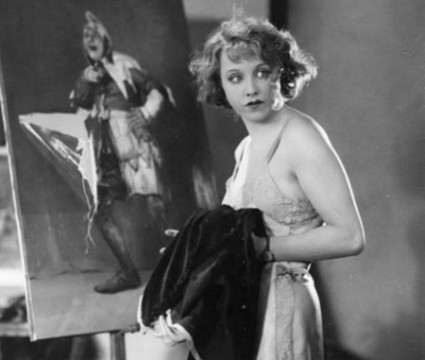
Anny Ondra as Alice White in Blackmail

The score for Blackmail was commissioned and premiered at Il Cinema Ritrovato in Bologna in 2008 and it has taken two years of pleading and negotiating to get it shown in London, for which Neil deserves quite as much praise as he does for having written the score in the first place. A debate which took place after the screening, with Neil, Timothy Brock, the BFI’s silent film curator Bryony Dixon, and omnipresent film guru Ian Christie, raised some interesting issues but didn’t quite address the matter of whether this would be both the first and the last British silent drama with full orchestra score to be shown since the silent era. Will other films follow?

The screening had been enthusiastically introduced by film critic (and occasional silent film accompanist) Mark Kermode, who called for more British silent films to be seen, pointing out the great work that the BFI has done in championing this largely forgotten corner of film history. The idea of a full orchestral score for any British silent would have seemed ridiculous only a few years ago. Now a growing wave of critical interest has provided us with a number of strong candidates: Shooting Stars, Underground, Piccadilly, Moulin Rouge, Hindle Wakes, The First Born, A Cottage on Dartmoor, The Lodger, The Ring and several more.

I’m not particularly a fan of orchestral scores for silent film myself. I prefer the improvising pianist or the small ensemble. But the big gesture brings in the big audiences. Although the Barbican Hall wasn’t completely full last night, it was fairly full, and there were several hundred people there who would never have seen a silent film with live orchestra before – or indeed with any form of music – and a good many of them had been made enthusiastic converts to the cause, to judge from the applause and the conversations I overheard afterwards.

The Carl Davis scores to Photoplay prints of the 1980s were media events. They generated popular interest and a general understanding of what silent films could be. They created a momentum which drove support for silent films, though that momentum has died down in recent years. Unfortunately orchestral presentations do not come cheap, and silent film screenings are viewed as a risk by programmers outside of specialist cinematheques. But it only takes one or two successful events to build up audience understanding and a thirst for more. The idea of rediscovering unknown British silents films, of reclaiming a neglected history, has strong appeal. Blackmail could point the way forward – because the audience is there.

The silent Blackmail is available on DVD from Arthaus in Germany. (Not with the Neil Brand score, fairly obviously)

The great white silence

Trailer for the BFI National Archive restoration of The Great White Silence

Last night I attended the premiere of The Great White Silence at the London Film Festival. The Great White Silence is a documentary feature, released in 1924, which documents the expedition of Captain Robert Falcon Scott to reach the South Pole. He of course failed, and died with four companions on his wretched journey back from the Pole, having discovered that he had been beaten into second place by Roald Amundsen’s Norwegian party.

But Scott had romance on his side. He left behind a diary of exceptional artistry and poignancy, which helped enshrine his legend and turn vainglorious failure into the epitome of noble, patriotic self-sacrifice. And he had ensured that future generations would become engrossed in his story through what they could see as well as what they could read. Herbert Ponting (1870-1935) was taken on as expedition photographer and cinematographer, both for documentary purposes and because the sale of photographic and cinema rights helped pay for the expedition (40% of the profits from the films’ exhibition went to the expedition, 40% to the Gaumont company for producing and distributing the film, and 20% to Ponting).

Ponting was a still photographer of renown, who had done notable work in Japan. But he had never handled a cine camera before. He turned out to be a cinematographer of uncommon ability. Kevin Brownlow pays him the highest of accolades in The War the West and the Wilderness by comparing his work that Mary Pickford’s cinematographer:

Herbert Ponting was to the expedition film what Charles Rosher was to the feature picture – a photographer and cinematographer of unparalleled artistry.

Herbert Ponting achieved work that was exceptional in every degree. It was exceptional in image quality, exceptional in the way it overcame the difficulties of filming in extreme conditions when cinema technology was still in its infancy, exceptional as a documentary record.

Iconic image of the Terra Nova, from The Great White Silence

The BFI National Film Archive has restored the 1924 feature because the footage no longer survives in the original forms in which it was released. The release structure of Ponting’s films was determined by the nature of the expedition and a need to keep up audience interest over the two years that the expedition would take. Ponting joined Scott’s ship the Terra Nova in New Zealand in November 1910. He took an initial 15,000 feet of negative film with him, along with Prestwich and Newman Sinclair cine cameras (the latter’s manufacturer Arthur S. Newman gave Ponting intensive instruction in its use, and added special ebonite fittings to prevent Ponting’s fingers from freezing to the camera). He shot and developed 8,000 feet of this on site (Cape Evans) before the Terra Nova returned to New Zealand in January 1911. This film was delivered to Britain, and edited by Gaumont into a 2,000 foot release (lasting around 30 minutes) entitled With Captain Scott, R.N. to the South Pole. This was first exhibited in November 1911. Ponting’s second batch of film was released by Gaumont as the ‘second series’ of With Captain Scott R.N. to the South Pole, into two 1,500 foot parts, first shown in September and October 1912 respectively, and which featured the final scenes of the polar party, included sequences where they demonstrated sledge-hauling and life inside their tent. By this time Scott and his final polar party were all dead, and news of Amundsen’s success in reaching the pole first dented the film’s commercial appeal. One of the most haunting passages of The Great White Silence is where four of the final five-man party illustrate how they were going to journey across the ice, including scenes of them huddled together for warmth in a tent. Scott, Birdy Bowers, Edward Wilson and Edgar Evans – but not Titus Oates – all appear in a sequence which was produced in anticipation of triumph but now looks like an uncanny intimation of their fate.

The tent scene from The Great White Silence, with (left to right) Evans, Bowers, Wilson and Scott

The bodies were discovered in November 1912 and the news reached the outside world in February 1913. Ponting then began to devote his life to the promotion of the Scott legend, and to the recouping of his investment, because in 1914 he purchased all rights in the film from Gaumont for £5,000. This he did against a waning audience interest, and much of the bitterness that Ponting was to feel in his latter years was due to the public’s insufficient awe at a story which he progressively built up and romanticised, as the Scott story evolved into myth. The films were re-edited and released in 1913, after Scott’s death had been reported, as The Undying Story of Captain Scott.

Ponting then lectured with the films constantly, giving a Royal Command performance in May 1914, where King George V declared that:

I wish that every British boy could see this film. The story should be known to all the youth of the Nation, for it will help to foster the spirit of adventure on which the Empire was founded.

He continued to show his films throughout the First World War, emphasising the call to patriotic sacrifice, but now to dwindling audiences. In 1924 Ponting re-edited the films once more as a feature-length documentary, The Great White Silence, which followed on from the 1921 publication of his book The Great White South. The film was 7,000 feet long (around two hours in length), and released by the New Era company. Reviews were complimentary, marvelling at the hardships endured, and praising both the film’s patriotic virtues and “extremely clever studies of Antarctic life”, while pointing out (a little meanly) that the final scenes were, of necessity, heavily dependent on still pictures, diagrams and intertitles. Scott’s adventures were already of another age, and the film was not a notable success.

Ponting failed in his subsequent attempts to sell his films to the nation, an appropriate film archiving body not existing at that time, and in 1933 he produced a sound version of his films, now entitled 90º South, released by New Era once again, and whittled down to 75mins. Ponting himself provided the film’s commentary, and years of lecturing to these images tell in his polished and succinct words. This time the reviews were more enthusiastic, as reviewers newly aware of the documentary as an art form rightly praised Ponting’s artistry.

90º South is the form in which we have been familiar with the footage in recent years, because the BFI did not have a complete viewing print of The Great White Silence. But with material from a release print held in the Netherlands, and with reference to Ponting’s uncut footage, an exceptional restoration has been produced. The images really do look like they were shot yesterday. The clarity of the faces of the explorers – Wilson, Evans, Bowers, Oates and the rest – is a revelation. The grading is a tour de force. Perhaps most notable is the colour tinting, introduced digitally by following Ponting’s own instructions (written onto gaps in the original footage), which results in the familiar polar scenes unfolding in strange, otherwordly amber, blues and greens. We see the familiar anew.

The film itself is not a documentary as we now expect. It was probably released by Ponting because he had been encouraged by the success of Robert Flaherty’s Nanook of the North (1922), but if that film ushered in the new form of documentary filmmaking, Ponting’s film is the ultimate expression of an older form of documentary, one with its roots in the magic lantern lecture. Ponting was a practiced lantern lecturer before he joined Scott, and entertained the expedition party with lantern shows during the Antarctic winter. Throughout his work on the Scott expedition, Ponting imagined how he would present such scenes to an audience back home, and selected, composed and arranged his material accordingly. This included a marked emphasis on animals, particularly penguins (inevitably), to what seems to us the surprising detriment of the human story, but Pointing knew his market and he balances his material admirably. Certainly the 2010 audience seemed as engrossed in seals, penguins, killer whales and skuas, and as susceptible to their anthropomorphic appeal, as those in 1912.

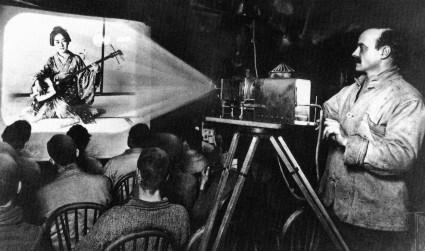
Herbert Ponting giving a magic lantern show on his Japanese travels for members of the Scott expedition

Once Scott had died and Ponting went on the road with the films, he lectured to them – and his hundreds of still photographs – literally hundreds of times. This experience is readily evident in The Great White Silence. The intertitles chat to us in familiar style; Ponting (the titles are written as though it is he speaking to us) points out things for us to look at, his words guide our eyes and our thoughts. He knew how to engage an audience, and he suceeded all over again in 2010. The film is a mixture of footage, photographs and intertitles, and is in effect a lecturer’s show with his words transferred to the intertitles. The slideshow effect reaches its height in the last half hour of the film, when there is no more footage (because Ponting did not travel with Scott into the Antarctic interior) and so all that he can use are photographs, passages from Scott’s diaries, and quaint but moving model animations showing ant-like sledges moving over the polar wastes. Scott’s diaries have barely lost their power to move even in this cynical age, and the film’s ending left the audience breathless, the final scenes accentuated by a solo voice singing ‘Abide with me’.

Ah yes, the music. The film was accompanied by a ‘soundscape’ by composer Simon Fisher Turner which combined strings (more plucked and scraped than bowed) with electronica, gramophone recordings from the time, recordings of banjo music, Terry Riley-ish sequenced keyboard music, singing, and at one disconcerting point a modern voice speaking in Scott’s hut from earlier this year. You can experience some of the electronica on the YouTube clip at the top of this post. The ‘music’ was clearly greatly appreciated by many in the audience, so I shall refrain from commenting as severely as I might. I shall say just this – the point of musical accompaniment for a silent film is to draw attention to the film, not to draw attention to the music. I’m all for imaginative forms of silent film presentation, but last night’s accompaniment drew far too much attention to itself.

The Great White Silence is going to be given the works when it comes to exhibition. A DVD and Blu-Ray release is planned for next year, it will be screened on the Discovery channel, and it is going to get a theatrical release in the UK. So, amazingly, we will have had Metropolis screened in many UK cinemas in 2010, and The Great White Silence at your local fleapit (who knows?) in 2011. These are remarkable times for silents, and The Great White Silence is a remarkable film. See it if you can – you are certainly going to be presented with every opportunity to do so.

The BFI Live channel has a fascinating short documentary on the technicalities of the film’s restoration. (It’s also available on yourdiscovery.com)

Some of the text of this post is adapted from an essay I wrote, The Great White Silence: Antarctic Exploration and Film’, in South: The Race to the Pole (London: National Maritime Museum, 2000).

Bob shows Intolerance

Well I’m back from Pordenone, with plenty of stories to tell, and all in good time there will be the Bioscope’s Pordenone daily diary for your delectation. But a week is a long time in ther world of silent movies, and much of interest has been happening. So we’ll be having a few quick-fire news items, starting off with what for me is the pick of the bunch.

Bob Dylan has revealed a novel opening act for his new tour – he is showing twenty minutes of D.W. Griffith’s Intolerance (1916), shown completely silent. At Dylan’s shows at Fort Lauderdale (6 October) and at the University of South Florida, Tampa (7 October), the opening two nights of the tour, the film played as the audience were finding their seats. The Bob Links site provides this startled reaction from ‘Tampa Steve’:

How many concerts have you been to where there was no pre-recorded music played before the show? None? Same here. How many have you been to where 20 minutes of a silent film (Intolerance, from 1916) was played (silently) before the show? None! Welcome to the current Bob Dylan tour. The usual pre-party atmosphere of a big arena filled with concertgoers was deftly subverted by this simple dashing of expectations. Then, at the appointed hour, the house lights dimmed and the band strode onto the stage. Dylan waited 5 seconds, then sauntered out, too. Classy! The USF Sun Dome was less than half full at the time.

Dylan then came on stage and played ‘Leopard Skin Pillbox Hat’, though on the first night it was ‘Rainy Day Women #12 & 35’, which perhaps offers a more obvious link to the film’s title (“Well, they’ll stone ya when you’re trying to be so good…”). Which section from Intolerance is being shown is not certain, the fans on the Dylan forums being unclear on this point so far, but presumably it’s the Babylon sequence.

Whether Dylan will continue to show this new reverence for silent film remains to be seen – he has long taken to dropping references to films in his song lyrics, but never as far back as the silents, so far as I know. However, he does have a personal connection of sorts to Intolerance. In 1997 he was the recipient of the annual Dorothy and Lillian Gish Prize, which was established by Lillian Gish (who plays The Eternal Mother in the film, of course) in her will to be awarded to “a man or woman who has made an outstanding contribution to the beauty of the world and to mankind’s enjoyment and understanding of life.” There is a biography of Dylan and other details on the Gish site.

Sound Workshop

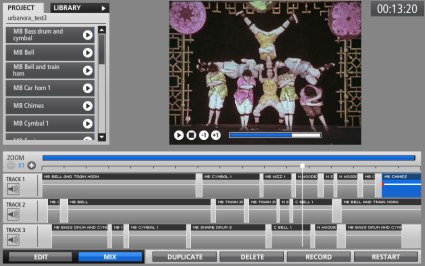
Adding a soundtrack to Les Kiriki – Acrobates japonais (1907) with Sound Workshop

Now this is fun. Europa Film Treasures, the online collection of film titles from archives across Europe created by Lobster Film Productions has introduced a new online tool, Sound Workshop, with which you can produce your own soundtrack for one of their silent films.

The site (developed in partnership with Court-Circuit, an Arte programme dedicated to short films) is a free service that offers you clips from seven films on the Europa Film Treasures site. You can then select from a wide range of sounds (under four categories: cartoon, sound effects machine, natural or science fiction), music (three ragtime tracks only) or sounds that you have uploaded yourself (if you have registered with the site). Sounds available include birds singing, car horns, percussion instruments, water running, whizzes and whooshes, fire alarms, telephones, doors opening, boings and crashes. Having made your selection, you are presented with a sound mixing page (see above) where you can drag and drop your sounds onto three tracks. Anyone can select the sounds and play back the finished video, but only registered users can save the results and have it made available on the site’s gallery.

The Bioscope had a go with a short sequence from Les Kiriki – Acrobates japonais (1907), a marvellous trick film with gorgeous stencil colour by Segundo de Chomón featuring a troupe of acrobats achieving impossible feats. My efforts aren’t going to put any silent film musician out of a job, but you’ll get the idea (it’s listed under Urbanora), or test out the interesting range of efforts from other users available on the gallery and add comments if you feel so inclined.

Should you want to have a go yourself, do note that the films take a little while to load before you can start playing with them. You can test the sounds beforehand by clicking (and holding down the click) on the arrows for each sound option, and having played back the results you can re-edit before recording. When you have made a recording it doesn’t appear automatically on the site – it took some hours for my video to be published, probably because I created it late in the evening. It appears that the work is done by real humans (‘your results will be put online by our team soon’ it says when you have clicked ‘record’), which seems bizarrely laborious in this day and age. Also I submitted more than one video, but only one made it to the gallery. It all feels a little bit uncertain.

Sound Workshop is a bright idea, if a little creaky in execution. Nevertheless, praise is due once again to the consistently imaginative folk at Lobster for coming up with a new way to engage audiences with silent films and to demonstrate just what new opportunities exist for such content once it exists in digital form and online.

Frankenstein versus Dracula

Sometimes circumstances throw up the perfect title for a blog post, and you just have to run with it. And what if circumstances were then to put a cherry on it by bringing together two of the Bioscope’s favourite musicians in an unexpected coming together of jazz, outré electric guitar and silent film? Well, that’s what we’ve got with the news that trumpeter Dave Douglas and guitarist Gary Lucas will be appearing not alongside one another but in competition at this year’s London Jazz Festival, as they present their respective musical takes on the Frankenstein and Dracula stories. The event is billed as Frankenstein V Dracula: Gary Lucas plays Dracula > Dave Douglas & Keystone re-imagines Frankenstein, and it takes place at the Queen Elizabeth Hall at the South Bank Centre, London, on 21 November 2010.

Dave Douglas (left) and Gary Lucas, from www.londonjazzfestival.org.uk

Dave Douglas‘s adventures in silent film have been documented by the Bioscope on several occasions. One of the many outlets for his musical energies is the group Keystone, which as its name might suggest takes its inspiration from American silent comedy, though the music tends more towards ‘inspired by’ rather than serving as conventional accompaniments to the films of Arbuckle and Keaton that have formed the basis of Keystone forays so far. Douglas’ experimental leanings and use of turntables might not be everyone’s idea of silent film (or jazz, for that matter), but all I can say is that you just have to witness it live when it all makes sense.

Keystone embraces silents overall rather that just the Mack Sennett studio, and Douglas’ latest Keystone project ventures into modern silents, while coinciding with the centenary of notable silent horror film. Spark of Being is a re-imagining of the Frankenstein story that he has devised with experimental filmmaker Bill Morrison (he of the acclaimed Decasia, a haunting art film made out of decaying nitrate clips of silent films). Their project appears in the centenary year of the 1910 Edison Frankenstein film, and they initially considered calling their work Frankenstein: The First 100 Years. The Edison film is a legend in film collecting circles after the one surviving copy was jealously guarded by the late Alois Dettlaff for many years. When Dettlaff finally made the film available to all there was astonishment at how accomplished, indeed horrific it was – a tour de force of the imagination. Charles Ogle plays the monster, the director was J. Searle Dawley, and you can view it on the Internet Archive (ripped from a DVD, so we won’t be embedding it, but it’s there so you are going to find it anyway).

Trailer for the Spark of Being project

Spark of Being started out as an event at Stanford University in April this year. Morrison worked with new, archival, and ‘distressed’ footage, while Douglas and his band supplied the score. The music has now been issued as a single and boxed set CD, and there is the live show with music and film featuring at the London Jazz Festival (and across Europe throughout November).

Gary Lucas is a rock guitarist with avant garde leanings (he started out playing with Captain Beefheart). He has accompanied silent films on several occasions, most notably for The Golem, which he has taken around the world. Other silents given the Lucas treatment (which veers between ambient sounds and dazzling pyrotechnics) are The Unholy Three, J’Accuse and his Sounds of the Surreal set (three films by Clair, Leger and Starewicz). For the London Jazz Festvial his choice isn’t a silent, but it is virtually so. It is the celebrated Spanish version of Tod Browning’s 1931 Dracula, which was discovered in Cuba in the 1980s. Made at night at the same time, on the same set and with the same script as the Bela Lugosi version, the film was directed by George Melford and stars Carlos Villarias as Dracula and Lupita Tovar as Eva.

Gary Lucas accompanies the Spanish-language Dracula (1931) at the Havana Film Festival, 11 December 2009

Though the film has Spanish dialogue, there are long stretches where it is effectively silent, giving Lucas ample space in which to introduce his score, which he has been touring since 2009. The London event will feature Lucas and Dracula first (18:00-19:45), then Douglas and Spark of Being (20:05-21:30). The event is being produced in association with BBC3, so presumably we can look forward to some form of television broadcast as well. At any rate, a gobsmacked Bioscope will be there.

There is more information on both projects at the Dave Douglas and Gary Lucas websites.