Musical accompaniment of moving pictures

Rose of the World cue sheet

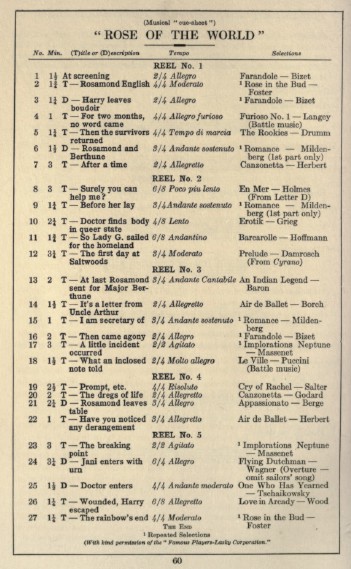
The latest addition to the Bioscope Library is Edith Lang and George West’s Musical Accompaniment of Moving Pictures (1920). This is a guide for pianists and organists in the silent era, with plenty of musical detail (‘Musical Characterisation’, ‘Transition and Modulation’, ‘Improvisation’) and practical advice (“The player will do well, first of all, to ‘size up’ his audience”), with repertoire suggestions. It is also wide-ranging in the kinds of films it advises on – not only feature films, but animation, slapstick comedies, newsreels, travelogues and even educational films. There is particular discussion, with music cue sheet (illustrated), of the Maurice Tourneur five-reel film Rose of the World (1918). The book gives special attention to the theatrical organ. It’s available from the Internet Archive in PDF (27MB), DjVu (2.6MB) and TXT (139KB) formats.

Keystone revisited

Keystone live

The Bioscope has been taking a short break while I’ve been holidaying in Ireland, but one of the reasons for going was to see Dave Douglas and his Keystone sextet play at the Bray Jazz festival. As reported in an earlier post, jazz musician and composer Dave Douglas was inspired by the films of Fatty Arbuckle to release a CD (with accompanying DVD) in 2005 entitled Keystone, which is perhaps rather more his response to the happy anarchy of Arbuckle’s films and his sad fate rather than music to accompany the films. As it is, the concert – which was utterly superb, exuberant modern jazz of the highest order – didn’t feature Arbuckle’s films at all, as had been trailed, so whether it all works in a live setting I cannot say (the DVD that goes with the CD suggests not). Some of the set was inspired by Arbuckle and Keaton’s The Rough House (1917), though the bit with just trumpet and turntables intercutting between an Iraqi woman singing and George Bush uttering the word ‘terrorist’ suggests that Douglas takes his interpretation of Arbuckle’s work quite broadly.

Anyway, the set will eventually be recorded for a follow-up Keystone CD, but in the meanwhile there’s a live CD now available of his previous Keystone set, recorded in Sweden in 2005. Here’s the blurb from the CD site:

In a brilliant stroke of tour routing, this gig at the Umea Jazz Festival in northern Sweden was immediately preceded by the San Francisco jazz festival in California and followed by one in Cormons, Italy. Nonetheless everyone came ready to play. The Keystone sound really came together here: sloppy and wild, but also focused, lyrical, delicate, and at times simply bizarre. Also, like the films it was written to, it was a lot of fun. The concert began with a showing of Fatty and Mabel Adrift, Roscoe Arbuckle’s 1915 three-reeler, probably the first (and finest?) surreal comico-psychological thriller drama. Next, we played the three main themes from my score for Mabel and Fatty’s Wash Day (in which the perennial slapstick potential of the laundry line is used to address some semi-serious marital issues) without accompanying the film. Finally, as an encore, we played Luke the Dog, written to the heroic canine suspense vehicle, Fatty’s Plucky Pup. Though we edited the chit chat and whatnot, this is the way the gig was played.

The man certainly knows and loves his Arbuckle. See you back in Blighty very soon.

Paul Merton on tour

Paul Merton

[Note: This is the 2008 tour – for the 2009 tour dates, click here]

These are the dates I’ve traced for Paul Merton’s Silent Clowns show, which will be touring the country later this year when his book Silent Comedy is published. The links are to booking details at each of the venues. I’ll add more if I find them (there are 22 dates in all). Neil Brand will be providing the piano accompaniment.

10 November – Warwick Arts Centre
11 November – The Anvil, Basingstoke
13 November – Cambridge Corn Exchange
14 November – St David’s Hall, Cardiff
16 November – Assembly Hall, Tunbridge Wells
17 November – Cheltenham Town Hall
18 November – Hackney Empire, London
20 November – The Royal Centre, Nottingham
21 November – Bournemouth International Centre
23 November – St George’s Hall, Bradford
24 November – Buxton Opera House
25 November – The Hexagon, Reading
27 November – Plymouth Pavilions
28 November – Royal and Derngate, Northampton
30 November – De Montfort Hall, Loughborough
1 December – The Lowry, Salford
2 December – Royal Liverpool Philharmonic
3 December – Villa Marina, Douglas, Isle of Man
5 December – Portsmouth Guidhall
7 December – Perth Theatre and Concert Hall
8 December – Caird Hall, Dundee
9 December – Aberdeen Music Hall

As the blurb says, “The funniest silent comedians of the 1920’s on a big, big screen with live accompaniment from the wonderful Neil Brand. Paul introduces a selection of clips from stars such as Charlie Chaplin, Buster Keaton, Harold Lloyd, Roscoe Arbuckle and Charley Chase. Finishing fantastically with a complete showing of a silent comedy masterpiece. Guaranteed to rock the house with laughter.”

Update: The list of dates above is now complete. Download the promo leaflet here (PDF).

Silent Shakespeare at the Globe

A reminder to anyone in London on Monday April 23rd that Shakespeare’s birthday is being marked in unique fashion by having assorted silent Shakespeare films projected onto the side of the Shakespeare’s Globe Theatre, on the south side of the Thames, with live musical accompaniment from Laura Rossi and the Fourth Dimension String Quartet. Screenings are now scheduled to run 8.00 pm – 10.00 pm.

How to Run a Picture Theatre – part 6

Electric Theatre

Continuing with our series on how to set up and manage a cinema, taken from How to Run a Picture Theatre (c.1912), we come to the crucial question of staff. The remarkable thing is the number of workers considered suitable for even a small operation. The average small pre-First World War cinema in London had eight to ten staff. Here it is recommended we have a manager, door keeper, box office assistant (note the coldly calculating recommendation for women in this role, being both ‘more reliable’ and cheap), ushers, pianist (with an interesting revelation that some cinemas relied upon mechanical pianos), someone to generate sound effects (a common role in pre-1914 exhibition), the projectionist (and his assistant), and those selling chocolates and programmes. We even learn the salaries, and what they should be wearing.

The Staff. Its Duties and Salaries. … As a general rule, it may be taken that from ten to twelve persons are required for the competent management of a theatre running a continuous show. These are: Manager, Cashier, Doorkeeper, Checktaker, two male or lady Attendants, Operator, Assistant Operator, Spool Boy, Effects Worker, and in some cases Program and Chocolate Sellers.

The Manager. Many a proprietor owes his success to his manager’s personality … The public like to go to a place of entertainment where the manager evinces a personal interest in them … His salary is calculated on the seating and earning capacity of the hall and may vary from £3 to £5 …

Much will depend on the way in which the manager engineers the opening ceremony … It is well to secure the attendance of the Member of Parliament for the Division, the Chief Magistrate of the City or Town, … Vicar of the Parish or some equally big wig to declare the show open.

Advantage should always be taken of this occasion to press home the educational aspect of the kinematograph and the high class nature of the entertainment which is to be provided.

The Doorkeeper. His wages run from 25s. to 40s per week.

The Box Office Attendant. It is best to put a woman in charge of the box office, partly because women are apt to be more reliable, and in part because they ask less money … One who is not too old to be attractive, and one who is steady enough to refuse the numerous opportunities for flirtation will become an asset … she is not too well paid at £1 per week, although cashiers can be had at 12s 6d.

The Ushers – Inside Attendants. You want bright youths or young women who are willing to work and whom you can trust to do as well when you are absent as when you are there … In many houses the attendants are supposed to polish up the brasswork in the morning and help with the place generally … As a rule these attendants are paid from 10s to 18s. per week, to which of course has to be added their commission on the sale of chocolates and programs.

They should each be provided with an electric torch … and should be instructed to always direct the light from their torches towards the ground and away from the faces of those who are following them.

The Pianist. Get a good one – the best you can afford. … [T]he patient plodder with a fair technique will sometimes be found to be better than a brilliant performer who has a soul above the pictures The man or woman who can read music well enough to memorize standard melodies, and who can pick up popular stuff “by ear”, is better than the more advanced player who cannot play without the music on the rack. … An automatic piano is to be preferred to a bad player.

The duties and responsibilities of the accompanist are by no means light or few – always excepting the cases where a mechanical piano is left in charge of the erratic and ubiquitous “chocolate boy”. Besides, a complete command of the keyboard, the pianist must have quick discernment, and a sense of the fitness of things …

The skilled accompanist will manage, with well-timed improvisations, to smooth over any awkward pauses and abrupt transitions … Finally, the pianist should commit to memory, or have to hand, a selection of pieces which are likely to suit the various idiosyncracies of the films …

The pianist should have the films at every change of program projected for his special delectation in order that he may arrange his musical program to suit the pictures and may know what is coming next. Too often films are changed and the man at the piano has no inkling of the subjects excepting what he has gained from a perusal of the synopsis … £2 to £3 a week is none too much to pay him. Where there is an orchestra, of course, the pianist’s salary is allocated to the conductor.

The Effects Worker. … It falls to him to give life to the picture by the aid of mechanical or other means … From 12s to 15s. a week is the usual age for a boy and 30s. for a man.

Program and Chocolate Sellers. …the vending of their wares shall not be to stentorian, for nothing detracts more from the pleasure of patrons than to have a loud voiced boy or girl continually brawling in one’s ears “Chocolates” or “Programs”.

The Operator and his Assistant. … The young man who knows a little about the machine, but who needs more experience and is willing to work cheaply in order to obtain it, is the most expensive operator who can hire. He only takes one pound out of the box office on pay day, but presently you have to pay for repairs to an abused machine that will run up, the shows will have been so poor that your attendance will have dropped off, and all at once you will realise that there are occasions when it is cheaper to pay a man three pounds than one. Your operator will cost you up to £3 a week, or even more.

You can get men to turn the crank for very low fees if you have only night shows, but a night operator who has other employment during the day is not apt to be in shape for his work, and a good operator is worth every penny you pay him.

How the Staff Should be Uniformed. The male attendants should be uniformed … The female attendants should be attired in black dresses with white aprons and caps or of preferred they may be made up as vivandieres, or in the style made famous by Marie Antoinette with powdered hair, patches and pannier dresses, as is done at some London theatres.

Next, we will need to consider how to go about selecting a programme of films.
Rock with the silents

Also appearing at the San Francisco International Film Festival is the frankly bizarre combination of 70’s new wave odd ball Jonathan Richman providing a score for Sjöström’s The Phantom Carriage. It appears that it was one of several silents shown to Richman, who then picked it as the one he wanted to provide a score for. It’s hard to imagine a more unlikely combination of composer and film, but who knows?

I’ve previously expressed wariness over the fondness for some modern rock and jazz musicians to provide scores for silent film, simply because the the films are too often used as inspiration for often incongruous musical expression, placing the musician first rather than the film, as it should be. Certainly there have been some dire vanity projects, but also some felicitious comings-together of modern sounds and silent film form, and the attention they bring to the medium is always welcome.

I guess the trend started with Giorgio Moroder’s renowned/notorious score to Metropolis. I’ve mentioned jazz musician Dave Douglas’ take on Fatty Arbuckle, and Gary Lucas‘ bravura guitar score for Der Golem. John Cale turned up at Pordenone in 1994 and provided a score for The Unknown. Joby Talbot of Divine Comedy provided a score for Hitchcock’s The Lodger. Jazz guitarist Bill Frisell (another personal favourite) has produced two CDs inspired by Buster’s Keaton’s Go West and The High Sign/One Week. Any more examples, anyone?

Gary Lucas plays The Golem


Just to show that jazz and rock musicians can come up with effective scores for silent films, here’s another great favourite of mine, jazz/experimental guitarist Gary Lucas, accompanying Der Golem (1920), which tells of a rabbi in medieval Prague creating a clay monster to save the Jews of the ghetto from annihilation. The score is by Lucas and Walter Horn, and Lucas’ interest in Jewish themes clearly informs his intense reading in this five minute extract.

Find out more about the music and the screenings that have taken place from Lucas’ website, which includes further sound extracts.

Dave Douglas and Keystone

Keystone

In 2005 the jazz trumpeter Dave Douglas released a CD, Keystone, which had music inspired by and designed to accompany the films of Roscoe ‘Fatty’ Arbuckle. The CD comes with a DVD featuring Fatty and Mabel Adrift (1916) and ‘vignettes’ from Fatty’s Tin-Type Tangle (1915), with Douglas’ scores. I’m a big fan of his music, but though it is excellent its own, to be frank I thought it was a singularly insensitive attempt at accompanying silent film. It is always encouraging when rock or jazz musicians take an interest in silents and attempt a score, but too often they think that the film is accompanying them, when they need to be subservient to the screen – as any good silent film pianist will tell you.

That said, Douglas’ music is great of itself and the effort is to be applauded. And so, starting tonight at the Iridium in New York City, Dave Douglas and his Keystone band will be touring with a programme of modern jazz and early American silent film. According to the record company website, “each set will will consist of new pieces composed since the release of their Grammy-nominated recording, Keystone, on Douglas’ own Greenleaf Music label. The band will also reprise music heard on that release and perform along with short silent film comedies from the works of Roscoe Arbuckle, unfairly maligned director and star of the early film era. This will be a passionate and humorous evening of music and film.”

These are the dates for the rest of the tour:
04-22: Geneva, Switzerland – Alhambra
04-23: Paris, France – New Morning
04-25: Brno, Czech Republic
04-26: Basel, Switzerland
04-28: Stockholm, Sweden – Fasching Club
04-30: Malmo, Sweden – Jazz in Malmo
05-01: Koln, Germany – Kolner Philharmonie
05-02: Amsterdam, Netherlands – Bimhuis
05-04: Bray, Ireland – Improvised Music Company
05-05: Liege, Belgium – ASBL Jazz a Liege
05-06: Katowice, Poland – Gornoslaskie Centrum Kultury

You can hear audio file extracts from Keystone at allmusic.com.

Festival in Amsterdam

Here’s some blurb on the upcoming biennial film festival in Amsterdam next month:

“From 11 until 15 April, the Filmmuseum in Amsterdam will be holding its third Filmmuseum Biennial. During this biennial film festival, the Filmmuseum will be showing silent films together with live performances of new soundtracks. Special finds from the historical film collection will also be presented. Visitors will be able to enjoy gems from film history in some forty screenings, many complete with musical accompaniment by, for example, classical ensembles, contemporary composers and DJs.

Restorers have been working behind the scenes of the Filmmuseum to safeguard films from the early period of cinema (1895-1928) and restore them to their former glory. The museum has gained international recognition with its much-discussed restorations and presentations of silent films from its collection (Beyond the Rocks, Menschen am Sonntag), complete with new soundtracks which are often performed live.

EVENING SCREENINGS ACCOMPANIED BY LIVE MUSIC
A set of five highlights resulting from the restoration efforts of both the Filmmuseum and the festival’s guest, the Österreichisches Filmmuseum, can be seen during the Filmmuseum Biennial. Under the slogan, a ‘feast for the eye and ear’, musicians and composers were invited to compose new scores. Singer, musician and composer Fay Lovsky will perform her own ‘soundscape’ during the showing of the opening film The Floor Below (C.G. Badger, 1918), a unique find from the Filmmuseum’s collection. In a performance in the Paradiso venue, a DJ will translate the energy of Dziga Vertov’s images in The Eleventh Year (Odinnadtsatii, 1928) in compelling electronic beats, bleeps en riddims. Composer and musician Corrie van Binsbergen gives Jacques Feyder’s L’Atlantide (1921) a new dimension with a mix of jazz, ‘grooves’ and ethnic music. Moreover, the Filmmuseum invited Rainer Hensel, the composer who used to create the soundtracks for Theo van Gogh’s films, to make a new score for Such Men are Dangerous (Kenneth Hawks 1930) and the Biennial curator Martin de Ruiter has written a new score for the Austrian classic, Der Mandarin (Fritz Freisler 1918), which will be performed by film and theatre orchestra Max Tak.”

Further information on the silent films and their musical accompaniment is here.

Silent film music

Among the joys of experiencing live silent film shows is the music accompaniment. A handful of pianists have established worldwide reputations for their skill in playing (frequently improvised) to the silents, among them Donald Sosin, whose elegant and informative website is at http://silent-film-music.com. As demonstration of something of the working life of a silent film pianist, here’s a list of shows where he can be seen and heard this year:

  • Mar 18 2pm FIG LEAVES (Howard Hawks) at Museum of Moving Image (part of a fashion series)
  • Apr 14 12pm PETER PAN (Herbert Brenon) at Tarrytown Music Hall
    (2nd silent series there)
  • Apr 15 12pm SPEEDY (Harold Lloyd) at Tarrytown Music Hall
  • Apr 19 7:30pm SON OF THE SHEIK (with Valentino) at Tarrytown Music Hall
  • Apr 27-28 residency at University of Wisconsin Stevens Point
  • Workshop with music students, public performance of shorts and THE KID BROTHER (Harold Lloyd)
  • Jun 2 Ithaca Festival films made in Ithaca
  • Jun 3 SUCH IS LIFE and KREUTZER SONATA National Gallery, Wash DC
  • Jun 10 11am STEAMBOAT BILL JR at Coolidge Corner (MA) Theater
  • Jun 12 TBA Brooklyn Academy of Music
  • Jun 30-Jul 7 Cinema Ritrovato, Bologna (performed there since 1999)
  • Jul 14/15 San Francisco Silent Film Festival (films TBA)
  • Sep 14/16 Port Townsend (WA) Film Festival
  • Oct 6-13 Le Giornate del Cinema Muto, Pordenone Italy (since 1993)
  • Oct 17-22 Brooklyn Academy of Music Pordenone at BAM series

More and updated information on his site.