21st Century Vertov

You may remember the report of a few months ago about video artist Perry Bard’s idea to recreate Dziga Vertov’s Man with a Movie Camera with uploaded contributions from volunteers around the world.

Man with a Movie Camera, scene 10

Man with a Movie Camera, scene 10, 1928 and 2007 versions, from http://dziga.perrybard.net

The initial deadline for this was 15 September, with the planned new, participatory version of the film being screened on Big Screen Manchester. However, as the project site demonstrates, the uploading continues, with people offering their modern video equivalents of scenes from Vertov’s original (which can be seen on her site in its entirety or scene by scene). You can view each of the sequences, original and remake, though not the new version in its entirety. I haven’t found evidence that it been screened anywhere as yet (does anyone know?), but the site is an extraordinary and thought-provoking work just by itself. Do explore.

Pordenone diary – day three

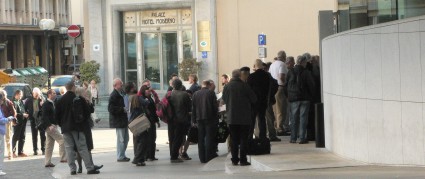
Queue outside the Verdi

Queue outside the Teatro Verdi

It was during the Pordenone festival that Peter Greenaway announced the death of cinema. He wasn’t at the festival himself, but rather in Korea at the Pusan International Film Festival, giving a masterclass, but his words went round the world, as words will these days. Now, the unfortunate demise of cinema is commonly reported – Pordenone stalwart Paolo Cherchi Usai has written a book on the subject – and still the corpse keeps dancing around on our many and various screens, but Greenaway had an interesting specific point to make:

Cinema’s death date was in 1983, when the remote control was introduced to the living room … Bill Viola is worth ten Martin Scorseses. Scorsese is old-fashioned and is making the same films that D.W. Griffith was making early last century … Every medium has to be redeveloped, otherwise we would still be looking at cave paintings … My desire to tell you stories is very strong but it’s difficult because I am looking for cinema that is non-narrative.

Well, aside from the irony that Scorcese wrote the foreword to Cherchi Usai’s book (which admittedly is on the preservation of cinema rather than the present and future reception of cinema), is he still making films like Griffith, and what have we been doing these past few years at Pordenone sitting through the entire works of Griffith, the arch-master of narrative cinema? And why aren’t the art works of Bill Viola on show at this silent film festival?

Pordenone serves both an academic-historical and a sentimental function. It displays the films of the first thirty years or so of cinema with full archival and scholarly rigour – intelligently selected titles presented as products of national, artistic or thematic output, with credits, sources, informative writing, all backed up with the best-available prints shown in the best-possible conditions. It also caters to the nostalgic, with conventional, albeit brilliantly played and usually improvised, music rich in themes from the early twentieth century, and an abiding fondness for the stars of that era. On day three (October 8th), for instance, we were treated to a visit from Jean Darling, one-time star of the ‘Our Gang’ shorts, and the day before we spoke on the phone to Hungarian actress and singer Márta Eggerth to thank her for the film of her that we had just seen. Some acknowledgment of modern silents is made at Pordenone, such as the ingenious pastiches of the Wisconsin Bioscope, but Bill Viola would look sadly out of place. This is a festival which looks back – to the roots of cinema, and to a lost past.

And, however scholarly, this is an audience that likes its stories. Non-fiction does begrudgingly receive its due at Pordenone, but many choose the opportunity of such screenings to visit the restaurants and cafés. Narrative cinema reigns supreme, and much of the academic enquiry seems in any case rooted in the ways in which silent cinema discovered how to tell a story. It’s a fundamental need. Martin Scorcese is still making films in the way D.W. Griffith made them, because the audience still wants to identify people, their personalities, their predicaments, and what happens to them under crisis. I suspect that he would be rather flattered by Peter Greenaway’s comparison of him with D.W. Griffith. But I also suspect that Greenaway would be dismayed by Pordenone’s faith in a cinema held in amber.
D.W. Griffith

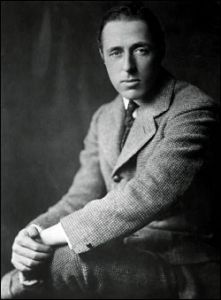
D.W. Griffith

But enough of such speculation – what of the immediate reality of sitting through another Griffith turkey, One Exciting Night (1922)? Word went round that this unfamiliar title was even worse than Dream Street, and at 136 mins it was going to be a grim ordeal. The film is a murder mystery set in an old dark house – a theme that is all too familiar now, but was fresh then. Griffith had tried to secure the rights to The Bat, a hugely popular play about a mysterious house with money hidden in it and many suspicious characters after it. Unable to afford the rights, Griffith simply rewote the story himself (using the pseudonym Irene Sinclair). The plot concerns an inheritance, an orphan (Carol Dempster), bootleggers’ loot, and a host of characters in the obligatory multi-roomed house, one of whom is a murderer. Title cards warn us of the mysteries that are to follow and how we should not reveal the identity of the murderer to those who might want to see the film after us. However, the identity of the murderer is glaringly obvious from the start, the plot is incomprehensible, and the handling of it inept. Griffith simply could not apply the necessary techniques for the mystery genre, filming in a flat, obvious style, failing to bring any clarity to a complex, incoherent plot, and leaving the audience both bored and bewildered.

And yet, and yet… Three quarters of the way through the film changes. The plot becomes so incoherent, the rushing between rooms of the increasingly panicky characters so manic, that all narrative coherence disappears and a kind of insane magnificence takes over. It’s at this point that a hurricane is introduced into the proceedings. There’s nothing to announce it – it has just built up in the background, and suddenly the characters are all outside and at the mercy of the wild elements. The expensive hurricane sequence was added on as an afterthought (clearly hoping to recreate the excitement of the final scenes of Way Down East), and has been much criticised as an illogical irrelevance. But to me it seemed to have a mad logic to it, and the pianist John Sweeney (on top form throughout the festival) certainly responded with gusto. One Exciting Night is a bad film by any conventional standard, but the way in which it tries to hold up a narrative, gives up, then welcomes in chaos, might have found it some favour with Peter Greenaway after all. Even Carol Dempster is not that bad. What is dreadful is more eye-rolling blackface ‘comedy’ from Porter Strong, which critics at the time shamefully found among the film’s best features.

OK, so what else did we have on day three? More of Starewitch’s stop-motion animations, from his Russian period: Strekoza i Muravei (The Grasshopper and the Ant) (1911) and Veselye Stsenki iz Zhizni Zhivotnykh (Amusing Scenes from the Life of Insects) (1912); and from his French period: L’Épouvantail (1921) and Le Mariage de Babylas (1921). L’Épouvantail mixes live action (Starewitch himself as a yokel, plus his daughter Nina) with puppet animation in a very effective mixture of film trickery and slapstick, while Le Mariage de Babylas is a delightful tale of a spoiled wedding among a child’s toys, which shows Starewitch’s agreeable lack of sentimentality – he is the Roald Dahl of animators, showing meanness and mischievousness as well as wide-eyed wonder in his childhood tales.
Posta

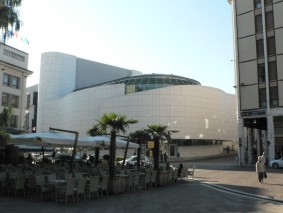
The Teatro Verdi and the Posta café, Pordenone

The main place for conversations and future plans is the Posta café, immediately across the street from the Verdi, and here I spent some time discusing with others the ongoing Women and Film History International project, co-ordinated by Jane Gaines, which is investigating women film pioneers from the silent era worldwide, in an ambitious programme of investigation and publication. The aim is not only to bring some unfamiliar names to the fore, but to challenge received ideas about the creative filmmaking process. Hopefully some major screen retrospectives will follow as well, and that we keep up this process of continually reinvestigating film history.

Georges Melies

Georges Méliès, from http://www.victorian-cinema.net

I kept ducking out of the German feature films to engage in such chats, alas, but it just isn’t possible to see everything and stay sane. I ducked out of Jean Darling and the ‘Our Gang’ shorts for reasons of taste, but it was back to the Verdi for four newly discovered Georges Méliès titles. How wonderful it is that new Méliès titles keep turning up, and that Pordenone always makes a special presentation of them. This year, the Filmoteca de Catalunya delighted us with Évocation Spirite (1899), La Pyramide de Triboulet (1899), L’Artiste et le Mannequin (1900) and especially Éruption Volcanique à la Martinique (1902), a spectactular recreation of the eruption of Mount Pelée and the destruction of St Pierre on 8 May 1902 with vivid hand-coloured explosions. It’s high time we had an up-to-date list of extant Georges Méliès films published.

I saw about fifteen minutes of the Soviet-Armenian comedy feature Shor I Shorshor (1926). Fascinating as its peasant comedy might have been, and intriguing as it was that such a picture of ‘backward’ rural lifestyles should be issued by a Soviet studio, I do object to being made witness to a comic routine which involved a live chicken being pulled apart by our two heroes. Animals overall had a hard time of it at the Giornate. I walked out.

The day for me was rounded off in happy style by René Clair’s Paris Qui Dort (1923-25), which I’d not seen before. It’s an odd film really – Paris is frozen by a mysterious ray, and only a few characters who were in a plane plus a man who lives at the top of the Eiffel Tower remain active because they were above the ray when it shot out. There is ample opportunity for satire, when the comic group discover that normal social rules no longer apply, but little is done with the concept. Instead it is the lightness of spirit which carries the film. It was surprising however to see such clunking continuity errors – several people could be seen walking around in the supposedly sleep-bound streets of Paris. Lastly we had a generally very funny Louis Feuillade comedy, Séraphin ou les Jambes Nués (1921), starring Georges Biscot. We cannot now of course make films about the social embarassment caused by someone losing his trousers, for today no one would blink an eye at Séraphin’s dilemma. Happily, we can still laugh at such films, because we understand the time and place. Imaginative sympathy – that’s what Pordenone audiences do best.

The Wisconsin Bioscope

Urban Bioscope

Urban Bioscope Model D, from http://www.wisconsinbioscope.com

The Wisconsin Bioscope is, as its own proud boast has it, “the leading silent film production company in the Midwestern United States, if not the world, today”. It is the brainchild of Dan Fuller, of the University of Wisconsin-Madison department of communication arts, who every year takes a group of students on a seminar, “Making the Early Silent Film”, with the result being a genuine silent film production.

The company takes its name from an Urban Bioscope Model D of 1907, with which their first two films, Plan B (1999) and Winner Takes All (2000) were filmed. Since then they have used a more accommodating Universal newsreel camera, circa 1923. The films are made in imitation of silent films of the 1907-1912 period, with loving attention paid to sets, performance, titles, developing, printing and music. The Wisconsin Bioscope website (recently revised), goes into fascinating detail about the technology employed, and the whole exercise is a delightful mixture of authentic investigation and tongue-in-cheek pastiche, as these introductory words from the website’s front page indicate:

All our productions are photographed with a hand-cranked motion picture camera on black & white 35 millimeter film, almost always at the rate of 16 frames per second. To crank faster is simply wasteful.

All our productions are developed, printed, toned, and edited by ourselves, following the motto:

If you want it done right, do it yourself.

Whenever possible, we film using daylight. Why pay for something that the sun freely provides?

We understand that other companies have experimented with motion pictures that, to some extent, duplicate color and sound.

This is a grave error.

If the public were to want color, it would visit a picture gallery or, better still, a botanical garden in the full bloom of spring!

If it were to want sound, it would attend the theatre or concert hall!

Although it may be temporarily seduced by kinemacolor, talking pictures, or even tele-vision, we know the great mass of the public has a deep desire for high-quality motion pictures produced and exhibited in the tried-and-true manner:

Pantomime accompanied by Live Music.

When false attractions grow tiresome, as they always do, the public will again demand the product pioneered by Mr. Edison and the frères Lumiére.

The Wisconsin Bioscope stands ready for that day!

Well, it’s hard to argue with any of that, but are the films any good? You bet they are – remarkably so. Technically excellent, but also wittily and sympathetically constructed. They’ve been good enough to feature regularly at the Pordenone Silent Film Festival, where three new titles will be showing next week. The revised website now has QuickTime examples of several of them: A Expedição Brasileira de 1916 (2006), Cosmo’s Magical Melt-A-Ways (2006), Rent Party (2006), A Day’s Work (2006), The Rivals (2005), Daddy Don’t (2005), The Dancer (2004), The Starving Artist (2004), The Sick Child (2004), Cadtastrophe (2003), The Magic Tree (2003) and Winner Takes All (2000). All of them are worth a peek. Or else take a look on YouTube at A Visit with Grandmother (2005), with piano by David Drazin.

The website is rich in information, including production stills. All in all, a project done in absolutely the right spirit. and named after just the right piece of equipment, of course.

The Turner Prize

Deadpan

Steve McQueen’s Deadpan, from http://www.bbc.co.uk/news

I visited Tate Britain today and saw the Turner Prize retrospective exhibition. There are exhibits there which relate to silent film. Best known probably is Steve McQueen’s Deadpan (1997), where the artist recreates Buster Keaton’s legendary stunt from Steamboat Bill Jr, with a similar wooden frontage of a house seen falling around McQueen from assorted angles. But you can also see Gillian Wearing’s 60 Minutes’ Silence (1996), a hilarious work in which a group of twenty-six police officers pose for a photograph in rows but have to stay still for sixty minutes. The more you look, the more they wobble, and the more hypnotic it becomes. And equally hypnotic is Douglas Gordon’s video installation Confessions of a Justified Sinner (1995), which shows blown-up sequences from the 1931 Dr Jekyll and Mr Hyde, with Fredric March, one positive and one negative side-by-side, eerily run slowly (and silently) as though digging inside the agony.

All this and the usual cows split in half, elephant dung and light bulbs switching on and off. Well worth seeing.

Celebrating Toronto

I reported a while back on the Cinema by Citizens: Celebrating the City initiative from the Toronto Urban Film Festival (TUFF), which invited people to submit silent, one-minute videos on a range of urban themes. The festival is currently running, and the sixty winning films are now being exhibited online (all via YouTube). I’ve skimmed through several, and the quality is very high. I rather like this one, My Beautiful City, by Nadia Tan and Maya Bankovic:

Sample the others on the TUFF site or via their YouTube page.

Dr Plonk

Dr Plonk

Next month sees the release of Dr Plonk, a modern silent comedy written, produced and directed by Australian filmmaker Rolf de Heer (who previously gave the world the film Bad Boy Bubby). It sounds rather engaging. Here’s the synopsis from the official site:

It is the great year of 1907. Dr Plonk, eminent scientist and inventor, calculates that the world will end in exactly 101 years unless immediate action is taken. As befalls visionaries through the ages, Plonk is ridiculed for his beliefs, by politicians, by bureaucrats, even by his faithful manservant Paulus. Being the lateral thinker that he is, Plonk invents a time machine and sets out to collect the necessary proof from the very future that’s ending.

But little about the year of 2007 makes sense to the intrepid doctor. His efforts to alert the appropriate authorities cause him to fall foul of the law and become a hunted man. With the nation’s entire law-enforcement system arrayed against him, a scientific question is posed … can Dr Plonk run fast enough?

According to the director, he made the black-and-white film out of 20,000 feet of unexposed stock that he found in a refrigerator. There’s a QuickTime trailer on the site which indicates that de Heer has seen a lot of Sennett comedies (the lead character looks very much like Ford Sterling) and absorbed the lessons well. There is apparently a strong element of contemporary social satire, with Dr Plonk being mistaken for a terrorist when he visits the madcap world of 2007. The film stars Magda Szubanski, Nigel Lunghi, Paul Blackwell and Reg the dog. It comes with its own music, played by the Stiletto Sisters (violin, piano accordion, double bass) and pianist Samantha White. And it runs for 86 mins.

The film will be released in Australia at the end of August.

Worldwide montage

vertov.jpg

Now here’s an extraordinary thing. Video artist Perry Bard is planning a remake of Dziga Vertov’s classic avant garde documentary Man with a Movie Camera, and is inviting the world to join in.

Her plan is to use the web to archive, sequence and deliver submissions for a remake of the 1929 film, which will then be exhibited on the Big Screen Manchester (a BBC initiative to bring big screen pictures to city squares) UK on 11 October 2007, with more public venues visited throughout the UK through 2008.

The project website, http://dziga.perrybard.net, has a scene index with every shot of Vertov’s film recorded in thumbnails and logged in seconds and number of frames. Would-be Vertov’s of today can upload their footage (or still images, or even text), which does not have to match the original shot but should come close to it in length – it’s the rhythmic patterning that counts. Presumably it’s meant to be one shot contributed per person.

Goodness what the results will be like (or how she will select what’s sent, or even how many different potential versions might emerge), but it’s an amazing idea, and certainly has something of the spirit of Vertov’s radical work about it. Here’s the artist’s explanation of how her work connects with that of Vertov:

Vertov’s 1929 film Man With A Movie Camera records the progression of one full day synthesizing footage shot in Moscow, Riga, and Kiev. The film begins with titles that declare it “an experiment in the cinematic communication of visible events without the aid of intertitles, without the aid of a scenario, without the aid of theater.” It is often described as an urban documentary yet the subject of the film is also the film itself – from the role of the cameraman to that of the editor to its projection in a theatre and the response of the audience. It is a film within a film made with a range of inventive effects – dissolves, split screen, slow motion, freeze frame – all of which are now embedded in digital editing software … When the work streams your contribution becomes part of a worldwide montage, in Vertov’s terms the “decoding of life as it is”.

The project site also has the the entire film to view (via Google Video). Uploading starts in August.

Whatever next?

Cinema by Citizens

Calling all would-be silent filmmakers of today. The Toronto Urban Film Festival (TUFF) has announced a competition under the title ‘Cinema by Citizens: Celebrating the City‘. They are calling for filmmakers, video artists, animators, and ‘urbanites with cameras (or video cellphones)’ to produce silent, one-minute films or videos on one or other of these urban themes:

– My Town
– Urban Ennui
– 905 to the 416
– The Imaginary City
– Big Smoke, Big Dreams
– Forgotten Places, Uncommon Spaces

The festival takes place 8-18 September, and the deadline for submissions is 20 August. International submissions are invited. Winning films will be exhibited online.

The Ground Beneath Her Feet

Alan Rickman and Mike Figgis

Salman Rushdie’s 1999 novel The Ground Beneath Her Feet has been turned by composer Victoria Borisova-Ollas into a multimedia semi-opera, which premiered at the Manchester International Festival on June 29th. The multi-layered, fabulist blending of the Orpheus and Euridyce myth with the tale two Bombay rock stars involves the Hallé orchestra, electric guitars, readings by Alan Rickman, and – the reason for its notice here – a silent film directed by Mike Figgis, who has also directed the stage production.

Figgis’ half-hour film echoes the action, as indicated in this extract from a Guardian article:

Figgis is putting together a combination of still images and brief snatches of action – a “tableau vivant” is how he describes it to me in between takes at the small studio in Battersea, London, where he is filming over four days, working with a small budget and revelling in it. “I enjoy the fact that you’re very clear about what your limitations are and they’re not negotiable,” he says. “You can’t suddenly stop traffic or get extras. I woke up this morning and thought, ‘I wonder if they’re going to get enough denim farmwear together [for a scene set in the American midwest]. I remembered I had two denim work jackets and some cowboy neckerchiefs, so I brought them in.”

Figgis is anxious not to produce images that overpower the music (“I have to behave – and I am, I really am,” he says), and he does not intend to tell the story literally. Instead, he will provide filmic allusions that echo both story and score. “The book uses magic realism,” he says. “Fables dovetail and parallel each other. Film should try and function in the same way. But it needs to be very simple. It can’t be doing the sort of fireworks that would take the audience out of the music. It’s an interesting reversal. I’m a composer, too, so I do film scores. The function of the film score is to support the image. This is the opposite: the imagery is to support the music.”

An intriguing reversal indeed, to have a silent film acompanying a score (actually it happens a lot, but is promoted the other way round). However, I’ve found frustratingly little to describe the actual content of the film, nor any news as yet of any other performances. There are reviews to read in The Guardian and The Times, though they make little reference to the film.

Passio at Tribeca

Paolo Cherchi Usai’s modern silent film Passio, comprising found footage put to a score by Arvo Pärt, continues to make a considerable impact with the few screenings that it has had so far. It has now received its American premiere at the the Cathedral Church of St. John the Divine in Manhattan, as part of the Tribeca Film Festival. This is the blurb from the festival programme:

Arvo Pärt’s 1982 “Passio,” based on the Passion in St. John’s Gospel, has been called one of the last masterpieces of 20th-century Music. Now it has inspired a silent film by Paolo Cherchi Usai. Together, they comprise a profoundly moving, unforgettable “oratorio for moving image and sound,” and a dramatic, often unsettling meditation on the very act of seeing.

The poet Rika Lesser once wrote to Pärt, “Yours is the only music I’ve ever wanted to live inside. Sometimes I wish that the music would stop, congeal, erect a lasting structure around me, one that would silently vibrate and, resonating, enclose me.” We are honored to be presenting this extraordinary work in two of our own city’s most magnificent “lasting structures,” the Cathedral Church of St. John the Divine (Friday, April 27 and Saturday, April 28) and Trinity Church, Wall Street (Sunday, April 29). This will be only the second time—the first was in Adelaide, Australia in February of this year—the work has been presented accompanied by live music.

Paolo Cherchi Usai is one of the world’s most respected film historians and scholars. With Passio, he has drawn on his immense knowledge of world cinema to create a stunning and revelatory film of surprising emotional and narrative power, one that explores the impending crisis of visual culture and its reflection in politics and society. Its disturbing images, drawn from a century of filmmaking, are woven into a tapestry of mysterious beauty and violence. This not a pleasing or easy film to watch. It is an impossible film to forget.


    “In the 1970’s, an engraved disc was sent out on one of the Voyager missions which left the solar system, and is headed for deep space since then. The disc contains our human existence in shorthand: a man and a woman saluting the aliens out there, a schematic depiction of our solar system, and Beethoven’s “Ode to Joy.” After having seen Cherchi Usai’s Passio, I think the experiment must now be repeated. If a similar mission is planned for the future, I propose that NASA launches this masterpiece into outer space.”

    Werner Herzog

Cherchi Usai does not want the film to be distributed conventionally in cinemas, nor to have a DVD release. He has also destroyed the negative. Just seven prints exist, for screening with live orchestra and chorus. Catch it when you can. Maybe in outer space.