Pordenone diary 2010 – day five

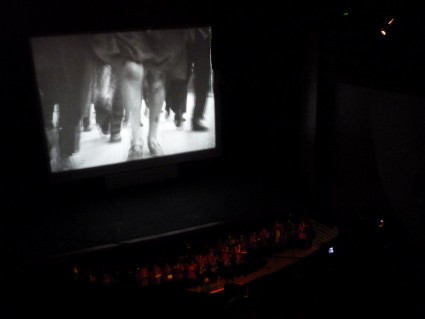
Seating in the Verdi theatre, Pordenone

Let’s talk about seats. Given the amount of time that filmgoers spend sitting down to watch films, it surprising that the objects on which they rest while doing so seldom get discussed. Yet what the seating is and how it is arranged bear significantly upon our enjoyment of what is on the screen. I have sat on wooden chairs, benches, stone steps, sofas, armchairs, velvet plush seating, church pews and grass to watch silent films. At the Zancanaro theatre in Sacile, which was home to the Giornate del Cinema Muto for a few years, the seating was admirably comfortable so long as you were not much more than five-and-a-half-feet tall. For anyone of my height, you practically had to stretch yourself over three rows and to do so in an upper tier to avoid those neighbours who might quite reasonably object to such a display.

The seats under discussion here are those at the Verdi theatre in Pordenone. They are particularly comfortable seats. You could go a long way before finding better, and they could have been designed specifically to support the earnest silent film enthusiast determined to make it through three hours of the next Japanese film and being able to walk away afterwards. But then there is the matter of arrangement, and here is where the Verdi has its critics, certainly among film followers. The theatre was not designed for cinema screenings. This is most obvious in the first circle, where the central portion of seats has to be covered up because the heads of the audience would get in the way of the projector beam. But it is the sight-lines that cause the most comment. It’s not a matter that bothers me that much – I have an odd preference for looking at films from the periphery – but many want to have an optimum view of the screen wherever they choose to sit, and here the Verdi comes up short. So there is great competition for favourite seats, and festival regulars tend to occupy the same section of the theatre year after year. There is the front row crew (earnestly taking notes on every film), those who like to stretch their legs over the gap between rows midway up the stalls, those happiest to look down from the first circle (like yours truly, always seated front row, penultimate seat to the right as you face the screen), and the upper circle afficionados who look to escape the madding crowd (and hello to the cheery bunch of American students who occupied the central portion of the upper tier and whose enthusiasm for all that the festival had to offer was a delight to witness). As with any public space, the Verdi is wonderful for people watching.

Choosing your favourite seat at the Verdi

And so, after all that talk of seats, we turn to a different sort of furniture with the first film on Wednesday 6 October, Tretya Meshchanskaya (USSR 1927), known in English as Bed and Sofa. Directed by Abram Room, this gained much notoriety on its release for its frank depiction of a ménage à trois between a building worker, his bored wife, and his printer friend who is invited to stay in their Moscow apartment. Its piquant polygamous set-up, the uncritical acceptance of sexual relations outside marriage, and discussion of abortion make the film strikingly modern in tone (Jules et Jim without the savoir faire), but what really fascinates is the background detail and the attention to the minutiae of life. There is the vividness of everyday life on the Moscow streets, and the absorbing clutter of the apartment with its nick-nacks, pictures, the Stalin calendar, the curtain dividing one couple from the other man, and of course the bed and sofa. The film also allowed space for its characters to be seen thinking, engaging in the mundane. Though in the end the ménage à trois itself felt too forced, what remained with you was the sense of a film true to life as seen and felt.

Another Room film followed, Yevrei Na Zemle (Jews on the Land) (USSR 1927), a documentary on Jewish resettlements in a stark, flat, tree-less Crimea whose impact wasn’t what it might have been because the Russian titles weren’t translated, which meant we missed the reportedly light-hearted tone that they took.

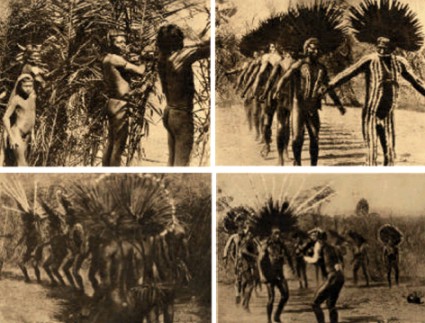
I decided not to sit through Rejin (Japan 1930) (The Belle), which tipped the scales at a mere 158 minutes this time, but the print was poor and I reckoned my eyes needed a rest. After a mooch around Pordenone and conversations at the Posta, I returned in the afternoon for one of the great treats (for me) of the festival, a series of films made in Madagascar in 1898 (images from Cinémathèque française site). As someone who thought he knew film from the 1890s pretty thoroughly, news of a filmmaker from this period entirely new to the history books was thrilling in itself. Louis Tinayre was a French artist with a fascinting personal history (his parents were Communards). He made a speciality of paintings as reportage. He travelled with a French military force to Madagascar in 1895 when an uprising was being quelled and was fascinated by the country. He returned later in the year to make sketches and photographs, then again in 1898 to work on a giant panorama of the surrender of the town of Antananarivo which he exhibited at the Paris Exposition in 1900. But he didn’t just take his brush and canvas – he brought with him a Lumière Cinématographe.

How and why he obtained the camera is not known – he may have been filming scenes to aid his work on the panorama. Eighteen films have survived, having been presented to the Cinémathèque française by the filmmaker’s grandson in 2009. They are thrilling to see. Artfully composed, they show Madgascan people at work in fields, road building, going to market, going about their daily drudgery. We were shown thirteen of the eighteen, with these titles:

  • Chantier de terrassement à Marorangotra [Construction of terraces at Marorangotra]
  • Femmes chargeés montant et descendant une colline [Laden women going up and down a hill]
  • Environs de Tananarive. Marché à Alatsinainy [Environs of Antananarivo, capital of Madagascar. Market at Alatsinainy]
  • Labour de rizières par les boeufs [Ploughing in the paddy fields with oxen]
  • Chantier d’empierrement à Marorangotra [Constructing a road at Marorangotra]
  • Vallée [Valley]
  • Forge malgache à Marorangotra [Malagasy forge at Marorangotra]
  • La route d’Ambohimanara. Un jour de marché à Tananarive [The Ambohimanara road. A market day in Antananarivo]
  • Labour de rizières à l’Angady [Ploughing the paddy fields at Angady]
  • L’artère principale du marché à Tananarive [The main road of the market at Antananarivo]
  • Jeunes garçons fabriquant des briques [Boys making clay bricks]
  • Femmes transportant paniers près d’un ruisseau [Women carrying baskets near a stream]
  • Hommes travaillant sur un chantier [Men working on a construction]

The people were all shown in mid-distance, with never a glimpse of a face, mere figures in a landscape (possibly supporting the panorama thesis) though always displaying movement. It was the colonial gaze par excellence. The films (in wonderfully sharp prints) were utterly compelling, just to be seeing so far back, images from a remote land being filmed for the first time, revealing landscapes and customs that were centuries old and were now captured in motion. An added bonus was that the films were accompanied by Touve Ratovondrahety, a Malagasy himself, who played piano and sang Madagascan songs. The happy sense of homeland rediscovered was palpable.

Some Pordenone regulars may mutter at these early films and hanker for the emotional journey that the feature film offers, but for others the rare chance to see the early films is why we want to be there. And so we moved to the latest installment of the Corrick Collection, a remarkable collection of films from the mid to late 1900s amassed by an Australian family of touring entertainers, and now featured over a number of Giornates. The films were introduced by festival director David Robinson, who comitted an engaging faux pas when he announced the award of some medal to the New Zealand film archive for its work in preserving the collection, an award that was diplomatically collected by the National Film and Sound Archive of Australia, which cares for the films.

The films were the usual marvellous mix. Among the stand-out titles were Le Singe Adam (France 1909), one of the most memorable films of the whole festival, in which a trained baboon imitated the actions of its trainer to an extraordinary degree that divided up the audience equally into amused and disturbed; an unidentified British film given the title The Arrested Tricar (GB c.1905) in which three boys steal a motorcar which eludes them and drives off by itself; Don Quixote (France 1904) a meticulously recreated set of scenes by Pathé including windmills that turned into giants and an impressive alternating between studio and open-air setting, all rounded off with the habitual appearance by the Pathé dancing girls; Le Sculpteur Express (France 1907), an unusual variation on the familiar ‘lightning sketch’ form of early film, here shown a sculptor making clay faces at speed; and the delightful A Winter Straw Ride (USA 1906) showing a bobsleigh journey through the show with beautiful scenic effects.

No Rastro Do Eldorado (The Silence of the Amazon), from http://www.cinemateca.gov.br

Farsangi mámor (Hungary 1921) was a three-minute fragment of an otherwise lost Hungarian feature film which was identified after stills were published on the Lost Films site. This was followed by No Rastro Do Eldorado (Brazil 1925) (The Silence of the Amazon), a return visit to the Brazilian jungle. The film was made by Silvino Santos and documented the travels of American geographer Alexander Hamilton Rice as he mapped areas of the Amazon. The film’s presentation was unusual – there were no intertitles, instead we got a somewhat breathy female live commentary taken from Rice’s own accounts of the expedition, plus a creative multi-instrumentalist who played electronica, clarinet, percussion and guitar. Rice’s words revealed a superior attitude towards the native peoples which jarred somewhat with the poetic delivery. The film was profficient at best (though the aerial views were stunning), but the print – which was supplied by the Brazilians but came via the BFI National Archive – was awful, with very poor definition. I just hope negative material survives and that someone can try and produce something a good deal sharper.

Marizza, from http://www.ilgazzettino.it

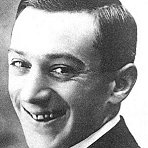
The Giornate likes to reserve the special treats for the evening shows, and pride of place went to a thirteen-minute, seventeen-second fragment of an otherwise lost feature film, Marizza, Genannt die Schmuggler-Madonna (Germany 1921-22). The reason this was so special was because the director was F.W. Murnau. The fragment survives with Italian titles in a tinted print. It would be easy to read too much into this early work of a master, and to be honest I wonder how many would detect Murnau’s hand in a tale of a bewitching gypsy loved by a customs officer and an elegant gentleman. However, even as an anonymous fragment you would have noted the adroit handling and keen eye for the right image. It looked like we were going to get Carmen in the countryside, then all too quickly it was gone and mere speculation remained.

Next up was one of the festival special musical events, with two French films accompanied by Maud Nelissen (piano), Lucio Degani (violin) and Francesco Ferrarini (‘cello). First up, shown to Yves de la Casinière’s original score, was Alberto Cavalcanti’s Rien Que Les Heures (France 1926). This venerable classic of the avant garde is an odd, beguiling work which gives an oblique view of life in Paris, mixing documentary shots with dramatised sequences. It sometimes gets labelled with the city symphonies, but it could have been set in any town or city. As the the title suggest, its real concern is time and its passing, which is the best of themes for a work of art. I’ve seen it many times and don’t think I will ever tire of it.

Next, and last for me that day, was Germaine Dulac’s La Folie des Vaillants (France 1926). I wasn’t quite sure what to make of this. It was a feminist gypsy drama of sorts (gypsies featured strongly at the Giornate), which emphasised feeling over such trivial matters as acting and plot (a Gorky story). Unfortunately acting and plot are just what audiences look out for to anchor themselves, and the film’s technical limitations distracted from the filmmaker’s symbolic intentions. Also it’s hard these days to take gypsies as the epitome of social freedom in the way that Dulac (and Murnau) did in the 1920s. So it didn’t quite work for me, but it was graced by a quite superb score from the Maud Nelissen trio – the music from the festival that I’d most want to hear again.

And then I slipped away, into the balmy night.

Pordenone diary 2010 – day one
Pordenone diary 2010 – day two
Pordenone diary 2010 – day three
Pordenone diary 2010 – day four
Pordenone diary 2010 – day six
Pordenone diary 2010 – day seven
Pordenone diary 2010 – day eight

Pordenone diary 2010 – day four

Giornate del Cinema Muto poster in a Pordenone shop window at night

And then it rained. There’s always one day of heavy rain at Pordenone (it is quite near the Alps, after all) and on Tuesday October 5th it came down in torrents. This was certainly a day for sheltering in the cinema and viewing everything that came up.

Unfortunately that meant starting at 9.00am with another selection of Boireau films. As noted in day three, the French comedian André Deed’s second stint as Boireau (1911-1914) produced work that was markedly inferior to his time in Italy playing the character Cretinetti. This second selection sufered from the same frantic gesticulation and body-bending from a performer who did not know how to stand still. Une Extraordinaire Aventure de Boireau (France 1913) stood out for the extraordinary comic conceit of having two men welded together after a heavy weight falls on top of them. One, Boireau, adapts to his new circumstances with zest; the other is wretched and complains all the time. It wasn’t exactly funny, but it was memorable. I kept thinking of the British comedian Norman Wisdom, whose death had just been reported, someone who once had audiences tearful with laughter only to live on to a time when audiences could only look on his work with bemusement and embarassment. What happens to humour when it isn’t funny any more? We just want to turn away.

And then we got a series of Calino films starring Roméo Bosetti, and Boireau looked like a comic master once again, at least by comparison. Enough of all this, let’s have some challenging Soviet documentaries.

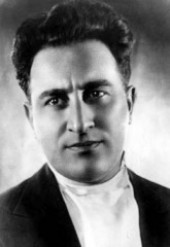
Even at this short distance in time, I have little memory left of Mati Samepo (Their Kingdom) (USSR 1928) a 22-minute fragment from a five-reel documentary compilation of Georgian newsreel material made by Mikhail Kalatozov. All that remains are some impressions of satirical intent about oil in Kalatozov’s native Georgia, and a noticeable number of stray dogs. Unforgettable, however, was his documentary Jim Shuante (Salt for Svanetia) (USSR 1930). This was a strange film about a strange corner of the world. Svanetia is a remote area of Georgia, high in Caucasus mountains. The areas is inhabited by the Svans, and in its focus on their hard lives and distinctive cultural practices, it was another in series the films of anthropological interest that featured throughout the festival. However it was far from being a conventional, fact-based documentary. Some of the customs featured were a fiction – such as turning pregnant women out of a house to give birth, which was the practice in another region of Georgia but not in Svanetia. It showed life at its most rudimentary and functional, with miseries piled upon miseries to the point where it was almost comical (I was reminded of Buñuel’s Las Hurdes which similarly piles on the wretchedness beyond the point of sympathy). The images were often brutal or earthy, and they were always astonishing composed, but they told you nothing about the people. They were merely ciphers – and ciphers for a society that bore only a tangential relationship to reality. They existed to serve as subjects for an exercise in filmic style, not as people in their own right. The film did not inform; it exploited. It was the antithesis of the model anthropological film.

Salt for Svanetia (1930), from Wikipedia

Nor did it work as piece of Soviet propaganda. The ostensible reason for making the film was to show how a road-building programme was bringing the much needed salt to Svanetia and connecting it to the outside world, ensuring its modernisation and survival. But, as the programme note told us, the road-building was fiction too, and the whole message felt tacked on, as no doubt it was to please the party critics and censors (though they suppressed the film anyway). For Kalatozov the poetics of the image is all, and one comes away with visions of sun and shadow sweeping over the mountain sides, the stark villages with their tall towers and seemingly no people out and about, and unanswered questions about how the people were persuaded to play for the cameras, and whether actors were used. Salt for Svanetia is an amazing film, but not an honourable one.

And they we were back in Japan. I missed a couple of short films, but then settled down for the afternoon’s epic, the 188-minute Ginga (The Milky Way) (Japan 1931), directed by Hiroshi Smimizu, he of the restless camera and uncertain directorial purpose. Or at least that’s how he had seemed so far, but for Ginga he reined in the gimmicks, aside from some deft lateral tracking shots which acted as an effective visual motif. The plot was pure soap opera once again. It concerned a daughter of a businessman who marries her seducer to avoid social disapproval, a storyline that was starting to get a bit too familiar, while the passive suffering of Japanese women was starting to grate just a tad. But in truth the plot was not that important, or rather the various relationships were obscure (at least to these Western eyes), and you just surendered to the gentle style and the astute balance of understated realism and melodrama. If there had been silent television, its dramas might have unfolded much like Ginga.

There then followed a pleasant interlude – an Irish television documentary on archivist and film historian Liam O’Leary, At the Cinema Palace: Liam O’Leary (Ireland 1983). This was a delightful account of the man who virtually single-handedly established the idea of Irish film history as something to document and the need for an Irish film archive. He also worked for a time at the British Film Institute, and there were some gorgeous archive images – David Robinson (the festival director) sporting a florid 1970s moustache, David Francis (one-time curator of the National Film Archive) with a truly terrible jacket, and such a young Kevin Brownlow (O’Leary introduced Brownlow to Abel Gance when no one at the BFI was available to greet the great silent director in Britain. What must Gance have thought when the BFI sent a 17-year-old schoolboy instead?). A film about a man whose purposeful passion for film spoke to every film archivist in the audience.

Charlie Chaplin (left) in A Thief Catcher, courtesy of Paul Gierucki and Slapsticon

In the evening we were treated to two of the most notable ‘lost’ film rediscoveries of the past year. First up, A Thief Catcher (USA 1914). Yes, at last a chance for us on this side of the pond to see the sensational discovery, made by Paul E. Gierucki, of a previously unknown performance by Charlie Chaplin in a Keystone comedy. It was known – because Chaplin said so in an interview – that he had appeared uncredited as a Keystone Kop early on in his film career, but never before had anyone rracked down such an appearance. A Thief Catcher is thought to have been either his second or fourth film for Keystone in terms of production (the catalogue told us it was shot 5-12 and 25-26 January 1914, with Chaplin’s bit probably in the latter) and the fourth in terms of release (19 February 1914). But enough of the historical minutiae – is it funny?

You bet it is. Not outstandingly so, but it gained more laughs in eight minutes than poor Boireau had managed to raise in two or three hours. It’s all in the cutting. The film is a typical breakneck speed Keystone offering, with routine knockabout elevated to something special simply by the speed of the action and the deftness of the edit. Boireau showed us comedy still rooted in the stage, the comic business contained within the single shot. Keystone gave us cross-cutting, the comedy of consequences, as each shot played off against the previous one. Ironically the film’s star, Ford Sterling, outdid André Deed in face-pulling, and probably no unfunnier man ever graced the cinema screen. But Chaplin was on the ball as a performer right at the start. He plays an inspector who investigates a shed where Sterling, playing a sheriff, has been imprisoned by three robbers. In his two-minute cameo (he appears briefly at the end as well) Chaplin gives an expert display in comic bemusement, ending up being knocked out by Sterling for his pains. The moustache is there, the baggy clothes, even a hint of splayed feet. It was a magical moment when he ambled on screen (the audience cheered). A Thief Catcher easily lived up to expectations.

Next up, after a trailer for the otherwise lost John Ford film Strong Boy (USA 1929) was an entire Ford feature film not known to exist until it turned up in New Zealand recently, Upstream (USA 1927). This was a comedy-drama set in a New York boarding house full of ‘resting’ actors, one of whom (Earle Foxe) unexpectedly gets an invitation to play Hamlet in London, because he comes from a great line of actors whose name he has inherited but with none of the necessary talent. But the plot didn’t matter much; what made Upstream such a delight was the series of comic vignettes of down-on-their theatrical types – knife-thrower, a pair of comic dancers, an old Shakespearean hand – a in a zippy, joyous opening sequence that was J.B. Priestley on roller skates. It showed you everything about why American cinema conquered the world – much as A Thief Catcher did, in fact.

It’s a minor film for all that, which ends rather abruptly with the rejection of the insufferably pompous Foxe character by his former colleagues, and one sensed that had they only had a stronger cast then the film could have been spun out to twice its length, because we wanted to know more about the characters. So, a lot of fun, a film to chalk up for those with an interest in Shakespeare on film (Foxe’s Hamlet mines every cliché about theatrical ham), and a film which does John Ford’s reputation no harm whatsover.

Capabalanca’s unwitting performance in Chess Fever, from ChessBase.com

In what was a peach of an evening’s programming, things were rounded off with me for one my all-time favourite films, Shakhmatnaya Goryachka (Chess Fever) (USSR 1925). This delirious comedy is terrific if you are a silent film fan, but if you are a chess fan as well, you’re in heaven. You get all startstruck in the opening sequence – look, there’s Réti! And Torre! And Marshall! And Grünfeld! And, wow, Capablanca! Chess Fever was shot by Vsevolod Pudovkin during the international chess tournament held in Moscow in November 1925. Its slight plot revolves around a man so obsessed with chess (even his socks have black-and-white squares) that he forgets his own wedding, but chess brings the two hearts together in the end. It’s filled with a succession of superb sight gags, where all of Moscow is shown to be chess-mad. It culminates with the great José Raúl Capablanca himself, the world chess champion, who appears in the film when the frustrated fiancée accosts him, though he was not aware that a dramatic film was being made with himself as a crucial character. Günter Buchwald (on top form all week) provided an appropriately lively score for violin, piano (he played both), double bass and drums, revealing himself in the catalogue to be a chess enthusiast as well. And has there ever been a better closing line for film than, “Darling, let’s try the Sicilian Defence”?

After all that I wasn’t much in the mood for Lev Push’s Gypsy Blood (USSR 1928) – some film titles make you fear the worst – and I called it a day.

Pordenone diary 2010 – day one
Pordenone diary 2010 – day two
Pordenone diary 2010 – day three
Pordenone diary 2010 – day five
Pordenone diary 2010 – day six
Pordenone diary 2010 – day seven
Pordenone diary 2010 – day eight

Pordenone diary 2010 – day three

Interior of the Verdi, showing the cover which goes over the central seats of the lower circle to prevent people sitting in front of the projector beam

Some said that it was a strong programme at Pordenone this year. But maybe they were misheard and what they really said as that you had to be strong for the programme at Pordenone this year. It certainly felt that way as we faced up to the epic offering on Monday morning, Ai Yo Jinrui To Tomo Ni Are (Love, Be With Humanity) (Japan 1931), all four hours and one minute of it. It took up the entire morning and the screening had to start half an hour earlier than usual, at 8:30, to fit it in.

I will confess that I lingered over breakfast and did not get to the Verdi until 9.00, where I expected to catch five minutes of the film and then head out for a coffee somewhere. But I got hooked. This wasn’t directed by Shimizu, it was the work of Shimazu (Yasujiro Shimazu), and what a difference the change in vowel made. This was as polished and authoritative a piece of direction as you could hope to find, aided by some outstanding performances. Love, Be With Humanity (is the title really that dreadful in Japanese too?) was the dramatic highlight of the festival so far.

The story was pure Peyton Place, or Jeffrey Archer. A rich, selfish father, superbly played by Sojin Kaminyama (who had returned to Japan after a period in Hollywood appearing in The Thief of Bagdad and as Charlie Chan), is deservedly saddled with four ungrateful, awkward children, each of different mothers. One is a wealthy wife most interested in jewelry than her child, another daughter is getting married, one son is a cold, intellectual, the other son is a fiery rebel (played by Denmei Suzuki) who refuses to take any money from his father, after the way his mother died wretchedly. The stage is set for a soap opera of epic proportions and concomitant confusion, but unlike his near namesake Shimazu so ably managed the interlocking elements of his narrative that you were never lost, and never impatient, despite the indulgent running time. In the end the father is ruined and the only child who cares for him is the rebellious son. Their climactic argument, where they trade insults yet the son’s wife recognises that they have actually already forgiven one another, exemplified the intelligent approach, constantly playing against expectation, that characterised the film.

And then there was the final reel. No one who was there is likely to forget it in a hurry. Father and son have emigrated to the USA, and taken up the cowboy life. The intertitles have switched from Japanese to English, and the whole conclusion, with stetsons, cowboy boots, beaming neighours and the home on the range, just boggled the mind. Doubtless it all rang true in Japan, but here we couldn’t quite believe our eyes. And then it was over, and there was huge applause for pianist Mie Yanashita, whose vivid accompaniment had been subtly attuned throughout to the film’s ebbs and flows, but it was sort of applause for ourselves as well for having made it all the way through.

I had been looking forward to the afternoon’s first offering. André Deed is generally thought of as one of the great non-American comic performers of the silent cinema period. He was a music hall comedian who joined the film business in 1901 with Georges Méliès in 1901, moving to Pathé in 1906. The character that he established, Boireau, became progressively popular throughout Europe and effectively established the idea of the comic character appearing in a series of films. He moved to Italy in 1908, establishing a new character, Cretinetti, for the Itala company (known as Foolshead in English) and it is Cretinetti films that I’ve long revered for their energetic style and clever mixture of half-wittedness with quick-wittedness. He returned to Pathé in 1911 and became Boireau once more before his career faded with the onset of the First World War.

Pordenone was presenting a strand on French comedy films (a speciality of festival director David Robinson) so it was Boireau that we got on Monday afternoon, ten titles, of which two were from his first period with Pathé, eight from his second. Sadly they were a huge disappointment. Deed mugged and gurned for all he was worth in a series of sloppily conceived scenarios that were resolutely unfunny. In the place of any visual invention we got face-pulling from Deed and much laughter directed at the camera from other performers – it’s always a bad sign when the actors feel obliged to laugh at the comic business, when that is our business. Alas, Boireau on this evidence was tedious, certainly no match for Cretinetti.

Variety is guaranteed at Pordenone. From pre-war French comedy we moved to late 20s Soviet cinema. One of the festival’s main strands was ‘Three Soviet Careers’, looking at the work of Mikhail Kalatozov, Abram Room and Lev Push. Lursmani Cheqmashi (The Nail in the Boot) (USSR 1931) was made by Georgian director Mikhail Kalatozishvili, who as Kalatozov would gain international fame for The Cranes are Flying (1957) and I Am Cuba (1964). His documentary films of the late 20s/early 30s were characterised by a truly extraordinary visual style but also a muddled ideology that saw them fall foul of Stalin’s censors.

The Nail in the Boot adapts the old tale of the nail eventually causing some great disaster as things build up because the original small irritation was not dealt with (“and all for the want of a horseshoe nail”). A group of soldiers in an armoured train come under attack. One of their number goes off to find help, but because of a nail in his boot he is hampered in his journey and the battle is lost. He is the subjected to a trial, where he comes in for intense criticism but eventually successfully argues his case.

The film was roundly criticised by the Soviets (particularly the Army) for being confusing and ideologically unsound, as a consequence of which it was banned. Seeing it now you have some sympathy with those critics. The nail theory is ridiculous, and the succession of calamities that befalls the soldier encourages our sympathies not our censure, so that he seems cruelly victimised by the subsequent show trial. Whosever’s fault it was that the armoured train was lost, it was surely not his. If there was a message there at all, it was not one that any true Soviet would wish to champion.

But in truth there is no message there at all. The Nail in the Boot is an exercise in pure cinematic style. No doubt Kalatosov was driven by some ideological certainties, but his camera drove him elsewhere. It is just an astonishing film to experience. Every image is burnished to perfection. The stylised results look like nothing on earth. There are the statuesque faces, the unreal landscapes, the astonishing shots from within gun barrels, the eerie intensity of the court room. It is cinematically brilliant – except that cinematic must mean more than technique, it must be technique applied to a particular and consistent aim. Here Kalatozov fails – but what an extraordinary failure.

Talking of extraordinary things, Stephen Horne‘s music was a multi-instrumental tour de force. Some may have though that there was a piano, accordion and flute trio accompanying the film, but no, it was the one man. Stephen can so far only play two of those three instruments at the same time, but it surely can’t be long before he is able to add the third as well.

Torres Straits islanders recreating ceremonies of the Malu cult for A.C. Haddon’s camera, from the 1898 film in the BFI National Archive

Anthropology was an unexpected sub-theme of the festival. Next up came The Masks of Mer (UK 2010), a documentary made by Michael Eaton about the Cambridge Anthropological Expedition of 1898 to the Torres Strait islands to the north of Australia. The expedition was led by Alfred Cort Haddon, a zoologist who became so fascinated by the native people he met on the islands when he first visited them in 1888 that he returned a decade later to study the humans. Remarkably he took with him not just notebooks to record his findings, but a phonograph to record songs and speech, and a motion picture camera.

The films survive, and form the centrepiece of Eaton’s fascinating and rather wise film. Haddon only received his camera a day or two before he was due to leave, but he captured short scenes of fire-making, of dances by some visiting Australian Aborigines, and most remarkable of all a Malu cult initiation ceremony dance which had had been suppressed by Christian missionaries. Haddon invited the people of the island of Mer to recreate three sacred masks (out of cardboard) which were essential to the ceremony and got them perform the forbidden dance for the camera. Some might think that this recreation falsifies the value of the film and the anthropological study, but Eaton argues persuasively that the collaborative nature of the film – Haddon working closely and sympathetically with his subjects – displays a deeper truth. Just pointing a camera at actuality does not reveal its true substance. It is what its subjects wanted to be shown that counts. This was as much the Torres Straits islanders’ film as it was Haddon’s, and that what was so extraordinary about Haddon, that he recognised this. The film also runs the sound recordings alongside the films. The two were not recorded together, but Haddon certainly exhibited them together (in 1906, if not before), so the experiment was justified. The film’s most magical moment was when Eaton visited Cambridge University and was shown the very masks that appear in the film, lovingly stored in the Haddon archive. It was a mysteriously moving moment. Anyway, a fine documentary of the kind you just don’t see on television any more.

So that was the afternoon done. Supper was spent in conversation about archives, exhibitions, scholarly project and the rich subject of colour, the fruits of which you may learn of at some other time. But then it was time to hurry back to the Verdi for the great treat of the evening, a film I had been waiting twenty years to see, ever since Kevin Brownlow programmed it at the National Film Theatre, describing it as one of the most amazing visual spectacles of the silent era, and for some reason I was unable to see it. This was going to be good.

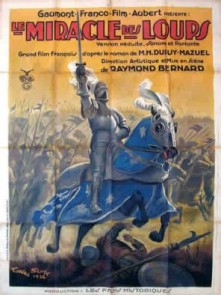
Le Miracle des Loups (The Miracle of the Wolves) (France 1924) has a reputation as one of the highpoints of French silent cinema. It is set in the fifteenth century during the reign of Louis XI (Charles Dullin) and it tells of the challenge to the king’s authority by the rebellious Charles the Bold, Duke of Burgundy (Vanni Marcoux), while rival noblemen fight over heroine Jeanne Fouquet, played by Yvonne Sergyl. The film, directed by Raymond Bernard, is on a truly epic scale, with setpieces of the battle of Montlhéry and the siege of the castle of Beauvais which are meant to show off the millions of francs that were clearly spent on them. Romance, rivalry, intrigue, violence, spectacle, all in the hands of a skilled director – what could possibly go wrong?

Oh dear, oh dear. Right from the start it was clear that something was wrong, when the prelude introduced us to the romance between Jeanne and Tobert Cotterau, played by the toe-curlingly unromantic-looking Romauld Joubé, during which she gets her pet dog to pass a message to him by lifting the bewildered dog over a wall. On top of this we were fed long and tedious intertitles filling us in on all the history, with all of the unwelcome earnestness of a history teacher of very much the old school. It set the tone for the disaster that was to unfold before us over the next two hours or more.

A more turgid plod of a movie it would be hard to imagine. What it did remind me of, in fact, is a 1909 Gaumont one-reeler, Le Huguenot, which crams in a complex plot with too many characters, overlong intertitles obsessed with pedantic detail, all put over with histrionic performances strong on gesture and redundant when it comes to human feeling. The Miracle of the Wolves is simply a 1909 historical film stretched out to 130 minutes. It was so half-hearted throughout. The performances were lethargic (particularly Charles Dullin, who tried to look Machivellian but just looked like he was struggling to remember where he was), and even the battle scenes were undercooked (despite some bloody examples of what fighting in the Middle Ages was actually like), with extras just about going through the motions.

The key scene was the miracle itself. Jeanne is being pursued by the evil Comte du Lau (Gaston Modot, chewing up the scenery) in the mountainside snows when she is surrounded by wolves, who settle down around her before attacking the Comte’s men. We were meant to be awe-struck – instead all too many of the audience laughted heartily at the scene’s absurd piety. All in all, a film without any heart at all. I’d waited twenty years to see it and it felt like twenty years watching it. There was some historical interest in the screening for which Touve Ratovondrahety played a piano transcription of Henri Rabaud’s original score, but to be honest it had little to stir the imagination. But then it had such poor material to work with. Oh dear oh dear.

But there would be better fare on the morrow.

Pordenone diary 2010 – day one
Pordenone diary 2010 – day two
Pordenone diary 2010 – day four
Pordenone diary 2010 – day five
Pordenone diary 2010 – day six
Pordenone diary 2010 – day seven
Pordenone diary 2010 – day eight

Pordenone diary 2010 – day two

Verdi theatre, Pordenone

There’s no time for slouching at Pordenone if you are serious about your film-watching. A few habitués of the Giornate del Cinema Muto seem to have come for the sun and conversation, taking up near permanent residence in the pavement cafés, but for the rest of us breakfast was swiftly followed by the first film of the day at 9.00am sharp and the final film of the day concluding around midnight. They do let you out for lunch and dinner, but in general it’s a tough regime we had to follow.

And so we move to day two, Sunday 3 October, and what was to become the daily routine of starting off with a long Japanese film, just to test our stamina. Our 9.00am offering was Nanatsu No Umi (Seven Seas) (Japan 1931-32), made in two parts and shown back-to-back over 150 minutes. The films were made by Hiroshi Shimizu, director of the previous day’s Japanese Girls at the Harbour, and there were clear similarities in preoccupations and style.

The film tells of Yumie (played by Hiroko Kawasaki) who is torn between two brothers. She is engaged to the first but seduced by the second, following which her father dies and her sister goes mad. She marries her seducer but takes her revenge by refusing to let him touch her and spending all his money on her sister’s care in a mental hospital. It was pure soap opera, with a somewhat discontinuous narrative (particularly in part 1) characterised by seemingly random elements (just who was it who committed suicide in part 1, and why?) and unclear connections between some of the characters. Then it all ended with a happy ending so rapidly organised that you suspected that a reel was missing. As with Saturday, Shimizu showed off plenty of directorial tricks but lacked the basic skill of connecting one shot with another to propel a narrative forward. But he also showed the same intriguing, codified cultural elements, dividing the action up into public lives that showed the influence of the West (clothing, occupations, the key location of a sports shop) and traditional Japanese dress and manners within the private sphere. You felt you had been given a privileged glimpse into early 1930s Japanese life in the kind of middle-brow film that doesn’t usually make it to retrospectives. Japan’s leading silent film pianist Mie Yanashita was an excellent accompanist for this and all the other Japanese films that featured in the festival.

Scenes from Rituaes e festas Borôro (1916), from http://www.scielo.br

Now these dramatic films are fine in themselves, and even the severest of film critics likes to see a story told well, but regulars will know that what really stirs the heart of the Bioscope is the non-fiction film. So I was looking forward greatly to what was next on the list – Brazilian documentaries – and was not disappointed. In particular the first film of three, Rituaes e festas Borôro (Rituals and Festivals of the Borôro) (Brazil 1916) was one of the highlights of the festival. The filmmaker was Luiz Thomas Reis, photographer and cinematographer with the Commission of Strategic Telegraph Lines from the Mato Grosso to the Amazon, more simply known as the Rondon Commission. The Commission was tasked with mapping the unknown regions of Brazil and making contact with remote tribes. Reis documented this work on film, in part with the hope that the exhibition of such films would raise further funding.

Rituaes e festas Borôro is an extraordinary work, simply by letting the extraordinary speak for itself. Its subject is the Borôro people of the Mato Grosso region, specifically the funeral ceremonies for an elder of the village. I am no expert in anthropology, but the film seemed to me notable for its observant, unpatronising, humane manner. The camera never intruded, only witnessed, and the Borôro were not looked upon as objects of curiosity but as people respected for their customary practices and milieu. This was somewhat charmingly exemplified by the dogs. Stray dogs in early films are something of a Bioscope fetish, and Reis’ film captured not just the dances of the Borôro but the dogs who casually wandered in and out of the frame, surveying the strange things that these humans do in whatever part of the globe that humans happen to gather. The only questionable note was the assurance made by the film’s titles that these rites were not permitted to be seen by whites or women – yet here was the camera filming them. Such are the paradoxes of the anthropological film, a subject to which the Giornate would find itself returning in subsequent days.

Two other Reis films made for the Rondon Commission followed, Parima, fronteiras do Brasil (Brazil 1927) and Viagem ao Roroima (Brazil 1927). Each just under 30mins in length, these were more conventionally ‘travelogue’ in style. The first documented an inspection of the Brazilian-French Guiana border, following the river, with some thrilling shots taken from the front of a travelling canoe (the Brazilian version of the phantom ride), but with plenty of signs of encroaching colonisation in the builings that littered the banks of the river. The second explored the borderland between Brazil, Venezuela and British Guiana and concluded with breathtaking views of 1,000-foot high rock faces. In both films there were sequences where they came upon tribes, so positioned in the film as to be the big pay-off shots, the exotic conclusions which would capture the interest and wallets of likely funders. Rituaes e festas Borôro was in every sense the better film.

Mutter Krausens Fahrt ins Glück, with a band in the understage area playing the Internationale

So that was the morning session. A foul snack lunch and earnest conversations about budget cuts (again) and we were back at 14:30 for Mutter Krausens Fahrt ins Glück (Mother Krause’s Journey to Happiness) (Germany 1929). This was being shown as pat of the Giornate’s ‘The Canon Revisited’ strand. There is an occasional air of pompousness about the festival, and this idea of re-assessing canonical films exemplifies it. It’s a good idea to revisit classics, especially for the new audiences the festival is attracting, but a number of these films were titles that many of us had not had any chance to see the first time round; indeed I suspect most of us had not even heard of them. Mutter Krausens Fahrt ins Glück was a case in point; a film I’d vaguely heard of, but never seen, though I will admit it’s a classic of sorts and certainly merits being brought back to the screen once more.

Mutter Krausens Fahrt ins Glück is as agit-prop a film as you could expect to see. Directed by Piel Jutzi, it combines melodrama with documentary realism in its depiction of the ground-down lives of the Berlin proletariat. It tells of the family and tenants of an apartment managed by the aged Mother Krause (Alexandra Schmidt), pitting the apathy and resignation of the individualised poor (generally the elderly) against the positive binding together of those who follow the Communist party (generally the young). Its highpoint is where the harassed daughter (Ilse Trautschold) joins her boyfriend in a protest march to the sounds of the Internationale – literally so in our case, because at this point a marching band of red-suited musicians entered the Verdi theatre and played the marching song to much applause. It was a wonderful thearical coup – typical of the imagination that goes into the Giornate.

However, despite such rousing gestures, the film’s message was an unsettling one. We were supposed to reject Mother Krause’s miserablist view of her fate, but only after the film had done all it could to make us feel sorry for her, so that the ending – where she gasses herself and a sleeping child, because life simply isn’t worth it for either of them – was distasteful and the conclusion ambiguous. It was a stylish and imaginatively experimental film, but what it expounded was more posture than principle.

Next up came a selection of Pathé short comedies with surprisingly sophisticated live musical accompaniment from pupils of the Scuola Media “Balliana-Nievo” from nearby Sacile, music that was a good deal richer in colour and instrumentation than other schools’ work with silent films that I have heard. They were followed by pupils of Pordenone’s Scuola Media Centro Storico, who took on the truly bizarre Charley Bowers, an American comedian whose gimmick was to combine comedy with stop-frame animation. In There it is (USA 1928) he plays a Scottish detective from Scotland Yard who tackles the case of a haunted house with the aid of his cockroach sidekick, MacGregor. It wasn’t strictly funny, but it left this viewer – whose first Bowers film it was – opened-mouthed at its unabashed weirdness. If Salvador Dali had been employed by Leo McCarey, he might have made There it is.

In need of a break, I missed the new documentary Palace of Silents (USA 2010) on the story of Los Angeles’ Silent Movie Theater, returning for the evening’s screenings. The Giornate was celebrating the 75th anniversary of two of the world’s leading film archives, MOMA and the BFI National Archive. To mark its 75th year, the BFI took the interesting decision to try and recreate part of a programme of the Film Society. The Film Society was formed in London in 1925 by a bunch of radicals led by the Hon. Ivor Montagu, which eventually included such notables as Anthony Asquith, Iris Barry, Sidney Bernstein, Roger Fry, Julian Huxley, Augustus John, Bernard Shaw and H.G. Wells. The Society (the first of its kind in the world) put on films of artistic, historic or political interest at the New Gallery Kinema in Regent Street, often showing films from the USSR which had been refused a licence by the British Board of Film Censorship (they could do so because the films were shown to members of a private club). The Film Society had a huge influence on British film culture, and after it ceased operating in 1939 its collection went to the BFI.

On 10 November 1929 the members of the Society witnessed perhaps the most remarkable film programming coup ever – the world premiere of John Grierson’s Drifters, the cornerstone of the British documentary movement, and the UK premiere of Sergei Eisenstein’s Battleship Potemkin, plus James Sibley Watson’s avant garde classic The Fall of the House of Usher (USA 1928) and Walt Disney’s Barn Dance (USA 1929). Now that’s programming.

Drifters (1929)

Audiences were made of sterner stuff in 1929, because we were only shown the first two. Drifters (UK 1929) is one of those classics more cited than seen and those who have seen it generally did years ago. Looking at it again after twenty years in my case, it is a work that easily merits its high reputation. It documents the work herring fishermen, and by its Soviet-inspired use of montage combined with a very British tatse for understated realism it immediately stands out from any other film of actuality produced in the UK (or anywhere else) to that date. One understands why its effect on audiences at the time was so electric, and why it did indeed inspire a whole school of documentary filmmaking.

However, it is also an odd film. It falls into three parts. The first, where the fishermen go out to sea, is in classic documentary style, showing man pitted against the elements, elevated (but not excessively ennobled) by toil. Part two, the night-time sequence, is strange. The fishermen sleep, but in the seas beneath we see the herring shoals swimming to and fro, menaced by dogfish. What has this to do with documentary? It tells us nothing of the people involved. Are we mean to gain insight into the lives of the fish? What is going on? It’s a sequence that dosn’t seem to get discussed much in studies of Drifters, yet here is the archetypal Griersonian documentary, and at its heart it slips into a strange, blue-tinted reverie, a fisherman’s dream. Part three is where the catch is taken to harbour, with often exhilaratingly scenes of commerce, industrialisation and human interaction. As Russell Merritt notes in the Giornate catalogue, “Grierson claimed the sequence was pointed social critique, exposing capital’s exploitation of the workers”. It is no such thing. It is unabashed championing of the power of the marketplace. Grierson the instinctive filmmaker was not the political filmmaker that he thought that he should be – he was too good for that.

Do you really need my thoughts on Bronenosets Potemkin (Battleship Potemkin) (USSR 1925)? As probably the most discussed film in history outside of Citizen Kane, I guess not. It was an odd way of celebrating the anniversary of the BFI National Archive, especially as the print came from the Deutsche Kinemathek, but it was enriching to compare and contrast with Drifters. It’s a film that disappointed me greatly when I first saw it (with the original Edmund Meisel score), probably because I was so expecting to be impressed and because of the absence of conventional narrative. As a story, it hasn’t got much going for it. As cinematic posturing, particularly as one of a planned series of films celebrating the 1905 revolution, it makes absolute sense. Every scene is overplayed, but it is always compelling to watch. There is not a dull composition in it.

And that was enough for a Sunday. I did see the first twenty minutes or so of Dmitri Buchowetski’s Karusellen (Sweden 1923), which looked fabulous. but I was sceptical of any story where a circus sharpshooter somehow is able to afford a vast country house and where the happily married wife instantly falls for a stranger because that’s what always happens with strangers. Enough of such artificiality – give me the kine-truth of documentary, and better still the unvarnished simplicity of actuality. For all of the canonical classics on show, the film of the day was a plain record of tribal dances from the Amazonian forest in 1916. So often the simplest is best.

Pordenone diary 2010 – day one
Pordenone diary 2010 – day three
Pordenone diary 2010 – day four
Pordenone diary 2010 – day five
Pordenone diary 2010 – day six
Pordenone diary 2010 – day seven
Pordenone diary 2010 – day eight
Pordenone diary 2010 – day one

Verdi theatre and Posta cafe, Pordenone, Italy

Every Giornate del Cinema del Muto has its particular theme. The world-renowned silent film festival, held in Pordenone, Italy every October, programmes according to themes. This year we were offered films from the Japanese Schochiku Company, three Soviet filmmakers (Kalatozov, Room and Push) and French clowns 1907-1914 as the main strands, but there is always another theme at play, usually a reflection of the world outside from which we festival-goers enjoy a week’s respite. And 2010’s theme was hard times.

Hard times first of all for the festival itself. The world economic crisis hit the Giornate as it has hit everywhere else, and the results were evident everywhere. The modest accreditation fee had gone up. The traditional Film Fair could not take place. There was only the one film venue (with the positive spin to be taken from this that everyone had a chance to see every film on show). There were fewer films on show. Early publicity for the festival had promised films from Weimar Germany and the comedy short films of Leo McCarey – they were not there.

Hard times were also the topic of many a festival conversation, particularly among those from cultural institutions, and especially among the British waiting to see how deeply the axe will fall come the Comprehensive Spending Review later this month. Everything cost a little more, the exchange rates were unkind, the invitations to guests were down. Hard times indeed.

And yet, and yet. This was also a particularly successful Giornate. If there were few out-and-out classics on display, there was a profusion of discoveries and revelations. The audiences were excellent (it was a struggle to find a seat for the evening shows), and among them there were many new, young faces either eager for silent films alone or simply widening their appreciation of film culture overall. There was a vitality about the place. Add on top of that some glorious sunshine (the one obligatory day of torrential rain aside – Pordenone is near to the Alps, after all), a most welcoming town, convivial company and an embarrassment of fine eating places, and we were in the best place possible enjoying the most civilised of activities.

And so we begin another Bioscope Pordenone diary – daily reports on each of the eight days of the Giornate, which ran 2-9 October 2010. Because your scribe was only there for five days or so, there will be some additional reporting from our substitute reporter who is known only by the name of The Mysterious X. His (or her) views on the films on show will be given in due course. But to kick things off, you are in my hands.

Cadging a lift in the Giornate car

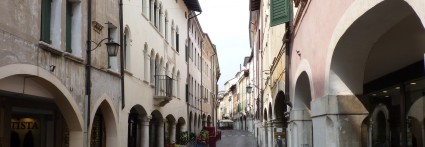
There are three airports to choose from if you are flying to Pordenone. Most come via Venice or Treviso; I took the more scenic route via Trieste, which takes longer but rewards you with glorious views over the Adriatic as you take the airport bus into the city. Or at least I would have gone that way had I not been fortunate to be offered a lift in a Giornate car with John Sweeney, one of the festival’s team of supremely talented pianists. So it was that I arrived at Pordenone well ahead of schedule and in royal style. Registration was in the new town Library, set around a beautiful colonnaded square, and armed with catalogue, other literature and a lurid orange festival bag, I was able to get to my first film having only missed a collection of French clowns films and Nelly Kaplan’s 1983 documentary on Abel Gance. The films are screened in the new Verdi theatre in the centre of Pordenone, a strikingly modernist building with curving white walls, lots of glass, and oh so comfortable seating within for the several hundred accredited to the festival (locals swelled our numbers still further by coming to the evening screenings).

And so to Minato No Nihon Musume (Japan 1933), or Japanese Girls at the Harbour. The festival’s main strand was films of the Shochiku studio, founded in 1920, and three of its leading filmmakers, Yasukiro Shimazu, Hiroshi Shimizu and Kiyohiko Ushihara. All three worked at Shochiku’s Tokyo studios, where the preference was for modern dramas with a strong element of Western influences. This was very clear in Shimizu’s Japanese Girls at the Harbour. The film told of two young women, Sunako (Michiko Oikawa) and Dora (Yukiko Inoue). Sunako falls in love with Henry (Ureo Egawa) who becomes involved with gangsters. He falls for another woman, who is shot and wounded by Sunako, who flees the city and becomes a prostitute. Meanwhile Henry marries steady Dora. Then Sunako returns…

The film was distinguished by striking pictorial compositions and an array of eye-catching devices, among them dissolves, tracking shots and jump cuts. When Sunako shoots her rival the camera zooms in on her face in jolts, then just as joltingly zooms out again. It was further distinguished by fascinating elements of Westernisation, particulaly associated with Henry, including suits, dance styles, clothing, motor cars, cigarette smoking, piano playing, and the prominent positioning of a Christian church. What was problematic was that none of these elements combined to make a coherent film story. Right from the outset you got an unsettling sense of no one shot really connecting with another. The narrative drifted, and just what point the director hoped to make became obscured as the plot thickened. Uncertainty hung over everything, and not in a deliberate way. There were good things there, but the individual elements never quite cohered.

But there was more than enough there to whet the appetite, and I see that the film is available on a Shimizu boxed set from Criterion, which includes the one film of his that I knew beforehand, the utterly delightful Mr Thank You (Arigatau-san) (1936). This was a great favourite of the late John Gillett, programmer extraordinaire at the National Film Theatre who did so much to bring Japanese films to the West. But Mr Thank You is a sound film – Japanese films continued silent for quite some while into the 1930s, but not quite as far as 1936.

The entertainments carried on, but I did not. I’m not a one for shows were every seat is taken and you have to sit where a ticket tells you too (if you’re as tall as me this is a major issue), so I avoided the evening’s special, ticket-only screenings that launched the festival. For the record there was Ivor Montagu’s short film The Tonic (UK 1928), based on an idea by H.G. Wells and starring Elsa Lanchester and Charles Laughton (which I do regret missing); a new animation by Richard Williams, Circus Drawings (UK 2010) and Buster Keaton’s peerless The Navigator (USA 1924) with musical accompaniment from the grandly named European Silent Screen Virtuosi (Günter Buchwald and friends).

Instead I chatted to friends at the Posta cafe, which is situated opposite the Verdi and fuels the festival with cappuccini, where we discussed looming budget cuts with gallows humour. Then I shuffled off back to my hotel and prepared myself for the rigours of the day to come. Which you’ll learn all about in Day Two.

Pordenone diary 2010 – day two
Pordenone diary 2010 – day three
Pordenone diary 2010 – day four
Pordenone diary 2010 – day five
Pordenone diary 2010 – day six
Pordenone diary 2010 – day seven
Pordenone diary 2010 – day eight
Pordenone pictures

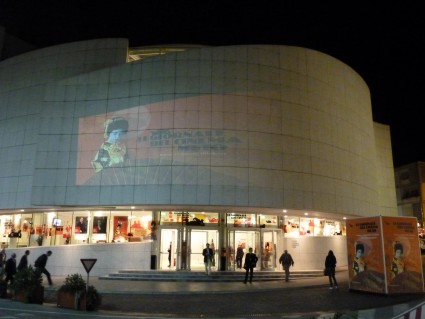
Verdi theatre, Pordenone, with trailer for the Giornate del Cinema Muto projected on the outside

Work has started on the Pordenone diary, which will take a little while to produce. In the meanwhile, I have uploaded a collection of photographs from the Giornate to the Bioscope’s Flickr site (scroll down to the bottom to find the Pordenone 2010 images) or else browse through my photostream (as they call it) starting here.

Pordenone bound

http://www.cinetecadelfriuli.org/gcm

The Bioscope is heading off to Pordenone to attend the Giornate del Cinema Muto. There will be our traditional detailed ‘diary’ of each day’s screenings after I get back, a week or so from now, but if you want to follow the progress of the festival as it happens, keep an eye on the Bioscope on Twitter from tomorrow. I will be tweeting throughout the festival (if I’ve managed to get the technology right), and I will do my best to conjure up such atmosphere as you can with 140 characters.

For the record, here’s the programe (web version), the daily schedule (1.6MB, PDF), and (jampacked with detailed riches) the full catalogue (8.5MB, PDF). The Bioscope’s reports on the Giornates of 2007-09 can be found on the Series page.

Muta Passione (Silent Passion)

Also for your delectation is this short documentary, Muta Passione (Silent Passion), made by Pasqualino Suppa in 2007. It’s a series of warm interviews with the founders, director, collaborators and guests of the Giornate, in the year where the festival moved from its temporary home in Sacile back to Pordenone. Most of it is in Italian, which is fine for our Italian readers (you know who you are), and features such festival luminaries as Paolo Cherchi Usai, Livio Jacob, Carlo Montanaro and Piera Patat. But you do also get ebullient festival director David Robinson and musicians Neil Brand, Günter A. Buchwald and Phil Carli in English, plus Donald Sosin and Joanne Seaton singing on stage and impromptu for the camera. It’s good to be going back.

See you in a week or so’s time.

Chaplin returns to Waterville

A new comedy film festival has been announced, named after Charlie Chaplin. The Charlie Chaplin Comedy Film Festival is intended to be an annual event held in Waterville, Kerry, Ireland. The first such festival will be 25-29 August 2011. Waterville was a favourite holiday location for the Chaplins, and a statue of Chaplin stands there (one of a number of statues of Chaplin around the world, as documented in an earlier post).

There isn’t much in the way of details about the contents of the festival as yet, but it will feature new films and be competitive (with the awards to be known as ‘charlies’), while its patron is Chaplin’s daughter Josephine. However, one does worry a little about a festival which has trouble spelling Chaplin’s name – until it was changed in the past day or two, the website’s banner was proudly announcing the Charlie Chaplain Comedy Film Festival. Ouch.

Image from Wikimedia Commons

Tuff times are here again

“emBodying Toronto” by Joyce Wong and Sonia Hong, 1st Place Winner at TUFF 2009

TUFF is the annuel Toronto Urban Film Festival, which has the noble ambition of showing new silent films to the commuters of Toronto. The festival, which takes place 10-19 September 2010, comprises an urban-themed programme of new one-minute silent films, which run repeatedly on the ONESTOP digital network of over 270 platform screens on fifty subway platforms of the Toronto Transit Commission (TTC) for ten days, reaching 1.3 million daily commuters. The top three films of the festival are chosen by a guest jury and guest judge; this year the judge is director, producer and screenwriter Deepa Mehta. The festival is now in its fourth year.

TUFF films on exhibition on a Toronto subway platform

TUFF is open to Canadian and international submissions by video artists, filmmakers – trained and untrained – animators and ‘urbanites’ with cameras or video-capable mobile devices. Filmmakers are asked to submit one-minute silent videos addressing one of seven themes: Urban Encounters; Urban Diversity; Urban Journeys; Urban Imaginary; Urban Natural; Urban Secrets; and Urban Ideas. Only the leading entrants in each category get to be screened on the TTC, from the hundreds of submissions made each year. The winning videos in each category from 2009 are now available to view on the TUFF site or on the festival’s YouTube channel (including entries from previous years).

Busy, busy, busy

Things are a bit hectic down at Bioscope Towers these days, and what with broadband problems, not only is it hard to find time to write posts but even when the time does appear I can’t post them. So, in my lunch break, and before heading off to the Imperial War Museum to mark the retirement of its highly estemeed Keeper of the Film and Video Archive, Roger Smither, and then to the BFI Southbank to see the ‘new’ Metropolis, here are links to some interesting posts on silent cinema which other bloggers have produced lately.

Doing things differently
George Clark reports on the pioneering programme of early films shown at the recent Oberhausen Short Film Festival, for AP Engine. Enthusiastic, but not uncritical.

From the career of Louis J. Mannix
Nick Redfern, at the highly impressive Research into Film blog, takes a break from statistical analysis to tell us about (and quote from) the rare memoirs of a Leeds projectionist operating in the silent era.

Never too late silents
Kristin Thompson assesses the silent films of Joseph von Sternberg through the recent Criterion DVD set at the indispensible Observations on Film Art blog that she shares with David Bordwell.

Kevin Brownlow to receive special Oscar
From the San Francisco Silent Film Festival blog, news that Kevin Brownlow is to be awarded an honorary award from the Academy of Motion Picture Arts and Sciences. Huge cheers and hats in the air about that piece of news.

The Lindgren manifesto
And from my other, infrequently updated blog, Moving Image, here’s philosopher-film archivist Paolo Cherchi Usai’s provocative but thought-provoking fourteen-point manifesto for film curators of the future, named after the founder of the BFI National Archive. Make of it what you will.