Coney Island goes silent

More evidence of the rude health of the modern silent, and of contests to reward its production, comes from the Coney Island Film Festival in New York. This is a competitive film festival, and budding filmmakers are invited to submit contributions in eight categories: Feature, Short, Documentary Feature, Documentary Short, Experimental, Animation, Music Video, and Silent Film. The latter is a new category (the festival is in its eighth year), and there doesn’t seem any stipulation other than what one might infer from the title (so, are you allowed to add a soundtrack?).

The Regular Deadline for submissions is April 25th, 2008 (postmarked), entry fee $25. The Late Deadline is June 25th, 2008 (postmarked), $35, and the Extended Late Deadline is July 3rd, 2008 (postmarked), $45. The festival itself takes place 26-28 September 2008. More information from the festival site.

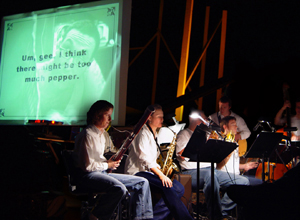
The sound of silent film

Sound of Silent Film

Sound of Silent Film, from http://www.acmusic.org

Further evidence of the rude health of the modern silent film. The third annual Sound of Silent Film Festival, an evening of modern silent films with music scores performed live, takes place at the Chopin Theatre, 1543 W. Division, Chicago on 26 March. The five films on the bill are Native New Yorker by Steve Bilich, Elastic Stronghold by Justin Heim, Birdcatcher by Chris Hefner, The Purse Belongs to Her by B.J. Moore, and Bajalica by Hurt McDermott. The composers are Natasha Bogojevich, Demetrius Spaneas and William Susman.

There’s a trailer for the festival (QuickTime), or find out more from the Academy of Accessible Music website.

Rats, ruffians and radicals in Nottingham

British Silent Cinema

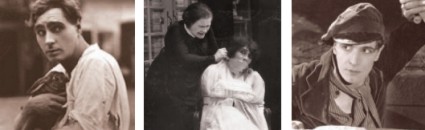
The Bargain, At the Villa Rose and The Rat

The full programme for the British Silent Cinema Festival has been published. The festival, entitled Rats, Ruffians and Radicals: The globalisation of crime and the British silent film (now there’s a theme and a half) takes place at the Broadway Cinema, Nottingham 3-6 April.

As usual, the festival will be a mixture of films, papers, symposia and special events, mostly (but not entirely) around the festival’s theme. The main outline of the programme has already been given here, but here’s a check list of the main films being shown:

Thursday, 3 April

AT THE FOOT OF THE SCAFFOLD
Dir. Warwick Buckland GB 1913, 24mins

THE BARGAIN
Dir. Henry Edwards, GB 1921, 1hr 15mins

RED PEARLS
Dir. Walter Forde, GB 1930, 1hr 15mins

AT THE VILLA ROSE
Dir. Maurice Elvey, GB 1920, 1hr 22mins

DER MANN IM KELLAR (THE MAN IN THE CELLAR)
Dir. Joe May, Germany, 1914, 44 mins

DIE CARMEN VON ST PAULI (aka THE WATER RAT)
Dir Erich Waschneck, Germany 1928, 1hr 54mins

Friday, 4 April

THE HILL PARK MYSTERY (NEDBRUDTE NERVER)
Dir. Anders Wilhelm Sandberg. Denmark, 1923, 1hr 15mins

CHICAGO
Dir. Frank Urson; USA 1927, 1hr 57mins

Saturday, 5 April

THE WHIP
Dir Maurice Tourneur, USA 1917, 1hr 10mins

PIMPLE IN THE WHIP
Dir Fred Evans/Joe Evans, GB 1917, 20mins

THE RAT
Dir. Graham Cutts, GB 1925, 1hr 18 mins

Sunday, 6 April

TRAPPED BY THE MORMONS
Dir. H.B Parkinson, USA 1922, 1hr

DANS LA NUIT
Dir. Charles Vanel, France 1929, 75 mins

The mostly crime-free special events are, on the Saturday: ‘Women and Silent Britain’, a series of presentations and screenings looking at the roles of women in the first three decades of British cinema; also on the Saturday, Luke McKernan presenting ‘The Olympic Games on Film 1900-1924’; on the Sunday, ‘Melodrama from Stage to Screen’, with emphasis on musical acompaniment (contributions from Phil Carli and Neil Brand); and most notably, on the Friday, Kevin Brownlow delivers the second Rachael Low Lecture.

And there’s more. You’ll have to read the programme for all the many papers featured during the four days, but expect to be informed, and quite possibly entranced, by presentations on subjects as diverse as crime in Finnish film of the 1920s, fan writing and self-representation in British silent films, the Biokam films of Laura Eugenia Smith, the eroticism of Anna May Wong and her representation as ‘other’, diamond smuggling in early cinema, the white slave trade and Traffic in Souls, and petty crime in Fred Karno’s music hall sketches as an influence in the early films of Charlie Chaplin.

And there are Sherlock Holmes and Fu Manchu shorts, and restorations from the Imperial War Museum, The Woman’s Portion (1918) and Everybody’s Business (1917). And lots more besides. Most of the films come from the BFI National Archive, plus some from the IWM, the Danish Film Archive, and UCLA Film and Television Archive (Chicago).

It’s always an excellently organised and amiable event, which achieves miracles on a funding shoestring, and is by now a more than well-established feature of the silent film calendar (this is its eleventh year). Full programme details, booking form, accommodation information and so forth are all available from the festival site. See you there, hopefully.
Cinéma muet dans les Hautes-Pyrénées

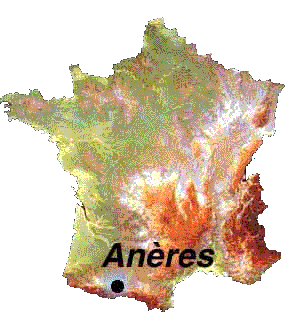
Anères

Some news of the 10th Festival d’Anères, an annual festival of silent films which takes place in the Hautes-Pyrénées, France. This year’s festival will run 7-11 May, and while the full programme has not been published as yet, the featured performers and filmmakers will include Fritz Lang, Luitz-Morat, Jean Epstein, Donald Crisp, Buster Keaton, André Antoine, Merian C. Cooper and Ernest Schoedsack, D.W. Griffith, Ernst Lubitsch, Jacques Feyder, Gennaro Righelli, Nemesio M. Sobrevila and Vsevolod Pudovkin.

The festival is new to me, but the site has useful information on past festivals, including programme details, lists of all films shown, directors featured and musicians. More news on the programme when I get it.

Joan in Sheffield

Passion of Joan of Arc

The Passion of Joan of Arc, from http://www.sensoria.org.uk

In the Nursery, the esteemed music duo (twins Klive and Nigel Humberstone) who have produced several scores of silent films, will be premiering their latest score, for Carl Dreyer’s The Passion of Joan of Arc (1928) at the Sensoria festival in Sheffield on 16 April. This is a new festival of film and music, running 12-18 April 2008, though a full programme has not been publishd is yet, so I don’t know if there will be further silent film/music combinations. The venue for The Passion of Joan of Arc will be Sheffield cathedral, and the box office is now open.

The Passion of Joan of Arc is of course one of the landmark films of silent era, indeed of cinema history as a whole. It is one of those superhuman works where you cannot imagine that the mundanities of filmmaking – camera set-ups, lighting, pauses, retakes, breaks for meals – ever took place. Using extensive use of probing, intense close-ups (no make-up was used), the film is like the history of a soul, quite unlike any other movie (what a vulgar term that is) that you will have come across. Information on the film is extensive, but check out Carl Dreyer’s illuminating thoughts on the production process, with its emphasis on staying true to the documents of the period, on the Criterion site. Dreyer, so it is said, wanted the film to be seen in silence.

In the Nursery’s website has information on their previous silent film scores. These have included Electric Edwardians (the Mitchell and Kenyon DVD collection of early actualities), Hindle Wakes, A Page of Madness, Man with a Movie Camera, Asphalt and The Cabinet of Dr Caligari. Sound extracts are available as mp3 files. The Passion of Joan of Arc will subsequently screen at Wave Gotik Treffen in Liepzig somewhere between 9-12 May, and at the Barbican in London on 1 June.

Presenting Keaton and Rogers

Buster Keaton

Here’s news of a novel competition from the Annual Buster Keaton Celebration:

The 16th Annual Buster Keaton Celebration, to be held September 26th & 27th, 2008 in Iola, Kansas, would like to announce its first annual Student Presentation Competition. The winner will receive a spot on the schedule of respected film and cultural authorities who are asked to
take part in the celebration each year and will receive a travel grant of $500 to facilitate his/her attendance. The student presenter will be expected to present a 30- to 40-minute presentation to the Celebration audience in PowerPoint format (with images either still or moving) and so
must be able to attend the conference as scheduled.

Eligibility: Full-time matriculated Undergraduate and Masters students at any point in their academic career, not affiliated with any employee or volunteer of the Buster Keaton Celebration, the Kansas Humanities Council or the Bowlus Fine Arts Center.

Required:
1. Applicants must complete an application to Frank Scheide or by sending a letter to Susan Raines, Bowlus Fine Arts Center, 205 East Madison, Iola, KS 66749-0705). Proof of current matriculation will be required as part of this application.

2. Applicants must submit their complete 30- to 40- minute presentation script for committee review, along with the above application, by the due date of May 1, 2008 along with images to be used in the final PowerPoint document. The applicant must also present evidence that images he or she wishes to use are available and in the applicant’s possession. Scripts must be typed and double-spaced (they may be in essay format, marked with indications as to what images will be utilized where in the presentation). Please do not submit the final PowerPoint demonstration.

To learn more about this year’s topic, please read the essay “Buster Keaton and Will Rogers: American Comic Heroes”, which can be found by visiting the Buster Keaton Celebration web site at http://iolakeatoncelebration.org. Committee members will be looking for original approaches to this topic and are especially interested in papers linking the two performers in some manner.

The Celebration Student Presenter committee will choose one winner and one runner-up, who will serve as an alternate. An announcement of the winner will be made by June 1st. The winner will have until June 30th to accept or decline the award. He or she will then have until July 31st to make his/her travel arrangements (assistance with this task will be provided by a committee volunteer). The winner will receive a spot on the schedule and a stipend of $200 and travel expenses up to $300 (airfare or mileage) to facilitate his/her attendance. Lodging and a daily food allowance will be provided by the Buster Keaton Celebration from Thursday evening, September 25th, through breakfast on Sunday, September 28th.

The chosen Student Presenter will be assigned a Celebration volunteer to assist with any and all parts of the actual presentation process, during the two days of the festival, in order to make the experience a successful and rewarding one for the studentand for the Celebration attendees!

Now how about a festival of PowerPoint one day? It’s the magic lantern de nos jours.

British silent cinema festival

Chicago

Chicago (1927)

The first news has been published of the feature films and main events taking place at this year’s British Silent Cinema Festival. As usual, the festival is being held at the Broadway, Nottingham, and runs 3-6 April.

This year the main theme is ‘Rats, Ruffians and Radicals: The Globalisation of Crime and the British Silent Film‘. The festival is a mixture of films, papers and special presentations, and usually pulls of the trick of attracting both an academic and an ‘enthusiast’ audience. Anyway, here are some of the delights on offer:

Chicago (USA 1927), sparky silent film version of the story that later became the musical Chicago. Directed by Frank Urson under supervision of De Mille this is a vibrant telling of the tale of Roxie Hart and her attempts to beat a murder rap in the most cynical city in the world. See the film that inspired the musical that inspired the film of the musical …

Red Pearls (UK 1930), Walter Forde’s psychological drama about a Japanese merchant who tries to drive his victim mad by sending him letters from beyond the grave.

Henry Edwards’ The Bargain (UK 1921) starring Chrissie White and actor/director Edwards in a tale of fraud, deception and family ties as a man purporting to be a long lost son returns from the Australian outback to claim his inheritance from his dying father.

At the Villa Rose (UK 1920), director Maurice Elvey’s classic locked-room murder mystery set in the fashionable and decadent expatriate community in Monte Carlo.

Die Carmen von St Pauli (Germany 1928), German director Erich Waschneck’s brilliant drama set in Hamburg’s dockside gangland featuring German stars Willi Fritsch and the delicious Jenny Jugo – who rivals Clara Bow for sheer screen presence. The film also shows there is more to German film than expressionism.

René Clair’s Le Fantôme du Moulin Rouge (France 1924) combines Grande Guignol, surrealism and playful avant garde film tricks. It’s the tale of a man whose spirit is released from his body to allow him to torment and trick his family but ultimately there’s a race against time when his spirit needs to get back into his lifeless body before the autopsy begins …

The Whip (USA 1917): more horse nobbling courtesy of Maurice Tourneur, based on the famous British stage play by Cecil Raleigh and Henry Hamilton. In the words of the legendary Tallulah Bankhead: “The Whip was a blood-and-thunder melodrama in four acts and fourteen scenes imported from London’s Drury Lane Theatre. It boiled with villainy and violence. Its plot embraced a twelve-horse race on a treadmill (for the Gold Cup at Newmarket), a Hunt Breakfast embellished by fifteen dogs, an auto-smash-up, the Chamber of Horrors at Madame Tussaud’s Waxworks, and a train wreck with a locomotive hissing real steam. It boasted a dissolute earl and a wicked marquis, and a heroine whose hand was sought by both knave and hero. It was a tremendous emotional dose for anyone as stage-struck and impressionable as our heroine.”

The Hill Park Mystery (Denmark 1923) (aka Shattered Nerves) features a detective trying to clear the name of a woman accused of murder, who finds matters complicated when he becomes romantically attached to his client.

Other highlights will include episodes from The Mystery of Dr Fu Manchu, The Adventures of Sherlock Holmes and tales from The Old Man in the Corner, Luke McKernan’s illustrated presentation to mark the centenary of the 1908 Olympics in the UK, a session on Melodrama along with a packed programme of presentations, screenings and social events.

So, yes, I’m one of the star turns (on Saturday the 5th), giving a glossy show on film and the Olympic Games, 1900-1924, with special attention given to the the London Games of 1908, whose centenary it is, of course. As for the feature films, there’s some fascinating choices there, though the British content seems a bit elusive in places. The festival website doesn’t have any programme details as yet, but further information will get published here in due course.

It’s only nine months away…

Sparrows

Sparrows, from http://www.cinetecadelfriuli.org/gcm

Let’s not wish away all the joys that 2008 in sure to bring, but the first news on the Pordenone Silent Film Festival (4-11 October) is out.

Among the main festival features will be

  • Aleksandr Shiryaev (Russian ballet dancer and producer of puppet dance films)
  • French comedy of the post-war silent era
  • Hollywood on the Hudson
  • Viktor Tourjansky
  • The Griffith Project, 12 (1925-1931)
  • The Corrick Collection, 2 (Australian collection of early actualities)

And the opening music event is to be a gala screening of the Mary Pickford classic Sparrows (1926), with score by Jeffrey Silverman, performed live for the first time by the Orchestra Sinfonica del Friuli Venezia Giulia, conducted by Hugh Munro Neely.

OK, October is a little time away, but a little closer is the 25 May deadline for applications to sign up to this year’s Collegium at Pordenone. This is a week-lomng programme of study into film history and film archiving with special sessions from notable expert visitors to the festivals. There are twelve places available, and applicants should preferably be under thirty years of age and pursuing education in cinema in some form. Collegians are given free hotel accommodation and breakfast during the week, but are responsible for their own travel arrangements, meals, and all other expenses. More information, including how to apply, from the festival site.

Clowning glories

Clara Bow

Clara Bow in The Wild Party, from http://www.birds-eye-view.co.uk

The Birds Eye View Film Festival returns 6–14 March 2008. This is the UK’s festival of women filmmakers, and as was the case last year it includes a silent film strand.

This year the festival features ‘Clowning Glories’, a retrospective of women in film comedy before 1930, to be held at the BFI South Bank. The titles being shown are:

  • 7 MarMy Best Girl (USA 1927 d. Sam Taylor). With Mary Pickford
  • 8 Mar Ich möchte kein Mann sein (I Don’t Want to be a Man) (Germany 1918 d. Ernst Lubitsch). With Ossi Oswalda + The Danger Girl (USA 1916 d. Clarence G. Badger). With Gloria Swanson
  • 10 Mar – The Vagabond Queen (UK 1929 d. Geza von Bolváry). With Betty Balfour
  • 11 MarShow People (USA 1928 d. King Vidor). With Marion Davies + Mabel’s Dramatic Career (USA 1913 d. Mack Sennett). With Mabel Normand
  • 12 MarThe Love Expert (USA 1920 d. David Kirkland). With Constance Talmadge, Natalie Talmadge + Blue Bottles (UK 1928 d. Ivor Montagu). With Elsa Lanchester
  • 13 MarThe Wild Party (USA 1929 d. Dorothy Arzner). With Clara Bow + A House Divided (USA 1913 d. Alice Guy)

There’s a complementary season of screwball comediennes of the 1930s, the UK premiere of Cannes hit Expired starring Samantha Morton, LFF critics’ choice Unrelated, and documentaries from Afghanistan, Pakistan, China and Nepal. Plus mobile phone filmmaking, women in video games, music vids, fashion films, and “a one off Whitechapel Gallery Late Night event starring a high profile all girl line up of live artists, VJ’s and DJ’s”. More details from the festival website.

Slapsticon 2008

A provisional list of titles for this year’s Slapsticon festival has been published. The annual festival of early film comedy takes place this year 17-20 July, Arlington, Virginia. The festival site says that the programme is still being selected, but nevertheless they are already promising (subject to change, of course) a remarkable line-up:

* Why Detectives Go Wrong (1928) — Poodles Hanneford
* Springtime Saps (1929) — Snub Pollard, Marvin Loback
* Winning Winnie (1926) — Ethelyn Gibson
* Three Stooges Rarity Show, hosted by Paul Gierucki
* Sally of the Sawdust (1925) — W.C. Fields
* Number One (1915) — Mr. and Mrs. Sidney Drew
* Pretzel and Flanagan (1914) — Lloyd Hamilton
* Taking Things Easy (1919) — Eddie Lyons and Lee Moran
* Nearly Spliced (1916) — Leon Errol
* Mishaps of Musty Suffer: Going Up (1916) — Harry Watson Jr.
* All Jazzed Up (1919) — Dan Russell, Hughey Mack
* It’s a Hard Life (1915) — Heinie and Louie (Jimmy Aubrey and Walter Kendig)
* The Bogus Booking Agents (1916) — Ham and Bud
* Sweeney’s Christmas Turkey (1913) — Hughey Mack
* Billy McGrath on Broadway (1913) — Augustus Carney
* Monkey Shines (1922) — Campbell Comedy
* The Tin Hoss (1925) — Hey Fellas
* Open Spaces (1926) — Malcolm “Big Boy” Sebastian
* A Pleasant Journey (1923) — Our Gang
* Among the Mourners (1915) — Chester Conklin, Syd Chaplin
* Are Waitresses Safe? (1917) — Ben Turpin, Charlie Murray
* Trimmed in Gold (1925) — Billy Bevan
* A Rainy Knight (1925) — Raymond Mckee, Eugenia Gilbert
* Taxi Dolls (1929) — Jack Cooper
* Doubling in the Quickies (1932) — Lloyd Hamilton, Marjorie Beebe
* Vacation Waves (1928) — Edward Everett Horton
* The Golf Bug (1923) — Monty Banks
* Golf Widows (1928) — Harrison Ford, Vernon Dent, Will Stanton
* Councel on de Fence (1934) — Harry Langdon
* See America Thirst (1930) — Harry Langdon
* Rush Orders (1921) — Snub Pollard
* Sherlock Sleuth (1924) — Arthur Stone
* Rough on Romeo (1921) — Paul Parrott
* The Rummy (1933) — Taxi Boys
* Harry Langdon Documentary (Paul Killiam) — never released Paul Killiam documentary from the late 1950’s, featuring rare clips and an interview with Vernon Dent.
* The Silent Partner (1955) — Buster Keaton, Joe E. Brown
* The Scribe (1966) — Buster Keaton’s last film
* An Aerial Joyride (1916) — Raymond Griffith
* His Foot-Hill Folly (1917) — Raymond Griffith
* Changing Husbands (1924) — Raymond Griffith and Leatrice Joy
* The Barnyard (1923) — Larry Semon
* Ladies Night in a Turkish Bath (1928) — Dorothy Mackail, Jimmy Finlayson
* Grass Skirts (1930) — Lloyd Hamilton
* Share the Wealth (1936) — Andy Clyde
* Dumb’s the Word (1937) — Edgar Kennedy, Billy Franey
* Alibi Bye Bye (1935) — Clark and McCullough
* Fiddlin’ Around (1938) — Monty Collins, Tom Kennedy
* Pistol Packin’ Nitwits (1945) — Harry Langdon, El Brendel
* Dangerous Females (1929) — Marie Dressler, Polly Moran
* Tomalio (1933) — Roscoe Arbuckle
* The Brown Derby (1926) — Johnny Hines
* His Private Life (1926) — Lupino Lane
* No Father to Guide Him (1925) — Charley Chase