The Land of Mystery

filmcans_banner1

UK 1920

Director/producer: Harold Shaw
Production Company: Harold Shaw Productions
Story: Basil Thomson
Script: Bannister Merwin
Cinematographer: Stanley Rodwell

Cast: Edna Flugrath (Masikowa), Norman Tharp (Lenoff), Fred Morgan (Prince Ivan), Christine Rayner, Harold French, M.R. Morand, Lewis Gilbert, John East, Phyllis Bedells (ballet dancer), Laurent Novikoff (ballet dancer)

Distributed by Laurillard & Grossmith
7,220 feet

land_of_mystery

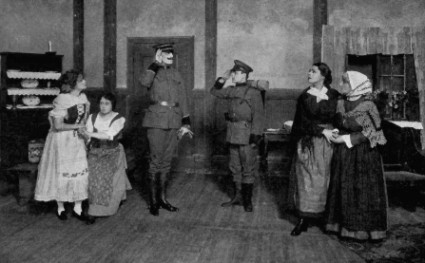
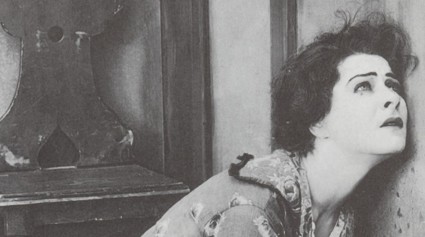
The only known production photograph of The Land of Mystery, taken in Kovno, Lithuania (from Kevin Brownlow, Behind the Mask of Innocence)

Welcome to day two of the Bioscope Festival of Lost Films. Today we find ourselves in the heart of London’s Soho district, at the Jardin de Paris, a cinema which once had a somewhat insalubrious reputation, but which now attracts a more discerning clientele, and certainly sees a little less of the police than it once did. Manager Felix Haté has even established a school for budding film projectionists at the cinema, which shows commendable enterprise. Our venue seats 250, and you will find it in Ingestre Place, just off Berwick Street. Our music this evening comes courtesy of I. Khudyakov, widely recognised as one of the finest improvising pianists for the cinema in Russia today. As you will see, he is an apt choice.

Our film for you this evening, The Land of Mystery, is adventurous in theme, and quite an adventure was had in its making. It is undeniable that the issue of the hour in 1920 is Soviet Russia, and what the Bolshevik revolution means not just for that indeed mysterious land but the lands that lie beyond it, indeed all of us. The cinema has a duty to inform as it has a desire to entertain, and it is right and proper that a film producer should have attempted to portray for us what has been happening in Russia.

That producer is known to you all. Harold Shaw is an American, an actor with the Edison company who came over to this country shortly before the Great War as a director for films made by the London Film Company. There he made such prestigious and fondly-remembered works as The House of Temperley (1913) and Trilby (1914), before venturing to make films in South Africa. Now back in this country, he tells us that took on the project at the behest no less a personage than Basil Thomson, head of the Criminal Investigation Department of the Metropolitan Police and Director of Intelligence at the Home Office. Mr Thomson’s work during wartime is naturally secret (we know something of catching spies and working with some peculiar organisation called MI5, but that is all), but his distrust of Bolshevism is a matter of record. Mr Shaw is vague on this point, but it seems that the idea for the production came from Thomson, who sees the cinema (which we know to be such a powerful medium of propaganda) as a new means to counter the Bolshevist threat. Hence Harold Shaw found himself with a handsome budget to produce a film based on a story provided by none other than Basil Thomson himself.

ednaflugrath

The story of the film’s production is remarkable. The film company, which included Edna Flugrath (pictured), Mr Shaw’s actress wife (sister of the cinema performers Viola Dana and Shirley Mason, of such renown), first travelled to Berlin, where they became caught in the middle of the Spartacist uprising of January 1919, with people being by shot by troops in the streets. One of the company ill-advisedly took photographs of some of the dead, which led to an uncomfortable delay in the hands of the authorities. The sights of a war-devasted Germany had a sobering effect on the company, who journeyed on by train accompanied by louse-ridden peasants on to Kovno (you may now know it better as Kaunas) in Lithuania, where the film was to be made.

Kovno itself was in ruins, having borne heavy fighting during the war. There was little food, street lighting was shut down owing to scarcity of fuel, and bodies of those who had starved to death were to be found in the streets. Each day a lorry left the town, laden with bodies for mass burial, and members of cast gargled and bathed in disinfectant to ward off disease. Astonishingly, in the middle of such circumstances, they began to film, first in Kovno and then at Alexandrova Elova, where filming was greatly limited owing to the sixteen hours of night. It is hard to believe that they spent some three months working under such conditions. But the resulting realism has startled all who have seen the film, declaring that nothing else like it has been witnessed on the screen before now. The remainder of the film was produced in rather more comfortable circumstances in London.

The film tells the story of Lenoff (played by Douglas Payne), and if you think that sounds a little like Lenin, well that is no accident. He is the son of middle-class parents, and is in love with a peasant girl, Masikova (Miss Flugrath). However, she comes to the attention of Prince Ivan, who sends her to Petrograd to become a dancer. Thwarted in love, Lenoff acquires a deep hatred of the ruling classes and becomes a Bolshevist. He goes into exile; on his return his fervour turns to madness after his mother is shot by Bolshevists without trial for having allegedly displayed Imperialist sympathies. Masikova joins the Imperial Ballet, but manages to escape to England with Ivan following the Bolshevist uprising.

All of this you may witness for yourselves. The film enjoyed a prestigious premiere at the Winter Garden Theatre in July 1920. In attendance were members of parliament, including the Home Secretary, the French ambassador, and some of the finest among London society. The film has had, it must be said, a mixed reception. The realism of some of the scenes, and the privations undergone by the film company, have elicited deserved praise. But disappointment has been expressed that Lenoff is driven not by political urgings but by romantic passion and wounded vanity. ‘The question of Bolshevism is not touched; neither a capitalist nor an industrial worker appears, the characters being exclusively Romanoffs, ballet girls and peasants’, complains the Kinematograph Weekly. Our sister paper The Bioscope feels that Mr Shaw has been hampered by the fear of appearing propagandist, but it praises individual details. It notes in particular the scene where a mad fanatic jumps onto the high altar, declaring ‘there is no God or I should die this minute’; whereupon a soldier shoots him dead. The staging interior of the Imperial Opera House comes in for much praise, and disappointment has been expressed that we do not see more of the two noted ballet dancers, Phyllis Bedells and Laurent Novikoff, so well known to British audiences.

lenin

The most remarkable fact about this remarkable film is that Vladimir Ilyich Lenin has seen it. The head of the Soviet diplomatic mission in London obtained a copy and sent it to the Kremlin. A screening was arranged at the Metropole cinema, apparently without Lenin or his wife, who accompanied him, being aware of the contents of the film beforehand. It was only when the film was halfway through that it stated to dawn on Lenin that the leading figure might be based on him. He is reported to have laughed heartily at the remainder of the film, thought whether he thought it a foolish romance or possibly satire, one can only speculate. If only one could have been there.
meyerhold2

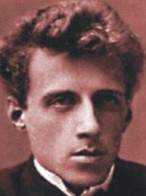
The film we have to accompany our feature is shorter, but but will undoubtedly be acclaimed by posterity as the greater. To contrast with a British view of Russian life, we have a Russian view of British life, The Picture of Dorian Gray (1915). Some may remember that last year’s festival featured the 1913 American version of Oscar Wilde’s story, with Wallace Reid as the doomed Gray. This year, we are showing the version produced by Vsevolod Meyerhold, a genius of the Russian theatre, whose symbolist, experimental ideas have revolutionised what ideas of what the theatre is there to show and how the artist should prepare for it. You may imagine the huge excitement caused when the great Meyerhold decided that he wanted to turn his talents towards the cinema, and did so with gusto. The result, we are informed (for we have not see the film as yet), are startling beyond measure. Maestro Meyerhold has sought to realise the buried potential of the screen. Compositions are in bold blocks of black and white, characters are silhouettes against a phantasmagorical background. There is innovation likewise in the casting; rejecting most performers as inadequate for his purposes, he has cast a woman, Varvara Yanova, as Dorian, and himself as Sir Henry Wooton. Meyerhold, we understand, has not illustrated but rather he has embodied the inner essence of Dorian Gray’s tragedy, through film.

This three-reeler has been acclaimed by all critics who have seen it, and roundly dismissed by the Russian public. It will be interesting to see how festival attendees judge this work – failed entertainment, or visionary insight into the future of cinema. Or you may simply enjoy the Wildean epigrams in the intertitles, which the festival staff have dutifully translated back into the correct English. Our two films this evening are very different in style and artisitic accomplishment, we suspect, but they each demonstrated the compulsion the best among cinema artists feel to bring telling visions to the screen. These are not idle films.

We hope you are enjoying the festival, and that you will join the other festivalgoers after each screening at one or other of the recommend eating houses: Romano’s, Simpson’s, or tonight’s rendezvous, the Rendezvous itself, in Dean Street, just around the corner from here. For those of serious intent where lost films are concerned, you may be interested to learn that out education officer will be providing notes on the research that went into locating the films once the festival is over, and thought is going into possibly organising a touring version of the festival. Lost films are for everyone, not just those in the metropolis.

Do join us tomorrow, where we will be in the East End to witness an elemental battle such as has never been surpassed on the screen. A charabanc will be laid on for festivalgoers, if you would like to assemble outside the Savoy at 7.00pm sharp, price sixpence.

War Brides

filmcans_banner3

USA 1916

Director/producer: Herbert Brenon
Production Company: Herbert Brenon Film Corporation
Cinematographer: J. Roy Hunt
Art director: George Fitch
Film editor: James McKay
Script: Herbert Brenon, Marion Craig Wentworth
Based on the one-act play by Marion Craig Wentworth

Cast: Nazimova (Joan), Charles Hutchinson (George), Charles Bryant (Franz), William Bailey (Eric), Richard S. Barthelmess (Arno), Nila Mac (Amelia), Gertrude Berkeley (The Mother), Alex K. Shannon (The King), Robert Whitworth (Lieutenant Hoffman), Ned Burton (Captain Bragg), Theodora Warfield (Mina), Charles Chailles (A financier)

Distributed by Lewis J. Selznick Enterprises
Eight reels

warbrides_cropped

Nazimova, in War Brides

Welcome one, welcome all, to the Bioscope Festival of Lost Films! Over the next five days we will be bringing to you five feature films (with accompanying shorts), selected from around the world, each a silent film now considered lost, untraceable in any of the world’s film archives or private collections.

We are opening with War Brides, Herbert Brenon’s pacifist masterpiece. Our venue is the Theatre de Luxe, in London’s The Strand. This select venue, star of the Electric Theatre circuit, lies adjacent to the Tivoli theatre (itself now no more) and seats 170 in the finest comfort. You will have noticed the luxuries of the foyer, and the special feature of a writing room, with complimentary notepaper, postcards and envelopes at the disposal of patrons. In such a modestly-sized venue, we must have musical accompaniment to match, so we are delighted to welcome as pianist Mr W. Tyacke George, author of that estimable and essential work for the aspiring silent film accompanist, Playing to Pictures (1914), who should certainly know what he is doing.

We are living in a time of war. We are always living in a time of war. The conflict in this case is the Great War, and while at the time of this film’s release Britain has been part of the fighting for two years, the United States has followed President Woodrow Wilson’s policy of neutrality. The British and the Germans have each plied the arts of propaganda to gain American sympathies, and the British have hopes that America will eventually side with it militarily. Some in America are thinking this way, and their call is for ‘preparedness’ should the need to fight arise. Others are appalled by the European folly, and speak out against war in all it forms. Already in 1916 American producers have given us Intolerance and Civilization, and now at the end of the year comes the most acclaimed film the year, and the strongest plea against war that we have yet seen on the screen, War Brides.

It has its basis in a one-act play, of the same title, written by Marion Craig Wentworth, which was such a success in the American theatres in 1915. Its star was that extraordinary Russian actress Alla Nazimova, who has been performing in America since 1905, excelling in Chekhov and Ibsen. Such was the sensation created by War Brides on the stage that producer Lewis J. Selznick persuaded Nazimova (she prefers to be known), for the handsome fee of $1,000 a day, to make her screen debut based on the stage success.

warbridesstage

The 1915 stage production, with Nazimova (as Hedwig, the original name for her character) second from the right

As is the case with many anti-war tales, the setting is an unidentified country which could be anywhere. Four brothers are called up to join a war. They leave behind their mother, sister and the wife of one of them (Joan, the Nazimova character). All four are killed. Joan tries to kills herself, but it persuaded not to do so because of her unborn child. Then the government decrees that all unmarried women must be compelled to marry returning soldiers to ensure a new generation of manpower for the war. Joan leads a protest movement of women against the decree, escaping from imprisonment to confront the king. On being told by him that war never ends, she kills herself and her unborn child.

This is an undeniably powerful theme. Nazimova proves herself as a great a tragic actress on the screen as she is known to be on the stage, managing both to be a symbol and a person at the same time. Gertrude Berkeley, as the mother, joins her from the stage production, as does Charles Bryant, playing one of the sons, who happens to be Nazimova’s husband. Among the actors playing the other sons, we are advised to look out for one Richard Barthelmess, whose first picture this is. A great future is predicted for him.

brenon_nazimova4

Herbert Brenon and Nazimova on the set of War Brides

The director is that talented Irishman Herbert Brenon. We have all admired his previous works, among them Dr Jekyll and Mr Hyde, Ivanhoe, Neptune’s Daughter and Sin, but Mr Brenon calls this his greatest work. Interestingly, we hear rumours that there are those within the British political establishment that agree with him. Can it be true that this producer of an anti-war masterpiece could be persuaded by the British War Office to produce a propagandist epic in favour of the British war effort? We shall await any such developments with the greatest interest.

Critics have been almost unanimous in their praise of War Brides. Few pictures in recent years have received such general acclaim. Yet there have been some adverse comments. The New York Times, while full of praise for Nazimova, who it says, ‘is a good subject for motion photography … she knows how to express herself in terms of the film’, was less enamoured of the film’s attempts to expand itself beyond the stage original.

The first half … in some respects is very bad indeed. It is palpably padded to make a holiday movie, some of the padding consisting of typical movie comedy, and is unnecessarily jerky and artificial. With such pictures as those of the battle of the Somme on view there should be a law against photoplay directors photographing sham martial scenes, or else to force them to make them depict scenes approximating reality. A bogus battle scene is included in “War Brides,” in which the defensive army occupies a system of trenches which rise from the foreground up and up into the background. All that an attacking army would have to do creep up to the edge of the top trenches and roll bombs down upon the helpless enemy, while if those in the trenches wishes to assume the offensive they would have to scale heights as high as the Palisades.

It is as curious to see a newspaper dramatic critic advise us on military strategy as it is to see a Hollywood studio attempt to depict it. As it is, the critic should perhaps read something of the futile Italian military campaign of the war, attempting to attack Austrian troops by scaling mountains while their enemy is securely positioned above them, before dismissing War Brides’ own illustration of military madness. However, it is telling that the critic compares its attempt to portray reality with the actual scenes of conflict in the remarkable films taken by British official cameramen of the battle of the Somme. It is difficult for the dramatic film to compare with the sober reality of conflict as depicted so honestly in The Battle of the Somme, and War Brides is strongest where it shows war’s consequences.

War Brides naturally speaks to the distaff side of the audience. It understands the suffering that war causes. Unlike some other films of pacifist intent, it successfully blends an idealised situation in a mythical land with the realities of home life and individual lives caught up in war’s inhuman machinery. It has touched a chord with audiences who may have found the melodrama or religiosity of Intolerance and Civilization unconvincing. Some states in America have banned the film because of its apparent pacifism, but we hear rumours that were America to join the war then the producers would find it is easy enough, with a judicious explanatory title or two, to make the film seem to promote the Allied point of view, a film not against war but against one side of the war. Thus do we see how powerful, and then how weak, the cinema can be.

To accompany our main film, we are showing Kiddies in the Ruins (UK 1918), George Pearson’s poignant portrait of the plight of French children in war-time. Pearson is an old friend of the Bioscope Festival of Lost Films, his work having appeared in last year’s festival. Here, inspired by a music hall sketch based on cartoons by that eminent French cartoonist Francisque Poulbot, he has shown us the lives and dreams of urchins in a bomb-shattered French city (enterprisingly filmed at Courneuve, near Paris). This touching three-reeler, starring Hugh E. Wright, may lack a little in narrative, but in sensibility alone it is a fine accompaniment to our main feature. We have seen the wretchedness of war, and yet the hopes that may arise even out of the ruins it has created.

Do join us again tomorrow night, when we will moving to the Soho district, and seeing a film of true mystery and daring, not only its in subject matter but in the extraordinary circumstances surrounding its production.

Bardelys comes to Kansas

The recently-rediscovered print of Bardelys the Magnificent, starring John Gilbert, gets its American premiere (albeit on DVD) at the Kansas Silent Film Festival in February. Here’s the full festival line-up:

Fri. Feb. 27, 2009
Rowdy Ann, 20 min. (1919), with Fay Tincher
— Organ music by Greg Foreman

Go West, 70 min. (1925), with Buster Keaton
— Music by the Mont Alto Motion Picture Orchestra

The Great K&A Train Robbery, 54 min. (1926), with Tom Mix
— Music by Marvin Faulwell, organ, & Bob Keckeisen, percussion

Sat. Feb. 28, 2009
Disney’s Laugh-O-Grams, 6 min. (1925), a film by Walt Disney
— Organ music by Marvin Faulwell

Thundering Fleas, 20 min. (1927), with Our Gang
— Organ music by Marvin Faulwell

The Poor Little Rich Girl, 65 min. (1917), with Mary Pickford
— Organ music by Marvin Faulwell

Fatty & Mabel Adrift, 30 min. (1916), with Roscoe Arbuckle & Mabel Normand
— Music by the Mont Alto Motion Picture Orchestra

Cobra, 75 min. (1925), with Rudolph Valentino & Nita Naldi
— Music by the Mont Alto Motion Picture Orchestra

Kidding Katie, 20 min. (1923), with Dorothy Devore
— Organ music by Marvin Faulwell

Her Sister from Paris, 74 min. (1925), with Constance Talmadge & Ronald Colman
— Organ music by Greg Foreman

A Flash of Light, 15 min. (1910), film by D.W. Griffith
— Organ music by Marvin Faulwell

That’s My Wife, 20 min. (1929), with Laurel & Hardy
— Organ music by Greg Foreman

Bardelys the Magnificent, 90 min. (1926), with John Gilbert
— Music by the Mont Alto Motion Picture Orchestra

The festival, which is free and open to the public takes place 27-28 February at the White Concert Hall, Washburn University campus, 17th and Jewell, Topeka, Kansas. Full details on the festival website.

It’s festival time again

filmcans_banner

We see out 2008 with a reminder that the Bioscope Festival of Lost Films returns on Monday 5 January and runs for five days. The five films (with accompanying shorts) have now been selected, after rigorous checks by our team of researchers to ensure that none exists in any archive around the world. No clues about what will be shown, but we can guarantee a star or two, some surprises, and a touch of controversy.

filmcan1

We can, however, give some organisational details for those who want to plan ahead. For a start, there are the venues. As was the case last time, each is a building that was cinema in London in the silent era, but now has either turned to other uses or is simply no more. They have been chosen for their distinctiveness and for their variety. So, our festival venues will be:

  • The Theatre de Luxe – small but luxurious cinema in the Strand, established in 1908 as one of London’s first cinema circuit, formed by Electric Theatres (1908) Ltd., and now a branch of Optical Express
  • The Jardin de Paris – a select venue in the heart of Soho, opened in 1909, closed in 1916, its space now occupied by a hotel
  • Wonderland – Whitechapel’s notorious home of Yiddish theatre, boxing bouts and freak shows, which also put on film shows and burned down in 1911
  • Pyke House Cinematograph Theatre – a grand building at the east end of Oxford Street, once the centrepiece of the famed Pyke circuit, now a Waterstone’s bookshop
  • The Picture House – located at 161-167 Oxford Street, one the site of where a Hale’s Tours of the World show once ran, and where the Academy Cinema of fond memory was to stand until recent times, and which is now a Marks & Spencer store

filmcan1

For those of you planning to stay over in London for the festival, we would like to recommend the Savoy, conveniently located in the Strand close by our opening venue, the Theatre de Luxe. Discount rates are available for festival attendees who are able to stay five nights and can bring an empty can of film to the hotel desk as evidence of your intentions (please call the hotel for details). For those who may find that the cost of the Savoy a little steep (particularly if it comes on top of any steamship costs for those travelling from overseas), we have done a special deal with a number of humbler establishments along Gower Street in Bloomsbury, within stout walking distance of most of our venues. Call the festival office (you know the number) for more details.

filmcan1

Prices are 6d, 3d and 1d for standing at the back, with a special ha’penny ticket for children (please note that some of the films we will be showing may not be suitable for younger eyes – contact the festival office for further information). You will realise, therefore, that we have kept our prices fixed for well nigh a century, which is quite a bargain in these straitened times. Boxes are a shilling per person, to a maximum of four. Festival notes will be provided on the night, and we hope that you will make the most of your time with us to visit the sights of this great city. For eating out, we naturally recommend the Strand’s best-known restaurant, Romano’s, evocatively described here, even if today it is the home of Stanley Gibbons, the stamp emporium.

filmcan1

For those who may be new to this unique event in the film calendar, please be aware that the Bioscope Festival of Lost Films is a celebration of silent films that were shown once but can be seen no more. All of the films, though they may be described in such realistic detail that they may appear irresistibly before your eyes, no longer exist. All that we can do is peruse those documents which record their presence, study the extant images, exercise our imaginations, and sigh.

Do join us on Monday.

Roll away the reel world

joyce

http://www.jamesjoyce.ie

2009 sees the centenary of one of the odder corners of early film history. In December 1909, the then unknown James Joyce, future author of Dubliners, Ulysses and Finnegans Wake, opened a cinema in Dublin. This was through no particular passion for film; Joyce was merely seeking the means to get rich quick, and like a good many other people at the time, he saw the new cinema business as the way to do so. Cinemas were springing up all over Europe, and in Trieste – where Joyce was based – he had fallen in with a group of cinema owners, to whom he sold the idea of a city in Europe which had a half a million inhabitants, and yet not a single cinema. That city was Dublin, and although recent research indicates that there probably were one or two cinemas in Dublin at that time (and numerous film shows not in cinemas as such), Joyce’s business partners were interested enough to send him across to Dublin to establish the Volta Cinematograph.

Happily for literature, Joyce turned out to be a hopeless cinema manager, or rather he left the business all too quickly in other hands, only to see the hoped-for source of his fortune rapidly fail. The Volta (which was located at 45 Mary Street) floundered, as much through competition from other film entertainments as its own mismanagement, and it was sold at a loss in June 1910. Joyce’s own specific involvement with the cinema was brief, but intense. He spent several weeks setting up the business, staffing and equipping, promoting it, obtaining a cinematograph licence, and – it is to be assumed – selecting the films.

It is this last element that continues to attract scholarly interest. What films were shown at the Volta, what role did Joyce play in their selection, what did he think of such films, and what traces of the cinema can be uncovered in his art? These questions are all to be covered in in a two-day conference organised by the Trieste Joyce School and the Alpe Adria Film Festival, entitled ‘Roll away the reel world’: James Joyce e il Cinema, to be held 15-16 January 2009 at the Sala Tessitori of the “Consiglio della Regione Friuli Venezia Giulia, piazza Oberdan, 5, Trieste, Italy.

huguenot

Le Huguenot (Gaumont 1909 d. Louis Feuillade), shown at the Volta 24-26 January 1910

Speakers include Luke McKernan (yours truly), who will introduce a programme of films known to have been shown at the Volta and give a talk, ‘James Joyce and the Volta Programme’, Eric Schneider (‘Dedalus among the film folk’), Maria di Battista (‘The Ghost Walks: Joyce and the spectres of silent cinema’), Louis Armand (‘Joyce and Godard’), Jesse Meyers (‘James Joyce, Contemporary Screenwriter?’), Cleo Hannaway (‘”See ourselves as others see us”: Cinematic Ways of Seeing and Being in Ulysses’), Marco Camerani (‘Circe, Fregoli and Cinema’), Carla Marengo Vaglio (‘Joyce, between futurist music-hall and cinema’), Philip Sicker (‘Mirages in the Lampglow: Joyce’s “Circe” and Méliès’s Dream Cinema’), Katy Mullin (‘Joyce, Early Cinema and the Erotics of Everyday Life’), Davide Maschio (‘On Bute’s Finnegans Wake’), and Keith Williams (‘Odysseys of Sound and Image: “Cinematicity” and the Ulysses Adaptations’).

Added to all that, the Alpe Adria Film Festival, or Trieste Film Festival, is hosting a retrospective on Joyce and cinema, running 15-22 January, co-ordinated by Elisabetta D’Erme; and there is to be an exhibition, entitled Trieste, Joyce and Cinema: A History of Possible Worlds curated by Erik Schneider, tracing the connections between Joyce’s imaginative world, the city, and the cinema. For further information on the conference, which is free of charge and open to all, contact Professor John McCourt at mccourt [at] units.it, or visit the Trieste Joyce School site for the programme details.

Metropolis at Seminci

My thanks to John Riley for alerting me to these two videos. They depict the screening of Metropolis at the Seminci film festival in Valladolid, Spain, late October, when the Fritz Lang film was exhibited at the Miguel Delibes Auditorium with live orchestral accompaniment from the Orquesta Sinfónica de Castilla y León. Of itself, this might be of passing interest but nothing special. What pleases me is what these two festival-produced videos is what they capture of the atmosphere of a prestige silent screening. The first shows the audience arriving, chatting in the auditorium and taking their seats. It captures the sense of a cultural treat, the festival spirit. Brief as it is, it’s a people-watching treat.

And then the audience settles down, the orchestra takes its place, the conductor is applauded, the lights go down and the film begins. The second video captures such opening moments familiar to anyone who has attended a silent film show with orchestra, but there’s not much recorded of such events in this way, particularly the point where the film gets underway and we can see both orchestra and film on screen. It’s a brief record, but one worth sharing with you.

Harold Shaw and De Voortrekkers

voortrekkers

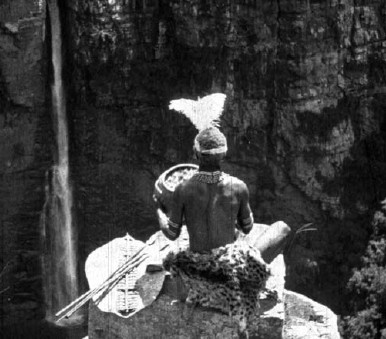
Still from De Voortrekkers, showing Zulu warrior Sobuza, who converts to Christianity. From Jane M. Gaines’ essay ‘Birthing Nations’ in Metter Hjort and Scott Mackenzie (eds.), Cinema and Nation (2000)

The London African Film Festival is taking place 29 November-7 December 2008, a wide-ranging celebration of African cinema involving a number of venues across London. The programme brings together an imaginative programme of new and classic titles, with some eye-catching surprises. Among the latter, the one that is catches this eye in particular is De Voortrekkers.

This 1916 epic film was one of the first South African dramatic film productions, and tells the story of the Boers’ Great Trek, concluding with a reconstruction of the 1838 Battle of Blood River, where a few hundred Voortrekkers (Afrikaners) defeated several thousand Zulus. Commemorating as it did their view of a highly contentious area of history, the film came to be revered by Afrikaners. It enjoyed a long after-life in South African classrooms and was (and may still be) shown annually on the date of the Battle of Blood River (16 December). For a long time remained unseen outside of the Afrikaner community, though copies have been available on video from a Canadian company, Villon Films, for some while now.

De Voortrekkers was one of four films made during a short period in South Africa by the remarkable Harold Shaw (1876-1926), whose full story needs to be told properly by someone some day. Briefly, Shaw was an American, who began his career in film as an actor with Edison in 1908, graduating to film director and moving to the IMP company. His best known work from this first period is the haunting fantasy film, The Land Beyond the Sunset (1912), now recognised by the National Film Preservation Board, which has placed it on its National Film Registry for permanent preservation as a national film treasure.

haroldshaw

Shaw (left) moved to Britain in 1913 to direct for London Film Productions, making such prestigious titles as The House of Temperley (1913) and Trilby (1914). His best British work, for me, is a barely-seen 1916 propaganda piece, You (1916), which encourages various people to support the war effort by means of a piece of paper that floats from person to person, asking each ‘What are YOU doing for your country?’ It is so creatively put together. That same year he ventured out with actress wife Edna Flugrath to South Africa, where he had been hired by African Film Productions. His first film for them, De Voortrekkers (1916), which starred Flugrath, was sensationally successful locally and even gained some screenings overseas (in the USA it was known as Winning a Continent). The scenario was written by historian Gustav Preller, and its version of the Great Trek emphasised the common point of view between Britons and Afrikaners (the Anglo-Boer War was long past and the political stress was now on the strength of the Union) and the ‘savagery’ of the native peoples (who, the film argues, are led to rise against the Boers by Portuguese traders). News reports at the time stressed the authenticity of the props and costumes and the huge numbers involved: hundreds of extras, black and white, many of them mine employees. Telling tales were told of a filmed charge which was undertaken too enthusiastically, the ‘natives’ neglecting to fall dead and instead assaulting some of the Europeans, with mounted police having to restore order. The completed film ran for some two hours.

rose_of_rhodesia

The Rose of Rhodesia, from http://www.slottsbio.com

Disagreements with the production company led Shaw to withdraw from a follow-up film on the Zulu wars, Symbol of Sacrifice (1918, directed by Dick Cruikshanks), fragments of which survive and are apparently available on a DVD entitled Isandlwana, Zulu Battlefield. Instead he made a melodrama about stolen diamonds for a rival producer, The Rose of Rhodesia (1917), which was recently discovered in the Netherlands and is attracting growing academic interest. Shaw and Flugrath made a third film (now lost), a horse-racing drama entitled Thoroughbreds All (1919), then returned to Britain.

Shaw next went another strange journey, to the Soviet Union to film Land of Mystery (1920), a melodrama (now lost) set in the USSR and loosely based on the life of Lenin, whose strange history (the story was written by Basil Thompson, who was high up in the British secret service) is covered in Kevin Brownlow’s Behind the Mask of Innocence. Shaw made more films in Britain, including two H.G. Wells adaptations, Kipps (1921) and The Wheels of Chance (1922), before returning to America to direct for Metro. He then died in a motor car accident in 1926.

It’s an extraordinary personal history, and one day someone needs to do Harold Shaw’s strange career adequate justice. As it is, he has a small but dedicated band of devotees around the world, myself among them (we used to gather around a table at the Pordenone silent film festival – it wasn’t a very large table). Meanwhile, De Voortrekkers, which I’ve yet to see, comes to the Barbican in London on 3 December, screening with Joseph Albrecht’s 1938 129-mins epic Building a Nation (Bou van ‘n Nasie), another piece of Afrikaner apologetics. The films runs for 60 mins and musical accompaniment will be provided by Juwon Ogungbe with piano and traditional instruments such as the kalimba and marimba. Both films clearly need to be seen in the context of Afrikaner nationalism and racism, but it is good to see De Voortrekkers move from its time of closet, propagandist screenings to a public festival where it can be viewed in the fuller context of African film production, past and present.

The Bioscope Festival of Lost Films

filmcans

As the bitter winds sweep down direct from the North Pole, and the first Winter snows settle upon the roof of Bioscope Towers, it is time to look to new hopes for the new year, and the return of the Bioscope Festival of Lost Films. Yes, it’s a year since we startled a complacent film world with the very first festival of lost films. Other festivals will show you newly-made films, classic films, obscure films, films you know well and films you’ve never heard of – only the Bioscope Festival of Lost Films will exhibit films that were shown once but can be seen no more.

filmcan

The festival will follow the pattern last year, with some innovations. Over five days, we will feature five silent films that, so far as our researchers are able to determine, no longer exist. Each will come with a programme of extras, such as short films, guest interviews and so on. Each will be shown in a venue that was once a cinema but is now dedicated to other business. There will be appropriate live accompaniment from some noted silent music practitioners of the past. As before, it is not possible to announce what any of the films to be shown will be. Partly this is to maintain the element of surprise, partly because the most stringent efforts need to be taken right up to the last minute to ensure than none of the films on show does, in some far-flung corner of the film archive world, exist.

filmcan1

The festival will take place 5-9 January 2009. Please cancel all other engagements. A year ago we had excellent participation from the Bioscopists, who very much got into the spirit of things, though none quite so much as the person who became so enthused that he asked if his own work could be considered for a future festival. The idea of producing films that are lost before they are even made (the dreams that never made it to celluloid reality) is for another festival, at another time. These are the films that were once, and are no more.

As before, the Bioscope Festival of Lost Films is dedicated to the anonymous person who visited this blog with the search request “lost films download”. We must all continue to live with such hopes.

Slapstick is here again

slapstick2009

http://www.slapstick.org.uk

Slapstick, Bristol’s silent film comedy festival, returns 22-25 January 2009. At just the time of year when we probably need it most, the Bristol festival (now in its fifth year) will be bringing together a programme of silent comedies with guest star comedians of today. The festival opens with a special gala event at Colston Hall of Buster Keaton’s Our Hospitality (1923), with live music from the Prima Visa Social Club, hosted by Paul Merton, who will introduce a supporting programme of comedy shorts including Laurel and Hardy in Liberty (1929).

Promised guests include Merton, Tim Brooke-Taylor, Graeme Garden, Neil Innes, and the Ukelele Orchestra of Great Britain playing to films from the BFI National Archive. British comedy great Eric Sykes will appear at the Bristol Old Vic on January 25th, in conversation with Phill Jupitus, to talk about his career as a writer and performer, to include a screening of his own classic ‘modern’ silent, The Plank (1967). Other venues will be the Watershed and the Arnolfini.

The remainder of the programme remains to be announced, but you are advised to book early, as this blurb from the festival says:

We are expecting unprecedented demand for these tickets and expect them to sell out quickly. A limited amount of priority tickets have been put aside for Bristol Silents Members and those people who purchase festival passes until 17th November and will be allocated on a first-come, first-served basis.

All Bristol Silents members and delegates will be able to purchase tickets at discounted rates.

We look forward to welcoming you once more to an extraordinary weekend of film, music and laughter in the heart of Bristol and would like to take this opportunity to thanks you for your ongoing support.

More programme news here as it appears.

Silents in the Hills

wiveliscombe

The Quantocks

Now here’s a commendable thing. The third Wiveliscombe Silent Film Festival (aka Silents in the Hills i.e. the Quantocks) takes place in the small Somerset town on 14-16 November.

The festival opens with Louise Brooks in Diary of a Lost Girl, with musical accompaniment by Devon-based harpist Elizabeth-Jane Baldry (fresh from her star turn at Pordenone). On Saturday 15th they are showing Metropolis, with accompaniment by Reflektor (Jan Kopinski and Steve Iliffe), and on the Sunday there’s Buster Keaton in Sherlock Junior and Lon Chaney Snr in The Phantom of the Opera, accompanied by Alan Eason and Andy McFarlane, guitarist and violinist from D.A.T.A. All films will be shown at the New Hall at Wiveliscombe Primary School, North Street, Wiveliscombe (where a special free show of comedy shorts for the children will be put on before the main Festival begins.)

More details from the festival web page.