A silent stroll through London

At the recent British Silent Film Festival a walk was organised for delegates around some of central London’s early film sites. With the kind permission of the walk’s organiser and guide, Ian Christie, the Bioscope is able to reproduce his notes, and encourages you (should you be in London) to follow in these footsteps. The contemporary pictures are by Matthew Lloyd. The text is followed by a review of the walk from Kelly Robinson, to whom my thanks for suggesting the idea for this post. Hyperlinks in bold are to map references. Happy trails.

(Very) Early Film Sites in Central London
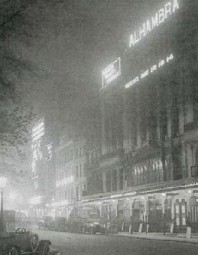
alhambra

1. We start in Leicester Square, beside the Chaplin statue (John Doubleday, 1981) and the Shakespeare monument (copied from Westminster Abbey, 1874), looking around the perimeter, first at the Empire (1884), site of the first Lumière Cinématographe run in Spring 1896; also at the site of the Alhambra music hall (1858) where R.W. Paul ran a competing show featuring his ‘Animatograph’, also starting in 1896 (image from http://www.arthurlloyd.co.uk). Paul also shot his first fiction film on the roof of the Alhambra. The Odeon West End opened in 1930 as one of the new sound-era cinemas (refurbished 1968) and the flagship Odeon Leicester Square opened in 1937, and remains London’s leading ‘red carpet’ venue.

Into Leicester Place, north of main square, to look at French Catholic Church, Notre Dame de France, first built in 1865 on site of Robert Mitchell’s 1793-4 Panorama. Look north into Lisle Street, where De Loutherbourg ran the Eidophusikon in February 1781, described as ‘Moving pictures, representing phenomena of nature’. Review of Leicester Square history and entertainments since 18th century.

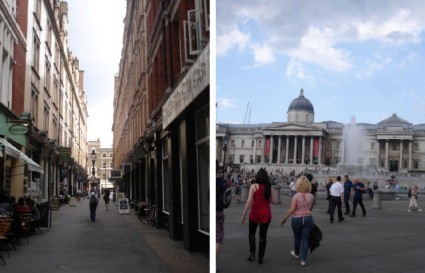
2. Out of Square at bottom, across Charing Cross Road, into Cecil Court once known as ‘Flicker Alley’, when it housed many early film companies, from 1897 to 1910 (detailed list in Simon Brown’s article, in Film Studies no. 10).

3. From Cecil Court, right into St Martin’s Lane, towards Trafalgar Square – noting location from which Wordsworth Donisthorpe shot frames of film in 1890.
ceciltrafalgar

Cecil Court and Trafalgar Square today

4. Then left into the Strand, to the site of Edison’s Kinetoscope parlour, opened on left of Adelphi Theatre in 1895 (not current Adelphi building).

5. Next to Adelphi Theatre, the Hotel Cecil, where W.K.L. Dickson lived from 1897 until his departure for South Africa.

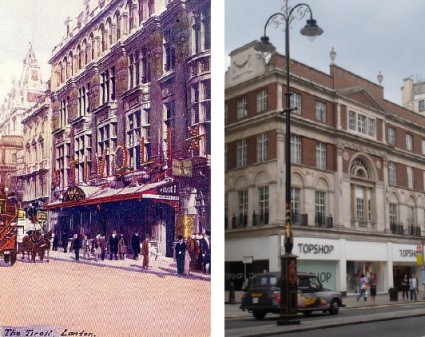
6. 64 Strand, where Dickson had his first lab, c.1903; and the site of the Tivoli Music Hall then Theatre, 65-70 Strand – which eventually became a cinema where the Film Society first met in the 1920s, but had the Biograph studio behind it in 1897.
tivoli

A postcard for the Tivoli Theatre, sent in 1908, from http://www.arthurlloyd.co.uk, and the site where the Tivoli stands today

7. We turn off the Strand and head up through Covent Garden, noting site Jury’s Imperial Pictures, 142 Long Acre. Then on to St Giles Circus and crossroads of Tottenham Court Road and Oxford Sreet, to site of the Horse Shoe Hotel where the Kinetoscope launch dinner was held on 17 October 1894 (copy of the menu in the Bill Douglas Centre collection).

8. Then along Oxford Steet, looking out for no. 70, the original London Kinetoscope parlour, and the site of Hales Tours of the World, at 165 Oxford Street, from 1906.

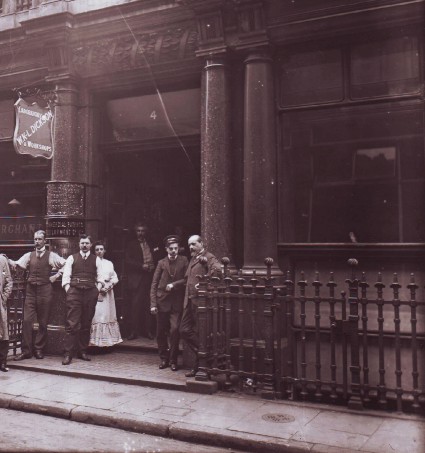
9. We turn back into Wardour Street and identifying a series of sites associated with Charles Urban and other British pioneer producers and distributors. At the bottom of Wardour Street, we note Gerrard Street, another site of early companies such as Cricks and Martin), and Birt Acres’ Kineopticon, at 2 Piccadilly Mansions (“Britain’s first cinema” in 1896), also the Biograph offices nearby at 18-19 Great Windmill Street and Rupert and Denman Streets, where many early film businesses were based (see London Project website at http://londonfilm.bbk.ac.uk)
denmanst

W.K.L. Dickson’s lab in Denman Street, image courtesy of Paul Spehr

10. Then back up Shaftesbury Avenue to Cambridge Circus, where the Palace Theatre was first the home of Biograph exhibition, then of Urban’s Kinemacolor.

palace

The Palace Theatre in the early 1900s, from http://www.arthurlloyd.co.uk

11. Finally, we finish in the Montagu Pyke public house, named after the early London cinema entrepreneur (and much else besides!).

Ian Christie
Birkbeck College – London Screen Study Collection, The London Project www.ianchristie.org

After apprehensively checking the weather forecast every day leading up to the walk we were all delighted that despite thunderstorms in the early morning it had cleared and the sun was shining. Ian Christie, our expert guide, had unfortunately various noises to contend with at the beginning including loud speakers at the Chaplin statue in Leicester Square, blaring all manner of strange sounds directly at us, and bells chiming at St Martin in the Fields. However, the walk was a delight – uncovering a hidden layer of London’s history that many of us were unaware of, including a Cocteau mural in the French Catholic Church in Leicester Place. It was a particular delight to imagine Cecil Court as ‘Flicker Alley’ a hustling and bustling street of film-related businesses before a fire encouraged relocation. With added impromptu contributions from W.K.L. Dickson’s biographer Paul Spehr and silent film historian and filmmaker Kevin Brownlow, the day was a spectacular treat. Down Wardour Street the gathering clouds could hold off no longer and we fought a torrential downpour. Luckily we were nearing the end of our walk and the Montagu Pyke pub our final destination and named after the rogue cinema entrepreneur. I’m looking forward to visiting these streets again and recollecting Ian’s anecdotes; my perception of London has certainly been transformed. Many thanks to Ian Christie and Bryony Dixon.

Kelly Robinson

SilentsWalk

British silent film enthusiasts on their walking tour of London, 7 June 2009. Photograph courtesy of Christian Hayes
Open weekend at the Cinema Museum

cmprojectors

http://www.cinemamuseum.org.uk

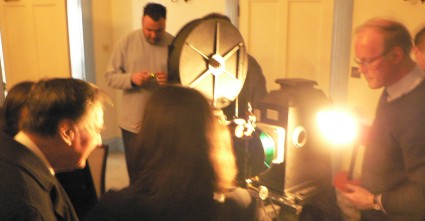
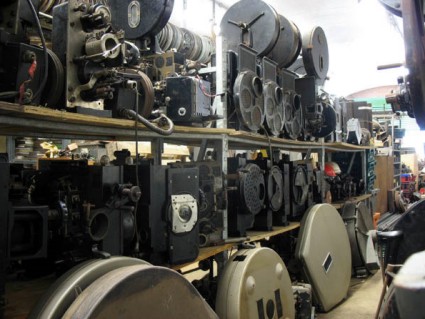
London’s Cinema Museum, whose good news about the renewal of its release was reported here recently, is having an open weekend. The Cinema Museum is a private institution, supported by its stills business, and it is not normally open to the general public, so this is a marvellous opportunity to discover one of London’s hidden gems, certainly if you have any interest in motion picture history. The collection represents cinema’s rich history from the earliest days to the present, containing every sort of item relating to film production, film exhibition and the experience of cinemagoing.

The open weekend runs 27-28 June June 2009. During the weekend you may enjoy any of the following:

  • Recipes to the Stars! – an edible talk with Jenny Hammerton
  • Rescuing Home Movies – a guide by David Cleveland
  • Classic Silent Comedy Shorts – a film screening with piano accompainment by Tom Bell
  • Guided tours of the Museum Collection
  • Chaplin and the Workhouse exhibition (the museum is located in the Lambeth workshouse which once housed Chaplin’s mother)

The weekend will also feature an exhibition of new artwork by Cnidoblasts and Anna Odrich, reconfiguring artefacts from the collection and exploring the mechanics and gestures of silent comedy through sculpture.

More information will appear on the Cinema Museum website in due course. And just to whet your appetite, there’s this delightful tour of the place hosted by the Museum’s founder Ronald Grant. We’ve featured it on The Bioscope before, but in the very early days of this blog, and it more than merits being screened again.

(The film was made in 2000 by Guy Edmonds and Anna Odrich)

Words on the screen

benhur1925

First the classics, now the Eng Lit department – UK universities are discovering silent films and examining them in welcome new ways. The Film and Literature Programme, Department of English and Related Literature at the University of York is organising a one-day symposium on silent cinema and literature on Friday 1 May, led by the university’s Judith Buchanan, whose forthcoming book on silent Shakespeare films will receive close attention here once it has forthcome.

Here’s the blurb on the symposium:

Silent Cinema and Literature

One-day Symposium

Friday 1 May 2009

University of York, 9.30am-6.30pm

  • Lawrence Rainey: ‘Modern melodrama: Chickie (1925)’
  • Erica Sheen: ‘Imperishable bodies: Graham Greene’s A Little Place Off the Edgeware Road
  • Judith Buchanan: ‘The biblical, the literary and the olfactory: synaesthetics in MGM’s 1925 Ben Hur
  • Lawrence Napper: on British cinema of the 1920s (title tbc)
  • Jon Burrows: ‘“A Vague Chinese Quarter Elsewhere”: The Cinematic Mapping of Thomas Burke’s Limehouse, 1919-1936’
  • Andrew Higson: ‘Becoming Michael Curtiz: “European” cinema, literary connections, and the challenge of Hollywood in the 1920s’

The day will end with a roundtable discussion of issues of shared interest followed by a drinks reception. To register, please email Emily Blewitt: seb518 [at] york.ac.uk.

Full registration (including refreshments and lunch): £25
Student registration (including refreshments and lunch): £10
University of York Department of English students: free registration

(Early registration is advised since places are limited.)

Let’s have more of this – medical departments looking at the work of Jean Comandon and other such pioneers, history departments considering the significance of early newsreels, art classes looking at 1920s set designs, geography students considering pioneering travelogues for their topographical content, medievalists looking at how their age is depicted in one-reelers, sport studies assessing the correct running speeds for silent films of … runners. Just so long as they tell us something new and jolt us out of our complacency.

(Another) Kinemacolor centenary

kinemacolor19

Brian Pritchard (right) demonstrating the No. 19 Kinemacolor projector to Bruce Mousell (left), step-grandson of Kinemacolor producer Charles Urban, February 2008

Kinemacolor, as you will probably have deduced by now, is of great interest to the Bioscope, and it was sad that so few could get to the invite-only ‘centenary’ screening of some Kinemacolor films which took place at the BFI National Archive in Berkhamsted in February of this year.

But if that was recognising the centenary of Kinemacolor as a public process (it was first shown to a public in May 1908), then there is the centenary of its name, since it wasn’t known as Kinemacolor until it had a matinee screening at the Palace Theatre, London, on 26 February 1909, swiftly followed by its commercial debut at the Palace on 1 March 1909.

All of which leads us to this cenentary event at the National Media Museum, Bradford, which is offering the chance to see Kinemacolor screening alongside other treasures. Here’s the blurb:

Here is news of a special presentation taking place on Sunday 15 February 2009 at the National Media Museum, Bradford to mark the centenary of Kinemacolor, the world’s first successful cinema colour process. Entitled Bringing Colour to the Movies – re-creating what it was like to go to the Picture Palace a century ago, it is presented by David Cleveland, Brian Pritchard and Nigel Lister, who provides piano accompaniment.

The show includes short films from the 1890s, comedies and trick films from between 1900 and 1908, the first successful British animated film Dream of Toyland and film of the Titanic in 1912. These are shown on a hand-turned Gaumont Chrono 35mm projector of about 1912, restored by Nigel Lister. This machine worked in the Picture Palace at Southwold, Suffolk and survived until 1958 under the raked seating of the cinema, from where it was rescued by David Cleveland.

Kinemacolor’s first public showing was on 26 February 1909 at the Palace Theatre, London. It was very successful for about six years, then, after losing a lawsuit claiming its patent invalid, Kinemacolor went into a rapid decline. At the height of Kinemacolor’s success there was a large library of films but these were later destroyed and very little survives. The Filmmuseum in Amsterdam have a few films and they have very kindly provided a print of one for this show.

The Kinemacolor projector used, No 19, is from the first batch delivered in 1910 and was used in the Argyll Theatre in Birkenhead. It somehow survived, and has been stored in the Wirral Museum. With the help of Colin Simpson, the Principal Museums Officer, the projector has been on loan to Brian Pritchard who has restored it to working order without altering the machine. With a motor to drive the mechanism at 32 frames per second and a new print of Italian Lakes (1910), Kinemacolor is on the screen once again.

The programme concludes with the science fiction drama of 1909 produced by Charles Urban called The Aerial Torpedo. This film demonstrates the one colour system in regular use throughout the silent period – tinting.

This special presentation will include an introduction and commentary between films by David Cleveland, with Brian Pritchard on the technicalities of Kinemacolor and Nigel Lister on the restoration of the Gaumont Chrono projector.

Bringing Colour to the Movies is on Sunday 15 February at 4.00 pm at On Location, National Media Museum, Bradford BD1 1NQ. Tickets £7.00 (full) and £5.00 (concessions). Call the Box Office 0870 70 10 200 (National Rate). Telephone booking 8.30am – 8.30pm daily, or book online at www.nationalmediamuseum.org.uk. Please note: seat numbers are limited, so early booking is advised.

An accompanying display of original objects and artefacts from the Museum’s Charles Urban archive and Cinematography collection, tells the story of Kinemacolor’s spectacular success. This will be on show from 10 February 2009 at Insight: the Collections and Research Centre on Level One of the Museum. Free entry Tuesdays–Sundays 10.00am–6.00pm.

As someone who spent years (literally) delving into the manifold riches of the Charles Urban archive (formerly of the Science Museum library in London but now held in Bradford), I can recommend going just to see a display of those alone. As for that lost Kinemacolor library,it is a tragedy that the great majority is lost. But we must never lose hope, and the Bioscope is keeping its eyes and ears open, and will let you know should it find anything, one day.

Lighting up again

smoking_tiger

There is a growing interest in exhibiting the alliances the silent cinema had with variety. Those alliances were undoubtedly there (so many early cinema shows were really variety programmes interspersed with films, or else the other way around), but what is novel is expounding the thesis through live entertainment. We have had the Crazy Cinématographe shows in Luxembourg, and in London there is The Smoking Cabinet.

This intriguing combination of early cinema screenings, cabaret and panel discussions was launched last year. A year on, the same concept returns to the Curzon Soho, 12-14 December. Billed as a ‘festival of early cabaret and burlesque cinema, 1894-1933’, the programme is suitably eclectic and exotic:

Opening Night The Smoking Cabinet Vs. Midnight Movies: Piccadilly (1929)
For this year’s opening night The Smoking Cabinet have teamed up with Midnight Movies to offer something a little different; live performance and music in the bar from 8:30pm followed by a special screening of E.A. Dupont’s Piccadilly (1929) featuring Anna May Wong.

Fri 12th Dec Bar performances and live music from 8:30pm, screening 11.30pm
Tickets £8 advance / £12 on door

On with the Dance!
A joyous evening of dance and showgirl themed films, featuring delights from Divine and Charles, Fatima and Carmencita, The Whirl of the Charleston (1927) and chorus girls galore.

+ Discussion Boom or Bust?
1894-1933 tracks the emergence of an entirely new form of entertainment in the shape of the moving image and cinema. We look at how the film absorbed more established forms of entertainment of the time from vaudeville to cabaret, burlesque and the musicals. We’ll also look at the cyclical nature of trends, asking why certain forms have boomed at specific times and bust at others. We’ll also ask if the death bell tolls for the current fascination with burlesque?

Sat 13th Dec 6:00pm
Tickets £8

smoking_woman
Sandow the Muscle Man and the Spirit of Coney Island

Roll up, roll up to witness boxing cats, the king of coins, and Edwin S Porter’s classic Coney Island at Night (1905), screening in a celebration of the extraordinary amusement empire that astonished, delighted and shocked a nation. There’s a rare opportunity to see Fatty Arbuckle and Buster Keaton’s 1917 romp Coney Island and to revel in the most magnificent spectacle of the world’s mad hunt for pleasure!

We’ll provide a Coney Island experience in the bar as we tip our sailor hats to the seaside fun and amusements of yesteryear and offer a free tipple to all guests!

+ Special guest speaker on the history and significance of New York’s decadent palace of pleasure.
Sun 14th Dec 4:00pm
Tickets £12

Closing Night: That’s all folks!
Join us for our last screening, live music, cakes and dancing as we wind down with an eclectic variety finale including Bob’s Electric Theatre (1909), Gus Elen: It’s a Great Big Shame and La Boite a malice (1903).
Sun 14th Dec 6:00pm
Tickets £8

There’s more information, including how to book, on The Smoking Cabinet website. Attendees are also encouraged to ‘dress to impress’, which – let’s face it – so few silent film audiences ever do these days. All this, and lessons in dancing the Charleston as well.

There’s no such thing as a bad home movie

Frame still of Mavis and Margaret Passmore (holding a piece of 35mm film), from the Passmore family films, c.1903, held by the BFI National Archive

So says John Waters, and while we’ve probably all sat through some relative’s earnest document of their holiday abroad and wished that some of the panning shots of scenery could have been a little shorter, he has a point. Home movies aren’t to be judged by the usual film rules. They are made for an interior purpose; every frame speaks to a select family audience which alone can decode the film’s particular references. And yet, as time passes, and such films turn up in archives, they then speak in a different way to us all, as we see the manners, the customs, the backgrounds, the clothing, the choice of subjects, that make these films such rich social historical documents. Moreover, in other people’s home lives, we see our own. In all these respects, there can be no such thing as a bad home movie.

Image from a Kinora portrait record of the polar explorer Ernest Shackleton and his son Edward, c. 1912, from http://www.jates.co.uk

Home movies are as old as cinema. They were produced throughout what was the silent era in commercial cinema, and continued to be shot silent for several decades thereafter. Some have argued for the scenes of their family life filmed by the Lumière brothers in 1895-96 to be the first home movies, but these were studied compositions for commercial consumption. However, cameras and projectors were soon aimed at the amateur market – indeed, in those first years of cinema some believed that the real money would be made by targeting the home. After all, the Kodak camera had shown where the business lay for still photography. Probably the first motion picture device for amateur use was the Birtac, a camera-printer-projector utilising 17.5mm film, introduced by Birt Acres (hence the name) in 1898. The Biokam, developed by Alfred Darling and Alfred Wrench followed in 1899. Gaumont in France came up with the Chrono de Poche, using 15mm film, in 1900. The Lumières themselves were behind the Kinora, a hand-held, flick-card viewer for which you could either have films made of your family as a ‘portrait’ in a studio, or film them yourself with camera using paper negatives (it was patented in 1896 but the first Kinora camera for amateur use appeared in 1907).

See a QuickTime movie of a Kinora in action, from the Royal Collection

Other such systems followed, employing narrow gauges which were cheaper and easier to handle. Initially the film used was flammable nitrate, but in 1912 there came the Edison Home Kinetoscope using 22mm safety film, and in the same year the Pathéscope, or Pathé Kok, using 28mm safety film. However, these were mostly for showing commercial films in the home, and it was 9.5mm film (introduced 1922) that was the format taken up most avidly by amateurs seeking to shoot their own films, though 16mm (introduced 1923) was used by the wealthy, and some of the first home movies in archives are those shot by the well-to-do upper middle class in the 1920s. A rival to 9.5mm that would soon overtake it in popularity was 8mm, introduced in 1932, and Super 8 appeared in 1965.

Thomas Edison with his Home Kinetoscope, introduced 1912, from Adventures in Cybersound

35mm was rarely used for home movies, such was the expense (and the fire hazard), but some examples exist, including what I think must be the earliest surviving home movies, those of the Passmore family of Streatham, filmed 1902-1908 and held in the BFI National Archive. They are a delight (they were shown at the Pordenone silent film festival in 1995). Home movies have grown in importance for film archives, or rather film archives have grown up which value such productions highly because of the way they record people and place. The smaller, or regional film archives around the world, are preserving a picture of our private selves which is likely to be rather more highly valued by future generations than the progressively quaint commercial entertainment films that still dominate moving image archiving philosophy generally.

All of which leads us to Home Movie Day. This is an international event, now in its sixth year, and for 2008 it falls on 18 October. Home Movie Day celebrates amateur film and amateur filmmaking through a wide number of events held locally at venues across the world. The events provide ordinary people with the opportunity to see home movies, show their home movies to others, to discover about home movie heritage, and to learn how best to care for such films. This year there are events taking place in Argentina, Australia, Canada, Germany, Italy, Japan, Mexico, the Netherlands, Slovenia, the United Kingdom, and at many points across the USA. The Home Movie Day site provides information on all the events and the home movie day ethos. In the UK, there will be events in Manchester and London. This is the blurb for the London event:

On Saturday October 18, archivists and film lovers around the world will take time out of the vaults to help the public learn about, enjoy, and rescue films forgotten with the advent of home video. Home Movie Day shows how home movies on 8mm, Super8 and 16mm film offer a unique view of decades past, and are an essential part of personal, community, and cultural history.

Home Movie Day returns to London this year at the Curzon Soho cinema bar. It’s a free event and open to everyone. There will be a Film Clinic, offering free film examinations by volunteer film archivists from the British Film Institute, Wellcome Library and BBC, who will check the film for any damage and deterioration, and offer advice about how to store film in the home.

After examination, the films can be passed to one of the projectionists, who will be continuously screening home movies throughout the day.

You don’t need to bring a film to attend and enjoy the event; everyone has a chance to win prizes generously donated by the BFI and Wellcome Collectionjust by viewing any of the films on the day. Prizes include BFI DVDs and tickets to the IMAX.

The archivists can also offer advice about preserving films in film archives around the UK and transferring films to other formats such as DVD so they’remore easily watchable in the home.

Don’t throw your films away; bring them to Home Movie Day!

The London event takes place at 12-5pm at the Curzon Soho, 99 Shaftesbury Avenue, London W1D 5DY. For more information, contact Lucy Smee, at Dearoldsmee [at] gmail.com. The Manchester event takes place at the North West Film Archive.

The history of amateur film remains underwritten, though work has been done of late to remedy this. You could start with by Karen L. Ishizuka and Patricia R. Zimmermann’s Mining the Home Movie: Excavations in Histories and Memories (2007), or seek out Zimmermann’s earlier Reel Families: A Social History of Amateur Film (1995). There’s also Alan Kattelle’s Home Movies, A History of the American Industry, 1897-1979 (2000).

For the cameras and projectors designed for amateur use in the ‘silent’ era, the best source is Brian Coe’s The History of Movie Photography (1981), while the Kinora is covered by Barry Anthony in The Kinora – motion pictures for the home, 1896-1914 (1996). For images and information on narrow gauge film formats from the early period, visit the excellent (if increasingly out of date so far as its name is concerned) One Hundred Years of Film Sizes.

To find out about the work of regional film archives in the UK, visit the Film Archive Forum website. Film Forever is a good online guide to the preservation of films at home. Our history is in your hands.

Professor Pepper at the Polytechnic

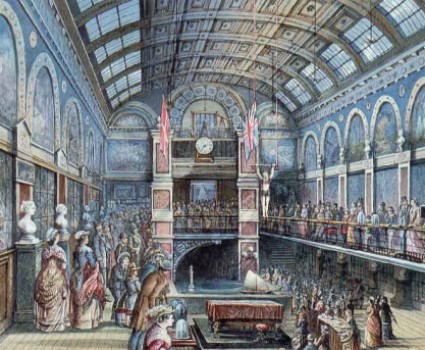
Interior of the Great Hall at the Royal Polytechnic, from http://www.magiclantern.org.uk

The Magic Lantern Society and the University of Westminster have organised a series of talk and events to be held at the University of Westminster’s central London site at 309 Regent Street, which was formerly the Royal Polytechnic Institution. For much of the nineteenth century the Polytechnic was London’s leading centre for the popularisation of science, hosting lectures, lantern shows, scientific demonstrations, and – on 20 February 1896 – the debut of the Cinématographe Lumière in Britain.

Visual technologies and performance were a stape attraction of the Polytechnic, and it is in this spirit that the series is being presented, under the name of one of the most popular of contemporary stage illusions, Pepper’s Ghost. This invention of ‘Professor’ John Henry Pepper, a director of the Polytechnic, this simple but ingenious illusions whereby ghostly figures could appear on stage was the subject of an earlier post, after its unexpected use in a Paul McCartney pop video.

As the blurb for the series puts it, the one hour talks and events

celebrate the spirit of the old Polytechnic featuring rarely-seen London-based historical material, physical demonstrations of “lost media” and surprisingly new applications of ancient optical techniques by contemporary visual artists, stage performers, filmmakers and designers.

Professor Pepper’s Ghost: Six Evenings of Optical Magic at the Old Polytechnic‘ got underway on 23 September, so apologies for being late with the news, but here’s the full line-up:

Tuesday 23 September
The World’s First Projection Theatre
Jeremy Brooker provides a guide (both virtual and actual) to the Royal Polytechnic’s famous optical theatre.

Tuesday 7 October
3D or Seeing Double
Dr David G. Burder offers a ‘sensational’ guide to the art and history of seeing things in 3-dimensions.

Tuesday 21 October
The Diorama: Weaving Time and Space
Photographer and video artist Simon Warner looks at the work of Daguerre and the Diorama phenomenon in the 1820s and 30s.

Tuesday 4 November
The Charing Cross Whale and the Fleas of Regent Street
Professor Vanessa Toulmin presents an illustrated and astonishing look at the wide range of ephemeral entertainments which captured the public imagination of visitors to London in the 19th century, drawing on rarely-seen flyers and bill material in the National Fairground Archive.

Tuesday 18 November
Old Media: New Light
Freelance illustrator Geoff Coupland showcases his own work and that of his students from the Camberwell College of Art applying what are often referred to as 19th century and earlier ‘dead media’ forms such as the magic lantern, shadow-play and flickbooks, to illustrate modern ideas and points of view.

Tuesday 2 December
The Magic Lantern Believe it or Not
In this unruly entertainment ‘Professor’ Mervyn Heard highlights some of the more bizarre, surprising and often horrifying lantern ‘entertainments’ of the 18th, 19th and 20th centuries and attempts to prove that, in the right hands, ‘the lantern lecture’ could be much more than a naive precursor to cinema: instead the basis for inspired live performance.

The prize goes to Professor Vanessa for the catchiest title, but all sound enticing. All the lectures start at 7pm, and admission is free, with tickets issued from 6pm. For further information, visit the University of Westminster site.

Happy birthday from James and Sagar

http://www.bfi.org.uk/whatson/bfi_southbank

The British Film Institute is seventy-five years old, and it wants the world to know about it. Specifically, it wants people in London next weekend looking for some rewarding way to spend their time to know about it, because it is organising a ‘Birthday Weekender‘ which promises as much fun for the family as film can probably provide.

Part of the celebration are two free shows of the renowned actuality films of Edwardian life made by (Sagar) Mitchell and (James) Kenyon, one on September 27th showing films of Ireland, the other on the 28th showing films of Liverpool, each introduced by Vanessa Toulmin, with music accompaniment by Stephen Horne. Both shows are at 14.00, and if by some chance you have managed to miss the films of Mitchell and Kenyon up til now (what have you been doing?), now is your chance.

Don’t forget also the Best of the British Silent Film Festival, also featuring 26-28 September at the same venue. Turn up on the 26th and see yours truly present an Olympic Games archive film show.

Crazy once more

Crazy Cinématographe has returned, and has a fabulous poster to prove it:

Last year saw the launch of Crazy Cinématographe, a project with multiple outlets based on the programmes of films shows presented in the touring fairground booths of Europe in the early years of the twentieth century. In 2007 it gave us a touring show (mostly in Luxembourg, but it also visited Germany, France and Belgium), a conference (in Luxembourg) and finally a DVD, published by the highly commendable Editions Filmmuseum.

The Crazy Cinématographe tent in 2007

Except that it wasn’t ‘finally’, because Crazy Cinématographe edition 2 has been announced. Taking place 22 August-10 September in Schueberfouer, Luxembourg, the new show opens the tent flaps once more to present a highly variegated programme of bizarre and surprising early cinema subjects taken from fifteen film archives around Europe. There is now a Crazy Cinématographe site, with details of the programme, in German. Among the promised delights are acrobatic sisters, a ‘Cabinet of Crazy Animals’ (including Percy Smith‘s acrobatic fly, Max Skladanowsky‘s boxing kangaroo, monkeys dining in a restaurant, and – according to my translation software – rabbits eating giant snakes, though possibly it may be the other way around), an evening of early erotic films, a ‘Live-Mix Crazystyle’ by DJ Kuston Beater, and a ‘best of 2007’ programme. I’m promised more information in English, and will pass this on in due course.

Behind all the showmanship, Crazy Cinématographe is a bold and interesting attempt to combine scholarship with entertainment, or rather making an entertainment out of a scholarly enthusiasm, both for the archival films themselves and for the renowed ‘cinema of attractions’ concept (a cinema of spectacle that preceded the cinema of narrative), which has proved so fruitful in early cinema studies.

To give you a flavour of the entertainment, here’s the promo video (look out for the acrobatic fly at the end).

There’s also a video report on last year’s show (on YouTube, in French), which gives a good idea of the presentation style.

The truth is never quite what it seems

The Docker and the Rose, from http://www.liverpoolecho.co.uk

Showing at the National Theatre in London 12-15 August as part of its ‘Watch this Space‘ summer festival of outdoor entertainment is Movieplex, an entertainment that tells the story of a forgotten pioneer of Indian cinema, one Shanta Rao Dutt (1881-1987). Dutt, it seems, led a remarkable life. In 1896, when aged just 15, he witnessed a Lumière brothers’ film screening at the Watson’s Hotel, Bombay. Instantly struck by the magic of cinematography, Dutt – a porter at the hotel – discovering the unattended machine spooled with film ready for a demonstration the following morning, could not resist having a go for himself, and shot a film of the baby son of his landlord (‘negotiations are currently in progress between the Lumière estate and the Dutt family to release this print from the Lumière archive for public exhibition’). The prank got him fired from the hotel, but led him to pursue the Lumières to France.

There he was briefly employed by the brothers, before being fired for taking an unauthorised time lapse film. Undaunted, he worked for a time with Georges Méliès, before acquiring his own cinematograph camera. He returned to India in 1900, making films of his trip along the ay, then made a film of his brother Jeevan’s journey to Fiji as a bonded labourer (the only copy of the film was lost in a shipwreck). Dutt next took on commission from the British Raj, filmed in Japan, then went to England where he worked as a newsreel cameraman from Pathé, before joining British intelligence during World War One. He shot a film, The Docker and the Rose, in Liverpool in 1920, marrying its heroine. A copy was rediscovered in 2006. The Dutt family travelled to the Soviet Union in 1927 and met Eisenstein, then in 1933 Shanta founded the Movieplex company. He was knighted in 1945. The family continued its entrpreneurial activities, with one family member opening a cosmetic firm, and another opening the Movieplex Emporium on London’s Tottenham Court Road in 1975, selling VHS players. Shanta died in 1987, aged 106.

http://www.movieplex.biz

OK, enough of all this. You can follow the whole convoluted story, with chronology, genealogy, filmography and business promotions on the Movieplex site. The whole thing is a fiction, but one on which an extraordinary amount of effort has been spent. Aside from the main website and exhibition, there is a blog where an academic earnestly discusses Dutt’s films, a MySpace site from a young American fan who thinks Dutt was ‘some dude’, and a WordPress blog from a woman who says she is related to Dutt’s wife and has been researching the family history. Most brazenly, there is the previously ‘lost’ film The Docker and the Rose, an extract from which has been published on YouTube by the Liverpool Echo, which would appear from this press report to have fallen entirely for the story.

A 1920s tape discovered two years ago in a Wallasey antique shop was the inspiration for a major piece of outdoor art.

Movieplex is based on the work and life of lost filmmaker Shanta Roa Dutt and a nine-minute silent film, Docker and the Rose, which he made in Liverpool.

It was specially commissioned by Liverpool Culture Company and premieres in the city as part of The Imagine Festival which takes place next week.

The film was found in 2006 in the drawer of an Edwardian display box bought from an antique shop in Wallasey.

It was bought by Ajay Chhabra, co-artistic director of arts company nutkhut, who was in Liverpool with wife Simmy for the performances of Bollywood Steps.

He said: “My wife and I found the tape when antique hunting and borrowed equipment to watch it.

“We couldn’t believe what we had found.

“We decided we wanted to make it into a piece of outdoor art. Simmy and I enjoyed our time in Liverpool with Bollywood Steps so much and had made a number of friends, so we approached the Culture Company with the idea.

“They were very keen and commissioned us to go ahead. It seemed only right that a film made and based in Liverpool should come home in the Capital of Culture year.”

The specially commissioned piece of outdoor art features two containers, one with memorabilia from the Dutt family’s many films and history and the second a miniature cinema which shows the nine minute silent comedy.

A 1920s tape? Others have bought the story seemingly hook, line and sinker – for example, the Liverpool Post, Screen India and The Hindu. Even Manchester’s the North West Film Archive, as quoted in the press reports, has been ‘closely involved in the conservation and digital conversion of the film’, though one assumes they were rather less fooled than the papers and are playing along with the game.

What is going on here? The people behind the mischief are called nutkhut, a London-based ‘creative organisation’. Nutkhut in Sanskrit means ‘mischievous’, and nutkhut have applied considerable ingenuity to spinning a tale of enterprise and adventure, with just enough attention to plausible detail (the journey to Fiji, the VHS emporium in Tottenham Court Road) to dupe the unwary. In particular, the ‘lost film’ clips shows how many cannot tell an original from pastiche. Some of the publicity hints as an aside that not all may be as it seems, and the Movieplex website itself carries warning words on its banner – ‘The truth is never quite what it seems’. Others seem not to have realised this.

Why has it all been done? Apart from the impetus of Liverpool as a ‘City of Culture’ in 2008 (it was co-commissioned by Liverpool Culture Company Ltd), the show (or installation, or whatever exactly it might be) takes its inspiration from a general fascination with, but also confusion about, popular Indian culture in the West. There’s a story there of an independence of spirit, mixed with elements of film history vaguely known many, that has a quirky appeal. But is it good to publish so much false history? Will some hapless student end up trying to investigate The Docker and the Rose, or writing Dutt into a history of early Indian film? Is early film history just a game after all?

Movieplex plays at Theatre Square, the National Theatre, London 12-16 August, and Crawley Town Centre, 21-24 August. Exact times and other details are on the Movieplex site.