Busy, busy, busy

Things are a bit hectic down at Bioscope Towers these days, and what with broadband problems, not only is it hard to find time to write posts but even when the time does appear I can’t post them. So, in my lunch break, and before heading off to the Imperial War Museum to mark the retirement of its highly estemeed Keeper of the Film and Video Archive, Roger Smither, and then to the BFI Southbank to see the ‘new’ Metropolis, here are links to some interesting posts on silent cinema which other bloggers have produced lately.

Doing things differently
George Clark reports on the pioneering programme of early films shown at the recent Oberhausen Short Film Festival, for AP Engine. Enthusiastic, but not uncritical.

From the career of Louis J. Mannix
Nick Redfern, at the highly impressive Research into Film blog, takes a break from statistical analysis to tell us about (and quote from) the rare memoirs of a Leeds projectionist operating in the silent era.

Never too late silents
Kristin Thompson assesses the silent films of Joseph von Sternberg through the recent Criterion DVD set at the indispensible Observations on Film Art blog that she shares with David Bordwell.

Kevin Brownlow to receive special Oscar
From the San Francisco Silent Film Festival blog, news that Kevin Brownlow is to be awarded an honorary award from the Academy of Motion Picture Arts and Sciences. Huge cheers and hats in the air about that piece of news.

The Lindgren manifesto
And from my other, infrequently updated blog, Moving Image, here’s philosopher-film archivist Paolo Cherchi Usai’s provocative but thought-provoking fourteen-point manifesto for film curators of the future, named after the founder of the BFI National Archive. Make of it what you will.

Suffragettes before the camera

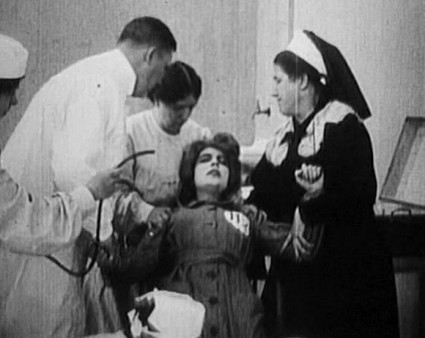
Asta Nielsen playing a suffragette undergoing forcefeeding in Die Suffragette (1913), from Stiftung Deutsche Kinemathek

Early film reflected the society in which it arose, and there is no clearer example of this than the campaign for women’s suffrage. The movement to gain women the vote in Britain reached its climax during the period when mass cinema-going was first underway in the early 1910s, and films reflected the popular understanding of the suffragettes. The militant woman became a standard figure in early ficition films, generally portrayed for comic or satiric effect. At the same time the suffragettes were regularly covered by the newsreels, a dynamic new medium for reporting what was happening in the world to a mass audience.

The relationship between women’s suffrage and early film is explored in Frühe Interventionen: Suffragetten – Extremistinnen der Sichtbarkeit (Early interventions / Suffragettes – extremists of visibility), a series of films and lectures being held at the Zeughauskino, Berlin, 23-27 September 2010. Behind the somewhat forbidding title is a tremendous programme of rare materials uncovered from archives across Europe and curated by Madeleine Bernstorff and Mariann Lewinsky. The films document not only the suffragettes as audiences saw them in fiction and non-fiction films, but also the role of women in early cinema generally, showing how trangressive, rebellious and sometimes just plain exuberant displays by women on screen echoed the drive for changes in society of which the campaign for the vote was but a part.

The Pickpocket (USA 1913), from EYE Film Institute Netherlands

Here is the programme:

Thursday 23. September 20:00 h

Radical maid(en)s
Cheerful young girls’ break-outs, class relations and radicalisations.

Sedgwick’ s Bioscope Showfront at Pendlebury Wakes, GB 1901, 30m 1’30“
La Grêve des bonnes, France 1907 184m, 10’
Tilly in a Boarding house GB 1911 D Alma Taylor, Chrissie White 7’
Pathé newsreel The Suffragette Derby, GB 1913, ca 5’
Miss Davison’s Funeral, GB 1913, 45m 2’
A Suffragette in Spite of Himself GB 1912 Edison R: Bannister Merwin D: Miriam Nesbitt, Ethel Browning, Marc McDermott 8’, 16mm
Break
Robinette presa per nihilista Italy 1912, D: Nilde Baracchi, 124m, 8’
Cunégonde reçoit sa famille France 1912 D: Cunegonde – name unknown, 116m, 6’
Les Ficelles de Leontine France 1910, D: Leontine – name unknown, 155m, 8’
Tilly and the fire engines GB 1911 2’ D: Alma Taylor, Chrissie White
[A Nervous Kitchenmaid] France c.1908, 74m, 4’
Introduction: Madeleine Bernstorff
Live piano accompaniment by Stephen Horne.

Friday 24. September 18:00 h

The Fanaticism of the Suffragettes
Lecture with images and filmclips by Madeleine Bernstorff

Following the lecture Mariann Lewinsky will present the DVDs Cento anni fa/A hundred Years ago: European Cinema of 1909 and Cento anni fa/A Hundred Years ago: Comic Actresses and Suffragettes 1910-1914 [for more information, see end of this post].

Friday 24. September 19:00 h

Militancies

Les Femmes députées France 1912 D: Madeleine Guitty 154m 8’
England. Scenes Outside The House Of Commons 28 January 1913 2’
Trafalgar Square Riot 10 August 1913 1913 2’
Milling The Militants: A Comical Absurdity GB 1913 7’
St. Leonards Outrage France 1913 21m 1’
Womens March Trough London: A Vast Procession Of Women Headed By Mrs Pankhurst. March Through London To Show The Minister Of Munitions Their Willingness To Help In Any War War Service GB 1915 23m 1’
Scottish Women’s Hospital Of The National Union Of Women’s Suffrage Societies France 1917 133m 6’30
Dans le sous-marin France 1908 Pathé 145m 5’
Introduction: Madeleine Bernstorff
Live piano accompaniment by Stephen Horne.

Friday 24. September 21:00 h

Women’s Life and Leisure in the Mitchell & Kenyon Collection
Presented by Vanessa Toulmin

The renowned Mitchell & Kenyon Collection provides an unparalled view of life at the turn of the twentieth century and this screening will allow us an opportunity to see women’s life and leisure in industrial England. The social and political background as well as working conditions will be shown on screen. The range and sheer diversity of women in the workplace will be revealed from the domestic to the industrial environment, women played an important role in the transition to modern society. From girls working in the coal mines to spinners and weavers leaving the factory this selection from the Collection will reveal previously unseen footage from the Archive, in a following workshop Vanessa Toulmin will speak about: Discovery and Investigation: The Research Process of the Mitchell & Kenyon Collection.

Women at Work: The ‘Hands’ Leaving Work at North-Street Mills, Chorley (1900), North Sea Fisheries, North Shields (1901), Employees Leaving Gilroy’s Jute Works, Dundee (1901), S.S. Skirmisher at Liverpool (1901), Birmingham University Procession on Degree Day (1901), Life in Wexford (1902), Black Diamonds – The Collier’s Daily Life (1904)
Women in the Social Environment: Liverpool Street Scenes (1901), Jamaica Street, Glasgow (1901), Manchester Street Scenes (1901), Manchester Band of Hope Procession (1901), Electric Tram Rides from Forster Square, Bradford (1902)
Leisure and Play: Sedgwick’s Bioscope Showfront at Pendlebury Wakes (1901), Spectators Promenading in Weston Park, Sheffield (1902), Trip to Sunny Vale Gardens at Hipperholme (1901), Bootle May Day Demonstration and Crowning of the May Queen (1903), Blackpool Victoria Pier (1904), Greens Racing Bantams at Preston Whit Fair (1906), Calisthenics (c. 1905).
Live piano accompaniment by Stephen Horne.

Saturday 25. September 18:00 h

La Neuropatologia
Lecture by Ute Holl+ screening of La Neuropatologia (I 1908)

La Neuropatologia is a medical instructional film by the Turin neurologist Camillo Negri. The film can be read – utilising medical-historical methology – as the presentation of an hysterical seizure, but it could also be called an expressionist drama, a love triangle. Medical fact cannot be visualized without the medical stage, the theatre, the mise-en-scène. End of the 19th century the visual turn in medical methodology and in neurological diagnosis gets introduced.

Saturday 25. September 19:00 h

Staging and Representation: A cinematographic studio

La Neuropatologia opens the view on representational relations. The Austrian company Saturn Film produced so-called ‘titillating’ films for a male audience, but the models also had her own ideas about erotic stagings. Normal work is part of an installation, and a re-enactment of four late-19th century photographies by Hannah Cullwick, who worked as a maid and produced numerous (self)portraits as part of a sado-masochist bond with her bourgeois boss Arthur Munby.

La Neuropatologia Italy 1908 Camillo Negro 107m 5’
La Ribalta (Fragment) Italy 1913 Mario Caserini D: Maria Gasparini 60 m 3’5’
Beim Photographen Austria 1907 Saturn 50m 3’
Das eitle Stubenmädchen Austria 1907 Saturn 50m 3’
Normal Work Germany 2007 Pauline Boudry, Renate Lorenz D: Werner Hirsch 13’ 16mm/DV
Concorso di bellezza fra bambini / Kindertentoonstellung Italy 1909 80m 4’
La nuova cameriera e troppo bella Italy 1912 D: Nilde Baracchi, 138m 7’
Rosalie et Léontine vont au théâtre France 1911, D: Sarah Duhamel + Leontine – name unknown 80m, 4’
L’intrigante France 1910 Albert Capellani 162m 8’
Introduction: Madeleine Bernstorff
Live piano accompaniment

Saturday 25. September 21:00h

Glittering stars, athletic women, first star personas
From 1910 on many female comedians had their own series. There was alsoa strong presence of female artistes and performers in the cinema before 1910.

Danse Serpentine / Annabella USA c.1902 Edison ca 2’ 16mm
La Confession France 1905 D: Name nicht bekannt 60m 3’
Femme jalouse France 1907 D: Name nicht bekannt 58m 3’
Lea e il gomitolo Italy 1913 D: Lea Giunchi 99m 5’
Danses Serpentines France / USA 1898-1902 D: U.a. Annabella 60m 3’
La Valse chaloupée France 1908 D: Mistinguett, Max Dearly 38m 2’
Sculpteur moderne France 1908 R: Segundo de Chomon D: Julienne Matthieu 8’
Les Soeurs Dainef France 1902 65m 3’
Introduction: Mariann Lewinsky
Live piano accompaniment Eunice Martins
+
Zigomar peau d’anguille France 1913 Eclair Victorin Jasset D: Alexandre Aquillere, Josette Andriot, 940m 45’
On the turntables: Julian Göthe

Sunday 26. September 18:00

Re-Reading Steinach
Lecture and video-presentation by Mareike Bernien

Re-Reading Steinach is a re-assembly of the popular-science film Steinachs Forschungen by Nicholas Kaufmann/UFA from 1922 – with the idea to analyze representations of normative and divergent body-and gender-constructions in the beginning of 20th century.

Sunday 26. September 19:00

Man/woman/norm/cinema
Cross-dressings of men and women: Elegant page-uniforms and pantskirts, men in nurse-dresses and the wonderful Lotion Magique which grows beards on breasts and breasts on bald heads.

Mes filles portent la jupes-culotte France 1911 120m 6’
Monsieur et Madame sont pressés France 1901 20m 1’
Le Poulet de Mme Pipelard France 1910 84m 5’
Cendrillon ou La Pantoufle merveilleuse France 1907 R: Albert Capellani 293 m 15’
Il duello al shrapnell Italy 1908 100m 5’
La Lotion magique France 1906 Pathé 80m 5’
La Grève des nourrices France 1907 190 m 10’
Schutzmann-Lied from Metropol-Revue 1908, Donnerwetter! – Tadellos! Germany 1909 D: Henry Bender Beta 2’ (digital sound image reconstruction by Christian Zwarg)
Introduction: Mariann Lewinsky and Madeleine Bernstorff
Introduction to Schutzmannlied: Dirk Foerstner
Live piano accompaniment

Sunday 26. September 21:00

The Woman of Tomorrow
Cinema before 1910 was abundant in non-fiction films about daily work. La Doctoresse is part of a comedy-serial by Mistinguett and her partner Prince. The Russian film The Woman of Tomorrow is about a successful feminist female doctor.

Recolte du sarasin France 1908
L’Industria di carta a Isola del Liri Italy 1909 147m 7’30“
La Doctoresse France 1910, D: Mistinguett, Charles Prince 140m 7’
Zhenshchina Zavtrashnego Dnya / The woman of tomorrow Russia 1914, D: Vera Yurevena, Ivan Mosjoukine, 795m 40’
Live piano accompaniment

Monday 27. September 18:00

Political Stagings of the Suffragettes in England
Lecture by Jana Günther on strategic image politics of the militant English suffragette movement: between permanent spectacle and crusade. The Suffragettes appropriated activist strategies of the workers’ movement and tried out acts of civil inobedience like chaining themselves to railings, hunger strikes and other distruptive acts.
+ presentation of the film A Busy Day aka A Militant Suffragette D:Charlie Chaplin, USA 1914 16mm 6’

Monday 27. September 19:00h

Die Suffragette

The restored version (by Stiftung Deutsche Kinemathek) of the Asta Nielsen melodrama Die Suffragette with some rediscovered scenes – including the force-feeding-scene which had been cut because of strict censorship regulations.

Bobby und die Frauenrechtlerinnen/Mijnher Baas + de vrije Vrouwen Germany 1911 Oskar Messter 112m 6’
Pickpocket USA 1913 260 m 13’
Les Résultats du féminisme France 1906 Alice Guy 5’
Die Suffragette Germany 1913 D: Asta Nielsen (Nelly Panburne) 60‘
Introduction: Karola Gramann + Heide Schlüpmann
Live piano accompaniment Eunice Martins

Monday 27. September 21:00h

The Year of the bodyguard
The film essay by Noël Burch deals with the subject of suffragettes in 1912 training under the first English female jiu-jitsu expert Edith Garrud to fight the police and protect their leaders.

Wife, The Weaker Vessel GB 1915 D: Ruby Belasco, Chrissie White, 190m 9’
Le Sorelle Bartels Italy 1910 74m 4’
The Year of the Bodyguard Noel Burch 1981 54’ ZDF
Works and Workers at Denton Holme GB 1910, 90m 5’

In the foyer of Zeughauskino there will be a video installation ‘I would be delighted to talk Suffrage’ by Austrian artist Fiona Rukschcio and a lightbox and bulletin board by Madeleine Bernstorff with materials from the National Archives, London on police spy photographs depicting the suffragettes.

Suffragette Demonstration at Newcastle, from BFI National Archive

Madeleine Bernstorff writes these words about women’s suffrage and film in the notes to the programme:

In the early twentieth century, the cause of women’s suffrage and the suffragette movement became a cinematic topic. Something seemingly untameable had appeared on the city streets, provoking a good deal of anxiety: women, often sheltered ladies of the bourgeoisie, were organising and even demanding participation in democratic processes! By 1913 more than 1,000 suffragettes had already gone to prison for their political actions. In addition to cartoons in the print media, newsreels and melodramas were produced along with countless comedies that referred – in all their ambivalence of subversion and affirmation – to the movement. They told the audience that women belonged at home and not at the ballot box, that these unleashed furies who now appeared in the streets en masse were growing mannish, neglecting their families and even setting public buildings ablaze. In the anti-suffragette films, women’s rights activists were often misguided souls who needed to be brought back to their proper calling. They also left plenty of room for nod-and-wink voyeurism on all sides. Men, too, masqueraded as suffragettes – to illustrate how inappropriate and grotesque it was for women to overstep their roles – or to act out against the prevailing order even more wildly?

The figure of the suffragette in early fiction (usually comedy- the seriousness of Asta Nielsen’s Die Suffragette is a notable exception) film is one that has been written about in several places, though never before has such an extensive collection of relevant films been seen in one place, to my knowledge. However, I would encourage those attending the event to look twice at the newsreels as well. There are many surviving newsreels showing the suffragettes – for the simple reason that they made it their business to be filmed.

The suffragettes showed themselves to be particularly media savvy by staging events that would attract the media. The simplest strategy was to organise marches with banners with bold slogans that could be easily picked up by the cameras. Then there was the obvious tactic of letting the newspapers and newsreels know beforehand of when a march or such like was going to take place. Just occasionally there was active co-operation with the newsreel companies. Rachael Low, in The History of the British Film 1906-1908, reproduces this report from the Kinematograph and Lantern Weekly 25 June 1908, p. 127, which shows how far this could go:

From certain sources whispers had reached us anent Mr. Harrison Ward’s secret conclaves with Mrs. Drummond and Miss Christabel Pankhurst, and as we surmised the plottings of the trio within the suffragette’s fortress have taken definite shape in the form of a picture history of recent performances of the ‘great shouters’ during their campaign … With exclusive right for kinematographing from the suffragists’ conning tower Mr. W. Jeapes obtained some exceptionally interesting pictures, those showing Mr. R.G. Knowles discussing the burning question with some of the leaders at the base of the tower being particularly good, the same remark applying to the life-size portraits of Mrs. ‘General’ Drummond, Miss Pankhurst and others. Mr. Jeapes and Mr. Ward probably never played to a bigger house than they did on Sunday, and the sight of the surging mass of humanity following the pantechnicon ‘conning tower’ as it emerged from Hyde Park, what time the energetic pair on top recorded the scene was something to arouse the envy of any kinematographer with an eye for picture effects.

The film, made by the Graphic Cinematograph Company, was a bit more than the average newsreel (it showed the major demonstration organised by the Women’s Social and Political Union that took place 21 June 1908 in Hyde Park). But the degree of pre-planning, co-operation and indeed the purchase of exclusive rights for a key camera position demonstrates that both news companies and suffragettes recognised the great value of one another, and that we should look on the newsreels of suffragettes as composed works rather than accidental actuality. We see what they wanted us to see.

Even when there wasn’t active co-operation with the newsreels, the suffragettes knew where cameras (still and motion picture) would be positioned, so that their protest acts would gain the greatest publicity. The best known example is that of the 1913 Derby, at which Emily Wilding Davison was killed after running onto the race-course and being knocked down by the King’s horse. The act was captured by a number of newsreels (the Pathé version is to be featured in Berlin) because they were all trained on the final bend before the end of the race, Tattenham Corner, and that is exactly where Davison chose to run out. Again, we see what they wanted us to see.

  • The Gaumont Graphic version of the 1913 Derby is here
  • The Pathé’s Animated Gazette version is here
  • The Topical Budget version is here (accessible to UK schools and libraries only)
  • (The Warwick Bioscope Chronicle version is here but I can’t make it play, and in any case Warwick either missed the incident or it has been cut from the extant film)
  • There are British Pathe compilations of suffragette newsreel footage here and especially here

There isn’t any information online about the Berlin screenings as yet (apart from this post, obviously), but information will appear on the Zeughauskino site once it gets round to publishing its September programme. (Now published)

Update (4 September): The full programme is now available (in German) from www.madeleinebernstorff.de (full marks for the striking design).

Finally, the DVD from this year’s Il Cinema Ritrovato mentioned above is now available for sale. Curated by Mariann Lewinsky, Cento anni fa: Attrici comiche e suffragette 1910-1914 / Comic Actresses and Suffragettes 1910-1914 is a DVD and booklet on nineteen films (Italian, French, English, American), featuring such female comedy stars as Tilly and Sally (Alma Taylor and Chrissie White), Cunégonde, Mistinguett, Rosalie, Lea and Gigetta, plus newsreel films (including two compilations) of suffragette action from the UK and USA. The DVD is priced 19.90 € and is available from the Cineteca Bologna site. For those not able to be in Berlin it’s going to be the next best thing.

My thanks to Madeleine Bernstorff for providing the programme information and stills.

Unveiling the secrets of nature

Mould growth, filmed by Percy Smith for The Plants of the Pantry (1927)

To see a world in a grain of sand
And a heaven in a wild flower

Things were not good for British films in the 1920s and 30s. Things seldom have very been good for British films, but in the 1920s in particular the situation was more than particularly desperate. There was too little production finance, too few stars, too few filmmakers of ability, too little appeal for audiences in thrall to Hollywood. Critics were utterly dismissive of the qualities of British film production, damning British producers and British creative talent for – well, a lack of creative talent.

But those critics did make an exception (OK, two exceptions – the other was was Alfred Hitchcock). It was Secrets of Nature. A series of nature films produced by British Instructional Films between 1922 and 1933, filmed by a small band of dedicated but unglamorous naturalists, and produced for in its latter years by one of the few women filmmakers of the 1920s, the Secrets of Nature series was widely acclaimed for its intelligence, inventiveness, dedication to science, and for the extraordinary beauty of some of its images. Paul Rotha, generally scathing of the silent British film in general, wrote in The Film Till Now:

… the numerous Secrets of Nature films … have always been admirable in conception and execution. They are, in fact, the sheet-anchor of the British Film Industry.

While Rachael Low, historian of British cinema, says:

… these outstanding films played a versatile role, as works of art and scientific record to their makers, entertainment to the cinemas, and teaching to the educational film enthusiasts.

They ticked every box. They did what many thought films were there to do – to illuminate the world.

Now the world can be illuminated a little further, because the BFI has shown considerable boldness by putting together a DVD of Secrets of Nature. It is itself an intelligent, inventive and beautiful production, and truly dedicated to science. It contains nineteen films dating 1922-1933, artfully arranged into four sections: The Techniques, The Birds, The Insects and The Plants. An extra film from the Charles Urban Movie Chats series shows filmmaker Percy Smith nursing a pair of herons. The hansomely illustrated thirty-six page booklet has essays by Dr Tim Boon (author of Films of Fact and the driving force behind this DVD), Tim Dee, Charlotte Sleigh and John Agar, each taking on one of the themes, each praising the films for their acute observations and high image quality. Archivist Jan Faull writes on the care of the films, and there is a set of mini-biographies of the filmmakers (one or two penned by your scribe).

Secrets of Nature was launched in 1922 by H. Bruce Woolfe, a former film distributor who set up British Instructional Films in 1919 with the ambition of creating popular informational films. Woolfe enjoyed great success with dramatised documentaries of the First World War, such as Zeebrugge and Mons, but his greatest achievement remains Secrets of Nature. He gathered together a remarkable array of naturalist-filmmakers, encouraging the development of a form of popular scientific filmmaking which had been pioneered by F. Martin Duncan and Percy Smith working for Charles Urban before the First World War.

Percy Smith attending to a pair of young herons, from a Charles Urban Movie Chat, 1921

F. Percy Smith (1880-1945) was one of the greatest filmmakers of the silent film era. Doubt my word? Just take a look at the The Plants of the Pantry (1927). This extraordinary work of art and science, beautifully entwined, shows how mould grows on household food such as cheese. Combining stop motion photography with micro-cinematography and even animation sequences, Smith illustrates the mysteries of the unseen, portraying the reality while unveiling the abstract unreality. His work is as close to that of avant garde animators of the period – Walter Ruttman, Oskar Fischinger, Viktor Eggling or Fernand Leger – as it is to the plain exposition of science lecture. One is continually left open-mouthed in amazement at the quality of his images, which challenge our understanding of nature and reality. It is usual to point to the French filmmaker Jean Painlevé as someone who combined surrealism with science, but Smith was there first and was probably the superior filmmaker. He simply saw more than most.

Percy Smith is the leading filmmaker on the Secrets of Nature set, but he was only one of a team. Others represented on the DVD set (some of whom were BIF employees, others freelancers) are ornithologist and pioneer of natural history cinematography Oliver Pike; Natural History Museum curator W.P. Pycraft; ornithologist Edgar Chance (“a scientist in search of evidence” as Rachael Low writes); bird photographer Walter Higham; naturalist Charles Head, a specialist in recording the everyday life of the countryside; and chemist-turned-documentary filmmaker H.M. Lomas, the only one of the Secrets of Nature team who was not a naturalist first, filmmaker second.

The White Owl (1922), filmed by Oliver Pike

Leading this team from 1929 was Mary Field, a former school teacher who joined British Instructional Films in 1926 as its education manager and rapidly became skilled in all aspects of film production, becoming editor of the Secrets of Nature series in 1929. She went on to enjoy a notable career promoting the educational value of film with the Rank Organisation (where she established the Children’s Film Foundation) and UNESCO. She wrote the book Secrets of Nature (1934) and co-wrote Cine-biology (1941), with Percy Smith and J.V. Durden.

Field was in charge when the series acquired sound, and it is the sound examples from the series which have perhaps caused Secrets of Nature to be looked down upon by later generations. The plummy-voiced commentaries can now sound comically quaint, paronising even, and it does require a degree of sympthatetic understanding of past manners to appreciate films whose photographic and observational qualities remained as high as ever. There is also a degree of anthropomorphism which even at the time caused commentators to complain, but which is really no worse than the typical wildlife documentary of today, where no lion or meerkat can be allowed to pass without our narrator giving them a name and a human outlook on the world.

Interestingly, the silent films on the DVD are presented in silence – no music accompaniment is included. Whether this is through economy or a wish to distinguish the earlier films from the later titles with soundtracks is not explained. The result draws one all the more to look in wonder at the exquisitely composed images, the product of keen observation, much patience, and an understanding of the power of the image to reveal scientific truth. The techniques on display, such as underwater photography, microcinematography (literally filming through a microscope), high-speed cinematography and stop-motion may be familiar to us now (or at least the results are), but here they were being shown to audiences who had never experienced such marvels, and one can only wonder at the astonishment that many must have felt at seeing the life that teemed on a piece of mouldy cheese or in a wine glass into which a wisp of hay has been placed, turning it into a mini-aquarium of micro-organisms (The World in a Wine-glass, 1931). These were films that not only informed but encouraged the cinema audience to think and to look at their world anew.

Secrets of Nature is an important part of British film history, but one that one hardly expected ever to see on DVD. All praise then to the BFI for its commitment to an inclusive film history, to encouraging us to think about that film history, and to see more.

(No one should miss the high quality images on the DVD, but if you are keen to sample some examples of Secrets of Nature beforehand, there are numerous examples in low resolution on the British Pathe website – though all from the sound series, please note).

Keystone and Laila

More good news from the fine people at Flicker Alley. Firstly, they are issuing Chaplin at Keystone, a 4-DVD set of Charlie Chaplin’s work at his first film studio. With the support of the With the support of Association Chaplin (France), Flicker Alley have rounded up 35mm full aperture, early-generation materials (few original negatives survive) through a process of international collaboration, working with the BFI National Archive, L’Immagine Ritrovata in Bologna, Italy, and the UCLA Film and Television Archive, with the results being digitally refurbished by Lobster Films in Paris. They then added muscial accompaniment by Eric Beheim, Neil Brand, Antonio Coppola, Frederick Hodges, Stephen Horne, Robert Israel, Rodney Sauer, The Mont Alto Motion Picture Orchestra, Ethan Uslan, and Ken Winokur with Tillie’s Nightmare, all of which makes this sound the definitive package.

Completely definitive? They haven’t released a title list as yet, but presumably the set can’t include the recently-discovered A Thief Catcher, in which Chaplin makes a bit part appearance as a Keystone Kop. Film history just won’t stand still, not even silent film history.

Part of that not standing still is uncovering new classics so that we constantly refresh the canon and rediscover what is greatest about the silent film. And it is particularly pleasing to see that Flicker Alley have taken note of the great reception the Noregian silent Laila (1929) received at Pordenone a couple of years ago (see the Bioscope’s enthusiastic report on what it declared to be the film of the festival). It’s not given on the Flicker Alley site as yet, but a picture of a DVD cover has appeared on their Twitter page, just to whet our appetite. Laila is a thrillingly dramatic and romantic drama of tribal passions amid the Norwegian snows, and is the sort of film to which you might take a silent sceptic to see and then tell them – there, that’s what I mean, that’s why these films are so good, that’s why you don’t need dialogue and you don’t want a soundtrack. And they will be forced to agree with you. It’s a bold move by Flicker Alley to pick up on a film which doesn’t figure in any of the film histories outside the Scandanavian ones. Don’t miss it when it comes out.

Classics upon classics

It must be evidence of the increasing taste of the disc-buying public that we seem to be getting more and more classic titles appearing on DVD and Blu-Ray, handsomely produced to appeal to the general cineaste as well as to the silent film specialist. And these are not just the obvious, every-good-home-should-have-one titles, but a range of titles that extends the available canon and increases the chance of discovery for those maybe investigating silents for the first time.

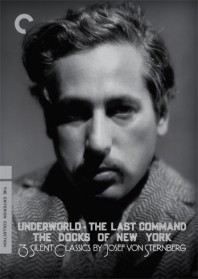
All of which is preamble to the news that Criterion is to release a collector’s set of three classic titles directed by Josef von Sternberg: Underworld (1927), The Last Command (1928) and The Docks of New York (1928). Von Sternberg is known to most film buffs for the exotic films he made in the 1930s with Marlene Dietrich, such as Shanghai Express and Morocco. His silent American films are more cited than seen, so there appearance of these three titles for the first time on DVD will give many the chance to see for the first time how von Sternberg’s brooding, rich visions were established in the 1920s and what continuity there is between the silent and sound era director. Underworld is the archetypal gangster film, The Last Command is a Russian Revolution drama for which Emil Jannings won the first-ever Academy Award for best actor, and The Docks of New York is a fog-bound, intense human drama of waterfront life in the kind of storytelling that silent film does better than another other medium.

The films each come with two scores: one by Robert Israel for each film; two by the Alloy Orchestra, for Underworld and The Last Command; and a piano and voice piece by Donald Sosin for The Docks of New York. The extras include two ‘visual essays’ by Janet Bergstrom and Tag Gallagher, a 1968 Swedish television interview with von Sternberg, a ninety-six-page booklet, the original film treatment for Underworld by Ben Hecht; and an excerpt from Sternberg’s autobiography, Fun in a Chinese Laundry, on Emil Jannings.

The box set will be available from Criterion on 24 August.

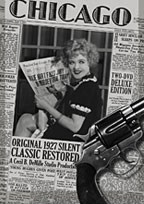
And if that wasn’t enough, Flicker Alley has announced a 2-DVD set of Chicago (1927), based like the recent musical on Maurine Watkins’ gleefully cynical 1926 play. The film was directed by Frank Urson, though it is generally understood to be mostly the work of Cecil B. De Mille (he declined to take a credit because such a tale of low life didn’t really fit in with his King of Kings image – the made both films in the same year). It has become established as a festival favourite since its recent restoration. It stars Phyllis Haver as Roxie Hart and Robert Edeson and Billy Flynn. The music on the DVD is supplied by Mont Alto Motion Picture Orchestra (listen to some extracts here). The extras include The Golden Twenties (1950), a compilation documentary feature produced by The March of Time; a documentary The Flapper Story (1985); a brochure by Thomas Pauly on author Maurine Watkins and the factual background to Chicago, notes by Robert S. Birchard, and a documentary supplement, Chicago; The Real-Life Roxie Hart by Jeffery Masino and Silas Lesnick.

Chicago will be released on 6 July.

Chaplin comes to Blu-ray

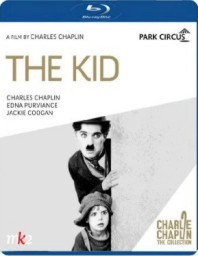
A quick post just to note the latest silent to appear on Blu-Ray. Hot on the heels of The General, Sunrise, City Girl, Battleship Potemkin and the announced future releases of Metropolis, Our Hospitality, Steamboat Bill Jr. and Sherlock Jr., we now have The Kid. Chaplin’s 1921 comic tear-jerker, in which he meets his acting match in the five-year-old Jackie Coogan, is to be released on 10 May by Park Circus, as part of Charlie Chaplin Collection, alongside The Great Dictator. The extras include an introduction by David Robinson; a 26mins documentary Chaplin Today: The Kid; scenes deleted for 1971 release (the Blu-Ray edition is the shorter version which Chaplin prepared in 1971); short items on recording the new score (1971) and Jackie Coogan dancing (1920) (2 mins); and the 1922 home movie Nice and Friendly featuring Lord and Lady Mountbatten, Jackie Coogan and Chaplin.

The Kid seems to be a Region B UK release only. It’s also being made available by the same company on DVD.

Flickers

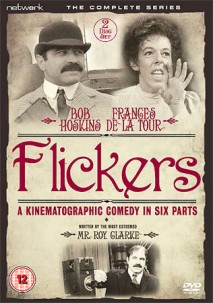
Does anyone remember seeing this? Flickers (“A Kinematographic Comedy in Six Parts”) was a 1980 UK television series set in the early days of the silent film business in Britain, produced by Thames and directed by Cyril Coke.

It was written by Roy Clarke (as in Last of the Summer Wine and Keeping up Appearances) and starred Bob Hoskins and Frances de la Tour. It received a Primetime Emmy nomination for Outstanding Limited Series in 1982. Now it is to be released on DVD (from 7 June) by Network, a two-disc set lasting 300mins. This is the company blurb on the background story:

Forty-year-old Arnie Cole is a movie pioneer, showing films in makeshift cinemas during the first quarter of the twentieth century – a long way ahead of the golden age that will be more glittering than his wildest dreams. But opportunities are opening up all the time, and Arnie’s true ambition is to produce films of his own. Financial backing is, inevitably, the stumbling block. But it comes his way in unexpected form when he is introduced to Maud, the snobbish, rather plain sister of a well-to-do acquaintance; at first, Maud finds Arnie brash and vulgar, and he is equally unimpressed with her – but having discovered that she is pregnant, she makes him an offer that he finds hard to refuse…

I don’t remember seeing it at the time – in 1980 I was at university, barely watched TV, and had no thought for silent films or their social history. It sounds like a soft-edged version of Pennies from Heaven without the songs. The New York Times called it “marvellously wacky”, adding:

one of the daffiest and most hilarious original screenplays written for television. As Arnie and Maud stagger through their unusual relationship, ”Flickers” provides representative samplings of types involved in the motion picture business, from short and alcoholic comedian stars to corrupt lawyers, from aging child stars to lazy cameramen.

I’m intrigued. Anyone out there with long memories?

The complete Metropolis

Frame still from the previously lost Metropolis footage, from http://www.kino.com/metropolis

The Metropolis bandwagon rolls on. After the premiere of the restored version in Berlin on 12 February, it received its North American premiere at the TCM Classic Film Festival at Grauman’s Chinese Theatre, Hollywood on 25 April, with music provided by the Alloy Orchestra.

And then there’s the new Kino Lorber website dedicated to the film, entitled The Complete Metropolis. Kino Lorber is issuing the restoration on DVD and Blu-Ray in November 2010. To whet your appetite it has issued a trailer which includes sequences showing the ‘lost’ footage. The website itself is a lavish affair, with thorough background information on the rediscovery of the missing sequences and the restoration work, an updated synopsis for the film and list of the missing sequences, a history of the film’s production with timeline, details of cast and crew, photo galleries, video clips from the film (including the discovered scenes), information on screenings, plus news, press releases and reviews.

You can also follow the restoration through its own Twitter account, and sign up to its Facebook page. Complete indeed.

An Italian Straw Hat

Albert Préjean as the bridegroom in An Italian Straw Hat, from http://www.flickeralley.com

Released on April 6th is the latest DVD release from Flicker Alley, René Clair’s Un Chapeau de paille d’Italie (1927), known in English as An Italian Straw Hat. This was one of the very first silent feature films I ever saw, some time back in the mid-1980s, and I remember it with such fondness, to an extent where I’m actually quite anxious that it lives up to the memories, as I’ve not seen the film since. It’s a comedy of bourgeois manners, set in late 19th century France, and based on a renowned stage play from 1851 by Eugène Labiche and Marc Michel. The plot revolves around the comic embarrassments that occur when a bridegroom’s horse eats the hat of an army officer’s mistress, leading to an intricately choreographed farce as efforts to restore social decorum are continually thwarted.

Flicker Alley have mastered the film in high definition at 19 frames per second (the speed at which it was shown at its French premiere) from the original 35mm negative used for the film’s English release in 1930, with elements cut for that release restored from an original French print. Intertitles are in English, while you get a choice of music scores, from the Mont Alto Motion Picture Orchestra and pianist Philip Carli.

Extras include Clair’s short film, La Tour (The Eiffel Tower) (1928) and Pathé’s Noce en Goguette (Fun After The Wedding) (1907, directed by Ferdinand Zecca), an an example of the kind of early film that inspired Clair. There is a new essay by Lenny Borger and a vintage one by Iris Barry, notes on the musical score by Rodney Sauer, and a 1916 English translation of Labiche’s play.

The Flicker Alley site includes an image gallery and two extracts from the film, including the opening horse-eating-hat sequence, plus an extract from Clair’s La Tour. Judging from those, I don’t think I’m going to be disappointed.

City Girl

http://www.eurekavideo.co.uk

We can still count the number of Blu-Ray silent film releases on the fingers of one hand, so the arrival of number five is an event. It’s F.W. Murnau’s City Girl (1930), now released by Eureka Video. City Girl was Murnau’s last silent, released after Sunrise and the now lost 4 Devils. It is set in the wheatfields of Minnesota, and covers the trials of newly-wedded life for a farmer’s son (Charles Farrell) and a Chicago waitress (Mary Duncan) among the mistrustful farming community.

The Blu-Ray only release is the 1080p high-definition 20th Century Fox restoration of the silent version of the film, with a new score, composed and arranged in 2008 by Christopher Caliendo. There is a full-length audio commentary by David Kalat and a 28-page illustrated booklet with an essay by Adrian Danks.

And what are the other fingers on the hand? As reported on in an earlier post, we already have The General (from Kino Lorber), Sunrise (from Eureka), a selection of early Oz films as extras to The Wizard of Oz (1939) (from Warner Home video), and the unlikely The Story of Petroleum (1923) which is an extra on the Blu-Ray release of There Will be Blood. Releases are promised for this year which will take us up to two hands’ worth: Battleship Potemkin (from a Swedish supplier), and Our Hospitality, Sherlock Jr. and the complete Metropolis (all from Kino Lorber).