More times past

Colorado newspapers

More information on digitised newspaper collections. Colorado’s Historic Newspaper Collection covers newspapers published in Colorado 1859-1923, an amazing 120 titles being available. The site uses the ingenious Olive Software programmes has been adopted by a number of digitised newspaper collections. Just type in your search term, make sure to tick the box marked Search All Publications, then there are various options for refining your search query. Search result provide you with an image of the article in question, which you click to view full size. Results for silent cinema subjects vary. There is plenty to be found searching on Charlie Chaplin and Mary Pickford, precious little on D.W. Griffith or Kinemacolor. Note also that the site works best with Internet Explorer.

Some other American historic newspaper sites out there (which are freely available) include Utah Digital Newspapers (1850-1950) and the Brooklyn Daily Eagle (1841-1902). Many more such collections are described in the earlier Times past post.

Stand up, Norma

Norma Talmadge

Browsing through Project Gutenberg, I have found a great many short or incidental references to silent movies which might never otherwise be found by researchers.

An example is Roving East and Roving West, a 1921 collection of essays by E.V. Lucas. Edward Verrall Lucas (1868-1938) was an over-prolific essayist, with an easy style and a view on practically everything. He was an interested observer of the rise of motion pictures in the early years of the twentieth century, but by 1921, he had grown cynical at the numbing qualities of popular cinema and the medium’s failure (in his eyes) to live up to the promise of the documentary account of Cherry Kearton’s African films or Herbert Ponting’s Antarctic films. The simple response to Lucas would be that a cinema that only showed us visits to the jungle or the South Pole would soon lose its appeal, and he lapses too easily into criticising a mass audience for its simple pleasures. Nevertheless, the whole Norma Talmadge sequence can still make us squirm. The essay is called ‘The Movies’:

We have our cinema theatres in England in some abundance, but the cinema is not yet in the blood here as in America. In America picture-palaces are palaces indeed – with gold and marble, and mural decorations, built to seat thousands – and every newspaper has its cinema page, where the activities of the movie stars in their courses are chronicled every morning. Moreover, America is the home of the industry; and rightly so, for it has, I should say, been abundantly proved that Americans are the only people who really understand both cinema acting and cinema
production. Italy, France and England make a few pictures, but their efforts are half-hearted: not only because acting for the film is a new and separate art, but because atmospheric conditions are better in America than in Europe.

It was in Chicago that I had my only opportunity of seeing cinema stars in the flesh. The rain falling, as it seems to do there with no more effort or fatigue to itself than in Manchester, I had, one afternoon, to change my outdoor plans and take refuge at the matinee of a musical comedy called “Sometime,” with Frank Tinney in the leading part. Tinney, I may say, during his engagement in London some years ago, became so great a favourite that one performer has been flourishing on an imitation of him ever since. The play had been in progress only for few minutes when Frank, in his capacity as a theatre doorkeeper, presented by his manager with a tip. A dialogue, which to the trained ear was obviously more or less an improvisation, then followed:

Manager: “What will you do with that dollar, Frank?”

Frank: “I shall go to the movies. I always go to the movies when there’s a Norma Talmadge picture. Ask me why I always go to the movies when there’s a Norma Talmadge picture.”

Manager: “Why do you always go to the movies when there’s a Norma Talmadge picture, Frank?”

Frank: “I go because, I go because she’s my favourite actress. (Applause.) Ask me why Norma Talmadge is my favourite actress.”

Manager: “Why is Norma Talmadge your favourite actress, Frank?”

Frank: “Norma Talmadge is my favourite actress because she is always saving her honour. I’ve seen her saving it seventeen times. (To the audience) You like Norma Talmadge, don’t you?” (Applause from the audience.)

Frank: “Then wouldn’t you like to see her as she really is? (To a lady sitting with friends in a box.) Stand up, Norma, and let the audience see you.”

Here a slim lady with a tense, eager, pale face and a mass of hair stood up and bowed. Immense enthusiasm.

Frank: “That’s Norma Talmadge. You do like saving your honour, don’t you, Norma? And now (to the audience) wouldn’t you like to see Norma’s little sister, Constance? (More applause.) Stand up, Constance, and let the audience see you.”

Here another slim lady bowed her acknowledgments and the play was permitted to proceed.

What America is going to do with the cinema remains to be seen, but I, for one, deplore the modern tendency of novelists to be lured by American money to write for it. If the cinema wants stories from novelists let it take them from the printed books. One has but to reflect upon what might have happened had the cinema been invented a hundred years ago, to realise my disturbance of mind. With Mr. Lasky’s millions to tempt them Dickens would have written “David Copperfield” and Thackeray “Vanity Fair,” not for their publishers and as an endowment to millions of grateful readers in perpetuity, but as plots for the immediate necessity of the film, with a transitory life of a few months in dark rooms. Of what new “David Copperfields” and “Vanity Fairs” the cinema is to rob us we shall not know; but I hold that the novelist who can write a living book is a traitor to his art and conscience if he prefers the easy money of the film. Readers are to be considered before the frequenters of Picture Palaces. His privilege is to beguile and amuse and refresh through the ages: not to snatch momentary triumphs and disappear.

The evidence of the moment is more on the side of the pessimist than the optimist. I found in America no trace of interest in such valuable records as the Kearton pictures of African jungle life or the Ponting records of the Arctic [sic] Zone. For the moment the whole energy of the
gigantic cinema industry seemed to be directed towards the filming human stories and the completest beguilement, without the faintest infusion of instruction or idealism, of the many-headed mob. In short, to provide “dope.” Whether so much “dope” is desirable, is the question to be answered. That poor human nature needs a certain amount, is beyond doubt. But so much? And do we all need it, or at any rate deserve it? is another question. Sometimes indeed I wonder whether those of us who have our full share of senses ought to go to the cinema at all. It may be that its true purpose is to be the dramatist of the deaf.

What great novels were lost because writers were lured by the easy money of Hollywood? What a ridiculous accusation. Why not ask what great films were made because bright minds were put to working on the medium made for the times, sparing readers from sub-Dickensian epic novels. The movies have given us much to be thankful for.

Early Discourses on Colour and Cinema

Early Discourses on Colour and Cinema

I have just stumbled across a really excellent thesis on the history, function and meaning of early motion picture colour processes, especially Kinemacolor. It’s written (in English) by Eirik Frisvold Hanssen, of Stockholm University, and is entitled Early Discourses on Colour and Cinema: Origins, Functions, Meanings. It is an historical and theoretical examination of motion picture colour processes 1909-1935, and in particular it focusses upon Kinemacolor, the colour system invented in 1906 by George Albert Smith and sold to the world by the ebullient Charles Urban. It was first exhibited in May 1908, given the name Kinemacolor in 1909, and for five or six years it was the sensation of film exhibitions worldwide, until it was brought down by a court case and then rival colour systems, such as Technicolor.

Hanssen’s thesis contextualises Kinemacolor within a broader history and analysis of colour, while remaining very sound on the purely technological side of things. Its centrepiece is a detailed study of the 1912 Kinemacolor catalogue and its representation of the idea of colour. The thesis can be downloaded as a PDF (1.47MB), or Hanssen’s book based on the thesis is available from Coronet Books, or it can be ordered via the US book site Barnes & Noble. It’s an exceptional piece of work – aimed at the specialist, but wise in the way it shows how important it is to view motion picture colour within a wider, historiographical undcerstanding of colour.

Kinemacolor has a perennial fascination, and there should be more activity coming up, given the centenary next year, and a recently-announced research project by the University of Bristol into Kinemacolor and Technicolor. As always, The Bioscope will keep you informed.

The Edison Motion Picture Myth

Thomas Edison W.K-L. Dickson

The latest addition to the Bioscope Library is something of a surprise, since it is a comparatively recent publication to be found on the Internet Archive. It’s Gordon Hendricks’ The Edison Motion Picture Myth (1961), a notable if idiosyncratic contribution to early film history.

Gordon Hendricks was a determinedly independent film historian who was driven to investigate the history of Edison’s development of the motion picture to overturn the “morass of well-embroidered legend” which existed at that time for the beginnings of American film, especially in the biographies of Thomas Edison. Hendricks wanted also to champion his own hero, William Kennedy-Laurie Dickson, Edison’s chief technician on the motion picture project.

The book is a meticulous exploration of the history of the Edison experiments 1888-1894 which led to the Kinetoscope peepshow viewer, the Kineotgraph camera, and the world’s first successful motion picture films. Hendricks made an intensive trawl through the archives at the Edison National Historical Site, overturning myth after myth, and producing solid information which has been gratefully turned to by succeeding film historians, but it has to be said the book is not an easy read. Hendricks aranges his information in tortuous fashion, swamping the reader with bewildering detail. As Charles Musser puts it, “the caustic historiography … verged on the impenetrable”. But Hendricks achieved his aim, and Dickson’s pre-eminent role as the inventor of motion pictures is widely accepted by historians (though some challenge the focus on personalities in considering the business of ‘invention’).

If that description of the book doesn’t quite whet the appetite of the non-specialist, there are several good sources online for finding out more about Edison, Dickson, and the invention of American film.

The Who’s Who of Victorian Cinema site has biographies of Thomas Edison and W.K-L. Dickson as well as a wealth of associated information.

The Edison National Historic Site has extensive information on all parts of Edison career. The Edisonia section has information on the archives, sound clips, Kinetoscope films, a large number of photographs, and a listing of all 1,093 of Edison’s patents.

The Library of Congress’ American Memory site has a section, Inventing Entertainment, with a large number of early Edison films and sound recordings all freely available for viewing and downloading. See such classics as Dickson Greeting (1891, arguably the first film ever made, illustrated below), Edison Kinetoscopic Record of a Sneeze (1894), Corbett and Courtney Before the Kinetograph (1894) and The Execution of Mary, Queen of Scots (1895).

Dickson Greeting

The Thomas A. Edison Papers is one of the great research resources on the net. The project they are undertaking is to edit over five million documents. The online edition has 180,000 document images and a searchable database of 121,000 documents and 19,250 names. The seaching mechanism is a bit on the elaborate side, but it’s more than worth it – for example, take a look at over 300 letters written between Edison and Dickson.

And if you don’t like all this revisionist stuff, why not visit the Edison Birthplace Museum, and be reassured that Edison invented it all.

Finally, the book to read is Charles Musser’s filmography de luxe, Edison Motion Pictures, 1890-1900 (1997).

Gordon Hendricks also wrote Beginnings of the Biograph (1964) The Kinetoscope (1966) and Eadweard Muybridge (1975), all of them rich in reliable, painstakingly uncovered evidence. The Edison Motion Picture Myth is available to download from the Internet Archive (note the mispelling of ‘Edison’ in the title, by the way) in DjVu (13MB), PDF (16MB) and TXT (589KB) formats.

The work of an early cinema actress

I’ve just stumbled across a Project Gutenberg ebook of Edith J. Morley’s Women Workers in Seven Professions (1914), produced for the Fabian’s Women’s Group. The Fabian Society was a socialist group committed to gradualist reform which helped form the Labour Party in 1900, and which of course continues to this day. Its Women’s Group was founded in 1908 and was active in producing reports and pamphlets on work and social conditions for women. Morley’s book looks at women’s work in teaching, medicine, nursing, health visitors and sanitary inspection, the civil service, clerks and secretaries, and the acting profession. The latter section is mostly about the stage, but it does include this intriguing snippet about the cinematograph work that the actress might occasionally find:

It is only possible for me to touch very lightly on employment by the cinematograph firms; but from the enquiries I have made, the usual payment seems to be roughly from 5s. to 7s. 6d. a day, the workers finding their own clothes: 10s. 6d. if the workers can ride and swim: 3s. a day for walking on, when light meals are provided. There is a form of application to be filled in, which demands the following particulars:-

Height.
Bust measurement.
Waist measurement.
Skirt length.
Age.
Line of work.
Remarks.
Ride horseback. Cycle. Swim.

The pictures take about ten days to prepare, and as a supplementary trade, undoubtedly this work is of value to the actress.

I think that the ability to cycle is something that has not been considered when researchers have looked at the work of women in early British film. Clearly a topic for further investigation. An ability to swim, however, we already know about. There’s a celebrated story of Will Barker selecting an Ophelia for his film of Hamlet (1908) purely because she was able to swim (see Robert Hamilton Ball’s Shakespeare on Silent Film, pp. 77-78).

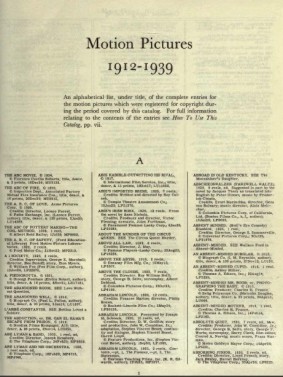
Motion Pictures 1912-1939

motionpictures.jpg

Good grief. Rick Prelinger, of the Prelinger Archive, the sainted digitiser of so many good things now made freely available online, has just made the Library of Congress Motion Picture Catalogs available for download from The Internet Archive. Four volumes have been put up, in PDF and uncorrected but word-searchable text versions, covering 1913 to 1969, with the 1894-1912 volume in preparation. For our purposes, this includes all 1,256 pages of the 1912-1939 volume, which is sensational news for anyone interested in the study of silent film.

The Library of Congress Catalogs of Copyright Entries list all motion pictures registered for copyright in the USA (i.e. films not just made in the USA but shown in the USA). The entries give title, year, company, length, date of registration, and sometimes some credits. The printed volumes have long been the first port of call for anyone seriously engaged in identifying films from the silent period, but they have been restricted to a handful of research libraries. Suddenly they are available to all. The PDF is a huge size (157MB), but there is a 9MB text file of the word-searchable uncorrected OCR, and already there is talk of it being converted into a database. Wow.

The Bioscope Library

I’ve started a new page to The Bioscope. On the top menu you will now see Library. I’m going to use this to gather together those documents available in their entirety online somewhere which will be highlighted first as posts, and then transferred to the Library. All are freely available from downloading from their respective sources.

A number of these documents will come from Project Gutenberg, which is the free electronic books resource which is one of the glories of the Internet. The silent film researcher might suppose that its out-of-copyright material does not extend beyond the nineteenth century, but there is in fact a substantial amount of material of interest, if you know where to look (using the Full Text option under Advanced Search is recommended). These two key books from our period are available, and have been added to the Library:

1) Vachel Lindsay, The Art of the Moving Picture (New York: Macmillan, 1915 [1922 revision]

The American poet Vachel Linday (1879-1931) wrote this celebrated study of the motion picture as an art form at a time when such a notion was generally considered ludicrous, though the grander works of D.W. Griffith were starting to change minds. It is an extraordinary work, categorising film by such grand phrases as Sculpture-in-Motion, Painting-in-Motion, Architecture-in-Motion and The Motion Picture of Fairy Splendour. It aims at the visionary, and recognises the importance of the medium in its time. It is often as foolish as it is insightful, and it has not worn well as a work of serious study, but its enthusiasm is unstoppable. It is also rich in information on films, performers and scenes that impressed themselves on Lindsay’s hyperactive imagination. It is available in ebook form as HTML (404KB) or plain text (180KB).

2) Hugo Münsterberg, The Photoplay: A Psychological Study (New York/London: D. Appleton & Co., 1916)

Hugo Münsterberg (1863-1916) was Professor of Experimental Psychology at Harvard University. His short book The Photoplay: A Psychological Study is regarded as being the first serious work of film theory, a text which remains a key text for the study beyond its purely hisorical interest. Münsterberg was interested in the psychology and the aesthetics of motion pictures (chiefly fiction films), which he rooted in human thought processes and emotions. He argues for the legitimacy of film as one of the arts (a highly controversial position at the time) by arguing for the special ways in which it transforms the world through the act of transferring it onto the screen. It is stimulating read, and has a fascination simply for the details it gives of the cinema-going process and his responses to specific films. It is available in ebook form as HTML (289KB) or plain text (274KB).

Terra Media

chronomedia.jpg

A key aspect of The Bioscope’s mission is to highlight resources for the study of silent film, particularly those not well known or obvious.

A model example is Terra Media. This is a one-man marvel of information on the history of media, beautifully arranged, and filled with riches. Its centrepiece is Chronomedia, a detailed chonology of media history year-by-year. As the site says, “Chronomedia is designed to become the most comprehensive and accurate timeline of developments in communications media ever compiled. By integrating references to all audio-visual media—film and cinema, radio and television, cable and satellite, interactive (multi)media, photography, telegraphy, telephony and even printing and publishing—it becomes easier to see the parallel developments and interactions that have formed the media scene we know today.” The year-search option alone is a joy to see, individual entries are to the point, and it is all very satisfactorily cross-indexed, linked and illustrated.

There are other sections on quotations, the history of television as public performance, the quest for home video, a reference section, and a fascinating section on British media legislation. There are further sections on statistics (including early British cinema circuits) and contemporary documents (none covering the silent era). The site continues to grow, and is just such a pleasure to use. Its editor is David Fisher, whose day job is editor of the media news and market research journal Screen Digest. Take a look.

The Written Word

Today I was looking over an article I located from the Illustrated London News dated August 19, 1922. The title of the piece is “The Birth of the Cinematograph: From Still to Moving Pictures”. This particular article was written by Will Day. Day was an enthusiastic collector of many things, among them some of the early apparatus of pre-cinema and moving pictures. The article is a very interesting document in that it relates much of the pre-cinema history as opposed to traditional moving images. It also has me reflecting on another group of individuals in motion picture history. People such as Day, Merritt Crawford, Earl Thiesen and countless others spent an inordinate amount of time and energy in the attempt to document moving image history. When you think about it, if not for these men, much sole source data such as first person interviews and correspondence might not exist. In many cases actual footage, and equipment is no longer available, so this turns out to be our only method of providing a sense of the history of the Industry. I have found it fascinating in the course of my own research; be it by design or by accident to locate and find written histories left by many more people who played a part in the development of the film industry.

Practical Cinematography and Its Applications

OK, back to the serious stuff, and another key text available for downloading from The Internet Archive. Practical Cinematography and its Applications (London: W. Heinemann, 1913) was written by F.A. Talbot, who wrote various popular science guides, including the much-cited Moving Pictures: How They Are Made and Worked (1912). This plain person’s guide to the practical aspects of cinematography covers operating the camera, film development, scientific applications of cinematography, military uses, education films and (rather oddly) how to write screenplays. Odd, because Talbot’s concern is otherwise about the motion picture as a tool of discovery, not entertainment. There is also an intriguing call for national cinematograph laboratories. It’s available for free download in DjVu (9.6MB), PDF (29MB) and TXT (357KB) formats.