…that the BBC4 series The Wonderful World of Albert Kahn is due for a repeat soon on BBC2, though this time in half-hour episodes (presumably BBC2 viewers have less of an attention span than the sturdy folk who patronise BBC4). I also hear that there isn’t going to be a DVD release of the series, presumably owing to licensing issues, but that the Albert Kahn Museum in Paris is planning to produce some DVDs of its Autochrome colour photographs (and its films?) which will be available from the museum itself next year… More news as and when I hear it.
Category Archives: Colour
Early Discourses on Colour and Cinema

I have just stumbled across a really excellent thesis on the history, function and meaning of early motion picture colour processes, especially Kinemacolor. It’s written (in English) by Eirik Frisvold Hanssen, of Stockholm University, and is entitled Early Discourses on Colour and Cinema: Origins, Functions, Meanings. It is an historical and theoretical examination of motion picture colour processes 1909-1935, and in particular it focusses upon Kinemacolor, the colour system invented in 1906 by George Albert Smith and sold to the world by the ebullient Charles Urban. It was first exhibited in May 1908, given the name Kinemacolor in 1909, and for five or six years it was the sensation of film exhibitions worldwide, until it was brought down by a court case and then rival colour systems, such as Technicolor.
Hanssen’s thesis contextualises Kinemacolor within a broader history and analysis of colour, while remaining very sound on the purely technological side of things. Its centrepiece is a detailed study of the 1912 Kinemacolor catalogue and its representation of the idea of colour. The thesis can be downloaded as a PDF (1.47MB), or Hanssen’s book based on the thesis is available from Coronet Books, or it can be ordered via the US book site Barnes & Noble. It’s an exceptional piece of work – aimed at the specialist, but wise in the way it shows how important it is to view motion picture colour within a wider, historiographical undcerstanding of colour.
Kinemacolor has a perennial fascination, and there should be more activity coming up, given the centenary next year, and a recently-announced research project by the University of Bristol into Kinemacolor and Technicolor. As always, The Bioscope will keep you informed.
The Dawn of Colour

The National Media Museum’s exhibition The Dawn of Colour: Celebrating the Centenary of the Autochrome opened today. The exhibition is sponsored by N.M. Rothschild & Sons, Lionel de Rothschild (1882-1942) having been an enthusiastic Autochome photographer, 700 of whose Autochromes are held by the Rothschild Archive.
The web site is beautiful to look at, with numerous examples of Autochromes and some welcome biographies of the photographers. It is good too on the technical details, with some downloadable PDFs including a 1908 instruction booklet. And the exhibition book, on the Rothschild collection, promises to be a treasure. There’s also information on Auguste and Louis Lumière, inventors of the Autochrome process as well as the inventors of the Cinématographe.
OK, that’s enough posts on colour photography. Back to the cinema…
Searching for Albert Kahn
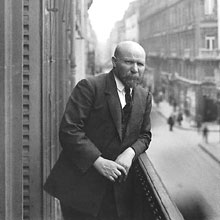
Albert Kahn, from http://www.ejumpcut.org © Albert Kahn Museum – Département of Hauts-de-Seine
A lot of people are coming to this blog in search of information on Albert Kahn, following the BBC4 series The Wonderful World of Albert Kahn. The Kahn collection is best known for its still photographs, which largely lie outside the concerns of The Bioscope, but he did employ motion picture cameramen too (as well as acquiring film from other collections), so here’s a short account of his Archives de la Planète, and some pointers on where to find out more.
Albert Kahn was a millionaire Parisian banker and philanthropist who decided to use his fortune to document the world in photographs. Between 1908 and 1931 he sent out still photographers and motion picture cameramen to create a photographic record of the globe. The project was supervised by geographer Jean Brunhes, who employed around eleven cameramen who visited forty-eight countries and brought back 72,000 Autochrome colour plates, 4,000 steroscopic views, and 600,000 feet of film. They also acquired film from commercial companies, including newsreels and scientific films. Kahn called the project the Archives de la Planète. Kahn lost his money in the Depression, bringing an end to the project, but the collection survived. It has remained remarkably little known, particularly the film component, but a steady trickle of academic interest in recent years has now been followed by the success of the BBC4 series, which has rightly startled people with the beauty of the images and the sheer extent of what they recorded.
Most of the film collection is in the form of unedited rushes of actuality subjects: everything from film taken in Mongolia in 1912-13, to the signing of the Briand-Kellogg Pact in 1928, A.J. Balfour visiting Zionist colonies in Palestine in 1925, fisheries in Newfoundland in 1922, and dancers in Cambodia in 1921. Kahn’s cameramen included Stephane Passet, Lucien Le Saint, Léon Busy, Frédéric Gadmer, Camille Sauvageot and Roger Dumas.
There is an informative and thoughtful article by Teresa Castro, ‘Les Archives de la Planète: A cinematographic atlas’, which is a good place to start, and has some beautiful Autochrome illustrations.
There is no Les Archives de la Planète or Albert Kahn website with a collection of the images on show (update: the BBC has now created www.albertkahn.co.uk). The Hauts-de-Seine.net site has some pages on the Musée Albert Kahn giving basic information and access details, in French. [Another update: the link is now www.albert-kahn.fr]
The Museum is located in the Paris suburb of Boulogne-Billancourt, and is renowned for its beautiful gardens. There is a plain official web page describing these, but you are better off reading the evocative New York Times article, ‘Philosophy in Bloom’, by Jacqueline McGrath, which describes a visit to the gardens (which are apparently not to easy to find).
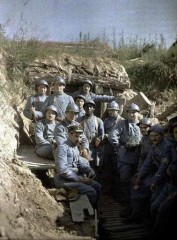
Autochrome of French troops during First World War, from http://www.worldwaronecolorphotos.com
If you are entranced by Autochromes, there are several good sites to visit. This year (2007) sees the centenary of the Autochrome, recognised by www.autochrome.com [link now dead]. The highly recommended Luminous Lint photography site has an explanation of the ingenious Autochrome photographic process, involving the use of dyed potato starch grains acting as colour filters, which helped give them their particular ‘impressionist’ effect.
The site World War I Color Photos has some astonishing images from a conflict we generally only imagine in monochrome. Australian and French First World War Autochromes are reproduced on the Captured in Colour site (which also displays the Paget plate colour system). And there are more First World War Autochromes on the Heritage of the Great War site (though do note this site mixes these up with other coloured images, including artifically-coloured postcards).
The Library of Congress has a page on the restoration of Autochromes. There is an exhibition of the expressive Autochrome work of Gabriel Veyre at www.gabrielveyre-collection.org (Veyre did not work for Kahn but was previously a film cameraman with the Lumière brothers, inventors of the Autochrome). George Eastman House has an online exhibit of eighty Autochromes from the Charles Zoller collection, reproduced in high resolution. The Galerie-Photo site has an exhibition of Autochromes (originally stereoscopic i.e. 3D), with some interesting technical observations.
American academic Paula Amad has written “Cinema’s ‘sanctuary’: From pre-documentary to documentary film in Albert Kahn’s Archives de la Planète (1908-1931)” for the journal Film History, the best single source for information on Kahn’s project, and is writing a book on the collection.
The site www.autochrome.org [link now dead] doesn’t have that much information, but it does tell you in detail how to make your own Autochromes the original way (it’s not easy). If you don’t want to try the original potato starch method, why not use Photoshop? PhotoshopSupport.com will show you how.
Pioneering scientific filmmaker Dr Jean Comandon was one of those who worked for Kahn, late on in the project, as the Institut Pasteur explains (in French).
Definitely the book on Autochromes to buy is John Wood’s The Art of the Autochrome. There will be no more beautiful title on your bookshelves.
Lastly, look out for the National Media Museum’s forthcoming exhibition The Dawn of Colour: Celebrating the Centenary of the Autochrome, which opens on May 25th.
Update (April 2008): The BBC has now produced an Albert Kahn website, www.albertkahn.co.uk, which has information on Kahn, the autochromes and the Albert Kahn museum, as well as promoting the new BBC book The Wonderful World of Albert Kahn: Colour Photographs from a Lost Age. No plans have been announced for a DVD release of the BBC series, presumably owing to licensing issues. However, the Kahn museum section of the new BBC site refers to some DVDs, without going into further details. It has been rumoured that the museum was planning to produce some DVDs of its own, showcasing its Autochrome colour photographs (and its films?). This may be a reference to these, which do not seem to have been published as yet.
Another update (March 2009): There are faint rumours of a possible DVD release, in some form. However, the original The Wonderful World of Albert Kahn series is now available on DVD from the BBC, but only from its educational service, BBC Active, where it is priced at an eye-watering £1,125 for 9x50mins DVDs – the intended market is institutions only. This existence (and price) of this would suggest that any subsequent commercial release to the public will be highlights in some form.
And another update (September 2009): There is now a proper website for the Musée Albert Kahn, at www.albert-kahn.fr. It’s all in French, but includes several examples of the autochromes, photographs of the museum and gardens, a biography of Kahn, and news of exhibitions etc.
Final (?) update (September 2009)
Good news – the BBC has brought out the series on DVD. The Wonderful World of Albert Kahn is a 3-disc set (PAL, region 2), divided into nine parts, running 462mins. It’s released by 2 entertain, which is part-owned by BBC Worldwide.
100 years of the Autochrome

Anyone entranced by the Autochrome photographs in the current BBC4 series The Edwardians in Colour: The Wonderful World of Albert Kahn will want to know about an upcoming exhibition at the National Media Museum in Bradford, celebrating the centenary of the Autochrome. It’s not moving pictures, of course, but the Autochrome – the most beautiful of all colour photography systems (it’s all down to the potato starch they used…) – was invented by Auguste and Louis Lumière, inventors of the Cinématographe, and so it gets honourable mention here. The exhibition is called The Dawn of Colour, and runs 25 May-23 September 2007. More news once it’s started.
Land and Kinemacolor

As reported earlier, I’ve been reading Simon Ing’s The Eye: A Natural History, which is not only an exceptional, highly-readable account of the mysteries and mechanics of eyesight, but incidentally has information of use to us in the study of early film. I’ve already covered his demolition of the persistence of vision fallacy. A later chapter covers how we see colour.
Silent cinema was filled with colour. From the earliest years selected films were hand-painted, a process that was then mechanised by a system of stencils (and massed ranks of women operatives) by the Pathé and Gaumont companies. Later films were subtly tinted and toned throughout, with colours used to denote emotions as well as settings. Restorations of sophisticated colour effects in silent films are the pride and joy of film archives. There is an excellent essay by Tom Gunning, ‘Colorful Metaphors: The Attraction of Color in Early Silent Cinema’ which places early, artificial colour within the broader context of colour reproduction across other media.
However, there was also ‘natural’ colour in the silent era. The 1920s saw systems such as Prizmacolor and two-colour Technicolor in use for a handful of films, but the first of them, and the colour system with the most romantic history, was Kinemacolor. You can read all about the history of Kinemacolor, which was invented in 1906 and first exhibited in 1908, on my Charles Urban website, Urban being the entrepreneur behind Kinemacolor.
The relevance of Ings’ book here is his account of the work of Edwin H. Land. Land was an American scientist and inventor, best known for having given us the Polaroid camera. In 1959, Land devised an experiment which challenged previous theories of colour vision. This is how Ings describes the initial discovery:
On evening, at the end of a long series of experiments with three projectors [they were experimenting with red, green and blue light], Land and his assistants shut off their blue projector and took the green filter out of the green projector. Then, one of Land’s assistants, Meroe Morse, called their attention to the screen. The red projector was still running, projecting the red record on the screen in red light, and the unfiltered green projector was projecting the green record with white light. That combination of red and white lights should, in Morse’s mind, produce something pinkish. But there was the original image, its every colour still identifiable. How could red and white lights throw blues and greens on the screen?
Answer – because in colour vision, context is everything. The eye perceives colours in relation to other colours, and even though Land and his team ‘removed’ colour filters in assorted combinations, they could still generate a full colour, projected image. The eye filled in the gaps.
This property of vision, however, had been discovered and exploited fifty years earlier by Charles Urban and G.A. Smith, the inventor of Kinemacolor. Kinemacolor (patented 1906) used rotating red and green filters on both camera and projector, with panchromatic black-and-white film being used at double the conventional speed (i.e. around 32 frames per second). The result, despite some colour fringing inevitable given the separation of the red and green records, produced a record that was remarkably close to full colour. Red and green in combination covered a fair bit of the spectrum, and the eye did its best to fill in the rest. Hence eye-witnesses reported seeing blues which, according to pure Newtonian colour theory, could not be there. Ironically, Kinemacolor eventually failed as business after a 1913 court case in which its patent was ruled invalid because it claimed to show all the natural colours, but could not reproduce blue.
Today, few Kinemacolor films survive, and we can in any case only judge (or be fooled by) the colour effect if a true Kinemacolor film is projected using correct equipment. However, it is possible to approximate the effect photo-chemically or electronically, as in these frames from the surviving fragment of the famous Delhi Durbar film of 1912 (‘red’ record, ‘green’ record and composite effect):

Land knew nothing of Kinemacolor, and Ings makes no mention of it, which is a shame, because its history has much to tell us about perception, the socio-psychological construction of colour, and the wider understanding of the phenomenon of moving pictures.
If you are interested in knowing more about the history of Kinemacolor, why not download the chapter from my thesis on Urban which covers Kinemacolor, available from my personal website.
Find out more about Land’s experiments from Chris Taylor’s site, which plays with generating colour images using just red and white.
If you are heavily into optics and want to know more about Land’s work, see Gerald Huth’s Rethinking the Vision Process blog.
And, if you are in a UK university, college, school or public library, you can see sample Kinemacolor films from the BFI’s Screenonline site, together with other examples of Charles Urban’s remarkable film career.
The Wonderful World of Albert Kahn

Autochrome of a fringe-maker in Galway, Ireland during May 1913 © Musée Albert Kahn
The BBC4 Edwardians season has just shown part one of a nine-part series on the remarkable Albert Kahn collection of early colour photographs and actuality films, taken from Kahn’s Archives de la Planete. Kahn was a millionaire Parisian banker who decided to create a visual record of the world in the early twentieth century using the new Autochrome photograph process invited by the Lumière brothers (also inventors of the Cinématographe, of course). He sent photographers to over 50 countries. They took more than 72,000 colour pictures and around 100 hours of (monochrome) film footage, recording sights and scenes across the world in an unprecedented documentary exercise.
The first four parts are being shown under the slightly misleading title of The Edwardians in Colour. The remaining five parts will feature in a future set of programmes on the 1920s.
Update: For background information on Albert Kahn, and links to various sources, see the Seaching for Albert Kahn post on this blog.
 The Bioscope