Colourful stories no. 4 – The unbearable effect

Edward Turner three-colour system

Three examples of the Lee and Turner three-colour process, c. 1901, from D.B. Thomas, The First Colour Motion Pictures (1969). Note the different tonal effects (e.g. the girl’s sash on the left-hand film) for the same image taken through red, green and blue filters.

The first patent for colour cinematography was that of the German Hermann Isensee, in 1897, but activity in this field now moved to Britain.

There were four names actively pursuing the goal of practical colour cinematography. One was William Friese-Greene, a figure who used to turn up in many film histories as one of the ‘inventors’ of cinema, and whose supposed discovery of motion pictures was romantically dramatised in the film The Magic Box (1951). That complex story can be told at another time. Suffice to say that Friese-Greene did not invent motion pictures (though he and his supporters claimed loudly that he did), and he turned his attention to colour cinematography. He patented a system (British Patent no. 21,649) in 1898 which posited use of a rotating disc with red, green and blue sectors, which echoed Isensee’s ideas but showed little comprehension of how the theory might work in practice. The other inventor was Captain William Norman-Lascelles Davidson, an experimenter in colour photography as well as cinematography, who in the same year patented (B.P. 23,863) a triple-lens camera with three filters (red, green, blue) behind each of the lenses. This was a step nearer in its thinking, though it led to no working model. There will be more on Friese-Greene and Davidson, who would soon be working together, later on in this series.

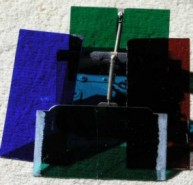
Lee and Turner three-colour projector

Lee and Turner three-colour projector (1901), from D.B. Thomas, The First Colour Motion Pictures

The first patent to be followed by a working model was B.P. 6,202 of 22 March 1899. The patentees were Frederick Marshall Lee of Walton-on-Thames, a racehorse breeder and financier of the project, and Edward Raymond Turner, of Hounslow, London. Turner had previously worked for Frederic Ives, inventor of the Kromskop, the device which employed the additive principle to create still colour photographic images. Ives wrote the following in 1926 about Lee and Turner:

The first recorded suggestion is the British patent of Lee and Turner, two young men who were employed in my workshop in London, and who with my consent patented a scheme which I disclosed to them but which I told them was of more theoretical than practical interest at that time. I considered it a great joke when their patent rights were afterwards sold for real money; but, as I predicted, the method was not practically satisfactory.

There is no evidence nor likelihood that Lee worked for Ives, but the latter was in effect right that Turner’s invention owed a lot to his ideas. Turner took a conventional cine camera and had its shutter replaced by a rotating disc with red, green and blue filters, interspersed with opaque sections, in synchronisation with the movement of the film through the camera. The black-and-white film passing through the camera would therefore record in succession a red, green and blue record. The film was to be shown through a three-lens projector (illustrated above), with each frame projected through each lens in turn, and again a rotating shutter was used to reintroduce the colour.

As with Isensee, Friese-Greene and Davidson, what looked fine in theory proved to be far more difficult to put into practice. Lee and Turner were certainly able to take films – some sample frames from three of the films they made around 1901 are illustrated at the head of this post – for which they employed a unique 38mm-wide film. What they could not do was project the results. If you look at the lenses of the projector you will see that there are three of them, arranged vertically. Each frame of film had to be projected through each lens in turn (the lenses had to be perfectly aligned so that the separate images whould synchronise on the screen). This was to avoid the huge strain on the film were each frame to be projected once, because the film would have to move three inches intermittently. As it is, the strain was still too great. If the original film had been shot at a likely 16 frames per second, the required projection speed would be a manic 48 f.p.s (i.e. successive red, green and blue records shown simultaneously). There is an eye-witness account of the results:

It was when we came to superimpose the pictures on the sheet through three-coloured glasses that we found the process unworkable. As soon as the handle of the projecting machine was worked the three pictures refused to remain in register, and no knowledge that any of us could bring to bear upon the matter could even begin to cure the trouble. The difficulty is mainly due to the fact that cinematograph pictures are small to begin with, and they have to be enormously magnified in exhibiting, as you all know. The slightest defect in registration it pitilessly magnified, and when the minute defects of registration in the first three pictures are followed by minute defects of another sort in the next three, and by yet another sort in the succeeding three, and so on throughout the length of a film, the effect on the observer is almost unbearable.

The witness is George Albert Smith (writing in 1908), a Brighton-based filmmaker and film processor, who processed Lee and Turner’s films and who would go on to invent Kinemacolor.

Synthesized Turner three-colour image

Computer-synthesized colour image of a Lee and Turner experiment, created by Martin Hart

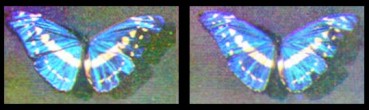
How do you bring three successive frames of the same image into synchronisation by such mechanical means? Lee and Turner’s invention seemed only to show that it was impossible – certainly unwatchable. That there was a colour record there that in theory be uncovered is shown by the above simulation, taken from the black-and-white separations illustrated at the top of this post (the two children may be those of G.A. Smith). A strip of Lee and Turner film exists in the BFI National Archive, which shows a goldfish in a bowl and then a parrot on perch (see top of this post, right-hand image). But it cannot be projected, and would not work even if it could – it is the oldest motion picture colour film in the world, but we cannot see it.

Lee and Turner turned to the Warwick Trading Company to support their work. With the unfortunate results reported above, Warwick and Lee lost interest. However, Warwick’s manaing director, Charles Urban, was not one to give up so easily. He sunk his own money into the futher development of Turner’s invention, though this hit a problem when Turner dropped dead of a heart attack in his workshop on 9 March 1903. Sadly we still know very little about Turner – there does not seem to be a photograph of him. Urban handed on the problem of making the Turner system work to G.A. Smith, with whom he had worked at Warwick. Could the three-colour records be brought into synchronisation, or was there some other solution?

Recommended reading:
D.B. Thomas, The First Colour Motion Pictures (1969)

Colourful stories no. 3 – The first patent

Isensee diagram

Diagram accompanying Hermann Isensee’s 1897 patent, from DEPATISnet

There was colour on film as soon as there was projected film. The Edison Kinetoscope, a peepshow device which introduced commercial motion pictures in 1894 presented too small an image to the viewer for hand-painted colour to be seen distinctively. But once films were shown upon a screen, colours started to be added – including some subjects originally exhibited through the Kinetoscope. Edward Henry Doubell, slide painter at the Royal Polytechnic in London, is known to have painstakingly added colours to Robert Paul films, at a rate of two or three frames per day. Paul showed coloured films at the Alhambra music hall on 8 April 1896, and on 23 April a coloured Serpentine dance was included on the debut programme of the Vitascope projector in New York.

A history of artifically-coloured films would follow, which we shall return to later in this series. For now, we are interested in the dream of the inventors, natural colour. Achieve true colour on the motion picture screen, and fortunes would be made.

And so the history of natural colour cinemaography begins in 1897 with a patent passed on 17 December 1897, in Germany. The inventor was Herman Isensee, and it reads (in translation) as follows:

Imperial Patent Office
Patent Specification
No. 98799
Class: 57: Photography
Hermann Isensee, of Berlin

Device for the Depiction of Coloured Animated Photography
Patented in the German Reich from 17th December 1897

With the help of this device, image projections that could hitherto only be shown in monochrome will, by means of a very quick succession of consecutive frames that are projected in the colours red, green and blue at regular intervals, appear to the eye of the beholder in their true natural colours.

For this purpose a disc with three sectors r, g and b, made up of red, green or indigo blue glass (or else any other suitable films), is placed eccentrically in front of the lens o of a series apparatus.

The movement of this disc is regulated in such a manner that for the duration of a photographic recording a coloured section moves past in front of lens o each time, so that the film strip consists of a regular succession of negative images generated by red, green and blue light-rays.

From these negatives, positives are made and the same are projected with the help of the series apparatus.

During this, in a way similar to the process that takes place during the photographic recording, the red, green, and indigo blue sectors move past in front of the lens, so that on the screen red, green and blue pictures develop in quick succession, in correspondence with the said negatives generated by the coloured rays.

While the known analogous procedure for the attainment of coloured pictures, for example the Ivesian Heliochromy (cf. Eder’s Jahrbuch der Photographie 1891 [Yearbook of Photography 1891], p. 174 ff., and Krone, Die Darstellung der natuerlichen Farben durch Photographie [The Representation of Natural Colours Through Photography], Weimer 1894, p. 103 ff.) involves the successful reproduction of three differently coloured pictures of one object from the same period of time, in this case differently coloured images from consecutive periods of time follow each other with sufficient speed, and it is in such a way that an animated picture in its natural colours is seen by the eye of the beholder.

PATENT CLAIM:

Appliance for apparatus used for the exhibition of animated photography, for the presentation of images in their natural colours, characterised by the fact that in front of the lens a disc with three light-filters in primary colours necessary for the creation of three-colour pictures moves in such a way that with every new recording, as well as projection of the same, a differently coloured section appears in front of the lens.

Attached 1 sheet of drawings.

(My grateful thanks to Eve for providing the translation)

As will be clear enough from the drawing reproduced above which accompanies the patent, this is not the most detailed of patent specifications. It outlines in general and idealised terms the principle of three primary colours being brought together additively, with the optimistic assumption that this could readily produce a motion picture colour record in the same way that Frederic Ives (inventor of the Kromskop, which employed the principle of ‘Heliochromy’) had demonstrated could be achieved practically for still photography. Nevertheless, it does establish the key idea of using a rotating colour shutter in front of camera and then projector, which others would soon adopt.

There is no evidence to suggest that Isensee had any sort of a working model to back-up his claims, and he disappears from this point on as far as colour cinematography is concerned (though he went on to patent other motion picture devices). Because he only patented his idea in Germany, it had no bearing on the experiments that were to take place in Britain the following year which (unwittingly) took up Isensee’s ideas and led to the first practical results in colour cinematography, in 1899. Which you’ll hear all about next time.

Recommended reading:
Adrian Klein, Colour Cinematography (1936)

Isensee’s patent is available online from DEPATISnet, the online German patent service (search under reference number DE000000098799A).

The Great War in Colour

The BBC is putting on more for the Albert Kahn and autochrome addicts among you. This Monday BBC2 starts a three-part series The Great War in Colour: The Wonderful World of Albert Kahn, which looks at the First World War through the colour photographs in the Kahn collection. Part one is on 21 January, at 19.00. The programmes are streamed online via BBC iPlayer for one week after transmission.

Note: If you are new to this site and looking for background information on Albert Kahn, please visit the Searching for Albert Kahn post.

Colourful stories no. 2 – The Kromskop

The road to colour cinematography began with the efforts of those pioneering colour photography itself. For the second part in our series, we look at the work of Frederic Eugene Ives, whose remarkable device the Kromskop was to play a key part in the history.

Frederic Ives (1856-1937) was an American inventor. Best-known for having developed the halftone printing process, he also experimented extensively with colour and stereoscopic (3-D) photography. From 1877 onwards Ives worked on ways of taking and viewing three-colour images with a camera known variously as a Heliochromoscope or Photochromoscope. The result of this experimentation resulted in the Kromskop, first marketed in 1895, a stereoscopic viewer which combined the Photochromoscope images from six monochrome transparencies through colour filters to created a stereoscopic colour image called a Kromogram.

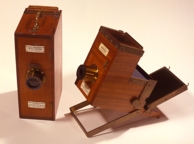
Kromskop camera and viewer

Kromskop camera and viewer, from http://www.spira.com

Kromskop colour filters

Kromskop colour filters, from http://www.earlytech.com

The camera, by a combination of mirrors, prisms and colour filters, took three pairs of images of a given object (an exposure time of a minute was required, which made it impractical for portrait work), respectively red, blue and green on a single plate that measured 2½ x 8 inches. The eventual positive was cut into three and mounted in a folded cardboard frame to form the Kromogram. The three pairs of transparencies were, of course, monochrome, but preserved a record of the alterations in the colour of the object as taken through the three separate filters. The Kromskop itself, by an arrangement of mirrors, coloured glass screens, red, green and blue filters, and a light source, produced a full colour and stereoscopic image.

Kromagram images

Kromagram images, from http://homepage.ntlworld.com/forgottenfutures

Ives believed that his invention formed part of a remarkable triumvirate – the Phonograph, which captured sound; the Kinetoscope, which captured motion pictures; and now the Kromskop, which captured colour:

The Kromskop is an optical instrument which accomplishes for light and color what the Phonograph accomplishes for sound and the Kinetoscope for motion … The Kromskop photograph is … although not a color photograph, a color record, just as the cylinder of the phonograph, although not a cylinder of sound, contains a record of sounds, and the kinetoscope ribbon, although not an animated photograph, contains a record of motion. The phonograph cylinder must be placed in the phonograph before it can be made to reproduce the sounds recorded; the kinetoscope ribbon must pass through the kinetoscope in order to visually reproduce the moving scene; and the Kromogram must be placed in the Kromskop in order to visually reproduce the object photographed.

Frederic Ives, Kromskop Color Photography (1898)

However, the Kromskop and its Kromogram put too much technology between the viewer and the object. Ives elsewhere admitted: ‘this is not the kind of color photography that the world has been looking for … because it does not produce fixed color images which can be framed and hung upon the wall’. It was possible to produce fixed colour prints from Kromskop negatives, but ‘only by so greatly complicating the process as to make it comparatively impracticable’. It was the additive synthesis (as demonstrated by James Clerk Maxwell) that was fundamentally impractical, and was soon to be abandoned as a means of securing photographic still images. However, the Kromskop enjoyed a brief period of popularity, marketed as being ‘invaluable for Evening Parties, At Homes, Conversaziones, Garden Parties &c, &c’. Showmen exhibited it alongside magic lanterns and other such visual marvels, and it caught the eye of some motion picture inventors, among them showman/inventor G.A. Smith, who owned a Kromskop, and would go on to invent Kinemacolor.

Ives established a British company in 1898, the Photochromoscope Syndicate. He took on as an assistant that year one Edward Raymond Turner. The following year Turner left Ives’ employment. Excited by the additive principle expressed through the Kromskop, Turner wanted to see if it could be utilised for cinematography. Turner built and patented his three-colour motion picture system in 1899, the story of which we will tell soon, but this in fact was not the first patent for a motion picture colour system. But you’ll have to wait until part three to learn about that.

Recommended reading:
William Ward, ‘The Newest Marvel of Science’, Pearson’s Magazine, December 1897

Colourful stories no. 1 – Red, green and blue

Maxwell’s three-colour photographic image

The world’s first colour photograph

This is how it all began. In 1855 the renowned Scottish physicist James Clerk Maxwell gave a lecture to the Royal Society, where he argued how the three-colour principle of colour vision might be applied to create colour photography. Maxwell said:

Let it be required to ascertain the colours of a landscape by means of impressions taken on a preparation equally sensitive to rays of every colour. Let a plate of red glass be placed before the camera and an impression taken. The positive of this will be transparent whenever the red light has been abundant in the landscape and opaque where it has been wanting. Let it now be put in a magic lantern along with the red glass and a red picture will be thrown on the screen. Let this operation be repeated with a green and a violet glass, and by means of three magic lanterns let the three images be superimposed on the screen. The colour of any point on the screen will then depend on that of the corresponding point of the landscape, and by properly adjusting the intensities of the lights, etc., a complete copy of the landscape, as far as visible landscape is concerned, will be thrown on the screen.

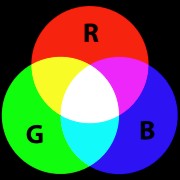
Maxwell here laid down the principles for three-colour additive photography. Using filters for the primary colours of red, green and blue in combination with monochrome photography to create three separate records would result in a full colour reproduction when those three versions of the same image were brought together.

The additive colour principle

The additive colour principle

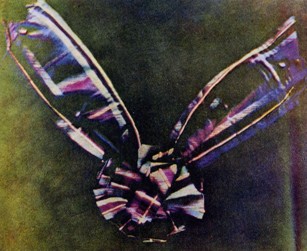
In 1861 at the Royal Institution Maxwell demonstrated the practical results of his theory, photographing a tartan ribbon through red, green and blue filters (using a very long exposure), then placing the three positive transparencies in three magic lanterns and projecting the images in synchronisation through the same colour filters (the actual photographs were taken for him by Thomas Sutton, editor of Photographic News). Maxwell’s image is therefore the world’s first colour photograph. This was of course before sensitising emulsions had been discovered, and Maxwell was using photographic plates that were insensitive to red light. However, a much later recreation of the experiment (1960) showed that both red filter and ribbon emitted ultraviolet rays, which made an impression on the photographic plate, resulting in an approximately true colour photograph.

It is from Maxwell’s theorising and practical example that we can trace the history of colour cinematography, and it is the starting point for the Bioscope’s year-long series on colour in the silent era. It had of course been the dream of those involved in the early years of photography to come up with a means of capturing colour, and assorted methods of adding artifical colours to photographs were employed throughout the nineteenth century. However, true colour was the goal, and various efforts were made to record colour directly in the same way that monochrome photography operated.

It was Maxwell’s experiment that demonstrated an indirect, practical solution – taking the three primary records, red, green and blue, and adding them together (hence the term ‘additive’), working on principles of colour vision developed early in the nineteenth century by Thomas Young. Other scientists then followed, refining Maxwel’s ideas, including Louis Ducos Du Hauron, Charles Cros and H.W. Vogel (who in the 1870s and 1880s discovering methods of greatly sensitising photographic plates to different colours). But most significant in the stages of experimentation that would eventually lead not only to a practical system of colour photography but for colour cinematography as well was Frederic Ives, who will be the subject of part two of this series.

Recommended reading:

Brian Coe, Colour Photography: The First Hundred Years 1840-1940
Jack H. Coote, The Illustrated History of Colour Photography

2008 – The Year of Colour

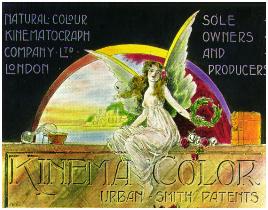
Kinemacolor poster

A happy new year to one and all!

2007 was a productive year for The Bioscope, from small beginnings, and I hope that the coming year will see the service continue to gow and for the archive of useful content to build up. In 2008 I’ll be continuing to provide news on events, festivals, conferences, screenings, DVD releases and online resources for early and silent cinema. The Library of freely-available digitised documents will continue to grow (there is quite a backlog of titles to be added in due course), and I hope to add new features and maybe indulge in a redesign somewhere along the line.

However, the major theme running through 2008 will be colour cinematography in the silent era. 2008 sees the centenary of the first public exhibition of Kinemacolor, the world’s first natural colour motion picture system. Pedants may say that the centenary of Kinemacolor might have been 1906/2006 (when it was patented), 1907/2007 (when it was exhibited in a preliminary form to an audience of film professionals) or 1909/2009 (when it was first called Kinemacolor and was first exhibited to a paying public). But 1 May 1908 was when the system was first shown to a startled general audience at Urbanora House, Wardour Street, London – and that’s good enough for me.

So throughout 2008 there will be posts on colour cinematography to 1930. Not just Kinemacolor (though there will be plenty on that), but the experimental efforts that preceded it, hand-painted and stencil colour, tinting and toning, Biocolour, Cinechrome, Chronochrome, Kodachrome, Prizmacolor, Technicolor, Polychromide, Kodacolor, and more. There will be potted histories, archive documents, illustrations and (if I can find them) film clips. It’ll all build up into a year-long series to cherish and keep.

Lastly, here’s a checklist of some of the silent film events taking place over the year (all of which and more will be recorded in the Calendar section):

14-18 January – The Bioscope Festival of Lost Films
17-20 January – Slapstick 2008 silent comedy festival, Bristol
24-27 January – StummFilmMusikTage festival, Erlangen
9 February – Border Crossings: Rethinking Early Cinema conference, Berkeley
22-23 February – Kansas Silent Film Festival
13-16 March – Cinefest, Syracuse
26-28 March – City in Film conference, Liverpool
3-6 April – British Silent Cinema Festival, Nottingham
11-13 June – The Fifth International Women and the Silent Screen conference, Stockholm
17-21 June – Domitor conference, Peripheral Early Cinemas, Perpignan and Girona
28 June-5 July – Il Cinema Ritrovato, Bologna
11-13 July – San Francisco Silent Film Festival
8-10 August – Capitolfest, New York
28 August-1 September – Cinecon festival, Hollywood
25-28 September – Cinesation festival
4-11 October – Giornate del Cinema Muto, Pordenone

Keep reading, keep commenting, and tell your friends.

Albert Kahn in print

Albert Kahn book

http://www.amazon.co.uk

Fans of the BBC series The Wonderful World of Albert Kahn will be delighted to learn that the BBC is publishing a book featuring the glorious Autochrome colour photographs from the series. The Wonderful World of Albert Kahn: Colour Photographs from a Lost Age will be published on 3 April 2008.

Other books on Autochromes already available are John Wood, The Art of the Autochrome and Victor Gray’s The Colours of Another Age: The Rothschild Autochromes, 1908-1912, subject of the recent National Media Museum exhibition.

For background information on Autochromes and the Albert Kahn collection, see the Searching for Albert Kahn post.

Update (January 2008): Intriguingly, the cover of the book as publicised on Amazon has now changed. Here’s the new look:

Wonderful World of Albert Kahn

Brian Coe 1930-2007

Brian Coe

Brian Coe

It is sad to have to report the death of Brian Coe on 18 October 2007. To anyone with an interest in the history of the technologies of cinematography or photography his work over four decades has been, and remains, indispensible. He joined Kodak in 1952, where he helped found its education service. He made a particular impact with his writings in the early 1960s which forensically overturned the romantic myths which had seen William Friese-Greene chauvinistically championed as a pioneer of cinematography.

He was Curator of the Kodak Museum from 1969 to 1984, building up the collection to be one of international renown, and curating many pioneering exhibitions. When the collection moved to the National Museum of Photography Film and Television in Bradford, Brian became Curator at the Royal Photographic Society’s collection in Bath. In 1989 he joined the Museum of the Moving Image as special events co-ordinator, organising shows, events and organisations on an extraordinary range of topics, all underpinned by exemplary research and presented with enthusiasm, finding a perfect balance between scholarship and entertainment.

At Kodak he built up not only a great collection but considerable personal expertise, which found lasting expression in his many publications. The remarkable thing about his books is that they have not dated. Twenty or thirty years on they are still relied upon as standard reference works, notable as much for their clarity of exposition as their steadfastly reliable content. They include The Birth of Photography (1976), Colour Photography (1978), Cameras: From daguerrotypes to instant pictures (1978), and the incomparable The History of Movie Photography (1981). This is still the best book on cinema technology that exists, and it is hard to see how it could be bettered. It is particularly strong on early cinema technologies – magic lanterns, the optical toys and chronophotographic experiments of the so-called ‘pre-cinema’ era, the first cameras and projectors, the development of colour cinematography, early widescreen systems, the birth of home movies. Its illustrations have been plundered by countless other sources. Film archivists swear by the book – it used to be (and I hope it still is) standard reading for anyone working at the National Film and Television Archive’s preservation centre. Another gem is Muybridge and the Chronophotographers (1992), a small exhibition book reportedly thrown together in a great hurry, but a handy reference guide that I turn back to again and again.

Sadly Brian suffered a serious stroke in 1995, and took no further active part in the worlds of film and photography to which he had contributed such invaluable knowledge. It was a sad curtailment to a varied and richly productive career, recognised through such honours as his Fellowship of the Royal Society Arts, but leaving him little known to the general film enthusiast. Check out one of his books – they’ll be in the local library or second-hand book store. They look beautiful, and they wisely and reliably inform. Thank you, Brian.

The Twenties in Colour

Twenties in Colour

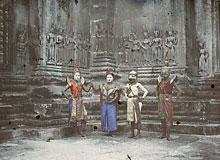
Dancers in ruins of Angkor-Vat, Cambodia, 1922 © Albert-Kahn museum, from http://www.ejumpcut.org

The promised follow-up series on Albert Kahn’s Archives de la Planète project, covering the 1920s, started on BBC4 this evening. The four-part series, The Twenties in Colour, follows on from the earlier series, The Wonderful World of Albert Kahn, in showing how Kahn’s team of still and motion picture photographers continued their task to make a photographic recod of the world. Included in the series is Paris after the Armistice, scenes in the Middle and Far East, and (I hope) some of the scientific-medical cinematography produced by Jean Comandon, who collaborated with Kahn in the late twenties.

Those who want find more about Kahn’s work, and web sources for Autochrome photographs etc, should go to the earlier post, Searching for Albert Kahn, which has the background story and a number of useful links.

Meanwhile, for those of us unable (or in my case, too idle) to get hold of BBC4, the original Wonderful World of Albert Kahn series is to be showing in re-edited, half-hour episodes form on BBC2, starting 16 November, at 19.30pm.

The Open Road

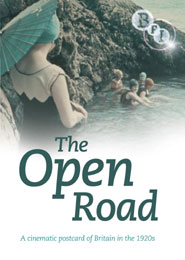
The Open Road

http://filmstore.bfi.org.uk

The BFI has just released its latest silent DVD, The Open Road. This is the colour footage of a road trip from Land’s End to John O’Groats filmed by Claude Friese-Greene 1924-25, which formed the basis of the 2006 BBC2 series, The Lost World of Friese-Greene, already released on DVD. The series was an attempt to emulate the success of The Lost World of Mitchell and Kenyon, with the same presenter, Dan Cruikshank, but without any of the social history or the great sense of revelation.

This BFI release presents the footage sans Cruikshank in what it calls a “special compilation of highlights”, which presumably means the extant footage from Friese-Greene’s footage minus the boring, repetitive bits, where he tests out the colour system and films rather too many rose bushes.

Claude Friese-Greene was the son of William Friese-Greene, the not-quite British film pioneer whose efforts to create motion pictures in the early 1890s were romantically but misleadingly portrayed in the film The Magic Box. Having failed to invent motion pictures, Friese-Greene tried to invent motion picture colour instead. It’s a convulted story that I’ll be telling you some other time, but essentially his experiments with a two-colour process (alternate frames stained red and green) were taken up by his son Claude, who improved the system signficantly and launched it as a 26-part travelogue in 1925. It made little impact at the time (the whole series was probably never released), and has been absent from practically all histories of colour cinematography. But restoration work by the BFI National Archive has demonstrated that, with a little bit of help from modern printing methods and digital technology, the results are really quite beautiful, and give a sweetly nostalgic view of Britain in the 1920s.

The 64mins DVD comes with a score by pianist Neil Brand and violinist Gunther Buchwald. It’s very interesting to see how the BFI is both getting documentaries made out of previously little-known archive film, and then following up with DVD releases of the original footage. It’s worked well with Mitchell and Kenyon, and I hope it works for them again.

Read here on the BFI’s site about The Open Road and the history of its restoration (which involved much re-editing of hat was originally very jumbled material.

Read this account of the Friese-Greene Colour process on the BBC History site.

Or read the shotlist of the pre-edited Friese-Greene footage (all 11,821 feet of it) in the BFI National Archive, diligently done by someone, somewhere, a long long time ago…