The Silent Film Bookshelf

The Silent Film Bookshelf was started by David Pierce in October 1996 with the noble intention of providing a monthly curated selection of original documents on the silent era (predominantly American cinema), each on a particular theme. It ended in June 1999, much to the regret to all who had come to treasure its monthly offerings of knowledgeably selected and intelligently presented transcripts. The effort was clearly a Herculean one, and could not be sustained forever, but happily Pierce chose to keep the site active, and there it still stands nine years later, undeniably a web design relic but an exceptional reference resource. Its dedication to reproducing key documents helped inspire the Library section of this site, and it is a lesson to us all in supporting and respecting the Web as an information resource.

Below is a guide to the monthly releases (as I guess you’d call them), with short descriptions.

October 1996 – Orchestral Accompaniment in the 1920s
Informative pieces from Hugo Riesenfeld, musical director of the Rialto, Rivoli and Critierion Theaters in Manhattan, and Erno Rapee, conductor at the Capitol Theater, Manhattan.

November 1996 – Salaries of Silent Film Actors
Articles with plenty of multi-nought figures from 1915, 1916 and 1923.

December 1996 – An Atypical 1920s Theatre
The operations of the Eastman Theatre in Rochester, N.Y.

January 1997 – “Blazing the Trail” – The Autobiography of Gene Gauntier
The eight-part autobiography (still awaiting part eight) of the Kalem actress, serialised over 1928/1929 in the Women’s Home Companion.

February 1997 – On the set in 1915
Photoplay magazine proiles of D.W. Griffith, Mack Sennett and Siegmund Lubin.

March 1997 – Music in Motion Picture Theaters
Three articles on the progress of musical accompaniment to motion pictures, 1917-1929.

April 1997 – The Top Grossing Silent Films
Fascinating articles in Photoplay and Variety on production finance and the biggest money-makers of the silent era.

May 1997 – Geraldine Farrar
The opera singer who became one of the least likely of silent film stars, including an extract from her autobiography.

June 1997 – Federal Trade Commission Suit Against Famous Players-Lasky
Abuses of monopoly power among the Hollywood studios.

July 1997 – Cecil B. DeMille Filmmaker
Three articles from the 1920s and two more analytical articles from the 1990s.

August 1997 – Unusual Locations and Production Experiences
Selection of pieces on filmmaking in distant locations, from Robert Flaherty, Tom Terriss, Frederick Burlingham, James Cruze, Bert Van Tuyle, Fred Leroy Granville, H.A. Snow and Henry MacRae.

September 1997 – D.W. Griffith – Father of Film
Rich selection of texts from across Griffith’s career on the experience of working with the great director, from Gene Gauntier, his life Linda Arvidson, Mae Marsh, Lillian Gish and others.

October 1997 – Roxy – Showman of the Silent Era
S.L. Rothapfel, premiere theatre manager of the 1920s.

November 1997 – Wall Street Discovers the Movies
The Wall Street Journal looks with starry eyes at the movie business in 1924.

December 1997 – Sunrise: Artistic Success, Commercial Flop?
Several articles documenting the marketing of a prestige picture, in this case F.W. Murnau’s Sunrise.

January 1998 – What the Picture Did For Me
Trade publication advice to exhibitors on what films of the 1928-1929 season were likely to go down best with audiences.

February 1998 – Nickelodeons in New York City
The emergence of the poor man’s theatre, 1907-1911.

March 1998 – Projection Speeds in the Silent Film Era
An amazing range of articles on the vexed issue of film speeds in the silent era. There are trade paper accouncts from 1908 onwards, technical papers from the Transactions of Society of Moving Picture Engineers, a comparative piece on the situation in Britain, and overview articles from archivist James Card and, most importantly, Kevin Brownlow’s key 1980 article for Sight and Sound, ‘Silent Films: What was the right speed?’

April 1998 – Camera Speeds in the Silent Film Era
The protests of cameramen against projectionsts.

May 1998 – “Lost” Films
Robert E. Sherwood’s reviews of Hollywood, Driven and The Eternal Flame, all now lost films (the latter, says Pierce, exists but is ‘incomplete and unavailable’).

June 1998 – J.S. Zamecnik & Moving Picture Music
Sheet music for general film accompaniment in 1913, plus MIDI files.

July 1998 – Classics Revised Based on Audience Previews
Sharp-eyed reviews of preview screenings by Wilfred Beaton, editor of The Film Spectator, including accounts of the preview of Erich Von Stroheim’s The Wedding March and King Vidor’s The Crowd, each quite different to the release films we know now.

August 1998 – Robert Flaherty and Nanook of the North
Articles on the creator of the staged documentary film genre.

September 1998 – “Fade Out and Fade In” – Victor Milner, Cameraman
The memoirs of cinematographer Victor Milner.

October 1998 – no publication

November 1998 – Baring the Heart of Hollywood
Somewhat controversially, a series of articles from Henry Ford Snr.’s anti-Semitic The Dearborn Independent, looking at the Jewish presence in Hollywood. Pierce writes: ‘I have reprinted this series with some apprehension. That many of the founders of the film industry were Jews is a historical fact, and “Baring the Heart of Hollywood” is mild compared to “The International Jew.” [Another Ford series] Nonetheless, sections are offensive. As a result, I have marked excisions of several paragraphs and a few words from this account.’

December 1998 – Universal Show-at-Home Libraries
Universal Show-At-Home Movie Library, Inc. offered complete features in 16mm for rental through camera stores and non-theatrical film libraries.

January 1999 – The Making of The Covered Wagon
Various articles on the making of James Cruze’s classic 1923 Western.

February 1999 – From Pigs to Pictures: The Story of David Horsley
The career of independent producer David Horsley, who started the first motion picture studio in Hollywood, by his brother William.

March 1999 – Confessions of a Motion Picture Press Agent
An anonymous memoir from 1915, looking in particular at the success of The Birth of a Nation.

April 1999 – Road Shows
Several articles on the practive of touring the most popular silent epics as ‘Road Shows,’ booked into legitimate theatres in large cities for extended runs with special music scores performed by large orchestras. With two Harvard Business School analyses from the practice in 1928/29.

May 1999 – Investing in the Movies
A series of articles 1915/16 in Photoplay Magazine examining the risks (and occasional rewards) of investing in the movies.

June 1999 – The Fabulous Tom Mix
A 1957 memoir in twelve chapters by his wife of the leading screen cowboy of the 1920s.

And there it ended. An astonishing bit of work all round, with the texts transcribed (they are not facsimiles) and meticulously edited. Use it as a reference source, and as an inspiration for your own investigations.
A thousand imbeciles together in the dark

A call for papers has gone out for the 3rd Edinburgh International Film Audiences Conference, which will take place 26-27 March 2009 at the Filmhouse, Lothian Road, Edinburgh. Taking its cue from a line by Billy Wilder, the conference takes as its theme “Is the audience ever wrong? Exploring the worlds of film audiences.”

The conference is interested in all kinds of empirical research into film audiences, from any time period and any country. This is area of ever-increasing importance in film studies generally, as evidenced by a body such as the HOMER Project which is dedicated to research into cinema audiences, and particularly silent cinema, as demonstrated by such online projects as Cinema Context and the London Project, and publications from Richard Abel, Melvyn Stokes et al (some of these were listed in a recent post on The Birth of a Nation)

Here’s the full call:

“An audience is never wrong. An individual member of it may be an imbecile, but a thousand imbeciles together in the dark – that is critical genius.” Billy Wilder made this comment about audiences but just how much do we know about what film audiences think and how often are they credited with being geniuses or more often seen as imbeciles? Empirical research into film audiences is a small but developing field and this conference continues its aim of providing a space where those involved or interested in this area can come together to share research findings and discuss future ideas. Whilst the conference will appeal primarily to academics it is not confined to them. Previous conferences have had contributions from those directly involved in the film industry and this is to be welcomed. We are very pleased to announce that the opening and closing speakers have been confirmed. The opening speaker is Professor Ian Christie, from the School of Art, Film and Visual Media, Birkbeck, University of London. He is Vice President of Europa Cinemas, an EU funded organisation which supports exhibitors throughout Europe who show European films, and a Trustee of the Independent Film Parliament. He is also a regular reviewer and broadcaster on film matters. The closing speaker is Dr Sean Perkins. He has been Research Executive at the UK Film Council since 2001. His research interests include UK and global theatrical markets, the UK video and online markets, film on television and film audiences. He has managed research projects on the impact of local cinema and a qualitative study of avid cinemagoers.

There is only one criterion for proposed papers: they should be concerned with empirical research into film audiences. The audiences can be anywhere in the world and for any genre of film. They can be historical pieces of work that explore the construction of film audiences through governmental policy or pieces that look at the construction of fans via archival material. We are happy to receive abstracts from students and new researchers as well as established researchers no matter what their background is.

The conference takes place over two days in the heart of Edinburgh. One of the main attractions for participants is that we only run single track sessions – no more difficult decisions about who to go and listen to or the awful experience of presenting to just a couple of people whilst everyone else has gone to hear the famous speaker! Everyone is guaranteed a decent audience plus 30 minutes to present their paper followed by 15 minutes of questions – and we are very proud of our reputation regarding time-keeping.

Abstracts of no more than 300 words should be submitted as virus-free MS Word or rtf attachments, to Dr Ailsa Hollinshead no later than 31st August 2008. Abstracts will be reviewed by external referees and all contributors will be notified of the outcome by 30th September 2008. Copies of the conference paper will have to be with Dr Hollinshead by mid January 2009. There will be a bursary for the best student paper, which can include undergraduates as well as postgraduates (subject to proof of status). Successful candidates will be expected to book a place within one month of their paper being accepted. Costs and application forms can be obtained from the conference website.

More information is available on the conference website, including abstracts from last year’s conference.

A ragged swarm of adventurers

Here’s another gem uncovered from using Live Search. In fact it’s a text I know well, but I hadn’t realised it was available on the Internet Archive because there is nothing in the title Fifty Years of a Londoner’s Life (1916), by journalist Henry George Hibbert, to indicate its interest to the film historian. But Hibbert’s book contains a lively and observant chapter on the emergence of cinema in London, being especially vivid in describing the rush of showmen and speculators who jumped upon the cinema-building boom after 1910. He is also accurate in pointing out that a previous boom in roller skating rinks, which had collapsed, had left a number of empty venues looking for a new use, and many such were converted into cinemas. And thanks to the Internet Archive, which provides a plain text version, here is that chapter:

THE ROMANCE OF THE CINEMA

Its Introduction to London – A Protégé of the Music Hall – Millions Made, and Lost – Its Wondrous Future

Of all the children to whom the music hall has been foster mother, none was so rapid in its growth, so wayward, so fruitful in surprise as the cinematograph. And, after twenty years of remarkable achievement, it is still, in the belief of them that know it best, but on the threshold of its greatness. “The British public,” said one recorder of its early exhibition, “has a new toy, of which it is not likely to tire quickly”; just as an American writer of the first importance had been interested, but found the cinematograph “a curiosity of no particular importance.” A toy; a curiosity!

Moving pictures, it is still necessary to explain to the technically unlearned, do not move. This illusion was produced by the earliest scientific toy-makers. All the early photographers strenuously endeavoured to capture impressions of movement. Edison casually gave to the world a contrivance known as the kinetoscope, which he did not effectually protect. And from that many inventors toiled simultaneously to develop what we know as the cinematograph.

To the imagination of the Londoner, Robert W. Paul made the first and the most prolonged appeal. He was a craftsman of delicate and ingenious scientific instruments, and, having made a greater, or at any rate a more important contribution to the development of the cinematograph in England than any other, having taught many men of more heroic enterprise, or better luck, how to become millionaires, he retired from the field and returned contentedly to his first calling.

Paul illustrates the romance of invention with a homely picture. When, in the small hours of one morning, his experimental pictures were first endowed with life, in his Hatton Garden workshop, his men uttered a great shout of victory, the police were alarmed and broke in. As a sedative, an impromptu exhibition was administered to them. And so, in the winter of 1895, the cinematograph came to London. In a few weeks it was brought to the notice of Augustus Harris, and, frankly regarding it as an entertainment novelty of an ephemeral quality, he tried a cinema side-show at Olympia, where it competed with Richardson’s show and kindred delights.

Meanwhile Lumière, a Parisian photographer, had arrived at similar results, from a manipulation of the kinetoscope. Trewey, the juggler, and exponent of comic expression with the aid of a flexible felt hat, brought the Lumière apparatus to London, and was certainly ahead of Paul in impressing the cinematograph on the great mass of pleasure-seekers. The music hall agents and music hall managers were incredulous. Trewey resorted to the home of the scientific toy – the Polytechnic, and was looked upon as having achieved the finality of his mission. But he persisted. He arranged an afternoon season at the Empire, in the early days of March 1896. He soon insinuated the cinematograph to the evening programme here. And the reign of the moving picture began. I remember asking Trewey what he believed to be its possibilities in expeditiousness. He declared that if the progress of improvement were maintained a day would come when an occurrence might be reproduced on the screen within forty-eight hours. Whether or not my old friend lived to see his estimate corrected to minutes, I know not. Paul was in immediate succession. Toward the end of March, 1896, his so-called Animatograph was established at the Alhambra, where a tentative engagement, for weeks, was extended to one of years’ duration. Indeed, I do not believe that either of the two great Leicester Square houses has been without some form of animated photograph in all the meantime. Soon a finer apparatus than that either of Paul or of Lumière arrived at the Palace – known as the American Biograph, which for many months drew all London. Its pictures were larger, steadier, more actual. Before the end of 1896 there was not a music hall without its equipment of animated photography. Its scientific, industrial, commercial, and above all its tremendous art possibilities, were not yet conceived or perceived. Let me, as merely of the ministry of popular entertainment, emphasise this fact. The greatest, or at any rate the most appellant, scientific invention of our time, was nurtured in the English music hall, just as the electric light was first exploited as the advertisement of a theatre. A third Londoner completed the group of the pioneers of animated photography – a young American salesman of apparatus, Charles Urban, to whom the higher development of the new invention – its use for illustrating travel, the wonders of nature, and of scientific investigation – has always appealed, more than its use for frivolous amusement – on occasion, debased amusement. And two young Frenchmen, the Brothers Pathe, who began life as the exhibitors of a gramophone at Paris, quickly built up an immense business for the manufacture and sale of apparatus and films.

Imagination recoils from an attempt to suggest the magnitude of the cinematograph to-day. Estimate England’s inexplicably small share, then multiply it many times, and begin the endeavour to appreciate the fact that the cinematograph represents the third largest industry of America, where millionaires operate in its finance as they do in public loans, in railways, mines and steel; where great theatrical managers, dramatists and actors have silenced its menace by alliance, where they think nothing of an expenditure equalling ten thousand pounds on a production, and where they maintain upwards of six hundred picture theatres in a single city, Chicago.

Is English enterprise to follow in the wake of this huge enterprise? There are, at any rate, points of remarkable likeness in the evolution of the cinematograph here. First of all, the fact is to be noted that the pioneers of the industry, in both countries, nearly all retired – a few of them enriched, some of them disappointed and disaffected, some of them utterly broken. There never was a business of such strange mutations. It has been called by one of its most important adherents, Fred Martin – one of my boys, when he first of all aspired to journalism – who is mainly responsible for the manipulation of the exclusive picture and the introduction of the five-reel or “full performance” film here, in preference to a programme of many items, “The Topsy Turvy Industry.”

One of its wealthiest men to-day was a travelling showman. But the experience of the travelling showmen as a community was very different. To a man they abandoned their waxworks and their freaks and their marionettes for the cinematograph. I recall a St Giles’s Fair at Oxford that historic function still retained, but I think then lost, its boyish fascination for me – when, of fifty-one booths, forty-nine enclosed crude cinematograph shows, mostly exploiting vulgar comedy. The travelling showman came next to the music hall in popularising the cinematograph as an entertainment and in supporting it as a manufacturing industry. But he was hoist with his own petard. His success stimulated local enterprise, and when he revisited an old pitch he found a permanent picture theatre established.

Ruin spread among the travelling showmen and a new era in the history of the cinematograph began. Not the Klondyke attracted such a ragged swarm of adventurers. The collapse of the skating rink fever had left numerous sites and building shells free. Wild-cat speculators attracted millions of money from ignorant speculators, always fascinated by the business of pleasure. You could count picture palaces by the score in a brief ride across London. Again a debacle; and the official liquidator busy. But out of the wreck a new, resplendent picture palace – the ideal picture palace – is slowly rising. Its architects have expanded to one hundred thousand pounds in outlay on a structure.

For the short, amusing picture play there will always be a particular market. Elemental amusement will never lose its charm and importance – not till the love of toys is dead in small children and great. But cinematograph has left the nursery, and – still with uncertain eyes – is surveying the world. It has fascinated nearly every great actor, nearly every great author of our time, and liberally rewarded their adhesion to its cause. It is forming its own schools of financiers, and artists, and mechanicians, formerly drawn from everywhere and anywhere. The millionaires of the moving picture world include a clothing salesman, an itinerant conjurer and a music hall “lightning cartoonist.” The redoubtable Charlie Chaplin, now drawing his weekly emolument in thousands of dollars, was a “Lancashire clog dancer.” The greatest producer of the day, D.W. Griffith, who begins his cash account with a retaining fee of four hundred pounds a week, was but a few years ago a desperate actor. Mr Frederick A. Talbot, the historian of the cinema, estimated that four million people visit picture palaces daily in Great Britain. They pay fifteen million pounds out of their pockets annually into the box-offices of the cinema halls, and one person out of every three hundred and fifty one passes in the street depends upon the pictures for a livelihood. Of what individual investment may mean Mr R.G. Knowles is an example. He has outlaid twenty-five thousand pounds on the material of his travel lectures, and his wife, once Miss Winifred Johnson, abandoned the musical career she so adorned to become his secretary, editress, librarian.

Fifty Years of a Londoner’s Life is available in the usual range of formats from The Internet Archive, as has plenty more in the way of fascinating detail on the changing London social scene. Unlike some nostalgists of this era, he does not exclude the modernistic cinema, but sees it as part of the historical thread of the city.

The nightside of Japan

As evidence of the value of Live Search for searching across the texts of books digitised by the Internet Archive (see previous post), here’s a passage from The Nightside of Japan, by Taizo Fujimoto, published in 1914. It’s a travel book on Japan written for a Western audience by a Japanese writer, and it includes this marvellously vivid portrait of attending a cinema show in Tokyo at this time, complete with benshi narrator, interval acts and food sellers.

The Asakusa is the centre of pleasure in Tokyo. People of every rank in the city crowd in the park day and night old and young, high and low, male and female, rich and poor. It is also a haunt of ruffians, thieves, and pickpockets when the curtain of the dark comes down over the park. All houses and shops along each street in the park are illuminated with the electric and gas lights. The most noisy and crowded part is the site of cinematograph halls. In front of a hall you see many large painted pictures,
illustrating kinds of pictures to be shown in the hall, and, at its entrance, three or four men are crying to call visitors: “Come in, come in! Our pictures are newest ones, most wonderful pictures! Most lately imported from Europe! “Men of another hall cry out: “Our hall gives the photographs of a play performed by the first-class actors in Tokyo; pictures of the revenge of Forty Seven Ronine!” Tickets are sold by girls in a booking-box near the entrance of each hall; they are dressed in beautiful uniforms, their faces painted nicely, receiving guests with charming smiles. Most of the Japanese carry geta (clogs) under their feet, instead of shoes or boots, and specially so are the females. When you come into the door of a hall, tickets are to be handed to the men, who furnish you zori (a pair of straw or grass-slippers) in place of your geta, and you must not forget to receive from them a wood-card marked with numerals or some other signs the card being the cheque for your clogs. When you step on upstairs you are received by another nice girl in uniform, who guides you to a seat in the hall. Now the hall is full of people; it seems that there is no room for a newcomer, but the guide girl finds out a chair among the crowd and adjusts it to you very kindly. Pictures of cinematograph are shown one after another, each being explained by orators in frock or evening coat. Between the photograph shows performance of comic actors or jugglers is given. After the end of each picture or performance there is an entr’acte of three or five minutes, and in this interval sellers of oranges, milk, cakes, sandwiches, etc., come into the crowds, and are crying out: “Don’t you want oranges? Nice cakes! New boiled milk! etc., etc.” The show of cinematograph is closed at about 12 P.M., and all people flow out of the hall. Where will they go hence? Of course most of them go to their home, but a part of them young fellows among others runs to the Dark Streets of the park, or Yoshiwara, the licensed prostitution quarter near the park.

The Nightside of Japan is available from the Internet Archive in the usual range of formats (PDF, DjVu, TXT), and contains a few more references to cinematographs. More such gems as I find them.

In the dock

Cinematograph theatre in Lordship Lane, London, in 1913, from http://commons.wikimedia.org

Let us celebrate the Bioscope’s imminent passing of the significant milestone of its 100,000th visitor (hurrah) by looking at a major new research resource for British historical studies in general which offers some minor but intriguing opportunities for the early film historian.

The Proceedings of the Old Bailey Online is just that – a fully searchable edition of digitised texts from London’s central criminal court, with details of 197,745 criminal trials. These are trial reports originally published for general consumption. Previously this remarkable resource (a collaboration between the Open University, and the Universities of Hertfordshire and Sheffield, funded by the Arts and Humanities Research Council and the Big Lottery Fund) covered the years 1674-1834. Now the collection has been augmented by texts of trials going up to April 1913 (when the printed Proceedings ceased publication). This makes it an obvious boon for historians of the nineteenth and early twentieth centuries, with a wealth of social detail alongside the intrinsic interest of the trials themselves. It is also a source of huge interest to family historians, who are exploring with nervous/eager anticipation to see if any of their forbears ended up in the dock (I’ve found one such forbear, but happily he was merely a witness to a crime). It is easy and helpful to use, and utterly engrossing to read.

So, given that the records go up to 1913, what is there for the film historian? Well, not a huge amount, but enough to merit further exploration by somebody. There are both cases which involve motion pictures, and cases where the accused or witnesses attended film shows which are recorded as part of the evidence.

For example, consider the case of Manuel Goldberg, alleged user of counterfeit coinage, from 8 January 1907. We get this evidence from one of the witnesses:

LOUISE VALLERS, wife of Henry Vallers, 129, Whitechapel Road, E. We keep a Bioscope Exhibition. I was there on the evening of December 22 last, between five and six, when prisoner came in on see the exhibition. The charge for admission was one penny. He tendered a half-crown. The people pay at the door as they enter. This is the coin marked by myself. I took it and gave him two separate shillings and fivepence change. He said to me, “Are there no tickets?” I said, “No,” and he went to the door again and beckoned to another man to come in. The other man came up, and he also gave me a half-crown for his admission, for which I gave him two and fivepence change. This is the one. I looked at them, being two half-crowns looked suspicious. I tested both of them with acid, and found they were bad. The second-man kept by the doorway, but the prisoner walked right to the end of the shop and sat down and waited for the exhibition. When the second man noticed that I saw the coins were no good, he took to his heels and ran away. I then closed my shop door and sent for a constable. I went up to prisoner, and said, “This half-crown ie no good to me,” and detained him till the other people in the shop had left. I gave him the coin back again. He simply said, “Not” and gave me a two shilling piece and ten halfpennies for his half-crown. A constable came in and I gave him in charge.

This is incidental evidence of a very early cinema in London, from which we learn its location, ownership, the price of admission, the ticketing policy, and the fact that, interestingly, the owner refers to the business as a shop (many early cinemas in London were simple shop conversions). He was found not guilty, by the way.

Next, this simple case report from 20 April 1909:

THOMPSON, William (31, operator), pleaded guilty of stealing two spools and four cinematograph films, the goods of Herbert Crow; also to stealing two spools and six cinematograph films, the goods of Horace Liver and another; also to stealing three cinematograph films, the goods of Frederick Weisker and another.

He confessed to a conviction for felony in 1906 in the name of Albert Storer. Several other convictions were proved, dating back to 1891. It being stated that another charge against him was pending, he also pleaded guilty to that in order that the Court might deal with all matters against him up to date.

Sentence, Two years’ hard labour on each indictment, to run concurrently.

And so on. It is necessary to use a variety of search terms to find relevant material. I’ve found evidence (as it were) using Bioscope, Cinematograph, Cinema, Biograph, Film (though look out for errors in the optical character recognition – a lot of ‘films’ should actually be ‘firms’) and Picture Palace. With the latter you get many glimpses of the regular habit of cinema-going at this time. Use the term Living Pictures, and you find the trial of the renowned anachist group behind the ‘Houndsditch Murders’ and the Siege of Sidney Street, as in this testimony from Luba Millstein :

When I got back to No. 59 Dubof was there; I cannot remember what time he left. Later that night Trassjonsky and I went to see some living pictures. On returning she and I were staying in the back room; Fritz and Trassjonsky lived there together. About midnight I heard two people coming upstairs. On my going to the front room door and knocking Fritz told me I must not come in. A little later the men left and I went with Trassjonsky into the front room and there saw the body of Gardstein lying on the bed. I heard a conversation between Fritz and Trossjonsky. Fritz told her that Morountzeff was wounded…

The only name from the British film industry that I’ve come across is J. Brooke Wilkinson, the future head of the British Board of Film Censors, who in December 1911 was a witness in a case of forgery.

As someone who is researching cinema-going in London at this period, the Proceedings of the Old Bailey Online is an absolute treasure trove to me. But there are other aspects there well worth pursuing, particularly relating to bankruptcy and fraud. Or maybe you’ll just what to find out if those rumours about great-grandfather’s criminal past are really true or not…

Knee-deep in orange peel and pea-nut shells

I gave a talk the other day on children’s cinema-going before the First World War, which reminded me that it’s been a while since I had any of the testimonies of cinema-going in the silent era that I occasionally reproduce here on The Bioscope.

The extracts below come from the unpublished memoirs of Hymie Fagan, of Jewish working class origins, who was born in Stepney in 1903. His autobiography is one of a large collection of unpublished working class autobiographies which are held in the Burnett Archive of Working Class Autobiographies at Brunel University. These autobiographies were collected by John Burnett, David Vincent and David Mayall while compiling their three volume annotated bibliography, The Autobiography of the Working Class (1984-1989). The texts aren’t available online, and there’s only an index available which gives author, title, and some indication of the location and time period of their memoir. So you’d have to go there to find out more, but here’s evidence from Hymie Fagan of why it would be a worthwhile trip for the dedicated researcher. Here he’s writing about going to the cinema in London before the First World War. It is full of observant detail:

The Picture Palaces, as cinemas were then known, or the Bioscopes, were becoming very popular. I vaguely remember once going with my father to one in Shoreditch High Street, where I was given a bag of sweets, and he a packet of Woodbines to popularise the cinema still more. After his death I used to go to one in Brick Lane. Admission was one ha’penny. Only one film was shown, usually a cowboy and Indian film. We cheered the cowboys like mad and hissed and booed the Indians, for they were always the baddies.

The one-film shows were for the childrens’ matinees. When the film ended the lights went on, and the children ushered out, to enable the next show to start, but some of the boys hid under the seats, so that they could see the film again without paying. Finally the manager became aware of this, and at the end of each performance the attendant would poke under the seats with a long pole to flush out the stowaways, who were then somewhat forcibly removed.

There was another, more expensive, picture palace in Commercial Street, where the gallery cost one penny and the stalls sixpence. A full programme was shown, and not only cowboy and Indian films. Such dramas as “Leah the Forsaken” all about the plight of a Jewess caught in the toils of the Spanish Inquisition. Another was “The Indiarubber Man” who could scale high walls with amazing jumps and disguise himself by changing the shape of his face. Then there were the serials. The heroine in most of these was a star named Pearl White. She was usually left tied to the rails whilst an express came thundering down towards her. I remember her in one serial named “The Perils of Pauline”, and I underwent agonies of suspense each week, until I learned how she managed to escape in the following episode.

Real picture lovers, but poor like me, went into the gallery. Others, who simply wanted to snog in the dark, went into the stalls. Looking down into it, it seemed that nearly all the seats were empty, as indeed they were, for the snoggers preferred the walls round the stalls. The floors from the gallery to the stalls were knee-deep in orange peel and pea-nut shells.

To keep Pearl White’s image before the public the P.R.O. [?] composed a song about her. It went

“My Little Pearl of the Army,
Pearl of my heart so true.
You’re the queen of the picture screen
And the pride of the whole world too.
Whilst the band plays Yankee Doodle
Rule Britannia too
There’s many a lad, who to die would be glad
For a Pearl of a girl like you”.

A later passage covers cinema-going during the First World War, and has useful evidence of the appeal of the cinema’ stars on the young:

Apart from reading and swimming, another joy was the cinema. It was becoming very popular indeed and there was a children’s matinee every Saturday afternoon. Admission was one penny and since mother had no objection because of the Sabbath, I went regularly. I used to arrive almost before anyone else, queuing up impatiently at the box-office, and as the crowd of children grew, so did the yells demanding that it opened, which at last it did, dead on two o’clock. Chaplin was always shown since he was the favourite, and I remember falling off my seat, helpless with laughter at “Champion Charlie”. Then there was Douglas Fairbanks, whose athletic exploits I tried to emulate. Once after he had escaped from his enemies by jumping down a cliff by a series of ledges, I tried to do the same thing on our pitiful crumbling cliffs, but when I jumped onto the first ledge it crumbled under me and I hobbled home on a badly sprained ankle.

There are several other such autobiographies in the Brunel collection, though in my research I looked only for those subjects who had lived in London in the 1896-1914 period. John Burnett’s books looking at nineteenth and early twentieth-century working class life through memoir evidence (Destiny Obscure, Useful Toil) are not hard to find in second-hand shops, and are well worth seeking out, even if none so far as I know touches on the cinema.

… and London screen history

Angel Islington

The Angel cinema in Islington, 1917

Hot on the heels of that last post on the East Finchley Phoenix comes news of a one-day event at Birkbeck College on London’s screen history. Organised by the University of London Screen Studies Group, in association with the London Screen Studies Centre, Birkbeck College and Film Studies journal, the event on Friday 14 March brings together a range of recent work on London’s heritage of film production and particularly reception. Here’s the programme:

London Screen History

Birkbeck College, Malet Street, London WC1
9.30–18.00 Lecture Theatre B33

  • Ian Christie: Introduction
  • Michele Daniels: The Coming of Talking Films to London, 1928-29
  • Jude Cowan: ‘The First Film Studios at Ealing: Warwick Trading Company 1907-1909 and Barker Motion Photography 1909-1918’
  • Pierluigi Ercole: ‘Little Italy on the brink: London Italians and War Films, 1915-1918’

11.00-11.30 tea and coffee

  • Brigitte Flickinger (Heidelberg): ‘Living and leisure: Cinema-going in London in the 1910s and 1920s – a view from outside’
  • Luke McKernan (British Library): ‘Children’s cinemagoing in London before WW1’

13.00-14.00 Lunch

  • Charlotte Brunsdon (Warwick): ‘Shaping the Cinematic City: Three London Journeys’

15.00

  • Toby Haggith: Early London housing films
  • Angela English, Jenny Davison: ‘Their Past Your Future and working with London community groups’
  • Roland-Francois Lack: ‘Still Point of the Turning World: Piccadilly Circus in Film’

16.30-17.00 Tea and coffee

  • John Sedgwick (London Metropolitan): ‘The commercial significance of London’s West End cinemas’
  • Richard Gray (CTA): ‘London’s cinema buildings’

The programme has been published a bit late in the day, but it’s a terrific line-up (your humble scribe notwithstanding), so do come along (there’s a small charge for tea and coffee) and see if we can get the audience to outnumber the speakers, at least by a little bit.

Silents at the Phoenix

Picturedrome

The Picturedrome, East Finchley, from http://www.phoenixcinema.co.uk

The Phoenix in East Finchley is believed to be Britain’s oldest continuously running cinema. It was founded in 1910 as the Picturedrome and has operated as a cinema ever since. It has been independently owned for most of that time, and after being known as the Coliseum and then the Rex it became the Phoenix in 1975. It now run by a non-profit-making trust and is a Grade II listed building.

This independent cinema proudly keeps up a tradition of showing independent films, and is now looking back to its roots by showing a season of silents, Into Great Silents – The Best in Silent Cinema. So do go along if you can to support them – on Sunday 9 March they are showing Alfred Hitchcock’s The Lodger, accompanied by Ivor Montagu’s Bluebottles, with piano accompaniment by Stephen Horne and an introductory talk by film historian Gerry Turvey. Later screenings will be Sunrise (8 June), Pandora’s Box (21 September) and Battleship Potemkin (28 November).

From silent screen to multi-screen

From Silent Screen to Multi-Screen

http://www.amazon.co.uk

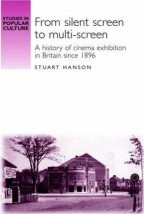
There are still so few books out there on cinema exhibition that the appearance of any new title is a cause for celebration. So it is very pleasing to note the publication of Stuart Hanson’s From Silent Screen to Multi-screen: A History of Cinema Exhibition in Britain Since 1896, published by Manchester University Press in its ‘Studies in Popular Culture’ series.

The book is a survey of British film exhibition from the 1890s through to the present day, organised chronologically, with an emphasis on economic, legislative and sociological conditions. It is a huge subject, and Hanson has evidently read very widely and absorbed and explained a great diversity of material. It is a very useful text, aimed squarely at the academic market, and as said there are too few titles on cinema audience studies still (it is a growing subject) not to call this book a welcome addition to the field. There is really isn’t anything quite like it which covers the whole range of British film exhibition.

New Egyptian Hall

Film audience at the New Egyptian Hall, London, 1907-08

That said, there need to be a few words of caution regarding its chapters on the silent era. For the most part the author has relied on secondary sources, and provides a useful summary of material to be found in Rachael Low and in the recent studies by Nicholas Hiley and Jon Burrows. However, while he has been attentive to arguments, he has not always alert when it comes to facts. There are several errors over dates (the ‘first’ British cinema, the Daily Bioscope, opened in 1906, not 1904) and numbers (there certainly weren’t forty films on offer at the inaugural British Kinetoscope exhibition in October 1894). There is also an unfortunate tendency to peddle old myths. For instance, we get the hackneyed story about people running away from film of an approaching train at the first Lumière show, despite the known fact that the December 1895 show did not feature Arrivée d’un train, and audiences in general did not run away in panic at films of approaching trains. Hanson has apparently read Stephen Bottomore’s subtle historical investigation of the ‘panicking’ audience phenomenon, but quotes from it as though unquestioningly supporting the myth. There are several such selective readings. In general Hanson is less at home with the early cinema period than he is with later developments, and it is a shame that some of the factual slips were not picked up on before publication (referring to the unquestionably male film historian Deac Rossell as a woman is another).

So do read it, but read the first two chapters with caution, and if you can check out the original essays by Bottomore, Hiley and Burrows which Hanson generously cites and which contain so much valuable primary information and insight.

If you are interested in early cinema audience studies, these are some of the key books to look out for:

And the best single book, in my humblest opinion, covering the phenomenon of audiences in general and so placing early cinema audiences within wider contexts, is Richard Butsch’s The Making of American Audiences: From Stage to Television, 1750-1990 (2000). If you are looking for a place to start, start here. It is clear, inclusive and wise.

From 1896 to 1926 – part 8

Let us return once more to the memoirs of Edward G. Turner, British pioneer film distributor, who in 1926 wrote a series of articles for the Kinematograph Weekly on his thirty years in the film business. Turner here describes how the ealy British film business in the late 1900s started to gather in one area of London, soon to be affectionately named ‘Flicker Alley’:

“Flicker Alley”
We had splendid premises at Dane Street, but as the industry grew, it was necessary to have a common centre, where customers from the provinces could make their purchases easily and not have to travel all over London to visit the different firms, and so the trade began to drift west, and Cecil Court, where Gaumont’s had so long been established, became the centre of the trade – so much so that the court lost its proper name and became known as “Flicker Alley”.

We reluctantly decided to go West, and did establish ourselves at 40, Gerrard Street. I always think it was a mistake for the Trade to setle upon the most expensive quarter in London for their offices, showrooms and stores, as our trade demands plenty of space, and the West is very expensive; that is why nearly all of us, even to-day, are cramped for room.

By this time the old showman had given up travelling and had opened permanent kinemas; others had followed, and everywhere the picture Industry was booming, and kinemas were springing up like mushrooms all over the country. This was good for houses like ours, which dealt not only in films and machines, but in all other requisities for the kinema. Those were good days indeed – and profitables ones.

Simon Brown has written an excellent essay on the history of Flicker Alley, which identifies all of the film businesses based there, for the latest issue of Film Studies (issue 10, Spring 2007). This specially-themed issue on cities just so happens to have an essay by me on children’s cinema-going in London before the First World War as well, so all the more reason for the dedicated to seek it out. Cecil Court is now London’s home for second-hand and antiquarian booksellers.

The Exclusive

About this period saw the introduction of the exclusive. Which firm introduced this system I am afraid will never been known definitely. They say great minds think alike, and it is a debatable point as to which was actually the firm, Jury’s, Andrew’s, or ourselves, but all exhibitors will remember our first one, namely: “Fools of Society”, as it brought golden records to their pay-boxes. The idea caught on with the Trade, and so a new era was started in film renting.

About this time we represented nearly all the German film producers, two of the stars being Henny Porten and the great Asta Nielsen, and the time came when we had to leave 40, Gerrard Street for larger and more commodious premises at 46.

This, I think, was in the year 1913, just at the time when the Famous players Producing Company began to put their films on the English market, and we purchased from them the first long Mary Pickford films ever made: “A Good Little Devil” (6,000 ft.), “In the Bishop’s Carriage” (6,000 ft.), and “Caprice” (5,000-6,000 ft.). We originated the phrase “The World’s Sweetheart” for this great little artist.

A bold and most unlikely claim!

About that time also we put the Clarendon Film Co’s big film, “The Great Fire of London”, and Barker’s big creations, “East Lynne” and “Jane Shore”, the latter being one of the most ambitious that any English producer had ever made.

What visions of full houses these names must conjure up to those exhibitors who played them!

(To be continued.)

The ‘exclusive’ film system was a break away from a uniform pricing policy for any kind of film (so much per foot) to the marketing of higher quality films on an exclusive basis, usually determined by territory or time period. The most notorious example was Will Barker’s marketing of his Henry VIII (1911), which he made available to exhibitors for a short period only (six weeks) at high prices, then publicly burned all the prints. No one else pursued such a drastic policy, but the introduction of exclusive hire for quality films caught on quickly, as was an important development for the British film trade, cementing the renting sector of the business, and impressing on everyone for the first time the idea of film as (occasionally) art.