Connected histories

http://www.connectedhistories.org

Out there a lot of bright-minded people and noble institutions are thinking of ways to make things easier and better for the researcher. They have considered all the digital content that has been produced so far, being it digitised or born digital, and now they want to construct ways of bringing this stuff together in useful ways. Of course, for initial enquiries, Google is there to answer most needs. But for less random, more structured enquiries, particularly the kinds of enquiry that the serious researcher (of whatever kind) is going to make, then you need dedicated resources. These resources depend on good metadata – that is, that all of the digital records under consideration are described in a consistent, logical manner according to agreed rules, so that like can be found alongside like. Consistency breeds discovery.

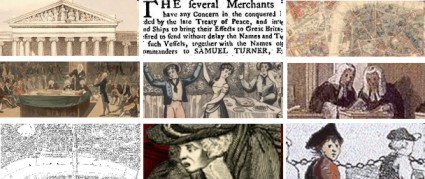
All of which is preamble to the launch of Connected Histories, a resource which bringing together a number of important digital resources relating to the study of early modern and nineteeth century Britain, under a single federated search system. ‘Federated’ simply means that several subject-related databases have been brought together to form, in effect, one super-database, so you don’t have to search in several different places, but instead just the one. Bringing these databases together allows you to conduct sophisticated searches that couldn’t be achieved singly, and simply to discover more, and more quickly.

Connected Histories bringings together eleven digital resources, two of which have been previously reviewed by the Bioscope. Not all cover our period, but some complement it, and all are well worth exploring anyway:

British History Online
The digital library of primary and secondary sources for the history of Britain, from the Middle Ages to c.1900.

British Museum Images
The collection provides searchable access to almost 100,000 images, relating to early modern and 19th-century Britain.

British Newspapers, 1600-1900
The most comprehensive digital historic British newspaper archive in existence, with 3 million pages of historic newspapers, newsbooks and ephemera from national and regional papers.

Charles Booth Archive
The online archive provides access to guides, digitised images and maps from the Booth archive collections at the London School of Economics and Political Science and the University of London Library. (This is Booth’s famous survey into life and labour in London, dating from 1886 to 1903)

Clergy of the Church of England Database 1540-1835
A database containing details of the careers of more than 130,000 clergymen of the Church of England between 1540 and 1835, from over 50 archives in England and Wales.

House of Commons Parliamentary Papers
The Parliamentary Papers gives access to page images and searchable full text for over 200,000 House of Commons sessional papers and supplementary information from 1688 onwards.

John Johnson Collection of Printed Ephemera
The collection provides access to more than 67,000 scanned items from the Bodleian Library’s holdings documenting various aspects of everyday life in Britain from the 18th to the early 20th century.

John Strype’s Survey of London Online
This is a full-text electronic version of John Strype’s enormous two-volume survey of 1720, complete with its celebrated maps and plates, which depict the prominent buildings, street plans and ward boundaries of the late Stuart capital.

London Lives 1690-1800
London Lives provides a fully searchable edition of 240,000 manuscript pages from eight London archives and 15 datasets, giving access to 3.5 million names.

Origins.net
Origins.net offers online access to some of the richest ancestral information available. The collection searchable through Connected Histories focuses on the early modern history of London.

The Proceedings of the Old Bailey Online, 1674-1913
The Old Bailey Online contains accounts of the trials conducted at London’s central criminal court between 1674 and 1913; and also the Ordinary’s Accounts – detailed narratives of the lives and deaths of convicts executed at Tyburn, published between 1676 and 1772.

Before you get too excited, please note that some of these are subscription services or available to UK higher education users only. Those that are free to all are British History Online (80% of it), British Museum Images, Charles Booth Archive (which I strongly recommend for detailed, socially-informed maps and data on life in late-19th century London), Clergy of the Church of England Database, John Strype’s Survey of London, London Lives, and Proceedings of the Old Bailey. British Newspapers, 1600-1900 and Proceedings of the Old Bailey are the two previously reported on by the Bioscope.

So, what can you find (those of you not paying subscriptions or having subscriptions paid for you by a university). Our traditional search term of ‘kinetoscope’ brings up just the one record, from an 1895 House of Commons parliamentary paper, with the frustrating information that you can’t proceed any further without a password. ‘Bioscope’ brings up eight hits, five free for all to view from the utterly compulsive Proceedings of the Old Bailey, such as the 1911 court case of “ROBERTS, George (19, bioscope operator), unlawfully uttering counterfeit coin; possessing counterfeit coin.” (Do note that the Old Bailey records stretch into the early part of the twentieth century). Searching on ‘cinematograph’ gives us thirty-two record, again with those from the Old Bailey records (eleven) being available to all. ‘Mutoscope’ yields thirty-six (lots of joint stock company reports under Parliamentary Papers).

You get an array of searching tools (keyword, place, person, date range), with filtering by source type, resources and access (so you can limit searches to freely-available content). There are also subject guides on topics such as ‘Family History’, and the ‘History of London’, and registered users can put together collections of documents (‘connections‘) under particular topics, and so your scribe has done his bit and created an “early cinema” connection that you can explore at your leisure. Don’t say that I’m not good to you, at least some of the time.

Connected Histories has been constructed by the University of Hertfordshire, the Institute of Historical Research, University of London, and the University of Sheffield, with natural language processing, indexing and the development of the search engine were carried out by the Humanities Research Institute (University of Sheffield). This is the first phase; in September of this year they will be adding 65,000 19th-century books from the British Library (which I imagine will be free to all); 23,000 19th-century pamphlets from JSTOR (a subscription-only digital store); Documents Online from The National Archives; data from People in Place: Families, Households, and Housing in London, 1550-1720 from British History Online; and History of Parliament Online. They are on the lookout for additional resources, though whether they will be able to extend their reach beyond the nineteenth into the twentieth century is not stated (such are the challenges that British copyright law presents).

A video introduction to Connected Histories

So, though Connected Histories is of mostly going to be of most value to those in our field interested in the origins and earliest years of film, it is a significant indicator of the ways things are going. Institutions and individual databases are becoming things of the past. Concatenations of datasets and federated search systems are going to take over. It’s the globalization of knowledge.

Canadiana

Detail from photograph showing Inuit man looking through a film camera in 1929, from the Library and Archives Canada collection

The Canadiana Discovery Portal is a new service (still in beta mode) that aims to be a ‘one-stop-shop’ (the dream of all administrators and information specialists) for seaching Canadian history. It brings together 60 million pages of information from fourteen institutions: Alouette Canada, Bibliothèque et Archives nationales du Québec, Calgary Public Library, Canadiana.org, Foreign Affairs & International Trade Canada, Library and Archives Canada, Manitobia, Memorial University Digital Archives Initiative, The National Gallery of Canada, Queen’s University, Scholars Portal/University of Toronto, Simon Fraser University, Toronto Public Library, University of Alberta, University of British Columbia, University of Saskatchewan and Vancouver Public Library.

All of these records point to actual digital objects, and on first inspection this looks like the complete digital library for Canada. A second look tells us that this is not quite the case, since some of the those libraries have only provided access to selected items from their digital collections (so Library and Archives Canada has contributed “part of their MIKAN collection, a wide-ranging repository of Canadian images, covering many aspects of Canadian life between 1850 and 1950”). But others have been more comprehensive, and in any case much more content promised in the future. So the result is much like the European Union’s Europeana (recently reviewed by the Bioscope), a portal to digital content accessible on the sites of individual institutions, selectively but handily made available through the one portal. The records on the portal itself are brief, with links taking you to the descriptions and the digial objects themselves on the sites of the contributing organisations.

Children going to Allen Theatre, Edmonton, Alberta in 1922 to see Penrod, from Glenbow Museum

OK, so we know what we’re dealing – now is it any use for researching our subject of silent films? The answer is yes, though the records available so far aren’t quite as extensive as might have been hoped. Searching for our usual test term of ‘kinetoscope’ brings up a measly two results – and that for the same book appearing twice. Trying ‘cinematograph’ yields 36 results, ‘cinema’ gives us 545 (narrowed down to 24 for a date range 1900-1930), ‘motion picture’ provides a more productive 95 (1899-1930 date range). Searches can also be refined by medium and contributor, and sorted by date and relevance.

And yet what you can find there is frequently fascinating, because you are being pointed to such a variety of original documents: books, official papers, photographs, letters, magazine articles, scores, video files and more (mainstream newspapers do not seem to be included). Some quick searches three up a letter from a Canadian soldier based in France in 1917 writing home to his mother to say he is about to see a Chaplin film and The Battle of the Somme; edition no. 1 of of Le panorama: le seul magazine en langue française consacré aux vues animées from 1919; an account of an 1899 screening before 600 doctors in Paris of a film of an abdominal hysterectomy made by Eugène-Louis Doyen, from the journal Maritime Medical News; and a marvellous set of photographs from Glenbow Museum of cinemas in Edmonton in the early 1920s showing how they promoted various films (such as Douglas Fairbanks in The Three Musketeers) (search under ‘motion picture’ and Alouette Canada collection).

Group of cameramen outside the Canadian Government Motion Picture Bureau, Ottawa, in 1923, from the Libraries and Archives Canada collection

It should be noted that some of the digital resources, particularly books contributed by the University of Toronto, are not accessible to general readers but only to Canadian users from higher education institutions.

Anyway, this is a very helpful route in to some rich Canadian resources. Go explore.

P.S. The Bioscope has previously covered other, film-specific Canadian resources. Here are the links:

Europeana

Europeana is one of those inestimably worthy, pan-European projects that the European Union funds handsomely, that some people get terribly idealistic about, and you wonder just how many people actually use. Launched in 2008, it is a multi-lingual portal to the digital resources of some 1,500 European museums, libraries, archives and audio-visual collections, among them the British Library, the Louvre and the Rijksmuseum. There are some 14.6 million items described and accessible on its site, which certainly makes for an exceptional collection. However, it is a portal, which means that all of this stuff is available elsewhere (i.e. on the websites of the contributing institutions), and Europeana depends on its success for the usefulness of having all this content in the one place and the degree to which researchers will identify with a Europe-wide culture and want to find content across its borders and languages.

Whether you think in a European kind of way, Europeana is undoubtedly hugely useful in bringing together such a cornucopia of content. It is simply and sensibly presented and records are meticulously described. Each record gives you the essential information on the chosen object (including in most case a thumbnail image, some of surprisingly poor quality), then provides you with a link to the object on the contributing institution’s website. The research will find paintings, drawings, maps, photos, pictures of museum objects, books, newspapers, letters, diaries, archival papers, cylinders, tapes, discs, radio broadcasts, films, newsreels and television broadcasts. Most are available for free (you do come across some paid access entries, mostly for Scotalnd’s SCRAN site). It is certainly something to explore.

Europeana search results page for ‘bioscope’

So, what will we find for the study of silent films? Our usual test search term of “kinetoscope” doesn’t yield too much, but type in “silent film” and you get 91 records (note that this will currently only bring up the English language records). Most of these are either photographs (particularly of cinemas, deriving for the UK resource Culture Grid) or a range of early films (mostly actualities) that derive from filmarchives online. Searchin under “cinematograph” brings up 37 records: among them photographs of cameras, postcards, posters and flyers, while “charlie chaplin” brings up 128 records: 3 texts, 100 images, 16 videos (mostly French TV programmes from INA) and 9 sound recordings (the latter all in French).

Other search terms worth pursuing include “bioscope” (26 results), “kinema” (33), “stumfilm” (62), “stummfilm” (110), “gaumont” (261) and “kino” (4,853). It is certainly worth knowing the common terms for film subjects in other languages (a tip is to check the keywords under item you’ve stumbled upon to find more of the same), though Europeana is working on solutions to provide true multilingual access through association of search terms (so you might type in “silent film” and get results from “stummfilm” as well). Among the surprises I have found are French First World War film posters from the Imperial War Museum (via the VADS visual resource site), a number of photographs of German silent films from Deutsche Fotothek, photographs of early cine cameras from the Norwegian DigitaltMuseum, and a terrific set of photographs of cinemas past in Leeds from Leodis.net.

Worth noting is that Europeana is to be the outlet for a three-year project, the European Film Gateway, which in 2011 will deliver its own portal to 700,000 digital objects including films, photos, posters, drawings and text documents from 21 archives across 15 countries. More on that initiative when the time comes.

Kinemacolor projector held by the Norsk Teknisk Museum, available via Norway’s Digitalt Museum and Europeana

Searching on Europeana is a somewhat haphazard experience. Because it is a compilation of the greatest hits of other institutions and resources, one does not go there to conduct comprehensive research but instead to wander round almost at random and see what catches the eye. The real fascination then comes in seeing where the digital object comes from and pursuing that source for more information. This is of course what a portal is supposed to do, and so Europeana performs its basic task very well. More and more content is being poured into it, and it certainly provides a far more useful function than the much-lauded and so far very disappointing World Digital Library. All of our libraries are trying earnestly to turn themselves into digital libraries, an inevitable consequence of which is that more and more content gets shared through linkages and common search platforms, raising the profile of major initatives like Europeana while relegating the individual library to a subsidiary role. It’s going to be hard for the individual institution to retain its identity in our bright new digital future. For the researcher, meanwhile, the assumption is that more access is better, and the easier the better. That’s not necessarily the case (research isn’t research if it’s easy), but there’s certainly no excuse now for any of us not to be discovering more.

The Bioscope will be doing its bit for individual institutions over pan-national behemoths by writing about some of the contributors to Europeana over the next few weeks.

The colonial gaze

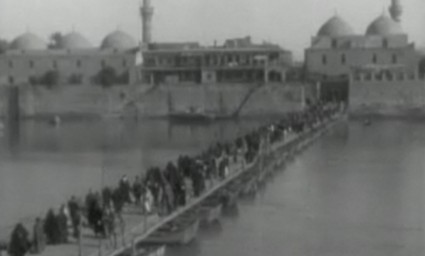
Baghdad (1928), made by British Instructional Films, from http://colonialfilm.org.uk

Colonial Film: Moving Images of the British Empire is a newly-published website supplying information on films about the British colonies. How quaint that sounds. But for a large part of the twentieth-century (and therefore for a large part of the time that there have been motion picture films) the British Empire and its aftermath was assiduously documented on film, dramatised on film, and film traffic between the colonies was much debated and legislated over.

The result is a substantial archive of film about the Empire that is no more which has become a rich source for socio-politcal historians as well as film historians with an interest beyond the familiar. It was to serve such an audience that the Colonial Film project was established, funded by the Arts and Humanities Research Council and organised by Birkbeck College and University College London in partnership with three film archives: the BFI National Archive, the Imperial War Museum, and the British Empire and Commonwealth Museum.

The chief result of this three-year project is the website, at the heart of which is a database of some 6,000 colonial films, taken from the records of the three archives. A lot of these records are available elsewhere i.e. on the databases of the BFI and the IWM, but there is obviously some convenience in bringing them together under this particular subject. The project researchers have added a great deal of background information for some the films, beyond the shotlists that the archives previously produced (some of them typed by these very fingers, a number of moons ago), including ‘context’ and ‘analysis’ sections, which put the films in a modern perspective. The project has also digitised and made available online some 150 titles.

The Stoll Film Company’s Nionga (1925)

The films catalogued range in date from Arrivée d’un train à Melbourne (1896) to RAF Gibraltar Flight Safety Commercials (2005). Our interest, as always, is in the silent film material, and of those 6,000 around 750 are from the silent era, and 32 are available to view online. The films described included actualities, newsreels, drama-documentaries, travelogues, industrial films and fiction films, all evidence of the abiding interest the Empire had for British filmmakers and (to a degree) British audiences.

What I want to highlight here are the films that are available to view, because they are fine collection in themselves. The site comes with some impressive searching tools, including an interactive map of the world for searching by country, and searching by theme (“Empire and Administration, Empire and Development, Empire and Education, Empire and Health, Empire and Independence …”), production company, genre and event. The advanced search option lets you select by date range and narrow searches down to films you can view, so select 1896-1929 and tick the box that says “show only works with videos” and there you are.

Among the treasures to view are three silent feature films, examples of the remarkable (and curiously British) mini-genre of dramas set in far-flung lands (usually Africa) featuring native performers. There is Palaver: A Romance of Northern Nigeria (1928), made by Geoffrey Barkas for British Instructional Films (“Filmed amongst the Sura and Angas people of the Bauchi Plateau in Northern Nigeria, where the rivalry between a British District Officer and a tin miner leads to war”); the Stoll Film Company’s Nionga (1925) (“Nionga, a chieftain’s daughter, is induced by a vindictive witch-doctor to persuade her betrothed lover, Kasari, to plot the destruction of a neighbouring tribe”), for which the filmmaker is not known; and Stampede (1930), made by the adventurers Majour Court Treatt and his wife Stella, filmed in the Sudan (“The film tells the story of Boru, adopted into the ‘Habbania’ tribe after his mother is killed by a lion, who grows up with the Sheikh’s son, Nikitu”).

One watches these curious mixtures of travelogue, ethnography and melodrama with both fascination and bemusement, the latter because to is hard to see how they were ever viewed as commercial propositions. The films attempt to be liberating in how they tell stories of African life with African performers, but the colonialist attitude is revealed in patronising titles, the portrayal of Africans as impressionable and child-like, and the choice presented of good (because paternalist) and bad (because they lead Africans astray) whites in Palaver. Nionga has an all-African cast and so offers the opportunity for a fresh point of view, but titles promising a drama of “a crude life of simple people” and “a glimpse into the minds of Savages” demonstrate that the film is constructed entirely from a Western White point of view. Stampede (which has a music track and commentary) was made by travel filmmakers who added a fictionalised element because it was the only way for them to produce a commercial film. In the end one watches these films not for the dramas imposed upon the performers but for the incidental details of African life that the dramas cannot entirely obscure.

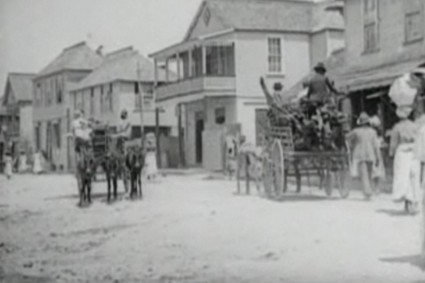
Montego Bay to Williamsfield, Jamaica (1913)

There are other short fiction films: the resoundingly gung-ho How a British Bulldog Saved the Union Jack (1906) and Edison’s drama of the Indian ‘Mutiny’, The Relief of Lucknow (1912). Among the non-fiction films and such gems as the Charles Urban Trading COmpany’s A Trip through British North Borneo (1907); British Instructional Film’s engrossing West Africa Calling (1927); another BIF travelogue of particular interest today, Baghdad (1928); Gaumont’s spectacular record of the 1911 Delhi Durbar ceremonies marking the coronation of King George V; and another Charles Urban production, the Kineto company’s Montego Bay to Williamsfield, Jamaica (1913), a subject apparently filmed in both Kinemacolor and monochrome (alas, only the monochrome survives).

This is an impressive resource, though some are going to find it frustrating to be faced with so many catalogue descriptions that aren’t accompanied by the films themselves. Other might find the contextualisation are little heavy on the political correctness, anxious that we should only interpret these films in the correct way. Ultimately most are not going to be interested in the lessons – either those imparted by the original colonialist filmmakers, or those deduced by modern commentators from a post-colonial point of view. It’s what we are allowed to see of the people, the landscapes, the industries, the townscapes that lingers in the mind. The camera came to observe and report back, but what endures are the individuality and dignity of its subjects and the difference of their cultural milieu. The camera ultimately serves them.

Go explore.

AFI Catalog Silent Film database

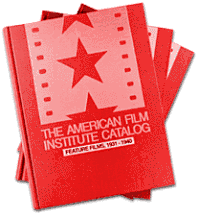
We are still ploughing our way through online catalogues and databases for silent film. Next up is the AFI Catalog Silent Film database. The American Film Institute Catalog of Feature Films is a series of catalogues that document the American film. The project began in the late 1960s, with the printed volumes covering decades (with a couple of exceptions), starting with 1921-1930, published in 1971. Subsequently the AFI issued volumes for 1961-1970 (in 1976), 1911-1920 (1988), 1931-1940 (1993), 1893-1910 (1995), 1941-1950 (1997) and Within Our Gates: Ethnicity in American Feature Films, 1911-1960 (1997). Publication of further printed volumes has now stopped (it was just too expensive), and all subsequent records (for the 1950s and some of the 1970s, with a few star titles from the 2000s) have been added to the online version of the catalogue.

The Catalog is a stupendous achievement, one where the AFI’s team got better as they went along, so the volumes for the 1930s and 40s are extraordinarily rich in the detail they provide. The earlier volumes were less thorough in their cataloguing, and the 1960s volume is unusual in that it includes all films released in the USA as opposed to produced in the USA, on account of the large number of co-productions. In 1997 the online edition was published, with the inestimable advantage of bringing all of the titles (some 50,000 of them) into one place. The full database is normally accessible to AFI members only or through the paid service ProQuest, but currently the entire catalogue is open to all. Use it while you can. However, from the outset the AFI decided to make a portion of the database freely available, namely the 25,000 films originally covered by the three volumes for the silent period 1893-1930, and will presumably continue to do so. And’s that’s what we’ll cover here.

The information is uneven because the original volumes are uneven. The 1921-1930 volume, first in the series, covers feature films only – that is, films of four reels or 4,000 feet in length or 40 minutes long (to use the AFI’s own definition). The 1893-1910 volume covers the pre-feature film era and includes every kind of film, fiction and non-fiction. The 1911-1920 volume follows the 1920s volume in concentrating on feature films, so there are no short films despite their high level of production at this time. For example, if you search under ‘Charlie Chaplin’ for the teens you will only get Tillie’s Punctured Romance, Carmen and the compilation films in which he appeared (the absence of Shoulder Arms is a puzzle, however).

Theere is a simple search option (which nevertheless lets you filter requests by title, personal name, character name, genre, summary and others) and a thorough advanced search option. The records give cast, role, credits, release date, duration in feet and reels, physical properties, genre terms and subject terms – all of which are hyperlinked for cross-searching with other records, so you can discover, for instance, how many 7-reel films were produced (3,409), how many films starred Richard Barthelmess (57), how many films featured dogs (457), and how many horror films were made (just 10 for the silent period). There is a plot summary, notes, bibiliographical sources, and information on availability on DVD and VHS (possibly not completely up-to-date, especially since Laserdisc availability is also given). When you first come to a record, do note that you only get partial details at first, and you need to click on Display Movie Detail to see the full details.

The 1893-1910 records do not offer so much detail, taken as they are from copyright records for the most part, often with little more information available than title, production company and date. Some records from this period are fuller, but they seldom have cast details, and plot summaries are rare. It should also be noted that access for some titles from the 1893-1910 period is restricted to AFI members if you use the silent film database, but are available if you search through the unified catalogue, which as we’ve said is currently open to all – but won’t stay that way.

Also to be noted is that films for African-American audiences which were not always covered in great detail in the 1920s volume are given in greater detail here, benefitting from the boom in research in the area in recent years and the publication of the Ethnicity in American Feature Films, 1911-1960 volume of the AFI Catalog, whose relevant records have been added to the silent film database. Finally, do note that not only are short films missing from 1911 onwards, but that the AFI has not included newsreels or magazine series. They are promised for one day, but as always they have been left til last.

And so as we move well into the seventh week of Catalogue Month, the AFI Catalog has been added to the growing list of resources included in the Catalogues and Databases section of the Bioscope Library. Though it is highly pleasurable to handle the printed volumes themselves, which are handsome, weighty productions, nothing can beat the convenience or cross-linking of the online version. The AFI Catalog does aim to be definitive, though some titles are known to be missing, and there are inevitable small errors in credits and descriptions. Also, and disappointingly, the notorious fake record that the AFI included in the teens volume, for a feature film of bizarre plot and ludicrously named actors, entitled Marooned Souls, is not given on the online version. The intention was supposedly to catch out those who might copy out its records wholesale, but beyond wanting to catching out plagiarists I think they just did it for fun.

Spinning the Spirograph

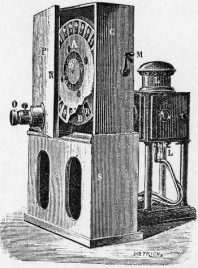
A Spirograph with disc in position, from http://www.westlicht-auction.com

We all know about having motion pictures in disc form. DVD and increasingly Blu-Ray are the domestic formats of choice, and we all understand that films need not appear as strips of film. What is not generally known is that there is nothing new about films in disc form, indeed that films could be found in this form from the earliest years of cinema – indeed the disc form precedes the motion picture film. The recent appearance online (40MB) of a catalogue for the most significant of the film disc formats before DVD – the Spirograph – is the spur for this quick history of the format.

Before there were films there were motion pictures in disc or in circular form. A number of the optical toys and motion picture devices of the nineteenth century involved sequences of images arranged around a disc, with some form of intermittency to enable the viewer to experience the illusion of movement. They included the Phenakistoscope (figures on a disc with slotted edges, effect illustrated here from MOMI), the Zoetrope (sequential images aranged around the inside of a drum with slit holes) and Eadweard Muybridge’s Zoöpraxiscope, which projected images in motion arranged around the edge of a glass disc.

When inventors first began combining the principles of such optical devices with photography, again some looked to discs to provide the solution, particularly if they were reproducing brief sequences (i.e. brief enough to fit within one rotation of the disc. In 1884 John Rudge patented a device which exhibited seven sequential lantern slides of posed photographs (so not motion truly captured by photography) arranged in a circle. The 1887 Tachyscope of Ottomar Anschütz exhibited a disk of twenty-four glass 9×12 cm diapositives turned by a crank. In 1892 Georges Demenÿ took sequential photographic images on celluloid film which were transferred to a glass disc and projected by means of his Phonoscope device (also known as a Bioscope, above). The sequences, of which a man mouthing the words ‘Je vous aime’ is the most famous, were fleeting, but they were motion pictures derived from photographs.

The problem with the use of glass discs was the brevity of the motion sequences. However, before he introduced his successful motion picture system utilising 35mm film strips, Thomas Edison had instructed his engineers to produce a viewing system which arranged celluloid images in micro-form around a cylinder. This wasn’t just being circular for circularity’s sake – the idea was to match motion pictures to devices for the playback of sounds (in this case, Edison’s Phonograph), and early motion picture efforts at creating a disc-based system were clearly driven by a belief that emulating the gramophone disc was the route to creating a successful device for home use.

Kammatograph, from http://www.victorian-cinema.net

It is often forgotten that many of the first motion picture producers saw the domestic market as being their route to riches. This made sense. The Eastman Kodak had put still photography in the hands of anyone; surely the same would occur for motion photography. It was a market that would remain elusive until the introduction (by Eastman) of 16mm film in 1923, but among the various attempts to crack the amateur market were disc-based systems, which offered a simpler, safer option to cameras and projectors using inflammable film.

Among the first and most significant of these was the Kammatograph. Invented in 1898 and marketed from 1900 by Leonard Ulrich Kamm, a Bavarian-born, London-based engineer, the Kammatograph utilised a 12-inch circular glass plate with notched edges caught by gearing with provided the necessary intermittency. There were 350 or 550 sequential images on the disc, arranged in a spiral, giving 30 or 45 seconds running time. It was aimed at the amateur market, and with those lengths of ‘film’ the idea must have been to encourage the filming of portrait shots, akin to snapshots. Not that much is known about the actual use of the Kammatograph, but two of the most prominent users of the device were not ordinary members of the public. William Norman Lascelles Davidson used a Kammatograph for his 1901 experiments on colour cinematography, while Rina Scott (Mrs D.H. Scott) was a botanist who used a customed Kammatograph to make time-lapse films of plant growth.

Theodore Brown with his invention, the Spirograph

There were other disc-based systems at this time, often developed as toys for children, among them Cinéphot developed by Clermont-Huet in 1904 and the Animatograph of Alexander Victor in 1909. However the great name is the pre-DVD history of disc-based cinema is the Spirograph. Its history is one of what-might-have-been, and it has of late become an almost cultish subject for those interested in forward-thinking technologies that nevertheless failed to succeed commercially.

The Spirograph was the creation of British inventor Theodore Brown (his wife Bessie was co-patentee) in 1907. It followed the basic idea behind the Kammatograph in presenting motion pictures in the form of miniaturised images arranged on a disc – though Brown’s original idea was to have the images arranged concentrically (he was thinking of very brief sequences and aiming for the toy market), and was tending towards using celluloid rather than glass. However his patent stated that the images could be arranged concentrically or spirally. Brown took the idea to documentary producer Charles Urban, who purchased the patent outright from Brown (supposedly for the hefty sum of $18,000, or £3,600). Urban did not work on the idea immediately, and indeed it was in need of considerable development work before it could be brought to market on the scale that Urban envisaged.

During the First World War, Urban put his engineer Henry Joy onto the task. The images were now arranged in a spiral, the results looking remarkably close to Victor’s earlier Animatograph. The first commercial version was due to appear in the USA in 1917, under the name of the Spiragraph [sic], and then the Homovie. There was no camera planned for sale, only a projector. But a hoped for $1,000,000 flotation of the Urban Spiragraph Corporation was a failure, and further work was held off until after the war.

Spirograph disc and the disc in its sleeve, c.1924, from http://www.spiracollection.com

Urban attempted to re-introduce the re-named Spirograph through his post-war American business Urban Motion Picture Industries, located at Irvington-on-Hudson. The Spirograph in its final form was designed for simplicity of use, being a compact box on a small plinth, operated by a handle, with the exposed disc mounted on the front. The 10½ inch disc was made of safety (i.e. non-flammable) celluloid film, and carried 1,200 frames in a spiral of twelve rows, each frame being 0.22 inches x 0.16 inches. These were miniaturised via a microscopic device from standard 35mm films in the Urban library (using original films between 85 and 100 feet in length, or no more than one-and-a-half minutes long). The Spirograph could project an image four feet wide at a distance of twenty-five feet. It was hand-cranked, with an electrical lamp, and users could halt the disc at any point for illustrative purposes. It was a liberating technology, devised with the teacher in mind – portable, flexible, affordable (the price was to have been $125 per machine and $1.00 per disc), easy to use and useful, except that the films themselves were so short. You can only get so many physical images on a disc. And that probably spelled the Spirograph’s doom

Urban’s intention was to make a huge impact on the burgeoning educational market. While his initial target in 1917 seems to have the home user, now he saw schools, clubs and libraries as his main audience, and he devised imaginative subscription schemes for the hire and return of discs. Urban’s extensive library of non-fiction films stretching back to 1903 would supply the content, thereby finding a new outlet for films that had otherwise ceased to have a commercial value. By the end of 1922 a substantial library of discs was prepared, described in lavish catalogues, with 4,000 Spirographs ready for shipment [update: it is very unlikely that there were actually 4,000 Spirographs made], and a major publicity programme in readiness. But it never happened. Urban’s business overall hit the rocks in 1923 – a simple case of trying to do too much with too little money behind him – and Urban Motion Picture Industries went into receivership in 1924. The Spirograph never made it into the thousands of schools, clubs, halls and homes that Urban dreamt of, and 16mm film (introduced in that fateful year of 1923) gave the target audience a technology that was just as safe and could provide longer films. The Spirograph could be spun no more.

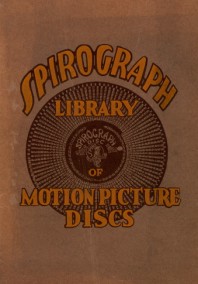
However, that wasn’t quite the end of the Spirograph. The appearance online at the Bibliothèque numérique du cinéma of a 1928 catalogue of Spirograph discs (40MB) shows that the Spirograph did have some sort of commercial life. After the collapse of Urban Motion Picture Industries in 1924 various parts of the Urban empire were picked up by a number of companies, some created for the purpose, among them the Spiro Film Corporation. Little is known about the New York-based company except the obvious source of its name, but clearly it was catering for a market which already had its Spirograph players, since the catalogue makes no mention of how to obtain these, instead restricting itself to listing and describing the 400 discs in the Spirograph collection under such headings as Science, Literature, Government, Physical Activities and Our Government. Theodore Brown himself picked up on residual rights in the Spirograph to market the device in the UK after 1924, but neither he nor Spiro made any success of a technology whose time had passed before it even had a chance to get going.

So the Spirograph Library of Motion Picture Discs (1928) goes into the Bioscope Library’s Catalogues and databases section as part of Catalogue month (which has now crept inexorably into September). The Spirograph is a fascinating technology, not just for its ingenuity but for its potential based around the needs of those outside the commercial exhibition sector. It put the individual user first. Film history, indeed technological history overall, is filled with blind alleys. Looking back on failed systems and collapsing businesses we can see different ways in which things might have gone, and contemplate an alternative cinema history. Instead it took until the 1980s for films to return to disc form for the domestic market (Laser Discs) and the mid-1990s for DVD to gain widespread acceptance among people at large, not because they wanted to be educated but because they wanted to be entertained. And the films were longer.

Finding out more

  • Stephen Herbert’s Theodore Brown’s Magic Pictures is a beautifully-illustrated biography of the Spirograph’s multi-talented inventor
  • On Charles Urban’s Irvington-on-Hudson venure, including the fateful development of the Spirograph, see my Charles Urban website
  • Close-up images of a Spirograph and disc are available on the Spira Collection site (no connection with Spirograph itself – it is the collection of George Spira)
  • A illustrated list of glass and disc-based motion picture systems is given on the very useful One Hundred Years of Film Sizes site (though the dates given for the Spirograph are incorrect)
  • In 2003 a George Eastman House restoration of a Spirograph disc entitled Man’s Best Friends (i.e. dogs) was presented (on the big screen in 35mm!) at the Pordenone Silent Film Festival (the catalogue date of c.1913 is incorrect – the disc would be c.1921-22)

The London Project

Next up for Catalogue Month (our survey of online catalogues and databases, selected for inscription in the Bioscope Library) is The London Project. I did write about this in the very early days of the Bioscope, in a very cursory manner, and it is high time that we returned to it. It’s a work I know quite a bit about, since I produced half of it, and it’s something of which I’m quite proud, even if the database has become a little compromised since the time when it was published in 2005, because it has not been possible to update it since. Databases should never be allowed to stand still. It is contrary to their nature.

The London Project database documents the film venues and film businesses to be found in London during the period 1896-1914 – around 1,000 venues and 1,000 businesses all told. It was the major output of a year-long project (2004-05) sponsored by the AHRB Centre for British Film and Television Studies, hosted by Birkbeck, University of London, and managed by Professor Ian Christie. The two researchers were Simon Brown (working on film businesses) and myself (working on cinemas and audiences). As well as the database we produced several essays, conference presentations and a touring exhibition (‘Moving Pictures Come to London’). But the star of the show was the database.

Interior view of Hale’s Tours (a film show set inside a mock train carriage) on London’s Oxford Street, which first opened May 1906

The London Project documents film businesses in London 1896-1914 and film venues (a more inclusive term than cinemas) from the date of the first identifiable cinema in London (The Daily Bioscope, opened May 1906), again to the start of the First World War. The information is taken from a wide range of sources, including film and stage year books, film trade papers, street and business directories, the records of the London County Council, local newspapers, published and unpublished memoirs, police reports and company records. The database allows searching by name of venue or business, address, London borough (as they were pre-1914), by business type (e.g. production, distribution, production, exhibition, venue), and by person (including notes relating to people).

A typical film business record will give you name, address (and any secondary addresses), category and tp of business, original share capital, trading information, the names of directors, and sources. Names and sources are hyperlinked to other records, making the pursuit of such links a fascinating business as you discover that, say, Cecil Hepworth was not only the managing director of the Hepworth Manfacturing Company, but a director of Film Agency (Russia) Ltd. You find all sorts of unexpected additional business interests and alliances in these lists of directors, especially as we chosen to interpret the film business quite broadly and to include equipment manufacturers, cinema uniform suppliers, electrical engineers, vending machine suppliers, musical instrument suppliers, and so on, reflecting the larger picture of what the cinema business really was (as indicated by the lists of such companies provided by the film trade year books of the period).

Film venues covers every sort of entertainment place in London which showed film on a regular basis betwen 1906 and 1914. That means cinemas, of course, but also theatres, music halls, town halls, sports arenas, converted shops, public baths and amusement parlours. The records are not as extensive as those for businesses (more’s the pity) but they do give you name, address, audience capacity, notes, related businesses and people, and sources of information. So it is possible to trace every cinema managed by Montagu Pyke or by Electric Theatres (1908) Ltd, or to pursue every film show surveyed by the Metropolitan Police in 1909 at a time of social alarm at these new dens of vice which allowed the young of either sex to mix unchaperoned in the dark.

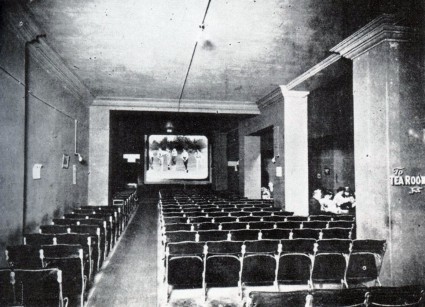
The Bioscopic Team Rooms, aka The Circle in the Square, the first true cinema in Leicester Square, opened June 1909

One feature we were particularly pleased with is the map of London boroughs, which allows you to search for businesses and venues in say Chelsea, Wandsworth, Lambeth or Poplar. It was an important part of the project that we were able to connect cinema history to social history and in particular to the many other histories of London. Geographical data is a good way of helping to achieve this, though we had neither the time nor the resources to take this further and use GIS data or mapping software.

Indeed there is much about the database that could do with an update, as new information has come in and there are plenty of corrections that need to be made. And if only we could have added pictures. But the project money ended in 2005 and it has not been possible to add to the database since. It is hosted by Birkbeck, and I hope that the university continues to do so and to maintain the URLs as they are – each individual business and venue has a unique web address with its ID number included in the URL, essential for citation and future reference.

If you want to pursue the project’s work further and look at what we wrote, four of our essays are freely available online (at present):

The London Project website itself has background information on the project and on the London of the 1896-1914 period. The database is a freely-available resource, and even if the website is not being updated there is still an email address on the site to which you can send fresh information. It’s being collected, somewhere, and maybe one day a fresher, more extensive London Project database will emerge, one that might even go beyond 1914 or beyond the confines of London. We can but hope.

Filmportal

We return to Catalogue Month, during which the Bioscope is highlighting freely available filmographic catalogues and databases for silent film, while entering them into the new Catalogues and databases section of the Bioscope Library. Next up is the first electronic database to be listed, though it is a resource that we have cited several times in previous posts as among the most useful and reliable out there. The database is the Deutsche Filminstitut’s Filmportal, an encyclopaedic database of information on German cinema.

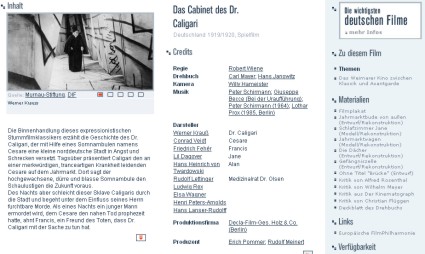
Filmportal documents some 73,500 German fiction films from 1895 to the present day, and is effectively the German national filmography. 7,000 of those records go into great detail, with synopses, reviews, posters and other illustrative material, photographs etc, but even the most basic records list title, cast, credits, and release information, taken from primary sources. There are also 165,000 names, 3,000 of which come with detailed biographies, and names and titles are extensively hyperlinked, making Filmportal eminently, indeed compulsively, browsable. It is also bi-lingual – the site’s primary language is German, of course, but all introductory and explanatory material is also available in English, with further English content promised for the future.

Page from Filmportal for Das Cabinet des Dr. Caligari

Searching is by a small search box on the front page, with an advanced option simply letting you search by title, person, role name, content, or freetext. This is very useful in itself, but it is a little disappointing not to have a more comprehensive advanced search offering allowing one to select across time periods, or by combining search terms. It isn’t possible, for example, to determine how many silent films it covers, or even simply to search across the period 1895-1930. Nor does there seem to be a year-search option. To get the best out of Filmportal you just have to start with a simple enquiry, and then explore laterally by utilising the very impressive cross-linking.

These are minor quibbles. In general Filmportal is rigorous, thorough and usefully set out (look out for the red arrow symbols which indicate further information for any one record). It doesn’t name its filmographic sources (except by inference when one is given a review reference or censorship record) but it exudes an air of accuracy and authority. It goes back as far as the first German film production of Max Skladanowsky, and as well as adding information on new German releases it keeps up a fresh feel by presenting new material on the front page and ever-changing features such as Director of the Week. It has a topics section which covers aspects of German film history in depth (and in English too), of which the section on Weimar cinema is going to be of greatest value to silent film afficionados.

There’s more besides, including a multimedia section with trailers, rare film clips, and exclusive audio and video materials to its features, plus an English-language edition of the Deutsche Welle-TV programme Kino (unfortunately not word-searchable). Filmportal does an excellent job in promoting German film and an equally excellent job of making German film enticingly researchable. Go explore.

Catalogues commerciaux

We have mentioned the large number of cinema-related catalogues that have been digitised by the Cinémathèque française for its online digital library, Bibliothèque numérique du cinéma. Some of these we will go on to describe in detail, but for ease of reference here’s a complete list of all the commerical catalogues. Not all are from the silent era (though most are), and the majority are equipment catalogues, covering cameras, projectors, electrical supply, lighting, fire protection, cinemas seats etc. Notable firms mentioned include Gaumont, Pathé frères, Paul, Urban, Edison, Tyler and Williamson. Many of the catalogues come from the collection of Will Day, whose exceptional collection of films, publications and documentation relating to early film was acquired by the Cinémathèque and comprises one of the most substantial collections devoted to early film anywhere. A number of the catalogues relate to Day’s own film equipment supply business.

All of the links are to the digitised documents, which are in PDF form, downloadable and fully word-searchable.

Paul’s Animatograph Works

And the good things just keep on coming. A while ago the Bioscope wrote about the Cinémathèque française’s Bibliothèque numérique du cinéma, a collection of digitised books on early cinema and pre-cinema. We are slowly making our way through these to put some of them in the Bioscope Library, but now many extra titles have been added by the Cinémathèque’s distinguished historian Laurent Mannoni which demand special attention. They include film catalogues, equipment catalogues and programmes. There are 170 documents all told.

The first of these that we’re going to highlight is something quite special – a 1903 catalogue for Paul’s Animatograph Works. It is a catalogue covering the films and equipment sold by one of the leading British film producers of the period, and it is an absolute treasure trove.

The catalogue is fifty-one pages long, and it begins with an introduction to the company and its founder, Robert W. Paul. There is a short company history and photographs of the offices, laboratories, studio, dark rooms, drying rooms and more. There are details of the services provided by the company, then a special feature on their star offering, the Animatograph projector. Other equipment described includes arc lamps, lenses, limelight jets, perforators and of course cameras, with prices given.

Then come the films. These are described in some detail, and most come with frame stills, plus details of length, price and telegraph code for ordering. The catalogues includes such gems as The Automatic Machine; or, What a Surprise!, Garters versus Braces; or, Algy in a Fix and Thrilling Fight on a Scaffold:

BRICKLAYERS, labourers and carpenters are seen busily engaged on different portions of the building of PAUL’S ANIMATOGRAPH WORKS. On a high scaffold, two men are carrying hods of mortar. A quarrel arises between them, and, throwing down their hods, they fight their way along the scaffold until they reach the portion nearest the spectator. The struggle goes on until one of the two throws his mate, who falls with a fearful crash, about 30 feet to the ground. As he lies helpless, his faithful dog runs towards him, and his mates hurry up from all directions, some sliding down the poles. On examination, he proves to be seriously injured, and is only able to rise slightly. His mates help him on to a stretcher and carry him off. A thoroughly exciting picture, well appreciated by country audiences. Code word—Scaffold. Length 100 feet. Price 75s.

Now that’s product placement. Other films described include the recruiting series Army Life, a series of films of the Epsom Derby, music hall acts (including Fregoli, Chirgwin and David Devant), trick films, comedies, actuality subjects, Boer War films and ‘sensational films’, including The Last Days of Pompeii (all 65 feet of it). The volume is available as a 17MB word-searchable PDF, and makes available the kind of precious volume that researchers previously had to travels miles at great expense to find. Now it’s yours (for you can download it, of course) at the click of a mouse.

Pages from the 1903 Paul’s Animatograph Works catalogue, advertising Sensational Films

The Mannoni collection has more on Paul alone. There is a separate Army Life catalogue, a series of films of the West of Ireland and his main catalogue for 1906-07 (17MB), another forty-three pages covering Paul’s later films – without the equipment this time, but with ample details about the films (so many of them lost, of course, with this catalogue providing the only available descriptions), including wonderful illustrations and an index as well. It will have to be the subject of another post.

There are all too few early or silent film catalogues available online as yet, though the Mannoni collection has already changed that quite a little. We’ve championed the digitisation of books, newspapers and journals – now the call needs to go out for catalogues to follow. And to encourage this, we are going to introduce a new section in the Bioscope Library, for silent film catalogues and databases. This section will include the few digitised print catalogues that are out there, but it will also cover online databases.

So welcome to Catalogue Month. Yes, August (we’ve started a bit late so it’ll probably have to run into September for a bit too) is going to see the Bioscope publishing a series of posts that highlight catalogues and electronic databases freely available to all that will help you locate and identify silent films. We will describe how to find them (fairly obviously), what they contain, what they don’t contain, things to look out for, searching tips, and whatever else might come to mind. It won;t cover equipment catalogue, because I just can’t get that excited about cameras and projectors, sorry. As each one is described, a shortened account will go into the Bioscope Library under the new Catalogues and Databases section, so it’ll build up into a collection to treasure. I hope you are going to find it useful.