150,000

Thank you to whoever you were who just clicked on The Bioscope and chalked up the 150,000th visit!

All bloggers are obsessed with their statistics, and I can tell you that as of this minute the Bioscope has had 150,000 visits, published 644 posts, has an average of 410 visits per day (up on 149 for 2007), and thanks to Akismet has fought off 23,049 spam comments. Most successful month ever was last month (13,912 visits). Top post remains Searching for Albert Kahn, with 8,450 visits (still rising). Most referrals have come from cablecarguy.blogspot.com (thanks Joe), and the most used search terms are ‘albert kahn’, ‘bioscope’, ‘louise brooks’, ‘kinetoscope’ and ‘european film treasures’. And, just in case I get too excited, The Bioscope currently lurks at position 148,422 in the Technorati scores for blog popularity. So, still some work to do.

Onwards and upwards.

Bioscope on Bioscope

http://www.madhusudhanan.com

The Bioscope is naturally delighted to record the release of Delhi-based K.M. Madhusudhanan‘s feature film Bioscope. The film’s subject is silent film in India. Set in Kerala, it tells of Diwakaran, who in the early years of the twentieth century encounters the Bioscope (a film projector), being operated by a Frenchman. He purchases the machines and tours local villages with his films, but he is beset by problems: practical, social and familial, as modernity clashes with tradition. Madhusudhanan says that his hero is based on a real figure, Varunni Joseph, who ran a Bioscope shows in Kerala in 1907.

Bioscope received its world premiere last week. It is produced by the National Film Development Corporation Ltd., India, it’s 94mins long, and in Malayalam and Tamil, with English subtitles. The film’s website has interesting background information on early film in India and assorted production stills. This article from ExpressIndia.com describes the film and its intentions:

Reel Beginnings

A filmmaker goes in search of the first flicker of cinema in Kerala

Anushree Majumdar

Flickering on a white sheet stretched across the wall, the image of a train entering the platform emitted a collective gasp. In 1906, the unsuspecting villagers at Thrissur Pooram in Kerala, who’d bought a ticket to the bioscope show, couldn’t believe what they were seeing. Surely this was the work of the devil. Instead, it was the work of man — the advent of cinema in India. This fascination with cinema and images is what Delhi-based filmmaker K.M. Madhusudhanan has lyrically portrayed in his first feature film, suitably titled Bioscope.

The film saw its worldwide premiere at the Osian’s Cine Fan Festival of Asian and Arab Cinema last week and has been awarded the NETPAC Jury Award for “crystallising a turning point in a country’s colonial past with meditative images and a strong metaphor evocative of cinema’s magical powers”.

As an artist, photographer and filmmaker, it was only natural that Madhusudhanan strung together a historical narrative with images that would embody the wonder that is the cinematic experience. “I wanted to show the curiosity of the human gaze through the film. The appearance of the bioscope in Kerala was something that drew me even closer to the subject,” says Madhusudhanan, who spent his formative years in Kerala before moving to Vadodara to study printmaking.

Set in the first decade of the 20th century in Kerala, Bioscope traces the life of Diwakaran, whose life is completely altered after his first brush with the bioscope and moving images. He buys the device from a Frenchman who ran bioscope shows and decides to take the instrument and its wondrous images to nearby villages. But suspicion, superstition and the lack of family support make it difficult for Diwakaran to fulfil his purpose. “I started to work on a project about silent films and early cinema. My research brought me to that time in history when Kerala had its first bioscope show and I found my story emerge from there,” says Madhusudhanan who is also painting an entire series on silent films as well. The entire series consists of 35 paintings in which film reels contain hazy images, and cameras share space with the artist’s imagination.

Funded by the NFDC, the film will soon head to various international festivals and by December, the sequel to the film will go on floor. “Bioscope is the first part of a trilogy. The second part is titled Kannadi Kottaka (Mirror Cinema Hall) and is set in contemporary Kerala. It is about a movie house and three people who are connected to it,” says Madhusudhanan.

It’s getting hard to keep up with the mini-rush of Indian films and books which are taking silent cinema as a theme and the bioscope (the sometime Indian name for a cinema) as redolent term. Probably calls for a round-up post on the subject some time soon.

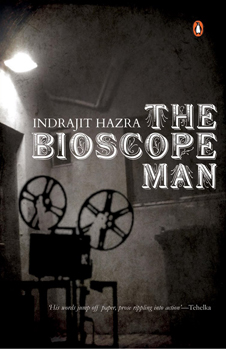
The Bioscope Man

Just recently published in paperback, The Bioscope Man is a novel by Indrajit Hazra, which has its background the days of silent cinema in Calcutta. It tell of the rise and tragic fall of Abani Chatterjee in the 1920s Indian bioscope business, starting as projectionist’s assistant and ending up a star performer, only for ignominy and failure to follow. Other fiction and reality interestingly combine – among the characters in the book are Adela Quested (from E.M. Forster’s A Passage to India) and Fritz Lang, who comes to India to make a film starring Chatterjee but ends up producing Metropolis instead. As with many aspects of Hazra’s book, this has some some grounding in historical reality, as in 1921 Lang and wife Thea von Harbou scripted the two-part Das Indische Grabmal, directed by Joe May and set (but not filmed) in India, and Lang had a lifelong fascination with India. The word ‘bioscope’ was – and remains – a common term for cinema in India, and Hazra notes that the name came from Charles Urban, whose Bioscope cameras and projectors were used by the first Indian filmmakers and exhibitors.

I’ve not read the book yet, but reviews from the Indian press, though mixed, give an interesting flavour of its contents. The Hindustan Times points out the care taken over making the background film history convincing:

The Bioscope Man is set in the Calcutta of early 20th century However, echoes of what is happening on the other coast in Bombay keep intruding into the margins of the story of the rise and fall of his protagonist.

Two years after Dadasaheb Phalke made the first full length feature film in India, Raja Harishchandra, in 1917, a Bengali film, Bilwamangal, produced under the banner of Madan Theatres, was screened in Calcutta. Harishchandra S. Bharvadekhar, a still photographer and dealer in equipment in Bombay was the first to make a film (two, brief films, in fact) in India in the late 19th century. And not too long after, in 1901, Hiralal Sen set up Royal Bioscope in Calcutta to make films: he photographed dance sequences and scenes from plays being staged at Classic Theatres. (‘Bioscope’ is the name of an early film projector for splashing moving images on a screen. It became the generic name for cinema after the American Charles Urban – producer of the world’s first successful natural colour motion picture system, Kinemacolor, as Hazra mentions in his book – popularised it.)

Hazra, a journalist who happens to be a novelist (perhaps it is the other way round), uses his ferreting skills to take the reader behind the silent parde ke peeche, into the fairly cut-throat world of the early pioneers of silent movies in Calcutta.

He also situates his story against a vividly portrayed background of a city whose confidence is being undermined by the decision of the British to shift their capital to Delhi. In the background as well, but palpably present, are the repercussions of the first partition of Bengal – usually through the fringe characters who keep popping up in the novel and the stray remarks tossed occasionally.

While the author has woven many themes into the novel – a critique of Orientalism, a portrait of the Bengali bhadralok in Victorian India, self-deception, the birth and infancy of silent movies – it is the marvellously drawn portrait of the actor whose rapid rise and fall marks him. The actor’s reflections upon his life and work are riveting.

The review in The Newindpress on Sunday shows how the hero’s experiences in the Indian film industry resonate with wider concerns, while describing how Chatterjee meets his downfall:

He starts as a projectionist’s assistant at the Alochhaya Theatre, graduates into being a prompter, and by a lucky twist of fate ends up playing the title-character of Prahalad Parameshwar. He subsequently essays the roles of Othello, Ram, Parasuram and Shivaji, and his silent movies lead to resounding success. He starts getting recognised in street corners and quaint cafes, and is nothing short of being a star.

Hazra successfully experiments with technique, so we find three interludes interspersing the narrative like the titles of the silent films: the stylised stories of Prahalad, Anandhamath and the Black Hole of Calcutta. These bioscopes starring Abani are instant hits with the masses because of their daring portrayal of intimacy and undercurrents of nationalist chic. Yet, he views freedom fighters as “criminals with ambition” and maintains his nonchalance towards nationalism even as various upheavals rock the subcontinent.

Here, brown men (teeming with Bengali pride) share a love-hate relationship with mems: Abani chooses corrosive satire to attack the shape-shifting Annie Besant, though he initially finds her “American” and desirable; Shombu Mama is infatuated with bioscope diva Faith Cooper; and Abani labours under the weight of his undeclared, one-sided love for his onscreen sweetheart Felicia Miller.

On hearing the news of Felicia being shipped to Australia by her disapproving father, Abani enters a trajectory towards ruin when he mistakenly enters a ladies’ restroom. The man with the “bioscope in his bones” falls from grace and spends a decade playing minor roles.

A tart review from The Hindu also focusses on the wider historical background, indicating how the novel may end up being viewed quite differently by audiences within and outside India:

What is it with Indrajit Hazra? Why is he so hung up on the English? A good deal of the novel is a diatribe about the partition of Bengal in 1905 and the shifting of the capital from Calcutta to Delhi in 1911. He tells us about how disastrous it all was for the cultural life of the city and how everything went to seed after that. Curzon, Minto and Hardinge come in for a lot of stick, which is bad enough, but then he goes after old Winston. During a discussion about whether Charlie Chaplin should be called English or American, one of the animated Bengalis inhabiting this novel comes up with this argument: “No, no Shombhu-babu. That doesn’t make him American. Does the British Minister of Munitions become an American just because his mother is American? No, Lahiri babu, Churchill is English.”

There are references galore to period socio-economic gloom, period costume, period food, period politics. Which is all very well but the fact of the matter is that all this does not push the plot forward at all. The author has done huge research, pushed the story into the canopy , then tucked in the ends.

The Bioscope Man is a well-written book in the sense that there is no doubt about Hazra’s command over the language. It is the content one is worried about. Sometimes one wonders which nation he is writing for. In the beginning of the novel he talks about the eating of shingaras and jilipis. Shingaras are, of course, the samosas of Calcutta but take a look at his description of jilipis — “bearing a resemblance to miniature French horns fit for an orchestra of midgets.” No doubt Hazra’s European translators will have a lot of fun with that.

They will also have a lot of fun with the last quarter of the book in which Fritz Lang, German expressionist film maker, turns up in Calcutta to make a film starring Abani Chatterjee. The film is titled: “The Pandit and the Englishman” and is about Pandit Ramlochan Sharma, the Sanskrit tutor of the Orientatlist Sir William Jones. The film is made with great fanfare, but in 1927 the film that is released by the UFA Studio in Berlin is not Abani Chatterjee’s film, but Lang’s Metropolis.

The Bioscope Man is published in India, the UK and the USA. It is Indrajit Hazra’s third novel. Curiously, it is not the only novel set in the early Indian film business to be out at the moment. Tabish Khair’s much-praised Filming: A Love Story, just out in the UK in paperback, centres on 1940s Bombay cinema at the time of partition, but looks back to earlier modes of filmmaking (while echoing these in the novel’s style and framework).

Silent cinema in India has attracted increated critical interest in recent years. There was a major retrospective at the Pordenone Silent Film Festival in 1994, out of which came Suresh Chabria’s book, Light of Asia: Indian Silent Cinema 1912-1934, which includes a lenghty filmography. The major reference source in English is Ashish Rajadhyaksha and Paul Willemen’s monumental Encyclopedia of Indian Cinema. A leading Indian authority is historian P.K. Nair, who writes about the origins of Indian cinema on the Phalke Factory wiki (D.G. Phalke being the creator of India’s first feature film, as noted in The Bioscope Man).

Indian silent films on DVD remain a rarity, but the BFI has issued Franz Osten’s A Throw of Dice (1929), with music by Nitin Sawhney, which strictly speaking is an Anglo-German production, but was filmed in India and has been understandably claimed as an Indian film.

Finally, there was an article recently in The Hindustan Times on preserving India’s film heritage which sadly notes that only twenty-four of the many hundreds of films made in India during the silent era are known to have survived (three of them being films made by Franz Osten).

An apology

The Bioscope would like to apologise to any visitors to this blog who are finding Adsense ads appearing on posts if they come via a Google link. This is a feature that WordPress has introduced, and I can do nothing about it. I understand that if you are a regular visitor, or if you are logged into WordPress yourself, then you do not see the ads, but if you a newcomer or an infrequent visitor, then the ads will occasionally crop up. There seems to be nothing I can do to change this – you can’t even pay to make them go away. So I just want to make it clear that I have not sanctioned the use of this blog to sell anything to anyone, and I am very unhappy that it has been hijacked in this way, contrary to what was my understanding when I first signed up with WordPress. If I can change things, I will.

Bioscope Newsreel no. 1

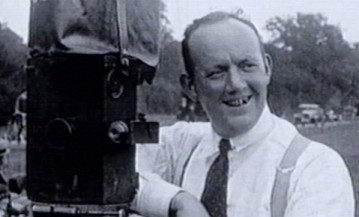
British newsreel cameraman Jack Cotter, working for Pathé Gazette in 1922

I need to do a little more to separate news pieces from background, more discursive pieces, and so I’m going to introduce The Bioscope Newsreel. This will be a gathering of news alerts on silent cinema, with links to further information, released at what will no doubt be irregular intervals. Nevertheless, just like the newsreels (which were of course an invention of the silent cinema), each release will be numbered, there will be an average five stories per reel, and each story will have a mildly jokey title. So here goes with issue number 1…

Filming the father of Indian film
A feature film is to be made of the life of Dadasaheb Phalke, who made Raja Harishchandra, the first Indian fiction film, based on Hindu mythology, in 1913. Learn more.

Read all about it
The bi-monthly PDF magazine on silent cinema, The Silent Treatment, is now available online, with back issues for 2007. Learn more.

Hard times
Flicker Alley is to release a DVD of the important American social dramas Traffic in Souls (1913) and The Italian (1915) in July 2008, under the title ‘Hardships of the New Land’. Learn more.

More from the alley
Flicker Alley is busy at the moment, because also promised in September 2008 is its DVD release of Abel Gance’s pacifist classic J’Accuse (1919) and a Douglas Fairbanks boxed set in November 2008. Learn more.

Repatriation
A collection of American newsreels, documentaries, trailers and promotional films, dating 1912-1927, is being repatriated from the National Film and Sound Archive of Australia to American film archives. Learn more.

‘Til next time!

Happy birthday, Bioscope!

A cake for the Bioscope

Yes folks, it was one year ago to the day that the Bioscope first opened its eyes, put its fingers to the keyboard, and produced these words:

Welcome to The Bioscope, the place for news, information, documentation and opinion on the world of early and silent cinema.

And here we are, some 500 posts, 10,350 deleted spam messages, 61,200 visitors and somewhere over 100,000 words later, still dedicated to the cause. And for my amusement, if no one else’s, these are the top twenty posts by number of visits over the past year (excluding visits to sections such as About and Library):

1. Searching for Albert Kahn
2. Paul Merton on tour
3. The Wonderful World of Albert Kahn
4. The Twenties in Colour
5. The Invention of Hugo Cabret
6. Slapstick, European-style – part 1
7. 100 years of the Autochrome
8. Crazy Cinématographe – Travelling Cinema
9. The silent films of Alfred Hitchcock
10. Paul Merton’s Silent Comedy
11. A Tour of the Cinema Museum with Ronald Grant
12. The Great War in Colour
13. Edwardian hoodies
14. Paul Merton’s Silent Clowns
15. The Silent Worker
16. The Bioscope Festival of Lost Films
17. Lost and Found no. 2 – Dawson City
18. Times past
19. Visiting the Volta
20. Picasso, Braque and Early Film in Cubism

So thank you to Messrs. Kahn and Merton for having attracted so much custom, and thank you dear readers for all your comments and collaboration. Let’s hope for new adventures and passions in year two.

Footnotes to the festival

Bioscope Festival of Lost Films

Now that the Bioscope Festival of Lost Films is over, here are a few notes on some of the sources used, credit having to be where credit is due.

For A Study in Scarlet and its partnering short, The Great European War, the chief source is the autobiography of its director George Pearson, Flashback: An Autobiography of a British Film Maker (1957). This is an evocative and at times inspiring account of dedicated creative endeavour amid the general poverty of budgets and imagination that existed in the British film industry in the silent era. There’s more information (which I didn’t have access to) in Harold Dunham and David Samuelson’s voluminous Bertie: the life and times of G. B. Samuelson, an unpublished biography of the film’s producer, a copy of which is held in the BFI Library. I also used contemporary reviews and David Meeker and Allen Eyles’ Missing Believed Lost: The Great British Film Search (1992), which was the source of the main photograph of Sherlock Holmes (the other photo, of the Mormon trek at Southport, comes from Pearson’s book).

For Ein Sommernachtstraum, my chief source was Robert Hamilton Ball’s incomparable Shakespeare on Silent Film: A Strange Eventful History (1968), which was also the source of information on the 1907 Hamlet, and the source of both photographs. Ball is so thorough in citing and quoting from his source (such as the Close-up review) that there wan’t much need to look elsewhere, but I did also used a review of the film in Variety.

The prime source of information on Human Wreckage was Kevin Brownlow’s Behind the Mask of Innocence: Sex, Violence, Crime, Films of Social Conscience in the Silent Era (1992), one of the essential sources on silent film. Images came from here and from Mark A. Viera’s Sin in Soft Focus: Pre-Code Hollywood (2003). Also useful was James C. Robertson, The Hidden Cinema: British Film Censorship in Action, 1913-1972 (1989). I also referred to assorted reviews of the film. I could find very little on Dorian Gray, the 1913 Wallace Reid film, and in the end turned to an Oscar Wilde filmography I’d compiled years ago and trusted that I’d got my facts and figures right then.

There is plenty of information available on The Mountain Eagle, inevitably. The best source is the warmly recommended English Hitchcock, by Charles Barr. Further information came from editions of the renowned Hitchcock journal, MacGuffin and Missing, Believed Lost. Stills from the film are handsomely reproduced in Dan Auiler, Hitchcock’s Secret Notebooks (1999) and can be found on the commendable Hitchcock Wiki’s Hitchcock Gallery. The famous François Truffaut interview book, Hitchcock, was the source of information on Number 13, including the unexpected still.

Drakula halála was the most difficult film to research, as there is so much that is not known about it, so much has been misreported, and such key sources as exist are in Hungarian – and even they make little mention of it. Sources vary over whether it should be 1921 or 1923, but in the end I went for 1921 as it is listed as such in the filmography given in the standard work, István Nemeskürty, Word and Image: History of the Hungarian Cinema (1974). My chief source, however, was www.hitchcock.hu. The main site is – bizarrely – about cats, but click on the Hitchcock.hu link on the front page and it takes you to a enthusiastic site on Hitchcockiana (in Hungarian), with offshoots on subjects such as silent horror, which is where I found a short history of the film, images, and reproductions of original texts – all in Hungarian, of course, and translation software can only do so much with one of the world’s more challenging languages, but I think I extracted the basics. Information on the Hungarian industry came mostly from Filmkultúra (rather good, in English). Christopher Frayling’s Mad, Bad and Dangerous?: The Scientist and the Cinema (2005) had some information on Life Without Soul, while the poster for the film is reproduced on the Frankensteinia blog.

Grateful acknowledgments to all those sources.

The Mountain Eagle

Bioscope Festival of Lost Films

UK/Germany 1926

Director: Alfred Hitchcock
Production company: Gainsborough Pictures/Münchner Lichtspielkunst AG (Emelka)
Producer: Michael Balcon
Assistant director: Alma Reville
Scenario: Eliot Stannard, Max Ferner
Story: Charles Lapworth
Art direction: Ludwig Reiber, Willy Reiber
Cinematography: Baron Ventimiglia

Cast: Bernard Goetzke (Pettigrew), Nita Naldi (Beatrice Brent), Malcolm Keen (John Fulton, known as Fearogod), John Hamilton (Edward Pettigrew), Ferdinand Martini

7,503 feet
Distributor: W & F

The Mountain Eagle

Bernard Goetzke (Pettigrew), in The Mountain Eagle

Good evening once again, and welcome to the latest screening at the Bioscope Festival of Lost Films. Today we find ourselves in London’s Tottenham Court Road at the Cambridge Circus Cinematograph Theatre (recently renamed the Super, but we prefer the old name), a marvellous venue which seats 1,000 of you, and has room for full orchestra and a pipe organ, which will be played for us by that nonpareil of silent film accompanists, Florence de Jong. Prepared to be stirred!

Our film this evening is the second feature film to be directed by a most promising talent for our British film industry, Mr Alfred Hitchcock. The film is The Mountain Eagle, which follows his The Pleasure Garden of the previous year. Mr Hitchcock has been a little dismissive of his latest work, something that we prefer to ascribe to a commendable modesty.

The film is excitingly set in the Kentucky hills, though you may be surprised to learn that the production was in fact filmed in the Austrian Tyrol, with studio scenes taken in Munich (we understand that some interiors were also filmed in Paris). The film’s producer Mr Michael Balcon has been keen to encourage co-productions with Germany, and many of you will remember that excellent film The Blackguard, made in 1925.

But what story does it tell? We can do no better than to provide you with the synopsis given in The Bioscope (a journal naturally close to our hearts):

Beatrice Brent, school teacher in a small mountain village, incurs the enmity of Pettigrew, the local Justice of the Peace and owner of the village stores, because he believes that she encourages the attentions of his son Edward, a cripple, who takes evening lessons. Pettigrew, while questioning Beatrice, is himself influenced by her charm and attempts liberties which she strongly resents. He is so furious at the rebuff that he proclaims her as a wanton and she is driven from the village by the inhabitants. Beatrice is saved from their fury by a mysterious strange known as Fearogod, who lives a solitary life in a cabin to which he takes her for shelter. To stop all scandal, Fearogod takes Beatrice down to the village and compels Pettigrew to marry them, explaining to her that he will help her to get a divorce. Beatrice, however, is content to leave the situation as it is, but Pettigrew, furious with rage, takes advantage of the fact that his son has left the village and arrests Fearogod for his murder.

In spite of the fact that there is no vestige of evidence that young Pettigrew has been murdered, Fearogod is kept in prison for over a year, whe he decides to escape. He finds that his wife has a baby and he goes off with them to the mountains. When they find that the baby is taken ill, Fearogod goes back to the village for a doctor, where he sees old Pettigrew. Some doubts as to which of them men is going to attack the other first is settled by an onlooker firing off a gun which wounds Pettigrew in the shoulder. The sudden return of his son Edward convinces the old man of the futility of proceeding with his accusation of murder, so he makes the best of matters by shaking hands with the man he has persecuted and all is supposed to end happily.

The Mountain Eagle

Production crew for The Mountain Eagle on location in the Austrian Tyrol

This is a remarkably intense, elemental drama of family passion. Mr Hitchcock has produced a powerful melodrama clearly inspired by its rugged mountain surroundings. Some critics have complained that the direction is a little too slow, and that Mr Hitchcock has perhaps not quite grasped the German style he has aimed for, while others complain that the supposed setting in Kentucky seems more than a little implausible. But if British films are to succeed in America they must tempt that huge potential audience with American subjects. This also explains the presence of that up and coming star Nita Naldi (you will remember her from Blood and Sand), even if she does appear less than comfortable with her role. Praise is due to that talented yet strangely underrated Italian cinematographer, Baron Ventimiglia, who has contributed so much to the film’s brooding expressionism. That thoughtful and sophisticated scenarist Eliot Stannard has a way of binding character and narrative that helps bring out the nascent genius that we suspect lies in Mr Hitchcock – even if some feel that the number of intertitles are excessive. This is the work of a strong team, even if the subject matter has not perhaps quite brought out the best in each of them.

In America, the film is to be known as Fearogod, while in Germany it is Der Bergadler. Here it has become The Mountain Eagle, though we must confess we are unsure who or what the mountain eagle is supposed to be. In truth, this has been a somewhat troubled production, but undoubtedly an essential part of the learning process for the promising Alfred Hitchcock, who now tells us he is working on an adaptation of Mrs Belloc Lowndes’ thrilling novel, The Lodger, which sounds to be a property ideally suited to this young man’s talents. We shall follow his progress with interest.

Number 13

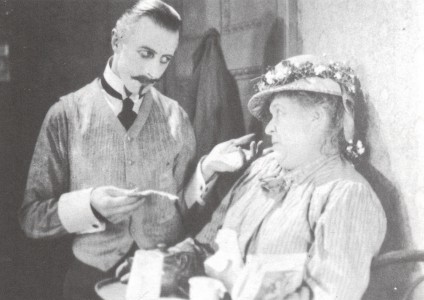
Ernest Thesiger and Clare Greet in Number 13

The lost short that accompanies our main feature is something of a coup. Gainsborough Studios has made available to us the rushes from Alfred Hitchcock’s uncompleted Number 13, which was to have been his first solo film as a director (he had taken over the direction of the two-reel Always Tell You Wife, one reel of which survives). Filmed at Islington Studios in 1922, this drama (also given the name Mrs Peabody), was to have starred Ernest Thesiger and Clare Greet. The shoot was a troubled one, and production on the two-reeler was halted after only a few scenes were shot.

Do join us tomorrow for the final screening of the Bioscope Festival of Lost Films, when we shall be at the Circle in the Square, in Leicester Square. We can promise you something truly sensational with which to round off the festival…

Human Wreckage

Bioscope Festival of Lost Films

USA 1923

Director: John Griffith Wray
Production company: Thomas H. Ince Corporation
Director of photography: Henry Sharp
Script: C. Gardner Sullivan

Cast: Mrs Wallace Reid (Ethel MacFarland), James Kirkwood (Alan MacFarland), Bessie Love (Mary Finnegan), George Hackathorne (Jimmy Brown), Claire McDowell (Mrs Brown), Robert McKim (Dr Hillman), Harry Northrup (Steve Stone), Victory Bateman (Mrs Finnegan), Eric Mayne (Dr Blake), Otto Hoffman (Harris), Philip Sleeman (Dunn), George Clark (The Baby), Lucille Ricksen (Ginger Smith), George E. Cryer (A city official), Dr R.B. von Kleinsmid (An educator), Benjamin Bledsoe (A jurist), Louis D. Oaks (A police official), Martha Nelson McCan (A civic leader), Mrs Chester Ashley (A civic leader), John P. Carter (A civic leader), Mrs Charles F. Gray (A civic leader), Dr L. M. Powers (A health authority), Brig. C. R. Boyd (Salvation Army worker)

7,215 feet
Distributed by Film Booking Offices of America

Human Wreckage

Mrs Wallace Reid and Bessie Love (right), in Human Wreckage

Ladies and gentlemen, good evening, and welcome to the third screening of the Bioscope Festival of Lost Films. Today we find ourselves at the Casino de Paris in London’s Oxford Street. This small but fine building, which first opened its doors on 18 September 1909, seats just 175 of you. The venue has been chosen for its select nature, as only an invited and carefully vetted audience could be allowed in to see this evening’s sensational production which – as you will know – has been banned by the British Board of Film Censors. It is only under special licence from the London County Council that we are able to show it to you at all. The music comes from that legend among silent film pianists, Mr Arthur Dulay (round of applause).

What is also special about this evening’s main film is that it is to be shown in the presence of its principal performer, Dorothy Davenport, previously a popular film actress but now perhaps best known to you all as Mrs Wallace Reid (murmurs of sympathy). For it was the unfortunate death of her husband, the much-loved Wallace Reid, as the result of a wretched morphine addiction, that led her to produce Human Wreckage, and she has been tireless in presenting the film herself at its screenings across America. She is in this country to promote the film’s serious message, and we welcome her (warm and prolonged applause).

The history of Wallace Reid you will know well. The highly popular American star of such popular films as The Affairs of Anatol and Forever, became addicted to morphine, it is said after he suffered injuries in a railroad crash in 1919, while making The Valley of the Giants. What was at first medical expediency became an increasing habit, to the extent that it is believed that Wallace had morphine administered to him by a doctor at Famous Players-Lasky studios, to ensure that he could complete the many motion pictures that were demanded of such a popular star (expressions of shock and dismay). Many among you will recall the apathetic look that Wallace bore in his later pictures – only now do we know why! His death came on 18 January 1923, aged just thirty-one (deathly silence).

Human Wreckage is not the story of Wallace Reid. Instead it is a product of Mrs Wallace Reid’s determination, following her husband’s death, to campaign against the evils of drug pedling and addiction. Of course, its theme of drug addiction runs against the normal American censorship codes, but the picture’s serious intent has seen it gain a special dispensation from Mr Will Hays, and it was made under the guidance of the Los Angeles Anti-Narcotic League. You will have noted the various civic and health figures included in the cast (murmurs of approval).
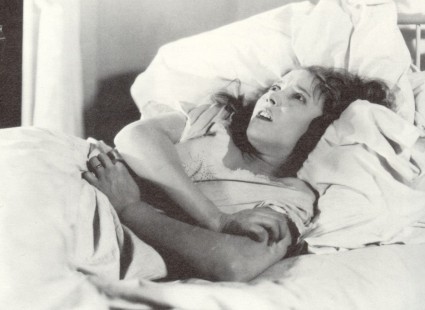
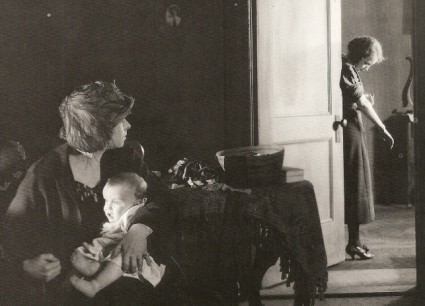
Bessie Love in Human Wreckage

Bessie Love as Mary Finnegan in Human Wreckage

The film tells of the evils of drug addiction as they affect several people. Jimmy Brown, a heroin addict, is arrested by the police but successfully defended in court by attorney Alan MacFarland. Jimmy is sent to hospital (where he endures the pains of withdrawal symptoms), while MacFarland, exhausted by pressure of work, is offered morphine by a friend. He gradually becomes addicted. Meanwhile his wife, Ethel, notices that a young girl, Mary Finnegan, living in the same tenement as Jimmy’s mother, is injecting herself with morphine. She is also putting morphine onto her breast to quieten the baby she is nursing. Mary tries to kill herself, but ends up in hospital and separated from her baby. Alan MacFarland is hired by Steve Stone, who is his own dealer, and manages to keep him out of jail. Ethel is unable to save her husband from his addiction, but then he discovers that despair has apparently led her to her own drug addiction, and this brings him to a shocked realisation of what he has put her through. Her ruse works, and he gives up morphine. Jimmy Brown takes Steve Stone on a mad taxi drive through the city, and both are killed in a crash. The film concludes with a plea from the MacFarlands for stronger laws to confront the evil of drugs.

The film has caused a sensation in the United States. Those uncertain about the film’s motives have been shaken by its sincerity and the power of its telling. Mrs Reid herself has been tireless in promoting the film, often introducing it herself, and using her profits to support the Wallace Reid Foundation Sanatorium, as well as establishing her own film production company (warm applause). It is no cheaply-made exposé; instead it has been handsomely produced by the Thomas Ince Corporation, and boasts some remarkable sets inspired by The Cabinet of Dr Caligari for one fantastical sequence. The producers’ confidence has been rewarded by the film’s noted financial success in America.

Here in Britain, where the American context of the story means less, the censors have been less accommodating. Our BBFC rejected the film in January 1924. Mrs Reid has organised some screenings for private individuals – our screening this evening is one of these – but this seems to have shocked the BBFC still further. The chief censor, Mr J. Brooke Wilkinson, has gone on to say:

There have been few, if any, films submitted to the Board since its inception which the examiners look upon as more dangerous than this film ‘human wreckage,’ and we see no possibility of altering it so as to make it suitable for public exhibition in this country.

And so it remains banned, and unseen (cries of ‘shame’).

The lost short accompanying our main feature is Dorian Gray (1913), also known as The Picture of Dorian Gray. How bitterly ironic it is that the young Wallace Reid should have starred in this film, playing Oscar Wilde’s seemingly unblemished young man, whose true, corrupted nature is revealed through a deteriorating portrait of him. The film was directed by Phillips Smalley and written by his talented wife Lois Weber, both of whom also appear in the film. It was made by the New York Motion Picture Corporation.

This has been a harrowing evening. We thank you all for you attention, and particularly to Mrs Reid for having graced us with her presence (loud applause). Tomorrow we will move around the corner to the Cambridge Circus Cinematograph Theatre, for a compelling Anglo-German production. Do join us.