Diverting Time

The Egyptian Hall

Courtesy of Maney Publishing, publishers of The London Journal, I am able to publish a PDF of my new essay, ‘Diverting Time: London’s Cinemas and their Audiences, 1906-1914’. Between 1906 and 1914, there were over 1,000 venues exhibiting film in London. They attracted a vast new, largely working class, audience, drawn to an entertainment which was cheap, conveniently located, placed no social obligations on those wishing to attend, and which was open at a time that suited them. The essay examines the rapid growth of the first cinemas in London and the impact that they had on audiences, particularly in terms of the value they offered, not simply economically but in terms of time spent.

The essay gets its title from Montagu Pyke, cinema chain owner, occasional rogue, and author of a fascinating pamphlet on the potential of cinema, Focussing the Universe (1910), in which he writes:

The Cinematograph provides innocent amusement, evokes wholesome laughter, tends to take people out of themselves, if only for a moment, and to forget those wearisome worries which frequently appal so many people faced with the continual struggle for existence. It forms in fact – I like the word – a diversion. It is in some respects what old Izaak Walton claimed angling to be: An employment for idle time which is then not idly spent, a rest to the mind, a cheerer of the spirits, a diverter of sadness, a calmer of unquiet thoughts, a moderator of passions, a procurer of contentedness.

Did anyone ever write a truer set of words to describe the appeal of cinema?

The essay is just one output from a research project into the film business in London before the First World War which was hosted at Birkbeck, University of London. Another output online, to which the essay refers in details, is the London Project Database of London film businesses and cinemas to 1914. More will follow, in due course.

What the first movie goers saw

slate.jpg

This is interesting. An online daily journal, The Slate, has published an article with video slide show on the reception of early films, inspired by the Phillips Collection’s Moving Pictures exhibition on early film and art, currently on exhibition in America. The article, by Jana Prikryl, is entitled ‘What the first movie goers saw’, and it is acompanied by ten films from the 1890s/1900s, a mixture of Lumiere, Edison and Biograph titles, courtesy of Williams College Museum of Art. The text reports on the Moving Pictures exhibition, which it says offers too narow an explanation of sources of inspiration for the first filmmakers, which is undoubtedly true. Interesting, the writer finds the films “oddly modern” because as short clips formed out of a “spirit of improvisation” they are close to the world of YouTube. While one must not be lured into the old belief that early films are naive and accidental – much artifice and deliberation went into even the simplest of actualities – she is right to say that in these mesmerizing clips we can see a “watershed moment in visual culture”, and the YouTube analogy is one worth pursuing (not least in view of the increasing number of early films now popping up there).

The clips include the bodybuilder Eugen Sandow in 1894, the Lumieres’ Feeding the Baby, Edison’s Uncle Josh at the Moving Picture Show and a Danse Serpentine. All of the clips have thorough credits and acknowledgment of source. Well worth watching, and reading, and pondering.

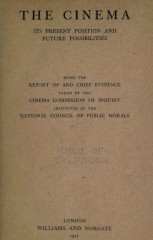
The Cinema: Its Present Position and Future Possibilities

The Cinema

There are so many interesting and valuable texts in the silent cinema field being added to the Internet Archive, but this latest addition to the Bioscope Library is perhaps the most exciting and important yet.

The Cinema: Its Present Position and Future Possibilities (1917) is a report and summary of evidence taken by the Cinema Commission Inquiry, instituted by the National Council of Public Morals. Essentially, it is a thorough investigation into the cinema in Britain and what its effects might be on the viewing public. As the introduction states, the National Council on Public Morals was “deeply concerned with the influence of the cinematograph, especially upon young people, with the possibilities of its development and with its adaptation to national educational purposes”. In other words, many in authority were alarmed at the popularity of cinema among those it deemed dangerously impressionable, and they wanted better to understand it, and to establish greater control over it. But they also wanted to find out what was best about it, and to replace hearsay with evidence.

The Commission was led by the Lord Bishop of Birmingham, and comprised assorted religious, educational and political figures, representatives from the film trade, T.P. O’Connor from the British Board of Film Censors, and others, including Dr Marie Stopes representing the Incorporated Society of Authors, Playwrights and Composers. The Commision sat from January to July 1917. Its terms of reference were:

  • To institute an inquiry into the physical, social, educational, and moral influences of the cinema, with special reference to young people; and into
  • The present position and future development of the cinematograph, with special reference to its social and educational value and possibilities;
  • To investigate the nature and extent of the complaints which have been made against cinematograph exhibitions;
  • To report to the National Council the evidence taken, together with its findings and recommendations, which the Council will publish.

The detailed report that was published is an unmatched treasure trove not only of opinions, fears, hopes and prejudices regarding the cinema and its audience, but of evidence relating to the production and exhibition of films in Britain at this time. Those supplying evidence included Cecil Hepworth, J. Brooke Wilkinson, A.E. Newbould, Gavazzi King and F.R. Goodwin, all key figures from the film industry, teachers, policemen, magistrates, social workers, and children.

The report is of importance in three areas in particular. First, for what it reveals of attitudes – positive as negative – towards the cinema from society’s moral guardians, for which there is much fascinating verbatim evidence, in the questions they ask as well as in the answers received. There are many questions about the supposed corrupting influence of cinema, and some heartening replies, such as this from J.W. Bunn, a headmaster from Islington:

A considerable number of people look upon the attendance of children at cinematograph entertainments with dislike if not with horror, and are apparently inclined to accuse the picture shows of being the main cause of juvenile misdemeanours. I do not agree with this view, and am firmly convinced that there is great exaggeration committed by this class. In my opinion these people are always to be found on the side of opposition of popular and cheap amusements for the working classes. The picture show is undoubtedly very popular with the women and children of the working class, but then it is still new enough to be a novelty, and it must be remembered that no other form of entertainment has ever offered to the poor the same value in variety and comfort for a very small outlay.

Secondly, there is invaluable statistical evidence provided by the film trade, including numbers of cinemas nationally, seats occupied, prices, investment in the cinema industry and the amount of film in distribution. Much of this data is unique to the report.

Lastly, there is the evidence from the school children about their cinema-going habits. Probably uniquely for this period in British film, we have the words of the audience members themselves. Here’s a revealing exchange between the Chairman and four boys from Bethnal Green (two aged eleven, two thirteen):

Q. What do you like best at the cinema ?
A. All about thieves.
Q. The next best?
A. Charlie Chaplin.
Q. And you?
A. Mysteries; and then Charlie Chaplin.
Q. And you?
A. Mysteries, and Charlie Chaplin.
Q. What do you mean by mysteries?
A. Where stolen goods are hidden away in vaults so that the police can’t get them.
Q. And you?
A. Cowboys; and then Charlie Chaplin second.
Q. When you have seen these pieces showing thieving and people catching the thief, has it ever made you wish to go and do the same thing?
A. Yes.
Q. Do you think the fellow who steals, then, a fine man?
A. No.
Q. But you would like to do it yourself?
A. Yes.
Q. Do you like the adventure or what?
A. I like the adventure.
Q. You have no desire, then, to steal in order to get things for yourself, but you like the dashing about and getting up drain-pipes and that sort of thing?
A. Yes.
Q. And you?
A. No, I don’t like that, I should not like to do that.
Q. Do you like pictures where you see flowers growing?
A. No.
Q. Do you like ships coming in and bringing things from distant lands?
(One boy replied ” No,” and the other three ” Yes.”)
Q. You like to have a consistent programme of detective stories and Charlie Chaplin, and you don’t want any more?
A. Yes.
Q. Do you sit amongst the girls?
A. Sometimes.
Q. What do you pay?
A. Id. and 2d.
Q. Do you ever have to sit on the ground?
A. No, we always have a seat.
Q. Have you ever seen the boys behave roughly to the girls?
A. Yes.
Q. What do they do?
A. Aim orange peel at them.
Q. Do they pull the girls about?
A. Yes, their hair.
Q. And do the girls pull back again?
A. No; they seem to enjoy it.

The Report was generally favourable towards the film industry, which was delighted to receive such vindication of its work. The Report recommended the implementation of a system of official censorship, superseding that of local authorities, but this was not implemented.

It’s a marvellous document, and I strongly recommend it to anyone interested in early British film or the social history of film. It’s available for download from the Internet Archive in DjVu (28MB), PDF (69MB), black-and-white PDF (21MB), and TXT (1.3MB) formats (the latter essential for word searching).

Moving Pictures in Westminster

The Moving Pictures exhibition on the film and cinema business is London before the First World War will be on show at the City of Westminster Archives Centre 5-30 June. The exhibition, which was previously shown at Hornsey Library and Hampstead Museum, focusses on the highly active film industry and cinema business in London before 1914, with an emphasis on the relationship with local communities. The exhibition is based on The London Project, a research project hosted by Birkbeck College, London, which resulted in The London Project database of film businesses and cinemas in London before the First World War.

There are associated talks taking place at the Centre on 19 and 26 June, at 6.00 pm (admission free). The Archives Centre is located here.

For the weekend of 23-24 June the exhibition will move temporily from the Archives Centre to feature as part of West End Live, in Leicester Square.

Modern Gladiators

I am poorer but richer. I have forked out for Antonia Lant’s Red Velvet Seat: Women’s Writing on the First Fifty Years of Cinema, as already promoted here. It is full of riches. The notes alone are a map to a marvellous world, with a host of tempting pathways down which to travel.

There’s so much that one could say about the texts in the volume, but the first thing to catch my eye was two pieces written by women who saw the film of the World Heavywieght Championship bout at Carson City, Nevada, between James Corbett and Bob Fitzsimmons, on 17 March 1897. One is a short, anonymous piece, ‘The Matinee Girl’, from the New York Dramatic Mirror, 12 June 1897; the other is a longer piece by Alice Rix, ‘Alice Rix at the Veriscope’, from the San Francisco Examiner, 18 July 1897, which is about women spectators of the film.

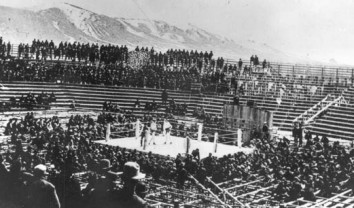
Corbett v Fitzsimmons

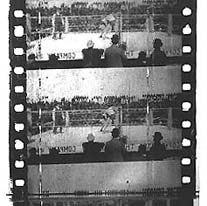
The film was made by the Veriscope Company, which employed three cameras in parallel, housed in a wooden cabin, so that when the film ran out of one the next door camera started (as the picture above shows). The result was a seemingly continuous, single-position record, which ran for well over an hour (there were fourteen rounds). The film was 63mm wide, giving a ‘widescreen’ effect which was shaped to the size of the ring:

Corbett v Fitzsimmons film strip

The film was widely shown and enthusiastically watched by audiences worldwide most of whom had never seen a boxing match (boxing was illegal in every American state except Nevada). There was clearly a number of women who went to see the film. And another of them wrote about the experience. Lady Colin Campbell, who wrote a column in The World, on 20 October 1897 wrote about seeing the film at the Aquarium in London (using the pen name Véra Tsaritsyn), under the title ‘Modern Gladiators’:

In spite of all that the humanitarians may say or the Peace Society may preach, the love of fighting will endure to the end of time … it is with satisfaction that I note the number of people who are crowding into the theatre of the Aquarium to see the cinematograph version of the great fight between Corbett and Fitzsimmons, which took place last March in Carson City, Nevada.

It certainly was an admirable idea to have got up this historic encounter for the sake of the pictures to be obtained of it. It is given to comparatively few to see a real prize-fight; but these pictures put the P.R. ‘on tap,’ as it were, for everybody. It is the real thing: the movements of the men, the surging of the crowd, the attentive ministrations of the backers and seconds, are all faithfull represented; only it is so bowdlerised by the absence of colour and noise that the most super-sensitive person, male or female, can witness every details of the fight without a qualm. Evidently the fair sex appreciate such an opportunity, for there are plenty of those tilted ‘coster-girl’ hats adorned with ostrich feathers that would delight the heart of a ‘donah,’ which are fashion’s decree for the moment, to be seen in the theatre … The five-shilling ‘pit’ (which are the lowest-priced seats for this peep-show) is soon filled up; the half-guinea stalls are not long behindhand; and the only part of the auditorium which remains partially empty is the back row of the stalls, which, for some mysterious reason, is thought to offer such exceptional advantages that the seats are priced at a guinea. The seats being exactly the same as the half-guinea abominations in clinging red velvet, and the point of view being precisely similar to that of the front row of the pit (which is only divided off by a rope), we ponder over the gullible snobbishness of the world, while a well-meaning but maddening lady bangs out ‘The Washington Post’ out of an unwilling and suffering piano in the corner. We have nearly arrived at the point of adding our shrieks of exasperation to those of the tortured instrument when the show begins and the ‘Washington Post’ is mercifully silenced.

We are first gratified with a little slice of statistics; the two miles of films on six reels, containing one hundred and sixty-five thousand pictures; the prize of 7000l. which went to the victor; the names of the referee, the timekeeper, and various other details, to which the audience listens with ill-concealed patience … [T]he first picture is thrown upon the sheet, and, having wobbled about a little to find the centre of the canvas, settles down into an admirably distinct view of the platform, with the two champions wrapped in long ulsters, each surrounded by his backers …

Here she goes on to describe the fight in great detail, commenting on the odd effect of the silence, complaining about clinching, and describing the dramatic end where the defeated Corbett in a rage tried to attack Fitzsimmons, causing mayhem in the ring.

The two miles of pictures have taken an hour and a half to pass before our eyes; but though we leave the theatre with aching heads, we regret that so little that we determine to return as soon as we can, to witness again this combat of modern gladiators.

And though here at the Bioscope we’re wary of pointing people to stuff published illegally on YouTube, you can see edited highlights of the bout from a 16mm print probably dating from the 1960s. The intertitles are an obvious modern addition, as is the use of slow motion where they repeat the shot of the knockout blow, where the original film has been damaged. About a third of the film survives today – disappointingly, the scenes showing the uproar at the end of the fight are missing.

The Glow in Their Eyes

Some of the most interesting work going on in early film studies (in fact, film studies in general) at the moment is the empirical work being done on audiences. There is an international organisation, HOMER, devoted to the subject, and Cinema Context in Amsterdam (subject of an earlier post) is one only example (albeit a spectacular one) on the work that is going on internationally. This call for papers for a conference is therefore particularly interesting:

The Glow in Their Eyes

Global perspectives on film cultures, film exhibition and cinemagoing

International Conference, Brussels, 15-16 December 2007

The aim of the conference is to review the current state of research in the history of moviegoing and film exhibition and distribution. We seek to bring together scholars dealing with these subjects from all over the globe. The growing number of case studies in local film history increases the need for comparative studies of cities, regions, and nations, while the relationship between micro and macro history(ies) is becoming a major issue for the field. The analysis of patterns and networks in film culture also calls for special attention to methodology. The conference aims to bring European perspectives on cinemagoing and film exhibition into dialogue with British, American and Australian research, and with research elsewhere in the world, in Africa, South America and Asia.

The conference aims to explore and map several crucial tensions arising from the issues of exhibition and cinemagoing, including:

  • The attention given to “top down” forces of industry, commerce and ideology as against “bottom up” forces of experience, consumption and escapism;
  • Contesting concepts of public and private space in media experience;
  • Questions relating to cinema’s integration into to the metropolitan experience of modernity, compared to its role in the construction of community in less urbanised and rural areas.

In line with the ECREA film studies section philosophy (www.ecrea.eu) the conference approaches the phenomenon of cinema in a broad, socio-cultural sense: cinema as content, as cultural artefact, as commercial product, as lived experience, as cultural and economic institution, as a symbolic field of cultural production, and as media technology. On a methodological level, the conference is open to multiple approaches to the study of historical and contemporary cinema: film text, context, production, representation and reception. Cultural studies perspectives, historical approaches, political economy, textual analysis, audience research all find their place within this scope.

The conference also signals the completion of two major interuniversity research projects, one in Belgium (‘The Enlightened City. Screen culture between ideology, economics and experience. A study on the social role of film exhibition and film consumption in Flanders (1895-2004) in interaction with modernity and urbanisation’), and one in Australia (‘Regional Markets and Local Audiences: Case Studies in Australian Cinema Consumption, 1927-1980’). These research projects use a combination of oral histories, archival documentation, demographic data and media reportage and personal papers to examine the audience experiences and business practices of cinemas in Belgium and Australia.

The conference is supported by the International Cinema Audiences Research Group (ICARG), and will be the second international gathering of the Group’s work on the HOMER (History of moviegoing, exhibition and reception) Project, following the successful ‘Cinema in Context’ conference held in Amsterdam in April 2006. The conference will be preceded by an ICARG workshop.

Confirmed Keynote Speakers: Annette Kuhn (University of London); Richard Maltby (Flinders University)

Possible topics for papers are e.g.:

  • Film exhibition, cinemagoing and film experience in relation to theories of imperialism, postcolonialism, etc.
  • Long term tendencies such as the rise of cinemas in rural and urban environments, the boom of cinemagoing, the decay and subsequent closure of many (provincial and neighbourhood) cinemas and the rise of multiplexes
  • Tensions between commercial and/or ‘pillarised’ film exhibition, between urban and rural areas, and between provinces and regions
  • Institutional developments, geographical location and programming trends
  • Audience and film experiences in urban and rural contexts
  • A comparative international perspective on cinemagoing and exhibition
  • Diasporic cinemagoing practices
  • Representations in films of cinemagoing, film exhibition, film culture(s)
  • Reflections on methods: How to reconcile/combine large scale analysis vs in depth case study? How to link up national or regional databases on exhibition and cinemagoing?

A selection of papers presented on the conference will be published in an edited volume in 2008 (publisher to be confirmed). Please submit abstracts (500 words) with short bio to Gert.willems2 [at] ua.ac.be and Liesbeth.vandevijver [at] @ugent.be before 6 July 2007. Speakers will be notified of acceptance by 31 July 2007.

Website (under construction): www.cinemagoingconference.ugent.be

Teenagers

Teenage

http://www.amazon.co.uk

Sometimes some of the most interesting writing on early cinema isn’t found under the heading ‘cinema’. A case in point is Jon Savage’s new book, Teenage: The Creation of Youth 1875-1945. It’s a history of the invention of teenagers before there were teenagers, as it were. Most social histories explore the phenomenon post-1945 – Savage looks at how we got to that point by looking at the growing power and influence of adolescents, partiularly American, from the late Victorian period, not least through the pleasures that they pursued. So he has a lot to say about the cinema of the teens and 1920s (making good use of Kevin Brownlow’s Behind the Mask of Innocence), for which the audience was, we must remember, significanly young (up to 50% of the early cinema audience were children or adolescents, according to some estimates). He places the cinema as a particular pleasure of the teenaged within his larger thesis about America as a young society, giving early cinema a social context beyond the boundaries used found in a film studies book. Or at least that’s what I gleaned from half an hour’s read in Waterstone’s…

There’s an interesting review by Libby Purves in The Times which highlights the cinema aspects of the book. Jon Savage is of course the author of the definite book on punk, England’s Dreaming.

How to Run a Picture Theatre – part 4

Back to the 1910 [correction – probably 1912] publication How to Run a Picture Theatre (see previous posts). Having attended to the location, exterior and lobby, it’s time to consider the auditorium itself. As before, the emphasis is on convincing the potential cinema owner of moving on from the slack, short-termist practices of the past and make the venue the sort of attractive proposition likely to attract a loyal clientele.

The Auditorium. The good impression created by the outside appearance and the entrance lobby is of no avail if it is not sustained by the auditorium.

The prosperity of the picture theatre depends upon its attracting a regular patronage. The evanescent visitor is of but little use to the exhibitor, except as a walking advertisement spreading the fame of the show and thus attracting other patrons …

For floor covering, it is becoming increasingly universal to use a good carpeting instead of linoleum. There is something in the feel of a velvet pile that sub-consciously suggests and conveys the impression of luxury …

Cinemas had been established on the principle of attracting a passing trade, but as it became clear that film was no flash-in-the-pan then new strategies were called for. Cinemas were becoming a long-term investment. Cinema owners also needed to take far more notice of fire precautions and cleanliness. Disinfectants were not only used on the building but on its customers as well. It was common for attendants to pass up and down spraying people with sweet-smelling disinfectant. Cinemas were not known as flea-pits for nothing, but is remarkable that there seems to be no evidence of audiences protesting at such patronising treatment.

Precautions from Fire and Disinfection. … every well-equipped building should contain a plenitude of automatic sprinklers, hand grenades and the like. It should also be well provided with fire hydrants, and it is well to give the staff a periodical turn out in order …

In a theatre well equipped with fire appliances the audience experiences an added degree of safety and the likelihood of panic is reduced to a minimum …

The interior of the theatre should also be well disinfected not only after each performance, but during the time the pictures are being shown. There is a multiplicity of sprayers and deodorising compounds on the market, most of which are of great service not only in warding off disease but in keeping the atmosphere pure and sweetly scented…

As deodorisers, Pinozal, Ozone, Empire Essence are probably the most effective.

Next, raking. Early shop-shows inevitably had a level floor. To enable everyone to be able to see the film, an inclined floor was essential.

The Rake. The floor must be inclined from screen to rear, a good rake being one in ten. Steps should always be avoided, as when the hall is in semi-darkness, accidents are likely to happen, with consequent actions at law, besides which, in an emergency, steps militate against a speedy emptying of the house.

And then there was the screen. Numerous types were available on the market. Intriguingly, the recommendation here is for a coated plaster screen. The reference to ‘daylight’ means those cinemas which were experimenting with an auditorium lighted during the performance, as some had expressed concern over audiences being left in the dark. It did not catch on.

The Screen. There are many kinds of screen, patent and otherwise, daylight and mirror, but the best is generally said to be one of plaster built into the wall and coated with preparation.

Interestingly it is recommended that seats not be too comfortable lest people stay too long. Most cinemas operated on a continuous show policy where people could come in when they liked and stay as long as they like, with the assumption that they wouldn’t stay forever to see the same programme shown over and over again. A surprise recommendation is for somewhere for people to place their hats, not least so that they could have hands free to hold the cup of tea that many cinemas provided.

Seating. Tip-ups for seating cannot be beaten, and care should be taken to see that they are comfortable, but remember that you do not wish your audience to remain the entire evening unless you are giving a one house a night show …

It is well to have a centre, as well as two side aisles where floor area permits. The sides can be used for entrance and the centre for exit. Give as much space as possible between the rows of seats, from 2ft. 6in. to 3ft. is a fair distance …

It is a good idea to have hat racks under the seats, as these not only conduce to the comfort of those who are considerate enough to remove their hats, but leave the hands free to hold the cup of afternoon tea, or the program, or what not.

Lastly, attention is given to the decor, and ventilation. Early cinemas, filled with smoke, could be unpleasantly fuggy. But fresh air was clearly something of an alien concept for some cinema owners.

Decoration and Upholstery. … most of the architects, builders, decorators and exhibitors are making a grave mistake, in having the interior walls and ornaments of light colours. Such colours will suit an opera house, but not a moving picture theatre. Sombre colours will undoubtedly bring out better effects from the screen …

A good plan is to have the panels in a rich red colour with the border of still a darker shade, and have all the plastic ornaments painted imitation walnut or mahogany …

Ventilation and Heating. There are still a great many showmen who, incredible as it may seem in this enlightened day, still have no artificial means of ventilating their theatres, or what is just as bad, depend entirely upon the electric fan revolving on a shelf or bracket, and simply churning up the air in the room, without renewing it.

Ventilation means change of air … Ventilation is good for everybody …

All healthy persons accustomed to living in fresh air, having to sit for three or four hours in an over-heated atmosphere, invariably experience the sensations, first of drowsiness, followed by headache, then a period of lassitude, and almost entire prostration …

The advent of a ventilating genius who could succeed in revolutionizing our present method of ventilation would be welcomed by all right livers and true thinkers. Certainly the ventilation of some of our picture theatres, music halls, and public buildings is anything but satisfactory …

The British Westinghouse Electric and Manufacturing Company, Ltd. stands in the forefront amongst firms manufacturing ventilating apparatus …
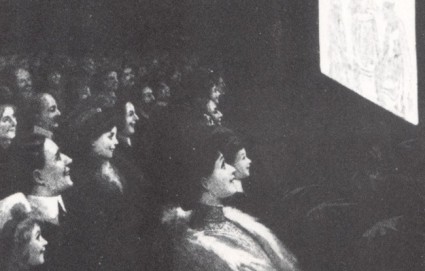
Organized dreaming

One of the plans behind The Bioscope is to develop themes, or strands, one of which is memoir evidence of filmgoing in the silent era. There are still people around who can be intervciewed about cinema in the 1930s, and assorted oral history programmes exist, but for the earlier period, if we want to recover what the experience of going to the cinema was like, we must have recourse to memoirs, oral history recordings, or contemporary interviews.

I have collected a large number of quotations from memoirs of life in London before 1914 which have references to the cinema. One marvellous passage that I was not able to use in my research, simply because it comes from the north of England, is in Jack Common’s autobiographical novel Kiddar’s Luck (Turnstile Press, 1951). This is a classic memoir in any case, but his recollections of going to see films pre-World War One in Heaton, near Newcastle-on-Tyne, are observant and richly informative:

He [his father] still took me about with him on occasion. We had a more or less established practice on a mid-week night of the day-shift of going to a new entertainment called ‘the pictures’, or in older dialect, ‘the pictors’. This was a cheap night out for him. The pictures cost no more than a copper or two, and my presence preserved him from extensive drinking if he ran into any of his mates. He always did. The two of them would disappear into a pub, leaving me outside …

Because I was outside, my father had an excuse for the curtailing of good cheer which his economics as a raiser of young on a working-man’s wage was asking for. Soon we made our way from pub to picture-hall to be followed all in good time, by many millions born and unborn who were to find themselves propelled by the same reasons that moved us toward this organized dreaming in semi-darkness and drought.

We then get a vivid picture of the reality of the cinema performance, with the important observation about the transitional nature of the audience from the conviviality and sense of ownership inherited from music hall, to the future ‘threat’ of the Art of Cinema:

It wasn’t so very organized for us, of course. The hall was in fact, a shabby affair which must have been a mission at some time. It had no electric signs or elaborate foyers. There might have been a couple of posters, and there was an old woman sitting by the kerb selling little hard pears out of a soap-box on wheels. Inside, there was no ramp to the floor. The seating was forms or hard chairs linked in fives by planking. If you couldn’t see at the back, you stood up; if the people in front of you stood up, you climbed in to your seat. This happened in moments of culminating excitement when on the screen – but it had ceased to be a screen; it was events we all saw with our own eyes – the faithful dog panted over the last ridge with the message that meant reprieve in its collar, or the blood of the wounded hussar dripped through the trap-door on to the table at which his enemies stood. I yelled and stamped on my feet, and was often in danger of falling into the next row or knocking somebody’s hat off, all of which amused my father immensely. Most of the audience made some noise or other. You see, they were recruited from the music-hall and the melodrama; they had not yet learnt the separate and introverted enjoyment so proper to the Art of the Cinema. The fact that the pictures were silent gave everyone a natural right to comment as and when and how. They weren’t taking the mike out of the show, by any means, no. Films were still far too real for anybody to be cynical about them. It was the utterly convincing reality of these scenes which compelled us to behave as though we were at the point of joining in upon them.

Rare for memoirs of cinema-going at this time, he puts in something about the musical interludes that were a common feature of the first shows:

Half-way through there was a musical interlude during which patrons had time to withdraw for refreshment to the nearby boozer. The lights went up on a shallow stage behind a row of artificial flowers and ferns. At the side of that, a gramophone began playing. There was a great deal of shuffling in the rows as stout matrons in cloth caps and shawls and heavily moustached blokes in mufflers or celluloid dickies pushed their way out. Quite a lot of these worthies never returned. When that became apparent without a doubt there would be a scramble for better seats on the part of those who reckoned themselves unsuited. But for the while we waited until the slides came on. The gramophone struck up ‘When the Fields are White with Daisies, I’ll Return’, and the first slide showed on the screen as half the lights were dimmed. It showed a sailor taking leave of his sweetheart – upside-down because the operator had gone out for a drink, too, and his boy had taken over. As the gramophone scratched and hooted its way through the immortal ballad, we waited to cheer each new slide.

When the fields are white with daisies
And the roses bloom again –
Let the lovelight in your heart
brightly burn.

For I’ll love you, sweetheart, always,
So remember when you’re lonely –
When the fields are white with daisies,
I’ll return.

He concludes with some delightful memories of the ramshackle nature of the cinema show, and a reminder that not evertyone was totally in thrall to the silver screen:

At last, there was Jack with his kit-bag at the girl’s feet and very truly the fields were white with daisies. We all joined in the final chorus and cheered its conclusion. Yes, but where was the operator? Very likely, after an interval of general unease and peering about, that last slide would wriggle across the screen and be held through a complete repeat of the song. The second half of the programme was often bulked out with films we had seen before, or with old news-reel material rather grossly re-edited in the projection box. A popular item such as King Edward’s funeral got dished up in some very queer shapes as the continued ripping of sprocket-holes made more and more cuts necessary.We were well-satisfied. I used to describe the whole show to my mother afterwards, and it always annoyed me that she couldn’t be made to understand the magic of it. She thought it was some trick business, manifestly inferior to the theatre, that’s why it was so cheap.

Marvellous stuff. Look out for more in future posts – and hopefully not just from Britain.