Wanted by the BFI

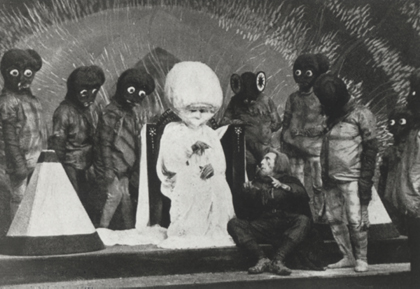
The First Men in the Moon (1919), from http://www.bfi.org.uk/mostwanted

In 1992 the BFI launched Missing Believed Lost. It was a campaign to raise awareness of Britain’s lost film heritage, and the work of the National Film Archive. A handsome book of the same title was published, edited by Allen Eyles and David Meeker, which listed 100 lost British feature films that the Archive was seeking in particular. In some cases they were being a tad disingenuous, because the Archive was fairly confident that prints existed out there somewhere and hoped to lure them out of the hands of collectors into national safekeeping.

The project was successful. A number of films were uncovered, including several early works by director Michael Powell, while among the few silents that the book listed one complete example and parts of others from the Ultus serials have turned up, plus the Walter Forde feature What Next? and the Ivor Novello-Mabel Poulton feature The Constant Nymph – all three can be seen at the BFI Southbank this August.

Eighteen years on, and to mark its seventy-fifth anniversary, the BFI National Archive is launching another lost film project, entitled Most Wanted. This time it has narrowed their target list to 75 (neatly enough) and demonstrated how changing tastes have altered to a degree what we now consider most precious among lost films. The original Missing Believed Lost stopped in 1945, with the still-missing Flight from Folly. The new list delves enthusiastically into exploitation films from the 1960s and 70s, and amazingly ends with a title as recent as 1983 ( Where is Parsifal? starring Tony Curtis and Orson Welles). The original book was mean when it came to silents, listing just ten. The new list reflects a greater respect for Britain’s silent film heritage, with twenty titles (interestingly, one title from the original book, the 1916 She, is not included in the new list, while all the other silents are).

Things have moved on in other ways since 1992. Now we have the Internet, and the BFI has gone to town in a most impressive way, produced a micro-site for the Most Wanted project, with impressively researched accounts of each film, including credits, synopses, reasons for its importance, and notes on when the film was last known to be seen. Each is richly illustrated with some evocative stills, but – naturally enough – not by clips…

Here’s the list of twenty lost silents, with short descriptions taken from the BFI site (those marked with an asterisk were selected for the 1992 book):

The Adventures of Mr Pickwick (1921 d. Thomas Bentley)
Silent version of Dickens’ breakthrough novel, directed by one of the writer’s most prolific screen adapters.

The Amazing Quest of Mr Ernest Bliss (1920 d. Henry Edwards)
A much acclaimed mini-serial showcasing the talents of Henry Edwards and Chrissie White, both major contributors to the success of the Hepworth production company.

The Arcadians (1927 d. Victor Saville)
Victor Saville’s solo directorial debut: a silent adaptation of the stage musical. ‘Pastoral masterpiece’ or woeful mistake?

The Crooked Billet (1929 d. Adrian Brunel)
One of the last films made by Michael Balcon’s Gainsborough studios before sound took over from silent cinema.

The First Men in the Moon (1919 d. J.L.V. Leigh)
The first screen adaptation of a novel by the influential British author H.G. Wells, and an early example of British science fiction cinema.

The Last Post (1929 d. Dinah Shurey)
A patriotic war picture from the only woman feature film director working in Britain at the end of the 1920s.

Lily of the Alley (1924 d. Henry Edwards) *
An experiment in film form that may be the first [British] silent fiction feature ever made without intertitles.

London (1926 d. Herbert Wilcox)
The adventure of a girl of the slums who is adopted by a titled lady but eventually marries an artist.

Love, Life and Laughter (1923 d. George Pearson) *
According to contemporary reports, a genuine lost classic: the struggle of an impoverished author and a little chorus girl against the odds of the world.

Mademoiselle from Armentieres (1926 d. Maurice Elvey)
Based on a popular trench song of the First World War, the film tells the story of a patriotic French woman who falls in love with a British soldier and feeds misinformation to the Germans. [Around half the film survives at the BFI National Archive]

Maria Martin or The Mystery of the Red Barn (1913 d. Maurice Elvey)
Film adaptation of a play about the notorious Victorian murder at Polstead in Suffolk in 1826. As the contemporary publicity put it, “A box office magnet on its title alone”.

Milestones (1916 d. Thomas Bentley) *
Family epic charting several generations of shipbuilders who are radical in youth but become conservative in later life.

The Mountain Eagle (1926 d. Alfred Hitchcock) *
Hitchcock’s second film and the only one of his 57 films as director to be lost: a Kentucky-set mountain melodrama of lust, injustice and social stigma.

The Narrow Valley (1921 d. Cecil Hepworth)
A young couple find romance amidst a narrow-minded valley community.

Reveille (1923 d. George Pearson) *
A story of the hectic, forced gaiety at the end of the First World War and the disillusionment which came to many soon after. [Note to the BFI – a short sequence from Reveille does survive somewhere (the famous ‘two-minutes’ silence’) and was shown on BBC2’s The Late Show 30 September 1992 in a programme on the Missing Believed Lost project]

The Story of the Flag (1927 d. Anson Dyer)
Britain’s first “full-length animated feature film” by the country’s most successful pre-war cartoon filmmaker, Anson Dyer.

A Study in Scarlet (1914 d. George Pearson) *
Murder, betrayal and revenge in an ambitious early adaptation of Sir Arthur Conan Doyle’s first Sherlock Holmes story.

Tip Toes (1928 d. Herbert Wilcox)
Three penniless music hall artistes take a suite at a fancy hotel, where the girl pretends to be an heiress in pursuit of an English Lord.

Who is the Man? (1924 d. Walter Summers)
Romantic melodrama that featured John Gielgud’s screen debut.

Woman to Woman (1923 d. Graham Cutts)
A British officer and a French dancer meet during the war, but are parted by accident, only to be reunited just before her death.

That’s a well-chosen list, with a number of titles that would be certain to be recognised as classics were they to re-emerge, even at this distance of time.

And what’s missing from this list of what’s missing? Well, one could go on and on and on, since hundreds of British silents are missing (no one had ever counted exactly how many). However, the Bioscope will indulge itself just a little by listing another twenty-five to bring it up to a missing 100 (including some non-fiction titles, which the BFI’s list excludes). The BFI would certainly rejoice if anyone of these turned up as well.

  • Oxford and Cambridge Boat Race (1895) [probably the first commercial British film]
  • The Mesmerist; or, Body and Soul (1898) [former spiritualist G.A. Smith makes a trick film about spiritualism]
  • Dan Leno’s Cricket Match (1900) [The Victorian era’s greatest comic performer captured on film]
  • The Macedonian Atrocities (1903) [documentary series filmed by C. Rider Noble]
  • Robbery of the Mail Coach (1903) [pioneering multi-scene drama made by Sheffield Photo Co.]
  • Voyage to New York (1904) [40-minute travelogue made by Charles Urban]
  • The Empire of the Ants (1906) [innovative anthromorphism from wildlife filmmaker Percy Smith]
  • Henry VIII (1911) [every print of this Shakespeare drama made by Will Barker was supposedly burned in a bizzare publicity stunt]
  • Hamlet (1912) [Will Barker film in which the actress to play Ophelia was famously recruited because she could swim]
  • With our King and Queen Through India (1912) [around ten minutes survive of this two-and-a-half-hour Kinemacolor spectacular account of the 1911 Delhi Durbar]
  • A Message from Mars (1913) [stagey but no doubt fascinating story of Martian who comes to earth with moral mission] [Update: This film exists! See comment]
  • The World, the Flesh and the Devil (1914) [Britain’s first colour feature film]
  • A Welsh Singer (1915) [directed by Henry Edwards, probably Britain’s most accomplished director of the 1910s]
  • The Manxman (1916) [much-praised drama directed by George Loane Tucker]
  • Hindle Wakes (1918) [Maurice Elvey’s first attempt at the story he would triumphantly film again in 1927]
  • Kiddies in the Ruins (1918) [wartime poignancy from George Pearson]
  • Towards the Light (1918) [characteristic Henry Edwards-directed tearjerker]
  • Victory and Peace (1918) [part of one reel is all that survives of the propaganda epic directed by Herbert Brenon and starring Ellen Terry]
  • Jack, Sam and Pete (1919) [Ernest Trimmingham gives first leading performance from a black actor in British film]
  • The Land of Mystery (1920) [drama loosely based on life of Lenin, filmed in the USSR]
  • The Mayor of Casterbridge (1921) [adaptation of Hardy novel witnessed in production by Hardy himself]
  • Number 13 (1922) [unfinished Hitchcock short]
  • Paddy-the-Next-Best-Thing (1923) [directed by lost talent Graham Cutts, starred D.W. Griffith favourite Mae Marsh]
  • The Virgin Queen (1923) [filmed in Prizmacolor and starring socialite Lady Diana Manners]
  • The Ball of Fortune (1926) [football drama with legendary Billy Meredith – the BFI holds a trailer for the film]

No doubt you can name your own (and please do).

At the same time the BFI has launched Rescue the Hitchcock 9, calling for funds to help preserve the nine silent Hitchcock feature films that do survive. You can donate here. See also the Bioscope’s silent Hitchcock filmography and the cod review of The Mountain Eagle in 2008’s Bioscope Festival of Lost Films.

Finally, and by way of a sort of obituary, the BFI’s notes for The Arcadians state that “An incomplete and deteriorating nitrate print (from a private collector?) was apparently viewed prior to July 2008 by independent film scholar F. Gwynplaine MacIntyre.” Last week it was announced that science-fiction writer and prodigious Internet Movie Database film reviewer F. Gwynplaine MacIntyre had apparently committed suicide by setting fire to his New York flat. It’s a sad end for one whose comments on silent film forums and the IMDb have greatly enlivened debate, even as they sowed the seeds of confusion. Macintyre was fond of spinning tales about his supposed exclusive access to a private collection of films which he would describe, one by one, in passionate detail. Macintyre was knowledgeable about film (particularly silent film), and had some descriptive skill, but he drew no distinction between truth and fantasy, and in the case of The Arcadians – as with so many other lost films he reviewed on IMDb – he is merely telling tales, and no more saw the film than you or I. He remained a writer of fiction to the end.
Summer on the Southbank

BFI Southbank

We don’t normally highlight what takes place on a regular basis at film theatres and cinematheques, but looking at the August booklet for the BFI Southbank, it’s time to make an exception. It’s certainly a rich offering for silents and archival film in general.

The headline attraction is the UK premiere of the reconstructed and restored Metropolis (1927), now with an extra twenty-five minutes of footage, as documented on the Bioscope here, here and here. The screening takes place on 26 August, at 18:00.

The BFI is celebrating the 75th anniversary of its achive. Originally known as the National Film Library, it has subsequently been known as the National Film Archive, the National Film and Television Archive, BFI National Film and Television Archive, BFI Collections, BFI National Film and Television Archive once again, and now BFI National Archive. Passing over whatever insecurities have led to such a long-running identity crisis, you can help celebrate its 75th by attending its Long Live Film screenings, which are highlighting previously lost films that the Archive had particularly sought. Now, after decades hidden from view, you can see Britain’s answer to Fantomas, George Pearson’s Ultus and the Grey Lady (1916) plus other Ultus fragments (9 August, 18:00), Cecil Hepworth’s Helen of Four Gates (1920) (11 August, 18:10), Walter Forde’s What Next? (1928) (18 August, 18:20) and Ivor Novello and Mabel Poulton in The Constant Nymph (1928) (20 August, 18:10). Look out soon for BFI Most Wanted, a relaunched search for 75 lost British films, which is certain to include some key silent titles.

Among other attractions, look out for Alfred Hitchcock’s The Lodger (23 August 20:40); a programme of early archival treasures, A Night in Victorian and Edwardian London (4 August, 18:10); and Kenneth MacPherson’s experimental classic Borderline (1930), with Paul Robeson and H.D., introduced by film artist Stephen Dwoskin (5 August, 18:10). Collecting for Tomorrow (7 August, 13:30) is a discussion event, hosted by Dylan Cave, on the future of film collecting, which will include clips of recently acquired material including the work of modern silent filmmaker Martin Pickles (previously covered by the Bioscope).

Along the non-silent material, I must note the screenings of nitrate prints that are taking place at the BFI Southbank in July and August, also part of Long Live Film. Cellulose nitrate film stock stopped being employed in cinemas in 1952, and became the defining challenge for film archives in the latter half of the twentieth century. Nitrate film, owing to its high silver content, gavce the films on the screen a lustrous finish which is missing from safety film stock (let alone digital copies). However, because of the fire risks, a special licence is required to show nitrate film and the BFI has the only such licence in the UK. No silent nitrate films are on offer, more’s the pity, but over the two months you can see Fugitive Lady (1950), The Private Life of Henry VIII (1933), The Yearling (1946), Brighton Rock (1947), Anchors Aweigh (1945), The Ghost of St Michael’s (1941), Volga-Volga (1938) and Les Maudits (1946) as they were originally seen.

On the smaller screens at the BFI Southbank, the drop-in archive facility the Mediatheque has a special focus on British silents, including such titles as At the Villa Rose (1920), Comin’ Thro the Rye (1923), High Treason (1928), The Man Without Desire (1923) and Sweeney Todd (1928).

Finally there is the welcome return of the Ernest Lindgren Memorial Lecture. The Lecture, named after the National Film Archive’s esteemed founder curator, used to be a prestigious annual event at which a leading archivist or film historian would give a keynote presentation on the state of things. Sadly allowed to lapse in recent years, the Lecture returns on 24 August (18:10) with Paolo Cherchi Usai, Director of the Haghefilm Foundation. As film archivist of world renown and author of the provocative The Death of Cinema and co-editor of the essential text Film Curatorship: Archives, Museums and the Digital Marketplace, this should be a talk not to miss.

More information on all the above from the start of the July at the BFI Southbank site.

Shoot a film, save a film

How good are you with a movie camera? Better than me, I hope, and if you are looking for a subject to bring out your finer skills and commitment to the moving image medium, then why not participate in the AMIA Short film Competition?

AMIA – the Association of Moving Image Archivists – has announced a short film competition on the theme of ‘Preserving the world’s moving image heritage’. AMIA is celebrating its twentieth years as an organisation dedicated to preserving moving images, and it wants the competition to provide an opportunity “to emphasize the importance of saving our moving images as important educational, historical, and cultural resources”.

The specific challenge is to produce a film running between two and three minutes which conveys the importance of saving the world’s moving image heritage. The competition is open to everyone, and you can submit more than one production. All entries must be in the English language or with English subtitles. Submissions may include any combination of original and archival material. All entries must be on DVD, formatted Region 1 or 0.

http://www.AMIA2010.org

Submissions will be accepted from 15 June 2010 and the deadline is 30 August 2010. There will be be Grand Prize of $2,500 (USD) prize, to be announced on October 27 as part of the World Day of Audiovisual Heritage celebration, and will be screened at the AMIA 2010 conference‘s Archival Screening Night, on 5 November 2010 in Philadelphia, PA. The runner-up will receive $1,000 (USD). The winner, runner-up and finalists’ productions will be included on the AMIA website.

Further details, including submission rules, technical requirements and entry form, are available on the AMIA website. Get cranking.

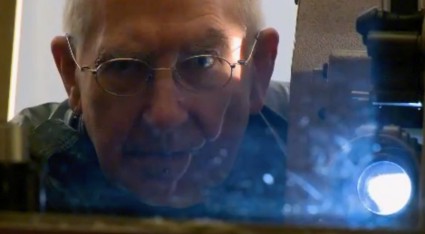
(The photo at the top of this post shows J.B. McDowell manning the camera, with British newsreel producer William Jeapes to the right, and Warwick Trading Company manager Will Barker obscured behind McDowell. It dates from 1908)

The lost Americans

The Sergeant (Selig Polyscope, 1910), from http://www.filmpreservation.org

You know, it’s getting difficult to keep up with all the silent news just at the moment. Hot on the heels of the discovery of a lost Chaplin film, A Thief Catcher, the National Film Preservation Foundation has announced a partnership with the New Zealand Film Archive to preserve and make available a collection of 75 American films (all silents) that no longer survive in American archives.

The films range in date from 1898 to 1929 and are a mixture of shorts and features, fiction and non-fiction. The plan is to preserve the films over the next three years and the make them accessible through the five major American silent film archives: the Academy of Motion Picture Arts and Sciences, George Eastman House, the Library of Congress, the Museum of Modern Art, and the UCLA Film & Television Archive. Copies of the complete films will also be publicly available in New Zealand and viewable on the National Film Preservation Fund Web site.

A full list of the films hasn’t been announced as yet, but these are the highlights:

  • The Active Life of Dolly of the Dailies—Episode 5, The Chinese Fan (Edison Manufacturing Co., 1914). In this episode of the famous serial (previously entirely lost in the United States), ace woman reporter Dolly Desmond, played by Mary Fuller, rescues the editor’s daughter from kidnappers and gets the scoop. In the early 1910s, on-going serial narratives starring intrepid heroines lured female moviegoers back to the theater week after week.
  • The Better Man (Vitagraph Company of America, 1912), a Western in which a Mexican American outlaw proves himself the better man. This film will be preserved through funds raised in February by the “For the Love of Film” Blogathon.
  • The Big Show (Miller Brothers Productions, 1926), the only surviving fiction film made by the famous Oklahoma-based Wild West Show managed by the Miller Brothers. The film showcases performances by many of the troupe’s performers as well as its owner, Col. Joseph Miller.
  • Billy and his Pal (George Méliès / American Wild West Film Company, 1911), a Western filmed in San Antonio, Texas, and the earliest surviving film featuring Francis Ford. The actor-director introduced the movie business to his younger brother, John, who soon blossomed as director. Released in New Zealand as Bobby and his Pal.
  • Birth of a Hat (Stetson Company, 1920), an industrial short illustrating how Stetson makes its hats.
  • The Diver (Kalem Company, 1916), a documentary showing how to set underwater explosives.
  • Fordson Tractors (Ford Motor Co., 1918), an industrial film promoting the all-purpose tractor introduced by Henry Ford & Son in 1917.
  • The Girl Stage Driver (Éclair-Universal, 1914), an early Western filmed in Tucson, Arizona. American-made Westerns were in demand by movie audiences around the globe and helped establish the United States as the major film-exporting nation by the late 1910s.
  • Idle Wives (Universal Moving Pictures, 1916), the first reel of a Lois Weber feature in which a film inspires three sets of moviegoers to remake their lives. More of the film exists at the Library of Congress.
  • International Newsreel (ca.1926), newsreel including five stories from the United States and abroad. By the late 1910s, newsreels became a regular part of the movie program. Because the footage was usually cut up and reused, very few newsreels from the silent era survive in complete form.
  • Kick Me Again (Universal Pictures / Bluebird Comedies, 1925), a short comedy with Hungarian silent star Charles Puffy. As America became the center of world film production in the 1920s, European actors, such as Puffy, came to Hollywood to build their careers.
  • Little Brother (Thanhouser Film Corporation, 1913), one of two one-reelers from New York’s Thanhouser Company repatriated through the project.
  • Lyman Howe’s Ride on a Runaway Train (Lyman H. Howe Films, 1921), a thrill-packed short entertainment that was accompanied by sound discs which survive at the Library of Congress.
  • Mary of the Movies (Columbia Pictures, 1923), Hollywood comedy about a young woman seeking stardom in the movies. This first surviving film from Columbia Pictures exists in an incomplete copy.
  • Maytime (B.P. Schulberg Productions, 1923), a feature with Clara Bow in an early role. Nitrate deterioration has reached the point where “blooms” are starting to eat away at the emulsion.
  • Midnight Madness (DeMille Pictures, 1928), comedy starring Clive Brook as a millionaire who decides to teach his golddigging fiancée a lesson.
  • Run ‘Em Ragged (Rolin Films, 1920), a short featuring slapstick comedian Snub Pollard.
  • The Sergeant (Selig Polyscope, 1910), a Western filmed in Yosemite Valley when the area was managed by the U.S. Army. This film will be preserved through funds raised in February by the “For the Love of Film” Blogathon.
  • Trailer for Strong Boy (Fox Film Corporation, 1929), a “lost” feature directed by John Ford and starring Victor McLaglen as a courageous baggage handler who thwarts a holdup. No other moving images from this film survive.
  • Upstream (Fox Film Corporation, 1927), a feature directed by four-time Academy Award winner John Ford. Only 15% of the silent-era films by the celebrated director are known to survive. This tale of backstage romance stars Nancy Nash and Earle Foxe.
  • Why Husbands Flirt (Christie Comedies, 1918), one of the nine short comedies that will be preserved through this project.
  • The Woman Hater (Power Picture Plays, 1910), a one-reel comedy starring serial queen Pearl White.
  • Won in a Closet (Keystone Film Company, 1914), the first surviving movie directed by and starring Mabel Normand. Released in New Zealand as Won in a Cupboard.

Among the numerous highlights there are John Ford’s Upstream, a significant addition to the small number of silent features directed by Ford (there is to be a retrospective on Ford’s silents at this month’s Il Cinema Ritrovato in Bologna, though not with Upstream, fairly obviously) and the Clara Bow feature Maytime, though let’s not overlook such certain gems as the proto-sound Lyman Howe’s Ride on a Runaway Train, documentaries on how to make stetson hats and how to set underwater explosives, and particularly a rare example of a complete silent newsreel (i.e. with full titles and all the stories in place – so many newsreels only survive as individual stories).

There’s also the heartening news that the preservation of two of the films, The Better Man and The Sergeant, is to be funded by monies raised by the recent For the Love of Film film preservation blogathon, which ran 14-21 February 2010 – hats off to the blogosphere for that noble action (and read more about this aspect of the preservation at the highly commendable Self-Styled Siren blog). Preview clips of The Sergeant are available on the NFPF site.

This isn’t expected to be the last such international film preservation project (and it emulates an earlier Australian/American initiative). The Library of Congress estimates that roughly one-third of American silent-era features that survive in complete form exist only in archives in other countries. That’s an exciting prospect, but we must also think of the cost – preserving the New Zealand treasure trove is going to cost $500,000. Just consider the millions upon millions that will be required to preserve just the entirety of the American silent film heritage, and then add up everyone else’s heritage. Tough decisions lie ahead.

There’s more on the project and the films’ discovery from The New York Times.

Forever film

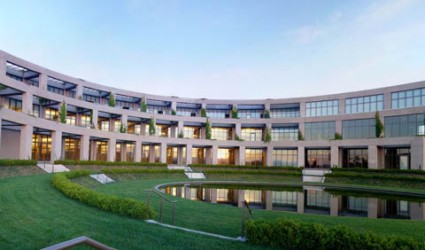
The National Audiovisual Conservation Center of the Library of Congress, Culpeper, Virginia

When good film archivists die, they’ll probably go to Culpeper. Or somewhere quite like it. Culpeper VA is home to the National Audiovisual Conservation Center (NAVCC) of the Library of Congress, a state-of-the-art film preservation centre funded by Packard half of Hewlett-Packard and a temple to the art of preserving the film heritage – 1.1 million film, television, and video recordings, to be precise.

The reason for mentioning the NAVCC is to introduce an engrossing account of the scale of the work that goes on there, written by Ken Weissman, Supervisor of the Film Preservation Laboratory. The piece, ‘The Ultimate Archive System‘, was written for Creative COW Magazine, and although it covers the breadth of the Library’s film collection across the last century and more, it has much to say about the treatment of its earliest films:

Here, for example, is what he writes about paper prints, which were once treated photochemically but are now being tested for digital restoration:

We started as a photochemical laboratory, and are primarily a photochemical laboratory to this day. It has only really been in the past half a dozen years, or less, that you can even begin a conversation that might convince people in the know that preserving motion pictures might be done digitally. So here in our lab, we began a pilot digital project for a very special collection that we have in the Library of Congress: the paper print collection.

These paper prints exist because of a vaguery in the copyright law at the time that motion pictures were invented. The Copyright Office at the Library interpreted the law to say that a motion picture film is simply a series of still photographs, and therefore the still photographic copyright law applied. If you wanted to copyright a motion picture, you had to provide the Library of Congress two copies of the film, and they had to be on paper. Not film.

A process was invented to literally create long strips of photographic paper, exactly the size of 35mm film stock, and then create contact prints from the original 35mm negatives, onto those long strips of paper. These were then deposited with the Library.

There are over 3000 titles within that collection, some of the earliest films ever made — from 1894-1915, with the vast majority from before 1912. Most of them are unique. In other words, these paper prints are the only copies of these films. They represent the single largest collection of early motion pictures in the world, by far. The Library is rightfully very proud of this collection.

The paper prints had been locked in a vault in the bowels of one of the library buildings, and rediscovered by librarian Howard Walls in the late 30s. The paper itself is still stable, but for the most part, you can’t see the images very easily except by looking directly at the paper — where of course there is no motion.

This is why there have been several attempts over the course of history since their rediscovery to put them back on film. One of the first was by Kemp Niver, and his company called Renovare. He took these 35mm prints (and there are some that are actually a larger gauge than that), and re-photographed them using a clever device that he built, printing to 16mm film. We have used various models of these Niver printers, including one where we replaced the 16mm camera with a 35mm camera, in order to print back to 35.

All of the processes have been interesting, and they’ve all been successful to some degree. However, they’ve also been unsuccessful to a great degree, in that the images are alternately soft, or fuzzy, or very shaky. There was also no way to accurately register the images. In fact, we’ve concluded that in many cases, the images aren’t very well registered on the paper.

The obvious solution is to scan the images, then take advantage of digital processing to stabilize them, correct positioning and so on. Our first scans of the paper prints were 2K x 2K, which theoretically should have been good enough, but in our analysis of the imagery, we think it might be better to go to 4K x 4K. But that’s one part of the pilot program, to figure out exactly how to do it. It’s more of a theoretical workflow because we haven’t practically implemented it yet, but we’re getting close.

Georges Méliès on a Library of Congress paper print

From film to paper to film to a row of ones and noughts – these particular ‘films’, a great many of which no longer exist in any other form than the paper on which their successive images are now held, would seem to be ripe for digitisation. But for Weissman, digitisation is essentially a means for returning the images to film. He argues that knowledge of of how ambient temperature and relative humidity affect decay, measured in a Preservation Index, means that film which under normal conditions might only last fifty years before serious degradation sets, when “stored at 25F and 30% relative humidity, you can expect it to last 40 times longer than that – 2000 years.”

That’s why, as we move further into digital technologies, the plan for now is still to scan the images, restore or preserve them as needed, then run them back to film, and put the film away at 25 degrees, 30% relative humidity, for practically forever. For most people, in practice, somewhere between 600 and 2000 years is beyond forever. Because frankly, once you get to that point, what are you really worrying about?

It reads likely a strangely regressive strategy, which so many other institutions are looking to become every more the completely digital library. But film takes up space, digitally speaking – one frame scanned at 4K amounts to 128MB, he informs us, or 24 terabytes for the average feature film. And then you’re not done with it, because you’ll probably have to migrate the files after five years “to the next greatest things”, and have back-up copies, and back-ups of backups, and then repeat the processes five years after that, and then again and again, and keep on paying for it all…

But what also drives Weissman is the love of film itself. A digital file tells you nothing until you can find the kit to run it (if it hasn’t become obsolete in those five years). But with reassuring filmstock all you need is a light source, a lens and a screen, and you can see what you’ve got. And it takes you back to what you started from. “I can’t help feeling in my heart of hearts that the simple solution is usually the best” he argues, adding “and film is a pretty simple solution.”

Film archivists like film, and arguments that film might actually be the best, even the most economic form for storing film long term, is bound to appeal. Until they stop producing film stock, of course. And then there are all those ‘films’ that weren’t ever on film because they were made digitally in the first place, which is what we’re making now. That might at least make the NAVCC’s challenge a finite one, because there will come a point when we stop producing films on film and so you’ll have a measurable problem. But what gets done with the 21st century’s motion picture medium of choice – born digital – doesn’t get mentioned.

It’s not easy having to think about keeping an impermanent medium forever.

For the love of celluloid

Two videos have turned up online this week which take us on tours of two enterprising small cinema museums.

This video from Swissinfo.ch reports on the Lichtspiel cinema in Bern, Switzerland, which also operates as an archive and museum. The interviewee is the cinema’s director, David Landorf, who describes the thrill of opening any film can, champions the simplicity of cinema technology, and shows us such treasures as a Scopitone (a sort of video jukebox), a Mutoscope and a cine fader (you stuck it on front of a camera lens and opened or closed it for automatic fades).

Secondly, The Guardian has produced a behind-the-scenes look at the Cinema Museum in London, based around an interview with its founder Ronald Grant, taking him from his days selling film stills in Portobello Road to guardian of a precious collection of Britain’s cinema heritage, still seeking a secure home. There’s a great selection of photographs of Ronald in years past sporting a fine assortment of hairstyles.

There’s a palpable sense in both videos of cinemas as living things, of something that dies when a cinema closes down. Out of this comes the essential, life-giving task for these museums of maintaining not just the artefacts but the memory of the cinema as something central to twentieth-century lives. Cinema museums must be about people more than they are about projectors.

Memory of the world

Roald Amundsen and his Norwegian team reach the South Pole. From http://unesco.no/generelt/english/norwegian-documentary-heritage

In the report on the British Silent Film Festival I covered the Amundsen polar films. What I didn’t mention is that the films have been included in UNESCO’s Memory of the World programme. It seems worthwhile just taking a look at Memory of the World and identifying those silent films which are registered on it.

UNESCO’s Memory of the World is an ongoing programme of identification and commemoration of key artefacts held in archives that are important to the world’s documentary heritage. The objective of the programme is described thus:

The vision of the Memory of the World Programme is that the world’s documentary heritage belongs to all, should be fully preserved and protected for all and, with due recognition of cultural mores and practicalities, should be permanently accessible to all without hindrance.

It has these three main mission statements:

  • To facilitate preservation, by the most appropriate techniques, of the world’s documentary heritage.
  • To assist universal access to documentary heritage.
  • To increase awareness worldwide of the existence and significance of documentary heritage.

In practice the Memory of the World means a register of the world’s archival gems. Archives, museums and libraries vie with one another for the honour of having their prized items listed on on the register (though nominations are by country, not by institution). There’s no monetary gain involved: merely glory, plus all the strength and worldwide recognition that comes from UNESCO’s backing. Consequently it is quite an achievement for the silent films and film collections that have made it to the register, although together they present a rather uneven picture of what is most precious about the world’s early film heritage.

These are the silent films (with their nomination details) currently on the register, alongside such world treasures as the Bayeux tapestry, the diaries of Anne Frank, Magna Carta and Criminal Court Case No. 253/1963 (State Versus N Mandela and Others).

METROPOLIS – Sicherungsstück Nr. 1: Negative of the restored and reconstructed version 2001

Documentary heritage submitted by Germany and recommended for inclusion in the Memory of the World Register in 2001.

Fritz Lang’s motion picture METROPOLIS (1927) is without doubt famous testimony of German silent film art, a testimony that made history. The combination of motion picture and architecture: this is above all and still METROPOLIS, the film which was shot by Fritz Lang in the Babelsberg Film Studios in 1925/1926, which, due to its immense expenditure, caused the UFA, the largest German film group, to run into financial difficulties, which then had a glittering première in Berlin in January 1927, and an unparalleled success all over the world ever since – and which became the symbol of a (film-) architectural model of the future.

Substantially shortened and changed almost immediately after the première in Berlin, only one (though fragmentary) of the initially three original negatives of METROPOLIS has been left in the possession of the German Federal Archives, as well as master copies of the lost original negatives in a few archives abroad.

As a result of intense investigations on the initiative of the Friedrich Wilhelm Murnau Foundation, a new reconstruction has been produced. It was first shown in February 2001, on the occasion of the Berlin Film Festival. Considering that the result this time is again not the original version of METROPOLIS, but “only” a synthetic version made of the fragments handed down, it comes, however, as close to the original piece of work as possible. With this reconstruction project a new digitized “original” negative has been produced to provide more independence and better copying quality in the future. This reconstructed version of METROPOLIS is proposed for nomination here.

Lumière Films

Documentary heritage submitted by France and recommended for inclusion in the Memory of the World Register in 2005.

The collection nominated for inclusion in the Memory of the World Register comprises all the original films (negatives and positives) known as the Lumière films (i.e. having round perforations) and listed in the catalogue of 1,423 titles produced at the factory of the brothers Louis and Auguste Lumière. Since 18 films have been lost, the collection comprises the original films of the 1,405 Lumière titles that have been identified and restored.

Roald Amundsen’s South Pole Expedition (1910-1912)

Documentary heritage submitted by Norway and recommended for inclusion in the Memory of the World Register in 2005.

Roald Amundsen and his 4-man team reached the South Pole, with the help of polar dogs, on 14 December 1911. The expedition, and particularly the dog-sled journey to the Pole, is described as daring and with an exceptionally good logistic planning and execution.

The Antarctic and the Arctic Polar Regions, for several centuries, were regarded as the final frontiers for mankind to conquer, and the North and South Poles were for a long period of time the great goals to attain within geographic discovery.

The discoveries in the polar areas contributed, not least in Norway but also internationally, to greater consciousness of, and political interest in, questions concerning sovereignty and rights in these sea and land areas.

The original film material of Roald Amundsen’s South Pole Expedition documents a great historic achievement, outside the borders of the civilized world and in an extreme climatic environment.

In his time, Roald Amundsen (1872 – 1928) contributed, through several expeditions and together with his teams, to new knowledge within several aspects of polar research. First and foremost, however, he is remembered as a master of the classic polar expedition’s planning and execution.

The film collection is unique, as it documents the important events of this first expedition to reach the South Pole. Though the material is incomplete, it is made up of original sequences, filmed between 1910 and 1912, consisting of negative film and first and second-generation print material.

The Battle of the Somme

Documentary heritage submitted by United Kingdom and recommended for inclusion in the Memory of the World Register in 2005.

The 1916 film The Battle of the Somme is uniquely significant both as the compelling documentary record of one of the key battles of the First World War (and indeed one which has come to typify many aspects of this landmark in 20th Century history) and as the first feature-length documentary film record of combat produced anywhere in the world. In the latter role, the film played a major part in establishing the methodology of documentary and propaganda film, and initiated debate on a number of issues relating to the ethical treatment of “factual” film which continue to be relevant to this day. Seen by many millions of British civilians within the first month of distribution, The Battle of the Somme was recognized at the time as a phenomenon that allowed the civilian home-front audience to share the experiences of the front-line soldier, thus helping both to create and to reflect the concept of Total War. Seen later by mass audiences in allied and neutral countries, including Russia and the United States, it coloured the way in which the war and British participation in it were perceived around the world at the time and subsequently, and it is the source a number of iconic images of combat on the Western Front in the First World War which remain in almost daily use ninety years later …

Finally, it has importance as one of the foundation stones of the film collection of the Imperial War Museum, an institution that may claim to be among the oldest film archives in the world.

The Story of the Kelly Gang (1906)

Documentary heritage submitted by Australia and recommended for inclusion in the Memory of the World Register in 2007.

Just as Fritz Lang’s Metropolis (1927) is testimony to German silent film art, The Story of the Kelly Gang (1906) symbolises both the birth of the Australian film industry and the emergence of an Australian identity. Even more significantly it heralds the emergence of the feature film format.

The Story of the Kelly Gang, directed by Charles Tait in 1906, is the first full-length narrative feature film produced anywhere in the world. Only fragments of the original production of more than one hour are known to exist and are preserved at the National Film and Sound Archive, Canberra. The original poster and publicity booklet provide confirmation of those fragments’ authenticity and together this material represents the unique and irreplacable beginning of feature film culture.

What is striking is just how much film is represented on the register so far. As well as the above, from the sound era there is Luis Buñuel’s Los Olvidados (1950), Norman McClaren’s animation film Neighbours (1952), The Wizard of Oz (1939), the Ingmar Bergman Archives, and the John Marshall Ju/’hoan Bushman Film and Video Collection – though one might query the documentary value of some of these choices. The prominence of film can be seen by looking an individual countries: there have been five items registered by the UK – the Hereford Mappa Mundi, Magna Carta, the Registry of Slaves of the British Caribbean 1817-1834 (submitted by the UK and Caribbean nations), the Appeal of 18 June 1940 (a radio broadcast, submitted by the UK and France), and The Battle of the Somme.

Not everyone would argue that The Battle of the Somme should be among the UK’s top five archival treasures (though I would), and its presence there is due in part to the strong arguments made in its favour by its host archive, the IWM – but nevertheless film is there on the register, again and again. It is not only heartening, but it adds significant strength to the arguments of archives that need to argue the case for the preservation of film as a medium equal to any other. Celluloid is the equal of vellum.

The individual records for the films listed above are worth checking out because there is a link to the nomination forms, which give much supporting information (in English and French) on the films’ preservation and current status. There are also some photographs.

But if you were picking five examples of silent film heritage to represent the world’s documentary heritage, would you have picked those five – or what would you argue should be included?

Finally, the restored Roald Amundsen’s South Pole Expedition film is to be made available on DVD from the Norwegian Film Institute on May 6th – details here.

First films

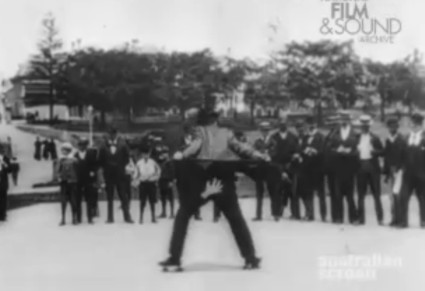
Patineur Grotesque, from australianscreen

I once had the privilege of attending a film show given in Paris, organised to mark the centenary of cinema in 1995, which brought together the various ‘first’ films from countries around the world. They made an interesting selection, for what survived, for how the national contributors interpreted the brief to find the earliest film in their collections, and for the sense of national competition. I was at the National Film Archive in those days, and we decided that we would defeat all comers by choosing Louis Augustin Aimé Le Prince‘s Traffic on Leeds Bridge, ‘filmed’ (on sensitised paper) in late 1888. France’s contribution was a selection of chronophotographic Phonoscope images by Georges Demenÿ from 1892-93, Germany’s the 1895 works of Max Skladanowsky. At this distance in time I forget most of the others, though I do remember vividly the Romanian choice, the 1898-1901 medical films of Gheorge Marinescu. The American choice would have been an Edison title filmed by W.K-L. Dickson – whether it was the ‘monkeyshines’ experiments from 1899 with microphotographs on a cylinder, or Dickson Greeting of 1891 (taken with horizontal feed camera) or A Hand Shake of 1892, where Dickson and his assistant William Heise shake hands to congratulate themselves on having finally cracked the problem of taking motion picture films, I can no longer recall.

There is – usually – something hauntingly special about such films, beyond their firstness. The ghostly hand-waving figure of the monkeyshines experiments, Dickson making to bow to the camera, the distant figures crossing Leeds bridge wholly unaware of their immortality, all contain something mysterious, something appropriate, that says that here is something new in the world. The variety acts captured by the Skaldanowsky camera (wrestlers, dancers, a boxing kangaroo) perhaps less so.

I don’t remember if Australia was included in the Paris show, but in any case time has marched on and what was previously considered the oldest surviving Australian film, a record of the Melbourne Cup horse race filmed by Marius Sestier on 3 November 1896, has now been replaced by a marginally earlier work by the same man. Discovered in 2005 (in France) and now restored by the National Film and Sound Archive of Australia (NFSA), Patineur Grotesque (Humorous Rollerskater) shows a man in exaggerated comic dress rollerskating in a Melbourne park before a small crowd [the location is now known to be Sydney – see comments]. A 10-second clip is available on the australianscreen site (why so short? the full film can only last 40-50 seconds), with the full action described thus:

A man in costume and on rollerskates performs for a gathering crowd. As part of the act the skater trips and falls, then drops his hat. As he attempts to retrieve the hat he continues to fall about. When finally the hat is restored to his head the act comes to a halt.

It is indeed grotesque, particularly when the skater lifts his coat-tails to reveal a hand printed on the seat of his pants. You do wonder whether Australia’s delight at having discovered this earlier film (which they estimate was filmed between 29 and 31 October 1896) might be tempered by some disappointment. It is a silly film, and the Melbourne Cup film that now comes second (and which you can also seen on australianscreen) is a more distinguished work and iconically Australian.

Sestier, the man who filmed both films, was French. He was a Lumière cameraman, one of a team sent around the world to spread the good word of the Lumière Cinématographe. Sestier was sent to Australia to work with the local Lumière concessionary, photographer Henry Walter Barnett. The first film he shot in Australia, Passengers Alighting from Ferry ‘Brighton’ at Manly, was filmed on 27 October, but no longer exists. Patineur Grotesque itself was shot soon after, but the NFSA has found no record of it being shown in Australia – instead it is first recorded being shown in Lyons, France on 28 February 1897.

So Australia has its earliest surviving film, but not its earliest film. The search for Passengers Alighting from Ferry ‘Brighton’ at Manly has to go on, not least to save Australia from the undignified embarrassment that, to be frank, is Patineur Grotesque. First films should be mysterious, or iconic, or in some way fitting that they are first. Otherwise they are just impostors.

More information on the discovery, and on Marius Sestier himself, is on the NFSA’s Marius Sestier Project, which includes fascinating biographical material and evidence of the detailed research undertaken by curator Sally Jackson using family history sources.

Film Biënnale 2010

http://www.filmmuseum.nl/biennale

Film Biënnale (formerly Filmmuseum Biënnale) is a festival of music, art and film held in Amsterdam and organised by EYE Film Institute Netherlands. EYE is the new institute for film in the Netherlands, uniting the Filmbank, Holland Film, the Nederlands Instituut voor Filmeducatie and the Filmmuseum. This year it takes place 7-11 April, with over thirty screenings with seminars and lectures. The Biënnale always has a srong silent film element, this year bolstered up by particular emphasis on film restoration. Here’s how the press release describes the highlights:

The Man with a Movie Camera
The Film Biennale will kick off in Muziekgebouw aan ’t IJ with the screening of The Man with a Movie Camera. Dating from 1929, this cinematographic masterpiece by Russian film pioneer Dziga Vertov continues to impress with its powerful visual style and clever montage of urban life in the Soviet Union. EYE Film Institute Netherlands has restored a ‘vintage print’ from its own collection.

British composer Michael Nyman – best known for his work with Peter Greenaway and the soundtrack to The Piano (1993) by Jane Campion – wrote a special score for the film. This score will be performed live by the Michael Nyman Band.

7 April 8.15 pm Muziekgebouw aan ’t IJ [Attendance is by invitation only]

Meet the MoMA; American film collection highlights
Our guest archive at this Biennale is the Department of Film at The Museum of Modern Art (MoMA) in New York. Founded in 1935 as the Film Library of the modern art museum, this collection now includes more than 22,000 films and four million film stills. Covering all periods and genres, it is the most important international film collection in the United States. The Film Biennale aims to reflect the full diversity of this rich collection with a programme incorporating everything from (experimental art films), to Hollywood classics, to silent movies. The material has been specially selected by the Department of Film and The Museum of Modern Art (Rajendra Roy, Joshua Siegel, Anne Morra, Katie Trainor, and Peter Williamson).

The Meet the MoMA programme includes works by Andy Warhol, Hollis Frampton, classics such as All About Eve (Joseph L. Mankiewicz, 1950), Lady Windermere’s Fan (Ernst Lubitsch, 1925), and highlights from MoMA’s own Cruel and Unusual Comedy programme, focusing on the American slapstick film. Screenings will be introduced by Anne Morra and Ron Magliozzi of the MoMA.

8 to 11 April in EYE (Vondelpark)

From Scratch to Screen
On 8 April, EYE offers the audience a chance to find out more about the challenges involved in restoring silent films. This day aims to underline the ongoing commitment of EYE to preserve and present silent films, despite the complexities presented by the fragile state of the film material. Throughout the day unique film finds and restoration projects will be screened (including several world premieres) illustrating different restoration approaches, with introductions by experts in the field. The day opens with the short film Waffen der Jugend (1912), the first film by Robert Wiene, the acclaimed director of Das Cabinet des Dr. Caligari (1919). This unique print unexpectedly turned up in a building that was about to be demolished in Rotterdam in 2009. Among the other highlights of the day is Liquidator (2010) by Karel Doing, an outstanding project making innovative use of existing archive images of Willy Mullens’ silent film Haarlem (1921). Karel Doing will present his digital adaptation immediately after the screening of Haarlem, preserved as it was found in 2008.

Following the premiere of the most recent Bits&Pieces episodes, another EYE discovery, Glorious Lady (1919) starring Olive Thomas, will be screened for the first time.

8 April 10 am -4.30 pm EYE (Vondelpark)

The Bankruptcy Jazz Live!
One of the highlights of the Film Biënnale is the multimedia film experience The Bankruptcy Jazz Live!, a co-production between Roxy Movies (Frank Herrebout and Leo van Maaren) and EYE Film Institute Netherlands. The Bankruptcy Jazz is the recent and only film based on a scenario written by Belgian poet Paul van Ostaijen in 1921, at a time when Europe was still in ruins. It is the world’s first true Dadaist scenario. The work features a 1920s style, employing an experimental, Dadaist collage technique to combine ready-made film footage and audio. The result is a turbulent, avant-garde spectacle. During the Dutch premiere in Bimhuis, The Bankruptcy Jazz will be staged with singers, actors, a children’s choir and jazz band conducted by composer Wouter van Bemmel. Van Bemmel will also make use of voice samples, sound effects, and music excerpts. Frank Roumen of EYE is directing the performance.

8 April 8.30 pm Bimhuis

Michael Curtiz before Hollywood
Before immigrating to the United States in 1926, Michael Curtiz, director of the Hollywood classic Casablanca (1942), was a very important figure in the thriving Hungarian film industry. Between 1912 and 1919, as Mihály Kertész, he made over forty silent movies – primarily popular genres, but also a few propaganda films. The Film Biennale will dedicate a whole day to screen his entire extant Hungarian work; inspired by the recent discovery of two silent feature films. The programme includes the premiere of the recently discovered and restored feature film Az Utolsó Hajnal (1917), as well as providing an exclusive opportunity to see A Tolonc (1914) while the restoration work is still ongoing. The Austrian film Fiaker nr. 13 (1926) from the EYE collection will also be screened.

The Curtiz Day will be moderated by film historian David Robinson, with contributions by Vera Gyürey and Gyöngyi Balógh (Magyar Nemzeti Filmarchivum), film restorers Simona Monizza and Annike Kross (EYE Film Institute Netherlands), and Miguel A. Fidalgo (author of Michael Curtiz; Bajo la sombra de ‘Casablanca’ [T&B editores, 2009]).

9 April 10 am – 5.15 pm EYE (Vondelpark)

Sessue Hayakawa: Hollywood’s first exotic superstar
Sessue Hayakawa (1889-1973) is primarily remembered for his role as the Japanese colonel in David Lean’s The Bridge on the River Kwai (1957). Less well-known is the fact that he was the first non-Caucasian Hollywood star and producer, and with his good looks and intense gaze he was also a veritable heartthrob at the beginning of the last century. He was especially praised for his subtle, non-theatrical acting style. Through his own production company, Hayakawa produced over twenty films, breaking through the stereotypical casting that required Asians to play ‘the villain’. On 10 April, EYE Film Institute Netherlands presents four successful films from Hayakawa’s career. The same evening, the unique (yet incomplete) EYE print of His Birthright (William Worthington, 1918) will be “completed” by stage actors (this performance is in Dutch only, with no translation!). EYE also has the one and only remaining print of The Man Beneath (William Worthington, 1919). The recently restored film will be screened in Pathé Tuschinski with new music by composer Martin de Ruiter, performed live by the National Symphonic Chamber Orchestra conducted by Jan Vermaning.

Hayakawa Day 10 April 10.30 am -5 pm EYE (Vondelpark)
His Birthright 10 April 8.30 pm Compagnie Theater (in Dutch, without translation!)
The Man Beneath 11 April 11 am Pathé Tuschinski

BaBa ZuLa plays Enis Aldjelis
Rounding off the Film Biennale is a spectacular performance by the internationally acclaimed Turkish group BaBa ZuLa, which will accompany the screening of Ernst Marischka’s film Enis Aldjelis – Die Blume des Ostens (1920) in Paradiso. Long before he became famous for his Sissi-series starring Romy Schneider, director Marischka shot this silent movie in Istanbul about ‘intimate Turkish life’, with an all-Austrian cast, including his wife Lily Marischka as Enis.
Hailing from Istanbul, BaBa Zula is renowned for high-energy live performances, mixing authentic Turkish rhythms, traditional instruments and electronic dub in their music.

Enis Aldjelis was originally discovered in EYE Film Institute Netherlands’ collection and restored by Filmarchiv Austria in 1991. A digitised English version produced by EYE will be screened at this event.

11 April 8.30 pm Paradiso

AMIA Seminar and The Reel Thing XXIII edition
EYE Film Institute Netherlands is hosting a day for film archive professionals on 7 April consisting of a morning seminar about on-line projects and an afternoon programme dedicated to recent film restorations.

The morning programme, organised on behalf of the international Association of Moving Image Archivists (AMIA), highlights recent projects offering on-line access to audiovisual archives. The aim of AMIA is to create an international platform for people and organisations involved in the preservation and presentation of audiovisual archives.
The afternoon programme, the XXIII edition of The Reel Thing, presents the most recent developments in film restoration and preservation, with demonstrations of both traditional and digital techniques. Michael Friend and Grover Crisp, both of Sony Pictures Entertainment, are organising this innovative programme featuring various presentations.

Attendance is free of charge. Please register directly on the AMIA website

7 April 9.30-12.30 am AMIA Seminar EYE Film Institute Netherlands
7 April 1.30-5.30 pm The Reel Thing EYE Film Institute Netherlands

film3 [kyü-bik film]
A new exhibition entitled film3 [kyü-bik film] will open on 8 April, in Culture Park Westergasfabriek, showcasing new installations and performances by eleven young film artists. Tying in with the exhibition, a book by the same name is being published, with essays and in-depth interviews. EYE Film Institute Netherlands will screen a film programme by two of the featured artists. The complete selection of short films can be seen in the Moving Concepts mobile cinema. Participating artists are: Rosa Barba, Nora Martirosyan, Roel Wouters, Daya Cahen, Jan de Bruin, Tijmen Hauer, Joost van Veen, Sietske Tjallingii, Telcosystems, Renzo Martens and Guido van der Werve.
film3 [kyü-bik film], 9 Apr – 2 May in KunstENhuis, Culture Park Westergasfabriek

Film programme: Episode I (Renzo Martens) and Number 12 (Guido van der Werve),
10 April 5.45 pm EYE (Vondelpark)
Moving Concepts mobile cinema will visit various Biënnale venues from 8 to 11 April

The full film programme (in Dutch but with information in English) is available in the Issu format (i.e. a page-turnable online document) here.

All the screenings and meetings listed here are in English, and all silent films will be accompanied by live music. For the complete Biënnale programme, schedule and other details please see: www.filmmuseum.nl/biennale. For tickets, fill in the accreditation form (here). The standard accreditation costs €50.00, payable on arrival. This gives you entrance to all screenings taking place in EYE (Vondelpark, 3). However, many performances are not repeated, and the number of seats is limited, so reservations in advance are recommended. Further information from the Film Biënnale website.

Alice – random but cool

Alice in Wonderland (1903) from http://www.youtube.com/user/bfifilms

It has been fascinating to watch what has been happening to the BFI’s latest online video release of Alice in Wonderland (1903). Restored and issued a few days ago to coincide with the release in the UK of Tim Burton’s new Alice in Wonderland feature film, made for Disney, the film has enjoyed a remarkable reception. Since 25 February it has attracted 123,564 hits on YouTube and has been embedded on numerous other websites (now including this one). Blogs have commented on it, websites have reviewed it. The link has been passed on goodness knows how many time via Twitter, and again and again the reaction from all kinds of people has been positive about the film. The line that keeps on being repeated is that the film is superior to Burton’s bloated effort, but there is more enough evidence of genuine appreciation for what could be achieved in 1903. Here are some sample tweets:

jolie_jolie In anticipation for the Alice in Wonderland movie, here’s the very first film, from 1903 – over 100 years ago! http://tinyurl.com/ydc4kp2

sillyjilly81024 RT @ohnotheydidnt Random but cool: silent Alice in Wonderland from 1903: Just in time for Tim Burton’s new, some… http://bit.ly/bUOhYZ

alisongang RT @neatorama Alice in Wonderland – 1903 version – Neatorama http://bit.ly/aJQe0x

RadioNikki The VERY FIRST Alice in Wonderland film from 1903 !! http://wmee.com/AirStaff/NicholeRoberts.aspx

katejcrowley The first Alice in Wonderland movie ever made. We’ve come a long way! Pretty cool though. From 1903: http://bit.ly/bvhaJL via @addthis

I read this as meaning that the general audience of 2010 is more than capable of appreciating the creative strengths of early cinema. There is delight at its invention alongside amusement at its quaintness. There is genuine appreciation of its proto-special effects with an understanding of how they fit into an ongoing history of film fantasy.

How different from the ways such films were disseminated and received only a few years ago. Alice in Wonderland has been in the BFI National Archive for years, and the common ways in which we were able to present such films to an audience were at very occasional screenings at the National Film Theatre as part of early cinema programmes (attended by a couple of dozen people if you were lucky) or at festivals and exchange screenings with other film archives and institutes. Sometimes we just viewed the films by ourselves and bemoaned the fact that so few people could see them, or might ever want to see them. Only we understood their true value – or so we believed. VHS and DVD came along to help spread the message, but it was always a tough proposition to sell a compilation of early films. What one seldom had the opportunity to do was to show such films individually.

Now look where we are. Alice may well have garned more views in the first week than it received on its original release in 1903 (does anyone know how many people got see an individual film in 1903? I’ve no idea). Moreover it is being seen by such a wide range of people. It has been taken out of its specialist field into general appreciation. This is what YouTube does, and what other film archives need to take note of. It establishes a common platform that is so much better for these films than the specialist ones that we have created for them in retrospectives, festivals and niche DVD releases. When these films are shown to the afficionados or those deemed to know best how to appreciate them, we learn little about them that is new. They are constrained by their select surroundings. Make them available among the skateboarding cats, comic skits, rants and ravings, music videos and TV clips that make up YouTube’s mad mix (all of them short films, just like early cinema) and they are given new life through new audiences. The reactions will be wild at times, there will be plenty of misinterpretation or ignorance of ‘proper’ film history, but the positives far outweigh the petty negatives. The positives are that the film is available to all, that it will be placed in contexts that we as curators or custodians might never think of, that it is exchangeable and shareable as information, that it belongs to today as much as yesterday. And since I started writng this post two hours ago, the number of views has risen by nearly 5,000 to 128,285. While I’ve been rambling, others have been watching, and sharing.

For the record, Alice in Wonderland was produced in Britain by Cecil Hepworth (left), whose studies were in Walton-on-Thames outside London. Denis Gifford, in his British Film Catalogue, credits the direction to Hepworth and his regular director at this period, Percy Stow. Mabel (May) Clark, who had joined Hepworth as a film cutter, plays Alice; Hepworth himself plays a frog, his wife Margaret plays the White Rabbit and the Queen of Hearts, while future director of Irish films Norman Whitten plays the Mad Hatter and a fish, while cinematographer Geoffrey Faithfull and his brother Stanley are two of the playing cards. The film was originally 800 feet or twelve minutes in length (though it was divided up into sixteen scenes which could be bought separately). Eight minutes survive today, in a somewhat ragged state. It was the longest British film yet made.

Alice was made with close attention to Tenniel’s original drawings, though it was bold enough to include its own additions to the narrative, giving Alice a magic fan (Tim Burton adds the Jabberwock to his version of the tale, which seems a somewhat greater liberty to take). Its special effects, achieved using optical printing and some ingenious use of scenery, allow us to see Alice grow large and small with impressive effectiveness. But perhaps the most delightful element is the procession of playing cards (filmed at the Mount Felix estate at Walton), which seems to have involved the participation of a local school. The narrative makes no sense when viewed with cold logic, but then neither does Lewis Carroll’s original. In short it is random – but cool. Now go tell someone about it.