City in Film

A call for papers has gone out for City in Film: Architecture, Urban Space and the Moving Image, an International Interdisciplinary Conference to be held at the University of Liverpool, 26-28th March 2008. City in Film will explore the relationship between film, architecture and the urban landscape drawing on interests in film, architecture, urban studies and civic design, cultural geography, cultural studies and related fields. The extensive list of potential subjects includes: Film, Place and Urban Identity; The role of archives in architectural, filmic and curatorial practice; Perception and aesthetics in early film actualities; Historiographies of cities in film; Presence and absence: spectral cities, ghosts and spaces of dereliction; Screen-based technologies – electronic billboards, interactive facades; Design in Architecture and the Moving Image; Film influenced architectural designs, and so on. Proposals for papers (300 words maximum) should be submitted to cityinfilm@liverpool.ac.uk by 1 September 2007.

City in Film is a two-year research project at the University of Liverpool, which is examining the relationship between the city’s urban landscape and architecture and the moving image, and aims to create an online database of Liverpool films for cinema goers, producers and researchers.

How I Filmed the War

Geoffrey Malins

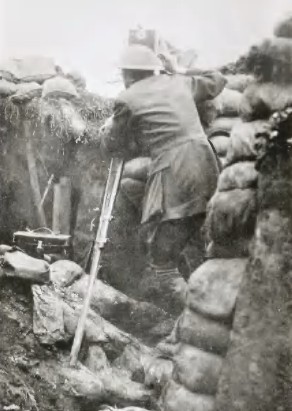
The latest addition to the Bioscope Library is Geoffrey Malins’ How I Filmed the War: a record of the extraordinary experiences of the man who filmed the great Somme battles etc. (1920). Malins was one of two British Official cameramen who filmed the Battle of the Somme in the summer of 1916 (the other was J.B. McDowell). The film that they shot was considered so outstanding that it was compiled into a feature length documentary (earlier Official war films had been much shorter), entitled The Battle of The Somme. It was first shown in London in October 1916 and was unquestionably a sensation. It is estimated that half the British population saw its unprecedented scenes of life for British troops on the Western front, with scenes of battle, troops going over the top, and the wounded. Malins’ book is vainglorious but rich in detail, a unique document of the making of what Nicholas Hiley has called the most socially significant British film of the twentieth century.

It’s available for free download from the Internet Archive, in PDF (24MB), DjVu (6MB) or TXT (532KB) formats. The film itself has been recently digitally restored by the Imperial War Museum, with remarkable effect, and a DVD release with new score is promised.

The work of an early cinema actress

I’ve just stumbled across a Project Gutenberg ebook of Edith J. Morley’s Women Workers in Seven Professions (1914), produced for the Fabian’s Women’s Group. The Fabian Society was a socialist group committed to gradualist reform which helped form the Labour Party in 1900, and which of course continues to this day. Its Women’s Group was founded in 1908 and was active in producing reports and pamphlets on work and social conditions for women. Morley’s book looks at women’s work in teaching, medicine, nursing, health visitors and sanitary inspection, the civil service, clerks and secretaries, and the acting profession. The latter section is mostly about the stage, but it does include this intriguing snippet about the cinematograph work that the actress might occasionally find:

It is only possible for me to touch very lightly on employment by the cinematograph firms; but from the enquiries I have made, the usual payment seems to be roughly from 5s. to 7s. 6d. a day, the workers finding their own clothes: 10s. 6d. if the workers can ride and swim: 3s. a day for walking on, when light meals are provided. There is a form of application to be filled in, which demands the following particulars:-

Height.
Bust measurement.
Waist measurement.
Skirt length.
Age.
Line of work.
Remarks.
Ride horseback. Cycle. Swim.

The pictures take about ten days to prepare, and as a supplementary trade, undoubtedly this work is of value to the actress.

I think that the ability to cycle is something that has not been considered when researchers have looked at the work of women in early British film. Clearly a topic for further investigation. An ability to swim, however, we already know about. There’s a celebrated story of Will Barker selecting an Ophelia for his film of Hamlet (1908) purely because she was able to swim (see Robert Hamilton Ball’s Shakespeare on Silent Film, pp. 77-78).

William S. Hart: Star of the West

William S. Hart

There’s a film season started at the Museum of the Moving Image, New York, on the films of the great star of the silent Western, William S. Hart, whose chilly vision of the West has been compared in recent times to that of Sam Peckinpah and Clint Eastwood. The season runs 21 April-6 May, and features Hell’s Hinges (1916), The Taking of Luke McVane (1915), The Captive God (1916), ‘Bad Buck’ of Santa Ynez (1915), The Bargain (1914, a new Library of Congress restoration), The Return of Draw Egan (1916), The Narrow Trail (1917), Branding Broadway (1918), Wagon Tracks (1919), The Toll Gate (1920), The Testing Block (1920), The Whistle (1921) and his masterpiece Tumbleweeds (1925), preceded by Hart’s spoken introduction to the 1939 re-issue.

Silent Shakespeare at the Globe

A reminder to anyone in London on Monday April 23rd that Shakespeare’s birthday is being marked in unique fashion by having assorted silent Shakespeare films projected onto the side of the Shakespeare’s Globe Theatre, on the south side of the Thames, with live musical accompaniment from Laura Rossi and the Fourth Dimension String Quartet. Screenings are now scheduled to run 8.00 pm – 10.00 pm.

Picasso, Braque and Early Film in Cubism

braqueandprojector1.jpg

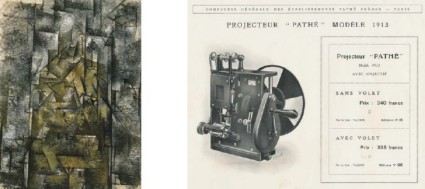
What sounds like a remarkable exhibition is opening at the PaceWildenstein gallery, East 57th Street, New York. It’s called Picasso, Braque and Early Film in Cubism, and it builds on art dealer Arne Glimcher’s feeling that Picasso and Braque were enthusiasts for early cinema, and that what they saw on the screen helped contibute to their new art i.e. cubism. The exhibition (which runs April 20-June 23) features nineteen paintings by Picasso and Braque, nine original works on paper, sixteen prints, two books, photographs, projections of early films, vintage cameras, projectors, and other objects.

It’s an intriguing theory, but with scant actual evidence. Surviving correspondence reveals nothing. Picasso saw his first film in 1896, there are assorted references to his friends and associates going to see films in the 1900s, and art historians claim to have detected relevant elements of imagery or technology in the paintings, but mostly the exhibition will have to be based on conjecture and suggestion. No matter – it’ll set minds thinking, and it’ll be further demonstration that early film did not (and could not) exist in cultural isolation. There’s an article in the New York Times, ‘When Picasso and Braque went to the movies‘, which gives the background to the exhibition.

Clearly there is something in the air here. Check out earlier posts on Lynda Nead’s essay about the image of artists in early film, and the Moving Pictures exhibition about the influence of early cinema on some American realist artists.

Brilliance

Brilliance

http://www.amazon.co.uk

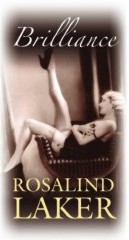
Romantic fiction and early cinema seldom mix, but they’re about to now. Romantic novelist Rosalind Laker has written Brilliance, published this month, which is set in 1890s Paris, and features both a magic lanternist hero and the Lumière brothers. Here’s the blurb from Amazon to tempt you:

This story is set in Paris, 1894. In a moment of impulse that she will never regret, Lisette Decourt flees her home and family on the eve of marriage to a man who has betrayed her. She attaches herself to a travelling ‘lanternist’, Daniel Shaw, whose ‘Magic Lantern’ show is a phenomenally popular precursor of silent movies. Lisette is fascinated by Daniel’s art and – though adamant that she will never fall in love again – irresistibly attracted to the magnetic Englishman. Though Fate intervenes to separate them, Lisette cannot forget Daniel. She builds a new life for herself as an independent, self-sufficient career woman, yet she remains fascinated by the vibrant new film-making industry whose French proponents are the famous Lumiere Brothers. When a chance encounter reunites Lisette with Daniel, by now a successful film-maker himself, he realizes that she has the magic, elusive quality that will make her a star…

How to Run a Picture Theatre – part 6

Electric Theatre

Continuing with our series on how to set up and manage a cinema, taken from How to Run a Picture Theatre (c.1912), we come to the crucial question of staff. The remarkable thing is the number of workers considered suitable for even a small operation. The average small pre-First World War cinema in London had eight to ten staff. Here it is recommended we have a manager, door keeper, box office assistant (note the coldly calculating recommendation for women in this role, being both ‘more reliable’ and cheap), ushers, pianist (with an interesting revelation that some cinemas relied upon mechanical pianos), someone to generate sound effects (a common role in pre-1914 exhibition), the projectionist (and his assistant), and those selling chocolates and programmes. We even learn the salaries, and what they should be wearing.

The Staff. Its Duties and Salaries. … As a general rule, it may be taken that from ten to twelve persons are required for the competent management of a theatre running a continuous show. These are: Manager, Cashier, Doorkeeper, Checktaker, two male or lady Attendants, Operator, Assistant Operator, Spool Boy, Effects Worker, and in some cases Program and Chocolate Sellers.

The Manager. Many a proprietor owes his success to his manager’s personality … The public like to go to a place of entertainment where the manager evinces a personal interest in them … His salary is calculated on the seating and earning capacity of the hall and may vary from £3 to £5 …

Much will depend on the way in which the manager engineers the opening ceremony … It is well to secure the attendance of the Member of Parliament for the Division, the Chief Magistrate of the City or Town, … Vicar of the Parish or some equally big wig to declare the show open.

Advantage should always be taken of this occasion to press home the educational aspect of the kinematograph and the high class nature of the entertainment which is to be provided.

The Doorkeeper. His wages run from 25s. to 40s per week.

The Box Office Attendant. It is best to put a woman in charge of the box office, partly because women are apt to be more reliable, and in part because they ask less money … One who is not too old to be attractive, and one who is steady enough to refuse the numerous opportunities for flirtation will become an asset … she is not too well paid at £1 per week, although cashiers can be had at 12s 6d.

The Ushers – Inside Attendants. You want bright youths or young women who are willing to work and whom you can trust to do as well when you are absent as when you are there … In many houses the attendants are supposed to polish up the brasswork in the morning and help with the place generally … As a rule these attendants are paid from 10s to 18s. per week, to which of course has to be added their commission on the sale of chocolates and programs.

They should each be provided with an electric torch … and should be instructed to always direct the light from their torches towards the ground and away from the faces of those who are following them.

The Pianist. Get a good one – the best you can afford. … [T]he patient plodder with a fair technique will sometimes be found to be better than a brilliant performer who has a soul above the pictures The man or woman who can read music well enough to memorize standard melodies, and who can pick up popular stuff “by ear”, is better than the more advanced player who cannot play without the music on the rack. … An automatic piano is to be preferred to a bad player.

The duties and responsibilities of the accompanist are by no means light or few – always excepting the cases where a mechanical piano is left in charge of the erratic and ubiquitous “chocolate boy”. Besides, a complete command of the keyboard, the pianist must have quick discernment, and a sense of the fitness of things …

The skilled accompanist will manage, with well-timed improvisations, to smooth over any awkward pauses and abrupt transitions … Finally, the pianist should commit to memory, or have to hand, a selection of pieces which are likely to suit the various idiosyncracies of the films …

The pianist should have the films at every change of program projected for his special delectation in order that he may arrange his musical program to suit the pictures and may know what is coming next. Too often films are changed and the man at the piano has no inkling of the subjects excepting what he has gained from a perusal of the synopsis … £2 to £3 a week is none too much to pay him. Where there is an orchestra, of course, the pianist’s salary is allocated to the conductor.

The Effects Worker. … It falls to him to give life to the picture by the aid of mechanical or other means … From 12s to 15s. a week is the usual age for a boy and 30s. for a man.

Program and Chocolate Sellers. …the vending of their wares shall not be to stentorian, for nothing detracts more from the pleasure of patrons than to have a loud voiced boy or girl continually brawling in one’s ears “Chocolates” or “Programs”.

The Operator and his Assistant. … The young man who knows a little about the machine, but who needs more experience and is willing to work cheaply in order to obtain it, is the most expensive operator who can hire. He only takes one pound out of the box office on pay day, but presently you have to pay for repairs to an abused machine that will run up, the shows will have been so poor that your attendance will have dropped off, and all at once you will realise that there are occasions when it is cheaper to pay a man three pounds than one. Your operator will cost you up to £3 a week, or even more.

You can get men to turn the crank for very low fees if you have only night shows, but a night operator who has other employment during the day is not apt to be in shape for his work, and a good operator is worth every penny you pay him.

How the Staff Should be Uniformed. The male attendants should be uniformed … The female attendants should be attired in black dresses with white aprons and caps or of preferred they may be made up as vivandieres, or in the style made famous by Marie Antoinette with powdered hair, patches and pannier dresses, as is done at some London theatres.

Next, we will need to consider how to go about selecting a programme of films.

London was dangerous

It’s been a while since I posted any memoir evidence of going to the cinema in the silent era, a particular research topic of mine. This quotation from V.S. Pritchett’s memoir A Cab at the Door: An Autobiography: Early Years (London: Chatto & Windus, 1968) also serves as further evidence of the term Bioscope, and of the early cinema practice of spraying the surprisingly compliant audiences of the time with disinfectant:

London was dangerous. We had a girl to help my mother for a few weeks and her mind, like the mind of the one at Ealing, was brimming with crime. She took me to the Camberwell Bioscope to see a film of murder and explosions called The Anarchist’s Son, in which men with rifles in their hands crawled up a hill and shot at each other. When the shed in which one of them was living, blew up, the film turned silent, soft blood red and the lady pianist in front of the screen struck up a dramatic chord. In the Bioscope men walked about squirting the audience with a delicious scent like hair lotion that prickled our heads.

The Pritchett family lived in a street off Coldharbour Lane in London. The cinema he is referring to is possibly Burgoyne’s American Bioscope, at 213 Rye Lane, Peckham. The date is around 1910, when he would have been ten years old. Pritchett of course went on to become a renowned short story writer and essayist.

Teenagers

Teenage

http://www.amazon.co.uk

Sometimes some of the most interesting writing on early cinema isn’t found under the heading ‘cinema’. A case in point is Jon Savage’s new book, Teenage: The Creation of Youth 1875-1945. It’s a history of the invention of teenagers before there were teenagers, as it were. Most social histories explore the phenomenon post-1945 – Savage looks at how we got to that point by looking at the growing power and influence of adolescents, partiularly American, from the late Victorian period, not least through the pleasures that they pursued. So he has a lot to say about the cinema of the teens and 1920s (making good use of Kevin Brownlow’s Behind the Mask of Innocence), for which the audience was, we must remember, significanly young (up to 50% of the early cinema audience were children or adolescents, according to some estimates). He places the cinema as a particular pleasure of the teenaged within his larger thesis about America as a young society, giving early cinema a social context beyond the boundaries used found in a film studies book. Or at least that’s what I gleaned from half an hour’s read in Waterstone’s…

There’s an interesting review by Libby Purves in The Times which highlights the cinema aspects of the book. Jon Savage is of course the author of the definite book on punk, England’s Dreaming.