Colourful stories no. 4 – The unbearable effect

Edward Turner three-colour system

Three examples of the Lee and Turner three-colour process, c. 1901, from D.B. Thomas, The First Colour Motion Pictures (1969). Note the different tonal effects (e.g. the girl’s sash on the left-hand film) for the same image taken through red, green and blue filters.

The first patent for colour cinematography was that of the German Hermann Isensee, in 1897, but activity in this field now moved to Britain.

There were four names actively pursuing the goal of practical colour cinematography. One was William Friese-Greene, a figure who used to turn up in many film histories as one of the ‘inventors’ of cinema, and whose supposed discovery of motion pictures was romantically dramatised in the film The Magic Box (1951). That complex story can be told at another time. Suffice to say that Friese-Greene did not invent motion pictures (though he and his supporters claimed loudly that he did), and he turned his attention to colour cinematography. He patented a system (British Patent no. 21,649) in 1898 which posited use of a rotating disc with red, green and blue sectors, which echoed Isensee’s ideas but showed little comprehension of how the theory might work in practice. The other inventor was Captain William Norman-Lascelles Davidson, an experimenter in colour photography as well as cinematography, who in the same year patented (B.P. 23,863) a triple-lens camera with three filters (red, green, blue) behind each of the lenses. This was a step nearer in its thinking, though it led to no working model. There will be more on Friese-Greene and Davidson, who would soon be working together, later on in this series.

Lee and Turner three-colour projector

Lee and Turner three-colour projector (1901), from D.B. Thomas, The First Colour Motion Pictures

The first patent to be followed by a working model was B.P. 6,202 of 22 March 1899. The patentees were Frederick Marshall Lee of Walton-on-Thames, a racehorse breeder and financier of the project, and Edward Raymond Turner, of Hounslow, London. Turner had previously worked for Frederic Ives, inventor of the Kromskop, the device which employed the additive principle to create still colour photographic images. Ives wrote the following in 1926 about Lee and Turner:

The first recorded suggestion is the British patent of Lee and Turner, two young men who were employed in my workshop in London, and who with my consent patented a scheme which I disclosed to them but which I told them was of more theoretical than practical interest at that time. I considered it a great joke when their patent rights were afterwards sold for real money; but, as I predicted, the method was not practically satisfactory.

There is no evidence nor likelihood that Lee worked for Ives, but the latter was in effect right that Turner’s invention owed a lot to his ideas. Turner took a conventional cine camera and had its shutter replaced by a rotating disc with red, green and blue filters, interspersed with opaque sections, in synchronisation with the movement of the film through the camera. The black-and-white film passing through the camera would therefore record in succession a red, green and blue record. The film was to be shown through a three-lens projector (illustrated above), with each frame projected through each lens in turn, and again a rotating shutter was used to reintroduce the colour.

As with Isensee, Friese-Greene and Davidson, what looked fine in theory proved to be far more difficult to put into practice. Lee and Turner were certainly able to take films – some sample frames from three of the films they made around 1901 are illustrated at the head of this post – for which they employed a unique 38mm-wide film. What they could not do was project the results. If you look at the lenses of the projector you will see that there are three of them, arranged vertically. Each frame of film had to be projected through each lens in turn (the lenses had to be perfectly aligned so that the separate images whould synchronise on the screen). This was to avoid the huge strain on the film were each frame to be projected once, because the film would have to move three inches intermittently. As it is, the strain was still too great. If the original film had been shot at a likely 16 frames per second, the required projection speed would be a manic 48 f.p.s (i.e. successive red, green and blue records shown simultaneously). There is an eye-witness account of the results:

It was when we came to superimpose the pictures on the sheet through three-coloured glasses that we found the process unworkable. As soon as the handle of the projecting machine was worked the three pictures refused to remain in register, and no knowledge that any of us could bring to bear upon the matter could even begin to cure the trouble. The difficulty is mainly due to the fact that cinematograph pictures are small to begin with, and they have to be enormously magnified in exhibiting, as you all know. The slightest defect in registration it pitilessly magnified, and when the minute defects of registration in the first three pictures are followed by minute defects of another sort in the next three, and by yet another sort in the succeeding three, and so on throughout the length of a film, the effect on the observer is almost unbearable.

The witness is George Albert Smith (writing in 1908), a Brighton-based filmmaker and film processor, who processed Lee and Turner’s films and who would go on to invent Kinemacolor.

Synthesized Turner three-colour image

Computer-synthesized colour image of a Lee and Turner experiment, created by Martin Hart

How do you bring three successive frames of the same image into synchronisation by such mechanical means? Lee and Turner’s invention seemed only to show that it was impossible – certainly unwatchable. That there was a colour record there that in theory be uncovered is shown by the above simulation, taken from the black-and-white separations illustrated at the top of this post (the two children may be those of G.A. Smith). A strip of Lee and Turner film exists in the BFI National Archive, which shows a goldfish in a bowl and then a parrot on perch (see top of this post, right-hand image). But it cannot be projected, and would not work even if it could – it is the oldest motion picture colour film in the world, but we cannot see it.

Lee and Turner turned to the Warwick Trading Company to support their work. With the unfortunate results reported above, Warwick and Lee lost interest. However, Warwick’s manaing director, Charles Urban, was not one to give up so easily. He sunk his own money into the futher development of Turner’s invention, though this hit a problem when Turner dropped dead of a heart attack in his workshop on 9 March 1903. Sadly we still know very little about Turner – there does not seem to be a photograph of him. Urban handed on the problem of making the Turner system work to G.A. Smith, with whom he had worked at Warwick. Could the three-colour records be brought into synchronisation, or was there some other solution?

Recommended reading:
D.B. Thomas, The First Colour Motion Pictures (1969)

The first wizard of cinema

Georges Méliès: First Wizard of Cinema

Georges Méliès: The First Wizard of Cinema, from http://www.flickeralley.com

2008 is not four weeks old, and yet what will have to be the silent DVD release of the year has already been announced. It won’t become available before 3 March 2008, but that just gives you a month’s worth of delicious anticipation, awaiting Flicker Alley’s thirteen-hour, five-disc DVD release, Georges Méliès: The First Wizard of Cinema (1896-1913).

The collection brings together over 170 films, comprising nearly all the surviving films of Georges Méliès (he made just over 500), from his first 1896 production Une partie de cartes (discovered by yours truly some twelve years ago – my very modest claim to early cinema fame), to his uproarious final film, Le voyage de la famille Bourrichon (1913). It includes such classics as Voyage dans la lune (A Trip to the Moon), Les quatres cent farces du diable (Satan’s Merry Frolics) and A la conquète du pôle (The Conquest of the Pole). Fifteen of the films are reproduced from partial or complete hand-colored original prints, while thirteen are accompanied by the original English narrations meant to accompany the films, written by Méliès.

The collection has been put together by the pre-eminent preservationist-producers Eric Lange (of Lobster Films) and David Shepard, from archival and private holdings in eight countries. A major extra is the half-hour documentary, Le Grand Méliès (1953), made by Georges Franju, which features Georges Méliès’ widow and star of many of his films, Jehanne d’Alcy and André Méliès portraying his father.

The Moon

Le voyage dans la lune

Georges Méliès (1861-1938), the pre-eminent artist of early cinema, a creator of ingenious fantasies coming out of his magicianship background, but which employ the cinema’s own entrancing trickery to the full. The sheer joy of filmmaking that his films express means that his best work does not date and continues to delight each generation that comes across him (just take a look at some of the admiring comments made of the many films of his to be found on YouTube). He is particularly deserving of the complete box set treatment, even if the majority of the films that he made are now lost (though more titles keep turning up). It is seventy years since his death, and presumably it is no accident that the DVDs are appearing this year, since under European law his films should be coming out of copyright in 2008 i.e. the rule that says copyright remains in a film production until seventy years after the death of the author. What the position is of the Méliès family, who have been so protective of his heritage up until now, I don’t know. Perhaps one of our knowledgeable readers might be able to say.

At any rate, warmest congratulations to Messrs. Lange and Shepard for a herculean piece of work, and to Flicker Alley for issuing such an ambitious release. It’s available at special pre-order price of $71.96 (do note that it will be Region 1 DVD). I’m off to pre-order mine.

(There will be more on Méliès on the Bioscope in a couple of months or so’s time, if I ever finish a small project I’m working on)

Laterna Magica – Magic Lantern

Porcelain figures

Porcelain figures of 18th/19th century magic lanternists, from http://www.fuesslin.de

A major new book on the magic lantern has just been published. Laterna Magica – Magic Lantern (vol. 1), by Deac Rossell, is the first in a two-part history which, as the publisher’s blurb indicates, looks at the subject not simply as a precursor of the cinema but as a phenomenon with a rich cultural history of its own:

This first volume covers the 17th and 18th centuries, plus the travelling lanternists – often Savoyards – who brought projected entertainment across Europe through the turn of the Nineteenth century. “Laterna Magica / Magic Lantern” is an attempt to bring together into a single narrative parts of lantern history that have previously been treated separately. It follows the central theme of the projected image in depth while simultaneously recognising the diverse and multifaceted offshoots produced by magic lantern culture.

We often think of the magic lantern today as the “precursor” of the movies and modern digital media; this it undoubtedly was. But at the same time, the magic lantern in its day was not a precursor of anything, but was a sophisticated instrument through which news, entertainment, and visual delight was projected for families, informal groups, and, ultimately, public audiences at fixed shows who enjoyed the elaborate and extraordinary visual rhetoric produced by highly skilled showmen.

The book is published by Füsslin Verlag in a bilingual (German/English) edition (the publisher’s website is bilingual too), and looks set to become a standard work. It also has 113 illustrations, most of them in colour. Deac Rossell is one of the world’s leading historians of the popular optical media of the nineteenth century and before, as well as having been at one time head of the National Film Theatre in London.

Buy one, and have your friends look upon you in awe at your erudition and taste…

Slapsticon 2008

A provisional list of titles for this year’s Slapsticon festival has been published. The annual festival of early film comedy takes place this year 17-20 July, Arlington, Virginia. The festival site says that the programme is still being selected, but nevertheless they are already promising (subject to change, of course) a remarkable line-up:

* Why Detectives Go Wrong (1928) — Poodles Hanneford
* Springtime Saps (1929) — Snub Pollard, Marvin Loback
* Winning Winnie (1926) — Ethelyn Gibson
* Three Stooges Rarity Show, hosted by Paul Gierucki
* Sally of the Sawdust (1925) — W.C. Fields
* Number One (1915) — Mr. and Mrs. Sidney Drew
* Pretzel and Flanagan (1914) — Lloyd Hamilton
* Taking Things Easy (1919) — Eddie Lyons and Lee Moran
* Nearly Spliced (1916) — Leon Errol
* Mishaps of Musty Suffer: Going Up (1916) — Harry Watson Jr.
* All Jazzed Up (1919) — Dan Russell, Hughey Mack
* It’s a Hard Life (1915) — Heinie and Louie (Jimmy Aubrey and Walter Kendig)
* The Bogus Booking Agents (1916) — Ham and Bud
* Sweeney’s Christmas Turkey (1913) — Hughey Mack
* Billy McGrath on Broadway (1913) — Augustus Carney
* Monkey Shines (1922) — Campbell Comedy
* The Tin Hoss (1925) — Hey Fellas
* Open Spaces (1926) — Malcolm “Big Boy” Sebastian
* A Pleasant Journey (1923) — Our Gang
* Among the Mourners (1915) — Chester Conklin, Syd Chaplin
* Are Waitresses Safe? (1917) — Ben Turpin, Charlie Murray
* Trimmed in Gold (1925) — Billy Bevan
* A Rainy Knight (1925) — Raymond Mckee, Eugenia Gilbert
* Taxi Dolls (1929) — Jack Cooper
* Doubling in the Quickies (1932) — Lloyd Hamilton, Marjorie Beebe
* Vacation Waves (1928) — Edward Everett Horton
* The Golf Bug (1923) — Monty Banks
* Golf Widows (1928) — Harrison Ford, Vernon Dent, Will Stanton
* Councel on de Fence (1934) — Harry Langdon
* See America Thirst (1930) — Harry Langdon
* Rush Orders (1921) — Snub Pollard
* Sherlock Sleuth (1924) — Arthur Stone
* Rough on Romeo (1921) — Paul Parrott
* The Rummy (1933) — Taxi Boys
* Harry Langdon Documentary (Paul Killiam) — never released Paul Killiam documentary from the late 1950’s, featuring rare clips and an interview with Vernon Dent.
* The Silent Partner (1955) — Buster Keaton, Joe E. Brown
* The Scribe (1966) — Buster Keaton’s last film
* An Aerial Joyride (1916) — Raymond Griffith
* His Foot-Hill Folly (1917) — Raymond Griffith
* Changing Husbands (1924) — Raymond Griffith and Leatrice Joy
* The Barnyard (1923) — Larry Semon
* Ladies Night in a Turkish Bath (1928) — Dorothy Mackail, Jimmy Finlayson
* Grass Skirts (1930) — Lloyd Hamilton
* Share the Wealth (1936) — Andy Clyde
* Dumb’s the Word (1937) — Edgar Kennedy, Billy Franey
* Alibi Bye Bye (1935) — Clark and McCullough
* Fiddlin’ Around (1938) — Monty Collins, Tom Kennedy
* Pistol Packin’ Nitwits (1945) — Harry Langdon, El Brendel
* Dangerous Females (1929) — Marie Dressler, Polly Moran
* Tomalio (1933) — Roscoe Arbuckle
* The Brown Derby (1926) — Johnny Hines
* His Private Life (1926) — Lupino Lane
* No Father to Guide Him (1925) — Charley Chase

Le Cinéma Expressionniste Allemand

Expressionismus und Film

Rudolph Kurtz’s Expressionismus und Film (1926), from http://cinema.expressionnisme.bifi.fr

I’ve just learned about an online exhibition on German Expressionisst cinema, which was published by BiFi (La Bibliothèque du film) towards the end of 2006.

The exhibition is entitled Le Cinéma Expressionniste Allemand, so yes it’s in French, but I encourage you to look even if you’re not able to read much. The exhibition was put together by regular Bioscopist Frank Kessler, of Utrecht university, and it examines the idea of Expressionism as it found expression in German cinema of the 1920s, and as it was interpreted subsequently by critics.

The exhibition is in two main parts: Exposition – which takes us through the history, the ideas, their realisation, and their critical exegesis; and Les repères documentaires, which proides supporting information and documentation, including a filmography, bibliography, a text by Laurent Mannoni on film historian-critic Lotte Eisner (author of The Haunted Screen), links and a glossary for such terms as Cubisme, Futurisme and ‘Caligarisme’.

It is handsomely illustrated with stills and documents, and is well-laid out and easy to navigate. Well worth investigating.

William Haggar’s phantom ride

William Haggar

William Haggar, from http://www.williamhaggar.co.uk

Talking, as we have been, about lost films, here’s an interesting piece from the South Wales Echo (we cast our investigative net widely here at the Bioscope) on a theatre show devised by performance group Good Cop Bad Cop:

Haggar remembered in ‘rough and ready’ show

WILLIAM Haggar was one of the first pioneers of cinema in a silent age where actors ‘spoke’ volumes with just a simple frown or smile.

A travelling entertainer from Essex, he settled in Wales and transformed live entertainment into the cultural industries of the early 20th Century.

Now his work is being resurrected by two-man company Good Cop Bad Cop, which has been commissioned by Chapter for three nights of experimental theatre.

In what has been described as a rough-and-ready production, John Rowley and Richard Morgan, who set up Good Cop Bad Cop in 1995, take to the stage for their performance of Phantom Ride.

Based on a series of lost silent footage, Phantom Ride aims to rejuvenate memories from a selected 32 of Haggar’s films in a creative leap of faith by the theatre group.

The two actors, who met when they worked with Welsh theatre company Brith Gof, have brought on board newcomer Louise Ritchie for the project.

The show will be performed purely through stand-up acting on a stage which has been stripped bare of scenery, props and bright lighting.

Each will give a brief synopsis of Haggar’s work and recount memories of those switched-on enough to have handed down thoughts about his films so that future generations could get an insight into a disappearing film era.

It will then be up to audiences to visualise the rest, albeit prompted by storytelling monologues and a background soundtrack.

John Rowley, co-artistic director of Good Cop Bad Cop, says they are still making changes to the production which is how the pair usually work best.

He said: “We are still working on it.

“Although the show is on Wednesday we’ll piece it together right up until Tuesday night.

“It’s rough and ready in a way. It’s not like going into the theatre seeing bright lights, scenery and costumes. It’s based on a series of lost films which do not exist any more.

“In the silent movie era after the people watched the film they didn’t care what happened to the footage which was combustible, so they went to powder.

“A lot of work has been done to restore them in different parts of the world but a lot have been lost. I think only eight exist at the moment and they are in fragments.”

During the 70-minute show the audience is expected to play its part by using imagination and imagery.

John added: “What we are interested in is the live raw experience of an audience member, and the relationship between the audience and the performer which is often kind of negative in traditional theatre.

“We will be using the same space as the audience as it’s not a built-up stage.

“It could be some of the audience end up standing next to the actor listening to them as if it was a personal conversation.

“That part of the audience is then turned into part of the performance.”

I like the idea of getting the audience to contribute to the imaginative recreation of a lost film. That sort of engagement with the audience is very much in the spirit of Haggar, who toured the fairgrounds with his films and knew that it was those who came to see the show that really made the films what they were. William Haggar is the great pioneer of Welsh cinema, responsible for such lively works as A Desperate Poaching Affray (1903) and The Life of Charles Peace (1905), and the subject of Peter Yorke’s recent biography. Yorke has also produced a website about Haggar and his book, at www.williamhaggar.co.uk.

Good Cop Bad Cop: Phantom Ride can be seen at Chapter, in Cardiff, Wednesday, January 23, to Friday, January 25, at 8pm. Further information from the Chapter website.

Welcome to the Silent Movie Blog

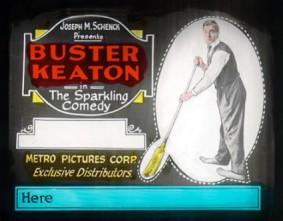
Generic slide for Buster Keaton shorts

Generic slide for Buster Keaton shorts, from The Silent Movie Blog

It’s always good news when another silent movie blog joins the throng, so welcome to Christopher Snowden’s The Silent Movie Blog. It’s just a couple of weeks old, but the emphasis seems to be on stills and other such promotional images from the period, laced with a welcome dash of humour. The blog accompanies his DVD site, UnknownVideo.

For other blogs on silent cinema, check out the Blog section on the right-hand side menu. All of them gems, but some shine particularly brightly.

Modernism and visual culture

And another call for papers and conference coming up. You have to look a little harder at this one to see the silent cinema connection, but it’s there.

MODERNISM AND VISUAL CULTURE

1st-2nd November 2008
Oxford University, UK

Keynote Speakers
David Trotter (Cambridge University)
Laura Marcus (Edinburgh University)
Maggie Humm (University of East London)

“A writer … has need of a third eye whose function is to help out the other senses when they flag.” (Virginia Woolf, 1925)

In the wake of recent analyses of the landscape of visual cultures at the end of the nineteenth century, new contexts have become available for understanding the emergence and shape of modernism. This conference seeks to unpick our tangled model of the relationships between the established arts in the modernist period and between modernism and popular culture, and to illuminate the types of reactions occasioned in the established arts by the emergence of modern mass media. Papers on any aspect of the relationship between modernist literatures and cultures with visual culture, including cinema and fine art, are welcome.

Possible questions to consider:

  • Are recent claims for modernism’s affinity with popular culture anything new?
  • Was Cubism’s debt to chronophotography a model for – or an exception to – modernism’s relationship with photo-chemical reproduction?
  • Was the ‘modernity’ to which the established arts responded actually the emergence of a rival new cultural landscape comprised of cinema, variety theatre, instantaneous photography, stage illusions, the moving panorama, mass spectator sports, moving-image lantern shows, the illustrated short story and the cartoon strip?
  • Did literary modernism emerge in emulation of the innovations occurring in modernist painting?
  • What role did modernism play in altering established theories of visual culture?
  • Can modernism and late-nineteenth-century popular visual culture be seen as the twin products of a single preceding historical development?
  • What singular and identifiable properties, if any, did such related forms as cinema, cartoon strips or shadowgrams have in impacting on the existing arts?
  • Were the different modernisms of the various established arts the product of their varying vantage points on new media forms?
  • If new visual media generated modernism, did they do so by threatening to become art forms themselves, or by throwing the distinct qualities of the existing arts into relief?
  • Were modernists already modernists when their work adopted the traits of various new forms of visual culture?
  • Is realism in cinema equivalent to modernism in the existing arts?
  • Was the reflexivity learned by the group of polymedia practitioners we call modernists the basis of modernist form in all of the arts?

Speakers are encouraged to use visual material in their presentations. Send 300-word abstracts for 20-minute papers to Andrew Shail (andrew.shail [at] at-annes.ox.ac.uk), by 1 April 2008. Panel proposals are welcome – please include contact details and affiliations for all speakers.

Heady stuff.

Funny people these foreigners

A call for papers has been issued for ‘Funny People these Foreigners’, an international conference on international comedy, organised by the Communication, Cultural and Media Studies Research Centre, the University of Salford. After the success their conference last year, ‘What Have You Got In That Box? – Comedy and Regional National Identity’, they are inviting proposals for papers that investigate any aspect of comedy with an international perspective. Suggested topics might include:

* Breaking language barriers – successful comedy crossovers
* Les Visiteurs
* Roberto Benigni
* Asterix
* M. Hulot
* USA/UK transfers: successes and failures
* Silent Cinema
* National/International Comedy stars
* Dubbing vs subtitling debate
* British Comedy in international markets
* Comedy co-productions
* Film and TV Comedy and national identity
* Viva Los Simpsons! Universality of humour

And all points in between. Proposals (maximum 300 words) should be sent to Dr C.P. Lee (c.lee [at] salford.ac.uk) or Dr Andy Wills (a.willis [at] salford.ac.uk), by 17 March. The conference will take place 5-6 June 2008.

Colourful stories no. 3 – The first patent

Isensee diagram

Diagram accompanying Hermann Isensee’s 1897 patent, from DEPATISnet

There was colour on film as soon as there was projected film. The Edison Kinetoscope, a peepshow device which introduced commercial motion pictures in 1894 presented too small an image to the viewer for hand-painted colour to be seen distinctively. But once films were shown upon a screen, colours started to be added – including some subjects originally exhibited through the Kinetoscope. Edward Henry Doubell, slide painter at the Royal Polytechnic in London, is known to have painstakingly added colours to Robert Paul films, at a rate of two or three frames per day. Paul showed coloured films at the Alhambra music hall on 8 April 1896, and on 23 April a coloured Serpentine dance was included on the debut programme of the Vitascope projector in New York.

A history of artifically-coloured films would follow, which we shall return to later in this series. For now, we are interested in the dream of the inventors, natural colour. Achieve true colour on the motion picture screen, and fortunes would be made.

And so the history of natural colour cinemaography begins in 1897 with a patent passed on 17 December 1897, in Germany. The inventor was Herman Isensee, and it reads (in translation) as follows:

Imperial Patent Office
Patent Specification
No. 98799
Class: 57: Photography
Hermann Isensee, of Berlin

Device for the Depiction of Coloured Animated Photography
Patented in the German Reich from 17th December 1897

With the help of this device, image projections that could hitherto only be shown in monochrome will, by means of a very quick succession of consecutive frames that are projected in the colours red, green and blue at regular intervals, appear to the eye of the beholder in their true natural colours.

For this purpose a disc with three sectors r, g and b, made up of red, green or indigo blue glass (or else any other suitable films), is placed eccentrically in front of the lens o of a series apparatus.

The movement of this disc is regulated in such a manner that for the duration of a photographic recording a coloured section moves past in front of lens o each time, so that the film strip consists of a regular succession of negative images generated by red, green and blue light-rays.

From these negatives, positives are made and the same are projected with the help of the series apparatus.

During this, in a way similar to the process that takes place during the photographic recording, the red, green, and indigo blue sectors move past in front of the lens, so that on the screen red, green and blue pictures develop in quick succession, in correspondence with the said negatives generated by the coloured rays.

While the known analogous procedure for the attainment of coloured pictures, for example the Ivesian Heliochromy (cf. Eder’s Jahrbuch der Photographie 1891 [Yearbook of Photography 1891], p. 174 ff., and Krone, Die Darstellung der natuerlichen Farben durch Photographie [The Representation of Natural Colours Through Photography], Weimer 1894, p. 103 ff.) involves the successful reproduction of three differently coloured pictures of one object from the same period of time, in this case differently coloured images from consecutive periods of time follow each other with sufficient speed, and it is in such a way that an animated picture in its natural colours is seen by the eye of the beholder.

PATENT CLAIM:

Appliance for apparatus used for the exhibition of animated photography, for the presentation of images in their natural colours, characterised by the fact that in front of the lens a disc with three light-filters in primary colours necessary for the creation of three-colour pictures moves in such a way that with every new recording, as well as projection of the same, a differently coloured section appears in front of the lens.

Attached 1 sheet of drawings.

(My grateful thanks to Eve for providing the translation)

As will be clear enough from the drawing reproduced above which accompanies the patent, this is not the most detailed of patent specifications. It outlines in general and idealised terms the principle of three primary colours being brought together additively, with the optimistic assumption that this could readily produce a motion picture colour record in the same way that Frederic Ives (inventor of the Kromskop, which employed the principle of ‘Heliochromy’) had demonstrated could be achieved practically for still photography. Nevertheless, it does establish the key idea of using a rotating colour shutter in front of camera and then projector, which others would soon adopt.

There is no evidence to suggest that Isensee had any sort of a working model to back-up his claims, and he disappears from this point on as far as colour cinematography is concerned (though he went on to patent other motion picture devices). Because he only patented his idea in Germany, it had no bearing on the experiments that were to take place in Britain the following year which (unwittingly) took up Isensee’s ideas and led to the first practical results in colour cinematography, in 1899. Which you’ll hear all about next time.

Recommended reading:
Adrian Klein, Colour Cinematography (1936)

Isensee’s patent is available online from DEPATISnet, the online German patent service (search under reference number DE000000098799A).