19th Century UK periodicals

Here at the Bioscope, when highlighting digitised resources, we tend to go for those that are freely available to all. However, it is worth pointing out some of those which are restricted to subscribers, institutions or educational users, either because you the reader may fall into such categories, or they may be resources that you can find (or request that they be subscribed to) at your local library.

Which leads us to 19th Century UK Periodicals. This new resource describes itself as “a major new multi-part series which covers the events, lives, values and themes that shaped the 19th century world.” It’s being published in stages, and Series 1, on New Readerships, provides access to close to 100 periodicals, mainly based on the collections of the British Library and the National Library of Scotland. Five series are planned, across 600 journals, the others being Empire, Culture, Working Life and Knowledge.

New Readerships is dedicated to the changes and influences in political and rural life, children’s literature and leisure, and includes such varied journals as The Northern Star, The Satirist, British Women’s Temperance Journal, The Boy’s Own Paper, Country Gentlemen, Pick-Me-Up, Little Wide Awake, Fun, Ladies Fashionable Repository, Bailey’s Monthly Magazine of Sport, and Punch.

And there is plenty there for the early film researcher. Using our trustworthy test search term of Kinetoscope, we get 115 hits, starting with The Sporting Times facetiously noting the appearance of “Mr Edison’s latest little toy” in its edition of 20 October 1894, through to The Turf, on 13 October 1900, noting that the racehorse Kinetoscope would be running at the two mile Handicap Hurlde Race at Sandown on Saturday. I’m sure there’s an interesting paper to be written on the undistinguished racing career of Kinetoscope, whose naming after a contemporary technology anticipates Sanyo Music Centre and others of that ilk by several decades.

Other terms such as Cinematograph (215 hits), American Biograph (175 hits), Mutoscope (31 hits), Animatograph (11 hits) or Bioscope (6 hits) bring up results that are fascinating not only for the incidental bits of concrete information they provide (particularly through advertisements), but also for they way they demonstrate how the idea of the medium swiftly became pervasive. You knew about the moving pictures through your light reading, before you might have had any chance to see them.

As an example of what can be find, he’s an intriguing little insight into perceptions and expectations of the medium. The Country Gentleman (27 January 1900, p. 103) is commenting on films at the time of the Anglo-Boer War:

Though several of our variety theatres announce exhibitions of war pictures, they are in reality nothing of the sort, but merely cinematograph pictures of the combatants preparing for the fight, or places of special interest at the present time, such as Pretoria, Kimberley, Mafeking, etc. Sightseers who believe they are going to witness an actual battle have hitherto been disappointed. But in the future this is likely to be altered, for the Warwick Trading Company, through their assistants at the front, have just received a consignment of films representing actual battles, skirmishes, etc., and these photographs are now being rapidly developed. Within a few days, therefore, all of us will doubtless have an opportunity of seeing what an actual battle looks like, and gain some idea of the horrors of warfare.

Fascinating to see that desire for the horrors of warfare to be served up as entertainment in the variety theatres, and the use of term ‘sightseers’ to describe proto-cinemagoers.

You can find out more about 19th Century UK Periodicals from the publishers, Gale. It’s not freely available, and do note these sorts of resources are aimed at (and priced at) institutions, not individuals. So go seek out your local institution.

The Handbook of Kinematography

William Friese-Greene

William Friese-Greene, from The Handbook of Kinematography

Just in at The Bioscope Library is one of the standard technical manuals of the period, and boon to many a film historian ever since, Colin Bennett’s The Handbook of Kinematography. Bennett was a cameraman, inventor (he devised a colour cinematograph process, Cinechrome, in 1914) and regular contributor on technical subjects to the Kinematograph and Lantern Weekly. This handbook, published by the Kinematograph Weekly in 1911, is a thorough and handsomely illustrated account of early motion picture technology and the practicalities of producing and exhibiting films.

It is easiest to give an idea of the range of the book by listing the chapters:

Part 1:
1. Photographic Principle
2. Kinematograph Camera
3. Choice of a Camera Kit
4. In the Field. Scenic Work
5. Topicals
6. The Dark Room
7. Development
8. Positive Making or Printing
9. Tinting, Toning and Titling Positives
10. The After-Treatment of Negatives and Positives
11. Drying
12. Trick Kinematography
13. Rehearsed Effects

Part 2:
1. The Elements of Projection
2. Persistence of Vision
3. Apparatus used in Projection
4. The Illuminant. Electricity
5. Limelight and Minor Illuminants
6. In the Operating Box

Part 3:
1. Acting before the Kinematograph (by Henry Morrell)
2. Playing to Pictures (by A.E. Taylor)
3. The Still Slide
4. The Kinematograph Camera Abroad
5. Scientific and Technical Kinematography
6. Self-Preservation in the Trade
7. Management of a Picture Theatre
8. The Law and the Kinematograph

All you needed to know, really. Some of Bennett’s understanding of film history is askew (particularly his patriotic championing of William Friese-Greene’s nebulous achievements), but for the motion picture technologies of the day his knowledge is prodigious, leavened with a lot of practical commonsense, and the illustrations alone (along with some contemporary advertisements) are a rich source of information. The book is available from our old friends the Internet Archive, in DjVu (16MB), PDF (44MB), b/w PDF (19MB) and TXT (689KB) formats.

The spice of life

One of the frustrating things for the online early film researcher has been the lack of film reviews available from the film trade press, as opposed to those in newspapers, whose digitised availability has been covered here several times. One exception in the Pacific Film Archive’s Cinefiles database, mentioned recently. Another is the venerable American film journal Variety, a selection of whose archive reviews are being put online.

It’s only a selection, so one hopes that it will continue to grow, but what’s there already is choice stuff, not least because they’ve selected some of the more familiar titles from the silent era. Seaching is either by word or by year, with a calendar of hyperlinks to individual years (some of them divided up into quarters). So, for the earliest year of the archive, 1914, you can find reviews on The Battle of the Sexes, The Escape, Home Sweet Home, Judith of Bethulia, Tess of the Storm Country and Tillie’s Punctured Romance. While for 1923 you get Anna Christie, Safety Last, The Christian, The Covered Wagon, Fury, Hollywood, The Hunchback of Notre Dame, Our Hospitality, Peg O’ My Heart, Ruggles of Red Gap, Scaramouche, The Ten Comandments, The Three Ages, The Wandering Jew and A Woman of Paris. Quite a year.

As a sample (from 1923) of what you’ll find, here’s that rarity for the time, Variety saying something positive about a British film:

The Wandering Jew

Stoll. Director Maurice Elvey; Screenplay Alicia Ramsey

Matheson Lang
Hutin Britton
Malvina Longfellow
Isobel Elsom
Florence Sanders
Shayle Gardner

With this Stoll picture Matheson Lang established a right to be regarded as a screen star. Throughout his impersonation of the Jew, condemned to wander through the ages, arrogant, proud, though broken-hearted, ever within reach of happiness, but always overtaken by disaster just as he is about to grasp his heart’s desire, is masterly.

The story follows the Temple Thurston play fairly close. In the opening scenes we see the Jew, Matathias, and his lover, Judith, his reviling of the Saviour on His way to Calvary and the dreadful outlawry which sent him into the world a wanderer. Thirteen hundred years pass and he is among the Crusaders; again a lovely woman loves him, but again fate stands between him and happiness, and so the story goes down the years until at last the Inquisition gives him the peace and eternal rest which before have always been denied him.

Spectacularly, the production is very fine and the subject is treated with great reverence by Maurice Elvey.

Conversely, here’s Variety in 1928 somewhat at variance with posterity, dismissing a film now widely considered to be one of the outstanding masterworks of the silent cinema:

The Wind

M-G-M. Director Victor Seastrom; Screenplay Frances Marion, John Colton; Camera John Arnold; Editor Conrad A. Nervig; Art Director Cedric Gibbons, Edward Withers

Lillian Gish
Lars Hanson
Montagu Love
Dorothy Cumming
Edward Earle
William Orlamond

Some stories are just naturally poison for screen purposes and Dorothy Scarborough’s novel here shows itself a conspicuous example. Everything a high pressure, lavishly equipped studio, expert director and reputable star could contribute was showered on this production. Everything about the picture breathes quality. Yet it flops dismally.

Tragedy on the high winds, on the desolate desert prairies, unrelieved by that sparkling touch of life that spells human interest, is what this picture has to offer. It may be a true picturization of life on the prairie but it still remains lifeless: and unentertaining.

The story opens with an unknown girl, Letty (Lillian Gish), from Virginia, train-bound for her cousin’s ranch, which she describes as beautiful to the stranger, Roddy (Montagu Love), who has made her acquaintance informally.

Roaring, blinding wind and sandstorms immediately frighten the girl. She remains in a semi-conscious state of fright throughout, excepting at the close of the picture.

At Beverly’s (Edward Earle) ranch the girl becomes too popular with Cora’s (Dorothy Cummings) children and is forced to leave. The girl then accepts a proposal from Lige (Lars Hanson), whom she had laughed at the night before. During a round-up of wild horses, brought down by a fierce northern gale, Roddy forces his way into Lige’s home and stays there for the night with Letty.

All in all, a very welcome selection of classic reviews (which goes on up to the present day), which hopefully may be expanded in due course.

Everybody loves Sessue

Sessue Hayakawa

Sessue Hayakawa, from The Evening Class

The silent star of the moment is Sessue Hayakawa. The Japanese-born star of American silents has been the subject of a critical study, film season and DVD releases, while an archive has announced that it has recently preserved a number of his films. This is a round-up of Hayakawamania.

The critical study is Daisuke Miyao’s Sessue Hayakawa: Silent Cinema and Transnational Stardom (Duke University Press), which has already been the subject of a post on the Bioscope. There’s an online interview with Miyao on The Evening Class blog. Miyao’s work inspired a Museum of Modern Art exhibition, Sessue Hayakawa: East and West, When the Twain Met, which ran September 5–16, 2007 – details of the films shown are on the web page.

The Dragon Painter

The Dragon Painter, from http://www.milestonefilms.com

The new DVD release is The Dragon Painter (1919), issued by Milestone. This is the blurb from their site:

Remembered mostly for his magnificent performance as the Japanese officer in The Bridge over the River Kwai, few filmgoers realize that Sessue Hayakawa was one of the great stars of the silent cinema. In many films he played a dashing, romantic lead — a rarity for Asian actors in Hollywood, even today. Hayakawa became so popular and powerful that he was able to start Haworth Pictures to control his own destiny. The Dragon Painter was the finest of the Haworth productions. Beautifully acted, gorgeously shot (with Yosemite Valley filling in for the Japanese landscape), and lovingly directed, the film is an absolute marvel.

Hayakawa plays Tatsu, an artist living as a hermit in the wilds of Japan. Thought mad by the local villagers, he believes that his princess fiancée has been captured by a dragon. His obsession leads to artistic inspiration. It isn’t until a surveyor comes across Tatsu in the mountains that his genius is discovered. The surveyor informs the famed artist Kano Indara about his discovery. Kano is desperate to find a male heir to teach his art, but when Tatsu meets Kano’s daughter (played by Hayakawa’s wife, Tsuru Aoki) and sees only his lost princess, a clash of wills brings the household to the brink of disaster.

Long considered lost, The Dragon Painter was rediscovered in a French distribution print and brought to the George Eastman House for restoration with the original tints. The film survives today as a tribute to Hayakawa’s great artistry and a shining example of Asian-American cinema.

The DVD comes with a remarkable set of extras, including the full-length feature, Thomas Ince’s The Wrath of the Gods (1914), starring Hayakawa, Tsuru Aoki and Frank Borzage; a copy of the script for The Wrath of the Gods; a 1921 short subject, Screen Snapshots (1921) with Hayakawa, Roscoe “Fatty” Arbuckle and Charles Murray; the original novel by Mary McNeil Fenollosa in PDF format; and the stills gallery includes Herbert Ponting’s exquisite images for his 1910 book In Lotus-Land Japan: Japan at the Turn of the Century (Ponting went on to be cinematopgrapher to the Scott Antarctic expedition).

You can download a presskit for the DVD from www.milestonefilms.com/presskits.php.

Other Sessue Hayakawa films available on DVD are The Cheat (1915) (from Kino in American and Bach Films in France) and The Secret Game (1917) (from Image Entertainment).

His Birthright

His Birthright, from http://www.filmmuseum.nl

Three Hayakawa films, or what remains of them, have recently been restored by the Nederlands Filmmuseum: The Man Beneath (1919), His Birthright (1918) and The Courageous Coward (1919): only The Man Beneath survives as a complete film. There is background information on the films, their restoration and Hayakawa’s career on the Filmmuseum site.

Finally, there’s information on The Cheat and Forbidden Paths (1917), shown recently at the Pacific Film Archive.

Emile Cohl

Emile Cohl

Emile Cohl

1895, the journal of l’Association française de recherche sur l’histoire du cinéma (AFRHC), has published a special issue on the work of Emile Cohl (1857-1938), the brilliant French graphic artist and pioneer of the animation film.

Cohl (born Emile Eugène Jean Louis Courtet) first established himself as a caricaturist, cartoonist and writer in the 1880s/90s. In 1908 he joined the Gaumont film company, originally as a writer. He soon graduated to directing comedy, chase and féerie (magical films in the style of Georges Méliès) films, but then moved to making animation films, a kind of film only just starting to be created, largely through the example in America of J. Stuart Blackton, whose Humorous Phases of Funny Faces (1906) and Haunted Hotel (1907) opened up a whole new world of cinematic possibility.

Cohl worked with line drawings, cut-outs, puppets and other media. He also took the idea of animation one step further by cresting a character, Fantoche. His first animated film, the delightful stick figure Fantasmagorie (1908), is held to be the first fully animated film, employing 700 drawings on sheets of paper, each photographed separately. Cohl developed a distinctive personal style of animation, where a figure would metamorphose into some unexpected different image, taunting notions of reality and logical sequence.

Fantasmagorie

Fantasmagorie

Cohl made over 250 films between 1908 and 1923, working for Gaumont, Éclair (including a spell in America), Pathé and others. Thirty-seven (some of uncertain attribution) survive in film archives, and Fantasmagorie is available on Lobster Films’ Saved from the Flames DVD. There is an elegantly designed website (in French), www.emilecohl.com. He is also the subject of an exceptional biography by Donald Crafton, Emile Cohl, Caricature, and Film (1990) which I warmly recommend, not only for being a thorough, readable and richly illustrated account of his life and works, but for all the context it provides for French cultural life, graphic art, and the early film industry.

The special issue of 1895 is in French, though on the 1895 website there are abstracts in English. A couple of the pieces are available to read in full (in French). There is a family history from Pierre Courtet-Cohl, an articles not just on his animated films but on his work in caricature, photography and cartoon strips.

A proper DVD anthology of Cohl’s work would be seem to be more than overdue. Beware of some films on YouTube credited to Cohl which are not his work – Fantasmagorie (alas, ripped from the DVD release) and Le Rêve D’un Garçon De Café (aka Le songe du garçon de café or The Hasher’s Delirium, available only as a brief extract) are his; The Automatic Moving Company (confused with Cohl’s Le Mobilie fidèle) and Le Ratelier are not.

Colourful stories no. 6 – Inventing Kinemacolor

Urban and Smith

Charles Urban (left) and George Albert Smith

Kinemacolor, the world’s first successful motion picture colour system, was invented by George Albert Smith. Smith (1864-1959) is one of the most fascinating figures in early cinema, and had already enjoyed a remarkable career prior to his work on colour cinematography.

In 1881, when aged seventeen Smith began a career as a stage mesmerist. He joined up with journalist Douglas Blackburn in a ‘second sight’ act. In such an act, very popular during the 1880s, the performer ‘transmitted’ information, ostensibly by thought alone, to his blindfolded accomplice about objects presented to him by members of the audience. The act attracted the attention of the credulous Society for Psychical Research. Smith took up with the SPR, becoming the subject of many of its experiments in hypnosis over the next few years, as well as being made private secretary to the SPR’s honorary secretary, Edmund Gurney. Leaving the SPR, in 1892 Smith developed a pleasure garden at St Anne’s Well, Hove, where people could encounter refreshments, lawn tennis, fortune tellers, a monkey house and Smith himself giving lantern shows. It was probably only natural that Smith would show a keen interest in moving pictures, and by 1897 he had acquired a camera and was making films. The creative imagination behind such titles as Grandma’s Reading Glass (1900), As Seen Through a Telescope (1900), The Kiss in the Tunnel (1899), Santa Claus (1898) and Let Me Dream Again (1900), with their use of cross-cutting, close-ups and subjectivity, has seen Smith acclaimed today as one of the important filmmakers of the period.

Let Me Dream Again

G.A. Smith’s Let Me Dream Again, with Tom Green and Smith’s wife Laura Bayley, from http://www.screenonline.org.uk

Smith’s most significant film work of the time, however, and certainly the most profitable, was his film processing business. It is unclear how Smith, with his background in psychical research, magic lanterns and pleasure gardens, came to acquire the necessary technical knowledge to pursue such a business with such success, but – already selling his films through them – he took on the processing work of the Warwick Trading Company in November 1898, as well as dealing with a number of independent filmmakers.

It was through this work that Smith came into close contact with Charles Urban, Warwick’s managing director. As already described, Urban had encouraged and then personally invested in the Lee and Turner three-colour system, and when Turner died in 1903 Urban turned to Smith to try and make the stubborn system actually work.

Smith knew his colour photography. He had an Ives Kromskop (covered in an earlier post), and he was well aware of the experiments on still and motion colour photography by his Hove neighbours William Davidson and Benjamin Jumeaux. They had come up with the idea of employing two rather than three colour filters to create a motion picture colour record, and though their efforts met with failure, Smith recognised that here was the germ of a practical solution.

It took him three years. His breakthrough was not simply in choosing two-colour filters (red and green, or close variations on those basic colours) but in his understanding of the sensitizing chemcials needed. Film stock at the time was orthochromatic; that is, it was not fully sensitive to the full colour spectrum. It was good for the blues and greens, but excluded oranges and reds. This was fine enough for monochrome results, but fatally flawed for convincing colour. For that they needed panchromatic stock, which would be sensitive across the whole visible spectrum, but such stock did not exist at the time.

So Smith had to panchromatise his own film stock, and he was fortunate that at the very time he began his experiments, German chemists were coming up with satisfactory sensitisers. However, the right way forward was far from instant, and the method of bathing the negative stock in the dyes frequently yielded very uneven results. Smith worked his way through a wide range of colour sensitisers, finally achieving an acceptable balance that in particular had a sensitivity to red.

Charles Urban recorded the moment when their trials achieved success. There are a number of suspect features in his account (he seems to be confusing the scene with the earlier Lee and Turner experiments), but he is surely right in recalling the emotion of the moment:

One Sunday – we were ready for the first real two-colour test. It was beautiful sunshiny day. Smith dressed his little boy and girl in a variety of colors, the girl was in white with a pink sash, the boy in sailor blue waving a Union Jack; we had the green grass and the red brick house for a setting. This was in July 1906. It took about thirty seconds to make the exposures on a specially prepared negative film after which we went into Smith’s small dark room to develop the results in absolute darkness. Within two hours we had dried the negative, made a positive print of the 50 feet length, developed and dried it – and then for the grand test. Even today – after seventeen years, I can feel the thrill of that moment, when I saw the first result of the two-colour process – I yelled like a drunken cowboy – ‘We’ve got it – We’ve got it’.

Smith patented his colour system in November 1906 (it would only become known as Kinemacolor in 1909). This is the outline description from the patent:

1. An animated picture of a coloured scene is taken with a bioscope in the usual way, except that a revolving shutter is used fitted with properly adjusted red and green colour screens. A negative is thus obtained in which the reds & yellows are recorded in one picture, & the greens & yellows (with some blue) in the second, & so on alternately throughout the length of the bioscope film.

2. A positive picture is made from the above negative & projected by the ordinary projecting machine which, however, is fitted with a revolving shutter furnished with somewhat similar coloured glasses to the above, & so contrived that the red & green pictures are projected alternately through their appropriate colour glasses.

3. If the speed of the projection is approximately 30 pictures per second, the two colour records blend & present to the eye a satisfactory rendering of the subject in colours which appear to be natural.

The novelty of my method lies in the use of 2 colours only, red and green, combined with the persistence of vision.

This patent was later to cause no end of trouble, and eventually would be revoked, owing to the imprecision of its language. But that was nine years away. The full text of the patent (B.P. 26671 of 1906) can be found on the esp@acenet web site or in its American version (issued 30 November 1909) from Google Patents.
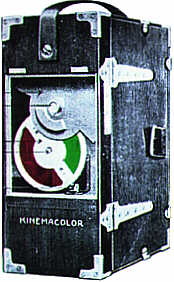
Kinemacolor camera

Kinemacolor camera, showing the red and green rotating filter

Kinemacolor therefore worked like this. Black-and-white film was exposed through a camera which was equipped with a rotating red and green filter. The film had to be taken at approximately double the normal speed, thirty frames per second. Thus successive frames recorded a ‘red’ and a ‘green’ record (a consequence of this was colour fringing when filming an object in motion, because what were supposed to be exactly adjacent records were slightly separated in time). The result was then exhibited through a projector similarly equipped with a rotating red and green filter, at thirty f.p.s. The result, after much experimentation with the exact type of filters and chemicals (not covered in any detail by the patent), was a motion picture colour record with a remarkably convincing natural colour effect. It could not be natural colour, of course (there was no blue, in effect), but it was convincing enough for most purposes, and what is more audiences became convinced that they could see the colours that were not there. Smith, the former mesmerist and trick filmmaker, knew all about the propensity, even the need for audiences to be fooled by what appeared on the screen. He described the illusion thus:

One has a very curious illustration about that with flags. I very often amuse myself about it, because this matter of blue has been on my mind a good deal, and I have discussed it a good deal. There is a rather curious thing that crops up in everyday life about blue, and that is in the Union Jack. You will find a Union Jack is very often indeed in a shocking state; it is a sort of dull drey [sic], red and black almost, and yet if you were to say to anybody, What colour is that? he would say, Red and blue; but when you took it down you would find there was no blue in it, it is red and black and dark grey, but no blue at all. I do not deny that you do get blue in Union Jacks, but it is called blue often when it is not; it is described as the good old blue and red Union Jack.

Kinemacolor was to be as much an act of faith as it was a plain technical achievement. It was the nurturing of that faith in audiences that was to bring out the genius in Charles Urban, as the entrepreneur behind Kinemacolor, and it is with Urban that we will take the story out of the inventor’s laboratory and on to its spectacular appearance on the world stage.

Recommended reading:
Brian Coe, The History of Movie Photography (1981)
D.B. Thomas, The First Colour Motion Pictures (1969)

Note: The quotation by Charles Urban comes from an unpublished (at the time) 1921 paper, ‘Terse History of Natural Colour Kinematography’. The Smith quotation on the colour blue comes from the documents accompanying the 1913 court case Natural Color Kinematograph Company, Limited (in liquidation) v Bioschemes Ltd.
Rohauer for sale

Sherlock Jr

Buster Keaton in Sherlock Jr., from http://www.guardian.co.uk

Got a million or two spare? Or maybe three? I’m not sure how much these things cost. Anyway, one of the world’s major commercial collections of silent films is up for sale. The Rohauer collection of some 700 titles, including many Buster Keaton titles, is being offered for either licensing deals or for a buyer to take the whole collection. The legendary collection was built up over three decades by collector Raymond Rohauer, around whom many a story has revolved but who has been rightly credited with bringing Keaton’s name back into public recognition.

The collection was bought by Gary Dartnall in 1995, who formed Douris to manage it, but they went into administration last year. So now the collection is on the market, and as The Guardian report says of the administrators Deloitte:

It sees potential buyers among those looking for steady income streams from licensing deals to the DVD, TV and video-on-demand industries as well as from film festival royalties. It also believes the collection could catch the eye of academics or a film enthusiast.

If you are interested in the story of Rohauer’s restoration (in more than one sense) of Keaton’s reputation, there’s an informative piece by David Shepard, ‘Polishing the Stone Face’, which discusses the problems involved in creating authentic restorations, because Rohauer had an unfortunate habit of ‘improving’ the prints in his care, rewriting titles and making editorial alterations.

But don’t let that put you off seeking that steady income stream, if you happen to be an academic or film enthusiast with a few pennies tucked away somewhere…

British silent cinema festival

Chicago

Chicago (1927)

The first news has been published of the feature films and main events taking place at this year’s British Silent Cinema Festival. As usual, the festival is being held at the Broadway, Nottingham, and runs 3-6 April.

This year the main theme is ‘Rats, Ruffians and Radicals: The Globalisation of Crime and the British Silent Film‘. The festival is a mixture of films, papers and special presentations, and usually pulls of the trick of attracting both an academic and an ‘enthusiast’ audience. Anyway, here are some of the delights on offer:

Chicago (USA 1927), sparky silent film version of the story that later became the musical Chicago. Directed by Frank Urson under supervision of De Mille this is a vibrant telling of the tale of Roxie Hart and her attempts to beat a murder rap in the most cynical city in the world. See the film that inspired the musical that inspired the film of the musical …

Red Pearls (UK 1930), Walter Forde’s psychological drama about a Japanese merchant who tries to drive his victim mad by sending him letters from beyond the grave.

Henry Edwards’ The Bargain (UK 1921) starring Chrissie White and actor/director Edwards in a tale of fraud, deception and family ties as a man purporting to be a long lost son returns from the Australian outback to claim his inheritance from his dying father.

At the Villa Rose (UK 1920), director Maurice Elvey’s classic locked-room murder mystery set in the fashionable and decadent expatriate community in Monte Carlo.

Die Carmen von St Pauli (Germany 1928), German director Erich Waschneck’s brilliant drama set in Hamburg’s dockside gangland featuring German stars Willi Fritsch and the delicious Jenny Jugo – who rivals Clara Bow for sheer screen presence. The film also shows there is more to German film than expressionism.

René Clair’s Le Fantôme du Moulin Rouge (France 1924) combines Grande Guignol, surrealism and playful avant garde film tricks. It’s the tale of a man whose spirit is released from his body to allow him to torment and trick his family but ultimately there’s a race against time when his spirit needs to get back into his lifeless body before the autopsy begins …

The Whip (USA 1917): more horse nobbling courtesy of Maurice Tourneur, based on the famous British stage play by Cecil Raleigh and Henry Hamilton. In the words of the legendary Tallulah Bankhead: “The Whip was a blood-and-thunder melodrama in four acts and fourteen scenes imported from London’s Drury Lane Theatre. It boiled with villainy and violence. Its plot embraced a twelve-horse race on a treadmill (for the Gold Cup at Newmarket), a Hunt Breakfast embellished by fifteen dogs, an auto-smash-up, the Chamber of Horrors at Madame Tussaud’s Waxworks, and a train wreck with a locomotive hissing real steam. It boasted a dissolute earl and a wicked marquis, and a heroine whose hand was sought by both knave and hero. It was a tremendous emotional dose for anyone as stage-struck and impressionable as our heroine.”

The Hill Park Mystery (Denmark 1923) (aka Shattered Nerves) features a detective trying to clear the name of a woman accused of murder, who finds matters complicated when he becomes romantically attached to his client.

Other highlights will include episodes from The Mystery of Dr Fu Manchu, The Adventures of Sherlock Holmes and tales from The Old Man in the Corner, Luke McKernan’s illustrated presentation to mark the centenary of the 1908 Olympics in the UK, a session on Melodrama along with a packed programme of presentations, screenings and social events.

So, yes, I’m one of the star turns (on Saturday the 5th), giving a glossy show on film and the Olympic Games, 1900-1924, with special attention given to the the London Games of 1908, whose centenary it is, of course. As for the feature films, there’s some fascinating choices there, though the British content seems a bit elusive in places. The festival website doesn’t have any programme details as yet, but further information will get published here in due course.

European film treasures

Daisy Doodad’s Dial

Florence Turner in Daisy Doodad’s Dial (1914), from http://creative.bfi.org.uk

Announced today is a plan by Lobster Films of Paris, with a number of partner organisations, to release up to 500 film titles from thirty-seven European archives, online and for free, with 50% funding from the European MEDIA programme, which is all about expanding markets for films and exposing content to new audiences. The partners include the British Film Institute and the Danish Film Institute. The project, European Film Treasures, launches in April.

Here’s a Reuters press report:

PARIS (Hollywood Reporter) – Where do you go if you want to watch rare archive films such as a 1916 document about life on a German submarine or John Ford’s 53-minute Western “Bucking Broadway” from the following year?

Until now, the answer would have been a trip to one of the film archives that house these prints, respectively London’s Imperial War Museum and the French Film Archive.

But that is about to change with the launch in April of a Europe-wide video-on-demand platform bringing together content from 37 film archives and cinematheques across the continent. And the good news for film buffs is that it’s free.

European Film Treasures, as the site will be known, is the brainchild of Serge Bromberg, founder of Paris-based historic film and restoration specialist Lobster Films. The European Union’s MEDIA Program has pledged to put up half of the approximately 500,000 euros ($725,000) needed to fund the project for its first year.

European Film Treasures is hoping to tap into a chunk of the huge audience for free on-line video sites like YouTube and Bebo. “The difficulty today is not so much to find old films and restore them, it’s finding an audience for them,” Bromberg says. “These are some of the best films shot in Europe over more than 80 years, but it’s often difficult to convince people to see films like these.”

Each partner archive will propose films, and a jury of historic film specialists will decide which to include on the VoD site based on criteria such as historical interest and artistic quality. Footage will be accessible for streaming only, not download, but the site may in the future extend to associated DVD sales.

Films will be available in their original language with translation where needed into English, French, German, Italian and Spanish.

The site is expected to launch with about 100 titles, but the aim is to include as many as 500 films once fully loaded. Lobster is coming up with original music to accompany silent films.

It took two years to convince all the archives to come on board. “They thought it was a good idea but considered it was impossible. The idea is not just to show their films, but also to present the archives and their work,” Bromberg says.

The only major national archive that decided not to be represented was from Belgium. “That is to their great shame,” Bromberg opines.

Bryony Dixon, curator (silent film) at the British Film Institute’s National Archive, says that VoD is a well-adapted platform for these early and short films, which are otherwise difficult to program. “Theatrical, you may get a few thousand viewers. On the Web, you can get hundreds of thousands or even millions. If you put it out there, people will find it. You get that long-tale effect.”

As with the other partner archives, the BFI is not putting in any financing but simply making films available. “We’re in a good position to do that as probably the biggest film archive in Europe,” Dixon says.

Among films the BFI is submitting are “Daisy Doodad’s Dial,” a 1913 British-made comedy starring U.S. actress Florence Turner, and a rare film of a French boxing champion. “We’ll pick things that have appeal, like the boxing film, which will be really interesting for the boxing community because it’s not seen before,” Dixon contends.

For its part, the Danish Film Institute is submitting a 1923 Danish film that is one of the earliest examples of a viable talking film; an animated sausage commercial film from the mid-1930s that uses Dufay Color, a mosaic screen additive system that predates Technicolor; and a raunchy 1910 one-reeler about Copenhagen nightlife.

“These are films that we restored recently. They’re all entertaining films, one about color and cinema, one about sound and cinema. It’s broadening people’s idea of the development of cinema,” said Thomas Christensen, curator of the DFI.

“It’s great that there’s this kind of channel for content that is otherwise sitting fallow in the archive,” said Christensen. “I don’t expect it to become a blockbuster phenomenon. It might never be more than marginal but it’s an interesting channel to be represented on. I think this is very much a transition time, and we have to explore the possibilities.”

This is exciting news, though it doesn’t explain where the other 50% of the money has come from, or what happens after the first year. Also, some of those films may have been already made available online elsewhere (Daisy Doodad’s Dial is being offered by the BFI for free downloading on its Creative Archive site). But the more exposure the better, because it is all about finding those new audiences.

So roll on the 1910 scenes of raunchy Copenhagen nightlife, and shame on Belgium.

Update (June 2008): The site is now available, from www.europafilmtreasures.eu. An initial review of the site fom The Bioscope is here.

What happens next?

Sleep with me series, Pihla, Nanna Saarhelo, 2007

Sleep with me series, Pihla, Nanna Saarhelo, 2007, from PM Gallery

Occasionally on the Bioscope we look to cinema’s roots in chronophotography, optical toys, magic lanterns and such like, and a new exhibition has just opened which both takes us back to chronophotography and up to the present day.

What Happens Next? is an exhibition dedicated to the photographic sequence. It takes as its inspiration the work of the nineteenth century photographer, Eadweard Muybridge, whose sequence photography – or chronophotography – of the 1870s/80s did so much to inspire the creation of cinema. The exhibition runs at the PM Gallery in West London 8 February-15 March 2008, and it explores the work of artists working in sequence photography from the nineteenth century to today. The artists featured are John Blakemore, Julie Cassels, Matt Finn, Steffi Klenz, Mari Mahr, Edweard Muybridge, James Newton, Nanna Saarhelo, Andrew Warstat, Sally Waterman and Cary Welling.

Coinciding with the exhibition is an article on Muybridge in this week’s New Scientist magazine (only an extract is available online). It’s a thoughtful piece (certainly a lot more thoughtful than its dire title, ‘Lights, camera, action!’ would seem to promise), with more emphasis on Muybridge’s Zoopraxiscope discs that one normally finds. The Zoopraxiscope was Muybridge’s proto-animation device, whereby he transferred some of his photographic sequences in silhouette form onto the edges of a glass disc so that they could be projected as fleeting animated images.

What Muybridge did not do was ever show his photographic sequences themselves as projected images in motion – he wasn’t able to. And yet how often to we see something like the animated sequences featured in this video?

This short piece on the exhibition has been posted on YouTube by the New Scientist, which rather goes to show that there are some limits to its knowledge of science. Muybridge’s photographic sequences were never seen in motion like this. To make them move he had to produce silhouettes derived from the photographs, making him a genuine pioneer of the animation film. The pure photographs he only displayed like so:

Ascending Stairs

Ascending Stairs

Of course, it is hugely tempting to animated Muybridge’s images, as has been done ever since Thom Andersen’s 1975 film Eadweard Muybridge, Zoopraxographer. Animated Muybridge sequences are found all over the Web, and have become an iconographic staple. But they falsify history – unless one argues that they display what Muybridge wanted to have displayed but was unable to achieve himself. In which case, they are a form of virtual history, which is all well and good, so long as we do not foget the true one.

As What Happens Next? demonstrates, chronophotography or sequence photography is alive and well today, practiced both as an art and as a science (either equally appropriate for Muybridge), for a sequential series both demonstrates a process and betrays a narrative. Chronophotographic sequences were used to striking effect for analysis in the BBC’s coverage of the last Winter Olympics, and there are numerous artists’ sites which display the possibilities of the medium. Some choice examples include P.J. Reptilehouse, Sequences, and my particular favourite, David Crawford, who photographs sequence of people on tube trains and at airports.

There’s also this review of What Happens Next?, which connects Muybridge with The Matrix, on the Telegraph‘s website.