Adventures in silent pictures

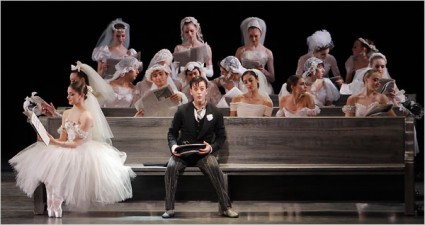
Makin’ Whoopee, part of Susan Stroman’s Double Feature, from http://www.nytimes.com

We haven’t had enough ballet here on The Bioscope. So, just opened at the New York State Theater is Broadway choreographer Susan Stroman’s “Double Feature”, performed by the New York City Ballet. The two parts of the ballet, which was first commissioned in 2004, are “The Blue Necklace” and “Makin’ Whoopee”. Both are inspired by silent movies, blending melodrama with slapstick comedy.

Silent film would seem to be a natural source of inspiration for ballet, and there are examples dotted around. Matthew Bourne’s dance company Adventures in Motion Pictures indicates some of its inspiration by its name, and Bourne has drawn on silent film for sets (Caligari helped inspired his “Cinderella”) as well as dance.

Amy Moore Morton, artistic director of the Appalachian Ballet Company, created and dances the lead in “With Chaplin”, which is none too surprisingly centred on Charlie Chaplin.

In the silent era itself ballet does not seem to have featured that often, but there are some notable exception. René Clair’s sublime Entr’acte (1924) was created as an interlude to feature between the acts of Francis Picabia’s ballet “Relâche”, performed by the Ballets Suédois with music by Erik Satie.

Also from the avant garde, Fernand Léger’s Ballet Mécanique is ballet in cinema form, even if it doesn’t feature dance as such, except the dance of objects and machines (plus a Chaplin figure). It was was created by American composer American composer George Antheil and Léger, though music and film did not come together for many years. So, in that spirit, here’s a clip from the film with music by guitarist Gary Lucas (a Bioscope favourite). Sorry about the faux scratches at the start.

Gary Lucas playing to an extract from Ballet Mécanique

Returning to Chaplin, don’t forget the dance (ballet) of the rolls from The Gold Rush (1925). And indeed you could argue for any number of Chaplin films for their balletic qualities.

Moving to modern silent director, Guy Maddin’s Dracula: Pages from a Virgin’s Diary (2002) is a ballet version of the Dracula story with German Expressionist decor and choreography by ballet director Mark Godden.

A modern oddity is Le Sacre du Printemps (2005), a film by Oliver Hermann which bills itself as a “‘Silent Movie’ to Stravinsky’s ballet score”. Sir Simon Rattle conducts the Berlin Philarmonic on the DVD release, and to judge from reviews it’s something of a challenging experience:

…a pair of albino men in tutus, a godlike black female figure baking tiny people like cookies in her kitchen, nuns, voodoo rituals, walls of neatly-mounted Polaroid snapshots being broken thru with an axe, or people endlessly lost in a giant green maze. Not to mention some very sexual scenes and a roomful of naked figures writhing around which disturbingly hovered between Dante’s Inferno and a Nazi death camp ‘shower’.

Hmm. Let us turn instead to Anna Pavlova, greatest of all ballerinas, who appears in three extant silent films, Lois Weber’s The Dumb Girl of Portici (1916), a feature film drama in which she acts rather than dances; Anna Pavlova (1924), which is a non-fiction film depicting her in various ballet sequences filmed in New York in 1924; plus there is a fragment of film of her dancing ‘Columbine’ on the set of Douglas Fairbanks’ The Thief of Bagdad (1924).

Lastly, it’s worth noting that many of the silent film pianists of today help earn their daily bread by playing for ballet and dance classes. Carl Davis has written for ballet as well as his renowned silent film scores, and it would be interesting to know how silent film musicians view accompanying dance or accompanying the screen, and what the interelationships might be.

Any more examples? Just let me know.

An apology

The Bioscope would like to apologise to any visitors to this blog who are finding Adsense ads appearing on posts if they come via a Google link. This is a feature that WordPress has introduced, and I can do nothing about it. I understand that if you are a regular visitor, or if you are logged into WordPress yourself, then you do not see the ads, but if you a newcomer or an infrequent visitor, then the ads will occasionally crop up. There seems to be nothing I can do to change this – you can’t even pay to make them go away. So I just want to make it clear that I have not sanctioned the use of this blog to sell anything to anyone, and I am very unhappy that it has been hijacked in this way, contrary to what was my understanding when I first signed up with WordPress. If I can change things, I will.

Silent music revival

Silent Music Revival is a series of live shows taking place in Richmond, Virginia, where bands of various hues play to silents that they haven’t seen before. It describes itself thus:

An organization that is interested in the juxtaposition of music and film. At an event a classic silent short film is played while accompanied by either live music or a DJ spinning records overtop of the film. Keep in mind that neither the band nor the DJ have seen the film. This combination always makes for an interesting view.

Today jazz group Glows in the Dark played to Buster Keaton’s The Electric House. Previous screenings have included Antlers playing to Starewicz’s The Mascot (1933), the ‘hip hop stylings’ of Swordplay playing to When the Clouds Roll By (1919), Beggar on Horseback (1925) and Dream of a Rarebit Fiend (1906), and Gamelan Raga Kusuma playing to Chaplin.

Find out more at www.myspace.com/silentmusicrevival.

Shell shocked

War Neuroses: Netley 1917, Seale Hayne Military Hospital 1918, from http://www.britishpathe.com

I’ve been reading (well, skimming through) Philip Hoare’s Spike Island, which is a poetic, not to say rococo history of the Royal Victoria Military Hospital at Netley, Hampshire. This is a building with a rich cultural history centring around its role during the First World War, where it was home to many casualties of the war, including Wilfred Owen, and became well known for treating victims of shell shock.

You’ll find many an account of the experiments and therapies for shellshock at Netley and elsewhere, from the sentimental to the Freudian. What concerns us here is the contemporary film record. One of the most notable films of the First World War, by what ever criteria you care to mention, is War Neuroses: Netley 1917, Seale Hayne Military Hospital 1918, made by Pathé (British branch) in 1918, which Hoare covers in some detail. War Neuroses shows the psychotherapeutic treatment of shell shock victims at Netley and Seale Hayne (Devon) military hospital, featuring the treatments undertaken by Doctors Arthur Hurst and J.L.M. Symns of the Royal Army Medical Corps. The catalogue of the Wellcome Trust Moving Image and Sound Collection describes the film thus:

Shows the symptomatology of “shell-shock” in 18 British “other rankers” and its treatment by two leading R.A.M.C. neurologists in two British military hospitals towards the end of the First World War. Captions tell us the men’s names, rank, medical condition, details of their symptoms and how long it took to complete the cure, which in one case was in two and a half hours. Clinical features shown include a variety of ataxic and “hysterical” gaits; hysterical paralyses, contractures and anaesthesias; facial ties and spasms; loss of knee and ankle-jerk reflexes; paraplegia; “war hyperthyrodism”; amnesia; word-blindness and word-deafness. Although there are no precise details of the kind of treatment given, apart from the description ‘cured and re-educated’ we do see a little physiotherapy and hypnotic suggestion in treatment, and of ‘cured’ men undertaking farm-work, drill and a mock battles entitled ‘Re-enacting the Battle of Seale Hayne / Convalescent war neurosis patients’.

At least three versions of the film exist. There are copies at the Wellcome, the BFI National Archive and the Imperial War Museum, but the ones to draw your attention to here are the versions held by British Pathe (currently managed by ITN). Pathé were the original producers, but not everyone might think to find it in the British Pathe online newsreel library, but there it is – or there they are – available for free download, albeit in low resolution.

Private Ross Smith (above), facial spams, and Private Read, hysterical gait, swaying movement and nose-wiping tic

There are five parts of the films on the British Pathe site: War Neuroses Version A reel 1, War Neuroses Version A reel 2, War Neuroses version B reel 1, War Neuroses version B reel 2 and Wonderful Shell Shock Recovery. For some impenetrable reason only two come up if you type in the words ‘war neuroses’ into the search box; type ‘netley’ instead and you’ll get all five. As indicated, there are two versions available (Wonderful Shell Shock Recovery is a fragment repeating scenes from the other films). The different versions, however, appear to be simply re-edits of the same material, with Version B being the most complete, with opening titles and scenes of some patients that Version A lacks. In its fullest form the film last around 25 mins. It is necessary to download the films (i.e. they won’t play instantly), with the site requiring you to fill out personal details before you do so.

The film demonstrates the symptoms of those suffering from shell shock, and are often quite heartbreaking. Private Preston, aged 19, we are told suffers from ‘Amnesia, word blindess and word deafness, except the the word “Bombs!”‘ He is shown sitting up in bed talking to one of the doctors, the key word is spoken, and immediately hides under the bed, and only reluctantly coming out again. Private Meek, aged 23, suffers ‘complete retrograde amnesia, hysterical paralysis, contractures, mutism and universal anaesthesia’. We see him seated in a wheelchair outside the hospital, legs rigid, leaning sideways, mvoing in awkward jerks and biting his thumb, while a nurse attends to him. It is a characteristic of War Neuroses that we see see before-and-after cases. So, after unseen treatment, we next meet Private Meek walking stiffly towards a group of patients weaving baskets (his peace time job), and later walking completely normally.

There are numerous such examples, the men shown with various forms of uncontrollable nervous spasms, next shown moving more or at less at ease, their return to normality sometimes illustrated by their performing tasks around the hospital as occupational therapy. One of the most distressing sequences is that of an unnamed patient (illustrated at the top of this post) suffering from hysterical pseudo-pseudohypertrophic muscular paralysis. We see the man in a dormitory, dressed only in a loin cloth. He walks with pathetic, angular awkwardness in a circle, before falling down, unable to get up without huge struggle. Next we see him in hospital uniform, walking calmly towards the camera. The reassuring scenes of rehabilitation seem almost as disturbing as the scenes of affliction. How can such mental wounds be healed so easily?

The purpose of the physical and psychotherapeutic treatment was not simply to cure, but to make the men literally fighting fit once more. Four-fifths of men who had been entering hospital suffering from shell shock were unable to return to military duty; the military authorities wanted to reverse this. What happened to the named and nameless soldiers seen in War Neuroses? One hopes fervently that none were returned to the battlefield. So what to make of the final scene from the film, where patients are shown taking part in a re-enacted battle scene: ‘The Battle of Seale Hayne, directed, photographed and acted by convalescent war neurosis patients’? Innovative psychodrama aimed at a final cure, or rehabilitation for war? Have we seen an actuality record, or a dramatisation of recovery to satisfy the wishes of those who chose to commission the film?

I don’t know enough of the history, either of the film (no one knows who the cameraman was, or much at all about the film’s production) or of the treatment of shell shock. It’s a subject that some have written about in great depth, yet it seems a subject where we still have much to learn. The film – which I urge you to see – provides no answers, only asks searching questions. Which is what films are there to do, whether they realise it or not.

Update (April 2009): A higher resolution copy of the film is available from the Wellcome Trust site, at http://catalogue.wellcome.ac.uk/record=b1667864~S8, as complete film and as four segments, plus a detailed catalogue record. Also, British Pathe is no longer managed by ITN Source.

Blackmail with strings

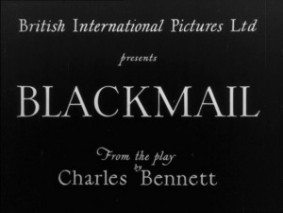
Opening title of the silent version of Blackmail, from http://www.hitchcockwiki.com

As a follow-up to yesterday’s item on the small band of British silents on DVD, here’s some heartening news. A special feature of this year’s Il Cinema Ritrovato film festival at Bologna will feature Neil Brand‘s new score for Alfred Hitchcock’s Blackmail (1929), with sixty-piece orchestra – the Opera Orchestra of Bologna, conducted by Timothy Brock. The event will take place at the Piazza Maggiore on July 1st, while the full festival (which includes silent cinema sections on Monta Bell, Comic Actresses and Suffragettes, Lev Kuleshov, Josef von Strenberg, Emilio Ghione, and films from 100 years ago) runs 28 June-5 July.

This may be the first orchestral score treatment of a British silent since the silent days. There have been small ensemble pieces (indeed, the Matrix Ensemble played Jonathan Lloyd’s score for Blackmail at the Barbican a couple of years ago), and in 2006 the documentary film The Battle of the Somme (1916) featured at the Royal Festival Hall with Laura Rossi‘s score for full orchestra, played by the Royal Philharmonia. But this – so far as I know – is the first time a British silent fiction film has been given the full works in modern times. Congratulations to Neil, bravo the Bologna festival for sponsoring it, and let’s hope it’s possible for to hear and see it elsewhere.

A Cottage on Dartmoor

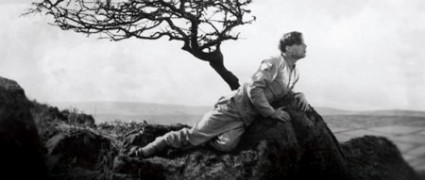
A Cottage on Dartmoor

Out on 26 May is the latest silent DVD release from the BFI, Anthony Asquith’s A Cottage on Dartmoor (1929). This intense melodrama about an escapee from Dartmoor prison was Asquith’s last silent, indeed one of the last silents to be made in Britain. A notable scene in the film is the pit orchestra for a part-silent, part-talkie movie having to sit around doing nothing while the sound passage plays. The film stars Norah Baring and Uno Henning, and has gained a modest reputation of late, thanks not least to Stephen Horne’s fine piano accompaniment at many screenings. Stephen provides the music here, while the extras include Insight (1960), a study of Anthony Asquith at work featuring on set footage and interviews, and Rush Hour (1941), a comedy film directed by Asquith about Britain’s workers coping with the transport system during the Second World War.

This is the film’s first DVD release in the UK – it’s already available on Region 1 in the USA, issued by Kino, with Stephen’s score, and the extra being Matthew Sweet’s commendable documentary Silent Britain (2006).

It wasn’t so long ago when your average film afficionado would have known nothing of British silents except Alfred Hitchcock’s The Lodger, and would probably have been proud to admit the fact. Now, thanks very much to the work of the BFI, the annual British Silent Cinema Festival, and above all to the quality of the best of the films themselves, a good selection is available on DVD and overturning prejudices. Here’s a round up of what currently exists of British silents on DVD, so far as I know (this list will get added to as new DVDs appear):

  • Blackmail (1929, d. Alfred Hitchcock) [Arthaus] (silent and sound versions)
  • A Cottage on Dartmoor (1929, d. Anthony Asquith) [BFI] [Kino]
  • David Copperfield (1913, d. Thomas Bentley) [Grapevine]
  • The Early Hitchcock Collection (includes Champagne [1928], The Ring [1927], The Farmer’s Wife [1928], The Manxman) [1927]) [Optimum] [Delta]
  • Easy Virtue (1927, d. Alfred Hitchcock) [WHE]
  • Hindle Wakes (1927, d. Maurice Elvey) [Milestone]
  • Hitchcock – The British Years (includes The Pleasure Garden [1925], The Lodger [1926] and Downhill [1927]) [Network]
  • The Informer (1929, d. Arthur Robison) [Grapevine]
  • Lady Windermere’s Fan (1916, d. Fred Paul) (VHS) [BFI]
  • Livingstone (1925, d. M.A. Wetherell) [Grapevine]
  • The Lodger (1926, d. Alfred Hitchcock) [Whirlwind]
  • Moulin Rouge (1928, d. E.A. Dupont) [Grapevine]
  • The Open Road (1924-1926, d. Claude Friese-Greene)[BFI]
  • Piccadilly (1929, d. E.A. Dupont) [BFI] [Milestone] [Sunrise Silents]
  • The Return of the Rat (1929, d. Graham Cutts) [Grapevine]
  • The Ring (1927, d. Alfred Hitchcock) (VHS) [BFI]
  • She (1925, d. Leander de Cordova) [Sunrise Silents]
  • South (1919, d. Frank Hurley) [BFI] [Milestone]
  • A Throw of Dice (1929, d. Franz Osten) [BFI]
  • Trapped by the Mormons (1922, d. Harry B. Parkinson) [Grapevine]
  • The Vortex (1928, d. Adrian Brunel) [Sunrise Silents]
  • The Woman He Scorned (1929, d. Paul Czinner) [Grapevine]

Compilations

  • Dickens before Sound (compilation of UK and USA titles) [BFI]
  • Early Cinema: Primitives and Pioneers (compilation of UK, USA and French titles) [BFI]
  • Electric Edwardians: The Films of Mitchell and Kenyon [BFI] [Milestone]
  • Mitchell & Kenyon: Edwardian Sports [BFI]
  • Mitchell & Kenyon in Ireland [BFI]
  • R.W. Paul: The Collected Films, 1895-1908 [BFI]
  • Silent Shakespeare (compilation of UK, USA and Italian titles) [BFI] [Milestone]

Television programmes

  • The Lost World of Friese Greene [BFI]
  • The Lost World of Mitchell and Kenyon [BFI]
  • Silent Britain [BFI] [Kino]

OK, it’s not a vast number (I’ve been selective over the Hitchcocks – there’s a fair amount of dross out there), but look at the quality (mostly). And there’s bound to be others (do let me know what I’ve missed). And let’s ponder what’s not on DVD but ought to be: Shooting Stars, The Rat, The Informer, The Battle of the Somme, East is East, The Life Story of David Lloyd George, The Hound of the Baskervilles, The Lure of Crooning Water, The Flag Lieutenant, The First Born

Bioscope Newsreel no. 2

The life of a vampire
The first biography of Max Schreck, cadaverous star of F.W. Murnau’s Dracula-inspired Nosferatu (1922) is being written by Stefan Eickhoff. Entitled Max Schreck – Gespenstertheater (Ghost theatre), it will be published later this year. Learn more.

Bardelys at Pordenone
The recently re-discovered King Vidor film, Bardelys the Magnificent (1926), will be unveiled at the Pordenone silent film festival in October. Other highlights announced include French comedies, the films of W.C. Fields, the films of W.K.L. Dickson, and ‘lost’ films of Sessue Hayakawa. Learn more.

Divas dolorosa
A new book has been published on the ever-suffering diva actresses of Italian silent film, such as Francesca Bertini and Lyda Borelli. Angela Dalle Vacche’s Diva: Defiance and Passion in Early Italian Cinema is published by the University of Texas Press and is accompanied by the DVD Diva Dolorosa made by silent found footage auteur Peter Delpeut. Learn more.

Sentiments past
Lea Jacobs’ new book is The Decline of Sentiment: American Film in the 1920s, and “seeks to characterize the radical shifts in taste that transformed American film in the jazz age”, looking at Erich von Stroheim, Charlie Chaplin, Ernst Lubitsch, and Monta Bell, among many others. It’s published by the University of California Press. Learn more.

‘Til next time!

A ragged swarm of adventurers

Here’s another gem uncovered from using Live Search. In fact it’s a text I know well, but I hadn’t realised it was available on the Internet Archive because there is nothing in the title Fifty Years of a Londoner’s Life (1916), by journalist Henry George Hibbert, to indicate its interest to the film historian. But Hibbert’s book contains a lively and observant chapter on the emergence of cinema in London, being especially vivid in describing the rush of showmen and speculators who jumped upon the cinema-building boom after 1910. He is also accurate in pointing out that a previous boom in roller skating rinks, which had collapsed, had left a number of empty venues looking for a new use, and many such were converted into cinemas. And thanks to the Internet Archive, which provides a plain text version, here is that chapter:

THE ROMANCE OF THE CINEMA

Its Introduction to London – A Protégé of the Music Hall – Millions Made, and Lost – Its Wondrous Future

Of all the children to whom the music hall has been foster mother, none was so rapid in its growth, so wayward, so fruitful in surprise as the cinematograph. And, after twenty years of remarkable achievement, it is still, in the belief of them that know it best, but on the threshold of its greatness. “The British public,” said one recorder of its early exhibition, “has a new toy, of which it is not likely to tire quickly”; just as an American writer of the first importance had been interested, but found the cinematograph “a curiosity of no particular importance.” A toy; a curiosity!

Moving pictures, it is still necessary to explain to the technically unlearned, do not move. This illusion was produced by the earliest scientific toy-makers. All the early photographers strenuously endeavoured to capture impressions of movement. Edison casually gave to the world a contrivance known as the kinetoscope, which he did not effectually protect. And from that many inventors toiled simultaneously to develop what we know as the cinematograph.

To the imagination of the Londoner, Robert W. Paul made the first and the most prolonged appeal. He was a craftsman of delicate and ingenious scientific instruments, and, having made a greater, or at any rate a more important contribution to the development of the cinematograph in England than any other, having taught many men of more heroic enterprise, or better luck, how to become millionaires, he retired from the field and returned contentedly to his first calling.

Paul illustrates the romance of invention with a homely picture. When, in the small hours of one morning, his experimental pictures were first endowed with life, in his Hatton Garden workshop, his men uttered a great shout of victory, the police were alarmed and broke in. As a sedative, an impromptu exhibition was administered to them. And so, in the winter of 1895, the cinematograph came to London. In a few weeks it was brought to the notice of Augustus Harris, and, frankly regarding it as an entertainment novelty of an ephemeral quality, he tried a cinema side-show at Olympia, where it competed with Richardson’s show and kindred delights.

Meanwhile Lumière, a Parisian photographer, had arrived at similar results, from a manipulation of the kinetoscope. Trewey, the juggler, and exponent of comic expression with the aid of a flexible felt hat, brought the Lumière apparatus to London, and was certainly ahead of Paul in impressing the cinematograph on the great mass of pleasure-seekers. The music hall agents and music hall managers were incredulous. Trewey resorted to the home of the scientific toy – the Polytechnic, and was looked upon as having achieved the finality of his mission. But he persisted. He arranged an afternoon season at the Empire, in the early days of March 1896. He soon insinuated the cinematograph to the evening programme here. And the reign of the moving picture began. I remember asking Trewey what he believed to be its possibilities in expeditiousness. He declared that if the progress of improvement were maintained a day would come when an occurrence might be reproduced on the screen within forty-eight hours. Whether or not my old friend lived to see his estimate corrected to minutes, I know not. Paul was in immediate succession. Toward the end of March, 1896, his so-called Animatograph was established at the Alhambra, where a tentative engagement, for weeks, was extended to one of years’ duration. Indeed, I do not believe that either of the two great Leicester Square houses has been without some form of animated photograph in all the meantime. Soon a finer apparatus than that either of Paul or of Lumière arrived at the Palace – known as the American Biograph, which for many months drew all London. Its pictures were larger, steadier, more actual. Before the end of 1896 there was not a music hall without its equipment of animated photography. Its scientific, industrial, commercial, and above all its tremendous art possibilities, were not yet conceived or perceived. Let me, as merely of the ministry of popular entertainment, emphasise this fact. The greatest, or at any rate the most appellant, scientific invention of our time, was nurtured in the English music hall, just as the electric light was first exploited as the advertisement of a theatre. A third Londoner completed the group of the pioneers of animated photography – a young American salesman of apparatus, Charles Urban, to whom the higher development of the new invention – its use for illustrating travel, the wonders of nature, and of scientific investigation – has always appealed, more than its use for frivolous amusement – on occasion, debased amusement. And two young Frenchmen, the Brothers Pathe, who began life as the exhibitors of a gramophone at Paris, quickly built up an immense business for the manufacture and sale of apparatus and films.

Imagination recoils from an attempt to suggest the magnitude of the cinematograph to-day. Estimate England’s inexplicably small share, then multiply it many times, and begin the endeavour to appreciate the fact that the cinematograph represents the third largest industry of America, where millionaires operate in its finance as they do in public loans, in railways, mines and steel; where great theatrical managers, dramatists and actors have silenced its menace by alliance, where they think nothing of an expenditure equalling ten thousand pounds on a production, and where they maintain upwards of six hundred picture theatres in a single city, Chicago.

Is English enterprise to follow in the wake of this huge enterprise? There are, at any rate, points of remarkable likeness in the evolution of the cinematograph here. First of all, the fact is to be noted that the pioneers of the industry, in both countries, nearly all retired – a few of them enriched, some of them disappointed and disaffected, some of them utterly broken. There never was a business of such strange mutations. It has been called by one of its most important adherents, Fred Martin – one of my boys, when he first of all aspired to journalism – who is mainly responsible for the manipulation of the exclusive picture and the introduction of the five-reel or “full performance” film here, in preference to a programme of many items, “The Topsy Turvy Industry.”

One of its wealthiest men to-day was a travelling showman. But the experience of the travelling showmen as a community was very different. To a man they abandoned their waxworks and their freaks and their marionettes for the cinematograph. I recall a St Giles’s Fair at Oxford that historic function still retained, but I think then lost, its boyish fascination for me – when, of fifty-one booths, forty-nine enclosed crude cinematograph shows, mostly exploiting vulgar comedy. The travelling showman came next to the music hall in popularising the cinematograph as an entertainment and in supporting it as a manufacturing industry. But he was hoist with his own petard. His success stimulated local enterprise, and when he revisited an old pitch he found a permanent picture theatre established.

Ruin spread among the travelling showmen and a new era in the history of the cinematograph began. Not the Klondyke attracted such a ragged swarm of adventurers. The collapse of the skating rink fever had left numerous sites and building shells free. Wild-cat speculators attracted millions of money from ignorant speculators, always fascinated by the business of pleasure. You could count picture palaces by the score in a brief ride across London. Again a debacle; and the official liquidator busy. But out of the wreck a new, resplendent picture palace – the ideal picture palace – is slowly rising. Its architects have expanded to one hundred thousand pounds in outlay on a structure.

For the short, amusing picture play there will always be a particular market. Elemental amusement will never lose its charm and importance – not till the love of toys is dead in small children and great. But cinematograph has left the nursery, and – still with uncertain eyes – is surveying the world. It has fascinated nearly every great actor, nearly every great author of our time, and liberally rewarded their adhesion to its cause. It is forming its own schools of financiers, and artists, and mechanicians, formerly drawn from everywhere and anywhere. The millionaires of the moving picture world include a clothing salesman, an itinerant conjurer and a music hall “lightning cartoonist.” The redoubtable Charlie Chaplin, now drawing his weekly emolument in thousands of dollars, was a “Lancashire clog dancer.” The greatest producer of the day, D.W. Griffith, who begins his cash account with a retaining fee of four hundred pounds a week, was but a few years ago a desperate actor. Mr Frederick A. Talbot, the historian of the cinema, estimated that four million people visit picture palaces daily in Great Britain. They pay fifteen million pounds out of their pockets annually into the box-offices of the cinema halls, and one person out of every three hundred and fifty one passes in the street depends upon the pictures for a livelihood. Of what individual investment may mean Mr R.G. Knowles is an example. He has outlaid twenty-five thousand pounds on the material of his travel lectures, and his wife, once Miss Winifred Johnson, abandoned the musical career she so adorned to become his secretary, editress, librarian.
Fifty Years of a Londoner’s Life is available in the usual range of formats from The Internet Archive, as has plenty more in the way of fascinating detail on the changing London social scene. Unlike some nostalgists of this era, he does not exclude the modernistic cinema, but sees it as part of the historical thread of the city.

The nightside of Japan

As evidence of the value of Live Search for searching across the texts of books digitised by the Internet Archive (see previous post), here’s a passage from The Nightside of Japan, by Taizo Fujimoto, published in 1914. It’s a travel book on Japan written for a Western audience by a Japanese writer, and it includes this marvellously vivid portrait of attending a cinema show in Tokyo at this time, complete with benshi narrator, interval acts and food sellers.

The Asakusa is the centre of pleasure in Tokyo. People of every rank in the city crowd in the park day and night old and young, high and low, male and female, rich and poor. It is also a haunt of ruffians, thieves, and pickpockets when the curtain of the dark comes down over the park. All houses and shops along each street in the park are illuminated with the electric and gas lights. The most noisy and crowded part is the site of cinematograph halls. In front of a hall you see many large painted pictures,
illustrating kinds of pictures to be shown in the hall, and, at its entrance, three or four men are crying to call visitors: “Come in, come in! Our pictures are newest ones, most wonderful pictures! Most lately imported from Europe! “Men of another hall cry out: “Our hall gives the photographs of a play performed by the first-class actors in Tokyo; pictures of the revenge of Forty Seven Ronine!” Tickets are sold by girls in a booking-box near the entrance of each hall; they are dressed in beautiful uniforms, their faces painted nicely, receiving guests with charming smiles. Most of the Japanese carry geta (clogs) under their feet, instead of shoes or boots, and specially so are the females. When you come into the door of a hall, tickets are to be handed to the men, who furnish you zori (a pair of straw or grass-slippers) in place of your geta, and you must not forget to receive from them a wood-card marked with numerals or some other signs the card being the cheque for your clogs. When you step on upstairs you are received by another nice girl in uniform, who guides you to a seat in the hall. Now the hall is full of people; it seems that there is no room for a newcomer, but the guide girl finds out a chair among the crowd and adjusts it to you very kindly. Pictures of cinematograph are shown one after another, each being explained by orators in frock or evening coat. Between the photograph shows performance of comic actors or jugglers is given. After the end of each picture or performance there is an entr’acte of three or five minutes, and in this interval sellers of oranges, milk, cakes, sandwiches, etc., come into the crowds, and are crying out: “Don’t you want oranges? Nice cakes! New boiled milk! etc., etc.” The show of cinematograph is closed at about 12 P.M., and all people flow out of the hall. Where will they go hence? Of course most of them go to their home, but a part of them young fellows among others runs to the Dark Streets of the park, or Yoshiwara, the licensed prostitution quarter near the park.

The Nightside of Japan is available from the Internet Archive in the usual range of formats (PDF, DjVu, TXT), and contains a few more references to cinematographs. More such gems as I find them.

Live searching

The British Library (the noble institution where I happen to work) has been engaged for some time in a major project with Microsoft digitising some 100,000 books from the nineteenth century. Around 30,000 of these have now been made public available through Microsoft’s Live Search facility (to UK users only). I haven’t investigated this collection to see what possible texts on moving images it might contain, but the news has drawn my attention to Live Search as research source, which I’d quite overlooked.

You will find many digitised historical texts there, as well as current texts where there is limited access (e.g. to 10% of the content), much as you do with Google Books. In truth, the two resources offer much the same results and extras, but I find Live Search superior for the clarity of layout, ease of navigation, the linkages offered, and the word searching. Click in a search term such as ‘cinematograph’ – 1,860 hits – and for each title you get the book record, publication information, hyperlinks to where the search term appears in the digitised text, links to World Cat (if you want to find it in a library somewhere), and where available the opportunity to download the book from the Internet Archive. It is this latter option that particularly appeals, because it offers a far better means to search through texts on the Internet Archive than the Internet Archive provides itself (there you can only search titles and a limited synopsis). Hence many more titles turn up with relevant material for early film studies, including texts not directly about the movies but which have handy incidental information. I’ll be bringing you the results of some of these in future posts.

Update (May 2008): Microsoft has just announced that it has withdrawn Live Search Books, as well as winding down its book digitisation programme. More information here. Sorry.