Slapstick, European-style – part 2

slapstick_blogathon_luke3.jpg

The Bioscope is taking part in the Slapstick Blog-a-Thon, a four-day festival of blogging on the subject of slapstick. The Bioscope’s contribution is to cover the story of the European comedians of the early cinema period whose work is less familiar to most now, but who enjoyed huge popularity in their day.

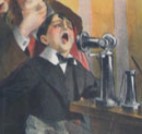
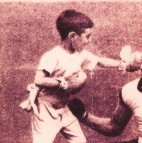
Today we look at a particular phenomenon of the period, child comedians. Here are three of the most popular of the period, all appearing in French films.

Bébé apache

Clemént Mary (1905-1974) was the the most celebrated of the European child stars of the silent period. At the age of five he was employed by the French Gaumont studios to star in a series of comedies under the name of Bébé. Bébé was a cheeky, resourceful character who was invariably far smarter than the adult world around him. Indeed, the common gag in the Bébé films was to place the child in adult situations, evidenced in such titles as Bébé apache (1910), Bébé millionaire (1911) and Bébé candidat au mariage (1911). In the first of those, Bébé’s ability to capture the mannerisms of the Parisian apache, and to play these convincingly and with deft coming timing amid an adult cast is extraordinary. He also played occasional non-Bébé roles. In 1912, Louis Feuillade at Gaumont introduced a new child character into the films, Bout-de-Zan (see below), and won a court case against Mary’s father who had protested at the competition. The father won the right to keep using the Bébé name however, and they moved to Eclectic Films to continue the series until 1916. In adulthood, he changed his name to René Dary and enjoyed a successful career in film and television into the 1970s.

There’s information on Louis Feuillade, Bébé and Bout-de-Zan in the Pordenone catalogue for 2000

See some of his credits (only a small selection of the Bébé films is given) on the IMDB, under René Dary

Bout-de-Zan

René-Georges Poyen (1908-1968) was taken on by Gaumont in 1908 as a co-star and planned replacement for Bébé, and was given the character name of Bout-de-Zan. Greater comic emphasis was placed on Bout-de-Zan being an ‘adult’ figure, as he dressed like an adult, aped adult mannerisms, and was generally an earthier character than Bébé. He would also often giving knowing looks to the camera, making the audience complicit in his trickery. Bout-de-Zan films stand up as well today as those of Bébé, displaying a cleverness and an apparent delight in peformance which helps override concern one might have at the exploitation of such young children, making films week after week. Poyen also appeared in the Louis Feuillade serials Les Vampires (1915) and Judex (1916). The last Bout-de-Zan film was made in 1916, but Poyen carried on making films into the 1920s.

The Image Entertainment DVD of Les Vampires includes a 1916 Bout-de-Zan short, Bout-de-Zan et l’embusqué

Willy Sanders

Willy Sanders (or Saunders) (1905-?) was a British music hall prodigy who first appeared on film aged four as a boxer, flooring an adult opponent, in The Man to Beat Jack Johnson (1910). His popularity was sufficient that he was brought over to France to star in the Little Willy series for Eclair, with seventy or so titles being produced 1911-16. Little Willy never had the same appeal as some of the great French child performers, but the series was reliable knockabout fare of the time, with such titles as Willy professeur de skating (1911), Willy diplomate (1913) and Petit Willy soigne la neurasthénie de son oncle (1911). Willy returned to boxing in 1913 for Willy contre le bombardier Wells, where our hero defeats ‘Bombardier’ Billy Wells, the great British boxing hero of the time. He seems not to have had a film career beyond 1916.

Read about Willy in Andrew Horrall’s Popular Culture in London c.1890-1918, which features him on the front cover

Read about The Man to Beat Jack Johnson on Screenonline

There will be more on the Europeans tomorrow…

Slapstick, European-style – part 1

slapstick_blogathon_luke2.jpg

Today, and for the next three days it is the Slapstick Blog-a-Thon, a bloggers’ festival of slapstick organised by Film of the Year. Numerous blogs are taking part, and Bioscopists are warmly encouraged to follow up the other blogs, add comments and so forth.

The Bioscope’s main contribution to the Blog-a-Thon is a survey of the great European comedians of the early cinema, whose names are sadly known only to the few these days, but whose fame once easily matched that of the Keystone stable and other American comics.

Here’s part one…

André Deed

André Deed (1879-1935) was a French music hall comedian whose film career started with Georges Méliès in 1901, but took off when he joined Pathé Frères in 1906. He established a comic character, Boireau, appearing under that name in numerous shorts, and enjoyed a growing screen reputation throughout Europe. The success of the character inspired numerous imitators at other studios, and essentially created the star comedy genre. His film career blossomed further when he joined Itala in 1908 and established a new character, Cretinetti (known as Foolshead in Britain and Gribouille in France). Cretinetti was an engaging mixture of dim-wittedness and sharp-wittedness, readily stumbling into chaotic situations but triumphantly working his way out of them. He went back to Pathé in 1911 and resumed the character of Boireau. He made hundreds of comic shorts in his career, whose anarchic quality seems to ally them with Dada and Surrealism. He made some further Cretinetti films in Italy from 1915, before his career faded away in the 1920s.

Read this essay on early film, Cretinetti and the Modernists

There’s a new book on Deed, Jean A. Gili’s André Deed – Boireau, Cretinetti, Gribouille, Toribio, Foolshead, Lehman… (Le Mani-Cineteca di Bologna, 2005), in Italian

Max Linder

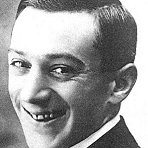
Max Linder (1883-1925) was arguably the greatest of all European silent film comedians, and in retrospect the most tragic. He was born Gabriel-Maximilien Leuvielle but took the stage name Max Linder, and began working in Pathé films, initially in minor roles, from 1905. Gradually he built up the character of Max, a sophisticated, elegant figure with top hat and cane, something akin to the flâneur of literary imagination, who could get caught up in foolery without ever losing his dignity. Max was a natural romantic, though his attempts to win the girl were frequently held up the booby-traps of everyday life. In contrast to the popular European comedians of the day, his style was more subtle, less pantomimic, and his comedy had a touch of grace about it that won his international admirers, none more so than Chaplin. His period of fame started around 1910 and he made hundreds of Max films up to 1914, becoming one of the most popular stars of the screen of that time. The war brought an end to his fame, and though he had a brief period in the USA at the Essanay studios in 1916, he was not a success, and his career gradually petered out. He made a few feature films (such as The Three-Must-Get-Theres in 1922), but he suffered badly from depression, and in 1925 he and his wife committed joint suicide.

There’s a DVD, Laugh with Max Linder, available from Image Entertainment

Find out more about Max Linder on Wikipedia

Pimple

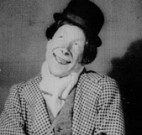
Fred Evans (1889-1951) was second only in popularity to Chaplin in Britain at the height of his career. He was the nephew of a well-known music hall comedian, Will Evans, and trod the boards himself before entering films in 1910 for Cricks and Martin, with the character Charley Smiler. The films were crudely-constructed affairs, but two years later Evans came up with the character of Pimple, a white-faced clown, perpetually accident-prone. Hundreds and hundreds of Pimple films were made, most of them routine knockabouts, but he also developed a taste of parodies, and in films like Pimple’s Battle of Waterloo (1913) he displays a proto-Pythonesque humour of the absurd while sending up the British epic film The Battle of Waterloo. In many of them he collaborated with his brother Joe. His comedy is sometimes held up by a weakness for punning intertitles, and few of his surviving films raise much a laugh nowadays, but at his best his comic inventiveness does indeed point the way to Python, The Young Ones, The Fast Show and a long British tradition of the gleefully absurd. He continued to make many films through the war years, and ended his film career as an extra in the 1930s.

Find out more about Pimple on Screenonline

There’s an excellent essay on Fred and Joe Evans by Michael Hammond in the book Pimple, Pranks & Pratfalls: British Film Comedy Before 1920 (2000)

Rigadin

Charles Prince (1872-1933) appeared in Pathé films as Rigadin, whose character was generally that of a bashful lover. He already enjoyed some fame as a theatre performer before joining Pathé in 1908, and he went on to appear in over 200 Rigadin films up to 1920, writing the senarios for many of them. In Britain and America he was known as Whiffles. Rigadin’s most interesting films were those that took on contemporay themes, such as Rigadin Peintre Cubiste (1912), where he mocked modern art by appearing as an angular figure, and Rigadin aux Balkans (1912) where he plays a war cameraman who gleefully fakes scenes for the camera in France rather than travel to the Balkan War. He ended his film career playing small roles throughout the 1920s and 30s.

More European comedians tomorrow… and don’t forget to read all the other Slapstick Blog-a-Thon posts.

(Acknowledgments to the Encyclopedia of Early Cinema for some facts and figures).

They said that

Kafka Goes to the Movies

OK, here are the answers to yesterday’s poser. The six people commenting on the experience of going to the cinema in the silent era were all notable authors, albeit four of them wrote the comments before they found fame.

Quotation no. 1 – “Nothing of my former mind seems to have remained except a heightened emotiveness which satisfies itself in the sixty-miles-an-hour pathos of some cinematograph or before some crude Italian gazette-picture” – This is James Joyce, writing to his brother Stanislaus while living in Rome in 1907. Joyce was twenty-five years old, working in a bank, and a long way from literary fame. He was to become a regular cinema-goer, despite failing eyesight, and of course managed a cinema in Dublin for a brief period 1909-1910 – though that had more to do with money (which did not come his way) than any love of early film.

Quotation no. 2 – “If I had my way, I would build a lethal chamber as big as the Crystal Palace, with a military band playing softly, and a Cinematograph working brightly” – This is D.H. Lawrence, writing to Blanche Jennings in 1908, imagining how he might dispose of society’s outcasts. It’s a familiar quotation, from its use in John Carey’s book The Intellectuals and the Masses: Pride and Prejudice Among the Literary Intelligentsia, 1880-1939 (1992). Lawrence was contemptuous of the cinema – elsewhere he describes it as the “triumph of the deaf and dumb”. His first novel was three years away.

Quotation no. 3 – “Was at the movies. Wept. Lolotte. The good pastor. The little bicycle. The reconciliation of the parents. Boundless entertainment” – This is Franz Kafka, aged thirty, writing short stories, and touring around Prague with his good friend Max Brod, with whom he went to the cinema. There is an extraordinary book by Hanns Zischler, Kafka Goes to the Movies (2003), which identifies the films the pair saw, from Kafka’s and Brod’s diaries, tracks them down in reviews and archives (where they survive), and writes a history of Kafka’s emotional life and cultural life through the films that he saw. There’s an extract from it here. Zischler is now working on a similar project on James Joyce.

Quotation no. 4 – “the encroachment of the cheap and rapid-breeding cinema” – This is T.S. Eliot, and it comes from one of his most celebrated essays, ‘Marie Lloyd’, published in 1922. Eliot praises one form of working-class entertainment, but expresses loathing for its successor, the cinema, the phrase ‘rapid-breeding’ unpleasantly melding the growth in cinema-building with his sense of an animalistic, proletarian audience that filled him with horror.

Quotation no. 5 – “In spite of my earnest resolution never again to waste time at a cinema I have spent both yesterday and this afternoon in that unprofitable way” – The man with the addiction for going to the cinema is Evelyn Waugh. It comes from his diary entry for 3 September 1924, the day after he had vowed not to go the cinema “promiscuously”. The entry for 4 September however records, “Last night I slept ill; I think through excess of cinemas. I went to two yesterday”. This clearly was an addicition of some kind, and visits to the cinema are regularly recorded in Waugh diaries. Around this time he made scurrilous amateur films with Terence Greenidge, Elsa Lanchester and others, but had yet to complete his first novel.

Quotation no. 6 – “They have never seen the savages of the twentieth century watching the pictures” – This is from Virginia Woolf’s celebrated 1926 essay, ‘The Cinema’. Woolf was intrigued by film of reality, which she found to be at a curious remove from reality. Woolf was genuinely interested in the possibilities of the cinema, the potential it offered for a new way of seeing. Her ‘savages’ metaphor, however, I find mysterious.

The reactions of the literary intelligensia to the early cinema is a subject that fascinates me, and we’ll have more on the Bioscope in future posts – particularly those writers who found that they could make money out of the movies, or who were inspired to take up the camera themselves.

Who said that?

A little quiz for you. I’m planning assorted future strands for The Bioscope, and as a taster for one of these (while also thinking of the views of the cinema from elites evidenced in the Stephen Paget essay yesterday), here are six quotations. Each is a response to silent cinema, and the authors are all connected in some way. I’ve given the dates of the utterances, but can you guess who they are? Answers tomorrow…

Quotation no. 1 (1907)

I have gradually slid down until I have ceased to take any interest in any subject. I look at God and his theatre through the eyes of my fellow-clerks so that nothing surprises, moves or excites or disgusts me. Nothing of my former mind seems to have remained except a heightened emotiveness which satisfies itself in the sixty-miles-an-hour pathos of some cinematograph or before some crude Italian gazette-picture.

Quotation no. 2 (1908)

If I had my way, I would build a lethal chamber as big as the Crystal Palace, with a military band playing softly, and a Cinematograph working brightly; then I’d go out in the back streets and main streets and bring them in, all the sick, the halt, and the maimed; I would lead them gently, and they would smile me a weary thanks; and the band would softly bubble out the ‘Hallelujah Chorus’.

Quotation no. 3 (1913)

Was at the movies. Wept. Lolotte. The good pastor. The little bicycle. The reconciliation of the parents. Boundless entertainment. Before that a sad film, Catastrophe at the Dock, afterwards the amusing Alone at Last. Am completely empty and meaningless, the electric tram passing by has more living meaning.

Quotation no. 4 (1922)

With the decay of the music-hall, with the encroachment of the cheap and rapid-breeding cinema, the lower classes will tend to drop into the same state of protoplasm as the bourgeoisie. The working-man who went to the music-hall and saw Marie Lloyd and joined in the chorus was himself performing part of the act; he was engaged in that collaboration of the audience with the artist which is necessary in all art and most obviously in dramatic art. He will now go to the cinema, where his mind is lulled by continuous senseless music and continuous action too rapid for the brain to act upon, and will receive, without giving, in that same listless apathy with which the middle and upper classes regard any entertainment of the nature of art. He will also have lost some of his interest in life.

Quotation no. 5 (1924)

In spite of my earnest resolution never again to waste time at a cinema I have spent both yesterday and this afternoon in that unprofitable way. I am ashamed and more than ever strengthened in my resolution.

Quotation no. 6 (1926)

People say that the savage no longer exist in us, that we are at the fag-end of civilization, that everything has been said already, and that it is too late to be ambitious. But these philosophers have presumably forgotten the movies. They have never seen the savages of the twentieth century watching the pictures. They have never sat themselves in front of the screen and thought how, for all the clothes on their backs and the carpets at their feet, no great distance separates them from those bright-eyed, naked men who knocked two bars of iron together and heard in that clangour a foretaste of the music of Mozart.

Quotations 1 and 2 comes from letters, quotations 3 (in translation) and 5 are from diaries, quotations 4 and 6 come from essays.

1st International Silent Film Festival

http://www.goethe.de

While I don’t expect it’s going to affect many Bioscope readers, I’ve just come across notice of the 1st International Silent Film Festival, currently taking place in Manila, Philippines. Organised by the Goethe-Institut Manila, Instituto Cervantes and the Japan Foundation, the festival is taking place 4-13 September, and features silent films from Germany, Japan and Spain. There are just three films showing, a little disappointingly for such a grandly-named venture: Lotte Reiniger’s The Adventures of Prince Achmed/Die Abenteuer des Prinzen Achmed (1926); the Spanish silent The Sixth Sense/El sexto sentido (1929), directed by Nemesio Sobrevilla; and the Japanese A Monster Serpent/Orochi (1925), directed by Buntaro Futagawa. There are further details on the films here.

Pictures ought not to move

Not everyone liked the silent movies. There were plenty of critics who scorned the new medium, often as much for the audience it drew as the quality of the films themselves. Mechanically-produced, cheap, easy to view, inescapably bound up with urbanisation and crowds, above all modern, they drew contemptuous attacks from many social commentators and critics more at ease with the well-established art forms.

A fascinating example is ‘Moving Pictures‘, an essay by the surgeon and essayist Stephen Paget, from his 1916 book Sometimes I Think, which a friend alerted me to recently. It can be found on the Gaslight website, and I’ll quote a few passages here and encourage you to investigate the essay in its entirety.

Here’s how Paget begins his argument:

We are so accustomed to moving pictures, that we do not trouble ourselves to study their nature, or their place in the general order of things. We take them for granted. Youth, especially, takes them for granted, having no memory of a time when they were not. But some of us were born into a world in which all the pictures stood still: and I challenge youth to defend the cause of moving pictures. Let the lists be set, and the signal given for the assault. On the shield of youth, the motto is Moving Pictures are All Right. On my antiquated shield, the motto is Pictures Ought Not to Move.

Pictures, of one sort or another, are of immemorial age. Portraits of the mammoth were scratched on gnawed bones, by cave-dwellers, centuries of centuries ago: and we look now at their dug-up work, and feel ourselves in touch with them. The nature of pictures was decided at the very beginning of things, as the natures of trees and of metals were decided. It is not the nature of trees to walk, nor of metals to run uphill: it is not the nature of pictures to move. Pictures and statues, by the law of their being, are forbidden to move. That commandment is laid on them which Joshua, in the Bible-story, lays on the sun and the moon – Stand thou still. They must be motionless: ’tis their nature to: they exist on that understanding, as you and I exist on the understanding that we are mortal. If I were not to die, I should not be a man. If pictures were to move, they would not be pictures.

It’s a curious argument, but at root Paget wants pictures not to move because to do so inhibits the imagination. And this leads him to his own logical conclusion, that motion pictures cannot be an art form:

The photograph of a friend, on my mantelpiece, gives play to my remembrance of him. Within the limits of photography, it is perfect. But if it moved – if its eyes followed me about the room, and its hands had that little gesture which he had with his hands, and its lips opened and shut – it would be hateful, and I should throw it in the fire.

The great pictures in the National Gallery – the Rembrandt portraits, the Raphael Madonnas – imagine them moving. Their beauty would vanish, their nature would be destroyed. The Trustees would immediately sell them, to get rid of them. Probably, they would go on tour: admission threepence, children a penny. Then they would be “filmed,” and the films would be “released,” and a hundred reproductions would be gibbering all over the country. The originals would finally be bartered, in Central Africa, to impressionable native potentates, in exchange for skins or tusks: and if pictures were able to curse, these certainly would curse the day on which they began to move.

By these instances, it is evident that pictures ought not to move. The worse they are, the less it would shock us if they did. The better they are, the more it would shock us. Why must they not move? Because they are works of art. It follows, that moving pictures are not works of art.

QED. Paget then intriguingly calls upon the common argument that films were originally a tool of science (which is quite true), only to use this to bolster his argument against them:

They are works of science: they are “scientific toys.” Science invented them, just for the fun of inventing them: made them out of an old “optical illusion.” They are that friend of my childhood, the zoëtrope, or wheel of life, adjusted to show the products of instantaneous photography. They are “applied science.” … But scientific inventions, unlike works of art, have an immeasurable power of growth and development. They can be improved ad libitum: they can be multiplied ad infinitum. Nothing could be less like a work of art coming from a studio than a scientific invention coming from a laboratory. The work of art is made once and for all: it may be copied, but it cannot be repeated: you cannot have two sets of Elgin Marbles, or two Sistine Madonnas. The scientific invention is like the genie who came out of the fisherman’s jar: you cannot tell where it will stop, nor what it will do next.

Paget, despite his distaste for the motion picture, appears to have been sufficiently aware of the medium to describe in knowledgeable detail the circumstances of its exhibition in war-time:

I should like to see the War bring down the moving-pictures business to one-third of its present size, bring it down with a rush, and with the prospect of a further reduction. Picture-palaces in London are like public-houses: too many of them, too many of us nipping in them; too many people making money out of us, whether we be nipping in the palaces or the houses. The more we patronise them, the more they exploit us: and some of us are taking more films than are good for us. … The bill of fare, at the picture-palaces, includes trash: but it pays them to sell it to us: and we behave as if these palaces belonged to us, while they behave as if we belonged to them. Picture-palaces and public-houses, alike, amuse all of us and enrich some of us: they do good, they do harm: they have to be watched, these by censorship, those by the police: and both these and those are backed by wealth, and by interests too powerful to be set aside.

Paget is most interesting, however, when he takes the motion picture to task for its illusion of reality, still more its pretension to drama:

What is the nature of moving pictures? What are they “of themselves,” and where do they come in the general order of things? Take, for instance, a waterfall. If we look at a waterfall, we see water moving. If we look at a picture of a waterfall, we imagine water moving. If we look at a moving picture of a waterfall, we see a picture moving, a very beautiful object: still, we are looking at an “optical illusion,” not at a waterfall. Or take a more critical example: take a moving picture which not merely moves, but acts. What is it, really, that we are looking at, when we see, on the screen, Hamlet, or How She Rescued Him, or Charlie Chaplin?

He is an actor equal to Dan Leno: the same unfaltering originality, the same talent for dominating the scene, holding our attention, appealing to us by his diminutive stature, his gentle acceptance of situations as he finds them, his half-unconscious air of doing unnatural things in a natural way. But think what we lose in the transition from Dan Leno on the stage to Charlie Chaplin on the screen. Dan was really there: Charlie is not. Dan talked and sang: Charlie is mute. Dan’s performance was human: Charlie’s, by the cutting of the film, and by the driving of the machine at great speed, is super-human. In brief, on the Drury Lane stage I saw Dan Leno, and heard him: but on the screen I do not see Charlie Chaplin–let alone hearing him: I see only a moving picture of him: and this picture so cleverly faked that I see him doing what he never did nor ever could. It was delightful, every moment of it: all the same, it is an optical illusion. Nor is it a straightforward illusion, like the old zoëtrope: it is rendered grotesque and fantastical by the conjuring-tricks of the people who made the film.

He then goes on to decry the idea of filming Shakespeare, particularly in dumbshow (‘Let nothing ever induce you to see him “filmed”‘). Yet he is not wholly against film, when it does what only film can do:

It follows, that the best plays, on the screen, are those which can best afford to lose the advantage of voices and presences, and to be taken for what they are. Wild farce, with lots of conjuring-tricks in it, is the best of all. In pantomime, with a film so faked and speeded-up that fat men run a mile a minute, and cars whirl through space like shooting stars, and all Nature is convulsed, these picture-plays are at their best, joyfully turning the universe upside-down with the flick of a wheel. In the mad rush of impossibilities, there is no time for words, and no need of them.

Perhaps inevitably, Paget is most sympathetic towards the film that depicts reality, and, as a doctor, he shows especial interest in the medical film.

In the display of moving pictures of real things, all the way up from elemental movement to human action, the picture-palace is our good friend: it is servant, by divine appointment, to reality. Moving pictures of living germs of disease, colossally magnified by the adjustment of micro-photography to the making of a film, are the delight of all doctors: moving pictures of wild creatures are the delight of all naturalists: scenes of human life in diverse parts of the world – the crowds in London streets, the crowds in Eastern bazaars, the work and play and habits and customs of the nations – these are the delight of all of us, and will never cease to delight us. For this wealth of visions, this treasury of knowledge, let us be properly grateful.

He concludes by referring to the Cabinet film – an failed attempt by Cecil Hepworth to make a film of the British cabinet – arguing that for the great to be filmed is to lower their dignity (“the value of a moving picture of a great man is lowered, if he is posing for it”); contrasting this with the official film of The Battle of the Somme.

A moving picture of a little group of great men, behaving as the camera expects them to behave, might deservedly fail to have power over us. But here are legions of men, not under orders from the camera, but employed in a business of tragedy such as the world has never suffered till now: men great, not in the Westminster-Abbey sense of the word, but in the greatness of their purpose, in their unconquerable discipline, their endurance: they go into the presence of Death without looking back, and they come out from it laughing, some of them: you see them treading Fear under their feet, you see Heaven, revealed in their will, flinging itself on the screen. You and I, safe and snug over here, let us receive what they give us, their exampl

This is a very interesting, thought-provoking essay, which is eloquent in the way it challenges the motion picture’s pretensions to art and its apprehension of reality. It calls for better pictures rather than no pictures at all, and its distaste is chiefly aimed at the business that creates films rather than the masses who watch them. The complete essay is well worth reading. After all, if we are equipped with an imagination, why do we need pictures to move at all?

Image and Sound

Friese-Greene film

Strange things going on at the Tate. This Friday, 7 September, Tate Britain is hosting Image and Sound, which it describes as

Iconic British silent films shown with live music dominate the enormous central gallery, and Steve Beresford, Scanner and David Toop perform together for one night only.

The event is organised by Artprojx (“a co-marketing, event production and creative strategic consulting agency”), and mixes artists’ films with experimental music/sounds and British silents – in this case, Anthony Asquith’s A Cottage on Dartmoor (1929), with Stephen Horne at the piano, and Claude Friese-Greene’s The Open Road series of colour films 1924-25, with the much-travelled Neil Brand on the piano.

Goodness knows how the ‘iconic’ silents will blend in with the experimental sounds, artists’ films (including Haris Epaminonda’s Light, Tarahi II, Tarahi IIII, Tarahi V, Michael Nyman’s Moscow 11.19.31, and what sounds like a special treat, Emily Wardill’s Basking in what feels like ‘an ocean of grace’, I soon realise that I’m not looking at it, but rather that I AM it, recognising myself). With a bar available in the gallery and folk wandering to and fro, it should make for an interesting happening, but possibly not the ideal circumstances in which to savour the silents (though they are at least in their own room, The North Duveens).

Still, why not go along and support Neil and Stephen, and see if I’m wrong. The Tate’s growing commitment to exhibiting silent film is commendable, and if they can continue to place the films before new audiences, even if the settings may sometimes be challenging, this can only be to the good. Doors open at 6.00pm with tickets on a first-come-first-served basis, and the event runs til 10.00pm. The central Image and Sound event runs 7.00-9.00, The Open Road is at 6.30 and A Cottage on Dartmoor at 7.45.

There’s rather more information on the Artprojx site than on the Tate’s.

More on Fflics

Jerry the Troublesome Tyke

Jerry the Troublesome Tyke, from http://www.fflics.co.uk

There’s more information now available on the Fflics Festival of Welsh and Welsh-related silent and sound film, to be held in Aberystwyth, 25-28 October. Here’s the programme:

Thursday 25 October
19.00 Opening Night Gala Celebration –
19.30 How Green Was My Valley (1941) 118 mins

Friday 26 October
10.00 The Proud Valley (1940) 77 mins
10.00 Arthur Cheetham Shorts
12.00 The Silent Village (1943) 36 mins
12.00 William Haggar Shorts
14.00 Jerry the Troublesome Tyke
14.00 The Corn is Green (US, 1946) 118 mins
15.30 The Citadel (1938) 110 mins
17.45 Blue Scar (1949) 90 mins
18.00 Valley of Song (1953) 74 mins
20.00 Dead of Night (1945) 102 mins
20.00 Fame is The Spur (1947) 116 mins

Saturday 27 October
10.00 A Run For Your Money (1949) 85 mins
10.00 Mitchell and Kenyon Shorts and Representations of Welshness – Discussion
11.30 Y Chwarelwr (The Quarryman) (1935) and Yr Etifeddiaeth (The Heritage) (1947-9)
13.45 Noson Lawen and Letter from Wales
14.30 The Shop at Sly Corner (1947)
15.00 The Rat (1925) 74 mins
16.45 The Stars Look Down (1939) 94 mins
17.15 Call of the Blood (France, 1920)
19.30 Next of Kin (1942) 102 mins
19.00 The Life Story of David Lloyd George (1918)

Sunday 28 October
10.00 The Last Days of Dolwyn (1949) 95 mins
11.00 David (1951) 37 mins
13.30 The Life and Death of Colonel Blimp (1943) 163 mins

Some corking stuff there. On the silent account, there’s Ivor Novello in Call of the Blood (a French production) and The Rat, the long-lost biopic The Life Story of David Lloyd George (1918), the 1920s Sid Griffiths cartoon series Jerry the Troublesome Tyke, and early shorts by the Welsh film pioneers Arthur Cheetham and William Haggar. Plus the ubiquitous Mitchell and Kenyon and their films of Wales in the 1900s.

And, in the proper spirit of these things, here’s some of that information in Welsh:

Fel rhan o ddathliadau blwyddyn canmlwyddiant Llyfrgell Genedlaethol Cymru, bydd gwyl ffilmiau Fflics yn dangos etifeddiaeth ryfeddol ffilm yng Nghymru.

Bydd yr wyl yn cynnig cymysgedd ddifyr o ffilmiau mud a sain. Ymysg yr uchafbwyntiau bydd Noson Gala Agoriadol gyda dangosiad o brint adferedig o’r ffilm eiconig How Green was my Valley (1941), yn ogystal a dwy ffilm o’r 1920au a fydd yn amlygu dawn Ivor Novello o Gaerdydd, un sêr mwyaf y cyfnod.

Mae uchafbwyntiau eraill yr wyl yn cynnwys Dathliad Gala o’r ffilm The Life Story of David Lloyd George (1918), a fu ar goll am nifer mawr o flynyddoedd ond sydd erbyn hyn yn destun dathlu cenedlaethol. Darperir cyfeiliant piano byw gan Neil Brand, sy’n arbenigo ar gyfeilio i ffilmiau mud.

Bydd Fflics yn canolbwyntio’n benodol ar sinema sydd â chyswllt Cymreig o gyfnod ffilmiau nitrad (1890au hyd 1953). Mae’r cyfnod yma’n cynnwys gwaith arloesol William Haggar, clasuron o Stiwdio Ealing, a hefyd yn dathlu ffimiau glofaol y 1940au a’r 1950au, megis Proud Valley gyda Paul Robeson.

Bydd Fflics yn dirwyn i ben ddydd Sul, 28 Hydref, gyda’r ffilm ryfel feistrolgar The Life and Death of Colonel Blimp, â pherfformiad bythgofiadwy gan Roger Livesey yn chwarae’r brif ran.

As ever, there’s more information on the conference website (in both languages).

20,000

The Bioscope has just received its 20,000th visit! It’s been just under eight months in existence, and took the first five to reach the 10,000 mark, so we’re on the up-and-up. Thank you to everyone who reads the outpourings, and do keep on sending me ideas, news and comments.

I thought that to mark the occasion I should point out some of the past posts which have useful reference information, and which have got buried now in the achives, as not everyone may be aware of them:

By far and away the most visited post on The Bioscope has been Searching for Albert Kahn. This is a guide to Autochromes (colour photographs) and the collection of Albert Kahn which featured in the BBC4 series The Wonderful World of Albert Kahn.

There are two posts on the digitisation of newspaper collections worldwide which have materials of value for the study of silent film, Times Past and More Times Past.

There is the eight-part series extracted from a 1912 guide, How to Run a Picture Theatre. Look out for other such series in the future.

There’s the two-part guide to the huge collection of downloadable newsreels, non-fiction and fiction films to be found on the British Pathe site, in British Pathe – part one (the fiction) and British Pathe – part two (the rest). Look out also for Movietone and Henderson, another freely-available newsreel collection – although Movietone was a sound newsreel, the site has a significant early film presence through the remarkable Henderson collection.

There’s a guide to good books on silent cinema, in A Good Read or Two; and a guide to Researching patents, demonstrating what can be found online for free.

Then there are some of my favourite posts: The Silent Worker, on silent films and the deaf; the spectacular Hollywood stage production of Julius Caesar in 1916, described in Shakespeare in the Canyon; the several posts on digitised books such as the 1917 National Council of Public Morals report The Cinema, the Paul McCartney video which uses the Pepper’s Ghost trick, explained in It’s all done with mirrors (well, glass actually); the intrepid war reporter Jessica Borthwick, in A Girl Cinematographer at the Balkan War; thoughts on Martin Scorsese’s wish to save lost films, in Nine out of Ten; discussions of optics coming out of Simon Ing’s book The Eye, in Land and Kinemacolor (the colour experimenter Edwin Land, that is) and The Persistence of Vision; the story of James Joyce’s brief career as a cinema manager, in Visiting the Volta; and the unlikely Croydon pioneer of film achiving, Louis Stanley Jast, whose work is described in Croydon and film archives and The camera as historian.

Plus there’s the Library, FAQs, the latest information on upcoming conferences and festivals, and a Calendar of events. And there are lots of new ideas lined up for the future.

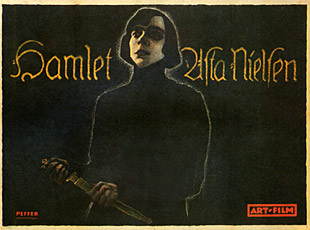
Asta Nielsen’s Hamlet

Hamlet

Asta Nielsen

Just back from the British Shakespeare Association conference, where I was able to tell them about the International Database of Shakespeare on Film, Television and Radio project that I’m supervising. This is an attempt at a ‘complete’ database of all Shakespeare-related titles ever produced in those three media, and so it will of course included all silent Shakespeare films. The ‘interim’ version of the database currently available doesn’t include any silents as yet, and you’ll have to wait for the proper release of the database in summer 2008 to see the full resource in all its glory.

The conference saw the first British presentation (on DVD) of the new restoration of the 1921 German Hamlet, starring Asta Nielsen. A tinted distribution print was discovered recently and has been restored by the Deutsche Filminstitut, using supplementary footage from the French distribution version in the Centre National de la Cinématographie. The film has long been available in black-and-white, but this the first time since the film’s original release that it has been possible to see it in its original colours, the processing work having been done by those acknowledged experts in silent film colour restoration, Haghefilm. The restoration then received its premiere at the Berlin Film Festival.

Hamlet was made for Nielsen’s eponymous production company, directed by Sven Gade and Heinz Schall. It is the best-known of silent Shakespeare films, if not quite (to my mind) the best of those that survive. The extraordinary aspect of the film is, of course, that Hamlet is played by a woman. For this they found academic justification, basing their interpretation on the scholarly endeavours of one Edward P. Vining, whose 1881 book The Mystery of Hamlet posited that the oddities of Hamlet’s behaviour might be explained by the fact that he was a woman in disguise. There had been (and continues to be) a tradition of female Hamlets, including Sarah Bernhardt, a glimpse of whose interpretation was filmed in 1900 (with accompanying sound effects).

Vining’s odd thesis helped legitimise Nielsen’s decision to play the part on film, but it is her luminous, intense performance that justifies it. She is extraordinary in the film, seeking to convey Hamlet’s agonising through diva-like dumbshow alone. The film has its dull patches, plus some unfortunate moments guaranteed to bring out the giggles in a modern audience, since a key aspect of the revisionist plot is that Hamlet is in love with Horatio (cue hoots of laughter when the astonished Horatio discovers, by manual examination, that the dying Hamlet is a woman). Shakespeareans may also be intrigued to find that Claudius dies in a fire, while it is Gertrude who administers the poison which she then drinks by accident – so all of those lying dead at the end of the film are women. The direction seldom rises above the routine, but there is a keen sense of palace life going on while the central figures progressively, and madly, destroy one another. It also gives no sense of a forced conversion from stage to screen – this is a wholly, and successfully reimagined work.

The best thing about the new restoration is its score by Michael Riessler. This blends conventional musical instrumentation with ‘archaic natural sounds’ and electronica. I found it extraordinarily haunting, and sympathetic to the film’s style and performances. The colour is colourful.

I don’t know when the restoration may get further UK screenings, but in the meanwhile, why not take a look at Tony Howard’s newly-published Women as Hamlet: Performance and Interpretation in Theatre, Film and Fiction, which tells the history of women playing Hamlet is a most entertainining and informative way. It has much to say on the film, and has Nielsen on the cover.