Mashing up some more

Well, it was fun picking out those YouTube clips where silents had been creatively mashed up with modern music tracks, so here are three more examples. These aren’t the same as silents to which modern composers (or would-be composers) have added new tracks – that’s an interesting subject for another time. Instead these are examples of re-edits or montages to modern music tracks which illuminate or heighten the films in interesting ways. To impose some sort of thematic reasoning to all this, the three videos below all derive from classic German 1920s silents.

Louise Brooks is one of the most popular search terms used on this blog, but such researchers have been going away disappointed. Well, no more, because here’s a dynamic and assured mix of scenes from Pandora’s Box (1929), skilfully edited by Adam Armand to the tune of The Killers’ ‘Mr Brightside’. It doesn’t tell us anything more about the film or the image of Brooks than we already know, but what else might the film have to say? The video expresses the quintessence of the iconography of Pabst’s film with a song that resonates with sexual torment and urgency. It may vulgarise Pabst’s artistry by reducing it to MTV-style editing, but it also expresses Brooks’ modernity and lasting appeal.

Paul Wegener’s Der Golem (1920), the classic proto-horror film telling of the creation of a clay creature, the Golem, brought to life to protect the Jews of 16th-century Prague, is accompanied by the death metal music of Fantomas, a band who sound like they know a silent film or two. In this case the band wrote a song inspired either by the legend or the film itself, and a fan (‘Monster Island Media‘) decided to do the decent think and match song to clips – which is why lyrics and imagery go together so well. Not exactly most people’s musical cup of tea, but it undoubtedly places the film within a modern, if crude, sensibility. What pop video director could ever have conjured up so convincing a vision of medieval magic?

Others have had the same idea: see here for a more frantically-edited homage.

After all that sex and musical violence, here’s some a little more surprising, and graceful. Scenes from The Cabinet of Dr Caligari (1920) are accompanied by Françoise Hardy singing ‘La Terre’, seemingly for no other reason than the chanson is a pretty one and it brings out the mystery of Robert Weine’s film. Note how well it fits in with Conrad Veidt’s Cesare slowly opening his eyes, and how delicately it accompanies the way the characters move.

The clip’s creator, Clay, has treated other silents to new scores, including Christus (1914), The Abyss (1910), Alice in Wonderland (1915) and Evgenii Bauer’s After Death (1915).

More examples to follow, as the mood takes me.

Caught on film

Just a quick note to let folks know that tomorrow (Tuesday 26 August) at 11.30am there’s a programme on BBC Radio 4 on film archives and silent film, produced at last month’s Bologna film festival. Entitled Caught on Film, the BBC blurb describes it thus:

Our cinematic heritage is literally rotting away. Critic Matthew Sweet visits the Festival Il Cinema Ritrovato in Bologna to explore the vulnerability of film and discovers why both cinematic gems and historically unique documentary films are rapidly disintegrating.

The half-hour programme will be available through the Listen Again service for a week after the broadcast.

Mashing things up

I’m completely against ripping silent films from DVDs and posting them for free online – it’s not just illegal but mean and thoughtless. But taking silent content and doing something with it to create a new work is more of a borderline case. It may all depend what legal system you exist under, but creativity is more of a justification for appropriation.

YouTube and its ilk are full of silent film clips, montages or sequences of stills where fans have added favourite music tracks over the top. The results are usually indifferent, if not glutinous, but just occasionally you get examples done with great skill. Such creative works don’t just make great juxtapositions of film and music, but can illuminate the films in refreshing ways. There are numerous examples, but here are three personal favourites to demonstrate what I mean.

Here were have scenes of black and ‘black’ characters from D.W. Griffith’s The Birth of a Nation set to Public Enemy’s ‘Burn, Hollywood, Burn’. No ambiguity here, or excuses from the defence about the film’s importance to the history of film form. The film is exposed for all its grotesque racism, all the more loathsome for the way the film still has its place in the pantheon. The music and rap lyrics hammer it. The film becomes the perfect vehicle for rage. It’s sharply edited, and the opening and closing titles are a nice touch. Its creator goes under the YouTube name of jewofmalta.

It takes a certain amount of creative inspiration to think of bringing together Buster Keaton and The Pixies. Here the creator (weepingprophet) complained of only ever coming across Keaton clips “set to contemporary music” and wanted to see a tribute to his favourite comedian set to music that made more sense to him. Choosing The Pixies’ ‘Down to the Well’ is a surprise, but how well it works. The montage itself, skilfully put together, is a collection of all the most familiar Keaton gags. With the music you get two different kinds of Americana brought together in strange harmony.

This is inspired. Charlie Chaplin (a favourite subject for the masher-uppers) does his dance of the bread rolls from The Gold Rush to the theme tune from the Spiderman TV series. It starts off feeling silly, then becomes just right. Chaplin as superhero. It comes over as cunningly synchronised, though the brain does a lot to help matters, as placing any film to a piece of music makes us instinctively look out for points of contact between the two. The video was created by Bob Loblaw.

I’ll publish more such examples from time to time, and do let me know if you have any favourites.

Crazy once more

Crazy Cinématographe has returned, and has a fabulous poster to prove it:

Last year saw the launch of Crazy Cinématographe, a project with multiple outlets based on the programmes of films shows presented in the touring fairground booths of Europe in the early years of the twentieth century. In 2007 it gave us a touring show (mostly in Luxembourg, but it also visited Germany, France and Belgium), a conference (in Luxembourg) and finally a DVD, published by the highly commendable Editions Filmmuseum.

The Crazy Cinématographe tent in 2007

Except that it wasn’t ‘finally’, because Crazy Cinématographe edition 2 has been announced. Taking place 22 August-10 September in Schueberfouer, Luxembourg, the new show opens the tent flaps once more to present a highly variegated programme of bizarre and surprising early cinema subjects taken from fifteen film archives around Europe. There is now a Crazy Cinématographe site, with details of the programme, in German. Among the promised delights are acrobatic sisters, a ‘Cabinet of Crazy Animals’ (including Percy Smith‘s acrobatic fly, Max Skladanowsky‘s boxing kangaroo, monkeys dining in a restaurant, and – according to my translation software – rabbits eating giant snakes, though possibly it may be the other way around), an evening of early erotic films, a ‘Live-Mix Crazystyle’ by DJ Kuston Beater, and a ‘best of 2007’ programme. I’m promised more information in English, and will pass this on in due course.

Behind all the showmanship, Crazy Cinématographe is a bold and interesting attempt to combine scholarship with entertainment, or rather making an entertainment out of a scholarly enthusiasm, both for the archival films themselves and for the renowed ‘cinema of attractions’ concept (a cinema of spectacle that preceded the cinema of narrative), which has proved so fruitful in early cinema studies.

To give you a flavour of the entertainment, here’s the promo video (look out for the acrobatic fly at the end).

There’s also a video report on last year’s show (on YouTube, in French), which gives a good idea of the presentation style.

Colourful stories no. 13 – Kinemacolor, its rise and fall

Coloured illustration from the 1912 Kinemacolor catalogue attempting to give an impression of the colour effect of With Our King and Queen Through India (1912)

After something of a gap, we return to our on-going history of colour and the silent cinema by marking the end of Kinemacolor. The attention given to Kinemacolor so far in this series might give the impression that it was widely experienced by audiences. This was not the case. Ordinary cinema audiences were far more likely to experience colour in the form of tinting or toning, or stencil coloured prints. Kinemacolor films were restricted to theatres equipped with specialist projection equipment, often charging higher prices. Kinemacolor was a select entertainment. The impression it made was therefore on the wealthier sort (relatively), and there is plenty of evidence for people deciding to attend a Kinemacolor show would have never deigned to attend a film show previously. The film industry recognised how Kinemacolor was attracting new audiences, raising the possibility of a different, classier kind of film show in the future. Although the trade respected Kinemacolor for its technical achievement, its real significance was social.

Kinemacolor had started off in Britain in 1908. It received its commercial debut in February 1909, when it was first named Kinemacolor, and the Natural Color Kinematograph Company was formed to produce Kinemacolor films, both dramas and actualities – the latter always being the company’s stronger suit. Kinemacolor’s producer, Charles Urban, set about making a hoped-for fortune by licensing Kinemacolor across the world. The policy enjoyed mixed fortunes.

In establishing a system of international licences, Urban sometimes managed to sell Kinemacolor three times over: the national patent rights, the exhibition rights (for restricted periods, then to be re-negotiated) and naturally the exclusive Kinemacolor apparatus and films necessary to put on such programmes. The sale of patent rights was the most lucrative business, though they were negotiated for eight territories only. £2,500 was paid for Switzerland, £4,000 for Brazil, £6,000 for Holland, Belgium and Luxembourg, £8,000 for Italy, £10,000 for France, £10,000 for Japan, £10,265 for Canada, and £40,000 for the United States of America. Few made much money for the investors, a general get-rich-quick mentality having taken over. Kinemacolor was a hard sell, and few outside Britain really understood how to market something so out of the ordinary. The demise of the Kinemacolor Company of America, after high hopes, has already been covered, but the stories of France and Japan are of interest.

France
Kinemacolor opened in France with a special exhibition in Paris on 8 July 1908. A three month engagement began at the Folies Bergère from September 1909. The French patent rights were sold in 1912 to the Raleigh et Robert firm, which created a prestige centre for Kinemacolor exhibition in Paris at the Biograph Theatre, Rue de Peletier. In July 1912, an attempt to float an independent company, Kinemacolor de France to supersede Raleigh et Robert’s business failed when insufficient working capital was raised by subscription. The Natural Color Kinematograph Company bought back the French patents for £5,000 more than they had sold them for, and this led Urban to attempt to repeat the formula through purchasing the lease on premises in the Rue Edouard VII, Boulevard des Capucines, Paris. Here he undertook to build his very own theatre, the Théâtre Edouard VII in 1913. This extravagant move proved catastrophic, with the theatre taking too long to build, being too small in size (it seated 800), obscurely located, and tickets priced too highly. Urban lost tens of thousands, and Kinemacolor in France came to an ignominious end.

Japan
Japan was a comparative success story. The patent rights for Japan and East Asian were acquired in 1912 by the Fukuhodo company, which paid 40,000 yen (£10,000). The rights then passed on to Toyo Shokai. A three-hour Kinemacolor programme was given before the Emperor of Japan in August 1913, and in October the first commercial Kinemacolor programme opened at the Kirin-kan in Asakusa, Tokyo. Toyo Shokai reformed itself on 17 March 1914 as Tennenshoku Katsudoshashin Kabushiki Kaisha (Natural Color Kinematograph Company), abbreviated to Tenkatsu. Kinemacolor exhibition in Japan was well-managed and profitable, and local film production followed, predominantly fiction films, which were adaptations from kabuki plays. However, the onset of the war led to a sharp rise in the cost of film stock, and as Kinemacolor used double the amount of film to monochrome production, its use became restricted to special scenes in selected productions. After a gap of two years the last Japanese film to use Kinemacolor (and quite probably the last Kinemacolor film produced anywhere), Saiyûki Zokuhen, was released in July 1917, but the novelty had passed.

Charles Urban (centre) with camera team in Delhi for the filming of the Durbar, December 1912

The Delhi Durbar
In Britain Kinemacolor enjoyed four or five years of spectacular success, driven by its films of travel and actuality, in particular scenes of royal spectacle. Urban was fortunate that the rise of Kinemacolor coincided with a series of royal events whose ceremonial pageantry naturally suited the colur system, and which proved excellent subjects for export. The funeral of King Edward VII (1910), the coronation of King George V (1911), the investiture of the Prince of Wales (1911), and above all the Delhi Durbar, a huge extravaganza held in India to mark the coronation of the new King-Emperor (1911), all made Kinemacolor a must-see attraction for many. The Delhi Durbar films, entitled With Our King and Queen Through India (first exhibited 1912), lasted for over two hours and was more of a flexible multimedia show than a film as such, as its many component parts could be shifted about according to taste, and its showings were accompanied by orchestral music that copied that which was played at the event itself, a lecturer, and in its prestige screenings at the Kinemacolor London showcase theatre, the Scala, a stage that was made up to look like the Taj Mahal. This lyrical passage – a favourite of mine – from the British film trade paper The Bioscope sums up the awe-struck reaction many had to seeing the Delhi Durbar films, and Kinemacolor in general:

Last Friday evening, at the Scala Theatre, was an occasion in many respects as significant and memorable as it was wonderful. It may be left for future generations to realise the full extent of its importance – men and women yet unborn who, by the magic of a little box and a roll of film, will be enabled to witness the marvels of a hundred years before their age, in all the colour and movement of life. Perverse old grandfathers will no longer be able to indulge disdainfully in reminiscences of the superiority of the times ‘when they were boys’; the past will be an open book for all to read in, and, if the grandfathers exaggerate, they may be convicted by the camera’s living record. Man has conquered most things; now he has vanquished Time. With the cinematograph and the gramophone he can ‘pot’ the centuries as they roll past him, letting them loose at will, as he would a tame animal, to exhibit themselves for his edification and delight. The cinematograph, in short, is the modern Elixir of Life – at any rate, that part of life which is visible to the eye. It will preserve our bodies against the ravages of age, and the beauty, which was once for but a day, will now be for all time.

The end
Kinemacolor was not to be for all time. Its demise came not from the failings of the international licensees but destruction at the centre. In 1913 a court case was launched against the Natural Color Kinematography Company by Bioschemes, a company marketing a rival motion picture colour system, Biocolour, invented by William Friese-Greene. Biocolour was an additive system which employed film frames alternatively stained red and green, close therefore in principle to Kinemacolor. Bioschemes had struggled to get off the ground because its every move seemed to infringe the Kinemacolor patent. With backing from motor racing driver S.F. Edge, Bioschemes challenged the Kinemacolor patent’s validity in the courts. The Friese-Greene case was lost, but on appeal in March 1914 the decision was reversed. The appeal judge declared that the patent claimed to produced natural colours, but also stated that it did not reproduce a true blue, since it used only red and green filters. The judge declared that it could not therefore support its claim to be natural. So the patent was invalid.

The decision was catastrophic for Kinemacolor, because it destroyed the foundations on which the whole licensing scheme was based. However, it did not of itself mean that Kinemacolor was necessarily over. The system was there for anyone to use – it was just that Urban no longer could market it exclusively. But tied to specialised projection, and being more expensive to produce (as said, Kinemacolor films were double the length of conventional films), no one (outside of Japan) was prepared to make a go of it.

‘Firing Four 12-in Gun Salvoes’, a Photochrom postcard recreating a colour scene from Britain Prepared (1915)

Urban did make a few more Kinemacolor films himself. With the outset of the First World War, he created another multimedia show, With Our Fighting Forces in Europe, which mixed library footage of troops and nations with some actuality film taken in Belgium in late 1914 – the only colour film taken of the war on land (none of this footage is known to survive today). Then for the British propaganda outfit Wellington House he made a documentary feature, Britain Prepared (1915), which included colour sequences of the British navy at sea off Scotland in October 1914. Some of these scenes were discovered recently in an American commercial archive, and are – I believe – now on their way to the Library of Congress. I’ll be able to say more on this later. (A monochrome-only Britain Prepared is held by the Imperial War Museum)

More later in this series also on Kinekrom, a would-be successor to Kinemacolor that Urban attempted to develop in the 1920s. But next up will be Gaumont’s Chromochrome, perhaps aesthetically the most sucessful of the pre-war colour processes, and then the winner of the colour wars – Technicolor.

Recommended reading:

Barbican jazz

15 November is a date to look out for at the Barbican in London. There are two concerts combining jazz with film. At 16:00, and billed as ‘the perfect Jazz festival event for families’, the Millennial Territory Orchestra, led by Steve Bernstein, play new scores to three Laurel and Hardy silents: Sugar Daddies, Double Whoopee and Wrong Again.

Then at 20:00 American jazz guitarist Bill Frisell, with Tony Scherr (bass) and Kenny Wollesen (drums) play Frisell’s scores to Buster Keaton’s High Sign and One Week, as well accompanying animations by ‘maverick cartoonist’ Jim Woodring and The Mesmerist by avant garde artist Bill Morrison (best known for the found silent footage film Decasia). The Bioscope admits to being a huge Bill Frisell fan, but has always had a problem with his Keaton scores, which seem uncomfortably disconnected to the action of the films – scores which pick up a wistful Americana which is a Frisell hallmark, but which are expressions of an idea of the film rather than credible accompaniments to the films themselves. But we’ve not had a chance actually to see the films matched to the scores, so there may be hope for revelation in live performance. More details on both concerts from the Barbican Jazz site.

Frisell has produced two CDs of his Keaton scores: Go West, and The High Sign/One Week.

Lined up for Pordenone

The programme for this year’s Giornate del Cinema Muto at Pordenone, Italy (4-11 October) continues to evolve, but it’s been some months since we outlined some of the promised highlights, so it seems a good idea to point out the programme as it now stands. As always, the programme is divded up into strands:

Musical Events
4 October 2008 [20.30]
Sparrows (dir.: William Beaudine; United Artists, 1926)
produced by and starring Mary Pickford

11 October 2008 [20.30]
Les Nouveaux Messieurs (Albatros, FR 1929)
dir.: Jacques Feyder; cast: Gaby Morlay, Albert Préjean, Henry Roussell

The traditional opening and closing prestige films with orchestral accompaniment. Sparrows is accompanied by the premiere of a score composed by Jeffrey Silverman, performed by the Orchestra Sinfonica del Friuli Venezia Giulia, conducted by Hugh Munro Neely. Feyder’s Les Nouveaux Messieurs has a new score by Pordenone regular Antonio Coppola, performed by l’Octuor de France.

Tribute to Vittorio Martinelli
La fanciulla, il poeta e la laguna (Carmine Gallone, 1922)
Tutto per mio fratello (Latium Film, 1911)
Maciste in vacanza (Itala Film, 1921)
La vita dl grillo campestre (Roberto Omegna)
Sicilia illustrata (Ambrosio, 1907)

A selection of Italian silents shown in tribute to the late Italian historian Vittorio Martinelli (see the Bioscope’s obituary notice)

Alexander Shiryaev
Richard Williams Masterclasses

The first-ever complete retrospective of the films of Alexander Shiryaev, made privately 1906-1909, which use animation as a means of recording choreography. Plus a masterclass from the great modern animator, Richard Williams.

The French Touch (1915-1929)

An eclectic selection of French films, programmed by Lenny Borger, including works by Jacques Feyder, Raymond Bernard (Triplepatte), René Hervil (Knock), Gaston Ravel (Figaro), Jean Renoir (Tir au Flanc), Augusto Genina (Totte et sa Chance) and René Barberis (La Merveilleuse Journée)

Hollywood on the Hudson

Programme of New York-based films, to accompany Richard Koszarski’s new book, Hollywood on the Hudson. Titles include His Nibs (Exceptional Pictures, US 1920-21), Enchantment (Cosmopolitan Productions, US 1921), The Headless Horseman (Legend of Sleepy Hollow Corp., US 1922), The Green Goddess (Distinctive Productions, US 1923), Little Old New York (Cosmopolitan Pictures, US 1923), Janice Meredith (Cosmopolitan Pictures, US 1924) and The Show Off (Famous Players-Lasky Corp., US 1926).

W.C. Fields

With some convenient overlaps with other festival sections, the programme features Pool Sharks (1915), Janice Meredith (1924), Sally of the Sawdust (1925), It’s the Old Army Game (1926), So’s Your Old Man (1926), Running Wild (1927) and The Golf Specialist (1930).

The Griffith Project, 12 (1925-1931)

Pordenone’s long-running D.W. Griffith restrospective finally comes to an end with Sally of the Sawdust (1925), The Sorrows of Satan (1926), The Drums of Love (1928), The Battle of the Sexes (1928), Lady of the Pavements (1929), Abraham Lincoln (1930), prologues to the reissue of The Birth of a Nation (1930), The Struggle (1931).

Early cinema
– Brighton in Pordenone
– W.K.L. Dickson
– The Corrick Collection, 2
– Before The Lonely Villa
The Evidence of the Film (Thanhouser, 1913)

Mish-mash of early cinema subjects including a programme commemorating the 30th anniversary of the legendary FIAF congress held in Brighton, which did so much to establish early cinema studies (see Bioscope post), a programme of W.K-L. Dickson films to accompany Paul Spehr’s new biography, and part two of the collection of films owned by the Corrick family, vaudevillians who toured Australia in the 1900s.

Films and History – WW1-90 years
Austrian newsreels
Danish newsreels
Gloria: Apoteosi del Soldato Ignoto (1921)
Umanità (Elvira Giallanella, 1919)
If My Country Should Call (Joseph De Grasse, Ida May Park, 1916)
– The Messina Earthquake

Pordenone usually tries to include non-fiction films in its programming, and this selection commemorates the 90th anniversary of the end of the First World War, with two war dramas from women filmmakers, and actualities of the Messina earthquake of 1909.

Rediscoveries and Restorations
Bardelys the Magnificent (King Vidor, 1926)
Cikáni ([Gipsies], Karel Anton, 1921)
Ed’s Co-ed (Carvel Nelson, James Raley, 1929)
Gribiche (Jacques Feyder, 1926)
Ihr dunkler Punkt (Johannes Guter, 1929)
When Flowers Bloom (Haghefilm/Selznick School Fellowship 2008)
– Sessue Hayakawa
– Max Linder
– Keystone

A rich selection of new discoveries and restorations, the highlight undoubtedly being the much-discussed Bardelys the Magnificent, directed by King Vidor and starring John Gilbert.

Portraits
The Boot Cake
David Gillespie: A Life of Film (2008)
Homage to Mary Pickford
Mary Pickford: The Muse of the Movies (2008)
Poteslui Meri Pikford (Sergei Komarov, 1926)
Katie Melua: “Mary Pickford” (promo video, 2007)

David Gillespie (left), who sadly died earlier this year, was a projectionist, film collector and dedicated attendee of Pordenone, even when his eyesight had almost totally failed. He would sit in the front row, still delighted in such shadows as he could sense. A documentary was made about him by friends and completed shortly before he died. There’s a tribute to him on the Pordenone site. At the other end of some spectrum, Mary Pickford is recognised by a new documentary, Sergei Komarov’s The Kiss of Mary Pickford, and – surprise surprise – the pop video for Katie Melua’s ‘Mary Pickford’ (already covered by the Bioscope).

21st Century Silents

No details as yet.

A really marvellous programme – goodness knows how they are going to fit it all in. There’s also the Collegium, FilmFair, music masterclasses, and the Jonathan Dennis Memorial Lecture, which will be given by Eileen Bowser. Full details of registration, transportation and accommodation are on the festival site.

The Bioscope will be providing daily reports, but if you’ve not been before and are wavering over whether to do so, this really is the year to take the plunge. Just think of David Gillespie, barely able to see and yet loyally and lovingly coming back year after year. Makes the usual excuses seem a little on the feeble side…

Hope maybe to see you there.

Are you ready? Shoot!

Until now, we have not had any fictional works in the Bioscope Library (the collection of texts on silent cinema which are freely available online from assorted sources). First up, therefore, is one of the first – if not the first – novels to tackle the subject of film (it was preceded by numerous short stories on the theme), Luigi Pirandello’s Si gira, published under that title in 1915 and in revised form in 1925 as Quaderni di Serafino Gubbio operatore (The Notebooks of Serafino Gubbio, Cinematograph Operator), the latter published in English in 1927 as Shoot!.

Pirandello, one of Italy’s greatest writers, best known for plays such as Six Characters in Search of an Author), does not have much good to say about cinema. Si gira is a bitter attack on modernity, in which Gubbio, the first-person narrator, becomes one with his machine in being increasingly desensitized to true life, a denial or absence of experience which is transmitted to people through that arch-representation of modern life, the cinema. The sense of the disturbing nature of modernity as annoying, incessant noise, with the cinematograph as machine, comes out in this passage:

There is one nuisance, however, that does not pass away. Do you hear it? A hornet that is always buzzing, forbidding, grim, surly, diffused, and never stops. What is it? The hum of the telegraph poles? The endless scream of the trolley along the overhead wire of the electric trams? The urgent throb of all those countless machines, near and far? That of the engine of the motor-car? Of the cinematograph?

The beating of the heart is not felt, nor do we feel the pulsing of our arteries. The worse for us if we did! But this buzzing, this perpetual ticking we do notice, and I say that all this furious haste is not natural, all this flickering and vanishing of images; but that there lies beneath it a machine which seems to pursue it, frantically screaming.

Will it break down?

Serafino Gubbio is a cinematographer operator working the Kosmograph studio by day, and writing his absurdist journal by night, as he describes the world that appears before his camera. Pirandello doesn’t attack the cinematograph so much for its own sake as to use it as a means to broaden his target to include all that is dehumanizing. His camera alienates him from society; the act of writing helps him recover his humanity. It is a thesis that some will recognise in Walter Benjamin’s famous essay, ‘The Work of Art in the Age of Reproduction’, and Benjamin cites Pirandello’s book as identifying the alienation inherent in the film performance – “the part is not acted for an audience but for a mechanical contrivance”. Says Pirandello (or rather, Gubbio):

Here they feel as though they were in exile. In exile, not only from the stage, but also in a sense from themselves. Because their action, the ‘live’ action of their ‘live’ bodies, there, on the screen of the cinematograph, no longer exists: it is ‘their image’ alone, caught in a moment, in a gesture, expression, that flickers and disappears. They are confusedly aware, with a maddening, indefinable sense of emptiness, that their bodies are so to speak subtracted, suppressed, deprived of their reality, of breath, of voice, of the sound that they make in moving about, to become only a dumb image which quivers for a moment on the screen and disappears, in silence, in an instant, like an unsubstantial phantom, the play of illusion upon a dingy sheet of cloth.

Ah, poor movies, cause of such anguish and alienation among the intelligensia. How much Si gira represents Pirandello’s own point of view is a matter of debate. There is some knowledge of the workings of the film industry, and Kosmograph owes something to the great Italian studios of the period, such as Cines. But one does not read Si gira (the English title, Shoot, is the phrase so constantly used of Gubbio that it becomes his name in effect) for any documentary accuracy. Its subject is the human, or the ongoing death of the human, rather than cinema per se.

The book is freely available from the Australian branch of Project Gutenberg (oddly enough, it is not on the main Gutenberg site), in its 1927 English translation by C.K. Scott Moncrieff. The same translation is published by Chicago University Press.

Pen and pictures no. 5 – John Buchan

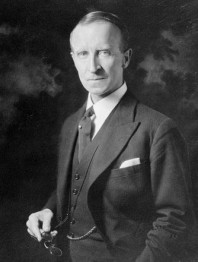
For the next in our series of literary figures who became involved in their various ways with silent films, we turn to John Buchan, 1st Baron Tweedsmuir (1875-1940). Assorted films and television programmes have of course been made of Buchan’s popular novels, in particular The Thirty-Nine Steps, but it is not the adaptation of Buchan’s work that interest us here (almost all of which come after the silent era), but rather his probably unique contribution to film production – unique, that is, for a novelist. For during the First World War Buchan served as the head of the Department of Information, with responsibility for British propaganda, and consequently was the person ultimately responsible, at least for a time, for British official films of the war.

Though these things are partly a question of much contested definition, it is generally held that the arts of state propaganda, through use of the mass media, were established during the First World War, and that the British were the masters of those arts. Certainly the British were quick off the mark, seting up the covert War Propaganda Bureau under MP Charles Masterman within days of the outbreak of war. One of Masterman’s first acts was to invite a number of Britain’s leading authors to Wellington House (the Bureau’s London headquarters) to discuss how they could use their arts secretly (i.e. without anyone knowing that they were being guided by the government) to promote British interests. Those invited to the meeting on 2 September 1914 included Thomas Hardy, Arnold Bennett, G.K. Chesterton, Arthur Conan Doyle, Rudyard Kipling (who was unable to attend), H.G. Wells, John Galsworthy and J.M. Barrie.

The War Propaganda Bureau wanted to use the literary intelligensia for all the influence on hearts and minds that they could command, but Masterman was also interested in using film to target other audiences, and commissioned Charles Urban to produce a documentary feature, Britain Prepared (1915), which was exhibited around the world.

John Buchan was not yet of sufficient literary eminence to be named among Masterman’s greats, but he had political experience, having served as private secretary to Alfred Milner, the High Commissioner for South Africa. His African adventure novel, Prester John (1910), enjoyed great popularity, and The Thirty Nine Steps in 1915 made him famous. Buchan was increasingly courted by the British authorities, leading delegations and delivering lectures on behalf of the Foreign Office and the War Office. Meanwhile, the somewhat elitist approach of the War Propaganda Bureau was coming under increasing internal criticism (the public knew nothing of its existence). Buchan’s former mentor recommended Buchan to the new Prime Minister, David Lloyd George, and after Buchan had written a memorandum on propaganda for the cabinet in January 1917, a new Department of Information (DOI) was set up, with Buchan as its head.

British propaganda policy had originally targeted neutral nations, particularly America, with the hope that America might join Britain as combatant. Not long after Buchan took over, America did indeed join the war, but the need for a propaganda policy was felt all the more, now to persuade America of Britain’s contribution to the fighting, while seeking to keep a war-weary home audience convinced of the necessity of the struggle. Film had become an increasingly important aspect of this work, particularly as the emphasis shifted from convincing influential elites to persuading the masses.

Buchan was therefore in charge when an official newsreel was established, the War Office Official Topical Budget, a wide variety of actuality, documentary and instructional films were produced and distributed around the world (including the feature-length documentaries The Battle of the Ancre and The Battle of Arras), and production started on the fiction epic Hearts of the World, directed by D.W. Griffith. This was bold and committed policy, a world away from the general suspicion – if not contempt – that most of those in authority felt towards film (and its lowly audiences) at the start of the war. However, the DOI Cinematograph department battled throughout 1917 with the War Office Cinematograph Committee (WOCC), which produced most of the films, for overall control. The WOCC was run by Max Aitken, soon to be Lord Beaverbrook, who ultimately had greater political clout than Buchan. He took charge of British propaganda when he became head of a new Ministry of Information early in 1918, for the first time unifying the various conflicting strands of British war information policy (including film). Buchan became Director of Intelligence under him.

Buchan therefore had a strategic eye over film as a part of propaganda policy in 1917, but Beaverbrook (later to be a notorious newspaper magnate) was closer to the actual production of films, and ultimately did more with them. Nevertheless Buchan recognised the necessity and the potential effectiveness of film as a medium of persuasion. But, like most of his class, he found the medium had its ridiculous side. This sense of the absurd comes out in the Richard Hannay novel (Hannay is the hero of The Thirty-Nine Steps) that Buchan published in 1919, Mr Standfast.

In the novel, Hannay is being pursued and is running across Yorkshire moorlands when he stumbles across a peculiar scene, which gives us some insight into Buchan’s view of the industry with which he had to tangle:

Suddenly from just in front of me came a familiar sound. It was the roar of guns – the slam of field-batteries and the boom of small howitzers. I wondered if I had gone off my head. As I plodded on the rattle of machine-guns was added, and over the ridge before me I saw the dust and fumes of bursting shells. I concluded that I was not mad, and that therefore the Germans must have landed. I crawled up the last slope, quite forgetting the pursuit behind me.

And then I’m blessed if I did not look down on a veritable battle.

There were two sets of trenches with barbed wire and all the fixings, one set filled with troops and the other empty. On these latter shells were bursting, but there was no sign of life in them. In the other lines there seemed the better part of two brigades, and the first trench was stiff with bayonets. My first thought was that Home Forces had gone dotty, for this kind of show could have no sort of training value. And then I saw other things – cameras and camera-men on platforms on the flanks, and men with megaphones behind them on wooden scaffoldings. One of the megaphones was going full blast all the time.

I saw the meaning of the performance at last. Some movie-merchant had got a graft with the Government, and troops had been turned out to make a war film. It occurred to me that if I were mixed up in that push I might get the cover I was looking for. I scurried down the hill to the nearest camera-man.

As I ran, the first wave of troops went over the top. They did it uncommon well, for they entered into the spirit of the thing, and went over with grim faces and that slow, purposeful lope that I had seen in my own fellows at Arras. Smoke grenades burst among them, and now and then some resourceful mountebank would roll over. Altogether it was about the best show I have ever seen. The cameras clicked, the guns banged, a background of boy scouts applauded, and the dust rose in billows to the sky.

But all the same something was wrong. I could imagine that this kind of business took a good deal of planning from the point of view of the movie-merchant, for his purpose was not the same as that of the officer in command. You know how a photographer finicks about and is dissatisfied with a pose that seems all right to his sitter. I should have thought the spectacle enough to get any cinema audience off their feet, but the man on the scaffolding near me judged differently. He made his megaphone like the swan-song of a dying buffalo. He wanted to change something and didn’t know how to do it. He hopped on one leg; he took the megaphone from his mouth to curse; he waved it like a banner and yelled at some opposite number on the other flank. And then his patience forsook him and he skipped down the ladder, dropping his megaphone, past the camera-men, on to the battlefield.

That was his undoing. He got in the way of the second wave and was swallowed up like a leaf in a torrent. For a moment I saw a red face and a loud-checked suit, and the rest was silence. He was carried on over the hill, or rolled into an enemy trench, but anyhow he was lost to my ken.

I bagged his megaphone and hopped up the steps to the platform. At last I saw a chance of first-class cover, for with Archie’s coat and cap I made a very good appearance as a movie-merchant. Two waves had gone over the top, and the cinema-men, working like beavers, had filmed the lot. But there was still a fair amount of troops to play with, and I determined to tangle up that outfit so that the fellows who were after me would have better things to think about.

My advantage was that I knew how to command men. I could see that my opposite number with the megaphone was helpless, for the mistake which had swept my man into a shell-hole had reduced him to impotence. The troops seemed to be mainly in charge of N.C.O.s (I could imagine that the officers would try to shirk this business), and an N.C.O. is the most literal creature on earth. So with my megaphone I proceeded to change the battle order.

I brought up the third wave to the front trenches. In about three minutes the men had recognized the professional touch and were moving smartly to my orders. They thought it was part of the show, and the obedient cameras clicked at everything that came into their orbit. My aim was to deploy the troops on too narrow a front so that they were bound to fan outward, and I had to be quick about it, for I didn’t know when the hapless movie-merchant might be retrieved from the battle-field and dispute my authority.

It takes a long time to straighten a thing out, but it does not take long to tangle it, especially when the thing is so delicate as disciplined troops. In about eight minutes I had produced chaos. The flanks spread out, in spite of all the shepherding of the N.C.O.s, and the fringe engulfed the photographers. The cameras on their platforms went down like ninepins. It was solemn to see the startled face of a photographer, taken unawares, supplicating the purposeful infantry, before he was swept off his feet into speechlessness.

It was no place for me to linger in, so I chucked away the megaphone and got mixed up with the tail of the third wave. I was swept on and came to anchor in the enemy trenches, where I found, as I expected, my profane and breathless predecessor, the movie-merchant. I had nothing to say to him, so I stuck to the trench till it ended against the slope of the hill.

It is gentle mockery, and there’s a degree of sympathy for the filmmaking process, in that Hannay thinks that the scenes will impress their target audience, but also a touch of naivety in how he believes the director could so easily lose control of his own film. Was Buchan thinking of any director in particular? Griffith hardly seems to be the target, but maybe there is an element of Herbert Brenon, who late in 1917 (during Buchan’s time with the DOI) began filming another officially-backed but ill-fated feature-length fiction film, which was to have been called Victory and Peace (it was unfinished at the end of the war and was never exhibited). It was filmed in Chester with British troops used to portray Germans (the scenario was provided by Hall Caine, a once famous and now unreadable author, who was one of those invited to Masterman’s meeting on 2 September 1914). But I doubt that Brenon ever wore a loud-checked suit.

Buchan had some connection with the film business after the war, joining the board of British Instructional Films in 1925, and contributing to the script of one of the company’s acclaimed semi-documentary recreations of events from the war, The Battles of the Coronel and Falkland Islands (1927), directed by Walter Summers. His novel Huntingtower was filmed by George Pearson in 1928 (Prester John had been filmed in South Africa by African Film Productions in 1920).

Buchan could be argued to have had the greatest influence over film production of any author during the silent era, albeit for a year only. His political role in overseeing British official film production as an integral part of British propaganda policy had little connection with his fiction, but he treated the medium with greater respect than the comedy of the Mr Standfast scene might suggest. Nevertheless, the passage shows how Buchan intellectually remained at a remove from this popular, peculiar new medium, and it was Beaverbrook who showed the greater instinctive feeling for film, its audiences, and for the political arts of propaganda in general.