Released next month is the latest mouth-watering, connoisseur-pleasing release from Flicker Alley, Douglas Fairbanks: A Modern Musketeer. This is a five-DVD set covering Fairbanks’ career 1916-1921, as he worked his way through the genres and ever-increasing stardom, before the series of great costume dramas that marked the peak of his fame in the 1920s. It’s officially released on 2 December, with a discount offer for advance orders.
The eleven titles featured on the set are:
His Picture in the Papers (1916)
The Mystery of the Leaping Fish (1916)
Flirting With Fate (1916)
The Matrimaniac (1916)
Wild and Woolly (1917)
Reaching for the Moon (1917)
A Modern Musketeer (1918)
When the Clouds Roll By (1919)
The Mollycoddle (1920)
The Mark of Zorro (1920)
The Nut (1921)
It’s a sensational package, not just for the instrinc value of the films, but for the portrait it provides of the ‘all-American’ character leaping out of a pre-war world into post-war opportunity. The release of the set is complemented by the publication of Jeffrey Vance’s new biography, Douglas Fairbanks. This, we are told, is
the first critical analysis of Fairbanks’s body of work in over twenty-five years as well as the first full scale biography in over a half century. This extensively researched, engagingly written and sumptuously designed book goes behind Fairbanks’s public persona to thoroughly explore his art and far-reaching influence. Utilizing access to Fairbanks’s personal and professional papers, Douglas Fairbanks is a superb portrait of a true pioneer, critically important to the creation of cinema as the defining art form of the 20th-century.
The DVD set takes its apposite name from the title of the recently rediscovered 1917 A Modern Musketeer, which the curmudgeonly Bioscope didn’t much care for when it was shown this year at Pordenone. For a more generous view, within an illuminating critique of the Fairbanks persona, read David Bordwell’s latest post.
There is a growing interest in exhibiting the alliances the silent cinema had with variety. Those alliances were undoubtedly there (so many early cinema shows were really variety programmes interspersed with films, or else the other way around), but what is novel is expounding the thesis through live entertainment. We have had the Crazy Cinématographe shows in Luxembourg, and in London there is The Smoking Cabinet.
This intriguing combination of early cinema screenings, cabaret and panel discussions was launched last year. A year on, the same concept returns to the Curzon Soho, 12-14 December. Billed as a ‘festival of early cabaret and burlesque cinema, 1894-1933’, the programme is suitably eclectic and exotic:
Opening Night The Smoking Cabinet Vs. Midnight Movies: Piccadilly (1929)
For this year’s opening night The Smoking Cabinet have teamed up with Midnight Movies to offer something a little different; live performance and music in the bar from 8:30pm followed by a special screening of E.A. Dupont’s Piccadilly (1929) featuring Anna May Wong.
Fri 12th Dec Bar performances and live music from 8:30pm, screening 11.30pm
Tickets £8 advance / £12 on door
On with the Dance!
A joyous evening of dance and showgirl themed films, featuring delights from Divine and Charles, Fatima and Carmencita, The Whirl of the Charleston (1927) and chorus girls galore.
+ Discussion Boom or Bust?
1894-1933 tracks the emergence of an entirely new form of entertainment in the shape of the moving image and cinema. We look at how the film absorbed more established forms of entertainment of the time from vaudeville to cabaret, burlesque and the musicals. We’ll also look at the cyclical nature of trends, asking why certain forms have boomed at specific times and bust at others. We’ll also ask if the death bell tolls for the current fascination with burlesque?
Sat 13th Dec 6:00pm
Tickets £8
Sandow the Muscle Man and the Spirit of Coney Island
Roll up, roll up to witness boxing cats, the king of coins, and Edwin S Porter’s classic Coney Island at Night (1905), screening in a celebration of the extraordinary amusement empire that astonished, delighted and shocked a nation. There’s a rare opportunity to see Fatty Arbuckle and Buster Keaton’s 1917 romp Coney Island and to revel in the most magnificent spectacle of the world’s mad hunt for pleasure!
We’ll provide a Coney Island experience in the bar as we tip our sailor hats to the seaside fun and amusements of yesteryear and offer a free tipple to all guests!
+ Special guest speaker on the history and significance of New York’s decadent palace of pleasure.
Sun 14th Dec 4:00pm
Tickets £12
Closing Night: That’s all folks!
Join us for our last screening, live music, cakes and dancing as we wind down with an eclectic variety finale including Bob’s Electric Theatre (1909), Gus Elen: It’s a Great Big Shame and La Boite a malice (1903).
Sun 14th Dec 6:00pm
Tickets £8
There’s more information, including how to book, on The Smoking Cabinet website. Attendees are also encouraged to ‘dress to impress’, which – let’s face it – so few silent film audiences ever do these days. All this, and lessons in dancing the Charleston as well.
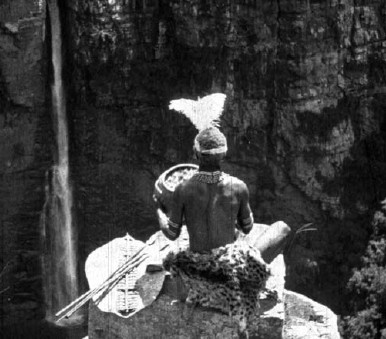
Still from De Voortrekkers, showing Zulu warrior Sobuza, who converts to Christianity. From Jane M. Gaines’ essay ‘Birthing Nations’ in Metter Hjort and Scott Mackenzie (eds.), Cinema and Nation (2000)
The London African Film Festival is taking place 29 November-7 December 2008, a wide-ranging celebration of African cinema involving a number of venues across London. The programme brings together an imaginative programme of new and classic titles, with some eye-catching surprises. Among the latter, the one that is catches this eye in particular is De Voortrekkers.
This 1916 epic film was one of the first South African dramatic film productions, and tells the story of the Boers’ Great Trek, concluding with a reconstruction of the 1838 Battle of Blood River, where a few hundred Voortrekkers (Afrikaners) defeated several thousand Zulus. Commemorating as it did their view of a highly contentious area of history, the film came to be revered by Afrikaners. It enjoyed a long after-life in South African classrooms and was (and may still be) shown annually on the date of the Battle of Blood River (16 December). For a long time remained unseen outside of the Afrikaner community, though copies have been available on video from a Canadian company, Villon Films, for some while now.
De Voortrekkers was one of four films made during a short period in South Africa by the remarkable Harold Shaw (1876-1926), whose full story needs to be told properly by someone some day. Briefly, Shaw was an American, who began his career in film as an actor with Edison in 1908, graduating to film director and moving to the IMP company. His best known work from this first period is the haunting fantasy film, The Land Beyond the Sunset (1912), now recognised by the National Film Preservation Board, which has placed it on its National Film Registry for permanent preservation as a national film treasure.
Shaw (left) moved to Britain in 1913 to direct for London Film Productions, making such prestigious titles as The House of Temperley (1913) and Trilby (1914). His best British work, for me, is a barely-seen 1916 propaganda piece, You (1916), which encourages various people to support the war effort by means of a piece of paper that floats from person to person, asking each ‘What are YOU doing for your country?’ It is so creatively put together. That same year he ventured out with actress wife Edna Flugrath to South Africa, where he had been hired by African Film Productions. His first film for them, De Voortrekkers (1916), which starred Flugrath, was sensationally successful locally and even gained some screenings overseas (in the USA it was known as Winning a Continent). The scenario was written by historian Gustav Preller, and its version of the Great Trek emphasised the common point of view between Britons and Afrikaners (the Anglo-Boer War was long past and the political stress was now on the strength of the Union) and the ‘savagery’ of the native peoples (who, the film argues, are led to rise against the Boers by Portuguese traders). News reports at the time stressed the authenticity of the props and costumes and the huge numbers involved: hundreds of extras, black and white, many of them mine employees. Telling tales were told of a filmed charge which was undertaken too enthusiastically, the ‘natives’ neglecting to fall dead and instead assaulting some of the Europeans, with mounted police having to restore order. The completed film ran for some two hours.
Disagreements with the production company led Shaw to withdraw from a follow-up film on the Zulu wars, Symbol of Sacrifice (1918, directed by Dick Cruikshanks), fragments of which survive and are apparently available on a DVD entitled Isandlwana, Zulu Battlefield. Instead he made a melodrama about stolen diamonds for a rival producer, The Rose of Rhodesia (1917), which was recently discovered in the Netherlands and is attracting growing academic interest. Shaw and Flugrath made a third film (now lost), a horse-racing drama entitled Thoroughbreds All (1919), then returned to Britain.
Shaw next went another strange journey, to the Soviet Union to film Land of Mystery (1920), a melodrama (now lost) set in the USSR and loosely based on the life of Lenin, whose strange history (the story was written by Basil Thompson, who was high up in the British secret service) is covered in Kevin Brownlow’s Behind the Mask of Innocence. Shaw made more films in Britain, including two H.G. Wells adaptations, Kipps (1921) and The Wheels of Chance (1922), before returning to America to direct for Metro. He then died in a motor car accident in 1926.
It’s an extraordinary personal history, and one day someone needs to do Harold Shaw’s strange career adequate justice. As it is, he has a small but dedicated band of devotees around the world, myself among them (we used to gather around a table at the Pordenone silent film festival – it wasn’t a very large table). Meanwhile, De Voortrekkers, which I’ve yet to see, comes to the Barbican in London on 3 December, screening with Joseph Albrecht’s 1938 129-mins epic Building a Nation (Bou van ‘n Nasie), another piece of Afrikaner apologetics. The films runs for 60 mins and musical accompaniment will be provided by Juwon Ogungbe with piano and traditional instruments such as the kalimba and marimba. Both films clearly need to be seen in the context of Afrikaner nationalism and racism, but it is good to see De Voortrekkers move from its time of closet, propagandist screenings to a public festival where it can be viewed in the fuller context of African film production, past and present.
As the bitter winds sweep down direct from the North Pole, and the first Winter snows settle upon the roof of Bioscope Towers, it is time to look to new hopes for the new year, and the return of the Bioscope Festival of Lost Films. Yes, it’s a year since we startled a complacent film world with the very first festival of lost films. Other festivals will show you newly-made films, classic films, obscure films, films you know well and films you’ve never heard of – only the Bioscope Festival of Lost Films will exhibit films that were shown once but can be seen no more.
The festival will follow the pattern last year, with some innovations. Over five days, we will feature five silent films that, so far as our researchers are able to determine, no longer exist. Each will come with a programme of extras, such as short films, guest interviews and so on. Each will be shown in a venue that was once a cinema but is now dedicated to other business. There will be appropriate live accompaniment from some noted silent music practitioners of the past. As before, it is not possible to announce what any of the films to be shown will be. Partly this is to maintain the element of surprise, partly because the most stringent efforts need to be taken right up to the last minute to ensure than none of the films on show does, in some far-flung corner of the film archive world, exist.
The festival will take place 5-9 January 2009. Please cancel all other engagements. A year ago we had excellent participation from the Bioscopists, who very much got into the spirit of things, though none quite so much as the person who became so enthused that he asked if his own work could be considered for a future festival. The idea of producing films that are lost before they are even made (the dreams that never made it to celluloid reality) is for another festival, at another time. These are the films that were once, and are no more.
As before, the Bioscope Festival of Lost Films is dedicated to the anonymous person who visited this blog with the search request “lost films download”. We must all continue to live with such hopes.
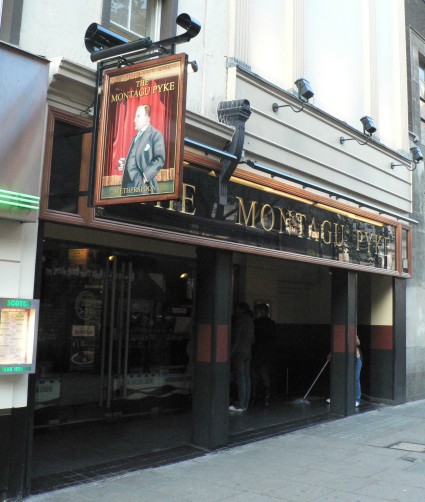
Should you find yourself in London’s Charing Cross Road, on the right-hand side looking south, halfway between the Palace Theatre and Foyles book store, you will find a bar. It bears the extraordinary name of The Montagu Pyke. It is part of the Wetherspoons chain, and is apparently a popular and fashionable spot. A sign outside bears the picture of an assured Edwardian gentleman in an immaculate suit, sporting a monocle, cigar in hand. He is Montagu Pyke, and for a time he was most renowned person in British film. For Monty Pyke was the cinema king.
A huge onrush of cinema building occured in London following the passing of the Cinematograph Act (the first UK legislation devoted to the new industry) at the end of 1909. Fortunes were to be made in this new business so attractive to a mass audience which, though it didn’t pay much for its pleasures, was prepared to turn up once or twice a week, every week, to the cinema. For a new breed of speculators, it looked like a licence to print money. That’s certainly how it must have appeared to Montagu A. Pyke, a former commercial traveller, gold miner and bankrupted stock market gambler. Pyke had seen crowds lined up in Oxford Street to see Hale’s Tours (films of journeys shown inside a rocking rail carriage) and decided this was the business for him.
Obtaining a £100 loan from a City business friend, Pyke formed Recreations Ltd in 1908, with nominal capital of £10,000, but no assets of his own. He identified a property in Edgware Road:
… firstly because it is a very thickly populated neighbourhood, and secondly, it appeared to me from the class of people one sees daily on the streets that they would make an appreciative audience if you gave them good value and the prices were right.
Pyke found two shop properties at 164-166 Edgware Road, and recalled that they were next door to Funland, a shop show which operated for a short period in 1908/09 and undoubtedly played its part in influencing the choice of location, as a proven film-going attraction. He raised money by exploiting society connections and spinning tales of vertiginous profits, including £1,000 from Lady Battersea, sister of Lord Rothschild. Pyke placed his first cinema in a populous neighbourhood with good passing trade, and offered a continuous show between twelve noon and midnight, with prices at 3d, 6d and a shilling. Programmes lasted between an hour and an hour and fifteen minutes. Takings, he recalled, were £400 a week, against outgoings of just £80, and Pyke embarked on a rapid programme of expansion, with investors queuing up to join him.
Initially Pyke’s cinemas were shop conversions, but his policy soon turned to larger venues in prestige locations. Each building was given the generic title of Cinematograph Theatre. Each cinema was also a limited company in itself (a common feature of cinema capitalisation at this time), but he established an umbrella company Amalgamated Cinematograph Theatres Ltd in 1910, with £150,000 capital, by which point he was managing five cinemas. At its peak, the ‘Pyke Circuit’ included fourteen cinemas in central London.
The Pyke Circuit
Recreations Theatre – 164/166 Edgware Road – opened 19 March 1909
Finsbury Park Cinematograph Theatre – 367-369 Seven Sisters Road – 1 October 1909
Walham Green Cinematograph Theatre – 583 Fulham Road – 29 December 1909
Pyke’s business methods were highly dubious, and soon exposed. A committee of investigation formed in 1912 uncovered numerous business irregularities, including dividends being paid out that had not been earned. Pyke was the most notorious exploiter of investors’ eagerness to profit from the cinema craze. His strategy was based on the assumption that the boom would be short-lived, tempting avaricious investors with quick-term profits from a pyramid of flotations. He certainly profited handsomely himself. From a salary of £25 a week in 1908 he had risen in 1911 to paying himself £10,000 a year. As the cinema business only established itself all the more, and competition from larger and more competently managed rivals grew, Pyke’s business necessarily collapsed. He had only two cinemas in operation by the end of 1913 (Piccadilly Circus and Cambridge Circus), and was made bankrupt in 1915, the same year in which he was accused of manslaughter following the death of an employee in a nitrate film fire at the Cambridge Circus venue. Pyke’s ambitions to expand into the provinces were never realised. Amalgamated itself was reconstituted as a company in December 1916 and continued to manage five theatres (Edgware Road, Finsbury Park, Oxford Street, Walham Green and Shepherd’s Bush) to the end of the war.
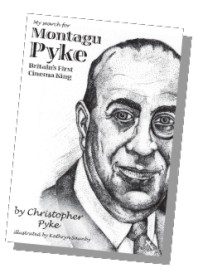
Pyke had been the most prominent figure in the British film business for a short while, but he disappeared into obscurity. Few cinema histories mention him, and it was only with the growth of interest in a social history of British cinema that researchers started to recover his story. Their task was helped by the publication of a chapter of Pyke’s otherwise unpublished autobiography, When I Was the Cinema King, in an edition of Picture House, the Cinema Theatre Association journal (no. 10, 1987). The text was made available by his grandson, Christopher Pyke, who has now produced a website devoted to Pyke and to selling a book, a self-published combination of biography of Pyke, using his memoir, and an account of Pyke’s own investigation into his grandfather’s history. The book, My Search for Montagu Pyke: Britain’s First Cinema King, can only be ordered online from CPI Book Delivery. It was launched last month at the Montagu Pyke bar.
I’ve long had a fondness for Monty Pyke. He was a rogue of sorts, and an employee did die in a fire at one of his premises, even if he was acquitted of manslaughter. But he had his philosophical side, and I’m fond of quoting lines from a 1910 pamphlet of his, Focussing the Universe (also reproduced in that issue of The Picture House). In an earlier post I gave you his use of the words of Isaac Walton to suggest the profound sense of cinema as a diversion. In this passage, he recognises its universal appeal:
Not least of the charms of the Picture Theatre for me is the fact that it is, in the real sense of the word, catholic, appealing not only to men and women of every class and degree, but to men, women and children of all ages. Before its advent, the process of amusing or interesting the child at a public entertainment was a somewhat difficult one, while the possibility of instructing him or her thereat, was never considered at all … The Picture Theatre, if it has done nothing else, has brought delight to the minds and souls of thousands upon thousands of mites in this great Metropolis, some of whom look upon it as the one oasis in the desert of their dull and sordid lives.
The signboard outside the former Cambridge Circus Cinematograph Theatre (where the fire took place) depicts Pyke in his pomp, adapted from the 1911 Vanity Fair portrait of him at the top of this post. He would be proud.
The Montagu Pyke, 105-107 Charing Cross Road, London
Harold Brown, on left in the 1940s (from the British Film Institute), on the right in 2008 (courtesy of Eve Watson)
You will not find the name of Harold Brown in many film history books, but there are quite a number of film histories that could not have been written without him. Harold, who died on Friday 14 November, essentially invented the art and science of film preservation. Countless films have been preserved either by his hands, or by the hands of those he tutored, or those archives around the world who adopted his methods.
It was in 1935 that Harold Brown (born 1919) started as office boy at the newly-formed British Film Institute, where Ernest Lindgren was setting up the National Film Library. Brown was subsequently to become its first preservation officer. In the early 1930s there were no film archives, or almost none. In that decade the four great national archives that were to become pillars of the film archiving movement were established: the Museum of Modern Art Film Library (New York), the Reichsfilmarchiv (Berlin) and the National Film Library (London) in 1935, the Cinémathèque Française (Paris) in 1936. These archives were established by a dedicated band of pioneer archivists with a passion for the film as art. They were driven in particular by the passing of the silent film era, and the imminent loss of the films of that first period of cinema history, films which were being dumped by the studios who saw no value in a heritage that they could no longer sell to anyone.
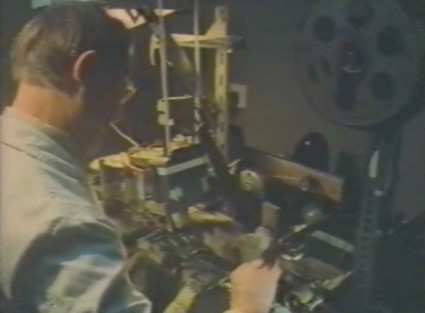
Harold Brown printing a film using the Mark IV
Ernest Lindgren, as Curator of the National Film Library (later the National Film Archive and now the BFI National Archive), laid down principles and Harold Brown came up with the working methods which formed the basis for film preservation. The original film was, as far as possible, inviolate. It needed to be copied, in a form as faithful to the original as possible. Films needed to be treated not only according to their importance but to the extent of, or their potential for, chemical decay. One of Harold’s most notable achievements was the artificial ageing test, which enabled archivists to determine when a film was likely to start deteriorating, and at what time it should be copied. This allowed archives to plan sensibly for the future. A noticeable legacy of Harold’s is the punch holes that you will see occasionally in National Film Archive prints, created so that a circle of film could be put through the ageing test. Another famous Brown creation was the Mark IV, a step printer for dealing with shrunken and non-standard perforation film, built out of bits of toy Meccano, string, rubber bands and parts from a 1905 Gaumont projector.
Harold was a self-taught pioneer. His investigations established basic methods for the identification of early film formats, the repair of damaged film, the storage of film, and the treatment of colour film (his work on Douglas Fairbanks’ 1926 film The Black Pirate, in two-colour Technicolor, was an early classic of film restoration). Awarded an MBE in 1967, he carried working at the National Film Archive until 1984, though he continued as a mentor and consultant to film archives internationally, well into retirement. He passed on his knowledge not only in person, but through some key publications. His Basic Film Handling (1985) and Physical Characteristics of Early Films as Aids to Identification (1990) are standard reference guide to the film archiving profession, and the latter is still available from the site of the Federation of International Film Archives (FIAF). Nor was he solely a nitrate era or early film specialist. He stayed abreast of issues in film archiving throughout, and it was he who gave the name ‘vinegar syndrome’ to the phenomenon of the degredation of acetate film which film archives discovered, to their alarm, in the 1980s.
You can see Harold at work in his prime in a 1963 Pathe Pictorial report on the work of the National Film Archive, available from the British Pathe site (just type in ‘film archive’, or click here for the same film from ITN Source). He features towards the end, delicately handling four frames of film, then seen operating the Mark IV. If you can, check out his modest four-page memoir in the FIAF publication This Film is Dangerous: A Celebration of Nitrate Film, edited by Roger Smither. Or you can read about how Brown and Lindgren went about creating a film archive in Penelope Houston’s Keepers of the Frames: The Film Archives (1994). Or read this text by David Francis (Lindgren’s successor as Curator of the National Film Archive) for this year’s Pordenone Silent Film Festival catalogue on Brown’s role overseeing the projection of the 548 films dating 1900-1906 shown at the seminal 1978 FIAF symposium on early film. Or get a copy of the BFI compilation DVD, Early Cinema: Primitives and Pioneers, most of the examples of which are films that Harold took in, preserved, and made available for future generations.
Harold was a wise, methodical, determined and kindly man. I was lucky enough to know him and to exchange information with him on early film formats at my time at the BFI, in the mid-1990s. I was rather awe-struck just to be holding conversations with him, but I found him to be every inch a gentleman. He has been held in reverence by generations of budding film archivists, and even as his pioneering methods have been superseded by more sophisticated technology, and as the film archiving profession now encounters the digital frontier, his understanding of the life – and the after-life – of a film underpins all that a film archive stands for. Gladly would he learn and gladly teach. Thank you, Harold.
There is a long tradition of British televison comedians honouring the silent comedians of the past. As documented on an earlier post, one strand of this began in the 1960s with Bob Monkhouse and Michael Bentine presenting silent comedy films to new audiences. Another strand that began at the same time was televison comedians producing their own silent, or near-silent comedies, among them Ronnie Barker (A Home of Your Own, Futtock’s End, The Picnic, By the Sea), Eric Sykes (The Plank, Rhubarb, It’s Your Move) and Benny Hill (The Waiters, Eddie in August). In recent times, Paul Merton has taken on the Monkhouse/Bentine mantle by inculcating a new generation attracted by his verbal humour into the purely visual humour of his heroes; while following the line set by Barker, Sykes and Hill, Rowan Atkinson has given us Mr Bean, for which we may or may not be grateful.
Now (and for the past couple of years) children in the UK are enjoying silent comedy courtesy of David Schneider, and the television series Uncle Max. This series, produced by Irish company Little Bird Pictures, started out on ITV in 2006 and then transferred to the BBC’s children’s channel, CBBC. It stars Schneider (best known as Steve Coogan’s unhappy sidekick in Knowing Me Knowing You) as the cheerfully accident-prone Uncle Max, a sort of cross between Michael Crawford in Some Mothers Do ‘Ave ‘Em and Mr Bean (without the undercurrent of malice). Episode titles such as Uncle Max Goes to the Dentist, Uncle Max Walks the Dog and Uncle Max Buys some Shoes give you a rough idea what to expect, and in presentation as well as spirit it has real echoes with the minor comedy series of the silent era. It’s obvious humour, but well enough composed for its target audience. And the nephew who endures Uncle Max’s chaotic approach to life is called Luke, something I heartily approve of.
Uncle Max episodes (10 minutes each) turn up on iPlayer when available, and there are trailers on YouTube. Curiously, for reasons of economy the whole series, while set in England, was filmed in South Africa.
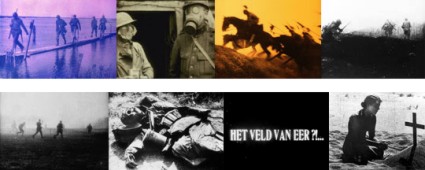
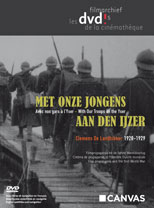
In this month, the ninetieth anniversary of the ending of the First World War, there have been many commeorative events, programmes and publication. The Bioscope has already reported on the Imperial War Museum’s DVD release of The Battle of the Somme. Now comes news of another important film, one originally released ten years after the war, issued on DVD for the first time. The film is With Our Troops on the Yser, a record of the war from the Belgian point of view, though a record of a quite particular kind. Here’s the blurb promoting it:
After four years of horror, the First World War ended on 11 November 1918. Ten years later, a Belgian veteran named Clemens De Landtsheer made With Our Troops on the Yser, a film on the ‘Great War’. The film is neither a triumphant retrospective nor an objective documentary, but a bitter protest in which the hardships of ‘our boys’, the simple soldiers at the front, are central.
As secretary of the ‘Yser Pilgrimage Committee’ De Landtsheer was part of a movement with a political agenda: to promote Flemish nationalism by emphasizing the purportedly disproportionate suffering and abuses endured by Flemish soldiers during the war. To this end, his film combines authentic archival footage from the war with staged images from existing fiction films, as well as a tendentious voice-over commentary. The result is both a unique cinematic experiment and a fascinating historical document, as Daniël Biltereyst (Ghent University) and Roel Vande Winkel (Ghent University – University of Antwerp) explain in the extras on the DVD.
With Our Troops on the Yser was screened more than 400 times in the interwar period. Its success inspired De Landtsheer to found the company Flandria Film. The fascinating story behind De Landtsheer’s film career is also illustrated in the extra documentary on this DVD, accompanied by several Flandria Film productions.
With Our Troops on the Yser was originally released in 1928, but was subsequently revised and augmented several times. The version on this DVD is the definitive colour version of 1933, restored by Noël Desmet (Belgian Royal Film Archive). The soundtrack is based on the original musical recordings used by De Landtsheer to accompany the images. The film can also be viewed with a scholarly audio commentary (in English, French or Dutch) co-written by Leen Engelen (Media & Design Academy), Roel Vande Winkel and Bruno Mestdagh (Royal Film Archive).
The film runs for 83mins, and comes with Dutch intertitles and English or French subtitles. Bonus features are three other Flandria Films productions by Clemens De Landtsheer: 10th Yser Pilgrimage (1929, 12 mins), Winter Has Come – Ice Festivities at Temse (1933-1934, 5 mins), Jules Van Hevel Tribute (1935, 9 mins); and a 25mins documentary Clemens De Landtsheer, by Daniël Biltereyst, Roel Vande Winkel and Erik Martens. Clearly this a pamphleteering film demanding contextualisation, particularly knowledge of Belgian nationalism, and the understanding of the experience of the war from the Flemish point of view. The commentary is provided by some of the leading lights in film and history today. Well done to all concerned for bringing out this title on DVD and widening our understanding of how film of the war was used and understood, not just during the conflict but in its aftermath. The DVD is Region 0, and is available from the Cinémathèque Royal de Belgique.
David Bordwell recently posted yet another jaw-droppingly good piece on his Observations on film art and Film Art blog, whose consistently high quality makes the rest of us look like mere gossip-mongers. This post, entitled Gradations of emphasis, starring Glenn Ford, examines widescreen cinema (you’ll have to read it to find out what the title means). But there was one aspect of it that caught my eye, something captured drifting across the screen, that reminded me of one of the odder corners of early film down which I like to wander sometimes.
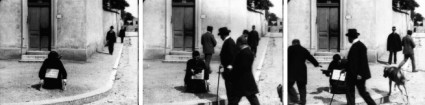
In his survey of lateral staging in film (i.e. action happening within the frame, literally coming in from the sides), Bordwell looks at early film strategies, and reproduces frames from the Lumières’ Le Faux cul-de-jatte (1897), in which a fake amputee begs in the street. He describes the action, until one frame (on the right, above), where a stray dog enters the action from the right. He writes, “The cop comes to the beggar, partially blocking the dog, who takes care of other business. (Not everything in this movie is staged.)” What interests Bordwell is the staged action. What interests me is the dog. Let me explain…
Cinema’s first dog, appearing in Edison’s Athlete with Wand (filmed February 1894) is noticeably at a remove from action and camera (though obedient enough to keep within the frame)
It was when I was presenting a series of programmes at the National Film Theatre on Victorian cinema (i.e. films made before 1901), in 1994, that I first noticed a peculiar phenomenon. As I introduced each short film in the compilation, and pointed out those points of central interest which I had recorded in my notes, I started to notice that the audience’s attention was being frequently been drawn away from the supposed subject and centre of the film’s attention, and instead they were detecting action to the edge of the frame, or crossing the frame, interrupting the action or courageously ignoring it, creating a vital counter-narrative. In short, their attention was irresistibly drawn to stray dogs.
This was a surprising phenomenon, which I exploited at the time for some simple humour, but on mature reflection it seemed that here was a hitherto wholly ignored yet clearly important facet of early cinema, a theme overlooked yet superabundantly obvious once pointed out to the idle observer. The number of stray dogs in early films is considerable, as anyone familiar with the period will readily acknowledge, and their distracting and engrossing qualities seemed to be in urgent need of analysis. Why were stray dogs accepted in early film dramas? What were they doing there? Where did they come from? Were there more such dogs in British films than others? What could their presence tell us about early film practice? How could one construct an overarching vision of early cinema that encompasses the animal and the accidental? Why are there no stray cats? Why, ultimately, were the audience looking in the wrong direction? Were the original audiences similarly distracted? In what sense could it said that such canine interruptions were directed, and by what agency? I resolved to write a paper that would answer these nagging enquiries. It would be called ‘First Film Dogs’.
I began first by collating the necessary data, and working on a critical theory which would most usefully and succinctly describe the phenomenon. The examples were easy to find: the exuberant Jack Russell which joins in the punishing of a sweep who wanders into a garden and dirties the laundry in James Williamson’s Washing the Sweep (1898, left); the stray dogs wandering over the parade ground amid the marching soldiers in the Boer War actuality Lord Roberts Hoisting the Union Jack at Pretoria (Warwick, 1900), upsetting the solemnity of the situation; dogs wandering casually onto the studio set of early Pathé films; the dog that takes position centre frame in film of a genuine mining tragedy funeral in the middle of the Pathé mining drama Au Pays Noir (1905); actualities such as Funeral of the World’s Greatest Monarch (1910), where King Edward VII’s own dog takes part in the procession, and is then accompanied by a passing stray (such thematic complexity!); the efforts of ‘Monarch’ the Lifeboat Dog to contribute to a life-saving re-enactment performed on the beach in Launch of the Worthing Lifeboat (Biograph, 1899).
Monarch’s contribution to an actuality which in fact incorporates a dramatic element illustrated the next stage of the theme, where the cinema progressively encroached upon the freedom of the dog, containing the dog within the frame, from Edison’s Laura Comstock’s Bag-Punching Dog (1901, right, though watch the film and see how the dog, Mannie, keeps trying to leap out of the frame only to be drawn back into it); to the passing dogs that enthusiatically take part in early chase films; to the triumph/defeat of Hepworth’s Rescued by Rover (1905), where the dog’s natural motion is contained entirely within the cinematic narrative. Did the sequel to that film, The Dog Outwits the Kidnapper (1905), where Rover gets to drive a car, indicate canine empowerment or slavery? What price the freedom of early cinematic form, when all that results from it in the end is Rin Tin Tin and Lassie?
The critical theory at this stage consisted mostly of a series of such questions, without a key, but I began to work on the concept of ‘canine space’. There was more going on in these early films than first appeared. There was a central performance, or news event, which the original catalogues declared to be the subject matter, but this could not necessarily be what the audience saw, nor was such a dictate bound to be obeyed by those appearing in these films. Anyone familiar with early films will know of the puzzled glances from passers-by that characterise street scenes, of the distracting matter which suggests that the camera operator was not in full command of the subject. In such circumstances, dogs run free. What adds to the fascination, reinforcing one’s belief in the essentially liberated nature of early films, is that stray dogs can be found in studio films of the period. The drama is enacted, the comedy routine performed, and in the background a dog watches, or wanders past, or joins in if it so desires, and this is accepted as part of the total action. ‘Canine space’ is therefore that other space, that world onto which the camera has intruded.
Rover (played by Blair) and Cecil Hepworth in Rescued by Rover (1905)
I never did write the paper. It was intended as a spoof of early film studies, but I couldn’t quite get the humour right. I was scheduled to give the paper at a British silent film festival some years ago, but in the end got up and apologised to the audience and said that the paper was beyond me. But I gave them enough of the argument that it probably affected the rest of the festival, as people starting spotting stray animals in every film, and ever since I’ve had people send me images or information on roving animals which they’ve spotted in some silent or other. A chord was touched.
It’s not a phenomenon entirely restricted to the early cinema (there a renowned stray dog in Joseph Losey’s Accident for instance), but it is a noticeable characteristic of early film which could make one think about the special free nature of film at that time. A cinema where dogs run free is a cinema that has not yet been pinned down, one that lets us look at the edges. You could call it the cinema of distractions. You could theorise about it seriously – there is perhaps some parallel with Roland Barthes’ concept of the ‘punctum’, the oddity in a photograph that shouldn’t really be there but which draws your attention away from what the photograph is ostensibly trying to convey.
Maybe I’ll write the paper one day. Maybe it’s the sort of paper that’s not meant to be written. Maybe we’re always going to be looking at the centre, while at the edges, or wandering across the frame, another kind of story passes by, always eluding us even though it may for a moment catch our eye. I don’t know. Try asking a dog.
Slapstick, Bristol’s silent film comedy festival, returns 22-25 January 2009. At just the time of year when we probably need it most, the Bristol festival (now in its fifth year) will be bringing together a programme of silent comedies with guest star comedians of today. The festival opens with a special gala event at Colston Hall of Buster Keaton’s Our Hospitality (1923), with live music from the Prima Visa Social Club, hosted by Paul Merton, who will introduce a supporting programme of comedy shorts including Laurel and Hardy in Liberty (1929).
Promised guests include Merton, Tim Brooke-Taylor, Graeme Garden, Neil Innes, and the Ukelele Orchestra of Great Britain playing to films from the BFI National Archive. British comedy great Eric Sykes will appear at the Bristol Old Vic on January 25th, in conversation with Phill Jupitus, to talk about his career as a writer and performer, to include a screening of his own classic ‘modern’ silent, The Plank (1967). Other venues will be the Watershed and the Arnolfini.
The remainder of the programme remains to be announced, but you are advised to book early, as this blurb from the festival says:
We are expecting unprecedented demand for these tickets and expect them to sell out quickly. A limited amount of priority tickets have been put aside for Bristol Silents Members and those people who purchase festival passes until 17th November and will be allocated on a first-come, first-served basis.
All Bristol Silents members and delegates will be able to purchase tickets at discounted rates.
We look forward to welcoming you once more to an extraordinary weekend of film, music and laughter in the heart of Bristol and would like to take this opportunity to thanks you for your ongoing support.













 The Bioscope