Digital 19th Century Britain

newsbycine

Headline from Penny Illustrated Newspaper, Saturday, 8 July 1911, from http://newspapers.bl.uk/blcs

There has been much fuss this week about the Digital Britain report, a blueprint for the country’s broadband future in which services, entertainment, knowledge and the health of the economy to come are pinned to the hope that everyone will be linked up to a frankly measly 2Mbps connection by 2012. The report has come in for much criticism, chiefly because it poses more questions than answers, but it does also cover important areas such a digital literacy (so everyone is able to navigate their way through this new world and enjoy a common level of benefits) and points out innovative models which have made digitised collections available to all.

A model example, highlighted in the report, is the British Library’s 1800-1900 Newspapers project. I must admit to a vested interest here, as the BL helps pay the rent that keeps up the tottering edifice that is Bioscope Towers. But by any measure this is a marvellous resource, exceptional in its content and presentation, but also a model of how a major digitised collection can be created that brings benefit to all.

Digitisation costs money. We know that are billions of pages in the world’s libraries, we know we’d like to have them all at our fingertips, and we know we’d rather not pay for it. The BL’s newspaper collection represents some 750 million pages. The new resource present 2 million of these. The money has come from a UK educational body which funds resources for higher education, the Joint Information Systems Committee, and a commercial partner, Gale Cengage. The JISC paid for the digitised newspapers to be made available for free to UK universities, while the public had to visit the British Library physical site to see the resource.

nineteenth

That was the case for the past year or so, but from today the commercial side of the deal kicks in. Gale Cengage co-funded the project on the understanding that it could make the newspaper resource available to the online public, under a subscription model. You can buy a 24-hour pass for £6.99 which allows you to view up to 100 articles, or you can buy a seven-day pass with 200 article views for £9.99. There is plenty, however, that is available for free – two newspapers, The Graphic and Penny Illustrated Paper, are free (the search page has a tick box where you can search for free content only), you can search and browse the database, see thumbnails of any article, and even call up a window which shows your chosen term in context – as in the example above, which gives us the heartening information that Trewman’s Exeter Flying Post or Plymouth and Cornish Advertiser was able to tell its audience about the Edison Kinetoscope on 10 March 1894. There are also a number of freely available PDF examples tied to some excellent background histories.

The sheer range of newspapers is eye-opening, including such titles (just to start from the top) as the Aberdeen Journal, Baner Cymru, Belfast News-Letter, Birmingham Daily Post and Brighton Patriot (along with forty-four others). The major papers that carried on into the 20th and 21st centuries, such as The Times and The Guardian are not there, both because they are ongoing businesses and because they have developed their own commercial digital archives. And although the title says 1800-1900, the actual range is 1800-1913 – ideal for early cinema studies.

So, using our regular search term of ‘kinetoscope’, there are 433 hits overall, and five available for free. So there is a huge amount you can discover about the spread nationally of the first motion picture film device, even if some of those articles will not lead you to Edison’s invention but rather to a not very successful racehorse given that name (an early example of product sponsorship or simply the whim of a technologically-savvy owner? Someone should be researching this). ‘Cinematograph’ yields 1990 hits, sixty-one of them free. You can either view the article, the full page, or browse that issue. One other handy feature – each thumbnail says whether what you have looked for comes under News, Arts & Entertainment, Advertising, Business News or People, depending on the section from which it comes.

The model of a commercial body paying for the digitisation of out-of-copyright material like this, making it available to all through (relatively) low-cost subscription, while the host library gets its collection digitised and can make the results freely available onsite, is hopefully one that may lead to still greater access to newspaper content from this era. 2 million pages done; just 748 million left to do. While you’re waiting, go explore.

Broncho Billy rides again

niles

http://www.nilesfilmmuseum.org/festival2009.htm

This year Broncho Billy Silent Film Festival takes place 26-28 June, as usual organised by the Niles Essanay Silent Film Museum at the Niles Edison Theater, Niles, Fremont CA. The theme of this year’s festival is ‘Independent Film Companies on the Rise’, and this is the schedule:

Friday Evening, June 26 – FROM LASKY TO PARAMOUNT

8:00 PM Main Program
The Enemy Sex – Betty Compson, Percy Marmont, Sheldon Lewis (1924)
A Trip Through the Paramount Studio – short: (1927)
When Clubs Were Trumps – Betty Compson, Neal Burns (1916)
The Butcher Boy – Roscoe “Fatty” Arbuckle, Buster Keaton (1917)
Phil Carli at the piano

Saturday Early Afternoon, June 26 – SHORT COMEDIES INTRODUCED BY DIANA SERRA CARY (Baby Peggy)

12:30 PM Comedy Program
Baby Peggy Birthday Newsreel – (2009, Niles-Essanay) Diana Cary and Fans
Cousins of Sherlocko – (1912)
Good Night, Nurse – Neal Burns, Billie Rhodes (1916)
The Kid Reporter – Baby Peggy (1923)
The Ghosts of Hollywood – William MacInnes Narrates (1931)
Drink Hearty – Snub Pollard, Marie Mosquini (1920)
Don’t Weaken – Ford Sterling, Charlie Murray (1920)
Judy Rosenberg at the piano

Saturday Late Afternoon, June 27 – THE AMERICAN FILM COMPANY, FROM CHICAGO TO SANTA BARBARA

3:30 PM Program
Faith – Mary Miles Minter, Margaret Shelby (1916)
Photoplay Magazine Screen Supplement – A behind-the-scenes look (1918)
The Capture of Rattlesnake Ike – J. Warren Kerrigan, Pauline Bush, Louise Lester (1911)
Calamity Anne, Guardian – J. Warren Kerrigan, Marshall Neilan, Louise Lester (1912)
Jon Mirsalis at the piano

Saturday Evening, June 27 – THOMAS H. INCE DOUBLE FEATURE

7:30 PM Program
The Crab – Frank Keenan, Thelma Salter (1917)
One a Minute – Douglas MacLean, Victor Potel. (1921)
With short:
A Tour of the Thomas Ince Studio – A behind-the-scenes look (1924)
Jon Mirsalis at the piano

Sunday Afternoon, June 28 – THANHOUSER 100th ANNIVERSARY, Introduced by Ned Thanhouser

12:30 PM Program
The Woman in White – Florence La Badie, Richard R. Neill (1917)
With shorts:
The Evidence of the Film – William Garwood, Marie Eline, Florence La Badie (1913)
Just a Shabby Doll – Mignon Anderson, Harry Benham, Helen Badgley (1913)
Phil Carli at the piano

Sunday Late Afternoon, June 28 – MADE IN THE BAY AREA SILENTS

3:30 PM Program
The Call of the Klondike – Gaston Glass, Dorothy Dwan (1926)
With shorts:
A Trip Down Market Street – Days before the earthquake and fire (1906)
Dream Picture – Lance, Mabel and Jimmy Nicholson, Albert Anderson. (1925)
Pop Tuttle, Deteckative – Dan Mason (1922)
Judy Rosenberg at the piano

Sunday Evening, June 28 – FROM IMP TO UNIVERSAL

7:30 PM Program
Foolish Wives – Erich von Stroheim, Mae Busch (1922)
With shorts:
Behind the Screen – Al Christie directs a film at Universal (1915)
Behind the Times – Ethel Grandin (1911)
Lizzie’s Dizzy Career – Eddie Lyons, Victoria Forde, Lee Moran (1915)
Bruce Loeb at the piano

The festival warns that there is very limited seating and purchasing tickets in advance is strongly recommended. Tickets can be purchased locally, online (using PayPal), or by US mail. Futher details, including directions and accomodation details, are on the festival web page.

Medical matters

capillaries

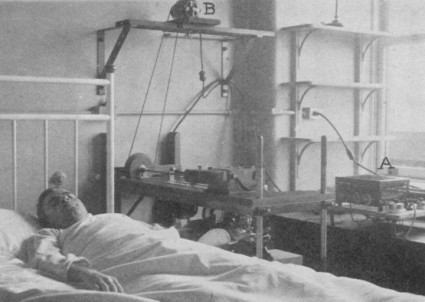
Fig 1: Photograph of the apparatus for cinematographic photomicrography of the capillaries of the nail fold in human subjects. A = an adjustable resistance; B = a motor, operated by a foot switch. From J. Hamilton Crawford and Heinz Rosenberger,’An Apparatus for Studies of Human Capillaries’, Journal of Clinical Investigation, 26 April 1926

Here at the Bioscope we like to keep an eye on online resources for the study of silent cinema, in particular digitised journals and newspapers. Few such resources exist online which are dedicated solely towards silent film, but there are plenty of a general or of a specialism other than film which contain material of great value to us. Plenty has been written here about newspapers, which you would expect to have worthwhile material, but our subject now is something a little more off the beaten track – medical journals.

It could be argued – in fact it has been argued – that it was scientific and medical investigation that brought about the invention of cinema. Chronophotographers in the 1880s and 90s, such as Etienne-Jules Marey, Georges Demeny, Ernst Kohlrausch and Albert Londe, used the emerging technology of motion picture film to record and analyse movement (chiefly human movement), generally with a medical or therapeutic aim in view. When motion pictures properly appeared on the scene, although they flourished as an entertainment, there were a number of medical investigators who took advantage of the new technology, such as Eugène-Louis Doyen (who filmed his operations in the late 1890s/early1900s) and Jean Comandon, who used microcinematographic film in completing his 1909 doctoral thesis De l’usage clinique de l’ultra-microscope en particulier pour la recherche et l’étude des spirochètes, and who went on to make films for Pathé. Other early explorers with a camera on the science/medicine border included Lucien Bull, Pierre Noguès, Gheorge Marinescu, Alejandro Posadas, Osvaldo Polimanti and Joachim-Léon Carvallo.

capillaries2

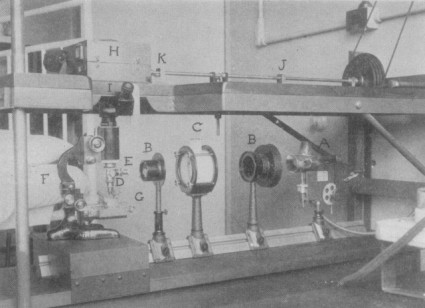
Fig. 2: Photograph showing details of the apparatus for cinematography of the capillaries. A = arc lamp; B = condensing system; C = heat filter; D = system for direct illumination; E = polarizer; F = microscope; G = stand for finger; H = camera; I = observation side piece; J = shaft; K = clutch

So it may not come as a surprise to find the cinematograph included among medical papers of the period, though the extent to which it is, and the number of people engaged in using motion pictures for medical investigation throughout the silent period, is nevertheless remarkable. Evidence of this can be found in digitised medical journals of the period, of which the major source is PubMed Central, the U.S. National Institutes of Health free digital archive of biomedical and life sciences journal literature. PMC is a digital library for a worldwide scientific and biomedical community, dedicated to the preservation and free access. It began operating in 2000, and in 2007 a UK offshoot, UK PubMed Central was launched. What is of interest to us is that its archive includes many runs of historical journals, covering (for our purposes) the 1890s to the 1920s, among them the British Medical Journal, The Journal of Medical Research, The Proceedings of the Royal Society of Medicine etc.

And there is plenty to discover. Just type in ‘cinematograph’ or ‘kinematograph’ (the most productive terms) and you will uncover a world of pioneering investigation. There is a 1918 article ‘Cinematograph Demonstration of War Neuroses’, on the renowned film of shell shock victims at Netley (previously covered by the Bioscope here), ‘The Rôle of the Cinematograph in the Teaching of Obstetrics’ (1920), ‘Kinematograph Film illustrating Anastomosis of Facial Nerve in Cases of Facial Palsy’ (1925), ‘The Cinematograph in Medical Education’ (1928) and ‘Cinematograph Demonstration of Methods of Bone-grafting’ (116). There is a number of pieces on the question whether going to the cinema was bad for your eyesight. There are references to key investigators such as Marey, Comandon, Marinescu and Doyen. And there are incidental references that intrigue, such as the British Medical Journal noting with some interest its receipt of a booklet on Kinemacolor (“With the motion of the picture and the natural colour representation, together with a certain amount of stereoscopic relief, all rolled into one, it is difficult to see what further conquests in this direction realism has to make”).

capillaries3

Fig. 3: Print of part of a cinematographic film taken by the method described

All of the documents are available in word-searchable PDF format, immaculately ordered and referenced, as one would expect. One can also find articles and reviews from more recent times that cover our area. Of course, the number of film enthusiasts keen to read a paper entiteld ‘An Apparatus for Motion Photography of the Growth of Bacteria’ is likely to be outnumbered to some considerable degree by those who would rather seek their entertainment elsewhere. But for those of an enquiring mind, PMC is an absolute treasure trove for anyone keen to explore how the motion picture developed in its earliest years as a tool of discovery, and gives evidence that the medical community was, from the outset, welcoming of the new medium where it could advance understanding.

There are other such medical journal databases. The British Medical Journal has puts its whole archive online, searchable by year or by subject terms. It appears that the content is the same as that to be found on PMC, but one should never assume. Next, there is the archive of historical nursing journals made available by the Royal College of Nursing. This does have material which is not on PMC, and the terms ‘cinematograph’, ‘kinematograph’ and even ‘kinetoscope’ all yield interesting results. Here, for example, is an account from The British Journal of Nursing, 15 November 1919, on a screening of the film The End of the Road:

By the courteous invitation of the National Council for Combating Venereal Diseases (London and Home Counties Branch), we attended a private exhibition of an Educational Cinematograph Production. bearing the above title. This powerful film is authorised by the Council, and produced With the approval of the Ministry of Health at the Alhambra Theatre, It is scarcely necessary to state that the splendid endeavours of the N.C.C.V.D. are bearing abundant fruit. Only a few years ago the production of a play handling social and sex questions with such frankness would not have been possible on our English stage. To-day a mixed audience watches it with the reverent silence of a Church congregation, a proof that the senseless prudery which has been so largely responsible in the past for an enormous amount of preventable disease, misery and degradation is breaking down, and giving place to a more sane, enlightened, and wholesome attitude of mind.

In the case of both the BMJ archive and that of the RCN, the article are available for free, as word-searchable and downloadable PDFs.

The history of early medical film can be traced in Virgilio Tosi’s Cinema Before Cinema: The Origins of Scientific Cinematography (first published in Italian 1984 and in English in 2005) which is accompanied by a DVD, The Origins of Scientific Cinematography, which demonstrates the work of chronophotographers, ethnographers, scientists and doctors who used film at the turn of the last century. The DVD contains some beautiful and occasionally eye-popping images (my favourite is a German doctor, Ernst von Bergmann, from 1903, who swiftly amputates a leg and then makes a bow to the camera).

Other studies around this area include Marta Braun, Picturing Time: Work of Etienne-Jules Marey (1830-1904) (one of the most beautiful books I know, as well as brimming over with intelligence) and Lisa Cartwright, Screening the Body: Tracing Medicine’s Visual Culture, a thought-provoking study of the meaning and intentions of the medical film, boldly arguing for its alliance with the avant garde and popular culture. Not published yet, but allied to Cartwright’s preoccupations, will be Hannah Landecker’s book which has the working title Cellular Features: A History of Biological Film in Science and Culture, information on which can be found here. As Landecker notes, while many medical films were shown only to specialists, or were used for instructional purposes, others made it into the popular cinema – notably the films of Jean Comandon.

One of the interesting things is that people didn’t draw the line between science and entertainment … It was all seen as film — something new. People were really excited that they could see something they’d never seen before — films of far-away places and of small things inside the body.

Has that line been drawn since? Dr Doyen’s 1902 film of the separation of Siamese twins ended up being shown on fairgrounds (and can be found on YouTube, if you know where to look), and only last month Channel 4 gave us The Operation: Surgery Live. Medical film is popular film, because we are drawn to watch it. It is certainly a part of film history that it would be wrong to ignore.

Lobster catalogue online

lobster

http://www.lobsterfilms.com

For some while now we have all admired hugely the work of Lobster Films of Paris in discovering and restoring early films, many of them fascinatingly obscure and bizarre. But what exactly have they got? There have festival screenings, some DVD releases, and selected examples available on the Europa Film Treasures site, but in the absence of an available catalogue all we could do was speculate, and dream.

Well, we dream no more, because Lobster has published its full catalogue online. The catalogue covers over sixty years of cinema, from the 1890s to the 1960s, with its great speciality being early cinema. The main page describes those areas where the collection is strongest – early film, slapstick, jazz, cartoons, features, documentaries, erotic films, and detective stories. Click on ‘search’, and that takes you to a simple search page, where you can search from terms across either title or within a summary.

To the top right of the page, however, are two further search options, alphabetical or multicriteria. This is where the real discovery can take place. The alphabetical search is the browse option, so you may find the full range of titles per letter of the alphabet – 132 results under A, 180 results under B, 196 results under C, and so on. Clicking on any record gives you full descriptive details (variable across the collection, and a number have no plot description, so searches across summary are therefore going to produce erratic results). Several have a frame still illustration.

The multicriteria search option enables to specify search by title, director, actor, music, year, summary, category, keyword, sound, country, colour, version and format. So, very quickly, you may discover that Lobster has 173 films made by Georges Méliès, 16 titles featuring Douglas Fairbanks, and 20 titles from the year 1909. However, beware of uneven categorisation – I put in ‘France’ as country and ‘silent’ as sound type, and came up with only 138 titles, which is clearly wrong. Other instances of incomplete or inconsistent categorisation mean that the better option is to use the simple or alphabetical search options. Minor quibbles aside, this is a privileged glimpse into Aladdin’s cave. Go explore.

Bardelys the Magnificent

bardelysdvd

Good news, because the silent film discovery of the past year or so, Bardelys the Magnificent, is released next month by Flicker Alley. The 1926 MGM film, starring John Gilbert and based on a typically swashbuckling novel by Rafael Sabatini, was directed by King Vidor – his first film after The Big Parade. Thought lost and long-lamented (a brief excerpt existed in the Marion Davies film Show People), a print of the film turned up in France in 2006. Restored by the continually splendid Lobster Films, the film started doing the rounds of archive film festivals late last year, and has proven to be a popular delight. The DVD version comes with a period score by the Mont Alto Motion Picture Orchestra provides a lovely score of period photoplay music, and an alternate piano score by Antonio Coppola (one suspects that alternate scores are shaping up to be a new trend). English titles have been inserted according to the original script, and a gap in the rediscovered footage is bridged with stills, titles, and footage from the original trailer.

Accompanying the main feature is Monte Cristo (1922), based on the Alexandre Dumas novel, starring Gilbert as Edmond Dantes. As with Bardelys, this was a lavish production in its day, which now survives in almost complete form through a single “worn and choppy” print found in the Czech Republic. English titles have been added from the original script, and Neal Kurz plays the piano score based on period French music. Extras on the DVD are an audio essay on John Gilbert by Jeffrey Vance and Tony Maietta, and a new thirty-minute documentary, Rediscovering John Gilbert, featuring an on-camera interview with his daughter and biographer, Leatrice Gilbert Fountain.

Bardelys the Magnificent and Monte Cristo: The Lost Films of John Gilbert is released as a 2-disc set on 14 July.

A silent stroll through London

At the recent British Silent Film Festival a walk was organised for delegates around some of central London’s early film sites. With the kind permission of the walk’s organiser and guide, Ian Christie, the Bioscope is able to reproduce his notes, and encourages you (should you be in London) to follow in these footsteps. The contemporary pictures are by Matthew Lloyd. The text is followed by a review of the walk from Kelly Robinson, to whom my thanks for suggesting the idea for this post. Hyperlinks in bold are to map references. Happy trails.

(Very) Early Film Sites in Central London

alhambra

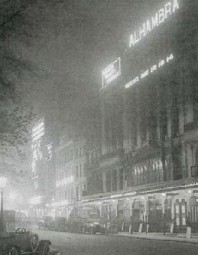
1. We start in Leicester Square, beside the Chaplin statue (John Doubleday, 1981) and the Shakespeare monument (copied from Westminster Abbey, 1874), looking around the perimeter, first at the Empire (1884), site of the first Lumière Cinématographe run in Spring 1896; also at the site of the Alhambra music hall (1858) where R.W. Paul ran a competing show featuring his ‘Animatograph’, also starting in 1896 (image from http://www.arthurlloyd.co.uk). Paul also shot his first fiction film on the roof of the Alhambra. The Odeon West End opened in 1930 as one of the new sound-era cinemas (refurbished 1968) and the flagship Odeon Leicester Square opened in 1937, and remains London’s leading ‘red carpet’ venue.

Into Leicester Place, north of main square, to look at French Catholic Church, Notre Dame de France, first built in 1865 on site of Robert Mitchell’s 1793-4 Panorama. Look north into Lisle Street, where De Loutherbourg ran the Eidophusikon in February 1781, described as ‘Moving pictures, representing phenomena of nature’. Review of Leicester Square history and entertainments since 18th century.

2. Out of Square at bottom, across Charing Cross Road, into Cecil Court once known as ‘Flicker Alley’, when it housed many early film companies, from 1897 to 1910 (detailed list in Simon Brown’s article, in Film Studies no. 10).

3. From Cecil Court, right into St Martin’s Lane, towards Trafalgar Square – noting location from which Wordsworth Donisthorpe shot frames of film in 1890.

ceciltrafalgar

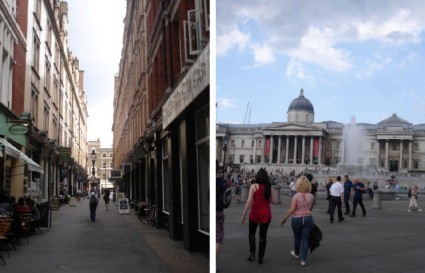
Cecil Court and Trafalgar Square today

4. Then left into the Strand, to the site of Edison’s Kinetoscope parlour, opened on left of Adelphi Theatre in 1895 (not current Adelphi building).

5. Next to Adelphi Theatre, the Hotel Cecil, where W.K.L. Dickson lived from 1897 until his departure for South Africa.

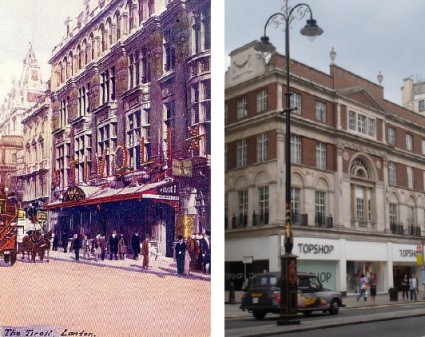
6. 64 Strand, where Dickson had his first lab, c.1903; and the site of the Tivoli Music Hall then Theatre, 65-70 Strand – which eventually became a cinema where the Film Society first met in the 1920s, but had the Biograph studio behind it in 1897.

tivoli

A postcard for the Tivoli Theatre, sent in 1908, from http://www.arthurlloyd.co.uk, and the site where the Tivoli stands today

7. We turn off the Strand and head up through Covent Garden, noting site Jury’s Imperial Pictures, 142 Long Acre. Then on to St Giles Circus and crossroads of Tottenham Court Road and Oxford Sreet, to site of the Horse Shoe Hotel where the Kinetoscope launch dinner was held on 17 October 1894 (copy of the menu in the Bill Douglas Centre collection).

8. Then along Oxford Steet, looking out for no. 70, the original London Kinetoscope parlour, and the site of Hales Tours of the World, at 165 Oxford Street, from 1906.

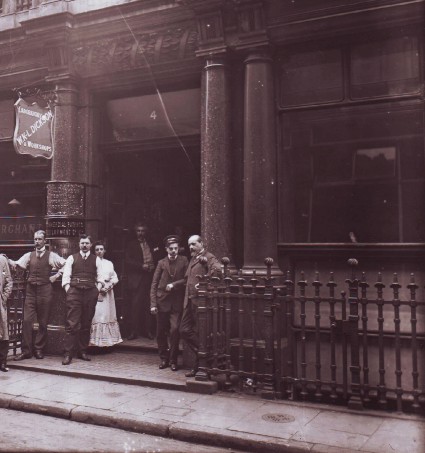
9. We turn back into Wardour Street and identifying a series of sites associated with Charles Urban and other British pioneer producers and distributors. At the bottom of Wardour Street, we note Gerrard Street, another site of early companies such as Cricks and Martin), and Birt Acres’ Kineopticon, at 2 Piccadilly Mansions (“Britain’s first cinema” in 1896), also the Biograph offices nearby at 18-19 Great Windmill Street and Rupert and Denman Streets, where many early film businesses were based (see London Project website at http://londonfilm.bbk.ac.uk)

denmanst

W.K.L. Dickson’s lab in Denman Street, image courtesy of Paul Spehr

10. Then back up Shaftesbury Avenue to Cambridge Circus, where the Palace Theatre was first the home of Biograph exhibition, then of Urban’s Kinemacolor.

palace

The Palace Theatre in the early 1900s, from http://www.arthurlloyd.co.uk

11. Finally, we finish in the Montagu Pyke public house, named after the early London cinema entrepreneur (and much else besides!).

Ian Christie
Birkbeck College – London Screen Study Collection, The London Project www.ianchristie.org

After apprehensively checking the weather forecast every day leading up to the walk we were all delighted that despite thunderstorms in the early morning it had cleared and the sun was shining. Ian Christie, our expert guide, had unfortunately various noises to contend with at the beginning including loud speakers at the Chaplin statue in Leicester Square, blaring all manner of strange sounds directly at us, and bells chiming at St Martin in the Fields. However, the walk was a delight – uncovering a hidden layer of London’s history that many of us were unaware of, including a Cocteau mural in the French Catholic Church in Leicester Place. It was a particular delight to imagine Cecil Court as ‘Flicker Alley’ a hustling and bustling street of film-related businesses before a fire encouraged relocation. With added impromptu contributions from W.K.L. Dickson’s biographer Paul Spehr and silent film historian and filmmaker Kevin Brownlow, the day was a spectacular treat. Down Wardour Street the gathering clouds could hold off no longer and we fought a torrential downpour. Luckily we were nearing the end of our walk and the Montagu Pyke pub our final destination and named after the rogue cinema entrepreneur. I’m looking forward to visiting these streets again and recollecting Ian’s anecdotes; my perception of London has certainly been transformed. Many thanks to Ian Christie and Bryony Dixon.

Kelly Robinson

SilentsWalk

British silent film enthusiasts on their walking tour of London, 7 June 2009. Photograph courtesy of Christian Hayes

Eight days and evenings of cinephilic joy

feu_mathias_pascal

Feu Mathias Pascal

The programme for this year’s Il Cinema Ritrovato has been announced. The festival takes place 27 June-4 July in Bologna, Italy, and is dedicated to restored films, silent and sound. Bologna always puts on a marvellously rich mix of astutely programmed themes, and this year looks like no exception. If it wasn’t quite so hot in Italy at that time of year I’d be there every year – though people keep telling me how good the air conditioning is. Well, one day, maybe… Anyway, here are the words of festival director Peter von Bagh to tell me what I’ll be missing:

Il Cinema Ritrovato, the festival sponsored by the Mostra Internazionale del Cinema Libero and the Cineteca del Comune di Bologna, invites film lovers from around the world to Bologna from Saturday June 27th through Saturday July 4th, 2009. Eight days and evenings of cinephilic joy to be experienced in various locations: the twin screens of the Cineteca’s Lumière cinemas, one dedicated just to silent cinema, the other to sound; the Bologna Opera House and the Arlecchino Cinema (where we can experience the miracle of big screen projection as films were meant to be seen, but almost never are these days).

Let’s get started with some of this year’s titles. We pay homage to certain films simply because they have a special place in film lovers’ memory: Michael Powell’s and Emeric Pressburger’s The Red Shoes in its splendid new Technicolor restoration by UCLA Film & Television Archive with The Film Foundation; a brand new restoration of Sergio Leone’s The Good, the Bad and the Ugly (for the closing night); Make Way for Tomorrow (Leo McCarey, 1937), the predecessor of Ozu’s Tokyo Monogatari and its equal as a deeply emotional experience.

As always, evening screenings with a live orchestra promise to be some of the most exciting events: Timothy Brock, with a new score for the print restored by Cinémathèque française of Marcel L’Herbier’s Feu Mathias Pascal, the greatest Pirandello film; and Otto Donner, the grand maestro of Scandinavian jazz, with King Vidor’s The Crowd. Of course, there are also films that will be shown because they have been forgotten for too long such as Village of Sin by Ol’ga Preobraženskaja (1927), a rural melodrama and a key film from a particularly rich period of Soviet silent cinema.

The director of the year is the great Italian-American Frank Capra: his entire silent output, of which amazingly little is known today. We will be enchanted by works from the already fully-formed comic mastermind during Capra’s silent period, with their incisive view of social life and without the ready-made formulas of his later years. We will also dive into the dynamic, original and little-known beginning of his first 8 sound films, culminating in decisive masterpieces like Platinum Blonde and The Bitter Tea of General Yen. The program was created in full partnership with Sony-Columbia and with the participation of scholar and screenwriter Joseph McBride.

Vittorio Cottafavi is comparable to Sirk or Fassbinder or Leone in his capacity to treat any marginal genre with respect, literary sophistication, visual flair (with beautiful ideas about space, irony and rhythm) and a deeply nuanced popular sensibility which he lavished upon everything he touched, especially historical subjects and the peplum, which in his hands became a noble genre. The series of 12 films is curated by Adriano Aprà and Giulio Bursi.

The pleasure dome of the Arlecchino Cinema will offer two special sections: CinemaScope, widening horizons for the sixth year in a row, and color, the beginning of something that will bless our programs for some years to come. Our CinemaScope selection offers treasures like The Track of the Cat (William Wellman’s strange western with an even stranger color concept) and three famous epic movies by Vittorio Cottafavi. The first session dedicated to color is an introduction to the most notable uses of color during the first 50 years of cinema history, including the oldest hand-painted films, like masterpieces from Méliès and de Chomón, the first full color systems (Gaumont Chronochrome, Kinemacolor), tinted films, early Technicolor (in films like Scherzinger’s Redskin) and of course the miracle of the full three-strip Technicolor, both through restorations using contemporary film stock and in examples of original prints that have survived from its glory days. In other words, unforgettable viewing: Drums along the Mohawk (Ford), Pandora and the Flying Dutchman (Lewin), and of course The Red Shoes.

One Hundred Years Ago, a time travel journey that began 6 years ago, will again showcase the most exciting documentaries and fiction films about the life and imagination of people who lived exactly one century ago, with two special features: an homage to the miracle of Méliès and a reconstruction of the very first film festival in history, which took place, of course, in 1909. Mariann Lewinsky is this section’s curator.

Among the silent highlights we’ll present two small-scale portraits of notable personalities. First up is director Eleuterio Rodolfi (1876-1933), who started as an actor and later became a director of a number of films, including the celebrated 1917 version of Hamlet. And Anita Berber (1899-1928), who was a legendary, androgynous figure of Weimar Berlin: an actress, nude dancer, writer, celebrated in a portrait painted by Otto Dix, and equally impressive in the surviving examples of her appearances on screen.

Chaplin’s influence was unlimited and can be seen in the high quality of his assistants’ work. After Monta Bell last year, we present an equally creative mind, Harry d’Abbadie d’Arrast, with his two most remarkable films, A Gentleman of Paris (1927) and Laughter (1930).

Mornings too will have a special start: a full pack of Maciste, thanks to the restorations of seven films in collaboration with Museo Nazionale del Cinema di Torino. The Italian superman was a personification of the mythical hero adventuring in the past or right in the middle of modern times – the first and arguably the greatest of all the strong men of film history. The films, celebrated by Fellini and others, are totally fascinating as such, and moreover present a kind of synthesis of the film history of their day, combining – as Vittorio Martinelli put it – elements of Méliès and Lang, Gustave Doré and Flash Gordon…

Sponsored by the Cinémathèque de Toulouse and Gosfilmofond, curated by Valérie Pozner and Natacha Laurent, Kinojudaica is a series on Russian and Soviet films featuring Jewish actors, directors and themes, presenting little-known films from masters and equally fascinating films from filmmakers doomed to remain in total obscurity because of circumstances or because the films were forbidden for what seemed an eternity. Kinojudaica presents a rich flowering of Jewish films made in Russia and the Soviet Union: four silent programs and three little known sound films like Frontier by Michail Dubson (1935), The Return of Nathan Becker by Boris Špis and Rašel Mil’man (1931) and Nepokoronnye (The Taras Family) by Marc Donskoï (1945), with its terrifying re-creation of Babi Yar on screen.

Then there are films that offer a cross-section of life, with 10-15 people from all walks of society who encounter each other in situations without any clear-cut protagonist. For unknown reasons, British cinema made this a subgenre all its own, with films like Rome Express (Walter Forde, 1932), Friday the Thirteenth (Victor Saville, 1933), The Passing of the Third Floor Back (Berthold Viertel, 1935), culminating with Carol Reed’s finest 1930s film, Bank Holiday (1938).

Richard Leacock will be our guest this year. The cameraman of Flaherty’s film, Louisiana Story, and as such a bridge between the greatest tradition and the new heights of “direct cinema”, Leacock will present his own masterpiece, A Portrait of Stravinsky.

The cinema of Vichy gives us a glimpse into that enigmatic, paradoxical period of French film, with the reconstruction of an entire program from April 17, 1942, feature films, short propaganda films from 1940-44, official Vichy and other collaborationist materials, and resistance films. This program was curated by Eric Le Roy with Les Archives Françaises du Film.

Last year’s von Sternberg series was such an astounding success that we can’t imagine it being over: so this year we are offering the master’s most sublime film of his later years (The Shanghai Gesture, the perfect Dietrich film without Dietrich) as well as a selection of fabulous footage from I Claudius, a film that was never finished and that still haunts the world’s cinephiles. And we will see Von Sternberg at work once again in an interview by Eric de Kuyper for Belgian TV.

The underlying theme of this all is again cinephilia, the absolute love of cinema. Several programs will be dedicated to this theme: films on notable personalities (Bernard Chardère, Henri Langlois’s television interviews), the unsurpassed Cinéastes de notre temps programs by André S. Labarthe.

The festival also sponsors the Film Publishing Fair (Books, DVDs, Antiquarian and Vintage Materials) and Il Cinema Ritrovato DVD Award (6th edition). We would like to remind you that Il Cinema Ritrovato will host two seminars: the continuation of the Film Restoration Summer School / FIAF Summer School 2009, organized by the Cineteca di Bologna, and a workshop for European cinema exhibitors organized by Europa Cinemas and Progetto Schermi e Lavagne. Enrollment in each seminar requires separate registration, available on this website.

On a sadder note, funding for our festival has been cut drastically, so we unfortunately have had to rethink the hospitality we can offer to our very dear public. The rates agreed on with various hotels in the city are still very advantageous, and we hope that the films we are showing this year will convince you to be with us once again this year.

You are most cordially welcomed to the most memorable eight days of 2009.

Artistic Director of Il Cinema Ritrovato
Peter von Bagh

The full programme is on the festival site (in English and Italian), from which these are the silent films and silent film-related events on offer (in Italian, but you’ll cope):

Martedì 30 giugno
THE CROWD (La folla) Stati Uniti, 1928 Regia: King Vidor
Accompagnamento dal vivo del gruppo Jazz di Otto Donner

Giovedì 2 luglio
Progetto Chaplin
A DAY’S PLEASURE (Una giornata di vacanza) Stati Uniti, 1919 Regia: Charles Chaplin
SUNNYSIDE (Charlot in campagna) Stati Uniti, 1919 Regia: Charles Chaplin
ONE WEEK (Una settimana) Stati Uniti, 1921 Regia: Buster Keaton
Accompagnamento dal vivo diretto da Timothy Brock

Domenica 28 giugno
FEU MATHIAS PASCAL (Il fu Mattia Pascal) Francia, 1926 Regia: Marcel L’Herbier
Accompagnamento dal vivo dell’Orchestra del Teatro Comunale diretta da Timothy Brock

Cento anni fa: i film del 1909 – programmi a cura di Mariann Lewinsky

Omaggio a Eleuterio Rodolfi, Anita Berber e Georges Méliès

Frank Capra: il nome sopra il titolo
VISITA INCROCIATORE ITALIANO A SAN FRANCISCO Stati Uniti, 1921 Regia: Frank Capra
FULTA FISHER’S BOARDING HOUSE Stati Uniti, 1922 Regia: Frank Capra
THE STRONG MAN (La grande sparata) Stati Uniti, 1926 Regia: Frank Capra
LONG PANTS (Le sue ultime mutandine) Stati Uniti, 1927 Regia: Frank Capra
THAT CERTAIN THING (Quella certa cosa) Stati Uniti, 1928 Regia: Frank Capra
SO THIS IS LOVE? (Dunque è questo l’amore?) Stati Uniti, 1928 Regia: Frank Capra
THE MATINEE IDOL (Il teatro di Minnie) Stati Uniti, 1928 Regia: Frank Capra.
THE WAY OF THE STRONG (La maniera del forte) Stati Uniti,1928 Regia: Frank Capra
SUBMARINE (Femmine del mare) Stati Uniti,1928 Regia: Frank Capra
THE YOUNGER GENERATION (La nuova generazione) Stati Uniti, 1929 Regia: Frank Capra
THE DONOVAN AFFAIR (L’affare Donovan) Stati Uniti, 1929 Regia: Frank Capra

Kinojudaica, l’immagine degli ebrei nel cinema russo e sovietico
OÙ EST LA VÉRITÉ? (Vu iz emes?) URSS, 1913 Regia: Semion Mintus
LE MALHEUR DE SARAH (Gorrié Sarry) URSS, 1915 Regia: Alexandre Arkatov
LÉON DREY URSS, 1915 Regia: Evgueni Bauer
VÉRA TCHЕBЕRIAK URSS, 1917 Regia: Nikolaï Brechko-Brechklovski
CONTRE LA VOLONTÉ DES PÈRES (Protiv voli otsov) URSS, 1926-27 Regia: Evgueni Ivanov-Barkov
LES CINQ FIANCÉES (Piat nevest) URSS, 1929-30 Regia: Alexandre Soloviev
RETENEZ LEURS VISAGES (Zapomnite ikh litsa) URSS, 1929-30 Regia: Ivan Mutanov

Tutto Maciste
MACISTE (IL TERRORE DEI BANDITI) Italia, 1915 Regia: Luigi Romano Borgnetto,V. Denizot
MACISTE ALPINO Italia, 1916 Regia: Luigi Romano Borgnetto
MACISTE INNAMORATO Italia, 1919 Regia: Luigi Romano Borgnetto
MACISTE IN VACANZA Italia, 1920 Regia: Luigi Romano Borgnetto
MACISTE ALL’INFERNO Italia, 1925 Regia: Guido Brignone
MACISTE NELLA GABBIA DEI LEONI Italia, 1926 Regia: Guido Brignone
MACISTE CONTRO LO SCEICCO Italia, 1926 Regia: Mario Camerini

Jean Epstein, il mare come definizione del cinema
FINIS TERRAE Francia, 1929 Regia: Jean Epstein
MOR VRAN Francia, 1931 Regia: Jean Epstein

Dossier Chaplin e Napoleone

Omaggio a Harry d’Abbadie Arrast

Dossier Metropolis

Dossier Blasetti

La crisi economica ai tempi del muto
Rome Express, Friday the Thirteenth, Rodolfi’s Hamlet, Kinemacolor (Bologna has possibily the world’s largest collection of Kinemacolor films) and chronochrome, the films of 1909… Such gems, such treasures. I must be mad.

More from Warners

beaubrummel

http://www.imdb.com

You will recall the recent good news that Warner Bros. has established a made-to-order DVD service for films from its archives that might not otherwise receive a DVD release. The films are being made in DVD-R format, burned to order, and priced at $19.95 for DVD copies in the post, $14.95 for downloads, and they can be ordered from www.warnerarchive.com. The only downside is that the titles are not being made available outside the USA, though the hope is that this will change in the future.

Warners have promised to keep adding to what was an original list of 150 titles (which ranges from the 1920s to the 1980s), and the latest batch includes more silents. The titles are:

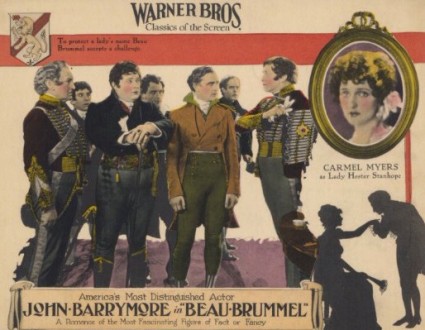
  • Beau Brummel (US 1924 d. Harry Beaumont), with John Barrymore, Mary Astor, Carmel Myers
  • The Sea Hawk (US 1924 d. Frank Lloyd), with Milton Sills, Enid Bennett
  • The Better ‘Ole (US 1926 d. Charles Reisner), with Syd Chaplin, Harold Goodwin, Jack Ackroyd
  • The First Auto (US 1927 d. Roy Del Ruth), with Russell Simpson, Frank Campeau
  • Old San Francisco (US 1927 d. Alan Crosland), with Dolores Costello, Warner Oland
  • When a Man Loves (US 1927 d. Alan Crosland), with John Barrymore, Dolores Costello
  • The Divine Lady (US 1929 d. Frank Lloyd), with Corinne Griffith, Victor Varconi

The DVDs will be available from June 15, making the total number available in this way (not just silents) 2007, with a total of 300 titles promised by the end of this year.

Open weekend at the Cinema Museum

cmprojectors

http://www.cinemamuseum.org.uk

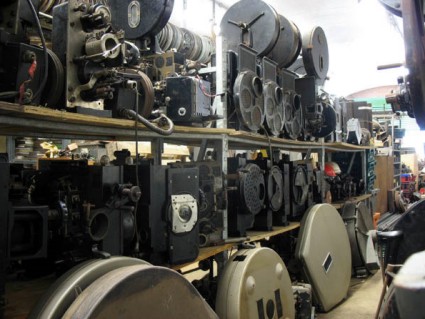
London’s Cinema Museum, whose good news about the renewal of its release was reported here recently, is having an open weekend. The Cinema Museum is a private institution, supported by its stills business, and it is not normally open to the general public, so this is a marvellous opportunity to discover one of London’s hidden gems, certainly if you have any interest in motion picture history. The collection represents cinema’s rich history from the earliest days to the present, containing every sort of item relating to film production, film exhibition and the experience of cinemagoing.

The open weekend runs 27-28 June June 2009. During the weekend you may enjoy any of the following:

  • Recipes to the Stars! – an edible talk with Jenny Hammerton
  • Rescuing Home Movies – a guide by David Cleveland
  • Classic Silent Comedy Shorts – a film screening with piano accompainment by Tom Bell
  • Guided tours of the Museum Collection
  • Chaplin and the Workhouse exhibition (the museum is located in the Lambeth workshouse which once housed Chaplin’s mother)

The weekend will also feature an exhibition of new artwork by Cnidoblasts and Anna Odrich, reconfiguring artefacts from the collection and exploring the mechanics and gestures of silent comedy through sculpture.

More information will appear on the Cinema Museum website in due course. And just to whet your appetite, there’s this delightful tour of the place hosted by the Museum’s founder Ronald Grant. We’ve featured it on The Bioscope before, but in the very early days of this blog, and it more than merits being screened again.

(The film was made in 2000 by Guy Edmonds and Anna Odrich)

Here comes the San Francisco Silent Film Festival

WildRose

The programme for the 14th Annual San Francisco Silent Film Festival has been announced. The festival runs 10-12 July 2009 at its traditional home at the Castro Theatre in San Francisco.

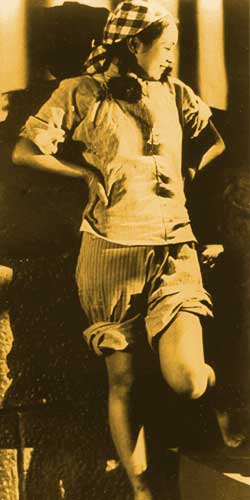
Among the festival highlights are Douglas Fairbanks and Lupe Velez in The Gaucho, Lillian Gish in Victor Sjöström’s sublime The Wind, John Gilbert in the joyously redisicovered Bardelys the Magnificent, W.C. Fields in So’s Your Old Man, gthe 1932 Chinese silent Wild Rose (illustrated) with Jin Yan, plus programmes devoted to Mary Pickford (the centenary of whose screen debut is marked this year) and Walt Disney’s Oswald the Lucky Rabbit.

There are classic films from the USA, USSR, Czechoslovakia and China; and a starry line-up of the world’s leading silent film musicians. And perhaps to top it all, Dennis James accompanies Aelita, Queen of Mars on the Theremin.

This is the line-up:

FRIDAY, JULY 10
The Gaucho 7PM

SATURDAY, JULY 11
Amazing Tales from the Archives 10AM
Bardelys the Magnificent 12 noon
Wild Rose 2:30PM
Underworld 5PM
The Wind 7:30PM
Aelita, Queen of Mars 9:45PM

SUNDAY, JULY 12
Oswald the Lucky Rabbit 10:30AM
Erotikon 1:30PM
So’s Your Old Man 4PM
The Fall of the House of Usher 6:15PM
Lady of the Pavements 8:15PM

Well, that’s a corking programme to be sure, further details of which are available on the festival site, along with the usual booking details, venue information, hotels etc. Or there’s the full press release to tell you more, as follows:

Tickets are on sale now for the foremost celebration of silent cinema in the Americas -The 14th Annual San Francisco Silent Film Festival, scheduled for July 10-12 at the Castro Theatre in San Francisco.

In the space of a mere three days audiences will have the chance to experience the breathtaking vitality and depth of the silent era with 12 programs of classic films and rediscoveries-complete with live musical accompaniment in a grand movie palace setting!

Douglas Fairbanks, John Gilbert, Lillian Gish – superstars of the silent era, all – are just a few of the legendary talents returning to the big screen, and we’re thrilled to welcome back some of the finest musicians to match music to image – including Mont Alto Motion Picture Orchestra, Philip Carli, Stephen Horne, Dennis James, and Donald Sosin.

Mont Alto will premiere its brand new original score, written expressly for the Silent Film Festival, to accompany our Opening Night presentation of THE GAUCHO (1927), starring Douglas Fairbanks and the revelation of the festival – Lupe Velez. Fairbanks, a huge star at the time, wrote this glorious adventure and generously shares the spotlight with the dazzling newcomer in her first starring role. Mont Alto will also accompany the West Coast Premiere of the restored legendary “lost” King Vidor film starring John Gillbert, BARDELYS THE MAGNIFICENT (1927), as well as playing for the Czech scorcher, EROTIKON (1929).

Pianist Stephen Horne of the National Film Theatre in London will return to accompany Jean Epstein’s surrealist masterpiece – THE FALL OF THE HOUSE OF USHER (1928). Luis Buñuel, fresh from his collaboration with Salvador Dali on Un Chien Andalou, assisted Epstein on this French take on USHER. Horne will also play for Josef von Sternberg’s proto-noir UNDERWORLD (1927), which will be introduced by the Noir City’s Eddie Muller; and AMAZING TALES FROM THE ARCHIVES, the fourth edition of our free-admission spotlight on film preservation. This special program will include the World Premiere of SCREEN SNAPSHOTS – 7TH SERIES, a rare short subject preserved by last year’s recipient of our Silent Film Festival Preservation Fellowship, Anne Smatla. We will
announce this year’s Fellowship recipient at this program.

Philip Carli of George Eastman House, returns to the baby grand to accompany our Director’s Pick program. Director Terry Zwigoff (Crumb, Ghost World, Bad Santa) has selected the rarely-screened comic gem SO’S YOUR OLD MAN, featuring the hilarious comedian W.C. Fields – a star well known for his work in talking pictures who proves to be a master of the silent screen as well!

The gloriously rousing Chinese film WILD ROSE (1932) starring Jin Yan, the Valentino of China will be accompanied by master pianist Donald Sosin, and the 2009 Silent Film Festival Award will be presented at this program to the Chinese Film Archive. Yan’s widow Qin Yi, herself a celebrated entertainer in China, will introduce the program. Sosin will also accompany our family-friendly matinee program, featuring the wonderful Disney character OSWALD THE LUCKY RABBIT (1927-1928). Leonard Maltin and animator Ub Iwerks’ granddaughter Leslie Iwerks will guide us through this enchanted animated program.

Our Closing Night film will be D.W. Griffith’s last silent film – LADY OF THE PAVEMENTS (1929), starring the beautiful Lupe Velez – who opens the festival as well! With its splendid cinematic flourishes, LADY marks the master’s return to the cinematic firmament after years in the critical wilderness. The film was completed as a silent, then partially re-shot to qualify as a part-talkie including two musical numbers – Griffith’s innovative experimentation with “sound modulation.” Our presentation will include piano accompaniment by Donald Sosin, and vocal recreation of the musical numbers by Joanna Seaton!

The master of the Mighty Wurlitzer, Dennis James, will premiere his original score – commissioned by the Silent Film Festival – at our Centerpiece Presentation of Victor Sjöström’s brilliant THE WIND (1928), starring Lillian Gish in her finest role. Along with Griffith and Murnau, Swedish director Sjöström was one of the giants of the silent era who convinced critics that the motion picture was not a bastard child of the stage, but a vital art form in its own right. Our presentation will include a special wind effect (the kind used in silent movie scores in the 1920s)! The Centerpiece Presentation will be introduced by Leonard Maltin. James will also accompany the delirious Soviet futurist drama AELITA, QUEEN OF MARS (1924) on the Mighty Wurllitzer and the Theremin, backed up by Mark Goldstein on the Buchla Lightning!

This year we celebrate Biograph Studios, director D.W. Griffith, and the company’s most famous star Mary Pickford. This year marks the 100th anniversary of Pickford’s screen debut and to celebrate the centenary of her career on the silver screen, we will present several shorts featuring America’s Sweetheart, as well as recent preserved and restored Biograph titles from the Library of Congress and George Eastman House.

McRoskey Mattress Company will once again be the festival’s lead sponsor. As part of their sponsorship they have generously donated a Salem Day Bed (a $2,700 value) which will go to the lucky winner of our Grand Prize Raffle!

For complete program information and to buy tickets, please visit www.silentfilm.org