The Dreyer standard

Dreyer puts his hand up to block the camera, from a documentary ‘Carl Th. Dreyer’ available on http://english.carlthdreyer.dk

After a long period of waiting, it is good to be able to announce the official launch of the Danish Film Institute’s much-anticipated Carl Th. Dreyer website.

It has been worth the wait. The website (available in Danish and English versions) contains extensive and handsomely presented information on Denmark’s greatest filmmaker. There is a biography (creatively illustrated by photographs of Dreyer running down the right-hand column); thoughtful essays and articles on Dreyer’s visual style, his working method, and workplaces with which he was associated; explorations of key themes in his work; and biographical pieces on his various collaborators.

And then there is the gallery. Here is where things get really good. On one side there is a great selection of photographs and posters, the former including both personal photos as well as production stills. On the other side, there are the film and sound clips. There are extracts from some of the feature films (including Leaves from Satan’s Book among the silents), shorts, videos and sound interviews with Dreyer (some in Danish, some in English or with English titles), and films about Dreyer.

Then there is Dreyer’s Archive. This is a database of original scripts, work papers, photos, research material, newspaper clippings, book collection and more than 4,000 letters, mostly deriving from Dreyer’s estate. It is well put together, with exemplary indexing and hyperlinked cross-linking, though it is all in Danish and contains description of the archive contents, not digitised copies (the introduction to the database says that “all relevant material has been digitised, e.g. artifacts, photos and manuscripts” but this seems to relate to onsite access at the DFI).

Carl Th. Dreyer’s Die Gezeichneten (Love One Another) 1922, from http://english.carlthdreyer.dk

There is also an excellent filmography, providing a complete overview of every film with which Dreyer was involved, as screenwriter, director, editor and actor. Each record contains a short introduction, complete credits, stills, posters, technical data, scripts, plot summaries, DVD availability, selected reviews from Danish papers, and background information on the films’ production, reception and sources.

Here’s a list of all of Dreyer’s silent films (with director’s name in parenthesis and Dreyer’s credit on the second line):

The Leap to Death (Rasmus Ottesen, DK, 1912)
Scriptwriter Actor

Dagmar (Rasmus Ottesen, DK, 1912)
Scriptwriter

The Hidden Message (Kay van der Aa Kühle, DK, 1913)
Scriptwriter

War Correspondents (Vilhelm Glückstadt, DK, 1913)
Scriptwriter

Won by Waiting (Sofus Wolder, DK, 1913)
Scriptwriter

The Secret of the Bureau (Hjalmar Davidsen, DK, 1913)
Scriptwriter

Lay Down Your Arms! (Holger-Madsen, DK, 1915)
Scriptwriter

The Skeleton Hand (Alexander Christian, DK, 1915)
Scriptwriter

Money (Karl Mantzius, DK, 1916)
Scriptwriter

The Devil’s Protegé (Holger-Madsen, DK, 1916)
Scriptwriter

Evelyn the Beautiful (A.W. Sandberg, DK, 1916)
Scriptwriter

The Spider’s Prey (August Blom, DK, 1916)
Scriptwriter

A Criminal’s Diary (Alexander Christian, DK, 1916)
Scriptwriter

The Temptation of Mrs. Chestney (Holger-Madsen, DK, 1916)
Scriptwriter

The Mystery of the Crown Jewels (Karl Mantzius, DK, 1916)
Scriptwriter

The Mysterious Companion (August Blom, DK, 1917)
Scriptwriter

Which is Which? (Holger-Madsen, DK, 1917)
Scriptwriter

Convict No. 113 (Holger-Madsen, DK, 1917)
Scriptwriter

The Hands (Alexander Christian, DK, 1917)
Scriptwriter

Hotel “Paradise” (Robert Dinesen, DK, 1917)
Scriptwriter

The Music-hall Star (Holger-Madsen, DK, 1918)
Scriptwriter

Misjudgement (Alexander Christian, DK, 1917)
Scriptwriter

Gillekop (August Blom, DK, 1919)
Scriptwriter

Lace (August Blom, DK, 1919)
Scriptwriter

The President (Carl Th. Dreyer, DK, 1919)
Director Scriptwriter

Leaves from Satan’s Book (Carl Th. Dreyer, DK, 1921)
Director Scriptwriter

The Parson’s Widow (Carl Th. Dreyer, SE, 1921)
Director Scriptwriter

Love One Another (Carl Th. Dreyer, DE, 1922)
Director Scriptwriter

Once upon a Time (Carl Th. Dreyer, DK, 1922)
Director Scriptwriter

Michael (Carl Th. Dreyer, DE, 1924)
Director Scriptwriter

Master of the House (Carl Th. Dreyer, DK, 1925)
Director Scriptwriter Production design

The Bride of Glomdal (Carl Th. Dreyer, NO, 1926)
Director Scriptwriter

The Passion of Joan of Arc (Carl Th. Dreyer, FR, 1928)
Director Scriptwriter Editor

The whole site is a model of how to present any creative person’s legacy, let alone a leading filmmaker. It is easy to navigate, well-designed, amply visual, and has extensive cross-linking to encourage one to explore further and see how the site is structured. And new material is promised, so it is only going to get better and better. If only some other of the great names in silent film history could have similar definitive treatment (D.W. Griffith? Georges Méliès? Louis Lumière? Sergei Eisenstein? Where are the sites that these people deserve?). It’s about time – and the standard has been set.
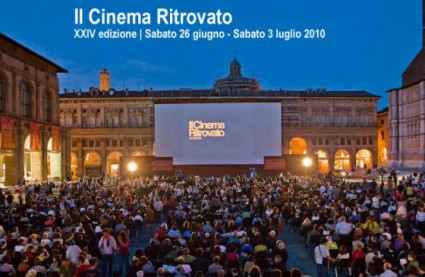
Bologna’s memorable days

http://www.cinetecadibologna.it/cinemaritrovato2010

I’m a bit late with this report on the upcoming Cinema Ritrovato festival at Bologna, but frankly the Bolognese are all too good at hiding the information on their website (come on guys, it’s not even listed on your calendar). Anyway, the festival takes place 26 June-3 July, and as usual the festival’s “memorable eight days” brings together a remarkable range of archive films from the silent and sound eras, maintaining its well-deserved reputation for catholicity, scholarship and quality presentation.

The major silent cinema elements are the traditional centenary survey of a year of cinema which has now reached 1910; the start of a retrospective of proto-auteur Albert Capellani; all of John Ford’s surviving silents; and cross-linking with the Women and Silent Screen conference, also taking place in Bologna.

Here’s the welcoming blurb from the festival site:

Bologna’s eight days and nights of cinephilic paradise from June 26 to July 3 will take place in four locations: the twin screens of the Cineteca’s Lumière cinema, one dedicated to silent cinema (which will feature images of life from exactly 100 years ago) and the other to sound, showcasing, for example, little known films of Italy as it was during the period 1945-48; the Arlecchino cinema, a haven for films requiring the size of a larger screen; and of course Piazza Maggiore, which will host splendid restorations like Visconti’s Il Gattopardo brought by the Film Foundation, or the new complete version of Lang’s Metropolis, for whom we can thank the Murnau Stiftung and Stiftung Deutsches Kinemathek, with the original score by Gottfried Huppertz, performed by the Orchestra of the Teatro Comunale di Bologna conducted by Frank Strobel. What a wonderful surprise it will be to rediscover the films that started it all – the first actuality films, street views, masterpieces by the Lumière brothers bristling with their newly restored beauty thanks to the Institut Lumière in Lyon.

Year 1910 of our history of cinema, compiled year after year film by film, includes encounters with bright stars like Mistinguett and Stacia Napierkowska, with a debuting Francesca Bertini and Léonce Perret, and cinematic explorations of real and fictional worlds in the first feature length films. In addition to this section, Mariann Lewinsky is also curating a retrospective – destined to grow over the years – about Albert Capellani, a director who contributed enormously to the development and worldwide success of Maison Pathé, one of the first auteurs and a crucial figure for the growth of the seventh art in connection with the other arts and the pursuit of photogénie.

The largest section is dedicated to John Ford. Just like the previous retrospectives on Josef von Sternberg and Frank Capra organized by Il Cinema Ritrovato, this section will feature all of Ford’s existing silent output (about twenty films from 1917), as well as some of his first sound films, including Pilgrimage (1933), a true masterpiece. 3 Bad Men (1926) will be shown in Piazza Maggiore with a new score by Timothy Brock to be performed by the Orchestra of the Teatro Comunale di Bologna. Joseph McBride, the author of the brilliant biography Searching for John Ford, will curate a special dossier on the director, and several great historians, friends of Il Cinema Ritrovato, will make their contribution as well.

Another important name in American cinema and festival protagonist, Stanley Donen, will be our guest this year, more than sixty years after his debut with On the Town and more than fifty years after the golden age of musical ended – after which Donen continued his career beautifully with his personal brand of elegant comedy (Charade, 1963, and Two for the Road, 1967). And of course the best known and loved of them all, Singin’ in the Rain (1952), will be shown in Piazza Maggiore.

Anni difficili, “Difficult years”, is the title of a section dedicated to Italian cinema from 1945-48: an intense, crucial (and yet largely unknown) period, full of incredible conflicts and uncertain victories – a time when two world systems were fighting over the soul and the economy of the country. The showing of films like Roma città libera (Marcello Pagliero, 1946), Il sole sorge ancora (Aldo Vergano, 1946) and Caccia tragica (Giuseppe De Santis, 1947) will be complemented by films made in other European countries at the time: They Made Me a Fugitive (Alberto Cavalcanti, 1947), Retour à la vie (Henri-Georges Clouzot, Jean Dréville, Georges Lampin, André Cayatte, 1949), Iris och löjtnantshjärta (Alf Sjöberg, 1946) and In jenen Tagen (Helmut Käutner, 1947).

As for the film world surrounding Chaplin, this year the spotlight is on Robert Florey, an eclectic, talented Frenchman in Hollywood who was the assistant director of Monsieur Verdoux. Though the larger part of his work was routine, Florey created films that were incredible for their experimental audacity and their "tender madness" much loved by Luis Buñuel: The Life and Death of 9413 – A Hollywood Extra (1928), a film version of Poe’s Murders in the Rue Morgue (1932) and The Beast with Five Fingers (1946).

The festival would not be the same without restorations of films left to the ravages of time sponsored by the World Cinema Foundation. Among the most anticipated a Fondation Pathé Archives restoration, Boudu sauvé des Eaux (Jean Renoir, 1932).

Just like at past editions, this year several “dossiers” will unearth rare or unseen materials relating to some of the greatest filmmakers: Fellini, Godard and Pasolini, letting viewers discover a whole world in the brief space of an hour.

The festival will be accompanied by a large exhibition about Fellini, Fellini. Dall’Italia alla luna, curated by Sam Stourdzé and promoted by the Cineteca and MAMbo-Museo d’Arte Moderna di Bologna. The exhibition will be on display in the museum until July, 25. The exhibition is a larger version of last year’s show in Paris. Drawings, posters, period illustrated magazines, scene and set images all make for a seductive journey through popular images and the filmmaker’s creative workshop.

Il Cinema Ritrovato’s program takes place this year after the international conference Women and the Silent Screen, now in its sixth year. Sponsored by Women and Film History International and organized by the Dipartimento di Musica e Spettacolo-Università di Bologna and the Cineteca di Bologna, the conference will be held from Thursday, June, 24 to Saturday, June 26, and will feature about one hundred lectures (in English) on different issues about women and silent film (see wss2010.wfhi.org). Our festival has always dedicated energy and time to presenting the feminine creative forces in silent film, with sections on divas and comedy actresses. This year we have started a new chapter about women in complicated stories of crime, revenge and espionage, introducing viewers to the powerful Astrea, charming Josette Andriot and beautiful Berta Nelson.

The festival also sponsors the Film Publishing Fair (Books, DVDs, Antiquarian and Vintage Materials) and Il Cinema Ritrovato DVD Award (7th edition). We would like to remind you that Il Cinema Ritrovato will host two seminars: the continuation of the Film Restoration Summer School / FIAF Summer School 2010 (deadline for submitting application is postponed to April 23rd) co-organized with the FIAF and ACE and with the support of the Media Plus Programme, and a workshop for European quality cinema exhibitors organized by Europa Cinemas and Progetto Schermi e Lavagne. Enrollment in each seminar requires separate registration, available on the website indicated below.

You are most cordially welcomed to the most memorable eight days of 2010.

Further information on the festival is on the site, in Italian, though there is no day-by-day programme (that I can find). Also worth seeking out on the site is a list of every film featured at the festival 1986-2009 (in Excel spreadsheet form) giving title, date, country and director, plus PDFs of festival publications and its DVD award winners 2004-2009. All wonderful stuff – once you can find it.

100 years of newsreels in Britain

Frame still from Pathé Gazette’s The Movie Cameramen’s Derby, released 7 September 1922, which shows a race between British newsreel cameramen (with their cameras) – available to view at www.britishpathe.com/record.php?id=19541

One hundred years ago, give or take a few days, a new kind of film appeared for the first time on British cinema screens. The Bioscope of those days took note of this interesting new development with this report:

There is no mistaking the smartness of Messrs Pathé, and their latest achievement — the production of a weekly cinematograph paper, The Animated Gazette — has just about beaten all records for the interest which it has awakened among the great B.P. [British Public]. The daily Press has been devoting considerable space to it, with the result that curiosity has been aroused, and people are now busily discussing the latest thing in moving pictures.

Briefly the idea is to incorporate the usual journalistic methods of writing into filming, and to portray, in lengths of about 80 odd feet, the chief items of interest that have happened during the week. Thus the illustrated newspaper is being superseded by The Animated Gazette, which depicts the actual scenes of contemporary history in living and moving reality.

Mr Valentia Steer, a well-known journalist, is editor of this moving picture periodical, and he has a staff of photo-correspondents, who are stationed in all the big cities of Europe, besides another staff at home. Last week’s news consisted of pictures of the cross-channel flight, Oxford University Eights’ trial, Peary at Edinburgh, Roosevelt at Cambridge, besides many interesting ‘glimpses’ from home and abroad.

This week’s contents bill announces motor-racing at Brooklands, the manouevres at Salisbury Plain, the departure of the Terra Nova, Chinese mission in Paris, quarrymen’s strike, Caruso in the street, Modes in Paris, and other ‘newsy’ films.

That the idea will catch on is undoubted, and it is perhaps not looking too far into the future to anticipate the time when the weekly Animated Gazette will become an indispensable ‘daily’.

The Bioscope, 9 June 1910

This piece announced the arrival of the British newsreel, in the form of Pathé’s Animated Gazette, edition no. 1 of which appeared at some point in the first week of June 1910. It wasn’t the first newsreel in the world – that honour generally goes to Pathé Fait-Divers (later Pathé Journal), launched in France in 1908. There has been film of news events ever since films had been invented, but they weren’t newsreels. Newsreels meant regularity of service, and that was dependent on a network of cinemas and an audience which could be guaranteed to come back to the cinema week after week. Before cinemas started to appear – the first ten years or so of film history – a film might be made of a news event, but it seldom could be presented as news, that is while the event was still current and with the report being understood as being part of a regular, always updated filmed news service. Cinemas supplied the loyal audience, and it is the audience that makes the news, because what is news to one person isn’t necessarily news to another – it all depends where you are, and where that news is coming from.

Pathé’s Animated Gazette main title card from 1915 (with British Pathé spoiler). Note the boast that it was reaching 20 million people (5 million is more likely for the UK) and the line about having been passed by the British Board of Film Censors – only in wartime were British newsreels subject to censorship

Pathé’s Animated Gazette was immediately recognised as an exciting innovation. It was a product of cinema, yet it had a clear relationship with newspapers. It gave a new social purpose to cinema-going. This new film form was called by a variety of names – animated newspapers, topicals etc.- but not as yet newsreels (that term didn’t begin to catch on until 1917 or so), and Pathé’s model was soon followed by Warwick Bioscope Chronicle (1910), Gaumont Graphic (1910), Topical Budget (1911), Eclair Journal and Williamson’s Animated News, all before the First World War. In the US there was Pathé’s Weekly (1911), Gaumont Animated Weekly (1912), Mutual Weekly (1912) and Universal’s Animated Weekly (1912); France added Gaumont Actualités and Eclair-Journal; Germany had Tag im Film (1911), Eiko-Woche (1913), Union-Woche (1913) and Messter-Woche (1914). Russia had Zerkalo voiny (Mirror of the World) (1914); Australia had Australasian Gazette.(Note by the way how the newsreels all emulated newspapers by taking on names like Gazette and Journal)

The form spread around the world, often as off-shoots of the French parent companies of Pathé and Gaumont. Filmed news became a product of the early film multinationals, and through means of international exchange, world news was screened in cinemas across the globe, though the time taken to transport film internationally lessened its value as news, and audiences expressed a strong preference for local news, on subjects that were news to them. ‘Foreign’ news often wasn’t news at all, in its timing or in how the audience viewed it.

The newsreels were released at regular intervals to match the pattern of cinema-going that people in their millions were starting to adopt. In Britain newsreels were very early on issued twice-weekly and stayed that way for five decades. In the US the distances were greater and so news tended to be issued weekly. Newsreels had become firmly established as part of practically cinema programme by the start of the First World War, and newsreels were to play a key part in informing audiences about how the war was progressing. Such was their importance that the British, French and American governments each took over or created a newsreel to act as a means to deliver officially sanctioned footage (i.e. propaganda) – respectively War Office Offical Topical Budget, Annales de la Guerre and Official War Review.

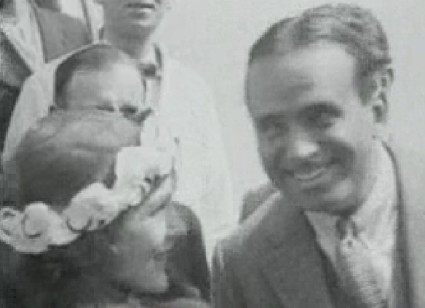
Mary Pickford and Douglas Fairbanks visit Britain, from Pathé Gazette issue 679, released 24 June 1920. Available to view at www.britishpathe.com/record.php?id=27815

In the 1920s newsreels built on these strong foundations and became an essential and popular element of the cinema programme. The average newsreel in the silent era ran for some 7-8 minutes and contained anywhere between four and eight stories, eached introdued by a title card with the story title and a short comment, and sometimes with further titles cut into the story as the newsreels increasingly sought to add commentary even before sound gave them their voice. The newsreels rapidly gained a repuation for light-hearted items, stunts and gimmicks, with a fascination for sport, royalty, pageantry, tradition and sensation. Oscar Levant notoriously summed up newsreels as being “a series of catastrophes ended by a fashion show”.

That’s unfair. Anyone who has looked at newsreels in any sort of depth will soon find that there was a lot more too them than fashion shows. The newsreels were acutely aware of what were the current topics of conversation (they were released after the daily newspapers, so the news agenda had been already set for them) and picked up on the personalities and issues of the day that audiences wanted to see covered with an astute eye. This propensity for the topical makes them an excellent barometer of contemporary social concerns, albeit usually sugared with that lightness of tone that the newsreels deemend necessary because they were, after all, in the entertainment business, and their audience had come to the cinema to be entertained.

The newsreels entertained, and that ultimately became the noose around their necks that condemned them. That however was in the future – our concern is with the silent era, and in the 1910s and 1920s the newsreels reigned supreme, and we cannot understand what silent cinema means if we do not take them into consideration. Indeed no other area of silent cinema is so well represented online as newsreels (such is their continuing commercial value).

Fortunately there is amply opportunity to consider them. The newsreels may have faded away in the 1950s and 60s, but their libraries live on, selling footage to television programmes. In the UK there are five major newsreel libraries and a great deal of what they hold has been made available online, either available to all or free at point of use for educational users. They are:

  • British Pathé
    Pathé operated a newsreel in Britain between 1910-1970. Its entire archive (3,500 hours) is freely available online, albeit with low resolution copies
  • ITN Source
    ITN holds the British Gaumont (1910-1959), Paramount (1929-1957) and Universal (1930-1956) newsreel libraries. A substantial amount of this is available on its site, included among other footage managed by ITN – go to the advanced search option and select ‘New Classics’ to narrow searches down to newsreels. The entire Gaumont collection is available in download form for UK higher and further education users only via Newsfilm Online
  • British Movietone
    The entire British Movietone News collection 1929-1979 is available for free, alongside non-Movietone silent material going back to the 1890s
  • BFI National Archive
    The BFI owns the Topical Budget (1911-1931) newsreel, examples of which are available on its Screenonline site (accessible to UK educational and library users only) and on its YouTube channel
  • Imperial War Museum
    The IWM holds service newsreels from the First and Second World Wars, a number of which are available through Film and Sound Online (UK higher and further educational users only)

These services has been covered by the Bioscope before now (see links below). As it is Pathé’s centenary, let’s finish with a few words about them. First of all, happy centenary! the Bioscope sends its congratulations on having achieved such a major milestone and still a significant commercial moving image presence. Pathé has changed hands several times down the years. Until a couple of years ago it was owned by the Daily Mail newspaper; now it is managed by venture capitalists.

http://www.britishpathe.com

For anyone who cares about newsreels, the British Pathé site is a mixed blessing. It is a wonderful window onto the past, the digitisation of the films having been originally funded by the Heritage Lottery Fund but kept on as a free service long beyond the original agreement with the HLF. But on the other side it has of late become a little soulless, disfigured by front page advertising, and dominated by an idea of news as gimmick and sensation, a lucky dip into the quaint ways in which our ancestors behaved rather than showing what the newsreel fundamentally was – a vehicle for the news.

One cannot get a sense of the Pathé newreels as newsreels i.e. as a set of stories released on a single reel, and for that it is necessary to cross-refer to the BUFVC’s News on Screen site (formerly the British Universities Newsreel Database) where you will find an almost complete record of issues for all British newsreels 1910-1979, together with background histories, biographies of those who worked in the newsreels, digitised documents, and links across to the British Pathé site. It is place to go if you appreciate newsreels for what they mean to the study of society and history. Newsreels matter – and the more we understand them the more we will get from viewing them.

Finding out more
These Bioscope posts have covered British newsreel collections and the use of online resources: British Pathe part one, British Pathe part two, Revisiting Pathe, Movietone and Henderson and Welcome to Newsfilm Online

Pathé editor P.D. Hugon wrote an informative booklet Hints to Newsfilm Cameraman (1915) with much information on how newsreels operated at that time. The online text has an important introduction by Nicholas Hiley.

British Pathé has a lively Twitter feed, drawing attention to exciting novelties they discover in their collection.

I’ve written lots about newsreels in the past. My history of the Topical Budget newsreel (1992) is long out of print (but you can get it dirt cheap second-hand), but there’s Yesterday News: The British Cinema Newsreel Reader (2002) which tells the history of British newsreels through texts contemporary and modern, and most recently I’ve an essay on newsreels in Richard Howells and Robert W. Matson’s Using Visual Evidence (2009).

3×3

This delightful short film doesn’t bill itself as being a silent film, but that’s what it is – exquisitely demonstrating wit and comic suspense through action, character and adroit choice of shot, and all wordlessly. It certainly has affinities with some of the comic masters of the silent era. The filmmaker is Nuno Rocha and his film, entitled 3×3 and made in 2009, has won awards at a number of festivals. It lasts just five minutes. Enjoy.

Lives in film no. 3 – Dan Leno

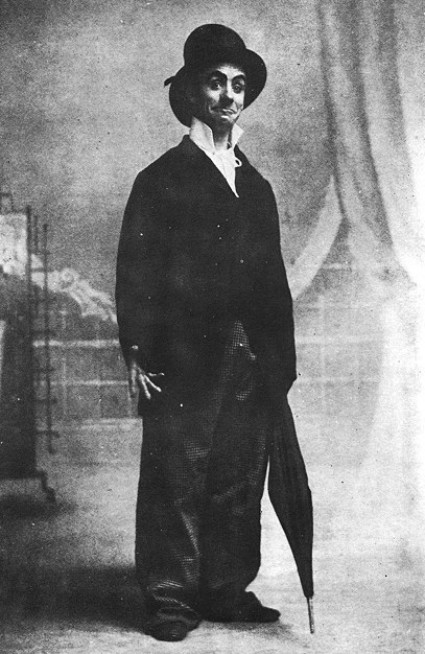
Dan Leno, from http://www.rfwilmut.clara.net/musichll/xleno.html

In 1921 Charlie Chaplin returned home to Britain to an ecstatic welcome. Touring his old London haunts, however, he found one shop-owner less than overawed by his worldwide fame. Chaplin went to a photographer’s shop on Westminster Bridge Road where he recalled seeing a framed picture of his comic idol, Dan Leno. It was still there. This conversation then followed:

My name is Chaplin … You photographed me fifteen years ago. I want to buy some copies.

Oh, we destroyed the negative long ago.

Have you destroyed Mr. Leno’s negative?

No, but Mr. Leno is a famous comedian.

Such is fame, as Chaplin notes. The man in the picture, Dan Leno, was for anyone of Chaplin’s generation the epitome of comedy. He was among the funniest and the most loved of comedians of the Victorian age, one whose career formed a bridge between the pantomime clowning of the Joe Grimaldi early-19th century era and the era of motion pictures that was to bring about the unprecedented fame of Leno’s successor as public favourite, Chaplin himself.

Dan Leno (1860-1904) was one of the greatest of all comedians. Born George Wild Galvin, the child of entertainers (as was Chaplin), he was raised in poverty in London, first trod the boards aged just four, and first rose to prominence by winning a world clog-dancing competition in Leeds in 1880. He made it to the main London stages by 1885, immediately acclaimed as a comic master, and soon established as a national favourite, particularly on account of his peformances in Drury Lane pantomimes. His artistry was built around an uncanny ability to mimic the trials and absurdities of everyday living. Leno excelled in making his comic characters as realistic as they were comic, products of an acute sense of human characteristics. As a railway guard, waiter, shop-walker, lodger, recruiting sergeant, swimming instructor or Widow Twankey (he was the archetypal pantomime dame), Leno’s befuddled demeanour reflected life’s puzzlements in a form that all could recognise and delight in. Max Beerbohm wrote of him:

Dan Leno’s was not one of those personalities which dominate us by awe, subjugating us against our will. His was of that other, finer kind — the lovable kind. He had, in a higher degree than any other actor I have ever seen, the indefinable quality of being sympathetic. I defy anyone not to have loved Dan Leno at first sight. The moment he capered on, with that air of wild determination, squirming in every limb with some deep grievance that must be outpoured, all hearts were his.

Leno’s humour was grounded in character observation and word-play, but as with all great comedians it was a shared understanding with his audience that made him special. He pinpointed what Beerbohm identified as “the sordidness of the lower middle class, seen from within” while making that “trite and unlovely material … new and beautiful”. How we laugh at ourselves is how Dan Leno made us laugh.

Dan Leno is now the subject of a new biography, the first since 1977. Barry Anthony’s The King’s Jester: The Life of Dan Leno, Victorian Comic Genius is published by I.B. Tauris and it is a delight from start to finish. Anthony (previously co-author with Richard Brown of A Victorian Film Enterprise: The History of the British Mutoscope and Biograph Company and a fine booklet on the Kinora) is well-known among a small coterie of music hall historians for his meticulous research and encyclopaedic knowledge. He also writes beautifully. The research is worn lightly, the observations are acute, the characters stand out vividly, and the material is handled in an engaging style that makes the Victorian music hall era come alive. There is much on the Victorian music hall in general, so that the book serves as a valuable general history as well as biography. It is particularly good at giving you the essence of Leno’s performances (and those of others), as if a motion picture camera had been there.

But, as Anthony points out, towards the end of Leno’s career, the motion picture cameras were there. Leno’s later career coincided with the rise of mass media as means to package and spread fame, and Leno was filmed on several occasions. Interestingly, the films that were made of Leno for the most part did not attempt to record his performances but rather focussed on his celebrity. There was a surprising number of films made of Leno – at least a dozen. But the reason why he seldom turns up in film histories is that only one of these films survives, and that in a non-film state.

Leno was first filmed on 23 June 1899 on a trip by the music hall society the ‘Water Rats’ to Box Hill in Surrey. Impresario A.D. Thomas had them filmed on the road to Mitcham travelling in coaches (‘The Rats’ off on a Picnic), at play befor a crowd of spectators (‘The Rats’ at Play) and picnicing (‘The Rats’ at Dinner). Alongside Leno were such notables as Herbert Campbell, Joe Elvin, George Robey, Will Evans and Harry Randall. A few days later Thomas filmed the Music Hall Sports at Herne Hill in London, the sports being interspersed with comic performances intended to raise money for the Music Hall Benevolent Fund. Dan Leno featured in Burlesque Indian Attack on Settlers’ Cabin, Dan Leno’s Attempt to Master the Wheel (in the character of his famous role of Mrs Kelly) and Burlesque Fox Hunt. All titles were subsequently included in the Warwick Trading Company catalogue.

Leno was filmed at other charity events. Birt Acres filmed Dan Leno’s Cricket Match in July 1900 at another mix of charity and sports, where Leno again took a turn on a bicycle. A year later, in September 1901, he was back on the cricket field (at Stamford Bridge) for Warwick’s Dan Leno’s Day Out, paired with Dan Leno, Musical Director, where he mock-conducted the Metropolitan Police Band in ‘A Little Bit Off the Top’. A few days later he appeared before the 70mm camera of the British Mutoscope and Biograph Company for Dan Leno’s Record Score, which showed him in comic argument with a wicket-keeper (for photographs from the day in Black and White Budget see the excellent Arthur Lloyd website). Anthony records that the film was exhibited alongside genuine cricket film of C.B. Fry and Ranjisinhji. Another Biograph film was Mr Dan Leno, Assisted by Mr Herbert Campbell, Editing ‘The Sun’ (1902) in which Leno and the frequent partner in pantomime, a comic promotional film for a journal run by the notorious Horatio Bottomley. This was the only film to show an acted peformance from Leno, apart from Bluebeard (1902), an extract from a Drury Lane pantomime in which Leno played Sister Anne, produced by Warwick.

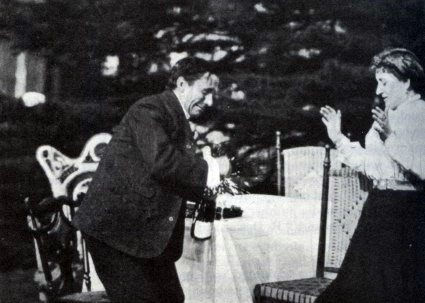
Dan Leno and his wife Lydia in The Obstinate Cork (1902), from The King’s Jester: The Life of Dan Leno, Victorian Comic Genius

Biograph produced the only film of Leno that exists today. Its 70mm products were often issued in flip-card or flip-book form through a variety of devices for viewing at seaside arcades (through the Mutoscope) or in the home (through the Kinora). Biograph made two films in 1902 of Leno with his family in the garden at their home in Clapham, one of which showed Leno and his wife Lydia struggling to open a bottle of champagne and eventually resorting to a giant property axe to do so. The Obstinate Cork survives – in private hands – as a Kinora reel (i.e. a set of flip-cards for exhibiting in a Kinora) and forms the only moving image that exists of the great comedian.

As said, most of these films did not present Leno in performance but rather Leno the celebrity, seen clowning in public, playing up to his popular persona. They crossed the barrier between fiction and non-fiction. If any were to be discovered they wouldn’t so much show us Leno’s art as his popularity, and that would be so precious in itself. Leno the comic giant belonged to his time. Nothing dates so remorsely as humour. What makes one generation roll in the aisles makes the succeeding generation shrug its shoulders or wince with embarassment. What matters for our understanding of the history of comedy is not whether we would find Grimaldi, Leno or Chaplin funny today (though we might) but that we appreciate just what they meant to the people of their time. This is what Barry Anthony’s book achieves so well. It tell us enough to give a good idea of Leno’s comedy, but still more it shows us how key he was to his times, how people identified with his humour, how much he was of his times and yet transcended his times. The films that were made of him were not intended to replicate his act but to reflect the profound affection with which he was held by millions.

Dan Leno suffered throughout his professional life from a series of mental and physical breakdowns, brought on by the pressures of huge popularity. He died in 1904, aged just 43.

Finding out more
Leno made a number of sound recordings, and unlike his motion picture legacy, all of these survive. Recordings from 1901 and 1903 can be heard Music Hall Perfomers site, while his famous number ‘The Grass Widower’ can be heard on YouTube. Peter Preston has written an interesting piece in The Guardian comparing Leno’s passing fame to that which endures for Marlon Brando – as unlikely a pairing as one could imagine. Paul Morris’ essay on the English Music Hall site evocatively sums up Leno’s art. Finally, Leno’s comical pseudo-autobiography, Dan Leno Hys Booke (1899) is available online from the Internet Archive.

Sounds and Silents

http://www.birds-eye-view.co.uk/kingsplace

Sounds and Silents is an off-shoot of the annual Bird’s Eye View festival of women filmmakers. The strand brings together classic silent films starring iconic actresses and innovative musical accompaniment by female artists.

Its latest manifestation is Sounds and Silents at King’s Place, bringing silents to one of London’s latest art venues. Four films are to be screened 27-29 May, and here are the programme details:

The Temptress with original live score from Natalie Clein
Dir. Fred Niblo, USA 1926
Hall One, Thur May 27, 7.30pm

Narcissistic Elena (Greta Garbo) drives every man she meets to despair. One of her victims, Manuel Robledo tries to escape, but this time Elena is in love and she follows him from Paris to his native Argentina.

Natalie Clein

‘Clein plays everything with passion’ – The Times

Natalie Clein’s exceptional musicality has earned her a number of prestigious prizes including the Classical Brit Award for Young British Performer of 2005, the Ingrid zu Solms Cultur Preis at the 2003 Kronberg Academie, and the BBC Young Musician of the Year aged just 16.

My Best Girl with original live score from Elysian Quartet
Dir. Sam Taylor, USA 1927
Hall One, Fri May 28, 7.30pm

Maggie (Mary Pickford) falls in love with Joe, her new colleague in the stock room, unaware that he is the son of the department store owner working undercover to prove his business skills.

Elysian Quartet

‘Feisty boundary pushers, four supremely talented classical musicians’ – Metro

The Elysian Quartet is one of the UK’s most innovative young ensembles. They have worked with artists as diverse as virtuoso beat-boxer Killa Kela, jazz pianist Keith Tippett, and experimental electronic composer Simon Fisher-Turner.

I Don’t Want to be a Man! with original live score from Zoe Rahman / The Danger Girl with original live score from Juice
Dir. Ernst Lubitsch, Germany 1919 / Dir. Clarence G Badger, USA, 1916
Hall One, Sat May 29, 7.30pm

– Ossi’s father hires a guardian to educate his rebellious daughter. Escaping from house arrest dressed as a man, Ossi begins to investigate whether life is more liberated this way.

– When vampish Helene (Gloria Swanson) uses her charms on Bobbie, Gloria breaks up the pair by disguising herself as a man to seduce Helene.

Zoe Rahman / Juice

‘One of the finest young pianists in Europe’ – The Observer

– Zoe Rahman has firmly established herself as one of the brightest stars on the contemporary jazz scene. Zoe has recorded four critially acclaimed albums, her second ‘Melting Pot’, wasnominated for the 2006 Mercury Music Award and was voted ‘Jazz Album of the Year’ at the 2006 Parliamentary Jazz Awards.

– Juice is an experimental vocal trio specialising in vibrant, theatrical performances commissioned countless new works. They draw on world music, jazz, folk and pop and have been featured on BBC Radio 3 and Classic FM and Resonance FM.

King’s Place (“a creative hub, a dining venue, a conference and events centre, and office complex”) is at 90 YorK Way London N1, close by King’s Cross and St Pancras stations. More details, including tickets, from the Bird’s Eye View site.

Louis

http://www.louisthemovie.com

Louis is a new silent film about Louis Armstrong. It is directed by Dan Pritzker (a rock musician and the 246th richest man in America, no less), photographed by the great Vilmos Zsigmond, and stars Anthony Coleman, Jackie Earle Haley and Shanti Lowry. Being a silent film in form as well as spirit, it requires live musical accompaniment, and the film premieres in five US cities this August with music provided by trumpeter Wynton Marsalis, pianist Cecile Licad and a 10-piece all-star jazz ensemble. The music will be a mixture of a Marsalis score primarily comprising his own compositions, and Licad playing the music of 19th century American composer Louis Gottschalk. Marsalis says of the experience:

The idea of accompanying a silent film telling a mythical tale of a young Louis Armstrong was appealing to me. Of course, calling it a silent film is a misnomer – there will be plenty of music, and jazz is like a conversation between the players so there’ll be no shortage of dialogue.

The film’s website supplies this plot summary:

LOUIS is an homage to Louis Armstrong, Charlie Chaplin, beautiful women and the birth of American music. The grand Storyville bordellos, alleys and cemeteries of 1907 New Orleans provide a backdrop of lust, blood and magic for 6 year old Louis (Anthony Coleman) as he navigates the colorful intricacies of life in the city. Young Louis’s dreams of playing the trumpet are interrupted by a chance meeting with a beautiful and vulnerable girl named Grace (Lowry) and her baby, Jasmine. Haley, in a performance reminiscent of the great comic stars of the silent screen, plays the evil Judge Perry who is determined not to let Jasmine’s true heritage derail his candidacy for governor.

Pritzker was inspired to make Louis while he was working on a screenplay for a feature film about Buddy Bolden. He went to a screening of Chaplin’s City Lights with the Chicago Symphony, calling it “without a doubt the best movie experience I ever had”. He decided to produce a film that would follow on historically from where Bolden ended, and to make it in the early film style of Louis Armstrong’s childhood. His original idea to produce a short, black-and-white silent with Marsalis’ music to accompany Bolden, under the title The Great Observer, but the idea grew – and gained colour. Bolden, which is not a silent film, will be released in 2011.

Louis is playing at these American cities in August:

San Francisco Silent Film Festival

Norma Talmadge in The Woman Disputed (1928), from http://www.silentfilm.org

This year’s San Francisco Silent Film Festival takes place 15-18 July at the Castro Theatre, and what is quite frankly a sensational programme has just been announced. The biggest draw is going to be the new version of Metropolis, but the programme is choc-a-bloc with classics everyone should see, rediscoveries, surprises, and some of the funniest comedy short films ever made. Here are the details:

Thursday, July 15th

The Iron Horse (USA, 1924, 150 mins, 35mm)
Directed By: John Ford
Cast: George O’Brien, Madge Bellamy
Accompanied By: Dennis James
Set in mid-19th century America, The Iron Horse is the silent era’s version of How the West Was Won, weaving its themes of romance and history around the story of the building of the first transcontinental railway. This glorious print is the only surviving 35mm print of the American version.

Friday, July 16th

Amazing Tales from the Archives 1 (60 mins)
Lost Films from the Silent Era: Presentations by Joe Lindner of the Academy of Motion Picture Arts and Sciences, and Paula Félix-Didier and Fernando Peña of Museo del Cine, Buenos Aires (the archivists responsible for finding the lost Metropolis footage).
Accompanied By: Donald Sosin

A Spray of Plum Blossoms (China, 1931, 100 mins, 35mm)
Directed By: Bu Wancang
Cast: Ruan-Lingyu, Jin Yan
Accompanied By: Donald Sosin
One of the most prolific Chinese directors of the silent era, Bu Wancang based this film on William Shakespeare’s “Two Gentlemen of Verona,” setting the action in China, circa 1930 and casting China’s favorite on-screen couple, Ruan Ling-yu and Jin Yan. Like any Shakespeare comedy, Plum Blossoms is replete with star-crossed lovers, mistaken identity, and a satisfying happy ending. By situating the play in the ’30s-era Chinese army, the “gentlemen” of the Shakespeare’s title are the film’s officers, the duke is a warlord, and his daughter’s ladies-in-waiting are military police!
Presented with both Mandarin and English intertitles.

Rotaie (Italy, 1929, 74 mins, 35mm)
Directed By: Mario Camerini
Cast: Käthe von Nagy, Maurizio D’Ancora
Accompanied By: Stephen Horne
One of the most important Italian movies of the late silent period, Rotaie is the story is of two young lovers, very poor and on the brink of suicide, who come into a bit of temporary good luck. Finding a lost wallet in a train station, the lovers hop a train to two thrilling weeks of high living. The film’s exquisite style is influenced by the expressionism of German master F.W. Murnau. Presented with Italian intertitles accompanied by a live English translation.

Metropolis (Germany, 1927, 148 mins, Digital)
Directed By: Fritz Lang
Cast: Rudolf Klein-Rogge, Brigitte Helm
Accompanied By: Alloy Orchestra
When Fritz Lang’s masterpiece debuted in Berlin in January, 1927, the sci-fi epic ran an estimated 153 minutes, but in order to maximize box office potential the German and American distributors cut the film to 90 minutes for its commercial release. For decades crucial scenes from the film were considered lost. In 2001, the Munich Film Foundation assembled a more complete version with additional footage from four contributing archives, and Metropolis had a premiere revival at 124 minutes (widely believed to be the most complete version that contemporary audiences could ever hope to see). But, in 2008 archivists from the Museo del Cine in Buenos Aires made a spectacular discovery—a 16mm dupe negative of Metropolis that was considerably longer than any existing print! That discovery led to this remarkable restoration and Metropolis can now be shown in Fritz Lang’s original—25 minute longer—complete version. Digital print from Kino International. Special Guests: Paula Félix-Didier and Fernando Peña of the Museo del Cine, the pair who found the lost footage!

Saturday, July 17th

The Big Business of Short, Funny Films (62 min)
The Cook (USA, 1918, 22 min), Pass the Gravy (USA, 1928, 22 min), and Big Business (USA, 1929, 18 min)

Variations on a Theme: Musicians on the Craft of Composing and Performing for Silent Film (70 mins)
This special moderated program will shine a light the process of composing scores for silent films. Pianists Donald Sosin and Stephen Horne will take part, along with organist Dennis James, Mont Alto Motion Picture Orchestra, Alloy Orchestra, and Swedish musician and composer Matti Bye. Chloe Veltman, Bay Area culture correspondent for The New York Times and producer and host of public radio’s VoiceBox, will moderate.

The Flying Ace (USA, 1926, 65 mins, 35mm)
Directed By: Richard E. Norman
Cast: Lawrence Criner, Kathryn Boyd
Accompanied By: Donald Sosin
Richard E. Norman was among the first to produce films starring African-American actors in positive roles. Between 1920 and 1928, the Norman Film Manufacturing Co. produced six feature-length films as part of a movement to establish an independent black cinema at a time when blacks were demeaned in mainstream movies. The Flying Ace is the only Norman film that survives and its story of a crime-fighting ace pilot is still a crowd-pleaser! 35mm print from Library of Congress.

The Strong Man (USA, 1926, 75 mins, 35mm)
Directed By: Frank Capra
Cast: Harry Langdon, Priscilla Bonner
Accompanied By: Stephen Horne
This Harry Langdon comedy will be shown in a pristine print from Photoplay Productions in England. Frank Capra’s second feature, this effervescent slapstick has Langdon as Paul Bergot, a mild-mannered Belgian soldier who goes on the road with German strongman Zandow the Great after World War I. When they get to the States, Paul searches for (and finds) his American sweetheart pen pal.

Diary of a Lost Girl (Germany, 1929, 116 mins, 35mm)
Directed By: Georg Wilhelm Pabst
Cast: Louise Brooks, Kurt Gerron
Accompanied By: Mont Alto Motion Picture Orchestra
Diary of a Lost Girl represents the second and final work of one of the cinema’s most compelling collaborations: G.W. Pabst and Louise Brooks. Together with Pandora’s Box, Diary confirmed Pabst’s artistry as one of the great directors of the silent period and established Brooks as an “actress of brilliance, a luminescent personality and a beauty unparalleled in screen history.” (Kevin Brownlow) This version has been mastered from a restoration of the film made by the Cineteca di Bologna with approximately seven minutes of previously censored footage. 35mm print of Kino International.

Häxan: Witchcraft Through the Ages (Sweden , Denmark, 1922, 90 mins, 35mm)
Directed By: Benjamin Christensen
Cast: Maren Pedersen, Clara Pontoppidan, Elith Pio, Oscar Stribolt
Accompanied By: Matti Bye Ensemble
Benjamin Christensen’s legendary film uses a series of dramatic vignettes to explore the scientific hypothesis that the witches of the Middle Ages suffered the same hysteria as turn-of-the-century psychiatric patients. But the film itself is far from serious—instead it’s a witches’ brew of the scary and darkly humorous. 35mm restored, tinted print from the Swedish Film Institute.

Sunday, July 18th

Amazing Tales from the Archives 2 (60 mins)
Presentations by Annette Melville (National Film Preservation Board) and Mike Mashon (Library of Congress, Moving Image Section)
Accompanied By: Stephen Horne
Presentations by Annette Melville (National Film Preservation Board) and Mike Mashon (Library of Congress, Moving Image Section)

The Shakedown (USA, 1929, 70 mins, 35mm)
Directed By: William Wyler
Cast: James Murray, Barbara Kent, Jack Hanlon
Accompanied By: Donald Sosin
Restored to 35mm by George Eastman house, The Shakedown is a superb action-drama about a boxer whose life changes when he meets up with an orphan boy. Director William Wyler is most celebrated for his talkies (The Best Years of Our Lives, Ben Hur, Funny Girl) and this uplifting tale is a splendid introduction to the master’s early career. Beautiful camerawork, fast-paced editing, and remarkable effects make this a riveting feature. Leonard Maltin will interview the children of director William Wyler onstage.

Man with a Movie Camera (USSR, 1929, 70 mins, 35mm)
Directed By: Dziga Vertov
Accompanied By: Alloy Orchestra
Considered one of the most innovative and influential films of the silent era. Startlingly modern, this film demonstrates a groundbreaking style of rapid editing and incorporates innumerable other cinematic effects to create a work of amazing power and energy. This dawn-to-dusk view of the Soviet Union offers a montage of urban Russian life, showing the people of the city at work and at play, and the machines that endlessly whirl to keep the metropolis alive. Vertov’s masterpiece employs all the cinematic techniques at the director’s disposal — dissolves, split-screens, slow motion, and freeze-frames — to produce a work that is exhilarating and intellectually brilliant.

The Woman Disputed (USA, 1928, 110 mins, 35mm)
Directed By: Henry King, Sam Taylor
Cast: Norma Talmadge, Gilbert Roland
Accompanied By: Stephen Horne
This splendid romance is a true discovery, starring the extraordinary Norma Talmadge as a goodhearted streetwalker who is coveted by Austrian and Russian rivals. “I have just seen The Woman Disputed and it’s a remarkable piece of filmmaking. The plot takes Maupaussant’s Boule de Suif to extremes, but it succeeds so well as a brilliant piece of film craft that it MUST be brought back to life.” (Kevin Brownlow).

L’Heureuse mort (France, 1924, 83 mins, 35mm)
Directed By: Serge Nadejdine
Cast: Nicolas Rimsky, Lucie Larue
Accompanied By: Matti Bye Ensemble
This remarkable comedy stars Nicolas Rimsky as Parisian dramatist Théodore Larue whose latest premiere is a disaster. His reputation gone, Larue takes a sea voyage, during which he is swept overboard in a storm and lost. The press and the literary world react with an abrupt revaluation of his work, elevating him to the stature of France’s greatest dramatist. His widow finds herself in possession of a hugely valuable literary property… At which point, Larue — inopportunely — returns home. But, dramatist above all, he decides to masquerade as his colonialist brother Anselme, while industriously turning out posthumous works by Théodore. But then the real Anselme turns up with his Senegalese wife… Beautiful 35mm print from the Cinémathèque Française. Presented with French intertitles accompanied by a live English translation.

The festival website is choc-a-bloc itself with things to explore, quite apart from standard stuff like ticketing details. Every film is illustrated, well described, and comes with links to the IMDB, biography of the musician, recommendations for other film like it in the festival (if you like L’Heureuse mort they suggest you try out The Cook), and chances to mark your favourites through Twitter, Digg and such like. You can view the programme by date, title or musician, follow the very active festival blog, catch up on news from the festival, read articles from past festival programmes, and more.

All in all it looks like quite some four days. The Bioscope particularly recommends The Shakedown, Pass the Gravy and (because it has a particular fondness for silent Shakespeare) A Spray of Plum Blossoms – a pleasant surprise to see that rather delightful curio included in the programme. Lucky all you who can get there.

The Brand Blackmail

Blackmail

Last year Neil Brand‘s orchestral score for the silent version of Alfred Hitchcock’s Blackmail was premiered (and much acclaimed) at Il Cinema Ritrovato, Bologna in July 2008. Happily there is going to be a further outing for the score, as film and music are to feature at the Barbican in London on 31 October 2010. The BBC Symphony Orchestra will be conducted by Timothy Brock, and tickets can now be booked from the Barbican site. As said before, this is probably the first full orchestral score to be written for a British silent fiction film since the 1920s (The Battle of the Somme, a documentary feature, received the orchestral treatment at the Royal Festival Hall in 2006).

For an extract from the score, photos of the Bologna screening, and extracts from reviews, see the Blackmail page on Neil’s personal site.

And there’s more. As regular readers will know, Neil is progressively building up a further reputation as a radio dramatist, and on 27 and 28 May (each at 14:15) BBC Radio 4 will be broadcasting Waves Breaking on a Shore, a two-part play about early cinema, Jewish culture, nationalism and radical politics in London’s East End, co-written by Neil and Michael Eaton. The two parts will be broadcast in the Afternoon Play slot and will be able to be heard live on the Radio 4 site and – one trusts – for a week thereafter on iPlayer (if you are in the UK).

I’ve read it and I warmly recommend it (and if it ends up mentioning Walter Gibbons’ Phono-Bio-Tableaux, then I contributed three words to it as well).

The art of the benshi

Here’s an interview from the Japanese Times with Midori Sawato, best-known of the small band of voice artists who keep alive the art of the benshi. There are around ten modern benshi in Japan, who continue the tradition of adding live narration to silent films, which was the standard manner in which silent films were exhibited in Japan up to the late 1930s, when – at its peak – there were some 7,000 such benshi in employment. The benshi would be positioned alongside the screen and take on the multiple roles, accompanied by live music, and putting their particular personality onto the film entertainment. Sawato gives around 100 such shows per year.

Sawato has been featured here before, as she is main voice artist featured on Digital Meme’s Talking Silents series of Japanese silents with benshi narration, reported on here. In the interview (which takes a couple of minutes before she gets to silent films) she describes how she was working in publishing in 1972 when she went to a silent film narrated by master benshi Shunsui Matsuda, one of a number of celebrated benshi still active. She became so engrossed by the art that she became his apprentice, making her debut with Chaplin’s The Rink. One of the interesting aspects of the interview is the realisation that benshi narrate for non-Japanese silents as well as Japanese – which is of course how it was during the silent era.

The interview covers how she learned the art (mostly by listening), how she conveys different characters, and her thoughts about the importance of silent film as a means to preserve history and culture. There’s also the oblique admission that she continues to perform to the films despite relatively small audiences, believing that it is good work to be doing whether the audience be large or small. It’s a noble activity.

The video serves as my means to introduce The Bioscope on YouTube. I’ve set up a channel, or playlist, on YouTube which lists almost all of the videos featured on The Bioscope since its inception in February 2007. I say almost all, because some videos have been taken down since then, and some have come from other sites (such as Vimeo). But it’s most of them, and I think they make interesting browsing. I’ll continue to add each new video to the channel as they are featured on the blog. The Bioscope on YouTube is now a link on the right-hand column of this site, alongside our other satellite sites, The Bioscope on Flickr (images featured on or associated with the blog), The Bioscope Bibliography of Silent Cinema (selected from the British Library catalogue, still ongoing), The Bioscope on Twitter (a feed from blog posts only), and Urbanora’s Modern Silents (another YouTube playlist, with some overlaps with the new channel).