Alternative music

Now this is something quite novel. Ben Model (left) is a respected silent film accompanist, probably best known for being his regular live performances at the Museum of Modern Art and for New York’s regular Silent Clowns film series. He has now come up with altscore.com, a download service providing alternative scores for silent films currently available on DVD. The scores are available as MP3 files, which (after paying through PayPal) you can download to your hard drive, then burn to CD, iPod or whatever. Put in your DVD, then start the MP3 file and following the synching instructions. Easy.

Scores currently are available for The Dragon Painter, The Forgotten Films of Roscoe “Fatty” Arbuckle, The Man from Beyond, Terror Island, Sherlock Jr., and Beyond the Rocks, with most priced at $3.95. There is a ‘freebie-per-month’ too (currently The Dragon Painter, the Sessue Hayakawa drama recently released by Milestone).

There is an ingenious bit of cheek about this whole exercise, but the more you think about it the smarter it is. I don’t know what the DVD producers think, but they are not going to lose anything by it. One or two of the original accompanists on those DVDs might feel a bit miffed. As for select group of punters, I suspect they are going to welcome the opportunity for choice. The beauty of experiencing silent films live is that you never encounter the same film twice, because the (generally) improvised score is different every time. Once you’ve bought the DVD you have just one film. Altscore introduces a small element of variety, based on an understanding that the silent film is a protean beast that, ideally, should never be the same film twice.

But we should not stop here. I’ve been thinking lately of creative ways in which music for silent films can be made available, and I’d like to see something done with scores that not only do you download but which you can edit and create for yourself. This could be an interesting element of a DVD release (perhaps with a schools/educational element), supplying the user with film and elements of music which is true VJ fashion they could then mix to create their own silent film accompaniment. This has already been done. Some years ago the BFI’s Education department produced Backtracks, an innovative CD-Rom with films clips with audio files for schoolchildren to experiment with blending the images with different kinds of music background (Neil Brand was involved). The BFI’s Creative Archive, which includes silent films clips, encourages you to remix and republish the downloadable films as you wish, under special licence. And recently the jazz trumpeter Dave Douglas, whose Arbuckle-inspired album Moonshine has been praised here already, is offering you the chance to download the separate tracks for the title tune of the DVD as uncompressed WAV files, along with the Arbuckle/Keaton film of that title, to remix as you see fit. I’ve downloaded the file and can play the tracks individually (it requires WinRAR to extract the files, which you can download as trial software) though I’ve not been smart enough yet to mix the results (“a child of five could do this – someone send for a child of five”). But the concept is a grand one. Let’s have more such interaction between the user and the artist – the tools are there.

Filmed by Curtis, directed by the Kwakwaka’wakw

Billboard for In the Land of the Head Hunters, from http://www.curtisfilm.rutgers.edu

In the Land of the Head Hunters (1914) is a remarkable, anomalous and much-misunderstood film. It was made by Edward S. Curtis (1868-1952), the renowned photographer of Native American life, in the hopes of attracting funds to support his North American Indian book series (the series, completed in 1930, would eventually run to twenty volumes). His chief benefactor, J.P. Morgan, had died in 1913, and it seemed a good idea to create a dramatic work which would appeal to the millions that were by then flocking to the cinema.

Note the term ‘dramatic work’. In the Land of the Head Hunters has gone down in rather too many film histories as a documentary endeavour, and one which falsified reality by getting the Kwakwaka’wakw, or Kwakiutl, people of British Columbia to enact customs that they no longer practiced (not least, head hunting), and to cheapen things further by spinning a love story in the hopes of attracting an audience. As the impressive, indeed almost dauntingly thorough and knowledgable website Edward Curtis meets the Kwakwaka’wakw states:

Since the 1970s, Curtis’s film has been treated as a documentary, adorning the halls of natural history and anthropology museums and being criticized for its staging of savage scenes from a “pre-contact” past as if they were part of the everyday life of contemporary tribal communities (as was also the case with his photography). Yet the film was intended as an innovation in feature film—one meant to stand out in the already crowded field of popular Westerns or “Indian Pictures” of the time—because of its exclusive use of “authentic” Native actors, its on-location shooting, its dynamic camera work, its spectacular color tinting and toning, and its ambitious musical score. The film truly represents an active, artistic collaboration between two dramatic traditions: the rich Kwakwaka’wakw history of staged ceremonialism and the then-emergent mass-market colossus of American narrative cinema.

The website has been created to complement a restoration of the film, which is about to start doing the rounds of American venues. In the Land of the Head Hunters was not the financial success that Curtis had hoped, despite glowing reviews, and it soon disappeared from view. In 1947 a single, incomplete copy was rescued from being binned as rubbish and was donated to the Field Museum, Chicago. A re-edited version of this was released in 1974 as In the Land of the War Canoes, with a new soundtrack recorded by members of the Kwakwaka’wakw. More material also turned up at the UCLA Film & Television Archive, and a copy of the original orchestral score ended up at the Getty Research Library. The present resotration has brought all of this material together, in the hands of project co-ordinators Brad Evans and Aaron Glass.

The website currently makes available a handful of clips of the unrestored version, with the promise of clips from the restored version to follow soon. The remainder of the website explains in incisive detail the film’s history, restoration, score, images and above all its relatation to and reflection of Kwakwaka’wakw culture. It is significant that in giving the history of the film’s production the site reverses the usual narrative by relating things from the Kwakwaka’wakw perspective. From this point of view, the Kwakwaka’wakw had significant control over the film’s production – agreeing to its being made in the first place, vetoing inauthentic scenes, while actively encouraging scenes which recreated customs that were on the wane or archaic in part through the assimilationist policies of the Canadian government. The film therefore became an important means for their cultural self-expression.

So to look on In the Land of the Head Hunters as either drama or documentary is merely to hold up both terms for their inadequacy. The film used the tools of the cinema to express a collaboration between two cultures, to document through drama. This is not to say that it is not a problematic film – that sensationalist title alone betrays Curtis’ muddled sympathies. But for a cinema where ‘cowboys and indians’ were predominant, any tale which put the native people (there are no white performers in the film) and the commemoration of a culture first was radical and affirmative. No wonder it failed at the box office.

The restored version of In the Land of the Head Hunters recives its premiere at the Getty Research Centre on 5 June 2008, with the score performed by the UCLA Philharmonia. Various screening dates are then in place for June and November 2008, with more to follow.

To find out more about Edward S. Curtis and the North American Indian project, visit the Library of Congress’ excellent American Memory exhibit, which reproduces Curtis’ famous photographs volume by volume.

Alice, Cleo, Dorothy, Lois and Ruth

http://www.kino.com

More DVD releases, though in this case it is the DVD release (22 April) of titles previously only available on videotape. Kino is issuing three DVDs of silent films made by American women directors, available singly or bundled as ‘First Ladies‘. Kino claims that “the mid-1910s was a virtual golden age for women directors, with over a dozen women working behind the camera.” ‘Golden Age’ might seem to suggest an era of unfettered opportunity and creative expression, which was hardly the case. No woman was able to get behind the camera without a tough struggle, but nevertheless there were proportionately more women directors at this period than for many decades thereafter, and enough survives for us to value a distinctive and often clearly feminist body or work.

First up is the double-feature The Ocean Waif (1916), directed by Alice Guy-Blaché and 49-17 (1917), written and directed by Ruth Ann Baldwin. Alice Guy (right) or Alice Guy-Blaché (she married cameraman/ producer Herbert Blaché) is arguably the most notable of early women filmmakers; certainly one whose career has been championed in some quarters to the point of myth. She was taken on as Léon Gaumont’s secretary in 1897, and swiftly became head of film production at Gaumont, producing hundreds of short films (including proto-sound films). She moved to America in 1907 when her husband was made head of Gaumont’s office in New York. She returned to filmmaking in 1910 for her own company, Solax, before becoming an independent filmmaker, and it was during this period that she made The Ocean Waif for William Randolph Hearst’s International Film Service. Kino describes it as “a romantic story, plenty of pathos but no brutality, a likeable hero and an innocent young woman, and a suspenseful plot with a dramatic and happy ending”. It is one of the few films of hers from this period that survives. She carried on directing with moderate success throughout the teens, but her career petered out after her divorce in 1922, after which she returned to obscurity, only to be rediscovered in old age and awarded the Legion d’Honneur by a grateful French government.

The American Ruth Ann Baldwin was a journalist turned screenwriter, film editor and director. 49-17 is a parody Western, starring Jean Hersholt. It was her only feature (she directed several two-reelers), though apparently it was a hit, and the remainder of her film credits are for scriptwriting.

Lois Weber

Baldwin worked for Universal studios, which seems to have been more encouraging of women directors than its rivals. It was home to Cleo Madison, actress turned director of the short film Eleanor’s Catch (1916), which is paired on the second DVD with Lois Weber’s feature The Hypocrites (1915). Weber (left) is the most notable of American women director of the silent era, a filmmaker as bold in technique as she was in ideas. She too started with the Gaumont company, as an actress, where for a time she worked alongside Alice Guy, and married a Gaumont manager Phillips Smalley. She turned to directing films in 1911, directing many shorts, including (with Smalley) the classic stylistic thriller Suspense (1913), before making her name with a succession of controversial and issue-led films, such as Where Are My Children? (1916) on abortion, The People vs John Doe (1916) on capital punishment as The Hand that Rocks the Cradle (1917) on birth control. The Hypocrites (1915), on religion and hypocrisy, itself caused contoversy for its use of nude woman (representing naked truth). She too worked for a time at Universal, enjoyed further success as a director into the early 1920, only to see her career crumble following the break-up of her marriage and a nervous breakdown.

The third DVD, The Red Kimona (1925) was directed by Dorothy Davenport Reid, better known as Mrs Wallace Reid (right), the wife of the wretched Wallace Reid. He was the actor whose death through drug addiction so shocked Hollywood and the nation, leading his wife to appear in the impassioned anti-drug film Human Wreckage (1923), which featured in the Bioscope Festival of Lost Films. After the success of that film she formed her own production company, and made this concerned drama (based on a true story) of a young woman lured into a life of prostitution, starring Priscilla Bonner. Its notable female credits continue, with a story by future director Dorothy Arzner and screenplay by Adela Rogers St. John. She continued to have some success as a director into the 1930s and thereafter as a screenwriter.

As said, it would be misleading to look upon 1910s America as some sort of golden period for women filmmakers, except by the modest proportion of women able to make films compared to later decades. It was still a cinema dominated by men in every field of production, and probably only Lois Weber rose to real prominence and power. Alice Guy worked regularly as a director in America throughout the 1910s, but generally for minor film companies set up by her husband. Her public profile was nothing like Webers. Dorothy Davenport made some courageous films, but she was never a leading figure, and by the mid-1920s women filmmakers were virtually unknown in America. The others were actresses or scenarists who were allowed a brief turn behind the camera.

However, if it was not Utopia, it nevertheless was a time of opportunities to be taken to create films from the woman’s point of view, and this Guy, Weber and Davenport undoubtedly did. They did not simply ape common themes and styles but purposefully chose subjects of particular interest to them as women, or simply revealed a different eye in how they placed and treate female protagonists within the narratives that they told. These films are no mere curiosities, but evidence of a different way of making films and seeing films. It’s good to see them made available again in this way.

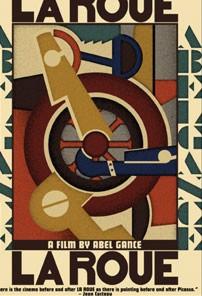
And now La Roue

http://www.flickeralley.com

Having already pronounced Georges Méliès: First Wizard of Cinema (1896-1913) to be the finest silent DVD release of the year, it looks the upcoming new release from the same company, Flicker Alley, may occupy a close second place. In May they are releasing a 2-DVD set of Abel Gance’s bravura La Roue (1923). Here’s the blurb to explain the film’s importance to the history of cinematic expression:

Never before released in the United States, this monumental French film is one of the most extraordinary achievements in the whole history of cinema. Written and directed by Abel Gance (Napoleon, J’Accuse), three years in production, and for its time unprecedented in length and complexity of emotion, La Roue pushed the frontiers of film art beyond all previous efforts. Said Gance, “Cinema endows man with a new sense. It is the music of light. He listens with his eyes.”

Taken to its bare bones, the story deals with Sisif, a locomotive engineer who saves Norma, an infant girl, from a train wreck and raises her as his adopted daughter. Norma thinks Sisif’s son Elie is her brother, and when the two fall in love, she leaves to marry a virtual stranger. Sisif is also obsessed with her and the plot elaborates this triangular relationship. German director G.W. Pabst, an ardent admirer of La Roue, was encouraged by Gance’s example to undertake his own remarkable explorations of human psychology in such silent films as Secrets of a Soul, Pandora’s Box and Diary of a Lost Girl.

Yet La Roue is even more remarkable for its cinematic accomplishment than for its story. The film was taken almost entirely on location. Sets were built along the railroad tracks in the yard at St. Roch, near Nice, and at an elevation of 13,000 feet on Mount Blanc. Gance pioneered a dazzlingly innovative style of rapid montage that revolutionized filmmaking around the world, especially in the works of Eisenstein and his contemporaries in the Soviet Union. Almost every sequence was experimental; as his cinematographer, L-H Burel recalled, “I’d never come to the end of it if I were to list all the tests we did, all the special effects I invented, and all the innovations we launched.” Like Intolerance and Citizen Kane, La Roue became a source book of cinematic invention that reverberated in countless other classic films over the decades. It was hailed by artists and intellectuals, who recognized it as a stunning advance in modern art. Said Akira Kurosawa, “The first film that really impressed me was La Roue.”

This new restoration with a running time of nearly four and a half hours, accompanied by Robert Israel’s symphonic score, is the fullest presentation of La Roue to reach the public since 1923. It at last allows audiences today to experience the amazing, poetic vision that Abel Gance brought to the world. The DVD also includes a short film that provides a vivid documentary record of the great work in production, along with a booklet containing an outstanding essay by William M. Drew on the history and impact of La Roue, and comments by Robert Israel on the score.

Though not on sale yet, there’s a pre-release offer of $31.95 (normal price $39.95), with orders shipped on or just before 6 May.

When the Far East mingles with the West

The Curse of Quon Gwon, from http://festival.asianamericanmedia.org

In 2004, American filmmaker Arthur Dong was working on a documentary, Hollywood Chinese. He came across two reels of a lost and barely-known silent film from 1916-17. Amazingly, it was made by and for the Chinese-American community. The Curse of Quon Gwon: When the Far East Mingles with the West was all the more remarkable for having been written and directed by a woman, Marion Wong. It was instantly recognised for its national importance, and in 2006 it was added to the National Film Registry of American treasures marked out for permanent preservation.

The film was found in a basement in Oakland, California, Marion Wong’s home town and location for the film. The film’s exhibition this week at the Grand Lake Theater in Oakland has generated a far bit of publicity, and a local news report on ABC7 News which is worth checking out because it has some clips from the film, plus an interview with Dong. The same clips are also available on the site of Deep Focus Productions, which made the documentary Hollywood Chinese, and which has background information on Wong’s film. It’s a graceful, professional-looking production, offering a tantalisingly narrow window on a community and on a little-known strand of American filmmaking.

Little seems known about the film itself. Marion Wong made it for Mandarin Film Productions, and employed mostly family members for its production. Wong herself acts in the film, as do her sister-in-law Violet Wong (whose daughters had held on to film until Arthur Dong discovered it) and her mother Chin See, while other family members worked on costumes, sets and finance. Overall there was a Chinese cast of thirty. The surviving film is incomplete, reels four and seven of what may have been an eight reel feature. A 16mm print duplicates this footage while adding an additional ten minutes. The film is now preserved by the Academy Film Archive.

What other Chinese-American filmmaking existed in the silent era? The Curse of Quon Gwon is thought to be the first Chinese-American film, but what led Marion Wong to produce it, and what followed it? Was it actually shown in public? There doesn’t seem to be any actual evidence that it was screened, just that it lost the family a lot of money. The Deep Focus website tells us that Motion Picture World of 17 July 1917 noted the film, saying that its plot:

… deals with the curse of a Chinese god that follows his people because of the influence of western civilization. The first part is taken in California, showing the intrigues of the Chinese who are living in this country in behalf of the Chinese monarchical government, and those who are working for the revolutionists in favor of a Chinese republic. A love story begins here and is carried through the rest of the production.

Another press notice from May 1916 has Wong’s thoughts on her film:

“I had never seen any Chinese movies,” Miss Wong said today, “so I decided to introduce them to the world. I first wrote the love story. Then I decided that people who are interested in my people and my country would like to see some of the customs and manners of China. So I added to the love drama many scenes depicting these things. I do hope it will be a success.”

There’s a helpful family history for Marion Wong on the CineMedua site, but I’ve found nothing else of Chinese-American filmmaking in the silent era (plenty of Chinese-American characters of course, usually of the tedious ‘yellow peril’ villainous type, alas), certainly not in the American Film Institute catalog. So maybe it’s a remarkable one-off, not a fragment of a lost history but a fleeting vision of a history that might have been. [See comments]

Immersive video

42nd Street, from http://www.immersivemedia.com

Here at the Bioscope we try to keep our eye as much on what’s new in silent film as what’s in the past, and there’s not much that’s newer than immersive video. This is 360 degree video which lets the viewer view all points of a motion picture. Many will be familiar with still images on the web where by dragging on the image with the mouse you can have a 360 degree view of a place from a fixed point – it’s used on art gallery websites and other such visitor attractions. Immersive video does the same, except the fixed point is in motion and the images move. Just play the video, then drag on its with the mouse to see left, right, above, below and behind you as the action unfolds. It is astonishing to see.

This is an emerging field, with a variety of solutions being employed. The leaders – or at least those with the best selection of videos to test out on its site – are Immersive Media. Their Telemmersion® System employs eleven cameras positioned in a ball-like device, each camera directed at different angle, the results all blended into a single moving image. There are assorted examples to try out on the Immersive Media site, most of which are street scenes taken from a moving car – see their GeoImmersive Database for a map of US and Canadian cities filmed in this way, or 42nd Street, New York (pictured above) from the main demo section of the site. What intrigues me is the similarity between these pioneering efforts and the phantom rides and street scenes taken from the front of moving vehicles which were common in the earliest years of film – see, for example, Panorama of Ealing from a Moving Tram (1901), on the BFI’s Creative Archive site. There is the same sense of excitement at capturing the real world in motion, the same sense of the innate drama of reality, the same sense of immersion.

And they are, for the most part, silent. All of the street scenes on Immersive Media are so, and most of the other videos on the site – underwater scenes of a coral reef, humpback whales, song and dance in New Guinea, and so on – may have music tracks, but there is no live sound. It is possible for the Immersive Media system to record sound (see the demo of the New Jersey Nets basketball team), but for some reason (is it a synchronisation issue? I don’t quite see why) they are avoiding it.

Immersive video seems to have been produced for the industrial, surveillance and promotional markets so far, but its applications are bound to grow (just wait until the first music video is made in this form). As said, Immersive Media is only one of a number of solutions, which roughly boil down to multiple versus single camera systems. You can read about the competing systems on the Immersive Video site. But go and try out the videos on Immersive Media, and be amazed.

War as it really is

German prisoners of war in Donald C. Thompson’s War As It Really Is (1916), from http://www.realmilitaryflix.com

Realmilitaryflix is the ungainly name for a remarkable new source of online video. The site has been put together by US Air Force combat camera veteran John Corry, who began building up a collection of war films while producing a television series in 1991. The site comprises 650 films (with 1,200 more promised by the end of the year), and ranges from the First World War to Iraq and Afghanistan today. Military enthusiasts can scour the decades of conflict; here at the Bioscope we concentrate on the silent material from the 1914-1918 conflict, which is significant enough in itself.

There are some thirty titles so far, most of them American official films of one kind or another, shot by the U.S. Signal Corps or produced by the propaganda outfit, the Committee on Public Information. Care has been taken to give correct titles and to determine dates, locations and regiments. I’ve not yet had the chance to view them all, but here’s a quick guide to some of the highlights:

Actualities of the World War
Realmilitary flix says “If you only watch one WWI film, make it this one”, and it’s not far wrong. This dynamic four-part compilation was made up of American military film after the war, and the material was expertly edited to form a general narrative of American participation in the war 1917-1918. Its correct title appears to be Flashes of Action, and the National Archives and Records Administration’s ARC catalogue identifies it as c.1921 (many of these films of this site are duplicated in NARA, and some of the descriptions come from NARA’s records). It is filled with vivid scenes of the kind we expect to see of the war, leavened with plenty of human detail.

War As It Really Is
This 1916 production is a single person’s effort – the redoubtable Donald C. Thompson, an independent and resourceful American cameraman who filmed British, French, Belgian, Russian and German troops over 1914-1916, speaking volumes for his diplomatic abilities. He was with the French army at Verdun, where he was wounded, and from which conflict much of this film derives. The quality of the footage is evident throughout, while some of it is startling – apparently close shots of trench warfare (one should always be suspicious of footage where the cameraman would have been in peril e.g. being positioned above the trenches), the shooting of a spy (before and after), and shots of corpses and skeletons.

German Film of the WWI Sea Commerce Raider “Moewe”
This, as it says, is a German-produced film, made in 1917, which was captured by the Allies and subsequently released as The Notorious Cruise of the Raider ‘Moewe’. It follows the German raider ship Moewe as it captures Allied shipping, several examples of which are shown sinking. Its breezy tone comes over as all the more startling having the matter-of-fact titles translated into English.

British WWI Film on the Mideast and other Naval Operations
This is British official film taken in Palestine and Mesopotamia 1917-1918. There is some very impressive footage here, including a gunboat firing on the Tigris and striking aerial photography of a British convoy at sea. It ends with famous, iconic footage of General Allenby entering Jerusalem in December 1917, with fleeting glimpses of Lawrence of Arabia (in military uniform), if you know where to look.

T.E. Lawrence and General Allenby, shown in British WWI Film on the Mideast and other Naval Operations, from http://www.realmilitaryflix.com

And there’s much more: demonstrations of gas warfare, the operation of observation balloons, the construction of dummy soldiers as camouflage, radio operations, black troops, and the peace treaty negotations at Versailles in 1919. As indicated, one should always take care assessing the authenticity of war footage from this era – the cameramen were frequently brave, but they were severely limited by both equipment and army officialdom, and of course had to preserve their own lives. Overly dramatic footage (always consider where the cameraman was positioned when the film was taken and then ask why he wasn’t killed) may show genuine action but may equally have been staged. That said, there seems relatively little fakery here, just much startling footage intercut with skilfully-shot scenes of the mundanities of warfare which somehow bring it home all the more to us today.

All of the titles are available in Flash, and look OK blown up to full screen. One notable last point to make – all of the contemporary films of the war are shown silent. Go explore.

Eight days in Bologna

http://www.cinetecadibologna.it

An outline of the Bologna festival of archive and restored films, Il Cinema Ritrovato, has been published. Promising “the most memorable eight days of 2008”, the festival takes place in Bologna, Italy, and runs Saturday 28 June to Saturday 5 July.

Bologna always offers a rich mix of films from past decades, both silent and sound, and the great pleasure of attending is being taken from, say, a programe of short films from the 1900s to Cinemascope features of the 1950s, back to 1930s musicals and on to silent features. Its wise eclectism is matched by an eye for the timely and the unusual, and it is deservedly recognised as being among the world’s leading festivals of archive film.

This year there are a number of silent strands, as described on the festival site:

The silent section opens with a series dedicated to films made exactly 100 years ago, curated by Mariann Lewinsky. 1908 will offer a panorama of fascinating themes, national productions, technological attractions (also with sound!), visions of the world and breaking news (from the London Olympic Games to the Messina earthquake) and cultural superproductions like Gli ultimi giorni di Pompei and L’assassinat du Duc de Guise, presented with Camille Saint-Saëns’ original music, during the final evening on Saturday July 5th, dedicated to the avant-gardes.

Emilio Ghione (1872-1930) is the silent star of our 2008 program. The creator of Za la mort and I topi grigi (1918, this year’s morning serial) was a hugely popular actor and director in his day. He was at home in almost every genre, yet he retained an original touch, creating heroes and anti-heroes that were strictly his own with decadent, Gothic elements combining cartoon-like directness and ironic, unexplained elements, as if he was moving through mystical imprints.

Gosfilmofond will have its 60th anniversary at the same time as Russian Cinema celebrates its 100th anniversary. It is thus apt to celebrate the life and work of Lev Kuleshov, one of the fathers of Soviet Cinema and its first great theoretician. Yet his work is little known with the exception of the captivating fun piece The Extraordinary Adventures of Mr. West in the Land of the Bolsheviks (1924) or perhaps By the Law (1926), a harsh adaptation of Jack London. Thus our season will come as a big surprise to many, the testimony of a nuanced, intelligent director inventing a language that reflected everyday life along with the passion and history of the Soviet Union of his time as well as international realities. There are famous titles that most of us know only from books – The Death Ray (1925), The Gay Canary (1929) – and highlights like Gorizont (1932) or The Great Consoler (1933), and even later evidence that Kuleshov (and his actress wife Khokhlova) never lost enthusiasm and creativity.

With the section Irresistible forces: Comic Actresses and Suffragettes (1910-1915), Il Cinema Ritrovato will proceed with the exploration of the origin of comic cinema, this year through a feminine eye. Those are the years of the Suffragettes, characterized by women’s fight for their fundamental rights, as witnessed by the collection of actualities and newsreels preserved by the British Film Institute/National Archive. In this context, characters like Rosalie, Cunegonde, Lea, Gigetta and the wild sisters Tilly and Sally have an explosive and freedom-breaking impact.

While last year’s Chapliniana still echoes in our minds, this year we will launch an annual “Chaplin’s filiation” program with a series of films devoted to Monta Bell, Chaplin’s assistant on A Woman of Paris (1924) and a wonderful director in his own right, as our selection – Lady of the Night (1925), Pretty Ladies (1925), Upstage (1926) – proves beyond question. At the crossroad of a Sternberg retrospective, we will dedicate a dossier to The Seagull/Woman of the Sea (1926), one of the most famous “lost films” of all time. The film was shot by Sternberg and produced by Chaplin who did not like it and eventually refused to release it. Its intriguing story will be traced with images and rare documents gathered from many sources.

Other strands include Josef von Sternberg and Marlene Dietrich, Warner films of the 1930s, films based on the work of Giovanni Guareschi (creator of Don Camillo), Cold War films on the atomic bomb, and a Cinemascope selection.

There are full details on the festival, its venues, booking etc., plus details of the Film Restoration Summer School on the site (in Italian and English). But look out also for the Archive section, which has PDFs on all past Il Cinema Ritrovatos, 1986-2007, plus an Excel spreadsheet listing every film title featured at the festival over those years – a really useful resource (just a shame the spreadsheet doesn’t include the name of the archive which supplied each print – for that you will have to cross-check via the individual programmes).

Georges Méliès, magicien du cinéma

http://www.cinematheque.fr

Why so much activity concerning Georges Méliès just now? First the (virtually) complete DVD box set of his work released by Flicker Alley, and now a major exhibition with lavish catalogue, screenings, DVDs etc from the Cinémathèque française. He’s neither one hundred years born nor one hundred years dead. In fact he’s seventy years dead, and that’s the point. Under European copyright law, 2008 is the year when the works of Georges Méliès, who died in 1938, come out of copyright, under the rule which says a creative work remains in copyright until seventy years after the death of the author.

So M. Méliès has become fair game – a fact which can be of no small amount of irritation to the Malthete-Méliès family which has so assiduously guarded his legacy until now. They had nothing to do with the acclaimed Flicker Alley set, but they have co-operated with the Cinémathèque française exhibition, which opens in Paris on 16 April and which is described in some detail (in French) on the Cinémathèque’s website.

Where to start? The exhibition itself is divided into three sections: Magie et cinématographe, Le Studio Méliès de Montreuil and L’univers fantastique de Méliès, covering his life, background, work and influence. Many artefacts not previously exhibited in public are promised, and Méliès is championed for the modern generation as the master of special effects and fantasy cinema, foreshadowing Georges Lucas and Steven Spielberg. A 360-page catalogue has been produced, edited by Jacques Malthete et Laurent Mannoni, with some 500 illustrations, which from reports I’ve had so far sounds like an outstanding production in itself.

There are two DVDs published to coincide with the exhibition. The first, Georges Méliès, produced by StudioCanal/Fechner Productions, is a two-disc set featuring thirty remastered Méliès films 1896-1912, with 32-page booklet but no indication of what film titles are included nor their source.

The second DVD is Méliès, le cinémagicien, another two-disc set, produced by Arte Vidéo. This features a documentary, La magie Méliès, by Jacques Mény (1997, 130 mins), a selection of fifteen of the films from 1898 to 1909 (55 mins in total) and the renowned Georges Franju film Le grand Méliès (1952, 37 mins) which is also available on the Flicker Alley set.

This documentary, which introduced many to his films for the first time, features Méliès’ son André, playing his father, and Méliès’ second wife and star of many of his films, Jehanne d’Alcy (then aged ninety).

And there’s more. There are screenings in April-May of Méliès films and in June-July of ‘L’héritage méliès’. A complete Méliès filmography is also promised, which will be a boon, particularly if it goes the whole hog and identifies the films by Star-Film catalogue number (his production company), length, English release title, which copies are extant and where. Meanwhile, Méliès, magicien du cinéma looks like a very good reason to visit Paris over the next few months (as though there weren’t reasons enough anyway, but you know what I mean).

Where to find out more about Georges Méliès? It’s a shame – indeed something of a mystery why there isn’t a single good site dedicated to him (interesting to see that http://www.melies.com, http://www.georgesmelies.com, http://www.georgesmelies.org and http://www.georgesmelies.fr have all been bought up opportunistically by domain sellers). Cinémathèque Méliès (in French) is a so-so effort of ancient design which I’ve had trouble accessing, but you can trace it back through the Wayback Machine. The Magical World of Georges Méliès likewise isn’t going to win any design awards, but it has a biography, filmography, and links to his films on YouTube. There’s a useful one page biography (written by David Robinson) on the Who’s Who of Victorian Cinema website. The Flicker Alley DVD set Georges Méliès: First Wizard of Cinema (1896-1913) has already been championed here, and serious questions will have to be asked of any silent film enthusiast who hasn’t purchased a copy before the year is out.

As for reading matter, apart from the new catalogue (which is in French, of course), a really good book in English doesn’t exist. The best, albeit slim and not easy to track down nowadays, is David Robinson’s Georges Méliès: Father of Film Fantasy (1993). Elizabeth Ezra’s Georges Méliès (2000) is one for the film studies courses. A standard, substantial, up-to-date biography in English (I don’t know of one in French, either) ought to be written – we repeat so much that has already been written in the film history/film studies field, and yet we leave a yawning gap like this. So you will have to make do with Brian Selznick’s haunting children’s book, The Invention of Hugo Cabret (2007), already championed by The Bioscope, in which Georges Méliès features as a central character. And wait to see if Martin Scorsese really does decide to make a film out of it.

Coney Island goes silent

More evidence of the rude health of the modern silent, and of contests to reward its production, comes from the Coney Island Film Festival in New York. This is a competitive film festival, and budding filmmakers are invited to submit contributions in eight categories: Feature, Short, Documentary Feature, Documentary Short, Experimental, Animation, Music Video, and Silent Film. The latter is a new category (the festival is in its eighth year), and there doesn’t seem any stipulation other than what one might infer from the title (so, are you allowed to add a soundtrack?).

The Regular Deadline for submissions is April 25th, 2008 (postmarked), entry fee $25. The Late Deadline is June 25th, 2008 (postmarked), $35, and the Extended Late Deadline is July 3rd, 2008 (postmarked), $45. The festival itself takes place 26-28 September 2008. More information from the festival site.