Pen and pictures no. 2 – The most popular authors

I’ve started up this new series on literary authors and their engagement with motion pictures of the silent era, but which authors were the most popular subjects for adaptation? It’s a difficult subject to research, because of the variable quality of the reference sources to hand. One could go to the IMDB, but it still misses out so much, and there would be no easy way that I know of to isolate all literary source credits and then match these to silent films.

A better route I’ve found is to use Denis Gifford’s Books and Plays in Films 1896-1915. This is a typically thorough and rigorous reference work from the late Mr Gifford. His filmography is arranged by original author, and then gives release date, title, title of original work if different, production company and length. Its measure is films that were released globally, so it omits titles that were probably only shown in Russia or China (to name two obvious gaps), but in most respects it is as near a definitive source as you are going to find. He stops at 1915 just before the age of the feature film, but also to demonstrate the astonishingly varied literary adaptations of the first twenty years of cinema. It is apart from anything else, an excellent guide to popular taste and the cultural ambitions of the early cinema business.

So, who comes out on top out of the 861 authors he lists? No, it’s no who you think it is – he comes second – and no it’s not the other guy – he comes fourth. Below I’ve listed every author who has ten or more film adaptations to his or her name 1896-1915, with the number given in brackets after their name), and an intriguing list it is too:

  • James Curwood (81) [sturdy tales of the Canadian north]
  • William Shakespeare (75)
  • George Ade (70) [American humourist best known for his ‘fables in slang’]
  • Charles Dickens (60)
  • Alexandre Dumas père (28) [Three Musketeers etc]
  • Victor Hugo (28)
  • Alfred, Lord Tennyson (27)
  • Arthur Conan Doyle (26)
  • Frederick Burr Opper (26) [creator of Happy Hooligan cartoon strip]
  • Henry Longfellow (24) [Hiawatha etc]
  • Sir Walter Scott (23)
  • Dion Boucicault (22) [Irish playwright]
  • Richard Harding Davis (22) [journalist and novelist]
  • Washington Irving (22) [Rip van Winkle etc]
  • Edward Bulwer-Lytton (21) [Victorian novelist, The Last Days of Pompeii etc]
  • Johann Wolfgang von Goethe (19) [Faust, mostly]
  • Bret Harte (19) [tales of the pioneer life in California e.g. The Luck of Roaring Camp]
  • O. Henry (19) [American short story writer]
  • Charles Perrault (19) [Cinderella, mostly]
  • Cyrus Townsend Brady (18) [journalist and adventure writer]
  • Bud Fisher (18) [creator of Mutt and Jeff]
  • Robert Louis Stevenson (17)
  • Victorien Sardou (16) [La Tosca, etc]
  • George R. Sims (16) [English journalist and writer of sentimental verse]
  • Honoré de Balzac (15)
  • Jack London (15)
  • Roy Norton (15) [writer of Westerns]
  • James Oppenheim (15) [American poet]
  • Frederic Kummer (14) [American novelist and short story writer]
  • Richard Outcault (14) [creator of Buster Brown]
  • Rex Beach (13) [tales of the Klondike]
  • Edgar Allan Poe (13)
  • Charles Reade (13) [Victorian novelist, The Cloister and the Hearth etc]
  • Hal Reid (13) [playwright, father of Wallace Reid]
  • David Belasco (12) [playwright and theatrical impresario]
  • Count Leo Tolstoy (12)
  • George Randolph Chester (11) [short story writer, Get-Rich-Quick-Wallingford etc]
  • Clyde Fitch (11) [American playwright]
  • George Bronson Howard (11) [playwright]
  • ‘Hal Meredith’ (Harold Blyth) (11) [creator of Sexton Blake]
  • Georges Ohnet (11) [French novelist]
  • Mary Imlay Taylor (11) [American novelist]
  • Robert Browning (10)
  • ‘Nick Carter’ (John Russell Coryell) (10) [detective stories]
  • Wilkie Collins (10) [Victorian novelist]
  • Rudolph Dirks (10) [creator of the Katzenjammer Kids]
  • George Du Maurier (10) [Trilby, mostly]
  • Prosper Merimée (10) [Carmen]
  • Sir Gilbert Parker (10) [Canadian novelist and British MP]
  • Arthur Shirley (10) [English actor and playwright]
  • Booth Tarkington (10) [American novelist]
  • Louis Vance (10) [American novelist]
  • Giuseppe Verdi (10)

Quite a few names there that are new to me. An interestingly high number of poets (when was the last time a popular film of today was adapted from the work of a contemporary poet?). Some names like Mark Twain, Frank L. Baum and Oscar Wilde just missed the cut. And only one woman author is listed. Anyway, fascinating stuff, and I’ll do some more analyis of this sort of data later. Which was the most popular single work 1896-1915, for instance? You’ll have to wait and see.

Fight pictures

I wrote a post a while ago on two new books on boxing and modern culture. I’ve just started reading Kasia Boddy’s Boxing: A Cultural History, which is a real treasure trove, so more on that in due course.

I’ve not yet laid eyes on Dan Streible’s Fight Pictures: A History of Boxing and Early Cinema, which is going to be a real treat, but anyone who’s in New York might like to know about an illustrated lecture the author will be giving at Light Industry, a new venue for film and electronic art in Brooklyn. The event takes place on 6 May at 8.00pm, and costs $6.

Here’s the blurb:

Between 1894 and 1915, the first generation of filmmakers produced more than 250 motion pictures with boxing and prizefighting as their subject. Fight pictures were among the most conspicuous, profitable and controversial productions of early cinema. From 1912 until 1940, U.S. law banned the interstate distribution of film recordings of prizefights. Congress enacted the law to suppress the celebrity of the first black heavyweight champion, Jack Johnson, titleholder from 1908 to 1915. Yet, only a few years after the start of the ban, fight pictures flourished again. Throughout the 1920s and 30s these supposedly criminal records were nearly ubiquitous in movie houses and other venues. In conjunction with his newly released book Fight Pictures: A History of Boxing and Early Cinema, Dan Streible presents glimpses of some of these ephemeral films, most of which no longer survive or exist only in fragments. Also on screen will be much of the ephemera – posters, photographs, cartoons, advertisements and the like – that accompanied these “moving fight pictures.”

See the likes of:
Corbett and Courtney Before the Kinetograph (1894)
Corbett-Fitzsimmons Fight (1897)
A Scrap in Black and White (1903)
Squires vs. Burns, Ocean View, Cal., July 4th, 1907 (1907)
Jack Johnson: Der Meister Boxer der Welt (1911)

It’s a compelling history, one well worth telling and telling again. More from the ring in the near future.

Colourful stories no. 10 – Happy centenary!

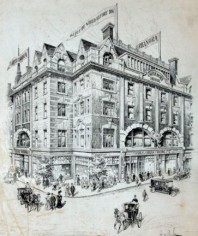
The projection hall at Urbanora House, where the first Kinemacolor films seen in public were shown

On 1 May 1908 a special demonstration was held for the press at 89-91 Wardour Street, London. The occasion was the opening of Urbanora House, a prestigious new home for the Charles Urban Trading Company, the leading British film company. Previously based at nearby Rupert Street, the CUTC had relocated to much larger premises, and in doing was to have an important effect on the future of the British film industry, as it was the first film company to move to Wardour Street, soon to become the unofficial home of the native film industry (a symbolic role that it arguably retains to this day).

Urbanora House was designed to dazzle. For anyone who believed that the British film business was a minor industry of ramshackle appearance and sometimes seedy reputation, the new building was a bold statement of better intent. The 250 attendees, representatives of daily newspapers, the photographic and cinematograph trade press, and the film industry, were led through stylish, well-appointed room after room. The Kinematograph and Lantern Weekly was particularly struck by its implications for the industry.

Urbanora House makes an impression on the member of the trade first of all because of its spaciousness but even more noticeable is the manner in which that space has been used. The many thousand feet of floor space are divided up among the bewildering number of departments so that hardly an inch is wasted. The building is at once factory and office. On the ground floor are the distributing offices, secretary’s office, advertising and correspondence departments and the projection hall. The latter calls for special notice. It is easily the largest in the English trade, accommodating over one hundred if necessary, and is beautifully fitted up. The size of the hall allows of a picture of a size equal to that of most public exhibitions being shown. The projection hall, like the entrance hall and staircase is beautified by a series of pictures, many reproducing scenes with which Urban films have already familiarised the trade.

The floors above continued the wonders of Urbanora House (left): the drying room with drums capable of drying 12,000 feet of film per hour, the rooms for film processing and equipment manufacture, a studio on the top floor, with Ladies and Gentlemen’s dressing rooms adjacent, and rooms for experimental work and colour cinematography. The latter was the day’s triumphal flourish. All were ushered into the projection hall, where there was to be an exhibition of ‘Animated Photographs in natural colours’. This was the first public exhibition of the two-colour motion picture process which had been patented by G.A. Smith in 1906 and whose development had been funded by Charles Urban, whose mansion Urbanora House was. 1 May 1908 was therefore the first time that the public saw motion pictures in natural colour.

Smith gave an introductory talk, explaining the as yet imperfect system that they were to witness, and having some barbed words for other inventors whose claims to have produced motion picture colour had not been backed up by any presentable results:

Another motive which prompts me publicly to exhibit my early results is the desire to bring to a crisis a sort of intellectual scandal. I have been actively engaged with Mr. Urban in the art of the Bioscope for the past twelve years, and during the greater part of that time have heard of people and have met people who claimed to be able to take pictures in natural colours. The Patent Office is presumably littered with the specifications of inventors who are free with their theories and loud in their claims. But we never see their performances! We frequently meet with gentlemen who tell us of their patented ideas, but never have they yet come to the practical point of showing us the thing on the sheet. So well is this state of things recognised and smiled at that I am beginning to be nervous of being placed in the same class and am therefore willing to take you into my confidence and exhibit my experimental results in the hope that other claimants will be sportsmanlike enough to follow my example if they are able.

Smith then went on to stress the universality of the equipment that he had used, before showing a selection of subjects, apologising for their rough-and-ready state and stating (a little ingenuously) that they were not taken with any thought of presenting them before an audience. Today, alas, only a handful of Kinemacolor (as the system would be named in 1909) films survive, but the two test films below indicate the sort of thing Smith and Urban exhibited before the press that day:

Tartans of Scottish Clans and Woman Draped with Patterned Handkerchiefs, two Kinemacolor test films held by the British Film Institute. The woman in the second film may be G.A. Smith’s daughter Dorothy

We don’t know precisely what films were shown, but we do know that to demonstrate the effectiveness of the colour, the audience was invited to compare them with Autochrome photographs of the same subjects, which included Smith’s wife Laura and daughter Dorothy. Smith described them as “improvised test subjects rigged up on the lawn as close to my Laboratory door as possible” i.e. they were filmed at his house ‘Laboratory Lodge’ in Southwick, just outside Brighton. The audience was duly delighted by the results, though there was at least one note of qualification. As enthralled as it was by the building, the Kinematograph Weekly nevertheless recognised imperfections in the colour films, even if they were acknowleged to be an obvious improvement on artificially-coloured films:

… we must observe that, as present produced, there are fringes of complementary colours, red and green, outlining swiftly moving portions of the composition. Thus, so long as the movement is of a moderate speed or the object is a considerable distance from the camera, this defect is not apparent, but when the object is in rapid motion and is located a very short distance from the lens, two sucessive images are sufficiently dissimilar to make absolute registration of the complementary images impossible, hence the coloured outlines.

That’s a good explanation of the inherent limitation of Kinemacolor, that the successive red and green records inevitably could not capture precisely the same image if the subject was in motion, and one which the system was never to overcome.

And so motion picture colour was launched upon the world. It’s not a centenary that’s likely to be picked up on by the broadsheets, or frankly even the motion picture press, alas. So let’s raise a glass here, and if you’re in London some time, take a look at the bottom of Wardour Street, where Urbanora House still stands, indeed with a grand stone fascia on top still bearing the name ‘Urbanora House’. That’s where it all began.

Happy centenary!

Pen and pictures no. 1: Thomas Hardy

Tess of the D’Urbervilles (1913), from http://www.thomashardyfilms.com

Time for a new series, I think. And its theme is the crossover between literature and film, looking at how the silent cinema tackled the works of assorted authors – and how authors came to terms with this strange new medium, which challenged their claims upon the popular imagination, frequently mangled their works as screen entertainments, yet also offered riches, either through selling the rights or through contributing their own screenplays. It’s an engrossing history, where every author’s experience is just that little different to anyone else’s. And we’ll start with Thomas Hardy.

Hardy seems so much a Victorian (if late Victorian) author, that it comes as a bit of surprise to release that he lived long into the era of film – long enough to see, somewhat to his bemusement, his novels adapted as films. There were four silent films made of Hardy’s work: Tess of the D’Urbervilles (US 1913), Far from the Madding Crowd (UK 1916), The Mayor of Casterbridge (UK 1921) and Tess of the D’Urbervilles (US 1924). Details of each can be found in the ‘Lost Hardy Adaptations’ section of the website Thomas Hardy: The Films Page.

The entertaining story of Hardy’s personal engagement with film is told in Matthew Sweet’s book Inventing the Victorians. Hardy was first approached by a film company in 1911. The Warwick Trading Company, a British business, wanted to film Tess of the D’Urbervilles, offering Hardy ten per cent of the gross turnover. Hardy told his agent:

I should imagine that an exhibition of successive scenes from Tess (which is, I suppose, what is meant), could do no harm to the book, & might possibly advertise it among a new class.

Scarcely overwhelming enthusiasm at the prospect of seeing his work filmed, though Hardy did sign the contract (the film did not get made). He also accepted money from Hubert von Herkomer, the artist turned filmmaker, who wanted to film Far from the Madding Crowd and The Mayor of Castebridge. Neither was produced, and Hardy was onto a nice little earner without a film having made it to the screen.

It was the Americans who first put Hardy on the screen. Adolph Zukor’s Famous Players produced Tess of the D’Urbervilles in 1913, with Broadway actress Minnie Maddern Fiske as a somewhat mature Tess – she had first played the role on stage in 1895 – David Torrence as Alec and Raymond Bond as Angel Clare. The film was shot in New England, and generally given an American look throughout, as well as having a softened ending (Tess goes to prison rather than being hanged). Hardy attended a press screening of the film at Pyke’s Cinematograph Theatre in London’s Cambridge Circus (today a fashionable bar named after its former cinema owner, the Montagu Pyke) on 21 October 1913. Matthew Sweet records Hardy’s bemused reaction:

It was a curious production, & I was interested in it as a scientific toy; but I can say nothing as to its relation to, or rendering of, the story.

In other words, the movies had produced some kind of bewildering aberation (at least as far as his work was concerned), but it was hard to complain about the money.

The clash between old arts world and new continued with Far from the Madding Crowd, made in 1916 as a five-reel feature by the British company Turner Films, whose great star was the American actress Florence Turner. Turner played Bathsheba Everdene, and her regular co-star Henry Edwards was Gabriel Oak. As with all other Hardy silents, the film is lost, and all we can glean from reviews is that the film did not look like it was filmed in Wessex. This was undoubtedly true, but films of literary properties needed to be true to their own medium first, not to the printed page, a lesson that was starting to be learned as films grew longer and the movie industry grew more assertive, and became richer.

Such riches, and such attitudes, were evidenced by Metro Pictures, which optioned Tess for an astonishing $50,000, but the next Hardy film came from a far humbler source, the Progress Film Company of Shoreham-by-Sea on England’s south coast. The tale of the artist/theatrical community in what was affectionately known as ‘Bungalow Town’ is charmingly told on the Bungalow Town website. The Mayor of Casterbidge was made there in 1921, directed by Sidney Morgan and starring Fred Groves as Michael Henchard. Hardy was receiving more and more offers from film companies, and seems to have selected according to the degree to which the treatment indicated a sympathetic understanding of his original. For the Progress proposal he wrote:

The general arrangement seems as good as is compatible with presentation with cinemas.

Hardy was invited to see the film in production (it was filmed in Dorset, which may have helped secure his approval), and so enjoyed the peculiar experience of seeing his characters come to life, as it were, writing in a letter:

This morning we have had an odd experience. The film-makers are here doing scenes for “The Mayor of C” and they asked us to come as see the process. The result is that I have been talking to the Mayor, Mrs Henchard, Eliz. Jane, & the rest, in the flesh … It is a strange business to be engaged in.

The last film to be made of his work while Hardy was still alive was Metro-Goldwyn-Mayer’s Tess of the D’Urbervilles, in 1924. This was a top-notch Hollywood effort (evidenced by that $50,000 payment for the rights), with Blanche Sweet as Tess, Conrad Nagel as Angel Clare and Stuart Holmes as Alec. Scenes were filmed in Dorechester, but Hardy never saw the film. Given that the film updated much of the action to the 1920s, with motor cars and nightclubs, it is perhaps best that he did not. Interestingly, it seems to have been made with two endings, exhibitors being given the option whether to choose Tess being hanged or Tess escaping the gallows.

And that’s Thomas Hardy and film. He displayed an intriguing tension in his letters between keenness to profit from the film rights and concern over how his work was represented. In Hardy’s personal engagement with the motion picture industry we see films move from being a peculiar distraction which might help book sales, to a medium which challenged the author’s hold upon the work of his imagination. Meeting the Mayor of Casterbridge in the flesh must have been an unsettling experience – evidence that the creative work had a life outside the printed page on which it first appeared.

None of the Hardy silent films are known to exist (there are rumours of a surviving fragment of the Progress Mayor of Casterbridge). Apart from Matthew Sweet’s book and www.thomashardyfilms.com, check out T.R. Wright’s Thomas Hardy on Screen or Paul J. Neimeyer’s Seeing Hardy: Film and Television Adaptations of the Fiction of Thomas Hardy, each of which tells much the same story about the silent films.

Despite having lived until 1928, Hardy does not seem to have been filmed himself. The nearest we get is film of his funeral, which you can see on www.britishpathe.com.

Rockin’ with Nanook

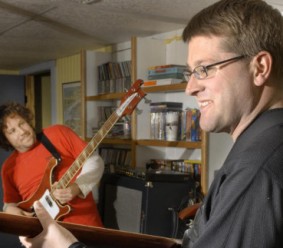
Sumner McKane, right, and bass player Josh Robbins, from http://www.mainetoday.com

This report from Maine Today on some local rock groups taking it turns to provide scores for silents rather appealed:

The members of the Sumner McKane Group composed their latest musical work while watching grainy, black-and-white footage of an Inuit man hunting seals to keep his family alive in the frozen Hudson Bay region of Canada 86 years ago.

Not exactly your typical pop-song fodder.

“There’s sort of a desperate sadness to some of it,” said McKane, guitarist for the Portland instrumental trio.

McKane and his bandmates – Josh Robbins on bass and Todd Richard on drums – have been working for three weeks on creating an original score to the classic 1922 silent documentary “Nanook of the North.”

They’ll perform the music live while the 79-minute film is shown next Wednesday and Thursday at One Longfellow Square in Portland as part of the 200-seat venue’s monthly series, “Local Scores, Silent Films.”

Each month, a different local band picks a silent film and composes a score for live accompaniment. This will be the fourth concert/film showing in the series, following Buster Keaton’s “The General,” scored by Samuel James; Fritz Lang’s “Metropolis,” scored by the Improvisational String Quartet; and the classic German vampire film “Nosferatu,” scored by the jazz group Tempera.

Tom Rota, manager of One Longfellow Square, said he contacts bands to find out if they are interested, then gives them a list of classic silent films from which to choose.

The venue presents a mix of live music, dance, film and other performances and was known as the Center for Cultural Exchange before the current owners bought the building and reopened as One Longfellow Square last July.

In a sense, the venue is recreating the theater experience of the silent film era, when live musicians, usually a pianist, performed onstage or in an orchestra pit while the movie played onscreen. By using modern scores, it’s giving the tradition a modern twist.

McKane said when he was approached about the series, he immediately thought of “Nanook of the North.” He had seen it, was fascinated by it and thought its slow pace and human themes would fit his band’s brand of instrumental music, which includes rock, country and ambient music.

“There are a lot of still shots of the landscape, which allow for some spacious music. That’s better for us than something that’s action-packed,” said McKane, 31.

Considered the first full-length anthropological documentary, the film follows a year in the life of Inuits in Arctic Canada. It was made by Robert Flaherty, who went to Hudson Bay looking for iron ore on behalf of the Canadian Northern railroad. While there, he became intensely interested in capturing Inuit life on film.

In the film, Nanook takes his family on a hunting expedition to try to get enough food to survive another winter. The family travels on dog sled, hunts with spears and sleeps in igloos that have to be made on the spot every night.

Being a documentary, it’s very different from most of the classic silent films that often get shown today with live musical accompaniment. Horror films, epics and slapstick comedies are the usual suspects for this kind of silent film/live music series.

To compose the score, McKane, Robbins and Richard have been gathering in the basement of McKane’s North Deering home. They got a copy of the film from Netflix and watched it on a laptop computer as they composed and played. When they got a piece they liked, they went back to make sure it matched up with a segment of film.

It’s a fairly slow process. At a recent rehearsal, band members estimated it took maybe four hours or more to get about 25 minutes’ worth of music for the film.

During rehearsal, the band focused on part of the movie that takes place in the heart of the Arctic winter, when the family has little food left.

While the family slowly travels over a barren, icy landscape, the band plays music that’s spacey and full of echo, with Mark Knopfler-like guitar work. When Nanook traps a small fox, the music becomes faster and joyous.

Another scene where the music mimics the mood is when the family struggles to get its dogsled through a field of ice boulders. Once the sled goes up and over the last hill and can travel freely, the band explodes into a fast, thumping, rock ’n’ roll passage.

Matching music to scenes is a challenge, as is remembering all 79 minutes of the piece in sequence.

“For us, a long song is maybe 10 minutes,” said Robbins, 33. “And it’s all structured. There’s no jamming in the middle of this.”

The Maine Today report provides a sample of the Nanook music.

Women and the Silent Screen conference

Tsuru Aoki and her husband Sessue Hayakawa in Courageous Coward (1919)

The Fifth International Women and the Silent Screen Conference is being held at Stockholm University, Sweden, 11–13 June 2008, and a full programme with screenings has now been published. The aim of the conference is to “celebrate the diversity of women’s engagement with silent cinemas across the globe”, and it’s very interesting to see the current issues being covered by the papers and some of the unfamiliar films which are being put back on the screens in response to such new debates. This is why we have research; so we can see more.

Here’s the outline conference programme:

Wednesday, June 11

Keynote address
Jane Gaines – Women and the Cinematification of the World

11:00–12:45
Parallel Sessions 1.1
National and Transnational
Rosanna Maule – Feminist Film History and the (Un)problematic Treatment of Trans-nationalism in Early Cinema
Christine Gledhill – Mary Pickford: Emerging Stardom and Transnational Circulation
Sanjoy Saksena – Image of Women in Colonial and Post-Colonial Indian Cinema
Phil Powrie – Josephine Baker and Pierre Batcheff in La Sirène des tropiques (1927)

Sharpened Pencils
Domenico Spinosa – The didactic-instructive task of cinema (1907-1918) in the Italian women writings
Luca Mazzei – Going to movies wearing a skirt and handling a pen. Women writing about cinema 1898-1916
Luigia Annunziata – Matilde Serao and the cinema
Louis Pelletier – Ray Lewis and the Birth of Canadian Film Culture

Germaine Dulac
April Miller – Pure Cinema, Pure Violence: Murder as Avant-Garde Aesthetic in Germaine Dulac’s La Coquille et le Clergyman and La Souriante Madame Beudet
Tami M. Williams – An Invitation to a Voyage: Cross medial spatial metaphors, modes of transport and sexual liberation in the cinema of Germaine Dulac
Catherine Siberschmidt – The concept of spectatorship in Germaine Dulac’s film theory
Sarah Keller – “Optical Harmonies”: Sight and Sound in Germaine Dulac’s Integral Cinema

13:45–16:00
Parallel Sessions 1.2
Conceptualizing “Female Pioneers”
Shelley Stamp – Lois Weber’s ”Feminine Hand” at Rex
Karen Ward Mahar – Working Girls: The Masculinization of American Business in Film and Advice Literature in the 1920s
Isabel Arredondo – Forgetting Women Film Pioneers: Juliet Rublee and the Myth of the Avant-Garde
Mark Lynn Anderson – The Real Dorothy: Mrs. Wallace Reid, the Newspaper, and Feminist Film Historiography
Monica Dall’Asta – What Means to Be a Woman: Theorizing Feminist Film History Beyond the Essentialism / Constructionism Divide

Case Studies in Stardom
Tijana Mamula – Ideal Situation: Projecting Knowledge in Prix de Beauté
Miya Tokumitsu – f(Swoon): The Function of the Female Swoon in Silent Film
Nicole Beth Wallenbrock – The Hollywood Flapper dies an Expressionist Death (Louise Brooks in Pandora’s Box)
Galen Wilson – Performance of Anxiety: Les Vampires and the Crisis of Gender in the Fin-de-Siecle
Hélène Fleckinger -“The wicked woman” On the character of Irma Vep in Les Vampires of Louis Feuillade

Authorship and Screenwriting
Vincent L. Barnett – The Novelist as Hollywood Star: Author Royalties and Studio Income in the 1920s
Alexis Weedon – Elinor Glyn the Author On Page and Screen
Stephan Michael Schröder – The conditions of freelance script writing – example Harriet Bloch
Claus Tieber – Between Sentimentalism and Modernity: The narrative structure of Frances Marion’s screenplays
Anke Brouwers – The Name Behind the Titles: Women, Authorship and Silent Screenwriting

Thursday, June 12

9:00–10:45
Parallel Sessions 2.1
Cross-Gender Casting and Lesbian Characters
Astrid Söderbergh Widding – Flickan i frack – A Case of Cross-Dressing
Laura Horak – Edna/Billy Foster, the Biograph “Boy”
Fiona Philip – Veiled Disclosures and ‘Speaking Back’: Borderline (1930) and the Presences of Censorship
Susan Potter – Opening up Pandora’s Box

American Stardom
Mary Desjardins – A Method to this Madness? The Myth of the Mad Silent Film Star
Charlie Keil – ’Studio Girls’: Female Stars and the Logic of Brand Names
Jeannette Delamoir – Mary Pickford and Louise Lovely: The silent motion-picture star in the age of reproduction
Tricia Welsch – From Pratfalls to Glamour: Gloria Swanson at Triangle

(Re)discovering Female Filmmakers 1
Nathalie Morris – “Alma isn’t Talking”: The Early Career of Alma Reville aka Mrs Alfred Hitchcock
Claudia Preschl and Elisabeth Streit – Making Noice (Proud to be loud). Women in the Silent-Period of Austrian Film History
Anne Bachmann – Parallel stories? Ebba Lindkvist’s brief career and the film version of a
theatrical play
Annemone Ligensa – “A Cinematography of Feminine Thought”: The Novel The Dangerous Age (1910) by Karin Michaelis and Its Filmic Adaptations

Parallel Sessions 2.2
(Re)considering Genres and “Feminine Tastes”
Lea Jacobs – On Hating Valentino: The Rejection of the Romantic Drama in the American Cinema of the 1920s
Annette Förster – Humorous reflections on acting, filmmaking and genre in comic film productions by Adriënne Solser, Musidora, and Nell Shipman
Kristen Anderson Wagner – “Ever on the Move”: Silent Comediennes and the New Woman

Fashion and Fandom
Mila Ganeva – Women between Screenwriting and Fashion Journalism: The Case of Ruth Goetz
Therése Andersson – Beauty Box – Film Stars and Beauty Culture in Early 20th Century Sweden
Andrea Haller – “Flimmeritis” and Fashion – Early intermedial practices of female movie fandom in Imperial Germany
Lisa Stead – “It costs nothing to wish!” Female Fan Writing and Self-Representation in the British Silent Cinema

(Re)discovering Female Filmmakers 2
Marcela de Souza Amaral – Alice Guy and the narrative cinema
Mike C. Vienneau – The discursive Art of Alice Guy: The cinema and the feminine silent word
Jindiška Bláhová – “The lady crazy about film” – demystifying Thea 􀀀ervenková, the mystery woman of the early Czechoslovak cinema
Micaela Veronesi – A woman wants to create the world. Umanità by Elvira Giallanella

14:00–15:45
Parallel Sessions 2.3
Stardom and Intermediality
Anne Morey – Geraldine Farrar: A Film Star from Another Medium
Victoria Duckett – A new anachronism: Sarah Bernhardt and the modern theatrical film
Elena Mosconi – The Star as an Artist: Italian Divas between Symbolism and Liberty
Maria Elena D’Amelio – Damned Queens. Two case studies on the dark ladies in Cabiria and Maciste all’inferno films

(Re)discovering Female Filmmakers 3
Begoña Soto Vázquez – How to research the exception: the power of the unknown
María Cami-Vela – Women, bullfighters and identity in Spanish Silent Cinema: Musidora
Bárbara Barroso – Virgína de Castro e Almeida: writing, producing and envisioning film
Nadi Tofighian – Isabel and José – the pioneer tandem filmmakers of the Philippines

More than Filmmakers
Anne Marit Myrstad – Film censorship, morality and female identity: Fernanda Nissen, a case study
Joshua Yumibe – The Gendering of Color and Coloring of Films: Female Film Colorists of the Silent Era
Christopher Natzén – Greta Håkansson – a female conductor in a time of change during the transition to sound film in Sweden 1928-1932
Tony Fletcher – Laura Eugenia Smith and the Biokam Films

16:15–18:00
Parallel Sessions 2.4
Film Festivals and Screening Networks
Kay Armatage – Women’s Cinema, Film Festivals and Their Contribution to Women’s Film History
Ingrid Stigsdotter and Kelly Robinson – ‘Clowning Glories’: A Case Study of a Festival Programme and its Audiences
Rebeca Ibanez-Martin and Andrea Gautier Sansalvador – Women as Archivers of Films Made by Women: the Project of Envideas

Russian Pioneers
Dunja Dogo – Re-editing History in the Works of Esfir’ I. Šub (1927-30)
Ilana Sharp – Esfir Shub’s Costructivist Non-Fiction Film and Soviet Silent Cinema
Lauri Piispa – Vera Kholodnaia: Queen of Screen, Slave of Love
Michele Torre – A woman of all trades: Zoia Barantsevich, a pioneer in early Russian cinema

Asta Nielsen
Ansje van Beusekom – Asta Nielsen in the Netherlands in 1920
Annette Brauerhoch – Between Pleasure and Pain: Asta Nielsens Acting Acts
Heide Schlüpmann – Playing History – Asta Nielsen in Early Cinema
Karola Gramann – Screening and discussion

Friday, June 13

9:00–10:45
Parallel Sessions 3.1
Three Histories, One Archive
Jennifer Horne – Premediations: Previewing for Better Motion Pictures, 1916-1930
Mark Garrett Cooper – The Universal Women: An Institutional Explanation
Richard Abel – Unexplored Margaret Herrick Library Resources, 1910-1916

Chinese Stardom
Yiman Wang – Between “Yellowface” and “Yellow Yellowface” – Anna May Wong and Her Chinese Audience during the Interwar Era
Erin Kelley – Dance, Stardom, and the Trans-National Celebrity Status of Anna May Wong
Qin Xiqing – Pearl White and the New Female Image in Chinese Silent Cinema
Yuan Chen – Wang Hanlun, a ‘successful’ Runaway Nora in Early Chinese Film Industry
Ruixue Jia – Silence can kill: rethinking Rua Ling-yu’s tradgedy

Images of Women
Constance Balides – Moralizing Typologies to Sociological Personalities: Delinquent Women in Early Social Problem Films
William Van Watson – Enrico Guazzoni’s Marcantonio and Cleopatra: The Feline-Feminine Construct and the Colonial Dangers of Heavy Petting
Selin Tüzün Gül – From stage to the screen: Actresses as one of the symbols of Turkish modernization project
Tommy Gustafsson – The Significance of the New Woman in Swedish Silent Film

11:15–13:00
Parallel Sessions 3.2
Politics of Ethnicity
Denise McKenna – What Happened to Myrtle? Latina Stars in Early Hollywood
Ora Gelley – Race and Gender in D.W. Griffith’s The Birth of a Nation (1915): Patterns of Narration and Vision
Nina Cartier – I Get Lifted?: Delineating Uplift’s Restrictions Upon Black Female Desire in Silent Era Race Films
Kyna B. Morgan – The First African American Woman Film Producer: Maria P. Williams and The Flames of Wrath

European Stars and Audiences
Dominique Nasta and Muriel Andrin – Engaging National Emotions on Screen: European Silent Women in “strikingly effective” Melodramas
Anna Cabak Rédei – Garbo as ’Greta’ in Pabst’s The Joyless Street (1925)
Irina Novikova – Female Stars of Cinematic Peripheries – Lilita Berzinja (Latvia)
Silvia Horváth – Feminine (self-)staging in the Hungarian Silent Film of the 1910th

Strike a Pose: Female Models and Magicians
Cynthia Chris – Censoring Purity
Pierre Chemartin and Nicolas Dulac – The pose as performance: Early cinema acting and the female stereotype
Matthew Solomon – Women and the Trick Film

An extraordinary line-up indeed. And here are the films scheduled for evening screenings, with the conference organisers’ notes and comments. Note in particular the premiere of the restoration of the recently rediscovered Mary Pickford title, The Dawn of Tomorrow:

LA RUSE DE MISS PLUMCAKE / MISS PLUMCAKE’S TRICK (France, 1911)
35mm b/w print from the Nederlands Filmmuseum
180 meters, 5 mins (18fps)
Dutch inter-titles
Prod: Pathé Frères / SCAGL
Director: Georges Monca
Script: unknown
Cast: Mistinguett, Andree Pascal, Charles Lorrain

This comedy offers us the music-hall star and future ‘queen’ of the revue, Mistinguett, in the role of a maid that is mistaken for her American mistress while visiting Paris. Mistinguett makes a parody of the
attractiveness of American women and lampoons Parisian men’s idolatry with them. The film’s inclusion in the program serves three purposes: first, because the print is incomplete, it may be taken as an example of a fragment, one of the core topics of this conference; second, bringing the existence of this rare print of a Pathé-SCAGL comedy with Mistinguett to the attention of feminist film historians; and third, calling attention to Mistinguett’s significance to the relations between French music-hall and cinema in the early 1910s, which deserves more research.

DIE LANDPOMERANZE / THE UNWIELDY COUNTRY WOMAN (Germany, 1917?)
35mm (Desmet method) colour print from the Nederlands Filmmuseum
540meters (ca)., 26mins (18fps)
German intertitles
Prod: Treumann-Larsen Film GmbH
Director: Dr. R. Portegg aka Rosa Porten and Franz Eckstein
Script: Rosa Porten
Cast: Rosa Porten (Isa), Franz Verdier (Caspar Freiherr), Max Wogritsch (Jürgen von Oesterlingk)

Isa’s father, a wealthy gentleman of the countryside, wants her to marry Jürgen. However, Jürgen is rather prejudiced towards country women. Furthermore, he is attracted to a rich girl from the city. Upon hearing this, Isa, who doesn’t want to get married anyway, swears to teach Jürgen a lesson. For this purpose, she leaves her house and applies for a job (disguised as a boy) at Jürgen’s household. This fast-paced comedy, written and directed by Rosa Porten herself, appears in almost no written sources. It is therefore no surprise that this film was lost for many years, until this incomplete print appeared in the Nederlands Filmmuseum collection, carrying the original German titles. Die Landpomeranze has been preserved in 2008 in order to be presented for the very first time at this conference. Given the impossibility to complete the missing ending, due to complete lack of written sources, the preserved print has an open end, in hope that the missing reel(s) get discovered somewhere in the future.

Trailer DIE GESUNKENEN / THE SUNKEN (Germany, 1925)
35mm b/w print from the Nederlands Filmmuseum
65 meters, 3 mins (18fps)
German inter-titles
Prod: Aafa Film
Director: Rudolf Walther-Fein
Script: Ruth Goetz and Leo Heller, based on the novel by Luise Westkirch
Cast: Asta Nielsen, Olga Tschechova, Hans Albers, Wilhlem Dieterle, Otto Gebühr

Dutch trailer from the presumed lost Asta Nielsen film Die Gesunkenen (1925), a drama based on a scenario by Ruth Goetz after the novel Diebe (Thieves) by Luise Westkirch. The Dutch censorship board noted about the film (2340 meters, + 117 minutes): ‘rough milieu’, ‘cocaine abuse’, ‘prostitution’, ‘ladies and gents of suspect repute’. In addition to Nielsen, the film featured the actors William Dieterle, Otto Gebühr, Olga Tschechowa and Hans Albers.

‘A SANTANOTTE / HOLY NIGHT (Italy, 1922)
35 mm colour print restored by Associazione Orlando (Bologna), Cineteca Nazionale (Rome) and George
Eastman House (Rochester, USA), with the endowment of the Italian Ministry of Culture.
1250 meters, 61 mins (18 fps)
Italian inter-titles
Prod: Films Dora (Neaples), “Serie grandi lavori popolari.”
Director: Elvira Notari
Script: Elvira Notari, based on the song ‘A Santanotte by Eduardo Scala (words), Francesco Buongiovanni
(music).
Photography: Nicola Notari.
Principal cast: Rosè Angione (Nanninella), Alberto Danza (Tore Spina), Eduardo Notari (Gennariello), Elisa
Cava (madre di Tore), Carluccio, a student of Notari’s school of acting.
Original length: mt. 1285.

Based on a popular Neapolitan song by Eduardo Scala and Francesco Buongiovanni, ‘A santanotte was one of the greatest hits of Elvira and Nicola Notari’s Dora Films. It tells the tragic story of Nanninella, a waitress who supports her alcoholic and abusive father Giuseppone. She is in love with Tore, but her father prefers the deceptive Carluccio. When Giuseppone accidentally dies, Carluccio accuses Tore of murder. Nanninella is forced to accept Carluccio’s marriage proposal hoping that this will convince him to withdraw his accusations against Tore. As she tries to escape with Tore on the day of her wedding, the film ends in death and misery. The story has several points in common with that of Assunta Spina, a popular theatrical drama by Salvatore Di Giacomo that Francesca Bertini had adapted into a film in 1915. Yet Notari’s film surpasses its predecessor in its crude representation of patriarchal oppression, offering a powerful melodramatic interpretation of the everyday experience of so many Italian working class women at the beginning of the century.

DIE BÖRSENKÖNIGIN / THE QUEEN OF THE STOCK-EXCHANGE (Germany, 1916)
35mm colour print from the Nederlands Filmmuseum
1090 meters, 52 mins (18fps)
Dutch inter-titles
Prod: Neutral Film
Dir: Edmund Edel
Script: Edmund Edel
Cast: Asta Nielsen, Aruth Wartan, Willy Kaiser-Heyl

Asta Nielsen plays the proprietor of a copper mine on the verge of ruin. After the plant manager has traced a new copper vein, she buys the almost worthless shares and therewith secures the finances of the mine and herself. Gratefully, she makes the manager, with whom she is also in love, a share-holder. But when he deceives her with another woman, she takes revenge with great sovereignty. The film is particularly interesting for its setting – the male-dominated milieus of an industrial plant and of the stock-exchange – and for Nielsen’s superior role in it, which she plays with both style and gusto.

Trailer VADERTJE LANGBEEN / DADDY LONGLEGS (The Netherlands, 1919)
35mm b/w print from the Nederlands Filmmuseum
32 meters, 1 min (18fps)
Dutch inter-titles
Prod: Mary Pickford Co.
Director: Marshall Neilan
Script: Agnes Johnson, based on the novel by Jean Webster
Cast: Mary Pickford (Jerusha Abbott), Milla Davenport (Mrs. Lippett)

Among the few silent trailers of the Filmmuseum collection, this stylish trailer is remarkable for the drawings it contains. Discovered and preserved in 2004 during the international Mary Pickford research project by Christel Schmidt, this film has only been shown in Amsterdam during the Pickford program. Although the trailer shows nothing of the film itself, it constitutes an important evidence to prove the
popularity of Mary Pickford with Dutch audiences.

THE DAWN OF A TOMORROW / NATTENS SKUGGOR (USA, 1915)
35mm colour print from the Archival Film Collections of the Swedish Film Institute
1283 meters, 66 mins (17 fps)
Swedish inter-titles
Prod: Famous Players Film Co.
Director: James Kirkwood
Script: Eve Unsell, based on the novel and the play The Dawn of a Tomorrow by Frances Hodgson Burnett
Principal cast: Mary Pickford (Glad), David Powell (Dandy), Forrest Robinson (Sir Oliver Holt), Robert
Cain (his nephew)

This conference screening will be the premiere of the restored Mary Pickford film The Dawn of a Tomorrow, a film that was considered lost until a tinted nitrate print with Swedish inter-titles surfaced in 2005. The film is set in London and Pickford plays Glad, ”the poorest and happiest of all orphans”. During the course of the film, this angel in a Dickensian world gives shelter to an evicted mother and child, prevents a suicide, intervenes to inhibit domestic violence, and convinces her sweetheart to reform. The beauty of the close-ups displays an extraordinary preciseness of expression that makes this long lost Pickford film a revelation to watch.

FLICKAN I FRACK / THE GIRL IN TAILS (Sweden, 1926)
35mm colour print from the Archival Film Collections of the Swedish Film Institute
2506 meters, 115 mins (19 fps)
Swedish inter-titles
Prod: AB Biografernas Filmdepôt
Director: Karin Swanström
Script: Hjalmar Bergman, Ivar Johansson, based on the novel Flickan i frack by Hjalmar Bergman
Principal cast: Einar Axelsson (Ludwig von Battwhyl), Magda Holm (Katja Kock), Nils Arehn (her father),
Georg Blomstedt (Starck, the headmaster), Karin Swanström (Hyltenius, the vicar’s wife), Erik
Zetterström (Curry, Katja’s brother)

An early example of cross-dressing in Swedish film, a restored version of the comedy Flickan i frack will be screened at the conference for the first time ever. Magda Holm plays Katja, a bright, small-town daughter of an inventor who cares more for the upbringing of his son than his daughter. When Katja’s request for money to buy a new dress for the examination ball is turned down by her father, she decides to attend the ball dressed in tails, creating a further scandal by drinking and smoking cigars. Flickan i frack was Karin Swanström’s fourth and last film as a director, and she also plays one of the leading parts in the film. The film was remade in 1956.

BILLY’S STRATEGEM / DE LIST VAN BILLY (USA, 1912)
35mm b/w print from the Nederlands Filmmuseum, courtesy of the AFI.
290 meters, 14 mins (18fps)
Dutch inter-titles
Prod: Biograph
Director: D.W. Griffith
Script: George Hennessy
Cast: Edna Foster (Billy), Wilfred Lucas, Claire McDowell, Inez Seabury, Robert Harron, William Butler

Billy and his sister are home with their grandfather, while their parents are out working. Their house gets attacked by the Indians, who get past the grandfather. However, Billy has a plan; he finds a way to get out of the house and blows up the house with the Indians in it. This Griffith film, starring Edna Foster as Billy, was repatriated from the Nederlands Filmmuseum archive to the USA, through the AFI, back in 1974. The film was then restored by the AFI, and a projection print, still carrying Dutch titles was kindly donated to the Filmmuseum Collection.

COURAGEOUS COWARD /SUKI’S REHABILITATIE (USA, 1919)
35mm (Desmet method) colour print from the Nederlands Filmmuseum
283 meters, 14 mins (18fps)
Dutch inter-titles
Prod: Haworth Pictures
Director: William Worthington
Script: Frances Guihan, based on a story by Tom Geraghty
Cast: Sessue Hayakawa (Suki Iota), Tsuru Aoki (Rei Oaki)

Suki Iota, a young Japanese-American lawyer, is investigating a murder case and is secretly in love with his custodian’s niece, Rei. When Suki realizes that Rei’s boyfriend Tom is involved in the murder case, he drops it, despite being called a coward for his actions. The only surviving fragment of this long lost film is its last reel. Despite the fact that most of the action is lost, Nederlands Filmmuseum decided to make a presentation print of this fragment, since it is still worthwhile to watch Tsuru Aoki and her real-life husband Sessue Hayakawa in the few romantic scenes that have survived. Another point of interest is the way in which Aoki’s character gets criticized in the film as a young woman of Japanese origins who in her eagerness to become Americanized neglects her own roots.

UMANITÀ / HUMANKIND (1919)
35 mm colour print restored by Associazione Orlando (Bologna) and Cineteca Nazionale (Rome), with
the endowment of the Italian Ministry of Culture.
720 meters, 35 mins (18 fps)
Italian inter-titles
Prod: Liana Film (Rome)
Director: Elvira Giallanella
Script: Based on Vittorio Emanuele Bravetta’s poem Tranquillino dopo la guerra vuol ricreare il mondo
Principal cast: a little boy (Tranquillino), a little girl (Serenetta)

Presented in an introductory title as a “humoristic-satirical-educational” work, the film is centered on two young siblings, Tranquillino and Serenetta, who get up during the night to steal from the jam jar and play with Daddy’s cigarettes. The smoke gives Tranquillino a terrifying dream: the world has been destroyed by a terrible war and his attempts to recreate the world only makes him retrace and redo the mistakes of humankind during the course of history, from dictatorship to war. The backward trip throughout the pastmakes the kids realise that history has been built on arms and war. Desperate and frightened, they seek help in prayer and are finally saved by a bearded God, who appears in the sky and takes them in his arms. Based on a poem for children by Vittorio Emanuele Bravetta, Umanità is the only title in Elvira Giallanella’s filmography as a director. A quite mysterious figure, Giallanella was involved in film production since 1913, when she participated in the founding of the Vera Film company, which produced one of the first Futurist films, Mondo baldoria (1913). It is uncertain whether Umanità was ever screened, as it’s not listed in the censorship archives and never mentioned in period film magazines.

KAERLIGHED OG PENGE / LOVE OR MONEY aka OUTWITTED (Denmark, 1912)
35mm colour print from the Nederlands Filmmuseum
260 meters, 13 mins (18fps)
Dutch inter-titles
Prod: Nordisk Films Kompagni
Director: Leo Tscherning
Script: Harriet Bloch
Cast: Else Frölich, Oscar Stribolt

Kaerlighed og penge is a comedy after a scenario by Harriet Bloch in which men’s intentions with women are getting spoofed. Both the situation and the plot are rather surprising. The main character, Karen, is a well-to-do single mother with a son. She has three admirers courting her: a lieutenant, a poet and a wealthy man. This amuses rather than impresses her, and she candidly questions if they are after her love or her money. One day, her friend from America, Ebba, visits Karin, who seizes the opportunity to throw a party. Together they concoct a test to find out about each man’s true intentions… and they are having a ball while evaluating the outcome.

PAS DE FEMMES! / NO WOMEN! (France, 1920)
35mm (Desmet method) colour print from the Nederlands Filmmuseum
506 meters, 27 mins (18fps)
Dutch inter-titles
Prod: Film Denizot, Marseilles
Director: Vincenzo Denizot
Script: unknown
Cast: unknown

This comedy is exceptional in two respects: first, it seems to be an unknown French production by the Italian director Vicenzo Denizot, known from Maciste-films; and most importantly in the context of this
conference, it seems a rare counterpart to the many anti-suffragette films of the time: it ridicules antifeminism. A luxury hotel by the sea is occupied by a bunch of spoiled girls eager for excitement beyond their daily routines of gourmet dining and playing tennis. The chief rascal among them is Suzy, who preferably drives her governess to despair with her unruliness. One day, a notorious anti-feminist arrives together with his nephew, to recover from the stress of campaigning against furious women. He demands to be served only by men and chases the chamber maid from his room. The girls agree that this is an affront to women’s dignity and Suzy is appointed by lot to scheme and lead their vengeance…

DIE LIST EINER ZIGARETTENMACHERIN / WANDA’S TRICK (Germany, 1918)
35mm colour print from the Nederlands Filmmuseum
920 meters, 45 mins (18fps)
French inter-titles
Prod: Treumann-Larsen Film GmbH
Director: Dr. R. Portegg aka Rosa Porten and Franz Eckstein
Script: Wanda Treumann
Cast: Wanda Treumann, Heinrich Schroth, Marie Grimm-Einödshofer

This is a film produced by and starring German comedienne Wanda Treumann, and co-written and co-directed by Rosa Porten. Rosa Porten made films in the 1910s together with her husband Franz Eckstein, using the pseudonym Dr. R. Portegg. According to contemporary press, they were known for their proficient direction. The film mixes comedy with romance and social drama. It focuses on the interrelations of gender and class and on a factory girl’s independent spirit, business competence, and sense of humour. The plot has a serious undertone, but both its comic twists and Treumann’s guileless acting lend it a striking breeziness and a pro-lib edge.

A remarkable selection, with a palpable sense of exciting discovery. All details of the conference and screenings, including registration, accommodation, location and so forth, can be found on the conference website.

Brighton beach memoirs

G.A. Smith’s Brighton studio in 1902, with the rooftop set for Mary’s Jane’s Mishap

It is probably not possible to pick up a book on early film studies and not find mention of the symposium ‘Cinema 1900-1906’ held at 1978 FIAF congress in Brighton. This formative, and now practically legendary event, took place thirty years ago, and the Giornate del Cinema Muto at Pordenone is going to mark the anniversary by having a special programme at this October’s festival where some of those who participated in 1978 each choose a couple of films that were shown at the original symposium.

The programme notes are on the Pordenone site, and John Barnes, Eileen Bowser, Michael Chanan, Tjitte de Vries, Jon Gartenberg, André Gaudreault, Tom Gunning, David Levy, Charles Musser, Barry Salt, Martin Sopocy and Paul Spehr each choose the two titles, provide their explanations and sometimes their misty memories of thirty years ago. Each demonstrates the extraordinary rich field that early cinema represents for those with the eyes to see, and the undimmed enthusiasm among those who have been working on this territory for three decades and more.

The International Federation of Film Archives (FIAF) holds annual congresses, and in 1978 in was Britain’s turn. David Francis, the Curator of the National Film Archive, decided to hold a symposium on film 1900-1906, reflecting both the active academic and archival interests in this area, and the role of Brighton (where the congress was held) as a hot-bed of creative filmmaking at this period (the so-called ‘Brighton School’ of filmmakers such as G.A. Smith, James Williamson and Esme Collings). 548 films were shown in Brighton, either during pre-screenings or at the symposium itself. These were contributed by film archives around the world, many of which, as David Francis notes in his memoir of the event, had not been preserved, so two negatives and two prints were produced of each title (one set for the donating archive, one set to stay at the NFA). The two-volume proceedings of the symposium (above), with papers and filmography, were edited by Roger Holman and published in 1982, and are still available from FIAF.

Huge efforts were therefore made to bring together practically every available film for the period (fiction film, that is – non-fiction film, ever the bridesmaid, was not included). 1900 to 1906 was chosen so as to avoid the contentious 1890s (which could have ended up as a ‘we-invented-the-cinema’ exercise in futile national boasting) while examining film form and style before the era of cinemas brought about its changes. The experience of seeing so many films for a well-defined period, allowing scholars to make reasoned assessments for film at this time based on unmatched access to the projected films themselves, had considerable repercussions. As said, hardly any writer on early film can avoid noting 1978 as a major milestone, if not starting point, for the whole field. Out of that gathering of academics eventually came the organisation, Domitor, which still represents scholarly interest in early film studies. Tom Gunning and André Gaudreault’s notion of the ‘cinema of attractions’ (another essential reference point for practically any writing on early cinema) was undoubtedly formed to some degree by the experience.

It could be argued that FIAF 1978 had its detrimental side, given that bias towards the fiction film, film form and the elevation of some films whose crudities, to the general observer, tend to outweigh their stylistic innovations. But it’s all part of a process, and if a gathering together of films 1900 to 1906 today would give rise to many different kinds of questions (particularly, I would like to think, on their social and contextual functions), that just shows the vitality of the medium and its continued relevance in the light of new kinds of questions and new theories.

But will we get other such gatherings of early films? David Francis makes it clear what a gargantuan effort effort it was to bring together, preserve, make accessible and exhibit 548 films in one place at one time. There hasn’t really been anything quite like it since (though David notes the slapstick symposium at the 1985 FIAF Congress in New York). One of the most memorable early film events I ever attended was the pre-screenings of pre-1914 films on religious themes, organised at the National Film Theatre in advance of the first Domitor conference in 1990 (in Québec). I’ve no idea how many films were shown, but it took up the whole of a weekend, and we were on our knees by the end of it. But what an experience – and what was so interesting was to encounter the papers that came out it, and to see how enriching it has been for those scholars who attended.

There should be renewed efforts to put on such epic surveys. Of course, the DVD box set can now bring us such astonishing treats as the entire (almost) extant works of Georges Méliès, but there are still vast number of early films that remain unseen by most, and of course many more films have been discovered for the period since 1978. Moreover, it is the experience of seeing such films projected, with an interested audience, that is so important. David Francis calls for year-by-year analyses of fiction and non-fiction films, which would be welcome – and not impractical – though I would still hope different kinds of arrangement, so that we don’t just get a lesson in emerging kinds of film form. The impact of FIAF 1978 has resounded for thirty years, surely a sound return for the investment in time, money and effort. Someone should try do something similar in the light of the critical perceptions we have today. It would be more than worth it.

Vittorio Martinelli RIP

Vittorio Martinelli

Vittorio Martinelli

Anyone who has attended one of the marvellous festivals of archive or silent film that the Italians have in such profusion will recognise Vittorio Martinelli (1926-2008). Even if you don’t know his many books of film history, he was a regular sight at Pordenone and Bologna. His death was announced recently, and there are fulsome tributes (in Italian and English) on the Pordenone website, include a fine tribute on PDF from film historian Ivo Blom. Martinelli is best-known for the multi-volume filmography of Italian silent cinema, Il cinema muto italiano, that he co-edited with Aldo Bernardini. He also wrote extensively on other national cinemas. Every nation seems to have produced these dedicated, principled documenters of our silent heritage (John Barnes, Denis Gifford, Einar Lauritzen, Henri Bousquet, Herbert Birett), believers all in the value of the accurate, comprehensive list. Will we see their like again in the next generations, or have we now the filmographies for silent film history that will sustain our subject for the future?

Now with added movies

Film medical realizat de profesor G. Marinescu (1898-1901)

Some you will know that as well as keeping the Bioscope bubbling along I manage other sites, including Who’s Who of Victorian Cinema, which I co-edit with Stephen Herbert. The site is based on our 1996 BFI book, Who’s Who of Victorian Cinema: A Worldwide Survey, and documents the lives of 200 or more people who were active in motion pictures before 1901. We keep the information up-to-date, add new names and resources, and the reason for this notice is that we’ve just added a new feature: links to Victorian films online. We haven’t got into hosting our own films (yet), but where there are freely available films, on YouTube, American Memory and such like, we’ve added links to the relevant individual’s entry on the Who’s Who.

We’ve also created a Films Online page in our Resources section, which offers a selection of films (all from YouTube so far), demonstrating the great variety of the form. For example, not everyone considering films of the late nineteenth century would think to include the works of the Romanian Gheorge Marinescu, whose studies of the movements of patients suffering from severe nervous diseases you can see included in the above compilation film (itself clearly post-1901).

We’ve tried to keep to legitmately available titles only, so there’s nothing from the Lumières (all still in copyright) or Georges Méliès (the only stuff available online has all been ripped from commercial DVDs). But we’ll add more where we can. One last point – all of the films that we show or link to relate to the individuals’ career pre-1901, so we don’t show anyone’s work from a later period. Do take a look.

Of Mutoscopes, Filoscopes and Kinoras

http://www.flipbook.info

Another day, another outstanding website. Out of the blue Flipbook.info has appeared (well, out of the blue to me – it’s been around for a while), and I warmly recommend it to you. It is a site dedicated to the history, definition and usage of the flipbook, that sister technology of the silent cinema. It defines the flip book, or flick book, thus:

A flip book is a collection of combined pictures intended to be flipped over to give the illusion of movement and create an animated sequence from a simple small book without machine.

Flipbooks became very popular in the late nineteenth century, and are still produced today – indeed, who among us has not created their own basic flip sequence by drawing successive figures at the corner of the pages of a school exercise book? (You mean you haven’t? – go out and do so straight away and discover what intermittent motion and animation mean). But it was at the end of the nineteenth and into the early years of the twentieth century that flipbook technology overlapped with, indeed shared with cinema technology.

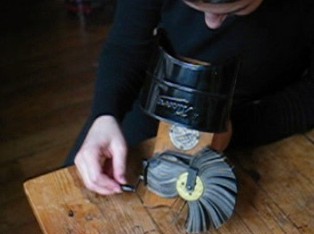
The Mutoscope (left), better known to many as ‘what the butler saw’, was one of the first photographic motion picture viewers. Invented by Herman Casler in 1895, the Mutoscope presented radially-mounted photographs on card which were flicked over in rapid sequence to give an illusion of movement. The American Mutoscope and Biograph Company was formed to exploit this invention, in tandem with 70mm films created by the Mutagraph camera, so that the same source generated product for showing on the big screen to a variety theatre audience or as a private pleasure for the single peepshow viewer. The company eventually shed the Mutoscope part of the business and became simply Biograph, took on a film director by the name of D.W. Griffith, and you know the rest. Other such hybrid technologies, using cinematograph films to generate the photographic sequences for flip cards, were the smaller Kinora viewer, invented by Auguste and Louis Lumière, and the Filoscope, invented by Henry Short.

All this and much, much more is covered by the site, which describes (with beautiful illustrations) an amazing range of flipbook views from the early years of the twentieth-century, demonstrating the interelationships with cinema, and how the form has been employed to illustrate sport, advertising, comic strips, pornography, even news and politics, how it has been used by artists, and how books themselves have use flipbook images. It is an astonishingly diverse field

And that’s not all. As well as the rich selection of images, there are demonstration movies for some of the types of viewer, including the Filoscope and the Kinora (frame grab right). The bilingual (English and French) site is the creation of Pascal Fouché, and is divided up into History, Typology, Viewers, Links (publishers, retailers, artists etc) and a blog (in French). The pags come with footnotes, and the knowledge on display is mightily impressive. Indeed my only criticism is that the search option only works in French – but do use it, because it brings up a whole load more images from a database, apprently of 4,250 flipbooks. Amazing stuff, lovingly put together, but as accessible as it is scholarly. Go explore.