A ragged swarm of adventurers

Here’s another gem uncovered from using Live Search. In fact it’s a text I know well, but I hadn’t realised it was available on the Internet Archive because there is nothing in the title Fifty Years of a Londoner’s Life (1916), by journalist Henry George Hibbert, to indicate its interest to the film historian. But Hibbert’s book contains a lively and observant chapter on the emergence of cinema in London, being especially vivid in describing the rush of showmen and speculators who jumped upon the cinema-building boom after 1910. He is also accurate in pointing out that a previous boom in roller skating rinks, which had collapsed, had left a number of empty venues looking for a new use, and many such were converted into cinemas. And thanks to the Internet Archive, which provides a plain text version, here is that chapter:

THE ROMANCE OF THE CINEMA

Its Introduction to London – A Protégé of the Music Hall – Millions Made, and Lost – Its Wondrous Future

Of all the children to whom the music hall has been foster mother, none was so rapid in its growth, so wayward, so fruitful in surprise as the cinematograph. And, after twenty years of remarkable achievement, it is still, in the belief of them that know it best, but on the threshold of its greatness. “The British public,” said one recorder of its early exhibition, “has a new toy, of which it is not likely to tire quickly”; just as an American writer of the first importance had been interested, but found the cinematograph “a curiosity of no particular importance.” A toy; a curiosity!

Moving pictures, it is still necessary to explain to the technically unlearned, do not move. This illusion was produced by the earliest scientific toy-makers. All the early photographers strenuously endeavoured to capture impressions of movement. Edison casually gave to the world a contrivance known as the kinetoscope, which he did not effectually protect. And from that many inventors toiled simultaneously to develop what we know as the cinematograph.

To the imagination of the Londoner, Robert W. Paul made the first and the most prolonged appeal. He was a craftsman of delicate and ingenious scientific instruments, and, having made a greater, or at any rate a more important contribution to the development of the cinematograph in England than any other, having taught many men of more heroic enterprise, or better luck, how to become millionaires, he retired from the field and returned contentedly to his first calling.

Paul illustrates the romance of invention with a homely picture. When, in the small hours of one morning, his experimental pictures were first endowed with life, in his Hatton Garden workshop, his men uttered a great shout of victory, the police were alarmed and broke in. As a sedative, an impromptu exhibition was administered to them. And so, in the winter of 1895, the cinematograph came to London. In a few weeks it was brought to the notice of Augustus Harris, and, frankly regarding it as an entertainment novelty of an ephemeral quality, he tried a cinema side-show at Olympia, where it competed with Richardson’s show and kindred delights.

Meanwhile Lumière, a Parisian photographer, had arrived at similar results, from a manipulation of the kinetoscope. Trewey, the juggler, and exponent of comic expression with the aid of a flexible felt hat, brought the Lumière apparatus to London, and was certainly ahead of Paul in impressing the cinematograph on the great mass of pleasure-seekers. The music hall agents and music hall managers were incredulous. Trewey resorted to the home of the scientific toy – the Polytechnic, and was looked upon as having achieved the finality of his mission. But he persisted. He arranged an afternoon season at the Empire, in the early days of March 1896. He soon insinuated the cinematograph to the evening programme here. And the reign of the moving picture began. I remember asking Trewey what he believed to be its possibilities in expeditiousness. He declared that if the progress of improvement were maintained a day would come when an occurrence might be reproduced on the screen within forty-eight hours. Whether or not my old friend lived to see his estimate corrected to minutes, I know not. Paul was in immediate succession. Toward the end of March, 1896, his so-called Animatograph was established at the Alhambra, where a tentative engagement, for weeks, was extended to one of years’ duration. Indeed, I do not believe that either of the two great Leicester Square houses has been without some form of animated photograph in all the meantime. Soon a finer apparatus than that either of Paul or of Lumière arrived at the Palace – known as the American Biograph, which for many months drew all London. Its pictures were larger, steadier, more actual. Before the end of 1896 there was not a music hall without its equipment of animated photography. Its scientific, industrial, commercial, and above all its tremendous art possibilities, were not yet conceived or perceived. Let me, as merely of the ministry of popular entertainment, emphasise this fact. The greatest, or at any rate the most appellant, scientific invention of our time, was nurtured in the English music hall, just as the electric light was first exploited as the advertisement of a theatre. A third Londoner completed the group of the pioneers of animated photography – a young American salesman of apparatus, Charles Urban, to whom the higher development of the new invention – its use for illustrating travel, the wonders of nature, and of scientific investigation – has always appealed, more than its use for frivolous amusement – on occasion, debased amusement. And two young Frenchmen, the Brothers Pathe, who began life as the exhibitors of a gramophone at Paris, quickly built up an immense business for the manufacture and sale of apparatus and films.

Imagination recoils from an attempt to suggest the magnitude of the cinematograph to-day. Estimate England’s inexplicably small share, then multiply it many times, and begin the endeavour to appreciate the fact that the cinematograph represents the third largest industry of America, where millionaires operate in its finance as they do in public loans, in railways, mines and steel; where great theatrical managers, dramatists and actors have silenced its menace by alliance, where they think nothing of an expenditure equalling ten thousand pounds on a production, and where they maintain upwards of six hundred picture theatres in a single city, Chicago.

Is English enterprise to follow in the wake of this huge enterprise? There are, at any rate, points of remarkable likeness in the evolution of the cinematograph here. First of all, the fact is to be noted that the pioneers of the industry, in both countries, nearly all retired – a few of them enriched, some of them disappointed and disaffected, some of them utterly broken. There never was a business of such strange mutations. It has been called by one of its most important adherents, Fred Martin – one of my boys, when he first of all aspired to journalism – who is mainly responsible for the manipulation of the exclusive picture and the introduction of the five-reel or “full performance” film here, in preference to a programme of many items, “The Topsy Turvy Industry.”

One of its wealthiest men to-day was a travelling showman. But the experience of the travelling showmen as a community was very different. To a man they abandoned their waxworks and their freaks and their marionettes for the cinematograph. I recall a St Giles’s Fair at Oxford that historic function still retained, but I think then lost, its boyish fascination for me – when, of fifty-one booths, forty-nine enclosed crude cinematograph shows, mostly exploiting vulgar comedy. The travelling showman came next to the music hall in popularising the cinematograph as an entertainment and in supporting it as a manufacturing industry. But he was hoist with his own petard. His success stimulated local enterprise, and when he revisited an old pitch he found a permanent picture theatre established.

Ruin spread among the travelling showmen and a new era in the history of the cinematograph began. Not the Klondyke attracted such a ragged swarm of adventurers. The collapse of the skating rink fever had left numerous sites and building shells free. Wild-cat speculators attracted millions of money from ignorant speculators, always fascinated by the business of pleasure. You could count picture palaces by the score in a brief ride across London. Again a debacle; and the official liquidator busy. But out of the wreck a new, resplendent picture palace – the ideal picture palace – is slowly rising. Its architects have expanded to one hundred thousand pounds in outlay on a structure.

For the short, amusing picture play there will always be a particular market. Elemental amusement will never lose its charm and importance – not till the love of toys is dead in small children and great. But cinematograph has left the nursery, and – still with uncertain eyes – is surveying the world. It has fascinated nearly every great actor, nearly every great author of our time, and liberally rewarded their adhesion to its cause. It is forming its own schools of financiers, and artists, and mechanicians, formerly drawn from everywhere and anywhere. The millionaires of the moving picture world include a clothing salesman, an itinerant conjurer and a music hall “lightning cartoonist.” The redoubtable Charlie Chaplin, now drawing his weekly emolument in thousands of dollars, was a “Lancashire clog dancer.” The greatest producer of the day, D.W. Griffith, who begins his cash account with a retaining fee of four hundred pounds a week, was but a few years ago a desperate actor. Mr Frederick A. Talbot, the historian of the cinema, estimated that four million people visit picture palaces daily in Great Britain. They pay fifteen million pounds out of their pockets annually into the box-offices of the cinema halls, and one person out of every three hundred and fifty one passes in the street depends upon the pictures for a livelihood. Of what individual investment may mean Mr R.G. Knowles is an example. He has outlaid twenty-five thousand pounds on the material of his travel lectures, and his wife, once Miss Winifred Johnson, abandoned the musical career she so adorned to become his secretary, editress, librarian.

Fifty Years of a Londoner’s Life is available in the usual range of formats from The Internet Archive, as has plenty more in the way of fascinating detail on the changing London social scene. Unlike some nostalgists of this era, he does not exclude the modernistic cinema, but sees it as part of the historical thread of the city.

The nightside of Japan

As evidence of the value of Live Search for searching across the texts of books digitised by the Internet Archive (see previous post), here’s a passage from The Nightside of Japan, by Taizo Fujimoto, published in 1914. It’s a travel book on Japan written for a Western audience by a Japanese writer, and it includes this marvellously vivid portrait of attending a cinema show in Tokyo at this time, complete with benshi narrator, interval acts and food sellers.

The Asakusa is the centre of pleasure in Tokyo. People of every rank in the city crowd in the park day and night old and young, high and low, male and female, rich and poor. It is also a haunt of ruffians, thieves, and pickpockets when the curtain of the dark comes down over the park. All houses and shops along each street in the park are illuminated with the electric and gas lights. The most noisy and crowded part is the site of cinematograph halls. In front of a hall you see many large painted pictures,
illustrating kinds of pictures to be shown in the hall, and, at its entrance, three or four men are crying to call visitors: “Come in, come in! Our pictures are newest ones, most wonderful pictures! Most lately imported from Europe! “Men of another hall cry out: “Our hall gives the photographs of a play performed by the first-class actors in Tokyo; pictures of the revenge of Forty Seven Ronine!” Tickets are sold by girls in a booking-box near the entrance of each hall; they are dressed in beautiful uniforms, their faces painted nicely, receiving guests with charming smiles. Most of the Japanese carry geta (clogs) under their feet, instead of shoes or boots, and specially so are the females. When you come into the door of a hall, tickets are to be handed to the men, who furnish you zori (a pair of straw or grass-slippers) in place of your geta, and you must not forget to receive from them a wood-card marked with numerals or some other signs the card being the cheque for your clogs. When you step on upstairs you are received by another nice girl in uniform, who guides you to a seat in the hall. Now the hall is full of people; it seems that there is no room for a newcomer, but the guide girl finds out a chair among the crowd and adjusts it to you very kindly. Pictures of cinematograph are shown one after another, each being explained by orators in frock or evening coat. Between the photograph shows performance of comic actors or jugglers is given. After the end of each picture or performance there is an entr’acte of three or five minutes, and in this interval sellers of oranges, milk, cakes, sandwiches, etc., come into the crowds, and are crying out: “Don’t you want oranges? Nice cakes! New boiled milk! etc., etc.” The show of cinematograph is closed at about 12 P.M., and all people flow out of the hall. Where will they go hence? Of course most of them go to their home, but a part of them young fellows among others runs to the Dark Streets of the park, or Yoshiwara, the licensed prostitution quarter near the park.

The Nightside of Japan is available from the Internet Archive in the usual range of formats (PDF, DjVu, TXT), and contains a few more references to cinematographs. More such gems as I find them.

Live searching

The British Library (the noble institution where I happen to work) has been engaged for some time in a major project with Microsoft digitising some 100,000 books from the nineteenth century. Around 30,000 of these have now been made public available through Microsoft’s Live Search facility (to UK users only). I haven’t investigated this collection to see what possible texts on moving images it might contain, but the news has drawn my attention to Live Search as research source, which I’d quite overlooked.

You will find many digitised historical texts there, as well as current texts where there is limited access (e.g. to 10% of the content), much as you do with Google Books. In truth, the two resources offer much the same results and extras, but I find Live Search superior for the clarity of layout, ease of navigation, the linkages offered, and the word searching. Click in a search term such as ‘cinematograph’ – 1,860 hits – and for each title you get the book record, publication information, hyperlinks to where the search term appears in the digitised text, links to World Cat (if you want to find it in a library somewhere), and where available the opportunity to download the book from the Internet Archive. It is this latter option that particularly appeals, because it offers a far better means to search through texts on the Internet Archive than the Internet Archive provides itself (there you can only search titles and a limited synopsis). Hence many more titles turn up with relevant material for early film studies, including texts not directly about the movies but which have handy incidental information. I’ll be bringing you the results of some of these in future posts.

Update (May 2008): Microsoft has just announced that it has withdrawn Live Search Books, as well as winding down its book digitisation programme. More information here. Sorry.

Timon’s Friendship Adventure

Timon’s Friendship Adventure

As regular readers will know, here at The Bioscope we try to keep up with current trends in silent filmmaking, while those who know me may know that I have an interest in that engagingly oddest of genres, the silent Shakespeare film. But who would have suspected that the two interests might come together, and that Timon of Athens would be its subject?

And so I offer you Timon’s Friendship Adventure, which is a modern silent (in modern dress) based on William Shakespeare’s Timon of Athens. It’s few people’s favourite Shakespeare play, and one of his least filmed (let alone performed), but writer Michael Weinreich, producer Lisa Shapiro and director Max Littman have created this oddity, shot in black-and-white, silent, with intertitles, and a familiar-style piano accompaniment (until, unfortunately, electric guitar and drums kick in halfway through). Jason Davids Scott plays Timon.

There’s website dedicated to the film, which was made in 2007, and has been doing the round of festivals. Timon is one of Shakespeare’s more misanthropic characters, but though in the play he holds a feast for friends who turn out to be false friends when he is in need, he doesn’t slaughter everyone, as happens here. The inspiration seems more Titus Andronicus than Timon of Athens. Anyway, it deserves notice for being different, and for showing that the honourable art of compressing Shakespeare into five minutes (and squeezing out his words while you’re at it) is not lost.

In the dock

Cinematograph theatre in Lordship Lane, London, in 1913, from http://commons.wikimedia.org

Let us celebrate the Bioscope’s imminent passing of the significant milestone of its 100,000th visitor (hurrah) by looking at a major new research resource for British historical studies in general which offers some minor but intriguing opportunities for the early film historian.

The Proceedings of the Old Bailey Online is just that – a fully searchable edition of digitised texts from London’s central criminal court, with details of 197,745 criminal trials. These are trial reports originally published for general consumption. Previously this remarkable resource (a collaboration between the Open University, and the Universities of Hertfordshire and Sheffield, funded by the Arts and Humanities Research Council and the Big Lottery Fund) covered the years 1674-1834. Now the collection has been augmented by texts of trials going up to April 1913 (when the printed Proceedings ceased publication). This makes it an obvious boon for historians of the nineteenth and early twentieth centuries, with a wealth of social detail alongside the intrinsic interest of the trials themselves. It is also a source of huge interest to family historians, who are exploring with nervous/eager anticipation to see if any of their forbears ended up in the dock (I’ve found one such forbear, but happily he was merely a witness to a crime). It is easy and helpful to use, and utterly engrossing to read.

So, given that the records go up to 1913, what is there for the film historian? Well, not a huge amount, but enough to merit further exploration by somebody. There are both cases which involve motion pictures, and cases where the accused or witnesses attended film shows which are recorded as part of the evidence.

For example, consider the case of Manuel Goldberg, alleged user of counterfeit coinage, from 8 January 1907. We get this evidence from one of the witnesses:

LOUISE VALLERS, wife of Henry Vallers, 129, Whitechapel Road, E. We keep a Bioscope Exhibition. I was there on the evening of December 22 last, between five and six, when prisoner came in on see the exhibition. The charge for admission was one penny. He tendered a half-crown. The people pay at the door as they enter. This is the coin marked by myself. I took it and gave him two separate shillings and fivepence change. He said to me, “Are there no tickets?” I said, “No,” and he went to the door again and beckoned to another man to come in. The other man came up, and he also gave me a half-crown for his admission, for which I gave him two and fivepence change. This is the one. I looked at them, being two half-crowns looked suspicious. I tested both of them with acid, and found they were bad. The second-man kept by the doorway, but the prisoner walked right to the end of the shop and sat down and waited for the exhibition. When the second man noticed that I saw the coins were no good, he took to his heels and ran away. I then closed my shop door and sent for a constable. I went up to prisoner, and said, “This half-crown ie no good to me,” and detained him till the other people in the shop had left. I gave him the coin back again. He simply said, “Not” and gave me a two shilling piece and ten halfpennies for his half-crown. A constable came in and I gave him in charge.

This is incidental evidence of a very early cinema in London, from which we learn its location, ownership, the price of admission, the ticketing policy, and the fact that, interestingly, the owner refers to the business as a shop (many early cinemas in London were simple shop conversions). He was found not guilty, by the way.

Next, this simple case report from 20 April 1909:

THOMPSON, William (31, operator), pleaded guilty of stealing two spools and four cinematograph films, the goods of Herbert Crow; also to stealing two spools and six cinematograph films, the goods of Horace Liver and another; also to stealing three cinematograph films, the goods of Frederick Weisker and another.

He confessed to a conviction for felony in 1906 in the name of Albert Storer. Several other convictions were proved, dating back to 1891. It being stated that another charge against him was pending, he also pleaded guilty to that in order that the Court might deal with all matters against him up to date.

Sentence, Two years’ hard labour on each indictment, to run concurrently.

And so on. It is necessary to use a variety of search terms to find relevant material. I’ve found evidence (as it were) using Bioscope, Cinematograph, Cinema, Biograph, Film (though look out for errors in the optical character recognition – a lot of ‘films’ should actually be ‘firms’) and Picture Palace. With the latter you get many glimpses of the regular habit of cinema-going at this time. Use the term Living Pictures, and you find the trial of the renowned anachist group behind the ‘Houndsditch Murders’ and the Siege of Sidney Street, as in this testimony from Luba Millstein :

When I got back to No. 59 Dubof was there; I cannot remember what time he left. Later that night Trassjonsky and I went to see some living pictures. On returning she and I were staying in the back room; Fritz and Trassjonsky lived there together. About midnight I heard two people coming upstairs. On my going to the front room door and knocking Fritz told me I must not come in. A little later the men left and I went with Trassjonsky into the front room and there saw the body of Gardstein lying on the bed. I heard a conversation between Fritz and Trossjonsky. Fritz told her that Morountzeff was wounded…

The only name from the British film industry that I’ve come across is J. Brooke Wilkinson, the future head of the British Board of Film Censors, who in December 1911 was a witness in a case of forgery.

As someone who is researching cinema-going in London at this period, the Proceedings of the Old Bailey Online is an absolute treasure trove to me. But there are other aspects there well worth pursuing, particularly relating to bankruptcy and fraud. Or maybe you’ll just what to find out if those rumours about great-grandfather’s criminal past are really true or not…

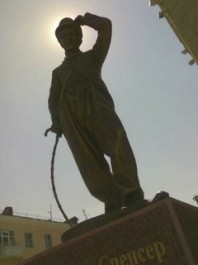
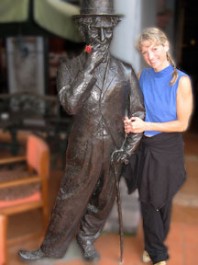
Putting up statues to Charlie

This intriguing news report just turned up on a Kazakhstan news site:

A monument to Charlie Chaplin has appeared in Kostanai last week. As reported, it is the 12th in the world. The very fact of a sculpture to the cinematographe idol being installed in our city is quite weird for the town’s standards, especially taking into account that the only movie theatre in Kostanai was recently demolished. In any case, now we have Charlie and a bench near charlie. And as Farid writes in the local newspaper, “the bench is good enough to sleep on it — that’s practical, because we have as much vagabonds in town as in NYC in early 1900s”.

What intrigues me is where the other eleven statues are. I wasn’t able to find a helpful source for this, and so I set out to track them down for myself – though it all depends on how you define ‘statue’. Anyway, I thought I’d share this information with you; certainly it’s pleasing to see how admiration for silent cinema’s most celebrated practitioner is marked worldwide in bronze. So to start with (left) we have the twelfth and most recent statue, that which has gone up in Kostanai.

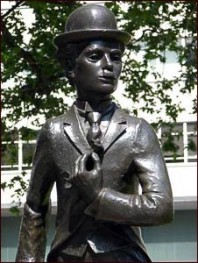
Next, there’s the renowned statue of Chaplin in London’s Leicester Square. He is located in the heart of London’s movieland, with cinemas all about him, while his fellow statues in the Square are Isaac Newton, William Shakespeare, Sir Joshua Reynolds, John Hunter (a pioneer of surgery), and William Hogarth. The Chaplin statue is by John Doubleday, and was created in 1981.

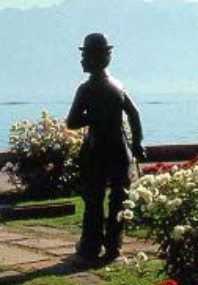
On to Chaplin’s final home, Vevey in Switzerland. In the Square Chaplin, Quai Perdonnet is you’ll find the double of John Doubleday’s statue, showing the little tramp looking out over his favourite view of Lake Geneva and the Alps. It is said to be the subject of pilgrimage, and certainly there are plenty of blogs out there showing people photographed next to Chaplin, leaving flowers there, or even kissing the statue. It was erected in 1982, and is a copy of the Leicester Square statue.

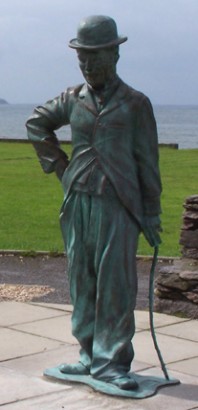
Our next statue is in the seaside town of Waterville, Co. Kerry, Ireland. Waterville was a favourite holiday destination of the Chaplin family. The legend on a stone nearby reads, “For the man who made the movies speak in the hearts of millions. Charlie spent many years in our midst as a welcome and humble guest and friend to many. This image was created by sculptor Alan Ryan Hall. It was funded by the generosity of Josephine Chaplin and by the EU Leader Programme”. It was unveiled in 1998.

And on to Norway. In Oslo, near the Frognerpark, in front of the Coliseum cinema there is a bronze statue of Charlie Chaplin by the renowned Norwegian sculptor (well, renowned to Norwegians, anyway) Nils Aas, dated 1976. Frustratingly, I haven’t been able to track down an image of this in situ [see comments], but here at least is a studio copy. There doesn’t seem to have been any special association of Chaplin with Norway, unlike most of the other statues on view here.

Now let’s away to China, no less. This statue is located outside the ‘Old Film Cafe’. Duolan Road, Hongkou District, Shanghai. The personal connection is that Chaplin secretly honeymooned in Shanghai with Paulette Goddard in 1936. No information as to sculptor or date, but much like most of the statues on display here, you have to say it looks nothing like him. It’s so easy to capture the outline figure, so difficult to capture the man.

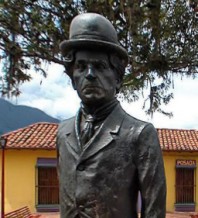
I’m not quite sure why there should be a statue on Charlie Chaplin in Venezuela, but there is. It is located in the city of Mérida, where it is to be found in the Plazoleta Charles Chaplin. No information that I can find as to artist or reason. So on to Disneyland Paris, where a statue of Charlie Chaplin welcomes visitors to the Production Courtyard, but I’ve not yet found a picture of this one.

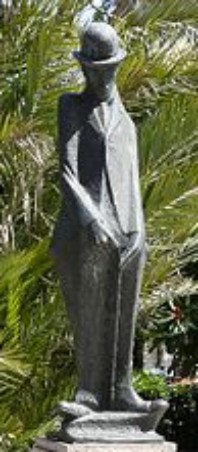
And now we travel to Alassio in Italy. This sheltered spot on the Ligurian coast (the Italian Riviera) is another place where Chaplin often stayed on holiday. The legend on the base of the elongated and not terribly Chaplin-like statue simply reads ‘Charlot’. No information as yet on sculptor or date.

The statue on the left is located in Gabrovo, a small mountain town in Bulgaria. Gabrovo and Gabrovians are apparently the butt of Bulgarian national jokes, but they have responded ingeniously by creating a museum of humour and satire. So it is an appropriate location for a statue of Chaplin. The statue was created by Georgi Chapkanov, and is situated next to Don Quixote and Sancho Panza. It also wins some marks for being a little different.

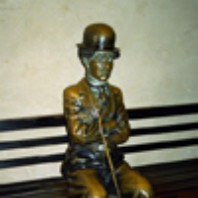
This sitting statue of Chaplin is to be found in the foyer to the Roosevelt Hotel, along Hollywood Boulevard, Los Angeles. It common with most of the statues, there is particular reason for its location. It was at the Roosevelt Hotel where Chaplin received his Academy Award for The Circus in 1929. Another favourite subject for a host of tourist photos.

Well, that makes eleven. Where’s the twelfth? I don’t think the twelve-foot statue of Kermit the Frog as Chaplin outside the Jim Henson Studios (the former Chaplin Studios) really counts. Nor do assorted figures of Chaplin outside restaurants. I think I’ll go with the statue of him outside the Hollywood Entertainment Museum in Los Angeles, which is pleasingly dynamic (pictured left). If anyone knows of any others, or has more information about those described, do say.

Update (16 March 2009): For the news story about the attempt to build a giant statue of Chaplin in India, which have aroused religious protests, see The 13th Statue.

It’s an ill wind…

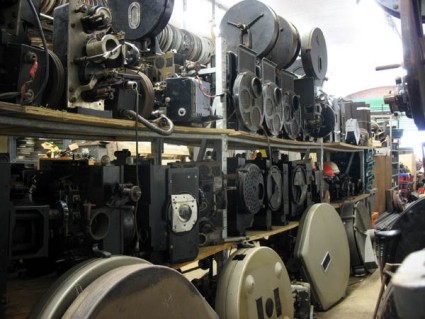
Projectors, sound systems and projection miscellanea, from http://www.cinemamuseum.org.uk

Good news re the Cinema Museum in London, which had been facing a bleak future when it was asked to move out of its current location at a former Lambeth workhouse, as it had not been able to find any suitable new home. Owing to the downturn in the UK property market, the NHS Trust which owns the building has decided not to put it on the market until their signs of upturn. So they have put the Museum on a monthly rolling contract for the next six months after which the position will be reviewed. The search is still on for a long term solution, but for the time being the collection is safe. Here’s hoping a new home emerges, just in time for those green shoots of recovery…

Bioscope Newsreel no. 1

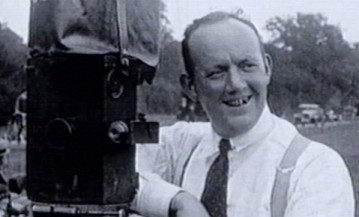
British newsreel cameraman Jack Cotter, working for Pathé Gazette in 1922

I need to do a little more to separate news pieces from background, more discursive pieces, and so I’m going to introduce The Bioscope Newsreel. This will be a gathering of news alerts on silent cinema, with links to further information, released at what will no doubt be irregular intervals. Nevertheless, just like the newsreels (which were of course an invention of the silent cinema), each release will be numbered, there will be an average five stories per reel, and each story will have a mildly jokey title. So here goes with issue number 1…

Filming the father of Indian film
A feature film is to be made of the life of Dadasaheb Phalke, who made Raja Harishchandra, the first Indian fiction film, based on Hindu mythology, in 1913. Learn more.

Read all about it
The bi-monthly PDF magazine on silent cinema, The Silent Treatment, is now available online, with back issues for 2007. Learn more.

Hard times
Flicker Alley is to release a DVD of the important American social dramas Traffic in Souls (1913) and The Italian (1915) in July 2008, under the title ‘Hardships of the New Land’. Learn more.

More from the alley
Flicker Alley is busy at the moment, because also promised in September 2008 is its DVD release of Abel Gance’s pacifist classic J’Accuse (1919) and a Douglas Fairbanks boxed set in November 2008. Learn more.

Repatriation
A collection of American newsreels, documentaries, trailers and promotional films, dating 1912-1927, is being repatriated from the National Film and Sound Archive of Australia to American film archives. Learn more.

‘Til next time!

Laws and cases

It’s high time we had a new addition to the Bioscope Library. Fresh in, and just being stamped and having its classification number assigned is The Law of the Motion Picture Industry (1916), by Gustavus A. Rogers. This is the text of a lecture given by a New York lawyer to the College of the City of New York on 28 November 1916. The legal side of early film may not seem to have that much appeal, but it is a crucial subject to grasp. Laws existing and laws which had to be devised for the purpose not only governed but helped define the new medium.

Gustavus A. Rogers proves to be a helpful guide, with a clear-sighted view of his subject and much case law that he is able to cite as milestones in the development of cinema as a social entity. There is a particularly helpful section on patent law (“Ask the average person who is the inventor of motion pictures and the answer will be, Thomas A. Edison. Mr. Edison himself would probably agree that he is the inventor, but the courts have held otherwise”.) and the formation of the Motion Picture Patents Company, which sought to restrict trade to those businesses which recognised Edison’s film patents. Out of this history Rogers draws some fascinating and helpful definitions of what motion pictures actually were (in law), what the technology was there to achieve, and how a motion picture production was to be defined. He cites in the important case of the Kalem Company v Harper Brothers, which determined that the Kalem 1907 film Ben Hur infringed the copyright of the Lew Wallace book on which it was based. Rogers’ interest is in what the ruling meant for the definition of a motion picture in other legal proceedings. He says that the the case had not “definitely determined as to whether a photo-play is really ‘a commodity’ or whether as such it comes under the jurisdiction of the Federal Anti-Monopoly Law”. Rogers’ inference from this is interesting:

I am, however, of the opinion that whenever it will become important to effectually dispose of the question, that it will be found that there is no difference between the photo-play and the celluloid record which is used upon the phonograph, or the picture postal-card. For, after all, what is sent in commerce is a strip, or strips, of film, contained in rolls of approximately a thousand feet each. On these are still photographs that are commercially useful when put into a projecting machine and ground out to portray the story on the screen, in the same manner as the phonograph record is put upon the machine for the purpose of reproducing the musical sounds or matter contained on the record.

This short document (sixty pages) is therefore useful not just as a survey of the law’s engagement with motion pictures to 1916, but as a thoughtful disquistion on what a motion picture actually is. There is useful discussion of trade marks, copyright law, censorship (with comparisons of the state of things in America, Britain and France), Sunday legislation, and an overview of the laws regarding motion pictures in various European countries. It’s available from the Internet Archive in DjVu (1.6MB), PDF (5MB), b/w PDF (1.5MB) and TXT (122KB) formats.

Neversink Valley Area Museum

The Neversink Valley Area Museum is in Cuddebackville, NY, an area know to film historians as a popular location for New York film companies in the pre-Hollywood era. In particular it was a favoured location of D.W. Griffith and the Biograph company, which filmed in Cuddebackville six times over the period 1909-1911. The local museum (which takes its name from the optimistically-named Neversink river) has a section on filmmaking in the area (Thanhouser and the Victor Film Company were other visitors). But more than that, it has established competitions for silent filmmaking today and writing scores or silent films. The rules for the silent film competition are as follows:

We will accept any film up to 18 minutes in length, it may be from any country and does not have to premiere at our festival. Films currently in distribution are not eligible.
Film makers to submit entries on DVD (all region compatible, as one judge is UK-based).
Length not to exceed 18 minutes.
No synchronized sound.
Music, if used, must be original or provide proof of licensing.
Intertitles acceptable.
DVD should be marked with Title Only.
Enclose sheet with all credits in submission packet.

And here are the rules for the original film score competition:

Entrant to compose an original score for one of these three films: King Lear, The Vagabonds and The Marvelous Marathoner, all made by Thanhouser Motion Picture Company.
Thanhouser will provide a copy of the film to interested entrants.
The winning entry (i.e. film + winner’s music) will be posted on the Thanhouser web site for viewing the winner can use the film with their music royalty free.

Prizes are to be announced later. All screenings to take place 23 August. Further details and application form on the museum’s website.