The Muybridge controversy

Eadweard Muybridge, The Human and Animal Locomotion Photographs, published by Taschen

The long-awaited Eadweard Muybridge exhibition opens at Tate Britain on 8 September, running until 16 January 2011. The exhibition has been developed by the Corcoran Gallery of Art, Washington DC, where it ran April-July under the title Helios: Eadweard Muybridge in a Time of Change. The Tate exhibition is entitled ‘Eadweard Muybridge: The Photographer who Proved Horses Could Fly’, which has to win some sort of an award for direst exhibition subtitle of the decade, but the change from the Washington show is significant. Because since the Muybridge show opened in America controversy has arisen over the authenticity of some of Muybridge’s works, and in particular the name ‘Helios’.

‘Helios’ was a name adopted by Eadweard Muybridge when marketing his photographs in the United States in the 1860s, in the period before he took up sequence photography. Muybridge had emigrated from the UK to the USA in 1851, when his surname was still that which his parents would have recognised, Muggeridge, and initially was involved in book selling. He moved to California and changed his name to Muygridge. After a traumatic stagecoach crash he returned to Britain in 1860. The biography is a bit vague for the next few years, but somewhere along the line he pick up considerable skills in the wet collodion photographic process. He returned to the United States in 1867, traded as Helios, and revealed himself to be a photographic genius (now named Muybridge), with stereoscopic and panoramic views of landscapes and cityscapes which reached the pinnacle of the art-form. Then in 1872 he was approached by railroad baron Leland Stanford to help settle a debate about whether a horses hooves left the ground when galloping, using rapid photography, and the rest was proto-motion picture history.

‘Helios’ photograph of Yosemite Falls, credited to Eadweard Muybridge, from Yosemite: Its Wonders and Its Beauties (1868) by John S. Hittell, c/o http://www.yosemite.ca.us. Note the ‘Helios’ credit in the bottom right-hand corner

The controversy lies in the ‘Helios’ period. Just as the Washington exhibition opened, a photography historian Weston Naef was interviewed for a fairly explosive three-part piece about Muybridge for Artinfo which claimed that much of Muybridge’s work at this time was the work of another photographer, Carleton Watkins, who photographed the Yosemite region at around the ame time as Muybridge. Here are the three parts:

You’ll have to read Naef’s interview to get the full conspiracy theory, but essentially he argues that Muybridge bought negatives from other photographers, particularly Watkins, marketing them under the ‘Helios’ name, then goes on to claim that Watkins taught Muybridge all he knew, sometimes standing over him to coach him (there is no evidence for either of those last two assertions). There are two aspects to this: the arguments and the conclusion. The arguments range from the intriguing to the silly. The silliest is where Naef says that no one could become a photographic genius with the speed that Muybridge showed, giving this reasoning:

It seems very likely that when Muybridge returned to San Francisco in 1867 that he would have acquired — in the same way he acquired patents and the rights to publish books — he would have used the same kind of method to establish himself in a new business in San Francisco, and that new business would have been as a publisher of photographs rather than as a maker of them. There is no evidence for how in 1868 he could have gained the mastery required to make many of the exceptional small works that are on view in the first several galleries. The mystery remains: When did Muybridge perform the 10,000 hours of practice in photography that people who are involved in studying the psychology of learning believe is required to become a world-class master in any subject?

What tosh. There are very few people who put in 10,000 hours of practice at anything and come out geniuses. They come out as averagely proficient. Geniuses tend to leap-frog the stages that we ordinary mortals have to follow, and to do so damn quickly. Muybridge was a photographic genius because he was gifted.

But if some of the reasoning is faulty (and I should add that Naef has many more arguments in favour of the photographer he admires, namely Watkins), the conclusion has an element of probability about it. Why might not have Muybridge marketed the work of others under the Helios trademark? He was a businessman before he became an artist (or scientist, depending on your point of view). It may have taken a while before he saw photographs as something he wanted to create rather than objects he wanted to sell. It’s a speculative area that merits further investigation, but with the realisation that this is but one small aspect of the career of a major creative artist. One of the exciting things about Muybridge is that we are still discovering so much about him, and that so many intriguing mysteries remain about him.

Naef’s allegations have led to all sorts of online speculation. The best responses have been Muybridge authority Stephen Herbert’s Muy Blog, which looks at Muybridge’s ‘lost’ years of the 1860s while artfully debunking Naef, and Rebecca Solnit, author of the excellent Muybridge biography Motion Studies (aka River of Shadows) whose piece in The Guardian ably defends Muybridge against the campaign of innuendo.

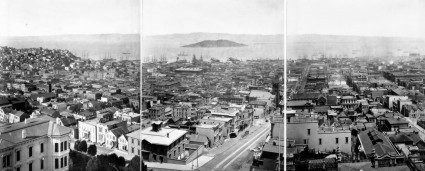
Part of Muybridge’s 1878 photographic panorama of San Francisco, from America Hurrah!

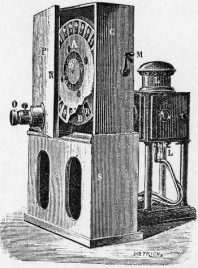
Meanwhile, there’s a major exhibition to enjoy, which promises to bring together “the full range of his art for the first time”, exploring the ways win which Muybridge created and honed such remarkable images, works which influenced artists such as Marcel Duchamp, Francis Bacon and Philip Glass’s music, and which continue to resonate powerfully with artists today. Highlights include a seventeen foot panorama of San Francisco and recreations of the Zoopraxiscope (pre-film motion pictures on a disc) in action.

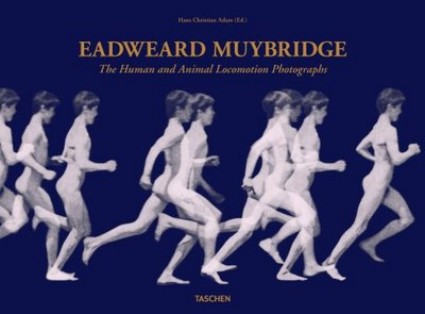
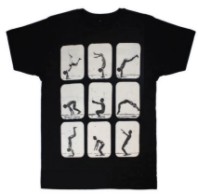
Needless to say, plenty of associated publications and events will be around to coincide with the exhibition. Most exciting among the former is probably going to be Taschen’s monumental Eadweard Muybridge, The Human and Animal Locomotion Photographs (published 25 September), put together by Hans Christian Adam. This reproduces all 781 plates from Muybridge’s Animal Locomotion (1887), the entirety of The Attitudes of Animals in Motion (1881), and an authoritative chronology by Stephen Herbert. At long last it looks like we have a replacement for the venerable volumes produced by Dover Publications. No less essential will be Marta Braun’s new biography, Eadweard Muybridge, published on 24 September, by Reaktion. Plus there’s the exhibition book, Eadweard Muybridge, edited by Philip Brookman, and from the Tate shop an irresistible selection of Muybridgean goodies, including posters, bags, calendars, prints, postcards, notebooks, T-shirts, rulers, and the inevitable fridge magnets.

Muybridge photographic sequences, from http://www.taschen.com

On the events side, Muy Blog provides this list (with the promise of adding more as they emerge):

Eadweard Muybridge at Tate Britain
8 Sept – 16 Jan
Tate Britain, Millbank
First major UK retrospective of Muybridge’s entire career.
Tickets £10/£8.50 from htpp://www.tate.org.uk/britain

Muybridge in Kingston Launch Day
Sat 18 Sept 12.30-7pm
Kingston Museum & Stanley Picker Gallery
Public launch of the Muybridge in Kingston exhibitions with special events for all the family, including a magic lantern show from Professor Heard, shadow puppetry from Zannie Fraser and an evening launch lecture on Muybridge’s links to the history of the moving and projected image by Muybridge expert Stephen Herbert.
All welcome – no booking required.

Park Nights at Serpentine Gallery Pavilion
Becky Beasley & Chris Sharp
Fri 24 Sept 8pm
Serpentine Gallery, Kensington Gardens
13 pieces, 17 feet is a monologue in thirteen parts that finds its point of departure in Muybridge’s extraordinary 1878 San Francisco panorama.
Tickets £5/£4 from http://www.serpentinegallery.org/park_nights/

Late at Tate: Eadweard Muybridge
Fri 1 Oct 6pm-10pm
Tate Britain, Millbank
An evening of Muybridge-inspired events.
Visit htpp://www.tate.org.uk/britain for further details.

In Conversation: Trevor Appleson
Wed 6 October 7pm
Stanley Picker Gallery
Exploring Muybridge’s influence on contemporary arts practitioners.
Limited seating – to reserve a FREE place please call 020 8417 4074

Muybridge & Moving Image History
Thurs 14 Oct, 28 Oct & 11 Nov 7pm
Kingston Museum
Evening lecture series offering unique insights into the relationship between Muybridge’s work and the history of visuality, film and animation.
Limited seating – to reserve a FREE place please call 020 8547 6460

See also the events programme given on the Muybridge at Kingston site (Kingston-on-Thames being the birth and deathplace of Muybridge and home of a huge collection of his works at its museum).

Once again, the Tate Britain exhibition runs from 8 September 2010 to 16 January 2011.

Well, all I can say is, beat that, Carleton Watkins.

Spinning the Spirograph

A Spirograph with disc in position, from http://www.westlicht-auction.com

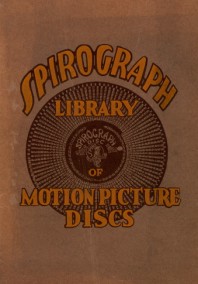
We all know about having motion pictures in disc form. DVD and increasingly Blu-Ray are the domestic formats of choice, and we all understand that films need not appear as strips of film. What is not generally known is that there is nothing new about films in disc form, indeed that films could be found in this form from the earliest years of cinema – indeed the disc form precedes the motion picture film. The recent appearance online (40MB) of a catalogue for the most significant of the film disc formats before DVD – the Spirograph – is the spur for this quick history of the format.

Before there were films there were motion pictures in disc or in circular form. A number of the optical toys and motion picture devices of the nineteenth century involved sequences of images arranged around a disc, with some form of intermittency to enable the viewer to experience the illusion of movement. They included the Phenakistoscope (figures on a disc with slotted edges, effect illustrated here from MOMI), the Zoetrope (sequential images aranged around the inside of a drum with slit holes) and Eadweard Muybridge’s Zoöpraxiscope, which projected images in motion arranged around the edge of a glass disc.

When inventors first began combining the principles of such optical devices with photography, again some looked to discs to provide the solution, particularly if they were reproducing brief sequences (i.e. brief enough to fit within one rotation of the disc. In 1884 John Rudge patented a device which exhibited seven sequential lantern slides of posed photographs (so not motion truly captured by photography) arranged in a circle. The 1887 Tachyscope of Ottomar Anschütz exhibited a disk of twenty-four glass 9×12 cm diapositives turned by a crank. In 1892 Georges Demenÿ took sequential photographic images on celluloid film which were transferred to a glass disc and projected by means of his Phonoscope device (also known as a Bioscope, above). The sequences, of which a man mouthing the words ‘Je vous aime’ is the most famous, were fleeting, but they were motion pictures derived from photographs.

The problem with the use of glass discs was the brevity of the motion sequences. However, before he introduced his successful motion picture system utilising 35mm film strips, Thomas Edison had instructed his engineers to produce a viewing system which arranged celluloid images in micro-form around a cylinder. This wasn’t just being circular for circularity’s sake – the idea was to match motion pictures to devices for the playback of sounds (in this case, Edison’s Phonograph), and early motion picture efforts at creating a disc-based system were clearly driven by a belief that emulating the gramophone disc was the route to creating a successful device for home use.

Kammatograph, from http://www.victorian-cinema.net

It is often forgotten that many of the first motion picture producers saw the domestic market as being their route to riches. This made sense. The Eastman Kodak had put still photography in the hands of anyone; surely the same would occur for motion photography. It was a market that would remain elusive until the introduction (by Eastman) of 16mm film in 1923, but among the various attempts to crack the amateur market were disc-based systems, which offered a simpler, safer option to cameras and projectors using inflammable film.

Among the first and most significant of these was the Kammatograph. Invented in 1898 and marketed from 1900 by Leonard Ulrich Kamm, a Bavarian-born, London-based engineer, the Kammatograph utilised a 12-inch circular glass plate with notched edges caught by gearing with provided the necessary intermittency. There were 350 or 550 sequential images on the disc, arranged in a spiral, giving 30 or 45 seconds running time. It was aimed at the amateur market, and with those lengths of ‘film’ the idea must have been to encourage the filming of portrait shots, akin to snapshots. Not that much is known about the actual use of the Kammatograph, but two of the most prominent users of the device were not ordinary members of the public. William Norman Lascelles Davidson used a Kammatograph for his 1901 experiments on colour cinematography, while Rina Scott (Mrs D.H. Scott) was a botanist who used a customed Kammatograph to make time-lapse films of plant growth.

Theodore Brown with his invention, the Spirograph

There were other disc-based systems at this time, often developed as toys for children, among them Cinéphot developed by Clermont-Huet in 1904 and the Animatograph of Alexander Victor in 1909. However the great name is the pre-DVD history of disc-based cinema is the Spirograph. Its history is one of what-might-have-been, and it has of late become an almost cultish subject for those interested in forward-thinking technologies that nevertheless failed to succeed commercially.

The Spirograph was the creation of British inventor Theodore Brown (his wife Bessie was co-patentee) in 1907. It followed the basic idea behind the Kammatograph in presenting motion pictures in the form of miniaturised images arranged on a disc – though Brown’s original idea was to have the images arranged concentrically (he was thinking of very brief sequences and aiming for the toy market), and was tending towards using celluloid rather than glass. However his patent stated that the images could be arranged concentrically or spirally. Brown took the idea to documentary producer Charles Urban, who purchased the patent outright from Brown (supposedly for the hefty sum of $18,000, or £3,600). Urban did not work on the idea immediately, and indeed it was in need of considerable development work before it could be brought to market on the scale that Urban envisaged.

During the First World War, Urban put his engineer Henry Joy onto the task. The images were now arranged in a spiral, the results looking remarkably close to Victor’s earlier Animatograph. The first commercial version was due to appear in the USA in 1917, under the name of the Spiragraph [sic], and then the Homovie. There was no camera planned for sale, only a projector. But a hoped for $1,000,000 flotation of the Urban Spiragraph Corporation was a failure, and further work was held off until after the war.

Spirograph disc and the disc in its sleeve, c.1924, from http://www.spiracollection.com

Urban attempted to re-introduce the re-named Spirograph through his post-war American business Urban Motion Picture Industries, located at Irvington-on-Hudson. The Spirograph in its final form was designed for simplicity of use, being a compact box on a small plinth, operated by a handle, with the exposed disc mounted on the front. The 10½ inch disc was made of safety (i.e. non-flammable) celluloid film, and carried 1,200 frames in a spiral of twelve rows, each frame being 0.22 inches x 0.16 inches. These were miniaturised via a microscopic device from standard 35mm films in the Urban library (using original films between 85 and 100 feet in length, or no more than one-and-a-half minutes long). The Spirograph could project an image four feet wide at a distance of twenty-five feet. It was hand-cranked, with an electrical lamp, and users could halt the disc at any point for illustrative purposes. It was a liberating technology, devised with the teacher in mind – portable, flexible, affordable (the price was to have been $125 per machine and $1.00 per disc), easy to use and useful, except that the films themselves were so short. You can only get so many physical images on a disc. And that probably spelled the Spirograph’s doom

Urban’s intention was to make a huge impact on the burgeoning educational market. While his initial target in 1917 seems to have the home user, now he saw schools, clubs and libraries as his main audience, and he devised imaginative subscription schemes for the hire and return of discs. Urban’s extensive library of non-fiction films stretching back to 1903 would supply the content, thereby finding a new outlet for films that had otherwise ceased to have a commercial value. By the end of 1922 a substantial library of discs was prepared, described in lavish catalogues, with 4,000 Spirographs ready for shipment [update: it is very unlikely that there were actually 4,000 Spirographs made], and a major publicity programme in readiness. But it never happened. Urban’s business overall hit the rocks in 1923 – a simple case of trying to do too much with too little money behind him – and Urban Motion Picture Industries went into receivership in 1924. The Spirograph never made it into the thousands of schools, clubs, halls and homes that Urban dreamt of, and 16mm film (introduced in that fateful year of 1923) gave the target audience a technology that was just as safe and could provide longer films. The Spirograph could be spun no more.

However, that wasn’t quite the end of the Spirograph. The appearance online at the Bibliothèque numérique du cinéma of a 1928 catalogue of Spirograph discs (40MB) shows that the Spirograph did have some sort of commercial life. After the collapse of Urban Motion Picture Industries in 1924 various parts of the Urban empire were picked up by a number of companies, some created for the purpose, among them the Spiro Film Corporation. Little is known about the New York-based company except the obvious source of its name, but clearly it was catering for a market which already had its Spirograph players, since the catalogue makes no mention of how to obtain these, instead restricting itself to listing and describing the 400 discs in the Spirograph collection under such headings as Science, Literature, Government, Physical Activities and Our Government. Theodore Brown himself picked up on residual rights in the Spirograph to market the device in the UK after 1924, but neither he nor Spiro made any success of a technology whose time had passed before it even had a chance to get going.

So the Spirograph Library of Motion Picture Discs (1928) goes into the Bioscope Library’s Catalogues and databases section as part of Catalogue month (which has now crept inexorably into September). The Spirograph is a fascinating technology, not just for its ingenuity but for its potential based around the needs of those outside the commercial exhibition sector. It put the individual user first. Film history, indeed technological history overall, is filled with blind alleys. Looking back on failed systems and collapsing businesses we can see different ways in which things might have gone, and contemplate an alternative cinema history. Instead it took until the 1980s for films to return to disc form for the domestic market (Laser Discs) and the mid-1990s for DVD to gain widespread acceptance among people at large, not because they wanted to be educated but because they wanted to be entertained. And the films were longer.

Finding out more

  • Stephen Herbert’s Theodore Brown’s Magic Pictures is a beautifully-illustrated biography of the Spirograph’s multi-talented inventor
  • On Charles Urban’s Irvington-on-Hudson venure, including the fateful development of the Spirograph, see my Charles Urban website
  • Close-up images of a Spirograph and disc are available on the Spira Collection site (no connection with Spirograph itself – it is the collection of George Spira)
  • A illustrated list of glass and disc-based motion picture systems is given on the very useful One Hundred Years of Film Sizes site (though the dates given for the Spirograph are incorrect)
  • In 2003 a George Eastman House restoration of a Spirograph disc entitled Man’s Best Friends (i.e. dogs) was presented (on the big screen in 35mm!) at the Pordenone Silent Film Festival (the catalogue date of c.1913 is incorrect – the disc would be c.1921-22)

Tuff times are here again

“emBodying Toronto” by Joyce Wong and Sonia Hong, 1st Place Winner at TUFF 2009

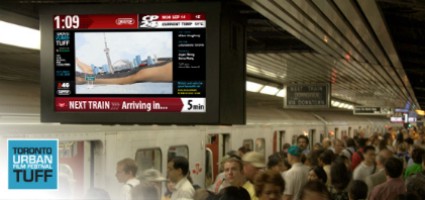
TUFF is the annuel Toronto Urban Film Festival, which has the noble ambition of showing new silent films to the commuters of Toronto. The festival, which takes place 10-19 September 2010, comprises an urban-themed programme of new one-minute silent films, which run repeatedly on the ONESTOP digital network of over 270 platform screens on fifty subway platforms of the Toronto Transit Commission (TTC) for ten days, reaching 1.3 million daily commuters. The top three films of the festival are chosen by a guest jury and guest judge; this year the judge is director, producer and screenwriter Deepa Mehta. The festival is now in its fourth year.

TUFF films on exhibition on a Toronto subway platform

TUFF is open to Canadian and international submissions by video artists, filmmakers – trained and untrained – animators and ‘urbanites’ with cameras or video-capable mobile devices. Filmmakers are asked to submit one-minute silent videos addressing one of seven themes: Urban Encounters; Urban Diversity; Urban Journeys; Urban Imaginary; Urban Natural; Urban Secrets; and Urban Ideas. Only the leading entrants in each category get to be screened on the TTC, from the hundreds of submissions made each year. The winning videos in each category from 2009 are now available to view on the TUFF site or on the festival’s YouTube channel (including entries from previous years).

The London Project

Next up for Catalogue Month (our survey of online catalogues and databases, selected for inscription in the Bioscope Library) is The London Project. I did write about this in the very early days of the Bioscope, in a very cursory manner, and it is high time that we returned to it. It’s a work I know quite a bit about, since I produced half of it, and it’s something of which I’m quite proud, even if the database has become a little compromised since the time when it was published in 2005, because it has not been possible to update it since. Databases should never be allowed to stand still. It is contrary to their nature.

The London Project database documents the film venues and film businesses to be found in London during the period 1896-1914 – around 1,000 venues and 1,000 businesses all told. It was the major output of a year-long project (2004-05) sponsored by the AHRB Centre for British Film and Television Studies, hosted by Birkbeck, University of London, and managed by Professor Ian Christie. The two researchers were Simon Brown (working on film businesses) and myself (working on cinemas and audiences). As well as the database we produced several essays, conference presentations and a touring exhibition (‘Moving Pictures Come to London’). But the star of the show was the database.

Interior view of Hale’s Tours (a film show set inside a mock train carriage) on London’s Oxford Street, which first opened May 1906

The London Project documents film businesses in London 1896-1914 and film venues (a more inclusive term than cinemas) from the date of the first identifiable cinema in London (The Daily Bioscope, opened May 1906), again to the start of the First World War. The information is taken from a wide range of sources, including film and stage year books, film trade papers, street and business directories, the records of the London County Council, local newspapers, published and unpublished memoirs, police reports and company records. The database allows searching by name of venue or business, address, London borough (as they were pre-1914), by business type (e.g. production, distribution, production, exhibition, venue), and by person (including notes relating to people).

A typical film business record will give you name, address (and any secondary addresses), category and tp of business, original share capital, trading information, the names of directors, and sources. Names and sources are hyperlinked to other records, making the pursuit of such links a fascinating business as you discover that, say, Cecil Hepworth was not only the managing director of the Hepworth Manfacturing Company, but a director of Film Agency (Russia) Ltd. You find all sorts of unexpected additional business interests and alliances in these lists of directors, especially as we chosen to interpret the film business quite broadly and to include equipment manufacturers, cinema uniform suppliers, electrical engineers, vending machine suppliers, musical instrument suppliers, and so on, reflecting the larger picture of what the cinema business really was (as indicated by the lists of such companies provided by the film trade year books of the period).

Film venues covers every sort of entertainment place in London which showed film on a regular basis betwen 1906 and 1914. That means cinemas, of course, but also theatres, music halls, town halls, sports arenas, converted shops, public baths and amusement parlours. The records are not as extensive as those for businesses (more’s the pity) but they do give you name, address, audience capacity, notes, related businesses and people, and sources of information. So it is possible to trace every cinema managed by Montagu Pyke or by Electric Theatres (1908) Ltd, or to pursue every film show surveyed by the Metropolitan Police in 1909 at a time of social alarm at these new dens of vice which allowed the young of either sex to mix unchaperoned in the dark.

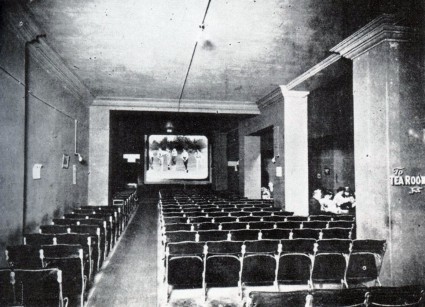
The Bioscopic Team Rooms, aka The Circle in the Square, the first true cinema in Leicester Square, opened June 1909

One feature we were particularly pleased with is the map of London boroughs, which allows you to search for businesses and venues in say Chelsea, Wandsworth, Lambeth or Poplar. It was an important part of the project that we were able to connect cinema history to social history and in particular to the many other histories of London. Geographical data is a good way of helping to achieve this, though we had neither the time nor the resources to take this further and use GIS data or mapping software.

Indeed there is much about the database that could do with an update, as new information has come in and there are plenty of corrections that need to be made. And if only we could have added pictures. But the project money ended in 2005 and it has not been possible to add to the database since. It is hosted by Birkbeck, and I hope that the university continues to do so and to maintain the URLs as they are – each individual business and venue has a unique web address with its ID number included in the URL, essential for citation and future reference.

If you want to pursue the project’s work further and look at what we wrote, four of our essays are freely available online (at present):

The London Project website itself has background information on the project and on the London of the 1896-1914 period. The database is a freely-available resource, and even if the website is not being updated there is still an email address on the site to which you can send fresh information. It’s being collected, somewhere, and maybe one day a fresher, more extensive London Project database will emerge, one that might even go beyond 1914 or beyond the confines of London. We can but hope.

Kevin, Roger and Metropolis

Kevin’s wineglass

Well, it’s been quite a day. As all the silent world knows by now, the Academy of Motion Picture Arts and Sciences has decided to award an honorary Oscar to Kevin Brownlow. Together with Francis Ford Coppola (who is receiving the Irving G. Thalberg Memorial Award), Jean-Luc Godard and Eli Wallach, he will be receiving his Academy Award at the Academy’s 2nd Annual Governors Awards dinner on Saturday, November 13, at the Grand Ballroom at Hollywood & Highland Center. To quote from the Academy’s press release:

Brownlow is widely regarded as the preeminent historian of the silent film era as well as a preservationist. Among his many silent film restoration projects are Abel Gance’s 1927 epic “Napoleon,” Rex Ingram’s “The Four Horsemen of the Apocalypse” (1921) and “The Thief of Bagdad” (1924), starring Douglas Fairbanks. Brownlow has authored, among others, The Parade’s Gone By; The War, the West, and the Wilderness; Hollywood: The Pioneers; Behind the Mask of Innocence; David Lean; and Mary Pickford Rediscovered. His documentaries include “Hollywood,” “Unknown Chaplin,” “Buster Keaton: A Hard Act to Follow,” “Harold Lloyd: The Third Genius” and “D.W. Griffith: Father of Film,” all with David Gill; Brownlow also directed “Cecil B. DeMille: American Epic” and “Garbo,” the latter with Christopher Bird.

Never was an Academy Award more richly deserved, nor – so far as I know – has such an award ever gone to a film historian [correction – he’s the third – see comments]. Brownlow is far more than a historian, of course, being a filmmaker, film preservationist and programme maker, but it is his principled and dedicated investigation into silent film history (out of which has come preservation, exhibition, writing and programmes) that stands out. He made silent films special once again.

By happy chance I met Kevin today, being warmly congratulated by all. I asked if I could take a photo of him for the Bioscope – he said I could take the photo, but not publish it online (there have been too many photos, he said), so I have acceded to this request and instead have published a quick snap made of the wineglass he was holding. Cheers to you Kevin.

The event we were both at was a retirement party for Roger Smither, held at the Imperial War Museum in London. Now while Kevin Brownlow is famed among all who revere silent films, Roger will only be known by a few, but his contribution to film history and film culture has been no less important. He retires as Keeper of the IWM’s Film and Video Archive, arguably the world’s oldest film archive (it was founded in 1919), and has presided over the British official film record of the First and Second World Wars, including hundreds of classic titles, and for the First World War a marvellously rich collection of silent film material documenting evey aspect of the war, including the home front experience. He was instrumental in the restoration of The Battle of the Somme (1916) and its inscription on the UNESCO Memory of the World register. He has written knowledgeably on the Somme and other war films in many publications, and he edited the weighty classic This Film is Dangerous, a history of nitrate film, published by FIAF – a body of which he was Secretary-General for some years. He has been an exceptional servant to film archives and the Bioscope warmly wishes him a happy retirement.

Metropolis

And then I left the party to go and see another filmed inscribed on the UNESCO Memory of the World, Metropolis – specifically the 2010 restored version receiving its UK premiere at the BFI Southbank. It’s interesting speaking to some film archivists to pick up on a bit of a backlash against the Metropolis restoration, which is perhaps a reaction to all the hype. Some are saying that the 16mm inserts don’t add anything, that the film was better the way that it was, and that the whole business is being oversold. Well, seeing the film at last for myself I was hugely impressed by the restoration. It seemed to me to be a model presentation of the material, with the 16mm material clearly of a substandard quality but giving a special thrill to the audience whever it turned up, as you picked up on what had been cut and why, so that you ended up with the sense of watching two films – the one we’ve known before, and the one we have now. It was an engrossing lesson in film restoration and the mutability of cultural artefacts.

The film itself I have never much loved, aside from the exceptional robot transformation sequence, and it seems even more ridiculous than ever. The additional sequences make the filmmakers’ intentions clearer, but they also expose what a muddled plot the film has (and why the cuts were made in the first place). It is muddled not only in narrative, but in conception, dramatic motive, politics and morals. It is a stupendous folly, packed full of glorious, iconic images, but without a single credible idea to hold them together.

I don’t know if the comparison has been made before, but I kept on thinking of Cabiria (1914). It wasn’t just that both films have Moloch scenes, or the histronics of Metropolis that hark back to an earlier age (the film critic Geoff Brown once memorably said of Alfred Abel’s performance that he played someone who, if you asked him what the time was, would mime the operations of a sundial). Metropolis and Cabiria were each epic European productions of the kind that (in the immortal words of Sam Goldwyn) starts out with an earthquake and works its way up to a climax, with buildings tumbling down and flood waters threatening to drown all. The humans are mere ciphers; chaos is all. The spectacle was designed to overawe audiences and to outdo what could be done on the American screen. In a way, Metropolis was a very old-fashioned sort of film for 1927.

Mad folly it may be, but it’s a film that has to be seen, and then argued over. There are ample opportunities to do so now that it has reached the UK – see the list of screenings provided by Eureka Entertainment. The DVD will follow shortly, but it’s a film for the cinema screen if you can.

Busy, busy, busy

Things are a bit hectic down at Bioscope Towers these days, and what with broadband problems, not only is it hard to find time to write posts but even when the time does appear I can’t post them. So, in my lunch break, and before heading off to the Imperial War Museum to mark the retirement of its highly estemeed Keeper of the Film and Video Archive, Roger Smither, and then to the BFI Southbank to see the ‘new’ Metropolis, here are links to some interesting posts on silent cinema which other bloggers have produced lately.

Doing things differently
George Clark reports on the pioneering programme of early films shown at the recent Oberhausen Short Film Festival, for AP Engine. Enthusiastic, but not uncritical.

From the career of Louis J. Mannix
Nick Redfern, at the highly impressive Research into Film blog, takes a break from statistical analysis to tell us about (and quote from) the rare memoirs of a Leeds projectionist operating in the silent era.

Never too late silents
Kristin Thompson assesses the silent films of Joseph von Sternberg through the recent Criterion DVD set at the indispensible Observations on Film Art blog that she shares with David Bordwell.

Kevin Brownlow to receive special Oscar
From the San Francisco Silent Film Festival blog, news that Kevin Brownlow is to be awarded an honorary award from the Academy of Motion Picture Arts and Sciences. Huge cheers and hats in the air about that piece of news.

The Lindgren manifesto
And from my other, infrequently updated blog, Moving Image, here’s philosopher-film archivist Paolo Cherchi Usai’s provocative but thought-provoking fourteen-point manifesto for film curators of the future, named after the founder of the BFI National Archive. Make of it what you will.

Filmportal

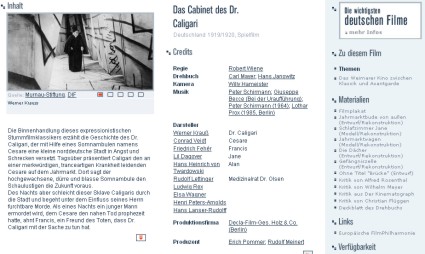
We return to Catalogue Month, during which the Bioscope is highlighting freely available filmographic catalogues and databases for silent film, while entering them into the new Catalogues and databases section of the Bioscope Library. Next up is the first electronic database to be listed, though it is a resource that we have cited several times in previous posts as among the most useful and reliable out there. The database is the Deutsche Filminstitut’s Filmportal, an encyclopaedic database of information on German cinema.

Filmportal documents some 73,500 German fiction films from 1895 to the present day, and is effectively the German national filmography. 7,000 of those records go into great detail, with synopses, reviews, posters and other illustrative material, photographs etc, but even the most basic records list title, cast, credits, and release information, taken from primary sources. There are also 165,000 names, 3,000 of which come with detailed biographies, and names and titles are extensively hyperlinked, making Filmportal eminently, indeed compulsively, browsable. It is also bi-lingual – the site’s primary language is German, of course, but all introductory and explanatory material is also available in English, with further English content promised for the future.

Page from Filmportal for Das Cabinet des Dr. Caligari

Searching is by a small search box on the front page, with an advanced option simply letting you search by title, person, role name, content, or freetext. This is very useful in itself, but it is a little disappointing not to have a more comprehensive advanced search offering allowing one to select across time periods, or by combining search terms. It isn’t possible, for example, to determine how many silent films it covers, or even simply to search across the period 1895-1930. Nor does there seem to be a year-search option. To get the best out of Filmportal you just have to start with a simple enquiry, and then explore laterally by utilising the very impressive cross-linking.

These are minor quibbles. In general Filmportal is rigorous, thorough and usefully set out (look out for the red arrow symbols which indicate further information for any one record). It doesn’t name its filmographic sources (except by inference when one is given a review reference or censorship record) but it exudes an air of accuracy and authority. It goes back as far as the first German film production of Max Skladanowsky, and as well as adding information on new German releases it keeps up a fresh feel by presenting new material on the front page and ever-changing features such as Director of the Week. It has a topics section which covers aspects of German film history in depth (and in English too), of which the section on Weimar cinema is going to be of greatest value to silent film afficionados.

There’s more besides, including a multimedia section with trailers, rare film clips, and exclusive audio and video materials to its features, plus an English-language edition of the Deutsche Welle-TV programme Kino (unfortunately not word-searchable). Filmportal does an excellent job in promoting German film and an equally excellent job of making German film enticingly researchable. Go explore.

Return to Opotiki

http://www.silentfilmfest.org.nz

The Opotiki Silent Film Festival, the New Zealand festival where the audience gets into the swing of things by dressing up in 1920s costume, returns 3-5 September 2010. What sounds like a charming event takes place at Opotiki’s Art Deco DeLuxe Theatre, and here’s this year’s programme, in their own words:

1. ROMANCE/DRAMA
Rudolph Valentino
THE SON OF THE SHEIK
5.30pm Friday 3rd ~ 1926 ~ 63mins
Ahmed falls in love with Yasmin and they meet secretly until one night, her father and his bandit gang capture, torture and hold him for ransom. Will Ahmed believe that Yasmin betrayed him? A dramatic story of deceit and intrigue – will love win through in the end?

2. HORROR / COMEDY Double-Bill
7.30pm Friday 3rd
DR JEKYLL & MR HYDE
Vintage Horror 1920 ~ 67mins
Dr. Jekyll experiments with scientific means of revealing the hidden, dark side of man and releases a murderer from within himself.

DR PYCKLY & MR PRYDE
with Stan Laurel 1925 ~ 20mins
Comedy favourite Stan Laurel plays Dr. Pyckle. In a parody of the classic horror story, he turns into Mr. Pryde, a fiend who scours London for fresh victims… of practical jokes.

3. SWASHBUCKLER
ROBIN HOOD ~ Douglas Fairbanks Snr
2pm Saturday 4th ~ 1922 – 133mins
Classic Tale with our favourite Swashbuckling heart-throb. This was a big-budget spectacular of its age – a timeless story of romance and intrigue, staged on a herculean scale.

TO BE SHOWN IN THE MAIN THEATRE – WITH FULL PIANO ACCOMPANIMENT!

4. COMEDY TRIPLE-BILL
Charlie Chaplin, Buster Keaton & Harold Lloyd
4.30pm Saturday 4th ~ 72mins
The Champion, From Hand to Mouth & My Wife’s Relations. Three Classic shorts from the Kings of Comedy.

5. DESERT ROMANCE
THE SHEIK – Rudolph Valentino
7.30pm Saturday 4th ~ 1921 ~ 80mins
Tempestuous love between a madcap English beauty and a bronzed Arab chief! Sheik Ahmed desperately desires feisty British socialite Diana, so he carries her off to his desert tent-palace…

TO BE SHOWN IN THE MAIN THEATRE – WITH FULL PIANO ACCOMPANIMENT!

6. ALRED HITCHCOCK SILENT
THE FARMER’S WIFE
11am Sunday 5th ~ 1928 80mins
An amazing selection of European and US shorts providing a fascinating insight into life before the Talkies.

7. COMEDY TRIPLE-BILL
Charlie Chaplin, Buster Keaton & Harold Lloyd
1pm Sunday 5th ~ 67mins
The Tramp, An Eastern Westerner & Hard Luck. Three more delightful shorts from our silent comedy favourites.

More details from the festival site, which includes colourful photographs from last year’s festival.

In a galaxy about ninety years ago…

Time for a diversion. This spoof of The Empire Strikes Back has been doing the rounds recently. There have been ‘silent’ versions of Star Wars before now, but generally along the lines of speeded-up film and tinkly piano, good for half a laugh and nothing more. This is a little better. It takes the climax to the film and plays it more or less straight, with the original dialogue replayed as intertitles and the image itself impressively distressed to look like a battered, monochrome dupe (such as was seen by few in the silent era itself, of course, but hey you know what is meant). Anyway, it’s quite good, even a little moving in its way – and it could be just me, but isn’t Mark Hamill rather better as a silent film performer?

Suffragettes before the camera

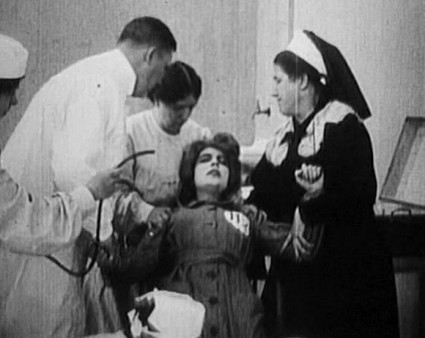
Asta Nielsen playing a suffragette undergoing forcefeeding in Die Suffragette (1913), from Stiftung Deutsche Kinemathek

Early film reflected the society in which it arose, and there is no clearer example of this than the campaign for women’s suffrage. The movement to gain women the vote in Britain reached its climax during the period when mass cinema-going was first underway in the early 1910s, and films reflected the popular understanding of the suffragettes. The militant woman became a standard figure in early ficition films, generally portrayed for comic or satiric effect. At the same time the suffragettes were regularly covered by the newsreels, a dynamic new medium for reporting what was happening in the world to a mass audience.

The relationship between women’s suffrage and early film is explored in Frühe Interventionen: Suffragetten – Extremistinnen der Sichtbarkeit (Early interventions / Suffragettes – extremists of visibility), a series of films and lectures being held at the Zeughauskino, Berlin, 23-27 September 2010. Behind the somewhat forbidding title is a tremendous programme of rare materials uncovered from archives across Europe and curated by Madeleine Bernstorff and Mariann Lewinsky. The films document not only the suffragettes as audiences saw them in fiction and non-fiction films, but also the role of women in early cinema generally, showing how trangressive, rebellious and sometimes just plain exuberant displays by women on screen echoed the drive for changes in society of which the campaign for the vote was but a part.

The Pickpocket (USA 1913), from EYE Film Institute Netherlands

Here is the programme:

Thursday 23. September 20:00 h

Radical maid(en)s
Cheerful young girls’ break-outs, class relations and radicalisations.

Sedgwick’ s Bioscope Showfront at Pendlebury Wakes, GB 1901, 30m 1’30“
La Grêve des bonnes, France 1907 184m, 10’
Tilly in a Boarding house GB 1911 D Alma Taylor, Chrissie White 7’
Pathé newsreel The Suffragette Derby, GB 1913, ca 5’
Miss Davison’s Funeral, GB 1913, 45m 2’
A Suffragette in Spite of Himself GB 1912 Edison R: Bannister Merwin D: Miriam Nesbitt, Ethel Browning, Marc McDermott 8’, 16mm
Break
Robinette presa per nihilista Italy 1912, D: Nilde Baracchi, 124m, 8’
Cunégonde reçoit sa famille France 1912 D: Cunegonde – name unknown, 116m, 6’
Les Ficelles de Leontine France 1910, D: Leontine – name unknown, 155m, 8’
Tilly and the fire engines GB 1911 2’ D: Alma Taylor, Chrissie White
[A Nervous Kitchenmaid] France c.1908, 74m, 4’
Introduction: Madeleine Bernstorff
Live piano accompaniment by Stephen Horne.

Friday 24. September 18:00 h

The Fanaticism of the Suffragettes
Lecture with images and filmclips by Madeleine Bernstorff

Following the lecture Mariann Lewinsky will present the DVDs Cento anni fa/A hundred Years ago: European Cinema of 1909 and Cento anni fa/A Hundred Years ago: Comic Actresses and Suffragettes 1910-1914 [for more information, see end of this post].

Friday 24. September 19:00 h

Militancies

Les Femmes députées France 1912 D: Madeleine Guitty 154m 8’
England. Scenes Outside The House Of Commons 28 January 1913 2’
Trafalgar Square Riot 10 August 1913 1913 2’
Milling The Militants: A Comical Absurdity GB 1913 7’
St. Leonards Outrage France 1913 21m 1’
Womens March Trough London: A Vast Procession Of Women Headed By Mrs Pankhurst. March Through London To Show The Minister Of Munitions Their Willingness To Help In Any War War Service GB 1915 23m 1’
Scottish Women’s Hospital Of The National Union Of Women’s Suffrage Societies France 1917 133m 6’30
Dans le sous-marin France 1908 Pathé 145m 5’
Introduction: Madeleine Bernstorff
Live piano accompaniment by Stephen Horne.

Friday 24. September 21:00 h

Women’s Life and Leisure in the Mitchell & Kenyon Collection
Presented by Vanessa Toulmin

The renowned Mitchell & Kenyon Collection provides an unparalled view of life at the turn of the twentieth century and this screening will allow us an opportunity to see women’s life and leisure in industrial England. The social and political background as well as working conditions will be shown on screen. The range and sheer diversity of women in the workplace will be revealed from the domestic to the industrial environment, women played an important role in the transition to modern society. From girls working in the coal mines to spinners and weavers leaving the factory this selection from the Collection will reveal previously unseen footage from the Archive, in a following workshop Vanessa Toulmin will speak about: Discovery and Investigation: The Research Process of the Mitchell & Kenyon Collection.

Women at Work: The ‘Hands’ Leaving Work at North-Street Mills, Chorley (1900), North Sea Fisheries, North Shields (1901), Employees Leaving Gilroy’s Jute Works, Dundee (1901), S.S. Skirmisher at Liverpool (1901), Birmingham University Procession on Degree Day (1901), Life in Wexford (1902), Black Diamonds – The Collier’s Daily Life (1904)
Women in the Social Environment: Liverpool Street Scenes (1901), Jamaica Street, Glasgow (1901), Manchester Street Scenes (1901), Manchester Band of Hope Procession (1901), Electric Tram Rides from Forster Square, Bradford (1902)
Leisure and Play: Sedgwick’s Bioscope Showfront at Pendlebury Wakes (1901), Spectators Promenading in Weston Park, Sheffield (1902), Trip to Sunny Vale Gardens at Hipperholme (1901), Bootle May Day Demonstration and Crowning of the May Queen (1903), Blackpool Victoria Pier (1904), Greens Racing Bantams at Preston Whit Fair (1906), Calisthenics (c. 1905).
Live piano accompaniment by Stephen Horne.

Saturday 25. September 18:00 h

La Neuropatologia
Lecture by Ute Holl+ screening of La Neuropatologia (I 1908)

La Neuropatologia is a medical instructional film by the Turin neurologist Camillo Negri. The film can be read – utilising medical-historical methology – as the presentation of an hysterical seizure, but it could also be called an expressionist drama, a love triangle. Medical fact cannot be visualized without the medical stage, the theatre, the mise-en-scène. End of the 19th century the visual turn in medical methodology and in neurological diagnosis gets introduced.

Saturday 25. September 19:00 h

Staging and Representation: A cinematographic studio

La Neuropatologia opens the view on representational relations. The Austrian company Saturn Film produced so-called ‘titillating’ films for a male audience, but the models also had her own ideas about erotic stagings. Normal work is part of an installation, and a re-enactment of four late-19th century photographies by Hannah Cullwick, who worked as a maid and produced numerous (self)portraits as part of a sado-masochist bond with her bourgeois boss Arthur Munby.

La Neuropatologia Italy 1908 Camillo Negro 107m 5’
La Ribalta (Fragment) Italy 1913 Mario Caserini D: Maria Gasparini 60 m 3’5’
Beim Photographen Austria 1907 Saturn 50m 3’
Das eitle Stubenmädchen Austria 1907 Saturn 50m 3’
Normal Work Germany 2007 Pauline Boudry, Renate Lorenz D: Werner Hirsch 13’ 16mm/DV
Concorso di bellezza fra bambini / Kindertentoonstellung Italy 1909 80m 4’
La nuova cameriera e troppo bella Italy 1912 D: Nilde Baracchi, 138m 7’
Rosalie et Léontine vont au théâtre France 1911, D: Sarah Duhamel + Leontine – name unknown 80m, 4’
L’intrigante France 1910 Albert Capellani 162m 8’
Introduction: Madeleine Bernstorff
Live piano accompaniment

Saturday 25. September 21:00h

Glittering stars, athletic women, first star personas
From 1910 on many female comedians had their own series. There was alsoa strong presence of female artistes and performers in the cinema before 1910.

Danse Serpentine / Annabella USA c.1902 Edison ca 2’ 16mm
La Confession France 1905 D: Name nicht bekannt 60m 3’
Femme jalouse France 1907 D: Name nicht bekannt 58m 3’
Lea e il gomitolo Italy 1913 D: Lea Giunchi 99m 5’
Danses Serpentines France / USA 1898-1902 D: U.a. Annabella 60m 3’
La Valse chaloupée France 1908 D: Mistinguett, Max Dearly 38m 2’
Sculpteur moderne France 1908 R: Segundo de Chomon D: Julienne Matthieu 8’
Les Soeurs Dainef France 1902 65m 3’
Introduction: Mariann Lewinsky
Live piano accompaniment Eunice Martins
+
Zigomar peau d’anguille France 1913 Eclair Victorin Jasset D: Alexandre Aquillere, Josette Andriot, 940m 45’
On the turntables: Julian Göthe

Sunday 26. September 18:00

Re-Reading Steinach
Lecture and video-presentation by Mareike Bernien

Re-Reading Steinach is a re-assembly of the popular-science film Steinachs Forschungen by Nicholas Kaufmann/UFA from 1922 – with the idea to analyze representations of normative and divergent body-and gender-constructions in the beginning of 20th century.

Sunday 26. September 19:00

Man/woman/norm/cinema
Cross-dressings of men and women: Elegant page-uniforms and pantskirts, men in nurse-dresses and the wonderful Lotion Magique which grows beards on breasts and breasts on bald heads.

Mes filles portent la jupes-culotte France 1911 120m 6’
Monsieur et Madame sont pressés France 1901 20m 1’
Le Poulet de Mme Pipelard France 1910 84m 5’
Cendrillon ou La Pantoufle merveilleuse France 1907 R: Albert Capellani 293 m 15’
Il duello al shrapnell Italy 1908 100m 5’
La Lotion magique France 1906 Pathé 80m 5’
La Grève des nourrices France 1907 190 m 10’
Schutzmann-Lied from Metropol-Revue 1908, Donnerwetter! – Tadellos! Germany 1909 D: Henry Bender Beta 2’ (digital sound image reconstruction by Christian Zwarg)
Introduction: Mariann Lewinsky and Madeleine Bernstorff
Introduction to Schutzmannlied: Dirk Foerstner
Live piano accompaniment

Sunday 26. September 21:00

The Woman of Tomorrow
Cinema before 1910 was abundant in non-fiction films about daily work. La Doctoresse is part of a comedy-serial by Mistinguett and her partner Prince. The Russian film The Woman of Tomorrow is about a successful feminist female doctor.

Recolte du sarasin France 1908
L’Industria di carta a Isola del Liri Italy 1909 147m 7’30“
La Doctoresse France 1910, D: Mistinguett, Charles Prince 140m 7’
Zhenshchina Zavtrashnego Dnya / The woman of tomorrow Russia 1914, D: Vera Yurevena, Ivan Mosjoukine, 795m 40’
Live piano accompaniment

Monday 27. September 18:00

Political Stagings of the Suffragettes in England
Lecture by Jana Günther on strategic image politics of the militant English suffragette movement: between permanent spectacle and crusade. The Suffragettes appropriated activist strategies of the workers’ movement and tried out acts of civil inobedience like chaining themselves to railings, hunger strikes and other distruptive acts.
+ presentation of the film A Busy Day aka A Militant Suffragette D:Charlie Chaplin, USA 1914 16mm 6’

Monday 27. September 19:00h

Die Suffragette

The restored version (by Stiftung Deutsche Kinemathek) of the Asta Nielsen melodrama Die Suffragette with some rediscovered scenes – including the force-feeding-scene which had been cut because of strict censorship regulations.

Bobby und die Frauenrechtlerinnen/Mijnher Baas + de vrije Vrouwen Germany 1911 Oskar Messter 112m 6’
Pickpocket USA 1913 260 m 13’
Les Résultats du féminisme France 1906 Alice Guy 5’
Die Suffragette Germany 1913 D: Asta Nielsen (Nelly Panburne) 60‘
Introduction: Karola Gramann + Heide Schlüpmann
Live piano accompaniment Eunice Martins

Monday 27. September 21:00h

The Year of the bodyguard
The film essay by Noël Burch deals with the subject of suffragettes in 1912 training under the first English female jiu-jitsu expert Edith Garrud to fight the police and protect their leaders.

Wife, The Weaker Vessel GB 1915 D: Ruby Belasco, Chrissie White, 190m 9’
Le Sorelle Bartels Italy 1910 74m 4’
The Year of the Bodyguard Noel Burch 1981 54’ ZDF
Works and Workers at Denton Holme GB 1910, 90m 5’

In the foyer of Zeughauskino there will be a video installation ‘I would be delighted to talk Suffrage’ by Austrian artist Fiona Rukschcio and a lightbox and bulletin board by Madeleine Bernstorff with materials from the National Archives, London on police spy photographs depicting the suffragettes.

Suffragette Demonstration at Newcastle, from BFI National Archive

Madeleine Bernstorff writes these words about women’s suffrage and film in the notes to the programme:

In the early twentieth century, the cause of women’s suffrage and the suffragette movement became a cinematic topic. Something seemingly untameable had appeared on the city streets, provoking a good deal of anxiety: women, often sheltered ladies of the bourgeoisie, were organising and even demanding participation in democratic processes! By 1913 more than 1,000 suffragettes had already gone to prison for their political actions. In addition to cartoons in the print media, newsreels and melodramas were produced along with countless comedies that referred – in all their ambivalence of subversion and affirmation – to the movement. They told the audience that women belonged at home and not at the ballot box, that these unleashed furies who now appeared in the streets en masse were growing mannish, neglecting their families and even setting public buildings ablaze. In the anti-suffragette films, women’s rights activists were often misguided souls who needed to be brought back to their proper calling. They also left plenty of room for nod-and-wink voyeurism on all sides. Men, too, masqueraded as suffragettes – to illustrate how inappropriate and grotesque it was for women to overstep their roles – or to act out against the prevailing order even more wildly?

The figure of the suffragette in early fiction (usually comedy- the seriousness of Asta Nielsen’s Die Suffragette is a notable exception) film is one that has been written about in several places, though never before has such an extensive collection of relevant films been seen in one place, to my knowledge. However, I would encourage those attending the event to look twice at the newsreels as well. There are many surviving newsreels showing the suffragettes – for the simple reason that they made it their business to be filmed.

The suffragettes showed themselves to be particularly media savvy by staging events that would attract the media. The simplest strategy was to organise marches with banners with bold slogans that could be easily picked up by the cameras. Then there was the obvious tactic of letting the newspapers and newsreels know beforehand of when a march or such like was going to take place. Just occasionally there was active co-operation with the newsreel companies. Rachael Low, in The History of the British Film 1906-1908, reproduces this report from the Kinematograph and Lantern Weekly 25 June 1908, p. 127, which shows how far this could go:

From certain sources whispers had reached us anent Mr. Harrison Ward’s secret conclaves with Mrs. Drummond and Miss Christabel Pankhurst, and as we surmised the plottings of the trio within the suffragette’s fortress have taken definite shape in the form of a picture history of recent performances of the ‘great shouters’ during their campaign … With exclusive right for kinematographing from the suffragists’ conning tower Mr. W. Jeapes obtained some exceptionally interesting pictures, those showing Mr. R.G. Knowles discussing the burning question with some of the leaders at the base of the tower being particularly good, the same remark applying to the life-size portraits of Mrs. ‘General’ Drummond, Miss Pankhurst and others. Mr. Jeapes and Mr. Ward probably never played to a bigger house than they did on Sunday, and the sight of the surging mass of humanity following the pantechnicon ‘conning tower’ as it emerged from Hyde Park, what time the energetic pair on top recorded the scene was something to arouse the envy of any kinematographer with an eye for picture effects.

The film, made by the Graphic Cinematograph Company, was a bit more than the average newsreel (it showed the major demonstration organised by the Women’s Social and Political Union that took place 21 June 1908 in Hyde Park). But the degree of pre-planning, co-operation and indeed the purchase of exclusive rights for a key camera position demonstrates that both news companies and suffragettes recognised the great value of one another, and that we should look on the newsreels of suffragettes as composed works rather than accidental actuality. We see what they wanted us to see.

Even when there wasn’t active co-operation with the newsreels, the suffragettes knew where cameras (still and motion picture) would be positioned, so that their protest acts would gain the greatest publicity. The best known example is that of the 1913 Derby, at which Emily Wilding Davison was killed after running onto the race-course and being knocked down by the King’s horse. The act was captured by a number of newsreels (the Pathé version is to be featured in Berlin) because they were all trained on the final bend before the end of the race, Tattenham Corner, and that is exactly where Davison chose to run out. Again, we see what they wanted us to see.

  • The Gaumont Graphic version of the 1913 Derby is here
  • The Pathé’s Animated Gazette version is here
  • The Topical Budget version is here (accessible to UK schools and libraries only)
  • (The Warwick Bioscope Chronicle version is here but I can’t make it play, and in any case Warwick either missed the incident or it has been cut from the extant film)
  • There are British Pathe compilations of suffragette newsreel footage here and especially here

There isn’t any information online about the Berlin screenings as yet (apart from this post, obviously), but information will appear on the Zeughauskino site once it gets round to publishing its September programme. (Now published)

Update (4 September): The full programme is now available (in German) from www.madeleinebernstorff.de (full marks for the striking design).

Finally, the DVD from this year’s Il Cinema Ritrovato mentioned above is now available for sale. Curated by Mariann Lewinsky, Cento anni fa: Attrici comiche e suffragette 1910-1914 / Comic Actresses and Suffragettes 1910-1914 is a DVD and booklet on nineteen films (Italian, French, English, American), featuring such female comedy stars as Tilly and Sally (Alma Taylor and Chrissie White), Cunégonde, Mistinguett, Rosalie, Lea and Gigetta, plus newsreel films (including two compilations) of suffragette action from the UK and USA. The DVD is priced 19.90 € and is available from the Cineteca Bologna site. For those not able to be in Berlin it’s going to be the next best thing.

My thanks to Madeleine Bernstorff for providing the programme information and stills.