Pordenone diary 2010 – day five

Seating in the Verdi theatre, Pordenone

Let’s talk about seats. Given the amount of time that filmgoers spend sitting down to watch films, it surprising that the objects on which they rest while doing so seldom get discussed. Yet what the seating is and how it is arranged bear significantly upon our enjoyment of what is on the screen. I have sat on wooden chairs, benches, stone steps, sofas, armchairs, velvet plush seating, church pews and grass to watch silent films. At the Zancanaro theatre in Sacile, which was home to the Giornate del Cinema Muto for a few years, the seating was admirably comfortable so long as you were not much more than five-and-a-half-feet tall. For anyone of my height, you practically had to stretch yourself over three rows and to do so in an upper tier to avoid those neighbours who might quite reasonably object to such a display.

The seats under discussion here are those at the Verdi theatre in Pordenone. They are particularly comfortable seats. You could go a long way before finding better, and they could have been designed specifically to support the earnest silent film enthusiast determined to make it through three hours of the next Japanese film and being able to walk away afterwards. But then there is the matter of arrangement, and here is where the Verdi has its critics, certainly among film followers. The theatre was not designed for cinema screenings. This is most obvious in the first circle, where the central portion of seats has to be covered up because the heads of the audience would get in the way of the projector beam. But it is the sight-lines that cause the most comment. It’s not a matter that bothers me that much – I have an odd preference for looking at films from the periphery – but many want to have an optimum view of the screen wherever they choose to sit, and here the Verdi comes up short. So there is great competition for favourite seats, and festival regulars tend to occupy the same section of the theatre year after year. There is the front row crew (earnestly taking notes on every film), those who like to stretch their legs over the gap between rows midway up the stalls, those happiest to look down from the first circle (like yours truly, always seated front row, penultimate seat to the right as you face the screen), and the upper circle afficionados who look to escape the madding crowd (and hello to the cheery bunch of American students who occupied the central portion of the upper tier and whose enthusiasm for all that the festival had to offer was a delight to witness). As with any public space, the Verdi is wonderful for people watching.

Choosing your favourite seat at the Verdi

And so, after all that talk of seats, we turn to a different sort of furniture with the first film on Wednesday 6 October, Tretya Meshchanskaya (USSR 1927), known in English as Bed and Sofa. Directed by Abram Room, this gained much notoriety on its release for its frank depiction of a ménage à trois between a building worker, his bored wife, and his printer friend who is invited to stay in their Moscow apartment. Its piquant polygamous set-up, the uncritical acceptance of sexual relations outside marriage, and discussion of abortion make the film strikingly modern in tone (Jules et Jim without the savoir faire), but what really fascinates is the background detail and the attention to the minutiae of life. There is the vividness of everyday life on the Moscow streets, and the absorbing clutter of the apartment with its nick-nacks, pictures, the Stalin calendar, the curtain dividing one couple from the other man, and of course the bed and sofa. The film also allowed space for its characters to be seen thinking, engaging in the mundane. Though in the end the ménage à trois itself felt too forced, what remained with you was the sense of a film true to life as seen and felt.

Another Room film followed, Yevrei Na Zemle (Jews on the Land) (USSR 1927), a documentary on Jewish resettlements in a stark, flat, tree-less Crimea whose impact wasn’t what it might have been because the Russian titles weren’t translated, which meant we missed the reportedly light-hearted tone that they took.

I decided not to sit through Rejin (Japan 1930) (The Belle), which tipped the scales at a mere 158 minutes this time, but the print was poor and I reckoned my eyes needed a rest. After a mooch around Pordenone and conversations at the Posta, I returned in the afternoon for one of the great treats (for me) of the festival, a series of films made in Madagascar in 1898 (images from Cinémathèque française site). As someone who thought he knew film from the 1890s pretty thoroughly, news of a filmmaker from this period entirely new to the history books was thrilling in itself. Louis Tinayre was a French artist with a fascinting personal history (his parents were Communards). He made a speciality of paintings as reportage. He travelled with a French military force to Madagascar in 1895 when an uprising was being quelled and was fascinated by the country. He returned later in the year to make sketches and photographs, then again in 1898 to work on a giant panorama of the surrender of the town of Antananarivo which he exhibited at the Paris Exposition in 1900. But he didn’t just take his brush and canvas – he brought with him a Lumière Cinématographe.

How and why he obtained the camera is not known – he may have been filming scenes to aid his work on the panorama. Eighteen films have survived, having been presented to the Cinémathèque française by the filmmaker’s grandson in 2009. They are thrilling to see. Artfully composed, they show Madgascan people at work in fields, road building, going to market, going about their daily drudgery. We were shown thirteen of the eighteen, with these titles:

  • Chantier de terrassement à Marorangotra [Construction of terraces at Marorangotra]
  • Femmes chargeés montant et descendant une colline [Laden women going up and down a hill]
  • Environs de Tananarive. Marché à Alatsinainy [Environs of Antananarivo, capital of Madagascar. Market at Alatsinainy]
  • Labour de rizières par les boeufs [Ploughing in the paddy fields with oxen]
  • Chantier d’empierrement à Marorangotra [Constructing a road at Marorangotra]
  • Vallée [Valley]
  • Forge malgache à Marorangotra [Malagasy forge at Marorangotra]
  • La route d’Ambohimanara. Un jour de marché à Tananarive [The Ambohimanara road. A market day in Antananarivo]
  • Labour de rizières à l’Angady [Ploughing the paddy fields at Angady]
  • L’artère principale du marché à Tananarive [The main road of the market at Antananarivo]
  • Jeunes garçons fabriquant des briques [Boys making clay bricks]
  • Femmes transportant paniers près d’un ruisseau [Women carrying baskets near a stream]
  • Hommes travaillant sur un chantier [Men working on a construction]

The people were all shown in mid-distance, with never a glimpse of a face, mere figures in a landscape (possibly supporting the panorama thesis) though always displaying movement. It was the colonial gaze par excellence. The films (in wonderfully sharp prints) were utterly compelling, just to be seeing so far back, images from a remote land being filmed for the first time, revealing landscapes and customs that were centuries old and were now captured in motion. An added bonus was that the films were accompanied by Touve Ratovondrahety, a Malagasy himself, who played piano and sang Madagascan songs. The happy sense of homeland rediscovered was palpable.

Some Pordenone regulars may mutter at these early films and hanker for the emotional journey that the feature film offers, but for others the rare chance to see the early films is why we want to be there. And so we moved to the latest installment of the Corrick Collection, a remarkable collection of films from the mid to late 1900s amassed by an Australian family of touring entertainers, and now featured over a number of Giornates. The films were introduced by festival director David Robinson, who comitted an engaging faux pas when he announced the award of some medal to the New Zealand film archive for its work in preserving the collection, an award that was diplomatically collected by the National Film and Sound Archive of Australia, which cares for the films.

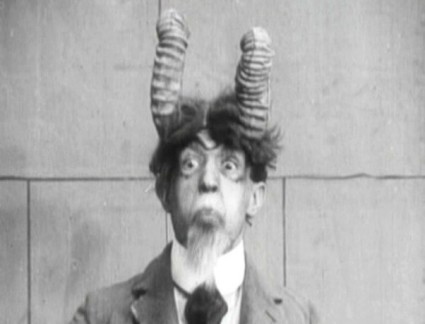
The films were the usual marvellous mix. Among the stand-out titles were Le Singe Adam (France 1909), one of the most memorable films of the whole festival, in which a trained baboon imitated the actions of its trainer to an extraordinary degree that divided up the audience equally into amused and disturbed; an unidentified British film given the title The Arrested Tricar (GB c.1905) in which three boys steal a motorcar which eludes them and drives off by itself; Don Quixote (France 1904) a meticulously recreated set of scenes by Pathé including windmills that turned into giants and an impressive alternating between studio and open-air setting, all rounded off with the habitual appearance by the Pathé dancing girls; Le Sculpteur Express (France 1907), an unusual variation on the familiar ‘lightning sketch’ form of early film, here shown a sculptor making clay faces at speed; and the delightful A Winter Straw Ride (USA 1906) showing a bobsleigh journey through the show with beautiful scenic effects.

No Rastro Do Eldorado (The Silence of the Amazon), from http://www.cinemateca.gov.br

Farsangi mámor (Hungary 1921) was a three-minute fragment of an otherwise lost Hungarian feature film which was identified after stills were published on the Lost Films site. This was followed by No Rastro Do Eldorado (Brazil 1925) (The Silence of the Amazon), a return visit to the Brazilian jungle. The film was made by Silvino Santos and documented the travels of American geographer Alexander Hamilton Rice as he mapped areas of the Amazon. The film’s presentation was unusual – there were no intertitles, instead we got a somewhat breathy female live commentary taken from Rice’s own accounts of the expedition, plus a creative multi-instrumentalist who played electronica, clarinet, percussion and guitar. Rice’s words revealed a superior attitude towards the native peoples which jarred somewhat with the poetic delivery. The film was profficient at best (though the aerial views were stunning), but the print – which was supplied by the Brazilians but came via the BFI National Archive – was awful, with very poor definition. I just hope negative material survives and that someone can try and produce something a good deal sharper.

Marizza, from http://www.ilgazzettino.it

The Giornate likes to reserve the special treats for the evening shows, and pride of place went to a thirteen-minute, seventeen-second fragment of an otherwise lost feature film, Marizza, Genannt die Schmuggler-Madonna (Germany 1921-22). The reason this was so special was because the director was F.W. Murnau. The fragment survives with Italian titles in a tinted print. It would be easy to read too much into this early work of a master, and to be honest I wonder how many would detect Murnau’s hand in a tale of a bewitching gypsy loved by a customs officer and an elegant gentleman. However, even as an anonymous fragment you would have noted the adroit handling and keen eye for the right image. It looked like we were going to get Carmen in the countryside, then all too quickly it was gone and mere speculation remained.

Next up was one of the festival special musical events, with two French films accompanied by Maud Nelissen (piano), Lucio Degani (violin) and Francesco Ferrarini (‘cello). First up, shown to Yves de la Casinière’s original score, was Alberto Cavalcanti’s Rien Que Les Heures (France 1926). This venerable classic of the avant garde is an odd, beguiling work which gives an oblique view of life in Paris, mixing documentary shots with dramatised sequences. It sometimes gets labelled with the city symphonies, but it could have been set in any town or city. As the the title suggest, its real concern is time and its passing, which is the best of themes for a work of art. I’ve seen it many times and don’t think I will ever tire of it.

Next, and last for me that day, was Germaine Dulac’s La Folie des Vaillants (France 1926). I wasn’t quite sure what to make of this. It was a feminist gypsy drama of sorts (gypsies featured strongly at the Giornate), which emphasised feeling over such trivial matters as acting and plot (a Gorky story). Unfortunately acting and plot are just what audiences look out for to anchor themselves, and the film’s technical limitations distracted from the filmmaker’s symbolic intentions. Also it’s hard these days to take gypsies as the epitome of social freedom in the way that Dulac (and Murnau) did in the 1920s. So it didn’t quite work for me, but it was graced by a quite superb score from the Maud Nelissen trio – the music from the festival that I’d most want to hear again.

And then I slipped away, into the balmy night.

Pordenone diary 2010 – day one
Pordenone diary 2010 – day two
Pordenone diary 2010 – day three
Pordenone diary 2010 – day four
Pordenone diary 2010 – day six
Pordenone diary 2010 – day seven
Pordenone diary 2010 – day eight

Blackmail at the Barbican

Extract from Neil Brand’s orchestra score of Alfred Hitchcock’s Blackmail

Your scribe journeyed last night to the vasty cavern that is London’s Barbican Hall to witness something of a landmark event – the first British silent drama to be newly scored for full orchestra since the advent of the sound film. The film was Alfred Hitchcock’s Blackmail (1929), the score was by Neil Brand, the orchestrator and conductor was Timothy Brock, and the music was played by the BBC Symphony Orchestra. (The qualification of ‘silent drama’ needs to be added, because the documentary The Battle of the Somme (1916) was given the full orchestral treatment back in 2006, with score by Laura Rossi, played by the Philharmonia Orchestra at the Queen Elizabeth Hall in London.)

Blackmail has a place in every film history book as the ‘first’ British sound film (it all depends on how you define things as to whether you agree with that or not), but a silent film version was made virtually the same time and with almost the same cast, for all those cinemas that had yet to convert to sound. For many years the silent version was forgotten about, but screenings in recent years have brought it increasing recognition, to the point where we are ready to agree with Hitchcock himself that the film is superior to the sound version. Whether it is Hitchcock’s best silent film is a matter for debate, but it certainly shows his mastery of the silent film form. It flows along with an easy, artful flow; it is choc-a-bloc full of memorable pictorial compositions; and it sets up complexities of relationships and moral dilemmas that make one disappointed when the film ends relatively tamely, albeit with hero and heroine nurturing their guilty secret that is left strikingly unresolved.

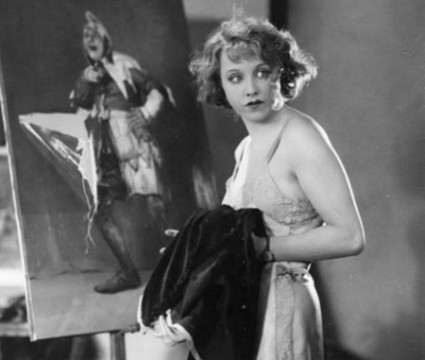
Anyway, back to the show, which was pretty much a triumph. Neil Brand’s score is lush and loud, filled with a tense energy and engrossing musical ideas. It was not an obviously ‘silent era’ score but instead consciously echoed the Hitchcock scores of later years from Bernard Hermann and Miklós Rózsa. It was knowing in other respects, with some great musical jokes such as the Alfred Hitchcock Presents theme when Hitch makes his customary cameo, as a passenger on an Underground train, or the introduction of the Dixon of Dock Green theme tune (for our younger and non-British readers, this was a British TV series of yesteryear with a rather cosy view of policing). The orchestra was on fine form, indeed enjoying itself, while conductor Brock had to demonstrate pin-point precision to make sure the orchestra hit its cues for such key points as door bells ringing, or laughter-like sounds when the creepy painting of the jester is shown.

Anny Ondra as Alice White in Blackmail

The score for Blackmail was commissioned and premiered at Il Cinema Ritrovato in Bologna in 2008 and it has taken two years of pleading and negotiating to get it shown in London, for which Neil deserves quite as much praise as he does for having written the score in the first place. A debate which took place after the screening, with Neil, Timothy Brock, the BFI’s silent film curator Bryony Dixon, and omnipresent film guru Ian Christie, raised some interesting issues but didn’t quite address the matter of whether this would be both the first and the last British silent drama with full orchestra score to be shown since the silent era. Will other films follow?

The screening had been enthusiastically introduced by film critic (and occasional silent film accompanist) Mark Kermode, who called for more British silent films to be seen, pointing out the great work that the BFI has done in championing this largely forgotten corner of film history. The idea of a full orchestral score for any British silent would have seemed ridiculous only a few years ago. Now a growing wave of critical interest has provided us with a number of strong candidates: Shooting Stars, Underground, Piccadilly, Moulin Rouge, Hindle Wakes, The First Born, A Cottage on Dartmoor, The Lodger, The Ring and several more.

I’m not particularly a fan of orchestral scores for silent film myself. I prefer the improvising pianist or the small ensemble. But the big gesture brings in the big audiences. Although the Barbican Hall wasn’t completely full last night, it was fairly full, and there were several hundred people there who would never have seen a silent film with live orchestra before – or indeed with any form of music – and a good many of them had been made enthusiastic converts to the cause, to judge from the applause and the conversations I overheard afterwards.

The Carl Davis scores to Photoplay prints of the 1980s were media events. They generated popular interest and a general understanding of what silent films could be. They created a momentum which drove support for silent films, though that momentum has died down in recent years. Unfortunately orchestral presentations do not come cheap, and silent film screenings are viewed as a risk by programmers outside of specialist cinematheques. But it only takes one or two successful events to build up audience understanding and a thirst for more. The idea of rediscovering unknown British silents films, of reclaiming a neglected history, has strong appeal. Blackmail could point the way forward – because the audience is there.

The silent Blackmail is available on DVD from Arthaus in Germany. (Not with the Neil Brand score, fairly obviously)

Roll away the reel world

And roll away the reel world, the reel world, the reel world!

So says James Joyce in Finnegans Wake, thereby giving a handy headline for anyone producing anything relating to Joyce and film, something which has grown as a subject of scholarly interest in recent years. Its most recent expression is Roll Away the Reel World: James Joyce and Cinema, a collection of essays edited by John McCourt and published this month by Cork University Press.

The book brings together talks given at last year’s conference, exhibition and film festival on James Joyce held at Trieste in Italy, which the Bioscope reported on at the time. The book includes an essay by myself on James Joyce’s management of the Volta cinema in Dublin December 1909-January 1910 (Ireland’s future literary giant was looking for a get-rich-quick scheme and thought that cinema management was the answer. It wasn’t). I’ve also contributed a filmography of all the film shown at the Volta from December 1909 to mid-April 1910, previously published in an obscure Irish journal and now updated and now a lot more accessible for the assorted Joyceans who have been emailing me for years now in pursuit of a copy of the original list.

There is more on silent cinema in the book, which makes it worth seeking out for anyone interested in the relationships between early film and literature. Indeed it is exciting to see how very well the current generation of literary scholars engage with both media. Erik Schneider writes on the history of the Volta from the Trieste angle (Joyce teamed up with some Triestine businessmen to launch the Volta initiative); Katherine Mullin writes on “Joyce, Early Cinema and the Erotics of Everyday Life” (on Edison, Biograph and peephole movies); Maria DiBattista and Philip Sicker each write on Georges Méliès in “The Ghost Walks: Joyce and the Spectres of Silent Cinema” and “Mirages in the Lampglow: Joyce’s ‘Circe’ and Méliès’ Dream Cinema” respectively; Carla Marengo Vaglio looks at a joint music hall and cinema relationship in “Futurist Music Hall and Cinema” while Marco Camerani explores the stage performer-turned-film perfomer angle further with “Circe’s Costume Changes: Bloom, Fregoli and Early Cinema”. And other writers carry on the argument into the sound era, from John Huston to Jean-Luc Godard to Mel Brooks.

A Glass of Goat’s Milk, from BFI National Archive

And if all that wasn’t enough, and if in particular you want to see the films shown at the Volta, then do take note of the December 1910 Centenary Conference being held in Glasgow, 10-12 December 2010, which takes as its theme Virginia Woolf’s notorious pronouncement that “on or about December 1910 human character changed”. As part of this event, on 10 December at 20:30 at the Glasgow Film Theatre I will be presenting “At the Volta with James Joyce” – an introductory talk followed by a screening of thse films, shown at the Volta during Joyce’s period of involvement with the cinema:

Une Pouponnière à Paris (France 1909, p.c. Éclair)
A Glass of Goat’s Milk (Great Britain 1909, d. Percy Stow p.c. Clarendon)
The Way of the Cross (USA 1909, p.c. Vitagraph)
Aviation Week at Rheims (Great Britain 1909, p.c. Pathé
Come Cretinetti paga i debiti (Italy 1909, d. André Deed p.c. Itala)
Bianca Capello (Italy 1909, d. Mario Caserini p.c. Cines)
Pêche aux Crocodiles (France 1909, p.c. Pathé)
Une Conquête (France 1909, d. Georges Monca p.c. Pathé)

The BFI National Archive has put together a compilation of the Volta films it holds (the BFI holds the majority of the surviving films known to have been programmed at the Volta). This is available to researchers able to get to its central London site (do book ahead, as with all BFI viewings). If you want live music accompanying the films and me burbling on about the history, then come to Glasgow.

In the swim for 2011

Joan Crawford and Dorothy Sheridan limbering up for 2011, from the June page of the Silent Movies Calendar

There’s a new year looming, would you believe, and for silent film buffs in need of friendly guidance throughout year as to which day is which, there is only one place to turn. For the 2011 Silent Movies Benefit Calendar, produced by Rodney Sauer of the Mont Alto Motion Picture Orchestra, is now available, with photos for each month of silent film stars in swimsuits, and each day noting marriages, death dates, film opening and other notable events from the silent period.

As in previous years, proceeds from the calendar will go to benefit film preservation. For example, the 2010 silent film calendar benefitted the Niles Essanay Silent Film Museum, the 2009 calendar funds supported an internship in film preservation through the San Francisco Silent Film Festival, and funds from the 2008 calendar supported the video restoration of Bardelys the Magnificent through Film Preservation Associates and Lobster Films.

The calendar costs 1 calendar: $14.74, with two calendars $27.59 and three $40.90. Details on how to order copies from the Monto Alto website.

Chaplin’s time traveller

Currently a short piece of silent film from the extras on a Charlie Chaplin DVD is a YouTube hit. At the time of typing, it has been viewed 1,569,512 times. The DVD is the MK2 boxed set of Chaplin feature films, specifically The Circus (1928). The extras footage shows a scene outside Graumann’s Chinese Theater where The Circus is being screened. There is a model of a zebra outside. A man walks past. Then a woman walks past, talking on a mobile phone.

Hang on, rewind – what was that? Graumann’s Chinese Theater, zebra, man, woman with … a mobile phone? Well that’s what it looks like, as she holds her hand to her ear as though clutching something, and she is clearly talking. It looks for all the world like someone using a mobile phone some sixty years before they were invented (and a small-sized one too, not like something Michael Douglas wielded in Wall Street).

So what’s going on? It’s fascinating to look all the theories proposed in the comments or by the person who spotted the clip and who introduces it on the video. His conclusion is that it’s an example of time travel. Since there is no such thing as time travel (I feel quite confident on this point), then we must look for other solutions. It could be digital trickery on the part of its discoverer – I don’t have the DVD to hand but presumably others would have checked this and discounted it. Some have said that she is holding a purse (and talking to it?). Some say that she has a hearing aid, of the bulky kind that then existed (but hearing aids don’t talk to you). Some say that she is simply shielding herself from the camera, or from the sun. Some say that she is not a she at all but a man in drag, though that just adds to the mystery. Perhaps she is just talking to herself.

The video is a bit long-winded, but he does shows us the clip repeatedly, slowed up and zooming in. The Bioscope has toyed with the theory that she’s a traditional folksinger with hand cupped to her ear, but maybe she is just shielding her face from the sun. And talking to herself.

Hmm.

Pordenone diary 2010 – day four

Giornate del Cinema Muto poster in a Pordenone shop window at night

And then it rained. There’s always one day of heavy rain at Pordenone (it is quite near the Alps, after all) and on Tuesday October 5th it came down in torrents. This was certainly a day for sheltering in the cinema and viewing everything that came up.

Unfortunately that meant starting at 9.00am with another selection of Boireau films. As noted in day three, the French comedian André Deed’s second stint as Boireau (1911-1914) produced work that was markedly inferior to his time in Italy playing the character Cretinetti. This second selection sufered from the same frantic gesticulation and body-bending from a performer who did not know how to stand still. Une Extraordinaire Aventure de Boireau (France 1913) stood out for the extraordinary comic conceit of having two men welded together after a heavy weight falls on top of them. One, Boireau, adapts to his new circumstances with zest; the other is wretched and complains all the time. It wasn’t exactly funny, but it was memorable. I kept thinking of the British comedian Norman Wisdom, whose death had just been reported, someone who once had audiences tearful with laughter only to live on to a time when audiences could only look on his work with bemusement and embarassment. What happens to humour when it isn’t funny any more? We just want to turn away.

And then we got a series of Calino films starring Roméo Bosetti, and Boireau looked like a comic master once again, at least by comparison. Enough of all this, let’s have some challenging Soviet documentaries.

Even at this short distance in time, I have little memory left of Mati Samepo (Their Kingdom) (USSR 1928) a 22-minute fragment from a five-reel documentary compilation of Georgian newsreel material made by Mikhail Kalatozov. All that remains are some impressions of satirical intent about oil in Kalatozov’s native Georgia, and a noticeable number of stray dogs. Unforgettable, however, was his documentary Jim Shuante (Salt for Svanetia) (USSR 1930). This was a strange film about a strange corner of the world. Svanetia is a remote area of Georgia, high in Caucasus mountains. The areas is inhabited by the Svans, and in its focus on their hard lives and distinctive cultural practices, it was another in series the films of anthropological interest that featured throughout the festival. However it was far from being a conventional, fact-based documentary. Some of the customs featured were a fiction – such as turning pregnant women out of a house to give birth, which was the practice in another region of Georgia but not in Svanetia. It showed life at its most rudimentary and functional, with miseries piled upon miseries to the point where it was almost comical (I was reminded of Buñuel’s Las Hurdes which similarly piles on the wretchedness beyond the point of sympathy). The images were often brutal or earthy, and they were always astonishing composed, but they told you nothing about the people. They were merely ciphers – and ciphers for a society that bore only a tangential relationship to reality. They existed to serve as subjects for an exercise in filmic style, not as people in their own right. The film did not inform; it exploited. It was the antithesis of the model anthropological film.

Salt for Svanetia (1930), from Wikipedia

Nor did it work as piece of Soviet propaganda. The ostensible reason for making the film was to show how a road-building programme was bringing the much needed salt to Svanetia and connecting it to the outside world, ensuring its modernisation and survival. But, as the programme note told us, the road-building was fiction too, and the whole message felt tacked on, as no doubt it was to please the party critics and censors (though they suppressed the film anyway). For Kalatozov the poetics of the image is all, and one comes away with visions of sun and shadow sweeping over the mountain sides, the stark villages with their tall towers and seemingly no people out and about, and unanswered questions about how the people were persuaded to play for the cameras, and whether actors were used. Salt for Svanetia is an amazing film, but not an honourable one.

And they we were back in Japan. I missed a couple of short films, but then settled down for the afternoon’s epic, the 188-minute Ginga (The Milky Way) (Japan 1931), directed by Hiroshi Smimizu, he of the restless camera and uncertain directorial purpose. Or at least that’s how he had seemed so far, but for Ginga he reined in the gimmicks, aside from some deft lateral tracking shots which acted as an effective visual motif. The plot was pure soap opera once again. It concerned a daughter of a businessman who marries her seducer to avoid social disapproval, a storyline that was starting to get a bit too familiar, while the passive suffering of Japanese women was starting to grate just a tad. But in truth the plot was not that important, or rather the various relationships were obscure (at least to these Western eyes), and you just surendered to the gentle style and the astute balance of understated realism and melodrama. If there had been silent television, its dramas might have unfolded much like Ginga.

There then followed a pleasant interlude – an Irish television documentary on archivist and film historian Liam O’Leary, At the Cinema Palace: Liam O’Leary (Ireland 1983). This was a delightful account of the man who virtually single-handedly established the idea of Irish film history as something to document and the need for an Irish film archive. He also worked for a time at the British Film Institute, and there were some gorgeous archive images – David Robinson (the festival director) sporting a florid 1970s moustache, David Francis (one-time curator of the National Film Archive) with a truly terrible jacket, and such a young Kevin Brownlow (O’Leary introduced Brownlow to Abel Gance when no one at the BFI was available to greet the great silent director in Britain. What must Gance have thought when the BFI sent a 17-year-old schoolboy instead?). A film about a man whose purposeful passion for film spoke to every film archivist in the audience.

Charlie Chaplin (left) in A Thief Catcher, courtesy of Paul Gierucki and Slapsticon

In the evening we were treated to two of the most notable ‘lost’ film rediscoveries of the past year. First up, A Thief Catcher (USA 1914). Yes, at last a chance for us on this side of the pond to see the sensational discovery, made by Paul E. Gierucki, of a previously unknown performance by Charlie Chaplin in a Keystone comedy. It was known – because Chaplin said so in an interview – that he had appeared uncredited as a Keystone Kop early on in his film career, but never before had anyone rracked down such an appearance. A Thief Catcher is thought to have been either his second or fourth film for Keystone in terms of production (the catalogue told us it was shot 5-12 and 25-26 January 1914, with Chaplin’s bit probably in the latter) and the fourth in terms of release (19 February 1914). But enough of the historical minutiae – is it funny?

You bet it is. Not outstandingly so, but it gained more laughs in eight minutes than poor Boireau had managed to raise in two or three hours. It’s all in the cutting. The film is a typical breakneck speed Keystone offering, with routine knockabout elevated to something special simply by the speed of the action and the deftness of the edit. Boireau showed us comedy still rooted in the stage, the comic business contained within the single shot. Keystone gave us cross-cutting, the comedy of consequences, as each shot played off against the previous one. Ironically the film’s star, Ford Sterling, outdid André Deed in face-pulling, and probably no unfunnier man ever graced the cinema screen. But Chaplin was on the ball as a performer right at the start. He plays an inspector who investigates a shed where Sterling, playing a sheriff, has been imprisoned by three robbers. In his two-minute cameo (he appears briefly at the end as well) Chaplin gives an expert display in comic bemusement, ending up being knocked out by Sterling for his pains. The moustache is there, the baggy clothes, even a hint of splayed feet. It was a magical moment when he ambled on screen (the audience cheered). A Thief Catcher easily lived up to expectations.

Next up, after a trailer for the otherwise lost John Ford film Strong Boy (USA 1929) was an entire Ford feature film not known to exist until it turned up in New Zealand recently, Upstream (USA 1927). This was a comedy-drama set in a New York boarding house full of ‘resting’ actors, one of whom (Earle Foxe) unexpectedly gets an invitation to play Hamlet in London, because he comes from a great line of actors whose name he has inherited but with none of the necessary talent. But the plot didn’t matter much; what made Upstream such a delight was the series of comic vignettes of down-on-their theatrical types – knife-thrower, a pair of comic dancers, an old Shakespearean hand – a in a zippy, joyous opening sequence that was J.B. Priestley on roller skates. It showed you everything about why American cinema conquered the world – much as A Thief Catcher did, in fact.

It’s a minor film for all that, which ends rather abruptly with the rejection of the insufferably pompous Foxe character by his former colleagues, and one sensed that had they only had a stronger cast then the film could have been spun out to twice its length, because we wanted to know more about the characters. So, a lot of fun, a film to chalk up for those with an interest in Shakespeare on film (Foxe’s Hamlet mines every cliché about theatrical ham), and a film which does John Ford’s reputation no harm whatsover.

Capabalanca’s unwitting performance in Chess Fever, from ChessBase.com

In what was a peach of an evening’s programming, things were rounded off with me for one my all-time favourite films, Shakhmatnaya Goryachka (Chess Fever) (USSR 1925). This delirious comedy is terrific if you are a silent film fan, but if you are a chess fan as well, you’re in heaven. You get all startstruck in the opening sequence – look, there’s Réti! And Torre! And Marshall! And Grünfeld! And, wow, Capablanca! Chess Fever was shot by Vsevolod Pudovkin during the international chess tournament held in Moscow in November 1925. Its slight plot revolves around a man so obsessed with chess (even his socks have black-and-white squares) that he forgets his own wedding, but chess brings the two hearts together in the end. It’s filled with a succession of superb sight gags, where all of Moscow is shown to be chess-mad. It culminates with the great José Raúl Capablanca himself, the world chess champion, who appears in the film when the frustrated fiancée accosts him, though he was not aware that a dramatic film was being made with himself as a crucial character. Günter Buchwald (on top form all week) provided an appropriately lively score for violin, piano (he played both), double bass and drums, revealing himself in the catalogue to be a chess enthusiast as well. And has there ever been a better closing line for film than, “Darling, let’s try the Sicilian Defence”?

After all that I wasn’t much in the mood for Lev Push’s Gypsy Blood (USSR 1928) – some film titles make you fear the worst – and I called it a day.

Pordenone diary 2010 – day one
Pordenone diary 2010 – day two
Pordenone diary 2010 – day three
Pordenone diary 2010 – day five
Pordenone diary 2010 – day six
Pordenone diary 2010 – day seven
Pordenone diary 2010 – day eight

From Russia with love

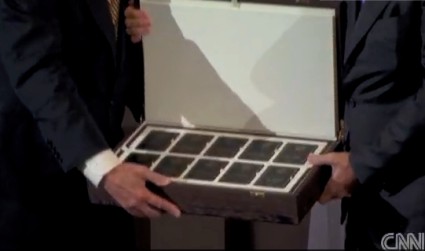
Digital copies of the ten American silent films donated to the Library of Congress by the government of Russia, from CNN

The discovery of silent films in countries other than those where they were produced and their repatration to the lands of their birth continues. Following on from the news of American silents found in New Zealand and last year in Australia now returned to the US, comes news of ten American silents held by the Russian state film archive Gosfilmofond, which have been donated in digital form to the Library of Congress. The ten titles, none of which are preserved in US film archives, are (with links to their IMDb entries):

  • Valley of the Giants (Famous Players, 1919 d. James Cruze), with Wallace Reid, Alice Terry
  • You’re Fired (Famous Players, 1919 d. James Cruze), Wallace Reid, Wanda Hawley
  • The Conquest of Canaan (Famous Players, 1921 d. Roy William Neill), with Thomas Meighan, Doris Kenyon
  • Kick In (Famous Players, 1922 d. George Fitzmaurice), with Betty Compson, May McAvoy
  • The Call of the Canyon (Famous Players, 1923 d. Victor Fleming), with Richard Dix, Lois Wilson
  • Canyon of the Fools (R-C Pictures, 1923 d. Val Paul), with Harry Carey
  • Circus Days (First National, 1923 d. Edward F. Cline), with Jackie Coogan, Claire McDowell
  • The Eternal Struggle (Metro Pictures, Louis B. Mayer, 1923 d. Reginald Barker), wtih Renée Adorée, Barbara LaMarr
  • The Arab (Metro, 1924 d. Rex Ingram), with Ramon Novarro, Alice Terry
  • Keep Smiling (Monty Banks, 1925 d. Albert Austin/Gilbert Pratt), with Monty Banks, Anne Cornwall

The films were handed over at a ceremony on 21 October at the Library Congress (reported on by CNN, which struggles hard to make a box of hard drives look fascinating). Reports suggest that these ten titles will be the first of 200 or so that will be repatriated over time. Russia tended to keep the films that were sent to it for distribution, whereas American studios all too often disposed of their silent features once they no longer had any commercial value. The Library of Congress is negotiating not only with Russia but with archives in France, Czechoslovakia and the Netherlands, so we can look forward to many more such happy homecomings.

The great white silence

Trailer for the BFI National Archive restoration of The Great White Silence

Last night I attended the premiere of The Great White Silence at the London Film Festival. The Great White Silence is a documentary feature, released in 1924, which documents the expedition of Captain Robert Falcon Scott to reach the South Pole. He of course failed, and died with four companions on his wretched journey back from the Pole, having discovered that he had been beaten into second place by Roald Amundsen’s Norwegian party.

But Scott had romance on his side. He left behind a diary of exceptional artistry and poignancy, which helped enshrine his legend and turn vainglorious failure into the epitome of noble, patriotic self-sacrifice. And he had ensured that future generations would become engrossed in his story through what they could see as well as what they could read. Herbert Ponting (1870-1935) was taken on as expedition photographer and cinematographer, both for documentary purposes and because the sale of photographic and cinema rights helped pay for the expedition (40% of the profits from the films’ exhibition went to the expedition, 40% to the Gaumont company for producing and distributing the film, and 20% to Ponting).

Ponting was a still photographer of renown, who had done notable work in Japan. But he had never handled a cine camera before. He turned out to be a cinematographer of uncommon ability. Kevin Brownlow pays him the highest of accolades in The War the West and the Wilderness by comparing his work that Mary Pickford’s cinematographer:

Herbert Ponting was to the expedition film what Charles Rosher was to the feature picture – a photographer and cinematographer of unparalleled artistry.

Herbert Ponting achieved work that was exceptional in every degree. It was exceptional in image quality, exceptional in the way it overcame the difficulties of filming in extreme conditions when cinema technology was still in its infancy, exceptional as a documentary record.

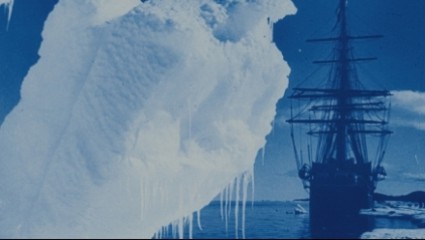
Iconic image of the Terra Nova, from The Great White Silence

The BFI National Film Archive has restored the 1924 feature because the footage no longer survives in the original forms in which it was released. The release structure of Ponting’s films was determined by the nature of the expedition and a need to keep up audience interest over the two years that the expedition would take. Ponting joined Scott’s ship the Terra Nova in New Zealand in November 1910. He took an initial 15,000 feet of negative film with him, along with Prestwich and Newman Sinclair cine cameras (the latter’s manufacturer Arthur S. Newman gave Ponting intensive instruction in its use, and added special ebonite fittings to prevent Ponting’s fingers from freezing to the camera). He shot and developed 8,000 feet of this on site (Cape Evans) before the Terra Nova returned to New Zealand in January 1911. This film was delivered to Britain, and edited by Gaumont into a 2,000 foot release (lasting around 30 minutes) entitled With Captain Scott, R.N. to the South Pole. This was first exhibited in November 1911. Ponting’s second batch of film was released by Gaumont as the ‘second series’ of With Captain Scott R.N. to the South Pole, into two 1,500 foot parts, first shown in September and October 1912 respectively, and which featured the final scenes of the polar party, included sequences where they demonstrated sledge-hauling and life inside their tent. By this time Scott and his final polar party were all dead, and news of Amundsen’s success in reaching the pole first dented the film’s commercial appeal. One of the most haunting passages of The Great White Silence is where four of the final five-man party illustrate how they were going to journey across the ice, including scenes of them huddled together for warmth in a tent. Scott, Birdy Bowers, Edward Wilson and Edgar Evans – but not Titus Oates – all appear in a sequence which was produced in anticipation of triumph but now looks like an uncanny intimation of their fate.

The tent scene from The Great White Silence, with (left to right) Evans, Bowers, Wilson and Scott

The bodies were discovered in November 1912 and the news reached the outside world in February 1913. Ponting then began to devote his life to the promotion of the Scott legend, and to the recouping of his investment, because in 1914 he purchased all rights in the film from Gaumont for £5,000. This he did against a waning audience interest, and much of the bitterness that Ponting was to feel in his latter years was due to the public’s insufficient awe at a story which he progressively built up and romanticised, as the Scott story evolved into myth. The films were re-edited and released in 1913, after Scott’s death had been reported, as The Undying Story of Captain Scott.

Ponting then lectured with the films constantly, giving a Royal Command performance in May 1914, where King George V declared that:

I wish that every British boy could see this film. The story should be known to all the youth of the Nation, for it will help to foster the spirit of adventure on which the Empire was founded.

He continued to show his films throughout the First World War, emphasising the call to patriotic sacrifice, but now to dwindling audiences. In 1924 Ponting re-edited the films once more as a feature-length documentary, The Great White Silence, which followed on from the 1921 publication of his book The Great White South. The film was 7,000 feet long (around two hours in length), and released by the New Era company. Reviews were complimentary, marvelling at the hardships endured, and praising both the film’s patriotic virtues and “extremely clever studies of Antarctic life”, while pointing out (a little meanly) that the final scenes were, of necessity, heavily dependent on still pictures, diagrams and intertitles. Scott’s adventures were already of another age, and the film was not a notable success.

Ponting failed in his subsequent attempts to sell his films to the nation, an appropriate film archiving body not existing at that time, and in 1933 he produced a sound version of his films, now entitled 90º South, released by New Era once again, and whittled down to 75mins. Ponting himself provided the film’s commentary, and years of lecturing to these images tell in his polished and succinct words. This time the reviews were more enthusiastic, as reviewers newly aware of the documentary as an art form rightly praised Ponting’s artistry.

90º South is the form in which we have been familiar with the footage in recent years, because the BFI did not have a complete viewing print of The Great White Silence. But with material from a release print held in the Netherlands, and with reference to Ponting’s uncut footage, an exceptional restoration has been produced. The images really do look like they were shot yesterday. The clarity of the faces of the explorers – Wilson, Evans, Bowers, Oates and the rest – is a revelation. The grading is a tour de force. Perhaps most notable is the colour tinting, introduced digitally by following Ponting’s own instructions (written onto gaps in the original footage), which results in the familiar polar scenes unfolding in strange, otherwordly amber, blues and greens. We see the familiar anew.

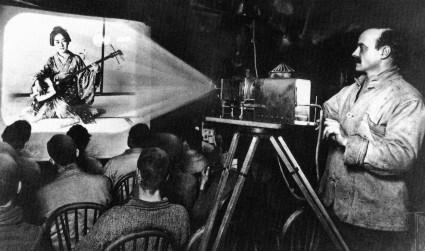
The film itself is not a documentary as we now expect. It was probably released by Ponting because he had been encouraged by the success of Robert Flaherty’s Nanook of the North (1922), but if that film ushered in the new form of documentary filmmaking, Ponting’s film is the ultimate expression of an older form of documentary, one with its roots in the magic lantern lecture. Ponting was a practiced lantern lecturer before he joined Scott, and entertained the expedition party with lantern shows during the Antarctic winter. Throughout his work on the Scott expedition, Ponting imagined how he would present such scenes to an audience back home, and selected, composed and arranged his material accordingly. This included a marked emphasis on animals, particularly penguins (inevitably), to what seems to us the surprising detriment of the human story, but Pointing knew his market and he balances his material admirably. Certainly the 2010 audience seemed as engrossed in seals, penguins, killer whales and skuas, and as susceptible to their anthropomorphic appeal, as those in 1912.

Herbert Ponting giving a magic lantern show on his Japanese travels for members of the Scott expedition

Once Scott had died and Ponting went on the road with the films, he lectured to them – and his hundreds of still photographs – literally hundreds of times. This experience is readily evident in The Great White Silence. The intertitles chat to us in familiar style; Ponting (the titles are written as though it is he speaking to us) points out things for us to look at, his words guide our eyes and our thoughts. He knew how to engage an audience, and he suceeded all over again in 2010. The film is a mixture of footage, photographs and intertitles, and is in effect a lecturer’s show with his words transferred to the intertitles. The slideshow effect reaches its height in the last half hour of the film, when there is no more footage (because Ponting did not travel with Scott into the Antarctic interior) and so all that he can use are photographs, passages from Scott’s diaries, and quaint but moving model animations showing ant-like sledges moving over the polar wastes. Scott’s diaries have barely lost their power to move even in this cynical age, and the film’s ending left the audience breathless, the final scenes accentuated by a solo voice singing ‘Abide with me’.

Ah yes, the music. The film was accompanied by a ‘soundscape’ by composer Simon Fisher Turner which combined strings (more plucked and scraped than bowed) with electronica, gramophone recordings from the time, recordings of banjo music, Terry Riley-ish sequenced keyboard music, singing, and at one disconcerting point a modern voice speaking in Scott’s hut from earlier this year. You can experience some of the electronica on the YouTube clip at the top of this post. The ‘music’ was clearly greatly appreciated by many in the audience, so I shall refrain from commenting as severely as I might. I shall say just this – the point of musical accompaniment for a silent film is to draw attention to the film, not to draw attention to the music. I’m all for imaginative forms of silent film presentation, but last night’s accompaniment drew far too much attention to itself.

The Great White Silence is going to be given the works when it comes to exhibition. A DVD and Blu-Ray release is planned for next year, it will be screened on the Discovery channel, and it is going to get a theatrical release in the UK. So, amazingly, we will have had Metropolis screened in many UK cinemas in 2010, and The Great White Silence at your local fleapit (who knows?) in 2011. These are remarkable times for silents, and The Great White Silence is a remarkable film. See it if you can – you are certainly going to be presented with every opportunity to do so.

The BFI Live channel has a fascinating short documentary on the technicalities of the film’s restoration. (It’s also available on yourdiscovery.com)

Some of the text of this post is adapted from an essay I wrote, The Great White Silence: Antarctic Exploration and Film’, in South: The Race to the Pole (London: National Maritime Museum, 2000).

A trip down Market Street

Last night CBS’s 60 Minutes programme had an item on A Trip Down Market Street, a ‘phantom ride’ view taken from a cable car travelling down San Francisco’s Market Street a month or less before the earthquake of 18 April 1906. The film, three copies of which survive, and which can be viewed on the Internet Archive or on the Library of Congress’s American Memory site, was previously thought to have been made in 1905, but film historian Dave Kiehn presents evidence in the programme (including weather reports and car registration numbers) to demonstrate that the film was probably made in March or early April 1906. The producers were the Miles Brothers, and two of their descendants appear in the programme as well as film archivist Rick Prelinger, owner of one of the surviving copies (that which appears on the Internet Archive).

We’ve covered the film on the Bioscope before now. There was a post on Bioscopist Joe Thompson’s discovery of a 1907 newspaper article on the film and more recently a post on the overlaying of a YouTube video of the film on top of present day Google Street View images of Market Street on the innovative There and Then site.

The SFGate blog has a full account of Kiehn’s research into the film’s correct dating.

The 60 Minutes piece includes footage of Market Street after the earthquake taken by a different filmmaker. Recently filmmakers Dan Meyerson and Matt Peterson put together a compilation of post-earthquake views of San Francisco, focussing on another travelling shot down Market Street. The post-nuclear landscape is all the more extraordinary for the matter-of-fact way in which people are seen to be still going about their daily business. Looking at pre- and post-earthquake films, the buildings are transient, fragile constructions, but ordinary people endure.

Who shot the post-earthquake films I don’t know. Some of the footage appears in a unidentified series of films of San Francisco in 1906 to be found on the Internet Archive (again from the Prelinger Archives). The main journey down Market Street appears to be unique, however. Anyone know who the filmmaker, or filmmakers, might be?

Pordenone diary 2010 – day three

Interior of the Verdi, showing the cover which goes over the central seats of the lower circle to prevent people sitting in front of the projector beam

Some said that it was a strong programme at Pordenone this year. But maybe they were misheard and what they really said as that you had to be strong for the programme at Pordenone this year. It certainly felt that way as we faced up to the epic offering on Monday morning, Ai Yo Jinrui To Tomo Ni Are (Love, Be With Humanity) (Japan 1931), all four hours and one minute of it. It took up the entire morning and the screening had to start half an hour earlier than usual, at 8:30, to fit it in.

I will confess that I lingered over breakfast and did not get to the Verdi until 9.00, where I expected to catch five minutes of the film and then head out for a coffee somewhere. But I got hooked. This wasn’t directed by Shimizu, it was the work of Shimazu (Yasujiro Shimazu), and what a difference the change in vowel made. This was as polished and authoritative a piece of direction as you could hope to find, aided by some outstanding performances. Love, Be With Humanity (is the title really that dreadful in Japanese too?) was the dramatic highlight of the festival so far.

The story was pure Peyton Place, or Jeffrey Archer. A rich, selfish father, superbly played by Sojin Kaminyama (who had returned to Japan after a period in Hollywood appearing in The Thief of Bagdad and as Charlie Chan), is deservedly saddled with four ungrateful, awkward children, each of different mothers. One is a wealthy wife most interested in jewelry than her child, another daughter is getting married, one son is a cold, intellectual, the other son is a fiery rebel (played by Denmei Suzuki) who refuses to take any money from his father, after the way his mother died wretchedly. The stage is set for a soap opera of epic proportions and concomitant confusion, but unlike his near namesake Shimazu so ably managed the interlocking elements of his narrative that you were never lost, and never impatient, despite the indulgent running time. In the end the father is ruined and the only child who cares for him is the rebellious son. Their climactic argument, where they trade insults yet the son’s wife recognises that they have actually already forgiven one another, exemplified the intelligent approach, constantly playing against expectation, that characterised the film.

And then there was the final reel. No one who was there is likely to forget it in a hurry. Father and son have emigrated to the USA, and taken up the cowboy life. The intertitles have switched from Japanese to English, and the whole conclusion, with stetsons, cowboy boots, beaming neighours and the home on the range, just boggled the mind. Doubtless it all rang true in Japan, but here we couldn’t quite believe our eyes. And then it was over, and there was huge applause for pianist Mie Yanashita, whose vivid accompaniment had been subtly attuned throughout to the film’s ebbs and flows, but it was sort of applause for ourselves as well for having made it all the way through.

I had been looking forward to the afternoon’s first offering. André Deed is generally thought of as one of the great non-American comic performers of the silent cinema period. He was a music hall comedian who joined the film business in 1901 with Georges Méliès in 1901, moving to Pathé in 1906. The character that he established, Boireau, became progressively popular throughout Europe and effectively established the idea of the comic character appearing in a series of films. He moved to Italy in 1908, establishing a new character, Cretinetti, for the Itala company (known as Foolshead in English) and it is Cretinetti films that I’ve long revered for their energetic style and clever mixture of half-wittedness with quick-wittedness. He returned to Pathé in 1911 and became Boireau once more before his career faded with the onset of the First World War.

Pordenone was presenting a strand on French comedy films (a speciality of festival director David Robinson) so it was Boireau that we got on Monday afternoon, ten titles, of which two were from his first period with Pathé, eight from his second. Sadly they were a huge disappointment. Deed mugged and gurned for all he was worth in a series of sloppily conceived scenarios that were resolutely unfunny. In the place of any visual invention we got face-pulling from Deed and much laughter directed at the camera from other performers – it’s always a bad sign when the actors feel obliged to laugh at the comic business, when that is our business. Alas, Boireau on this evidence was tedious, certainly no match for Cretinetti.

Variety is guaranteed at Pordenone. From pre-war French comedy we moved to late 20s Soviet cinema. One of the festival’s main strands was ‘Three Soviet Careers’, looking at the work of Mikhail Kalatozov, Abram Room and Lev Push. Lursmani Cheqmashi (The Nail in the Boot) (USSR 1931) was made by Georgian director Mikhail Kalatozishvili, who as Kalatozov would gain international fame for The Cranes are Flying (1957) and I Am Cuba (1964). His documentary films of the late 20s/early 30s were characterised by a truly extraordinary visual style but also a muddled ideology that saw them fall foul of Stalin’s censors.

The Nail in the Boot adapts the old tale of the nail eventually causing some great disaster as things build up because the original small irritation was not dealt with (“and all for the want of a horseshoe nail”). A group of soldiers in an armoured train come under attack. One of their number goes off to find help, but because of a nail in his boot he is hampered in his journey and the battle is lost. He is the subjected to a trial, where he comes in for intense criticism but eventually successfully argues his case.

The film was roundly criticised by the Soviets (particularly the Army) for being confusing and ideologically unsound, as a consequence of which it was banned. Seeing it now you have some sympathy with those critics. The nail theory is ridiculous, and the succession of calamities that befalls the soldier encourages our sympathies not our censure, so that he seems cruelly victimised by the subsequent show trial. Whosever’s fault it was that the armoured train was lost, it was surely not his. If there was a message there at all, it was not one that any true Soviet would wish to champion.

But in truth there is no message there at all. The Nail in the Boot is an exercise in pure cinematic style. No doubt Kalatosov was driven by some ideological certainties, but his camera drove him elsewhere. It is just an astonishing film to experience. Every image is burnished to perfection. The stylised results look like nothing on earth. There are the statuesque faces, the unreal landscapes, the astonishing shots from within gun barrels, the eerie intensity of the court room. It is cinematically brilliant – except that cinematic must mean more than technique, it must be technique applied to a particular and consistent aim. Here Kalatozov fails – but what an extraordinary failure.

Talking of extraordinary things, Stephen Horne‘s music was a multi-instrumental tour de force. Some may have though that there was a piano, accordion and flute trio accompanying the film, but no, it was the one man. Stephen can so far only play two of those three instruments at the same time, but it surely can’t be long before he is able to add the third as well.

Torres Straits islanders recreating ceremonies of the Malu cult for A.C. Haddon’s camera, from the 1898 film in the BFI National Archive

Anthropology was an unexpected sub-theme of the festival. Next up came The Masks of Mer (UK 2010), a documentary made by Michael Eaton about the Cambridge Anthropological Expedition of 1898 to the Torres Strait islands to the north of Australia. The expedition was led by Alfred Cort Haddon, a zoologist who became so fascinated by the native people he met on the islands when he first visited them in 1888 that he returned a decade later to study the humans. Remarkably he took with him not just notebooks to record his findings, but a phonograph to record songs and speech, and a motion picture camera.

The films survive, and form the centrepiece of Eaton’s fascinating and rather wise film. Haddon only received his camera a day or two before he was due to leave, but he captured short scenes of fire-making, of dances by some visiting Australian Aborigines, and most remarkable of all a Malu cult initiation ceremony dance which had had been suppressed by Christian missionaries. Haddon invited the people of the island of Mer to recreate three sacred masks (out of cardboard) which were essential to the ceremony and got them perform the forbidden dance for the camera. Some might think that this recreation falsifies the value of the film and the anthropological study, but Eaton argues persuasively that the collaborative nature of the film – Haddon working closely and sympathetically with his subjects – displays a deeper truth. Just pointing a camera at actuality does not reveal its true substance. It is what its subjects wanted to be shown that counts. This was as much the Torres Straits islanders’ film as it was Haddon’s, and that what was so extraordinary about Haddon, that he recognised this. The film also runs the sound recordings alongside the films. The two were not recorded together, but Haddon certainly exhibited them together (in 1906, if not before), so the experiment was justified. The film’s most magical moment was when Eaton visited Cambridge University and was shown the very masks that appear in the film, lovingly stored in the Haddon archive. It was a mysteriously moving moment. Anyway, a fine documentary of the kind you just don’t see on television any more.

So that was the afternoon done. Supper was spent in conversation about archives, exhibitions, scholarly project and the rich subject of colour, the fruits of which you may learn of at some other time. But then it was time to hurry back to the Verdi for the great treat of the evening, a film I had been waiting twenty years to see, ever since Kevin Brownlow programmed it at the National Film Theatre, describing it as one of the most amazing visual spectacles of the silent era, and for some reason I was unable to see it. This was going to be good.

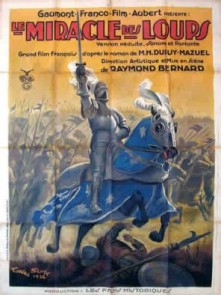
Le Miracle des Loups (The Miracle of the Wolves) (France 1924) has a reputation as one of the highpoints of French silent cinema. It is set in the fifteenth century during the reign of Louis XI (Charles Dullin) and it tells of the challenge to the king’s authority by the rebellious Charles the Bold, Duke of Burgundy (Vanni Marcoux), while rival noblemen fight over heroine Jeanne Fouquet, played by Yvonne Sergyl. The film, directed by Raymond Bernard, is on a truly epic scale, with setpieces of the battle of Montlhéry and the siege of the castle of Beauvais which are meant to show off the millions of francs that were clearly spent on them. Romance, rivalry, intrigue, violence, spectacle, all in the hands of a skilled director – what could possibly go wrong?

Oh dear, oh dear. Right from the start it was clear that something was wrong, when the prelude introduced us to the romance between Jeanne and Tobert Cotterau, played by the toe-curlingly unromantic-looking Romauld Joubé, during which she gets her pet dog to pass a message to him by lifting the bewildered dog over a wall. On top of this we were fed long and tedious intertitles filling us in on all the history, with all of the unwelcome earnestness of a history teacher of very much the old school. It set the tone for the disaster that was to unfold before us over the next two hours or more.

A more turgid plod of a movie it would be hard to imagine. What it did remind me of, in fact, is a 1909 Gaumont one-reeler, Le Huguenot, which crams in a complex plot with too many characters, overlong intertitles obsessed with pedantic detail, all put over with histrionic performances strong on gesture and redundant when it comes to human feeling. The Miracle of the Wolves is simply a 1909 historical film stretched out to 130 minutes. It was so half-hearted throughout. The performances were lethargic (particularly Charles Dullin, who tried to look Machivellian but just looked like he was struggling to remember where he was), and even the battle scenes were undercooked (despite some bloody examples of what fighting in the Middle Ages was actually like), with extras just about going through the motions.

The key scene was the miracle itself. Jeanne is being pursued by the evil Comte du Lau (Gaston Modot, chewing up the scenery) in the mountainside snows when she is surrounded by wolves, who settle down around her before attacking the Comte’s men. We were meant to be awe-struck – instead all too many of the audience laughted heartily at the scene’s absurd piety. All in all, a film without any heart at all. I’d waited twenty years to see it and it felt like twenty years watching it. There was some historical interest in the screening for which Touve Ratovondrahety played a piano transcription of Henri Rabaud’s original score, but to be honest it had little to stir the imagination. But then it had such poor material to work with. Oh dear oh dear.

But there would be better fare on the morrow.

Pordenone diary 2010 – day one
Pordenone diary 2010 – day two
Pordenone diary 2010 – day four
Pordenone diary 2010 – day five
Pordenone diary 2010 – day six
Pordenone diary 2010 – day seven
Pordenone diary 2010 – day eight