The woman who did not care

A fool there was and he made his prayer
(Even as you or I!)
To a rag and a bone and a hank of hair,
(We called her the woman who did not care),
But the fool he called her his lady fair –
(Even as you or I!)

Rudyard Kipling’s 1897 poem The Vampire (said to have been inspired by a painting of the same name by Philip Burne-Jones) has been hugely influential. It took a piece of Eastern European folklore which had had been popularised in Victorian literature and applied it to a new kind of woman whose sexual adventurous caused alarm and thrill in equal measure. The vampire came to films in 1913 with Robert Vignola’s The Vampire, starring Alice Hollister, but it was A Fool There Was (1915), which took its name from the first line of Kipling’s poem (by way of a play by Porter Emerson Browne), that stamped the idea of the vamp (and then the verb to vamp) on the consciousness of a generation.

The star of A Fool There Was was Theda Bara, and in her wake followed a number of screen vamps, each driving men mad and giving not a damn. Among them were Valeska Suratt, Olga Petrova, Musidora, Pola Negri, Helen Gardner, Louise Glaum, Dagmar Godowsky and Virginia Pearson. Lesser known than some of these, yet with perhaps a greater cult, is Nita Naldi, now the subject of a new website, Nita Naldi, Silent Vamp.

She was born Mary Dooley in Harlem, New York in 1894, into a “solidly blue collar, devoutly Catholic, and upwardly mobile” family. The family hit hard times, and Mary took to the stage, developing an exotic persona (Spanish or Italian according to whim). She took her name name from actress Maria Rosa Naldi, who she described as her sister for many years thereafter. She developed her vamp persona in assorted variety shows, including working for Florenz Ziegfeld. She got her first named screen role in 1920 in Dr. Jekyll and Mr. Hyde, worked hard for a time for both screen and stage as she built up her name, then got her big break playing opposite Rudolph Valentino in Blood and Sand (1922). As the Nita Naldi site says, in its characteristically keen style:

Nita, cast as fire-breathing man-eater Doña Sol, executes her signature role with a gleam in her eye and all the gusto she can muster. She swans about in outré ensembles, ogles Valentino and every other male in the film suggestively, wears a series of harebrained hats (one, a favorite here at Naldi HQ, is festooned with grapes), yawns as her victim dramatically perishes in front of her, and generally refuses to behave. It was not a role for Lillian Gish – but it suited Nita down to the ground.

Paramount awarded her a five-year contract and several nondescript titles followed (Anna Ascends, You Can’t Fool Your Wife, Lawful Larceny, Glimpses of the Moon, Don’t Call it Love, and The Breaking Point). She starred opposite Valentino again in A Sainted Devil and Cobra, but her star was on the wane, chiefly it seems because of a weight problem, though stories of heavy drinking and unclear sexuality probably didn’t help matters. As with many American stars on the way down, she sought work in Europe, and one of her last film roles was to play a non-vampish schoolteacher in Alfred Hitchcock’s lost film The Mountain Eagle (1925). She returned to the stage, married a wealthy man who promptly lost all his money in the Depression, soldiered on after his death maintaining the social life of a one-time film star, and died in straitened circumstances in 1961.

Nita Naldi, from ‘The Viewpoints of a Vamp’, Picture Show, December 1, 1923

It’s a not untypical tale of a screen performer’s rise and fall, but what makes Nita Naldi such an interesting, and now cultish figure is her intelligence, wit, style and devil-may-care attitude to life. She vamped on-screen and she vamped off-screen. Two of her fervent acolytes, Donna L. Hill and Joan Myers, members of the splendidly named ‘Daughters of Naldi’, plus auxiliary ‘daughter’ Christopher S. Connelly, have produced this excellent tribute site. It comprises a full biography, photo-gallery (divided up by film), ephemera section (photoplay books, articles etc.), filmography, stageography, a handy guide to vamping (Lesson 1: Lure the victim; Lesson 2: Assume the position; Lesson 3: Bite! Truly, Madly, Deeply!; Lesson 4: Celebrate!) and a Nita Naldi Cocktail.

Some of the exceptional material here is quite well hidden. The Daughters of Naldi have taken particular care over researching biographical material, including lengthy trawls through censuses, shipping records, naturalisation records and the like, and wherever US public domain laws allow, they have made available copies of the original documents in their notes and references section, with hyperlinks to PDFs. Similarly the articles, filmography and stageography sections have a number of valuable documents available in PDF format. Just look out for the hyperlinks.

Nita Naldi, Silent Vamp demonstrates that film history research can and should be fun. The research has been rigorous but the style is knowingly playful. More material is promised, including essays, more photographs and more biographical information – because many questions remain and the search must go on.

Well done to all concerned.
When films go astray

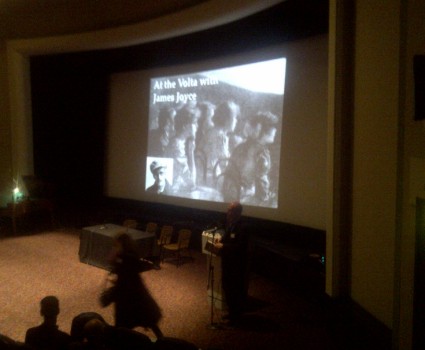
John McCourt introducing me (not there – I’m taking the picture) for the ‘At the Volta with James Joyce’ show, Glasgow Film Theatre, 10 December 2010

I’m back from my latest film adventure, which this time took me to Glasgow to present ‘At the Volta with James Joyce’, a programme of films programmed by Joyce at the Volta cinema in Dublin at the end of 1909/early 1910. I’ve written on a number of occasions on this story (here, here, here, and here, not to mention here. Oh, and here too), so no need to add any more, except to say that this was presented as part of the December 1910 Centenary Conference – the centenary being that of modernism (which Viriginia Woolf decided began 100 years ago – specifically she prononouned that “on or about December 1910 human character changed”). So it was full of modernists, who are full of brains and hifalutin jargon yet great people to go out for a drink afterwards.

But what made the event memorable for me is what went on behind the scenes. Owing to the snow that has hit the UK over the past week or so (though thankfully there was a thaw in Glasgow when I was there) there has been a big delay in deliveries of all kinds and – to keep the story simple – we discovered on the afternoon before the show that the films were sitting in a vault awaiting collection by DHL who were still dealing with a 7-day backlog. Much panic and frantic phone calls ensued. I thought briefly of carrying the films with me on the plane (not really practical, and likely to cause comment in airport security). However we found some of the Volta films on a DigiBeta tape which was copied onto DVD, though most of them had German intertitles and we had no translation. But a second DVD that had been lent to the pianist (the excellent Forrester Pyke) had further films with English titles, albeit with timecode at the top of the image. With five films on one DVD arrriving by car from Stirling and me flying up to Glasgow with three films on a second DVD (with a Google Translate approximation into English for the longest German-intertitled film, which I then read out while it was screened), and with two hours to spare, we had a show.

It’s always hazardous programming films, especially early films, where the more things you have to show the more things there are to go wrong. You can get the wrong film sent to you, you can be sent the right film can but find a different film inside, you can get a different film with the same title as the one you want to show (two films from the 1900s called Cheese Mites and two from the 1940s called Dressed to Kill at the BFI have always caused confusion). You can get films with a reel missing. On one occasion, which has passed into legend, the BFI’s print of A Night to Remember was sent for a screening at MOMA as part of a major British cinema retrospective, only for MOMA to discover that the last reel wasn’t there. Undaunted, BFI staff on hand went on stage and acted out the final reel – to what degree I’m not sure, since the final reel does feature the sinking of the Titanic, of course.

I had a similar experience myself at a conference in Bristol, when I was talking about the first ever Shakespeare film, King John (1899), which had recently been re-discovered. Owing to a series of errors, which I fear were my fault, the film hadn’t turned up. So I put up a still image, got up in front of the audience, and acted out the entire film. This wasn’t quite as much of a challenge as it might seem, since the film is just minute long and chiefly features King John in his death agonies, and though I’m no actor I can do death agonies. Anyway, it brought the house down.

On another occasion, at the Museum of the Moving Image in London, we were putting on a show of Chaplin rarities, and had announced beforehand that we would be showing the super-rare The Life Story of Charles Chaplin (1926), a British-made semi-documentary, semi-biography which Chaplin’s lawyers got banned. Unfortunately at the last minute the rights-owner refused us permission to screen the film, which was ironic. So all we could do was hold the tape copy that we had before the audience and say that, we promised to show it to you and here it is. They were remarkably good about it in the circumstances.

Anyway, the show must always go on, and my thanks go to everyone behind the scenes in Glasgow and London who turned what looked like being a disaster into a particularly successful screening. You just never know how things are going to turn out.

There’s a 1910 Conference blog report on the Volta show here. For the record (because no film list could be given out on the evening), here are the films that were shown:

  • La Course au Mouchoir (France 1909 d. Adrien Vély p.c. Pathé/S.C.A.G.L.)
  • Come Cretinetti paga i debiti (Italy 1909 d. André Deed p.c. Itala)
  • A Glass of Goat’s Milk (UK 1909 d. Percy Stow p.c. Clarendon)
  • Une Conquête (France 1909 d. Georges Monca p.c. Pathé)
  • Saffo (Italy 1909 d. Oreste Gherardini p.c. Societa Anonima Pineschi)
  • Une Pouponnière à Paris (France 1909 p.c. Éclair)
  • Bianca Capello (Italy 1909 d. Mario Caserini p.c. Cines)
  • Il signor Testardo (Italy 1909 p.c. Itala)

Update: I neglected when writing this post to say something about the conference itself. I only heard a few papers, and overall the conference was covering modernism across all the arts and culture. Nevertheless there were a number of papers that addressed film or film-related subjects. I heard Katy Mullin speak about H.G. Wells’ 1909 novel Ann Veronica, comparing his propulsive heroine to the heroines of screen railroad dramas. John McCourt spoke on ‘Joyce, Ulysses and the Corruptions of Cinema’ with remarkable extracts from the unpublished diaries of Stanislaus Joyce (James’ brother) on filmgoing in Trieste in 1909-10 (including seeing pornographic films akin to those made by Saturn Films of Austria, samples of which can be found on the Europa Film Treasures site). It’s a huge shame permission has not been granted to publish the diaries. Cleo Hanaway spoke on ‘Joyce’s Ulysses and Early Films as Phenomenological Texts’ which was tough stuff to take in after a late night but made me want to read Maurice Merleau-Ponty and to consider whether we now (or then) view films as subjects or objects.

I would also like to have heard Keith Williams speak on Wells, Joyce and Object Animation (looking at literary parallels between literature and trick films); Rosalind Leveridge on the ‘kaleidoscopic change’ for cinema in 1910; Anthony Paraskeva on Joyce and the actress Eleonora Duse (the Italian stage great who made just the one film, Cenere); and Maria Antonia Velez Serna, who is doing excellent work on early cinema and Scotland, looking at exhibition and distribution patterns. There is so much interesting work going on in our field outside the confines of film studies – and the more it goes on outside those confines, the better.

Sounds of Britain – and beyond

Beau Geste (1926), from http://www.ronaldcolman.com

The 2011 British Silent Film Festival will be taking place 7-10 April 2011 at the Barbican Cinema, London. As was the case in 2009, the festival will run in conjunction with ‘The Sounds of Early Cinema in Britain’ conference, previously trailed on the Bioscope. The title of the festival will be Going to the Movies: Music, Sound and the British Silent Film. However, as one may judge from the programme highlights advertised so far, the festival is continuing the trend of the past few years of stretching beyond the confines of British silent cinema to look further afield – which I think is a good thing.

Here’s the descriptive blurb:

Music and sound in silent film will be our key themes during the four days of the 2011 British Silent Film Festival. A packed programme of rare silent films will explore how filmmakers communicated sound to cinema audiences through music and visual clues, what it was like to be in the audience of the ‘silent movies’ and how the British industry geared up for the talkies. Accompanied by the world’s best silent film musicians the programme will feature special events, presentations by special guests and unique archive film from the BFI, the Imperial War Museum and other collections.

Highlights will include

  • The Annual Rachael Low Lecture
    Delivered by Matthew Sweet, broadcaster and author of Shepperton Babylon, on stars, stardom and scandal in British silent cinema
  • Topical Budget is 100!
    Celebrating 100 years since the birth of the British newsreel with highlights from the Topical Budget series
  • ‘Only the Screen Was Silent’
    Luke McKernan, moving image archivist from the British Library, will talk about the experience of cinemagoers from the silent days using oral history material from the British Library and BFI
  • Cinema on the Fronts
    Toby Haggith will screen highlights from the Imperial War Museum collection showing how cinema addressed soldiers at the Front and their families back on the Home Front during the Great War
  • Radio on Film
    Bryony Dixon will present a selection of films looking at silent cinemas fascination with the birth of radio including radio Europa, Romance of the Postal Telegraphy, ‘I’ Got a Sweetie on the Radio’, Mr Smith Wakes Up, Bonzo Broadcasted and Wireless Whirl
  • In Sound and Silence
    Tony Fletcher presents a programme of popular classical music, opera and dance in the 1920’s and the various experiments in synchronous sound that recorded these performances
  • Transports of Delight
    A family programme of vehicular fun featuring trains, planes, automobiles and silent comedy
  • New Discoveries in British Silent Film
    Including Cecil Hepworth’s Helen of Four Gates (1921) starring Alma Taylor, rediscovered almost ninety years after it was believed destroyed and Walter Forde’s 1928 comedy What Next?
  • From Silent to Sound
    An illustrated presentation from Robert Murphy and Geoff Brown on the how British cinema made the transition from silent to sound cinema
  • Genre Film and Genre Music
    Neil Brand and Phil Carli discuss why high staccato strings means murder in cinema and how various musical themes developed during the silent period
  • Beau Geste (1926)
    Hollywood director Herbert Brenon’s adaptation of the best-selling British adventure story about the Foreign Legion starring the quintessentially English Ronald Colman
  • Twinkletoes (1926)
    US director Charles Brabin’s take on the British music hall starring Hollywood’s favourite flapper Colleen Moore
  • Lonesome (1928)
    Paul Fejos’s brilliant part-talkie where dialogue was introduced as a novelty in this story of two lonely people trying to find love in New York. The film features a fantastic jazz-fuelled parade in Coney Island
  • Morozko (1925)
    Yu Zhelyabuzhsky’s rarely seen Soviet fantasy about a stepdaughter who is driven out to face the spirit of winter is here presented with its original music score rediscovered and reconstructed for orchestra. Presented in conjunction with Sounds of Early Cinema Conference
  • I Was Born But … (1932)
    Ozu’s classic family comedy marks the very end of the silent period. As one of the greatest silent films ever made, it is screened here to celebrate the artistic excellence which the silent cinema had achieved

The Festival is organised in partnership with the British Film Institute. The conference is funded by the Arts and Humanities Research Council as part of its ‘Beyond Text’ programme, and organised in conjunction with Royal Holloway, University of London and the University of Edinburgh.

Well, that looks like an interesting mixture of usual suspects and unexpected suspects. Among the usuals, my contribution will hopefully be a bit more than just me talking about the experiences of filmgoers during the silent era – I plan to be putting together an entertainment of some sort. Anyway, riches a-plenty, and it’s always good news to learn that the festival has managed to survive another year – no mean feat in these straitened times.

More information will appear in due course on the British Silent Film Festival website.

The Tenement Ghost

As regulars will know, here at the Bioscope we like to champion the modern silent film, of which there are growing numbers. The explosion in film production brought about cheap cameras, broadband and online video platforms has led to many experiment with a variety of film forms, silent among them. There are many such home-made or semi-home-made efforts which are of short duration, but the organisation required for a feature length silent means that these are inevitably fewer in number. Nevertheless we’ve been able to champion such titles as How I Filmed the War, Silent, Hannah House, The Gold Bug and Prometheus Triumphant.

Now we can add to their number The Tenement Ghost. This 51-minute film was directed and produced by Thomas Cochrane for his Twisty-Headed Man Company in 2009. Set in Scotland just after the First World War (though costumes seen to veer between 1919 and 2009), the film documents the disintegration of a marriage following the husband’s descent in alcoholism. Physical and emotional violence follow, then spectral occurences are experienced by the bride, as the film’s press handout describes:

Her rapid transition from starry-eyed bride to battered wife is marked by the appearance of a ghostly apparition and, though we are never sure whether this spectre is real or simply a fantasy borne of her brutal situation, its appearances become more frequent as her personality disintegrates. The death of their unborn child pushes her ever closer to the edge of sanity until the ghostly visitor’s promptings finally impel her into a last desperate attempt to free herself from torment, bringing the Tenement Ghost to its ghastly and appalling climax.

The film boasts a busy electronic score by Skirlin Burster and stars Frances Rowan as the wife, Barry Ward as the husband heading a cast and crew of twenty. Apparently it was made in just a week on the thinnest of shoestring budgets. The director writes of his enthusiasm for silent films:

It’s not a unique situation – it’s something you see in the newspapers on a far too regular basis – but it is a situation that, if you look at it through the very charming medium of silent film, becomes, I think, more powerful, more shocking … I love silent films. I love the look of them, the feel, the atmosphere. And in producing one I thought the effect would be… the first effect that came to mind was charming – it would be something pleasant to look at. You’d get a warmth from it.

Trailer for The Tenement Ghost

So what is it like? Up to a point the director knows his silents, with plenty of familiar camera angles, visual motifs, intertitles and appropriately attuned performances. It is also in monochrome with faux scratches (such as they wouldn’t have seen in 1919, of course). However he has gone for an odd stop-motion-style look to people’s movements which doesn’t really add to the film’s attractions. Also alcoholism is seldom a good subject for film drama (just ask D.W. Griffith, whose film career came to an end with the unfortunate The Struggle) and there isn’t much story here. But there are some striking visuals, a good performance from Frances Rowan, and an overall a sense that it was right to shoot the film silent – it’s not simply a sound film shorn of its words. It’s just that over 50 minutes you need a bit more of a story, or just a little more complexity.

The film can be seen in its entirely on Vimeo or on the film’s website, where you are also offered the choice buy it on DVD (£10.00 plus p&p) or download it as a free torrent.

There an interview with Thomas Cochrane on his experience making the film on Eye for Film.

Footage on demand

http://www.criticalpast.com

There are many archive footage websites which are offering their wares to the commercial footage researcher, but whose holdings are going to be of interest to the academic enthusiast. We’ve previously covered such resources as British Pathe and British Movietone, and will return to other such sites in due course. One that has come to my attention that is just a little bit different is CriticalPast. It’s certainly worth some investigation.

CriticalPast is designed to make films and still images easily available to professionals and non-professionals alike. It currently holds over 57,000 videos and 7 million still images, all royalty-free, much of it content from US government agencies, plus such familiar collections as the Ford and Universal Newsreels collections. While many footage allow visitors to view preview clips, CriticalPast lets users download footage or images immediately (upon payment, of course, and after assenting to a licence agreement), with different image resolution and prices according to usage. The cheapest rate is $3.97 (for iPhone, iPad, PowerPoint etc); the commercial rate for say an HD MPEG2 1080-25p depends on file size e.g. a 5 minute video of at 1.3GB would cost $145.

What makes CriticalPast stand out, apart from the user-friendly ordering, is the quality of the searching experience and the sheer quantity and quality of what is on offer. It is almost all non-fiction film material, ranging from 1891 (genuinely so – it’s an early Edison test) to 1996 (a few rogue fiction films have slipped in, like Chaplin’s The Bond, D.W. Griffith’s The New York Hat and clips from The Birth of a Nation). The largest amount of material comes from the 1940s. As well as the simple front-page search there is an advance search option which allows to to search by specific dates, date range, colour, silent or sound, edited or unedited, language, and location. There is a very helpful timeline dividing clips up by decade, then year and thereafter by location. Once you have searched for any subject there is the option to refine your search further by decade/year, location and format. The cataloguing information is generally good, with concise, informative description and US Government Archive ID numbers. For any item you choose you can tweet about it, send to Facebook, Stumble Upon etc., email the information to a friend – and, yes, you can even view it. The images are all frame stills from the videos (British Pathe is another footage library which has created a subsidiary image archive by capturing frames as regular intervals as part of the video digitising process).

Charlie Chaplin and Edna Purviance in The Bond (1918), available in its 1942 Canadian reissue form under the title Some Bonds I Have Known

If we concentrate on the silent film era (which is our wont) there are some 7,200 clips available. You can find Edison films from the 1890s, then news-based material from around the world (it certainly isn’t just restricted to the USA, and interestingly there are quite a few British Gaumont Graphic newsreels), with strong World War I material (there isn’t that much in the archive before 1915), travel, exploration and industrial films, and much surprisingly material for the curious browser. I have found oil exploration in Persia in 1908, British food aid being received by Russian villagers in 1917, US black troops on horseback and bicycle in 1918, Hungarian newsreels of its brief Soviet republic of 1919, footage of Ernest Shackleton’s final Antarctic expedition in 1922, and the production of nitrate film stock in Rochester, NY in 1929.

It’s a fascinating site, compulsively browsable, and really useful whether you are looking to use clips yourself or not. Go explore.

A perfect light

Robert Flaherty filming Nanook of the North

The relief to be out of the sun,
To have come north once more
To my islands of dark ore
Where winter is so long
Only a little light
Gets through, and that perfect.

I think this is my favourite film poem. It’s not immediately obvious that it is about film; for that you need its title and subtitle: “Epitaph for Robert Flaherty (after reading The Innocent Eye, by Arthur Calder-Marshall, in Montreal, Canada)”. It was written by the Irish poet Derek Mahon and first published in 1968 in his collection Night-Crossing (the long subtitle appeared later). It is the last two lines that are so acute: “Only a little light/Gets through, and that perfect”. Is there a better, more poetically concise summation of photographic art?

Though the poem is called an epitaph, it gives the impression of being the thoughts of Robert Flaherty, while at the same time Derek Mahon himself. The location is similarly ambiguous. Mahon references Canada in the subtitle, and with the mention of the north, “dark ore” and the long winter it seems he is thinking of the Arctic wastes where Flaherty first filmed in 1913 (on the Belcher Islands of Hudson Bay). Although Flaherty had gone out the as a prospector (for iron ore) he became fascinated by the Inuit people and was encouraged to operate a motion picture camera by the railroad entrepreneur William Mackenzie who had sponsored the prospecting work. He was dissatisfied with the results (and lost much of what he had filmed in a fire) and returned in 1920 to northern Quebec to film what became Nanook of the North (1922), a study of the lives of the Inuit and the founding statement of the art of documentary.

But Mahon the Irishman and Flaherty the Irish-American are just as much thinking of Aran, the island location of Flaherty’s 1934 documentary, Man of Aran (a sound film, but one that was shot silent). The Aran Islands, in Galway Bay, contain no dark ore, but Mahon is thinking of that deep vein of timeless culture (or an idea of that culture) that has drawn so many artists, Flaherty among them. His film notoriously documents a romantic idea of Aran, with the islanders being encouraged to recreate cultural practics (such as the shark hunt) which they had not followed for decades. For Flaherty, literal truth is less important than elemental truth.

Man of Aran, from moma.org

So, is the island of the poem in Hudson Bay or Galway Bay? The volume in which ‘Epitaph for Robert Flaherty’ appears, Night-Crossing contains a second poem, ‘Recalling Aran’), while the two poems are book-ended by ‘Canadian Pacific’ and ‘April on Toronto Island’, showing how the poet has purposefully mixed up thoughts of home and abroad. But the poem is an epitaph, and consequently about death (“out of the sun”), the island therefore being not so much an actual place as an idea of death as Ultima Thule – “death as the terminal island … with the island as ultimate art” as Edna Longley describes it), the place at the edge of the world (to give the title of another film made about remote lives).

The dilemma for the ethnographic filmmaker has always been that the camera they take with them – the symbol of modern civilization – helps bring about the destruction of that which it seeks to record (“Each man kills the thing he loves”, as another Irishman put it). Flaherty’s solution was to record the dream rather than the actuality – the idea of a pure, remote culture, rather than the compromised reality. He filmed with a poet’s eye. Derek Mahon responds with a poet’s appreciation of the filmmaker’s quest, equating the escape from the remorseless advance of the modern with the capture, out of the dark, of that elusive, perfect light.

Trailer for A Boatload of Wild Irishmen

Robert Flaherty is the subject of a new feature-length documentary, A Boatload of Wild Irishmen, directed by Mac Dara O’Curraidhin and written by Brian Winston. I ‘ve not seen it yet and don’t know if it will get shown beyond the festival circuit, but the trailer certainly whets the appetite, both to see the films again (Louisiana Story – such a beautiful film) and to learn more about a filmmaker whose vision is still so inspirational for anyone seeking out the dark ore of why it is we want to film the world at all.

Arthur Calder-Marshall’s classic biography of Flaherty, The Innocent Eye is available on the Internet Archive, and will be placed forthwith in the Bioscope Library. Nanook of the North is available on DVD from Criterion. Man of Aran is not currently available on DVD, but used copies can be easily found. Derek Mahon’s Night-Crossings is out of print, but ‘Epitaph for Robert Flaherty’, ‘Recalling Aran’ (later retitled as ‘Thinking of Inishere in Cambridge, Massachusetts’), ‘Canadian Pacific’ and ‘April in Toronto Island’ can all be found in his Collected Poems.

Slapstick is back

http://www.slapstick.org.uk

Here comes 2011, and first off the blocks will be the seventh edition of the annual Slapstick festival, held in Bristol. The festival has developed into a celebration of visual comedy in general by bringing together silent slapstick with British television and radio comedians of today (not that radio excels in visual comedy, but it all fits somehow). This year the presenters include Bill Oddie, Ian Lavender, Barry Cryer, Tim Brooke-Taylor, Neil Innes, Shappi Khorsandi and Chris Serle. Kevin Brownlow turns up presenting ‘Unknown Chaplin’ material, while the silent performers featured include Chaplin, Keaton and Langdon. And there is also a welcome tribute to one of Bristol’s finest, the Aardman Animation studios’ children TV series Shaun the Sheep, which the Bioscope should have championed long before now as a truly great example of the art of silent comedy happily carried on into the 21st century (and who would have guessed that Sir Christopher Frayling was a fan? Good on him).

Here’s the full programme:

THURSDAY 27 JANUARY

5.40pm Watershed
UNKNOWN CHAPLIN with KEVIN BROWNLOW
Academy Award winning film historian Kevin Brownlow introduces a selection of the rarest and least known footage of Charlie Chaplin as the festival opens with the first of four events dedicated to the ‘Little Tramp’.

8.00pm Colston Hall
Neil Innes: A People’s Guide to World Domination
The very welcome return of Slapstick Festival supporter and patron, Rutle and Bonzo front man Neil Innes as he brings his new solo show to Colston Hall for one night only on the opening night of Bristol’s Seventh Slapstick Festival. Neil performs a wry, poignant, humorous and topical one-man show, spiced with anecdotes of his life and times in the worlds of media and show business. Neil’s solo shows tickle the emotions with a potent mix of fine musicianship and enlightened lyricism, packed with sharp observations celebrating the absurdities of modern existence. Join us for a unique musical experience in the company of the self proclaimed ‘Ego Warrior’ and ‘Seventh Python’

FRIDAY 28 JANUARY

2pm Arnolfini
CLARA BOW in MANTRAP (Dir Victor Fleming; USA, 126 mins)
Clara Bow wasn’t just the ‘IT’ girl of a generation, she was also a fine actress and comedienne. Here in one of her funniest films, Bow plays the sexy wife of an old Canadian backwoodsman who becomes attracted to a young, rich and famous divorce lawyer who comes to town on vacation.

4pm Watershed
SLAPSTICK INTERNATIONAL (U) with live piano accompaniment
In a continuation of Slapstick’s tradition of sharing the best new silent comedy finds, three superb films discovered by the Giornate Cinema Muto for Italy’s Pordenone Silent Film Festival: W.C. Fields, making his silent screen debut, in THE POOL SHARKS; the same wise-cracker in the early sound short, THE GOLF SPECIALIST, plus a delightful silent from Russian, CHESS FEVER. Introduced by Pordenone’s director David Robinson, with John Sweeney on piano and Chris Serle as host.

7.30pm Colston Hall
SLAPSTICK SILENT COMEDY GALA
with Bill Oddie, Ian Lavender, Barry Cryer and Neil Innes; the Jazz Train orchestra; the European Silent Screen Virtuosi and Paul McGann

Four living comedy icons introduce a four-film salute to the best-loved past masters of silent humour, showing here on a giant screen with music from the 25-piece jazz combo, Jazz Train, and the European Silent Screen Virtuosi. Plus a ukulele tribute to Chaplin and an appearance by Paul McGann. £20 (£16 conc); £6 under 12s.

SATURDAY 29 JANUARY

9.30am Colston Hall
HOMAGE TO CHAPLIN (U, Germany, 50 mins)
A rare chance to see a fine visual tribute to Charlie Chaplin, made in association with, and performed by students from, a German school for young people who are deaf. Showing here with a live piano accompaniment by Guenter Buchwald.

11am Colston Hall
HARRY LANGDON: BEST COMEDY SHORTS with Graeme Garden
Baby-faced Harry Langdon used a subtler form of visual comedy than that which became known as ‘slapstick’ but his talent made him a worthy rival of those who became better known. Here, Graeme Garden, of The Goodies and the I’M SORRY I HAVEN’T A CLUE panel explains why he’s a Langdon champion and introduces some of the comic’s brightest and funniest shorts. With live music.

2pm Arnolfini
CHAPLIN: THE CIRCUS + a new animation CIRCUS DRAWINGS
Too often overshadowed by his more legendary comedies, THE CIRCUS boasts Chaplin’s most brilliant gags, including a Hall of Mirrors chase and climaxing with a de-trousering by monkeys on the high wire! Showing here with the UK premiere of a new short by the triple Oscar-winning animator, Richard Williams, based on his 1950s drawings of a circus in Spain.

4pm Bristol Old Vic
CELEBRATING BUSTER KEATON with IAN LAVENDER
DAD’S ARMY and EASTENDERS star Ian Lavender makes his first Slapstick visit appearance to share his long-held passion for Buster Keaton – his chosen subject on a recent Celebrity Mastermind – before revealing and screening his all time favourite short by ‘the great stone face’ and then introducing SHERLOCK JUNIOR (PG, 1924, 45 mins) in which Keaton plays an aspiring detective wrongly accused of a crime by the family of the girl he loves. With live accompaniment by the five-piece European Silent Screen Virtuosi.

8pm Bristol Old Vic
BARRY CRYER’S TOP COMEDY MOMENTS with ROB BRYD0N
The man who has probably worked with &/or written for more UK comics than anyone else on the planet shares his favourite moments and memories with another bright star of British comedy, Rob Brydon. Together, they’ll be telling tales and showing clips celebrating almost 100 years of film and tv humour – from Harold Lloyd and Buster Keaton, via Morecambe & Wise and David ‘Del Boy’ Jason to today.

SUNDAY 30 JANUARY

9.30am Colston Hall
REDISCOVERIES & REVELATIONS
Amazingly, 2010 saw the rediscovery of not one but two unknown Chaplin films, a lost Charley Chase, and the recovery of films featuring Laurel & Hardy, Harry Langdon and British stars, Walter Forde and Pimple. Join silent comedy expert David Wyatt as he brings these gems and others to the screen again, concluding with the UK premiere of Stan Laurel’s restored Monty Python-like classic WHEN KNIGHTS WERE COLD (1923).

11am Colston Hall
MARTY! with TIM BROOKE-TAYLOR and CHRIS SERLE
Writer, actor and wit Tim Brooke-Taylor shares his memories of working with the instantly-recognisable but often overlooked bug-eyed funny man Marty Feldman in his pre-Hollywood days. With clips of some of Marty’s best visual gags from shows like the seminal AT LAST THE 1948 SHOW and the BAFTA award-winning MARTY to illustrate and Chris Serle as host.

2pm Arnolfini
LECTURE: SLAPSTICK & THE CITY: Silent Comedy and the Metropolitan Playground plus HEAVEN’S SAKE and music from The Slapstick Boys
Dr Alex Clayton, Lecturer in Screen Studies at the University of Bristol, looks at how early slapstick films used urban architecture – including statues, giant clocks, escalators and industrial machines – to create some of their most vivid and comic sequences. With illustrative clips and, to follow, a Harold Lloyd comedy (U, 1926, 58 mins) set in the ‘Big Apple’, with a live accompaniment.

2pm Watershed
IT’S… SHAUN THE SHEEP
Eighty years on from the end of the silent film era, silent comedy is alive and well and regaining massive new audiences and global success in the guise of the Wallace and Gromit spin-off character Shaun the Sheep’. Here, Aardman Animation’s Creative Director Richard Goleszowski, chats with Sir Christopher Frayling about Shaun’s inspirations, development and popularity, using extracts from the shows and original models.

4pm Bristol Old Vic
CHAPLIN: THE GREAT DICTATOR with SHAPPI KHORSANDI
When comedian and author Shappi Khorsandi was invited to add an item to BBC Radio 4’s THE MUSEUM OF CURIOSITY, she chose Charlie Chaplin and revealed that his THE GREAT DICTATOR is her all-time favourite film. Here, she explains why she is so drawn to this satire on dictatorship, Fascism, and racism before iintroducing the film (PG, 1940, 120 mins) in which Chaplin plays both the Hitleresque Adenoid Hynkel and his look-alike, a poor Jewish barber. £10-£5

8pm Watershed
MARTY: THE YOUNG FRANKENSTEIN with TIM BROOKE-TAYLOR
To close Slapstick 2011, Tim Brooke-Taylor introduces the Frankenstein spoofathon which catapulted his comedy colleague Marty Feldman to international stardom. Here, Feldman plays Eye-Gore in a piece of inspired lunacy which also stars Mel Brooks and Gene Wilder. Dir: Mel Brooks, USA, 1974, 105 mins.

All the necessary information, with booking details and information on past festivals, can be found on the Slapstick site.

Europeana

Europeana is one of those inestimably worthy, pan-European projects that the European Union funds handsomely, that some people get terribly idealistic about, and you wonder just how many people actually use. Launched in 2008, it is a multi-lingual portal to the digital resources of some 1,500 European museums, libraries, archives and audio-visual collections, among them the British Library, the Louvre and the Rijksmuseum. There are some 14.6 million items described and accessible on its site, which certainly makes for an exceptional collection. However, it is a portal, which means that all of this stuff is available elsewhere (i.e. on the websites of the contributing institutions), and Europeana depends on its success for the usefulness of having all this content in the one place and the degree to which researchers will identify with a Europe-wide culture and want to find content across its borders and languages.

Whether you think in a European kind of way, Europeana is undoubtedly hugely useful in bringing together such a cornucopia of content. It is simply and sensibly presented and records are meticulously described. Each record gives you the essential information on the chosen object (including in most case a thumbnail image, some of surprisingly poor quality), then provides you with a link to the object on the contributing institution’s website. The research will find paintings, drawings, maps, photos, pictures of museum objects, books, newspapers, letters, diaries, archival papers, cylinders, tapes, discs, radio broadcasts, films, newsreels and television broadcasts. Most are available for free (you do come across some paid access entries, mostly for Scotalnd’s SCRAN site). It is certainly something to explore.

Europeana search results page for ‘bioscope’

So, what will we find for the study of silent films? Our usual test search term of “kinetoscope” doesn’t yield too much, but type in “silent film” and you get 91 records (note that this will currently only bring up the English language records). Most of these are either photographs (particularly of cinemas, deriving for the UK resource Culture Grid) or a range of early films (mostly actualities) that derive from filmarchives online. Searchin under “cinematograph” brings up 37 records: among them photographs of cameras, postcards, posters and flyers, while “charlie chaplin” brings up 128 records: 3 texts, 100 images, 16 videos (mostly French TV programmes from INA) and 9 sound recordings (the latter all in French).

Other search terms worth pursuing include “bioscope” (26 results), “kinema” (33), “stumfilm” (62), “stummfilm” (110), “gaumont” (261) and “kino” (4,853). It is certainly worth knowing the common terms for film subjects in other languages (a tip is to check the keywords under item you’ve stumbled upon to find more of the same), though Europeana is working on solutions to provide true multilingual access through association of search terms (so you might type in “silent film” and get results from “stummfilm” as well). Among the surprises I have found are French First World War film posters from the Imperial War Museum (via the VADS visual resource site), a number of photographs of German silent films from Deutsche Fotothek, photographs of early cine cameras from the Norwegian DigitaltMuseum, and a terrific set of photographs of cinemas past in Leeds from Leodis.net.

Worth noting is that Europeana is to be the outlet for a three-year project, the European Film Gateway, which in 2011 will deliver its own portal to 700,000 digital objects including films, photos, posters, drawings and text documents from 21 archives across 15 countries. More on that initiative when the time comes.

Kinemacolor projector held by the Norsk Teknisk Museum, available via Norway’s Digitalt Museum and Europeana

Searching on Europeana is a somewhat haphazard experience. Because it is a compilation of the greatest hits of other institutions and resources, one does not go there to conduct comprehensive research but instead to wander round almost at random and see what catches the eye. The real fascination then comes in seeing where the digital object comes from and pursuing that source for more information. This is of course what a portal is supposed to do, and so Europeana performs its basic task very well. More and more content is being poured into it, and it certainly provides a far more useful function than the much-lauded and so far very disappointing World Digital Library. All of our libraries are trying earnestly to turn themselves into digital libraries, an inevitable consequence of which is that more and more content gets shared through linkages and common search platforms, raising the profile of major initatives like Europeana while relegating the individual library to a subsidiary role. It’s going to be hard for the individual institution to retain its identity in our bright new digital future. For the researcher, meanwhile, the assumption is that more access is better, and the easier the better. That’s not necessarily the case (research isn’t research if it’s easy), but there’s certainly no excuse now for any of us not to be discovering more.

The Bioscope will be doing its bit for individual institutions over pan-national behemoths by writing about some of the contributors to Europeana over the next few weeks.

Their films, our music

Gary Lucas playing to Dracula at the New York Film Festival, September 2010, with Carlos Villarias was Dracula, from http://www.garylucas.com

Will silent films survive? After the present generation of enthusiasts is gone, and now with almost no one left who remembers silent films the first time round, what impetus will there be in an age of HD, 3D, video games, home cinema, web video and mobile video to attract young audience to a silent, monochrome world filled with quaint manners, outdated narrative conventions and names that no longer hold the magic that once they had?

This issue was debated recently on the silent film discussion forum Nitrateville, and many interesting arguments were given for the survival of silent films. The great availability of silent films on DVD and Blu-Ray, the rude health (general global economic downturn notwithstanding) of some excellent festivals, the sheer fascination of viewing a past that recedes ever further away from us, scholarly investigation, the importance of book publications to inspire and intrigue, and the dedication of archives, all are cited as reasons for optimism.

I would add another, which is the silent film’s need for music. What is distinctive about the silent film as a medium is that it requires accompaniment by us. We have to add something of ourselves – our music, that is – to bring the films back to life. This performance imperative is not unique to silent films. Of course it applies to dramas, operas, indeed the music of the past. The playscript and the sheet music are the preserve of the expert until what they contain is given life through performance, is popularised. But what particularly distinguishes the silent film is that marrying of two forms of artistic expression – the film, and our music alongside it.

The Battle of the Ancre and the Advance of the Tanks (1917)

I experienced three illustrations of this last Sunday. It is surely strong evidence of the vitality of the medium that I was able to go to three very different screenings of silent films where the music was the real subject of interest in one city (London) on one day. I started off at Imperial War Museum to see The Battle of the Ancre and the Advance of the Tanks (1917). This documentary feature was made by the British goverment’s War Office Cinematograph Committee as the successor to the hugely successful The Battle of the Somme (1916), and the film – made by Geoffrey Malins, J.B. McDowell and Oscar Bovill – documents the later stages of the Somme conflict. While the film does not have the shock value or socio-historical resonances of the first film, it is more elegantly crafted and has shots of striking visual quality, in particular shellfire at night and iconic silhouetted figures against the sky.

The film depicts the routine of war in distinctively poetic terms. No other documentary medium can tell us so much about such engrossingly mundane details as soldiers donning thigh boots to fight off frost-bite, the wounded being given tea and sandwiches, and the ominpresent mud. It also features genuine footage (filmed at a distance with shaky camera) of troops going over the top and crossing no-man’s land. And of course it has tanks, which is what the public particularly came to see and which helped make the film a commercial success.

For the screening Toby Haggith of the IWM and pianist Stephen Horne had constructed the original ‘score’. As with their earlier project of The Battle of the Somme, there wasn’t a score as such, but rather a collection of musical suggestions for the different stages of the film, recommended in 1917 by musical director J. Morton Hutcheson. Horne has put together this pot pourri of popular tunes from the era, which was played by Horne himself (piano, flute and accordion), Geoffrey Lawrence (cornet), Sophie Langdon (violin) and Martin Pyne (percussion). The emphasis was on popular. Hutcheson had picked the pop hits of the day without much thought on their relevance to the film sequences they were to match, except for some association of names, though it was hard to fathom why a tune entitled ‘The Happy Frog’ had been chosen for a scene with a tank. As the film progressed so Hutcheson became more caught in the gravity of what was being shown and the music became of greater moment, but my abiding memory of the screening is of a line of howitzers shown to the sounds of a palm court orchestra with the occasional polite thud of the drum each time of of the guns fired. You did wonder what audiences made of such a musical mélange. Did it seem appropriate? Did it affect their view on what was on the screen? Did they hear differently to ourselves? Did they simply not pay it much attention?

This might seem to be the converse of adding our music to their films, but it is our modern taste to seek out authenticity in this way. Horne’s meticulous musical reconstruction took us that much closer to the past, while at the same time making the past seem all the more like the foreign country where things are done differently.

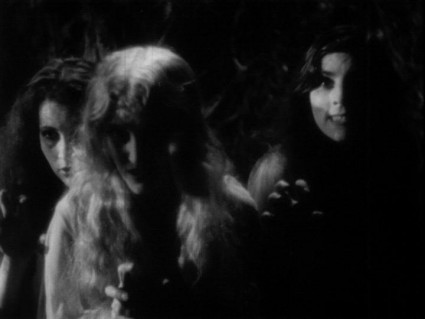
The brides of Dracula from the Spanish version of Dracula (1931), from http://www.garylucas.com

A few hours latter, and I was at the Queen Elizabeth Hall on the South Bank for two film screenings with live music that were part of the London Jazz Festival. This was something of a personal thrill as two of my favourite musicians were on the same bill. First up was guitarist Gary Lucas playing guitar to the Spanish version of Dracula (1931). This is the version of Tod Browning’s film that was shot on the same sets at night with a Spanish cast and director Geoge Melford. So yes it’s a sound film, albeit one with long stretches of silence and no background music except at the beginning and end. So why accompanying it with live music?

The effect certainly was jarring to begin with. Dialogue, translated titles and great swooping washes of electric guitar laden with effects pedals was a bit too much for the ears to take in all at once, but gradually you acommodated yourself to it, and Lucas’ wall of sound has proven itself an effective form of providing musical accompaniment to silents (notably his music for Der Golem) and now quasi-silents. He speaks through his guitar and his music is an expression of his enthusiasm for what is being shown on the screen. That’s the key point. It is not simply a rock musician doing his thing with a silent film (as others have done, often with painfully inapposite results). Enthusiasm for the film comes first, and with that an expression of that enthusiasm through his medium of choice – the electric guitar (two in fact). The result leaves the film still very much a 1931 film, but also one that connects through music with 2010.

The film itself is quaint, but while I wouldn’t say it was hugely superior to Browning’s original (as some have done), it shows invention and the sort of creepiness, except where adherence to the stage production drags it down. Carlos Villarias’s smiling Dracula drew laughter from the audience (I found him off-puttingly similar to Steve Carrell), but Pablo Alvarez Rubio (Renfield) played insanity as well as I’ve ever seen it done, and Lupita Tovar (Eva) was strikingly voluptuous.

Keystone, from http://www.davedouglas.com

The second film that evening was a silent film of sorts – a new work by experimental filmmaker Bill Morrison, who has enjoyed much acclaim for his work Decasia, composed out of found, distressed footage, which finds an otherworldly beauty in images in the process of decay. Morrison has continued to produced work in a similar vien, his latest effort being Spark of Being, inspired by the Frankenstein story, which he has developed with jazz trumpeter Dave Douglas. Douglas is building up a distinctive track record of silent film-inspired work with his band Keystone, though his modern jazz sound with strong beats behind it is better viewed as being inspired by the silents of Keaton and Arbuckle (subjects of earlier Keystone recordings) than ideal accompaniments to the films themselves.

The band came on stage – trumpet, saxophone, bass, drums, Rhodes and someone off-stage providing electronic noises – and played a punchy overture, then the film began. It was divided up into chapters (“The Captain’s Story”, “The Doctor’s Creation”, “The Creature Confronts His Creator” etc.) with the band accompanying what was shown on the screen. Morrison’s film is a mixture of distressed actuality footage and archive film, all of it silnet (or rather sound-less) including polar exploration (some of it Frank Hurley’s film of the Shackleton expedition), crowds (an amusing short sequence where people glower at the camera to signify public reaction to the Creature), two naked lovers running through woodland (““Observations of Romantic Love”) and a delightful sequence showing a Bavarian wedding projected at a slow speed that gave it a mesmeric quality). However, with the exception of the wedding, the archive film didn’t really convey the symbolic quality that was expected of it, and sometimes jarred with the bolder use of distressed footage. It was these sequences where the band seemed happiest, letting rip against a furious cavalcade of distorted images. On other occasions it seemed constrained by the need to follow the film, and one sensed that the audience would have been content just to have had the band play and never mind the film.

That’s a shame, because it was a bold coming together of experimental film and post-bop jazz, telling a familiar story in an imaginatively oblique fashion. And it was a modern silent film, given its own spark of being by Douglas’ music. I especially admire Douglas’ imaginative vision of the silent film as a springboard for musical invention, which has taken him from Keaton and Arbuckle’s Moonshine to Bill Morrison with the same band, Keystone. Certainly Sunday night would have comes as a surprise to Mack Sennett.

Silent films will survive for many reasons, but one of them is music. They are always going to sound new, to have a connection with our times, so long as we keep on re-imagining how we want to make them sound. It is a key to their enduring appeal to the imagination.

Spark of Being, from http://www.fest21.com

Tied to the tracks

I’m grateful to Bioscope regular Penfold for bringing this delightful short animation by Aidan McAteer to my attention. It is funny, stylish, and will have particular resonance for any weekend train traveller in the UK who has come up against the words ‘engineering works’ …

It’s a mocking idea of a silent film, the kind of silent film that was never made. All those know don’t know silent films know one thing about them – that they featured evil villains who twirled their moustaches then tied a hapless female to the railway track. And all those who do know silent films know that such scenes were hackneyed even before films were invented, and the few films that did show them did so as parody.

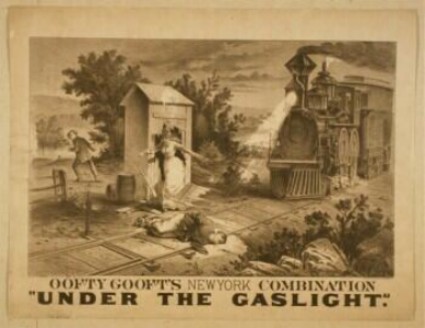
It’s an issue that comes up time and time again, so let’s try and pin down the historical truth. The idea of an entertainment where someone is tied to a railway track and is rescued in the nick of time certainly predates cinema. The entertainment that put the idea into the popular imagination was an 1867 stage melodrama written by American playwright and theatre manager Augustin Daly entitled Under the Gaslight which featured a man tried to railway tracks who was rescued by a woman before he could be run over by the oncoming train (Victorian theatre revelled in such stage spectaculars). An earlier play, The Engineer, had some elements that may have inspired Daly, but he put all the right elements together.

Poster for Under the Gaslight, from http://www.josephhaworth.com. Note the male victim and the female rescuer

When the man in peril was changed to a woman in peril in the popular imagination is unclear, but it is no surprise that the transference was made. The play was wildly popular and was re-produced many times, while Daly complained that his big idea was stolen by other theatrical managers who adapted it for their own entertainments. When films appeared, thirty years later, the mannerisms of stage meldorama that had sent shivers up Victorian spines were out-of-date (so no more twirling of moustaches if you wanted your villain to be taken seriously) while the elaborate stage effects were increasingly supplanted by the realism that cinema could provide by filming on location. So, as dramatic films emerged a major sub-genre emerged of the train thriller (including such notable titles as D.W. Griffith’s The Lonedale Operator and The Girl and Her Trust). But the thrill had transferred from the tracks to the train itself. It is the speed, power and modernity of the train that characterises such films, not the notion of tying someone to the tracks which was too much ingrained in outmoded stage conventions to be taken seriously.

That said, the transference was not immediate, because there were at least two films featuring a woman in peril of being run over by a train that played it straight before anyone played it for laughs. Edwin S. Porter and Wallace McCutcheon’s The Train Wreckers (Edison 1905) features a switchman’s daughter who is pursued by a gang of outlaws, tied to a tree, then when she she escapes (her dog unties the rope) the outlaws knock her unconscious and lay her on the railway track. Happily her boyfriend is a rail engineer who scoops her up from the cow-catcher in the nick of time. So, not exactly tied to the rails, but near enough, and a work very much in the spirit of the Victorian melodrama.

The set-up was still credible in 1911 because it turned up again with Pathé/American Kinema’s The Attempt on the Special, which is very close in action to the earlier film, down the heroine being left unconscious on the rails (rather than tied up) and the assistance from a dog. It is described thus by the BFI National Archive:

Nell, the pointsman’s daughter is tied up by a gang who plan to rob a train. A greyhound, taught to relay messages between herself and her boyfriend comes to her aid and unties her. She sends the dog off with a message for help, but in attempting to escape she is knocked down and left lying on the track. The message is recieved in time to save the girl and the gang is routed.

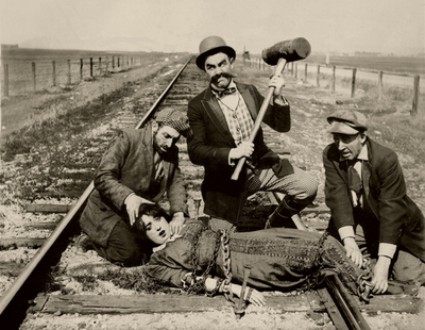
Ford Sterling with the sledgehammer and Mabel Normand tied in the rails in Barney Oldfield’s Race for a Life (1913), from moma.org

The film that established the parodic idea, and which is often used to illustrate it, is Keystone’s Barney Oldfield’s Race for a Life (1913), featuring real-life motor racer Barney Oldfield, Ford Sterling as the moustachioed villain and Mabel Normand as the victim. The film plays it entirely for laughs, and the still above shows you everything you would expect to see. Not only is it not the archetypal silent, but it is unusual for its time in parodying dramatic conventions that someone like D.W. Griffith was still half in thrall to. Perhaps 1913 was some sort of a threshold year of a lack of respect for Victoriana, because stage melodrama is similarly ridiculed by the British film Blood & Bosh, made in the same year by Hepworth. It can be seen as a sign of the growing maturity of the film medium as it outgrew its stage origins, and as the twentieth century increasingly outgrew the nineteenth.

Betty Hutton playing Pearl White in The Perils of Pauline (1947), from http://www.dvdbeaver.com

It is commonly believed that heroines being tied to the tracks was a common element in the adventures serials that appeared around this time, such as The Exploits of Elaine (1914), The Perils of Pauline (1914) or The Hazards of Helen (1914-17). Such serials skilfully married the melodramatic conventions of an earlier age with independent heroines that were a part of the modern world. The heroines were put into perilous situations, but they had the resourcefulness to escape from them. Trains feature frequently in such serials, but the heroine is more likely to be tackling danger on the train rather than being passively threatened by it. The Perils of Pauline, often cited as showing Pauline (Pearl White) being tied to a railway track, contained no such scene. Indeed, the only example from a silent serial I have traced with anything like such a scenario is the Helen Holmes serial, A Lass of the Lumberlands (1916). Here a person was a person tied to the tracks, but it was a man, and it was Helen – in true Under the Gaslight fashion – who rescued him. In the 1947 feature film The Perils of Pauline Betty Hutton (playing Pauline heroine Pearl White) does get tied to the rails, but that just shows what had been forgotten about silents in less than two decades. And it was probably from here – a parody of a parodic idea – that the idea as being archetypally silent film took hold, and has remained.

Helen Holmes to the rescue in A Lass of the Lumberlands

Interestingly Under the Gaslight itself was filmed, in 1914, with Lionel Barrymore and Millicent Evans, though the plot synopses I’ve seen make no mention of any trains at all (and the film is lost). Instead it was Keystone who returned to the comic idea established in Barney Oldfield’s Race for a Life when they made Teddy at the Throttle (1917), in which Gloria Swanson gets tied (strictly speaking, chained) to the tracks, Wallace Beery is the villain, and it is the quick-witted dog (Teddy) who saves Gloria.

So the idea was around in the silent era, but infrequently so. It was played straight on a few occasions, parodied on about as many, and inverted on at least one occasion. It is anything but a major theme.

But the myth goes on. The villain twirls his moustache. The pianist pounds away furiously as the train grows ever closer. The girl, bound with rope, squirms and screams. Will the hero get there in time? Will the idea that this is what silent films were about ever be shaken off? Probably not. It’s what people need to know who don’t need to know. We’ll just have to live with them.