The second longest film in the world

http://www.gerardcourant.com

Well here’s something I didn’t know before – the world’s second-longest film is a silent film. Indeed, until it was beaten by the compellingly-titled Modern Times Forever (Stora Enso Building, Helsinki) only this year, which weighs in at a daunting 240 hours, Cinématon by the French experimental filmmaker Gérard Courant was the longest film in the world, at 156 hours, or six days twelve hours.

Courant has been making the film for thirty-three years. He started making it in 1978 and is still being added to, so he could yet catch up once more with his rival. It’s not a narrative film, indeed it’s not really a single film but rather a series of unedited silent portraits (cinématons) of people, each of which is three minutes and 25 seconds long, shot on Super 8 film. To date there are 2,350 of them. Courant says he only intended to shoot 100 but the idea was so popular that he just kept on going.

The subjects range from the famous to the unknown. Included among the former are Jean-Luc Godard, Sam Fuller, Maurice Pialat, Wim Wnders, Sandrine Bonnaire, Terry Gilliam, Joseph Losey and Roberto Benigni. A number are available to view on Courant’s website, while others (appaently with the filmmaker’s blessing), appear on YouTube. They are silent films, and Courant has said he prefers silent movies “because of their power to convey strong emotions and connect with the audiences”. Whether you connect in an emotionally strong way with the film of Godard below, for example, may be open to question. It is typical of the series, where the subject, shown in close-up, simply sits before the camera. Many subject look self-conscious, uncertain of what to do, of how to fill the time.

Jean-Luc Godard, Cinématon #106, filmed 22 February 1981

The ‘film’ has been screened in its entirety on a number of occasions, each time getting longer of course, most recently at the Microscope Gallery, New York in 2010, and sequences are currently being featured at the Gulf Film Festival.

French critic Jacques Kermabon wrote this about the series in 1983:

Le Cinématon renoue avec la vocation originelle du cinématographe, émerveillé par la reproduction du mouvement et la possibilité de conserver la trace d’une existence. L’émotion naît de découvrir au cinéma la palpitation d’un corps: respiration, clignements d’yeux, hochements de tête. Tout est enregistré sans possibilité de reprise : les gestes manqués, les maladresses, les hésitations … Tout un corpus gestuel, honni du cinéma traditionnel, est ainsi exhibé, rendant caduque la notion de réalisme dans le cinéma de fiction. La pellicule a impressionné le souvenir de 3 minutes 20 d’existence. Elle restitue dans sa pesanteur, le temps qui est passé un jour. « La mort au travail », disait Cocteau du cinéma.

The original vocation of cinema? Well there is something of the Lumières about the exercise – single shot films, each of identical length, arranged in series, records of seeming plain reality that become anything but because the camera was there. And yet it is the negation of cinema, because fundamentally cinema takes you somewhere (a characteristic of every Lumière film) while Cinématon takes you nowhere. Whether you spent three minutes 25 seconds watching it or six-and-a-half days would probably make no difference. But cinema overall would be the poorer without such grandes folie.

There is to be a retrospective of Courant’s work at La Cinémathèque de Bourgogne in October or November of this year, and the Cinémathèque’s website is currently screening one cinématon per week.

The place of the past

Venice, California today and inset the same location as featured in Kid Auto Races at Venice, Cal. (1914), from a PowerPoint presentation of famous Chaplin filming locations on http://silentlocations.wordpress.com

John Bengtson is the author of Silent Traces, Silent Echoes, and Silent Visions, three books which take a fresh look at classic silent comedy films by revisting their locations today. Traces covers the films of Charlie Chaplin; Echoes covers Buster Keaton; and Visions (published May 2011) covers Harold Lloyd. The publications have gained much praise for their novel, illuminating approach to film history and simply because they are such a delight to look at.

Bengtson has now gone online with Silent Locations, a blog that promises to cover ‘Chaplin-Keaton-Lloyd film locations (and more)’. It’s early days for the site as yet, but already there are some fascinating then-and-now photographs for films of each of the three stars, with instructive background information on location and production, plus the promise of other kinds of content to follow. For example, there is a downloadable PowerPoint presentation on classic Chaplin locations, with a frame still from the film inset within a photograph of the location today, which is as beautiful as it is informative. It’s going to be a site to keep an eye on.

We can be so engrossed in what we see on the screen that we can forget that there is more to the movies than stars and stories. Every film made is a time capsule. The way people look, dress, talk, interact with one another, the social assumptions that are made, the places they live in, visit, work in, the functions and histories of those places, the transport they use, their hopes, fears, loves and hatreds. Few history books are able to pack in as much as a film does, if we are prepared to look.

This was the great theme of the late Colin Sorensen, museum curator and cultural historian. In building up the modern collection at the Museum of London, he became fascinated by film’s capacity to impart the history of London. By this he didn’t just mean documentaries, but more particularly fiction films, because of their frequently deeper resonances. Films show both a literal and an imaginary past. There are actual locations and buildings still standing or now lost, of course, and Sorensen was very good at pointing out buildings shown standing in films that exist no more, so that the film becomes a precious record of a place’s appearance and social functions. But film is also a dream of how people imagined the city was, and embeds a rich set of associations with other histories. As he wrote in his book London on Film (1996):

This unique accumulation of insight and information, of fact and fantasy, has created a vast resource for the study and appreciation of London. It offers us a largely unprobed field for a new kind of urban archaeology: the archaeology of recorded action rather than of surviving artefact.

It was Colin’s great frustration that he could mostly only present his ideas through still images, and that even when a film was running he could not find the means to fix associations between what was on the screen and the links he detected with other histories that lay in his head (he might have been able to do so much more with today’s computer software). It isn’t that films belong in the museum so much as films are a museum – it’s just that we so seldom take the time to look at them in that way.

London (1926), from London on Film

See, for example, this still from the lost British film London, directed by Herbert Wilcox in 1926, which comes from London on Film. It’s a studio setting, but a precisely recreated one of a part of London life that once was. He writes:

The ebb and flow of city life continues throughout the day and night. Paths cross and the diverge as people go their different ways … [T]he coffee stall, now a vanishing feature of London life, once provided a unique meeting place where people of all types and classes rubbed shoulders for a few moments, refreshing themselves with a drink and a sandwich.

So the setting has a historical, symbolic and practical function – the latter being that it makes for a good point at which to bring together disparate characters, and one with strong character recognition. Of course, there is much more. There are the dowdly, well-worn clothes of the Londoners. Everyone wears hats, all the man have buttoned-up shirts with ties. There is the stall itself (evidently horse-drawn even though this is the 1920s), its pavement location, its wares and its advertisements. But also running through the image is a history of British filmmaking, from the assertive Britishness of the film’s title, to the contrary fact that the lead performer is an American (Dorothy Gish, on the left), typical of many an American star with a career on the wane being snapped up on the cheap by a British studio. But she is a Gish sister, so embedded in her image is a whole history of narrative cinema that comes out of D.W. Griffith. And London was based on the London stories of Thomas Burke, another of whose novels inspired Broken Blossoms). Or we can just look at the coffee cups and think that, apart from the size of the cups, maybe there’s not that much about London life that has changed after all.

John Bengtson has done an excellent job showing how traces of the past exist in the locations of today, and by showing past and present side by side he makes us think historically. But it’s not just the stills but the films themselves that we need to annotate in a far richer form than we have achieved so far. Film’s special capacity for encapsulating times past and creating associations between where we are now and where we once were needs not just to be acknowledged but to be documented. Otherwise the history will be lost.

Bioscope Newsreel no. 20

Well, it’s all been happening in the land of the silents. Here’s your latest edition of the Bioscope Newsreel, rounding up some of the news stories from the week, starting with what might just turn out to become the most watched silent film ever …

Doodling with Chaplin
We kick off with Charlie Chaplin’s 122nd birthday, which Google has commemorated in distinctive fashion by making a Chaplin video its Google logo (or doodle) for the day (strictly speaking, for 36 hours). It is the first time the Google logo has been a live-action video, and it is most elegantly done. It’s not Chaplin himself, alas – instead we get a so-so pastiche, starring members of the Google Doodle team, including Mike Dutton as Chaplin. The background to the video is given on the Google blog. Read more.

Top 50 lost films
The idea of lost films is endlessly engrossing, and listing those films believed lost that one would most like to see is many a film fan’s favourite parlour game. In 2008 the Film Threat site gave us a list of 50 top lost films it would most like to see, and now it has returned with another 50. Most of them are silents, and there are some obscure but knowledgeable choices among them. Tsunekichi Shibata’s Tokyo’s Ginza District (1898), anyone? The Church of Jesus Christ of Latter-Day Saints’ One Hundred Years of Mormonism (1913)? Or the clever-clever choice of Olives and their Oil (1914) the other half of the split reel on which Chaplin’s Kid Auto Races at Venice was released. Read more.

Gorgeous George
There’s a (fairly) new website published, dedicated to George O’Brien, star of Fox silents, and a screen history immortal for his presence in F.W. Murnau’s Sunrise. Entitled Gorgeous George O’Brien, it comes with biography, photos, articles and filmography. Read more.

Silent Britain
The British Silent Film Festival recently took place. The Bioscope was only there for a short while, but the Dumdidumdum tumblr has some short reports, and Pamela Hutchinson of the lively Silent London blog has written a thoughtful, historically informed piece on the festival and silent film music for The Guardian. Read more.

An understanding
And finally, it doesn’t have much to do with silents directly, but anyone interested in film, research and digital opportunities should take note of the news that the British Film Institute and the British Library have signed a memorandum of understanding, with the intention of increasing “public, professional and research access to audiovisual and broadcast content and integrating it with other knowledge collections”. I write about this on my other, somewhat disused blog, Moving Image. Read more.

‘Til next time!

Pure motion

Slate for Peter Jackson’s production of The Hobbit, showing the 48 frames per second rate. From Jackson’s Facebook page

Here are two quotations. The first is from 1891:

My idea was to take a series of instantaneous photographs of motions so rapidly that in the reproduction the photographic representatives become resolved into a pure motion, instead of a series of jerks. The kinetograph takes a series of forty-six photographs in one second and keeps it up as long as desired. It starts, moves, stops, uncloses the shutter, takes a photogaph, and starts on, forty-six times a second. The result when reproduced is a pure motion.

The second is from 2011:

The key thing to understand is that this process requires both shooting and projecting at 48 fps, rather than the usual 24 fps … So the result looks like normal speed, but the image has hugely enhanced clarity and smoothness. Looking at 24 frames every second may seem ok … but there is often quite a lot of blur in each frame, during fast movements, and if the camera is moving around quickly, the image can judder or “strobe.”

Quote number one comes from Thomas Edison, at a time when he and his team were still at the experimental stage of development for a motion picture camera (and the means to exhibit the results). Quote number two comes from Peter Jackson, writing about his production of The Hobbit on Facebook. Jackson’s announcement has generated a lot of interest. He goes on to say:

It looks much more lifelike, and it is much easier to watch, especially in 3-D. We’ve been watching HOBBIT tests and dailies at 48 fps now for several months, and we often sit through two hours worth of footage without getting any eye strain from the 3-D. It looks great, and we’ve actually become used to it now, to the point that other film experiences look a little primitive.

He points out that 24 frames per second – the speed at which films are shots and projected – was determined in the late 1920s as the standard for shooting sound films, probably because it was the minimum speed from which audio fidelity could be gained from the first optical sound tracks, and because a minimum figure would help save on expensive film stock (the faster the speed film went through the camera, the more stock was used up, of course). Films don’t have to run at a particular speed. So long as the frequency is above a threshhold sufficient to generate the illusion of movement – somewhere around 12 frames per second is the minimum – you can have as rapid a frame rate as your technology can bear.

In the silent era, frame speeds generally ranged from 14 fps to 24 fps (sometimes more), and got progressively faster from the earliest years up to the late 1920s. This, however, is a gross simplification, and something of a hotly contested area, particularly when it comes to projecting silents today or presenting them on DVD. I’m not going to wade into that debate. Suffice to say that films could be projected at speeds different to those in which they were shot; indeed different parts of films could be shot at different speeds, and projected at different speeds; and what a producer or cinematographer hoped for, and what was actually practiced in the cinemas were not necessarily always the same thing. Many silent films were exhibited at speeds far faster than those at which they were shot, sometimes because they were comedies or thrillers that benefitted from such treatment, but often simply because exhibitors could squeeze in more film into a show if they showed the films more quickly than their makers intended.

What I am pointing out is that there is nothing new about film speeds above 24 fps, and that the silent era was not simply about a gradual climb in speed from the 1890s to the 1920s. Right at the start of motion pictures Thomas Edison was setting 46 fps as the ideal, fearing that at anything less there would be troublesome flicker. His aim was pure motion, much as Peter Jackson now dreams of, and at much the same speed.

However, although Edison and his chief motion picture engineer William Kennedy-Laurie Dickson often spoke of achieving 40 to 46 fps in the early 1890s, they seldom if ever achieved it. The need for lighting of sufficient brilliance meant that only filming in bright sunshine would be suitable, and the wear and tear on the machinery had to be considerable. The Black Maria studio devised by Dickson for shooting the first Kinetoscope films did use sunlight (from a gap in the roof, with the studio revolving to catch the moving sun) but he shot the films at between 30 and 40 fps, and probably nearer to 30 most of the time. Such films are frequently shown today at no faster than 24 fps, which is why so many early Edison films look like they were shot in slow motion. See Blacksmith Shop (1895) on the British Pathe site for an example of an Edison film shown too slowly, and the examples of early Edison films on the Library of Congress’ YouTube playlist for how they should look.

Edison was not alone in going for the highest frame rate possible. The Mutoscope and Biograph Company (of which Dickson was a founder director) produced films from 1896 with a motor-driven camera that could vary in speed but which generally operated at 30 fps. My not entirely scientific memory from having viewed a lot of these is that the American Biograph productions of 1896-97 were shot at 30 fps and above, but that subsequent Biograph productions of the 1890s in Europe and the USA look ‘natural’ at 24 fps. Higher speeds were also required for some early colour systems. Kinemacolor (1908) required a speed of at least 30 fps, because of its successive red-green frames (i.e. two frames in succession supplied a single colour image on the screen) while Gaumont’s Chronochrome (1911), a three-colour red-green-blue successive frame system, demanded 48 fps. And scientific experimenters working with high-speed techniques for analysing subjects such as animal motion or ballistics were able to achieve filming speeds of 100,000 fps by the mid-1920s (e.g. Lucien Bull).

The essential place to go from an understanding on film speeds in the silent era is Kevin Brownlow’s renowned essay, ‘Silent Films: What Was the Right Speed?‘, written in 1980 for Sight and Sound and made available through David Pierce’s indispensible Silent Film Bookshelf site, which also reproduces a number of articles from the time on the vexed issues of correct shooting and projecting speeds. See, for example, what Brownlow writes about instructions supplied by D.W. Griffith for a 1914 film:

His instructions for Home Sweet Home (1914) recommended 16 minutes for the first reel (16.6 fps), 14-15 minutes for the second (17.8-19 fps), and 13-14 for each of the other reels (19-20.5 fps). ‘The last reel, however, should be run slowly from the beginning of the allegorical part to the end’ (Moving Picture World, 20 June 1914 p. 652). ‘The projectionist,’ said Griffith, ‘in a large measure is compelled to redirect the photoplay.’

Brownlow discusses Edison and Biograph in his wide-ranging essay, but for a more detailed investigation, see Paul Spehr’s recent biography, The Man Who Made Movies: W.K.L. Dickson (see Exposure, rate of, in the index).

And so we wait for Peter Jackson to bring motion pictures back to that pitch of pure motion that Thomas Edison had decided was essential 120 years ago.

The Zoetrope lives!

Phonotrope animation by Jim Le Fevre made in collaboration with DJ Malcolm Goldie

A favourite website of mine is Jim Le Fevre, the personal site of a British freelance animator. Aside from his standard animation work, Jim Le Fevre is a focal point for what has become a whole school of film artists working with what was once called pre-cinema technology to explore new forms of animation.

It works like this. The Zoetrope was an optical toy devised in the 1830s which presenting a strip of successive images around the inside of a drum. When the drum was revolved, viewing through slits in the side created the illusion of a single moving image. Le Fevre’s reinterpretation of this he originally called the (take a deep breath) Phonographantasmascope and now, a little more practically, calls the Phonotrope. For this he used a record player (revolving at 45 rpm) combined with a video camera shooting at 25 frames per second. By placing images or objects on the revolving turntable, and then playing with assorted variations on the basic set-up, some extraordinary animations emerge.

Here, for example, is Le Fevre demonstrating the process at the Flatpack Festival in 2009:

Le Fevre has a page on his website dedicated to the work of other animators and video artists working with their own variations on the Phonotrope idea. The level of invention is outstanding. You must visit his site (or follow his blog for regular updates) to see a fuller list of names working in this area, but here are few examples to whet the appetite (with links to the artists’ personal websites).

Retchy (aka Graeme Hawkins) uses balsa wood and a turntable to create what he calls 3D Zoetrope Sine Waves:

This extraordinary work is by Sculpture, who are Reuben Sutherland (animator) and Dan Hayhurst (music). They recently released a picture disc LP, ‘Rotary Signal Emitter’ and the video shows the disc being played:

Clemens Kogler calls his version of the technique Phonovideo. This ingenious video was created with two turntables, cameras, a videomixer and prints on cardboard.

Simon Oosterdijk has produced this brief but haunting video with 3D running figures on his turntable (sound design by Paul Gerring):

Here is David Wilson with a deluxe version of the technique made for a pop video (Moray McLaren, ‘We Got Time’). Everything you see in this video was created in camera.

On a humbler but no less inventive level is Tim Wheatley’s inspired use of a bicycle wheel instead of a turntable to create what he calls the Cyclotrope:

What is so pleasing to see in these videos is the continuation of the Victorian delight in motion recaptured. Narrative, or photographic realism aren’t required (though some have started to introduce both). All that is needed to engross us is a repeated motion, the very basics of the inanimate brought to life. It takes you back to the wonder that is the motion picture. What has been done with the medium since 1896 is all very well, but it’s just extending the basic idea to pass the time. Go back to that primal capture and replaying of motion, and you have the eureka moment played over and over again. Look, it moves!

I must just show you one more – Eric Dyer‘s ‘The Bellows March’. Motion pictures in their purest form.

Slapsticon 2011

Preview trailer for Slapsticon 2011

Slapsticon, the annual festival of rarely seen comedies from the silent and early sound eras, returns to the Rossyln Spectrum Theatre, Arlington VA 15-18 July 2011. Last year the festival made headlines around the world with the amazing rediscovery of a lost Chaplin film, A Thief Catcher. It may not be every year that they are able to repeat such a coup, but once again the organisers have come up with a programme rich in treasures and rarities. Here’s the programme so far:

Thursday July 14, 2011

12:00 pm — Spectrum Doors Open

1:00 pm

* To Be Announced

3:00 pm — Weiss-O-Roni III and Other Stuff

* Seeing Things (1928) — Ben Turpin
* Sock and Run (1928) — Snub Pollard, Marvin Loback

5:00 pm&ndash7:00 pm — Dinner Break

7:00 pm — Marx Brothers Rarities

9:00 pm

* Father’s Close Shave (1920) — Johnny Ray, Laura LaPlante
* Bringing Up Father (1946) — Joe Yule Sr., René Riano

Friday July 15, 2011

8:00 am — Spectrum Doors Open

9:00 am — Early Comedies:

* A Charming Villain (1916) — Smiling Billy Mason, Madge Kirby
* Ham Among the Redskins (1916) — Ham and Bud
* Her Anniversaries (1917) — Mr. and Mrs. Sidney Drew
* Local Showers (1916) — Musty Suffer
* The Child Needs a Mother (1916) — Fatty Voss
* Honeymooning (1919) — Mr. and Mrs. Carter DeHaven
* Risks and Roughnecks (1917) — Larry Semon
* Faint Heart and Fair Lady (1917) — Victor Moore
* Cupid’s Hold Up (1919) — Bobby Vernon

11:00 am — Kids ‘N’ Animals

* The Home Wreckers (1925) — Hey Fellas
* No Children (1929) — Smitty Comedy
* Young Sherlocks (1922) — Our Gang
* Mickey’s Tent Show (1933) — Mickey McGuire

12:30 pm–2:00 pm — Lunch Break

2:00pm — Hal Roach Comedies

* Follow the Crowd (1918) — Harold Lloyd
* All in a Day (1920) — Snub Pollard
* Are Parents Pickles? (1925) — Paul Parrott
* Never Too Old (1926) — All-Star with Claude Gillingwater
* Girl Shock (1930) — Charley Chase

4:00 pm — Rob Stone Rarities

6:00 pm–8 pm — Dinner Break

8:00 pm

* Dynamite (1919) — Lloyd Hamilton
* Silent Feature to be announced

10:00 pm

* War, Italian Style (1967) — Buster Keaton

Saturday July 16, 2011

8:00am — Spectrum Doors Open

9:00 am — Dave Snyder’s Cartoon Show

10:30 am — The Sennett Spot

* On His Wedding Day (1912) — Ford Sterling, Dot Farley
* The Great Toe Mystery (1914) — Charley Chase, Alice Howell
* A Janitor’s Wife’s Temptation (1915)
* Won by a Fowl (1917) — Paddy McGuire, Fritz Schade
* His One Night Stand (1917) — Harry McCoy
* Keystone Girls Open Trout Season (1917)
* What Happened to Mrs. Jones? (1917) — F. Richard Jones
* Galloping Bungalows (1924) — Billy Bevan, Sid Smith
* Matchplay (1930) — Andy Clyde

12:30 pm–2:00 pm — Lunch Break

2:00 pm — David Wyatt Rarities

* Moonshine (1921) — Lloyd Hamilton

4:00 pm

* April Fool (1921) — Lloyd Hamilton
* Professor Beware (1938) — Harold Lloyd

6:00 pm–8 pm — Dinner Break

8:00 pm — Chaplin Rarities

* The Simp (1920) — Lloyd Hamilton
* Red Hot Tires (1925) — Monte Blue, Patsy Ruth Miller

10:00 pm — A Columbia Conglomeration

* Blitz on the Fritz (1943) — Harry Langdon
* Many Sappy Returns (1938) — Charley Chase
* Tramp, Tramp, Tramp (1935) — Andy Clyde
* One Too Many (1934) — Leon Errol

Sunday July 17, 2011

9:00 am — Spectrum Doors Open

10:00 am — More Talkie Comedies

* Idle Roomers (1931) — Cameo comedy Directed by Roscoe Arbuckle
* Thanks Again (1931) — Edgar Kennedy
* Blonde Bomber (1936) — Harry Gribbon, Shemp Howard
* Free Rent (1936) — Monty Collins, Tom Kennedy

12:00pm–1:30 pm — Lunch Break

1:30 pm

* The Battling Orioles (1924) — Glenn Tryon
* Queen of Aces (1925) — Wanda Riley
* Misfit Sailor (1926) — Billy Dooley
* Swiss Movements (1926) — Jimmie Adams

3:30 pm — Ones for the Road

* Who’s Afraid? (1927) — Lupino Lane
* Short Kilts (1924) — Stan Laurel
* High Society (1924) — Our Gang

Plus a few surprises, then it’s back to the Holiday Inn Rooftop Restaurant for a good meal, a few drinks, a few more drinks, some fond farewells, a few more drinks, some more fond farewells, a few more drinks, some fonder farewells, a few more drinks, some less fond farewells, a few more drinks, perhaps a fistfight or two, a few more drinks, then a fond passing into unconsciousness …

Clesrly a festival conducted in just the right spirit. Details on registration, accommodation, musical accompaniment and more, are available from the festival site.

Bioscope Newsreel no. 19

http://gawker.com

The Bioscope Newsreel failed to hit your screens last Friday, as the entire editorial team was in Spain. But we have returned, with items curious and diverting for your delectation and instruction.

100 Years of YouTube
In case you missed it, one of Google’s contribution to April Fools’ Day was to add a “1911” button to YouTube that allowed users to convert videos into faux silent films, complete with sepia tone, scratches (naturally) and tinkly piano (of course). Unfortunately the joke fell somewhat flat for some, as many videos of serious note (9/11, the Japanese tsunami etc.) hardly lended themselves to facetious treatment. Read more.

We have an app for that
More on faux silents, as we now have Silent Film Director, a new app made by MacPhun for iPhone, iPod Touch, and iPad and available on the iTunes App Store. It allows you to convert your videos into “classic silent movies”. There are six themed filters: an “old and grainy 20s-era movie filter”, 60s home video, 70s-era home video, standard black-and-white, sepia-toned, and “Vintage Sepia” with extra graininess and signs of wear and tear. There are soundtracks you can add, then upload your video to YouTube, share it on Facebook, or enter the developers’ “International Silent Film” content. Read more.

Silent Naruse
Eclipse has issued a three-disc set that brings together the five surviving silent films of Japanese master Mikio Naruse, pre-eminent in studies of women’s lives. They are the short film Flunky, Work Hard (1931), No Blood Relation (1932), Apart From You (1933), Every-Night Dreams (1933) and Street Without End (1934). The films are presented silent, with optional soundtracks, and come with English subtitles. Read more.

The Garbo note
Greta Garbo is going to be on a banknote. She is one of six prominent Swedes (including Ingmar Bergman) whose faces have been selected to appear on Swedish bills scheduled to come into circulation around 2014-15. Is she the first film person (and of course she was a silent film person) to be so honoured? Read more.

Fascinating Chomón
One of the items we brought with us from Spain was the English version of Joan M. Minguet Batllori’s Segundo de Chomón: The Cinema of Fascination. It’s a pleasing critical biography of the leading Spanish of the early cinema period, someone whose reputation as a master of the fantastical continues to grow. See for instance Chris Edwards’ detailed appreciation of Sculpteur moderne (1908) over at the fine Silent Volume blog. Read more.

Second birth

I hope I have not allowed it to be inferred that the developments I have mentioned are a mere epitome of the occurrences of a single year. On the contrary they represent a crescendo of change which began in or around 1911 and continued for a long time – continued in some respects indeed right up to the year of the Great War.

Registration is now open for the Second Birth of Cinema conference. The conference is taking place at Percy Building, Newcastle University, UK, 1-2 July 2011, and takes as its somewhat contentious theme the idea that cinema really only got its act together in 1911, so that we should be celebrating its centenary now, and all of those who got the bunting out in 1895 were jumping the gun. The thesis is argued thus:

This conference commemorates cinema’s ‘second birth’, the historical developments and departures that broke film’s subordination to other media to give us the medium, the industry and the building that we know as ‘the cinema’.

If, as André Gaudreault and Philippe Marion have recently insisted, cinema was born once as a technology and then again as a medium, just when and how did this occur? What caused film practice, the film business and film discourse all to generate a media identity for cinema? How did we get from ‘animated photography’ to ‘the pictures’?

Interesting questions, and silent filmmmaker Cecil Hepworth, quoted at the top of this post and used by the conference as an epigraph, clearly thought there was something in it. So do quite a few other people now, because they have a handsome list of topics as the subject of some of the papers now accepted:

  • Film Architecture in Southern California, 1909-1915
  • The Victorian Novel and Early Narrative Film
  • The Second Birth of Cinema in Belgium, 1904-1913
  • The Reinvention of Colour in the Single-Reel Era
  • Animated Films and Negotiated Intermediality
  • The Second Birth of Cinema in Quebec, 1906-1916
  • Measuring the ‘Double Birth’ Model Against the Digital Age
  • The Lightning Cartoon Film
  • André Bazin’s Second Birth of Cinema
  • The Emergence of By-Programme Genres in Germany
  • The Serial and the Institutionalization of the Film Industry
  • The Local Picture Show and the Second Birth in Canada
  • The British Film Industry’s Transition from the Local to the National
  • The Futurists’ New Era of Cinema
  • The Emergence of Film Celebrity in Britain
  • The Newsreel and the Variety Format
  • The Autorenfilm Movement and Cinema’s Second Birth in Germany
  • The Production Crisis and the Formation of the British Film Industry

Keynote speakers are André Gaudreault (Université de Montréal),
Philippe Marion (Université catholique du Louvain), Ian Christie (Birkbeck College) and Joe Kember (Exeter University). The conference website has details of bookings, travel and accommodation.

Is the new film history or the old film history with a slightly different hat? I’ll guess you’ll have to attend to find out. Or wait til someone decides that 1915/2015 will be the third birth of cinema. And so on.

Connected histories

http://www.connectedhistories.org

Out there a lot of bright-minded people and noble institutions are thinking of ways to make things easier and better for the researcher. They have considered all the digital content that has been produced so far, being it digitised or born digital, and now they want to construct ways of bringing this stuff together in useful ways. Of course, for initial enquiries, Google is there to answer most needs. But for less random, more structured enquiries, particularly the kinds of enquiry that the serious researcher (of whatever kind) is going to make, then you need dedicated resources. These resources depend on good metadata – that is, that all of the digital records under consideration are described in a consistent, logical manner according to agreed rules, so that like can be found alongside like. Consistency breeds discovery.

All of which is preamble to the launch of Connected Histories, a resource which bringing together a number of important digital resources relating to the study of early modern and nineteeth century Britain, under a single federated search system. ‘Federated’ simply means that several subject-related databases have been brought together to form, in effect, one super-database, so you don’t have to search in several different places, but instead just the one. Bringing these databases together allows you to conduct sophisticated searches that couldn’t be achieved singly, and simply to discover more, and more quickly.

Connected Histories bringings together eleven digital resources, two of which have been previously reviewed by the Bioscope. Not all cover our period, but some complement it, and all are well worth exploring anyway:

British History Online
The digital library of primary and secondary sources for the history of Britain, from the Middle Ages to c.1900.

British Museum Images
The collection provides searchable access to almost 100,000 images, relating to early modern and 19th-century Britain.

British Newspapers, 1600-1900
The most comprehensive digital historic British newspaper archive in existence, with 3 million pages of historic newspapers, newsbooks and ephemera from national and regional papers.

Charles Booth Archive
The online archive provides access to guides, digitised images and maps from the Booth archive collections at the London School of Economics and Political Science and the University of London Library. (This is Booth’s famous survey into life and labour in London, dating from 1886 to 1903)

Clergy of the Church of England Database 1540-1835
A database containing details of the careers of more than 130,000 clergymen of the Church of England between 1540 and 1835, from over 50 archives in England and Wales.

House of Commons Parliamentary Papers
The Parliamentary Papers gives access to page images and searchable full text for over 200,000 House of Commons sessional papers and supplementary information from 1688 onwards.

John Johnson Collection of Printed Ephemera
The collection provides access to more than 67,000 scanned items from the Bodleian Library’s holdings documenting various aspects of everyday life in Britain from the 18th to the early 20th century.

John Strype’s Survey of London Online
This is a full-text electronic version of John Strype’s enormous two-volume survey of 1720, complete with its celebrated maps and plates, which depict the prominent buildings, street plans and ward boundaries of the late Stuart capital.

London Lives 1690-1800
London Lives provides a fully searchable edition of 240,000 manuscript pages from eight London archives and 15 datasets, giving access to 3.5 million names.

Origins.net
Origins.net offers online access to some of the richest ancestral information available. The collection searchable through Connected Histories focuses on the early modern history of London.

The Proceedings of the Old Bailey Online, 1674-1913
The Old Bailey Online contains accounts of the trials conducted at London’s central criminal court between 1674 and 1913; and also the Ordinary’s Accounts – detailed narratives of the lives and deaths of convicts executed at Tyburn, published between 1676 and 1772.

Before you get too excited, please note that some of these are subscription services or available to UK higher education users only. Those that are free to all are British History Online (80% of it), British Museum Images, Charles Booth Archive (which I strongly recommend for detailed, socially-informed maps and data on life in late-19th century London), Clergy of the Church of England Database, John Strype’s Survey of London, London Lives, and Proceedings of the Old Bailey. British Newspapers, 1600-1900 and Proceedings of the Old Bailey are the two previously reported on by the Bioscope.

So, what can you find (those of you not paying subscriptions or having subscriptions paid for you by a university). Our traditional search term of ‘kinetoscope’ brings up just the one record, from an 1895 House of Commons parliamentary paper, with the frustrating information that you can’t proceed any further without a password. ‘Bioscope’ brings up eight hits, five free for all to view from the utterly compulsive Proceedings of the Old Bailey, such as the 1911 court case of “ROBERTS, George (19, bioscope operator), unlawfully uttering counterfeit coin; possessing counterfeit coin.” (Do note that the Old Bailey records stretch into the early part of the twentieth century). Searching on ‘cinematograph’ gives us thirty-two record, again with those from the Old Bailey records (eleven) being available to all. ‘Mutoscope’ yields thirty-six (lots of joint stock company reports under Parliamentary Papers).

You get an array of searching tools (keyword, place, person, date range), with filtering by source type, resources and access (so you can limit searches to freely-available content). There are also subject guides on topics such as ‘Family History’, and the ‘History of London’, and registered users can put together collections of documents (‘connections‘) under particular topics, and so your scribe has done his bit and created an “early cinema” connection that you can explore at your leisure. Don’t say that I’m not good to you, at least some of the time.

Connected Histories has been constructed by the University of Hertfordshire, the Institute of Historical Research, University of London, and the University of Sheffield, with natural language processing, indexing and the development of the search engine were carried out by the Humanities Research Institute (University of Sheffield). This is the first phase; in September of this year they will be adding 65,000 19th-century books from the British Library (which I imagine will be free to all); 23,000 19th-century pamphlets from JSTOR (a subscription-only digital store); Documents Online from The National Archives; data from People in Place: Families, Households, and Housing in London, 1550-1720 from British History Online; and History of Parliament Online. They are on the lookout for additional resources, though whether they will be able to extend their reach beyond the nineteenth into the twentieth century is not stated (such are the challenges that British copyright law presents).

A video introduction to Connected Histories

So, though Connected Histories is of mostly going to be of most value to those in our field interested in the origins and earliest years of film, it is a significant indicator of the ways things are going. Institutions and individual databases are becoming things of the past. Concatenations of datasets and federated search systems are going to take over. It’s the globalization of knowledge.

Museu del Cinema

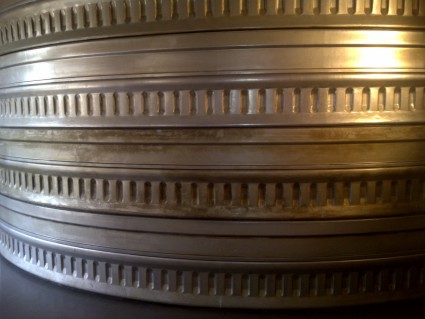
Giant film cans (floor to ceiling) at the entrance to the Museu del Cinema, Girona, Spain

I’m back from my sojourn at the Origins of News in Early Cinema seminar in Girona, some thoughts on which will follow in due course. While I was there, I visited the town’s Museu del Cinema. It’s an excellent place in every degree, and worth a short description here to encourage you to visit should you ever think of being that sunny corner of the world (which I can warmly recommend in any case).

For some, the history of the motion picture begins with Edison or the Lumière Cinématographe. For others, that’s more or less where it ends. The delight is in pursuing the history of the projected image and the recreation of motion by their various routes from antiquity through to the late nineteenth century, when these innovations finally coalesced into the phenomenon that is cinema. Thereafter what we have is a playing out of principles confirmed by 1896. The period before is usually, if not uncontentiously, described as pre-cinema, and pre-cinema is the primary subject of the Museu del Cinema.

Late eighteenth century Catalonian peepshow in the Museu del Cinema

The Museum’s core collection was amassed by amateur filmmaker and collector Tomàs Mallol, who was inspired by C.W. Ceram’s famous book The Archaeology of the Cinema to concentrate on objects that documented cinema’s antecedents. The collection of some 20,000 objects comprises 8,000 museum objects, apparatuses and pre-cinematographic and early cinema accessories, 10,000 images documents (photographs, posters, prints, drawings and paintings), 800 films of all types and a library of over 700 books and magazines. Much of it was apparently acquired from Paris flea markets in the 1960s, when such objects (now worth thousands) were unwanted discards. It was purchased by the Girona authorities in 1994.

The museum is arranged on four floors. You begin by sitting through a six-minute three-screen video projection on the history of the human desire to place moving images on a screen. You then take a lift to the top floor and work your way downwards. The collection is in ten sections:

1. Shadow Projections
2. Mirrors and anamorphosis
3. Magic lantern
4. Capturing images
5. The moving image
6. The race to cinematography
7. The cinema arrives
8. The tools of the cinema
9. Amateur cinema
10. Children’s cinema

What you will see are shadow theatres, camera obscuras, anamorphic projection devices, magic lanterns, lantern slides, peepshows, optical toys and devices, stereoscopes, optical boxes, Chromatropes, Thaumatropes, Zoetropes, photographic equipment, Daguerrotypes, Calotypes, flick card devices, a rare projecting Praxinoscope, Mutoscopes, a reproduction Kinetoscope, early motion picture cameras and projectors, toy lanterns and cinematographic devices, and then a quick rush through the remainder of motion picture history, including a side-step into television (a 1930s Baird televisor) and an interesting foray into cinematographic toys for children.

Display of magic lanterns

It’s a museum of the traditional sort, in that it predominantly consists of objects behind glass, though there are plenty of optical devices to peer through, working models of assorted ‘tropes and ‘scopes, and video projections of Edison, Lumière and Méliès films. What makes it special is how it documents the great human urge to see the essence of life recaptured. Since the mid-seventeenth century, when the magic lantern was devised (arguably), or as far back as pre-history if you want to think of the magical powers that were invested in pictures drawn on the walls of caves, we have thrilled to our world and ourselves reflected on a screen. The instruments devised to satisfy this need have been various, ingenious and often beautiful. In sum they show that cinema answered a powerful human need, and indeed that everything since 1896, be it cinema, television, the VCR or YouTube, is a continuation of that expression. Those later developments don’t need to be in the museum – it is the opening of the eye, not what the eye then saw, that matters.

The Museu del Cinema is one of just a handful of cinema museums in Europe. Others include the Museum of PreCinema in Padua, Italy; the Museo Nazionale del Cinema in Turin; the Musée de la Cinémathèque of the Cinémathèque Française in Paris, France; the National Media Museum in Bradford, UK; the Bill Douglas Centre at the University of Exter; and the private Cinema Museum in London. The Museu del Cinema itself has a useful tri-lingual website (Catalan, Spanish and English), with a tour of the museum through many illustrated objects, and background information including a listing of cinema and pre-cinema museums and collections throughout the world.

A set of photographs of exhibits in the Museu del Cinema can be seen on the Bioscope’s Flickr site.