By kind permission of …

Frame still from the documentary film of the 1928 Olympic Games held in Amsterdam, Olympische Spelen, showing distance runners Paavo Nurmi, Ville Ritola and Edvin Wide, with innovative on-screen titles

Fascinated by the deathless prose demonstrated by this blog? Fancy reading more, only this time with footnotes? Well, if you go to my personal website you’ll find a growing number of my articles for scholarly journals which I’ve been able to put up online for free by kind permission of the publishers. There are two very welcome trends being demonstrated by journal publishers: one, they are offering increasing amounts of content online for free, though obviously in the hope of attracting subscribers to the greater amount of content that remains behind paywalls; and two, when you do write an essay for them, often they allow you to post a PDF (or a link to it) on a personal web page or departmental page, just so long as you acknowledge the source and link to the journal in question.

I raise this now because, just in time for 2012, I’ve just put up a new essay, ‘Rituals and Records: The Films of the 1924 and 1928 Olympic Games‘, recently published in European Review, vol. 19 no. 4, 2011, by kind permission of Cambridge University Press. The link here is to my web page, so that readers see the full acknowledgment before finding the PDF.

Below, in reverse chronological order, are other essays of mine that currently are freely available, via one route or another (others are listed on my site that link to subscription-only sites):

The glamour of restoration

Miles Mander and Madeleine Carroll in The First Born (1928), from http://www.bfi.org.uk/lff

Silent film restorations, they seem to be everywhere at the moment, pitched ever more as gorgeous attractions whose time has come. They have (re)premieres, they are presented as works restored to life, as somehow belonging as much to our time as the time in which they were made. Maybe it’s the tinting and toning, maybe it’s the orchestral scores, maybe it’s just the hype – but they have glamour.

It is certainly striking to see a silent film restoration among one of the star attractions in the London Film Festival programme, and a British silent that few will have heard of to boot. The First Born (1928) is a film well worthy of the honour, however; indeed it is a rather better film than the festival blurb might suggest, whose attempts to sell it to a modern audience include comparisons with the TV series Downton Abbey and an invitation to consider how far the action on the screen mirrors the private lives of its stars. There are better reasons to see it than those – it is sophisticated, subtle, mature in theme and and bold in technique, perhaps what Mauritz Stiller might have made had he been in Britain rather than Sweden. It was directed by Miles Mander, and stars he and Madeleine Carroll in a tale of marital disharmony. The BFI’s copy of the film has long suffered from a missing ending, but additional footage has been uncovered to complete what should now gain the acclaim it deserves as a masterpiece. Stephen Horne has produced a new score, and it screens at the LFF on October 20th.

The LFF has a regular ‘Treasures from the Archives’ section, showing the pick of the world’s film restorations, and the silent selections this year are Clarence Brown’s The Goose Woman (USA 1925); Mikhail Kalatosov’s visually extraordinary The Nail in the Boot (USSR 1931) paired with Lois Weber’s powerful tale of urban poverty, Shoes (USA 1916); and a selection from the Wonderful London series of travelogues from 1924, made by Frank Miller and Harry B. Parkinson, a hack director of humblest ambition who just for this series found the technique to match the theme and produced some hauntingly simple vignettes of London life. Well worth catching.

Another restoration grabbing our attention, not least through the strategy of a stylish web presentation, including the above trailer, is Ernst Lubistch’s The Loves of Pharoah (Das Weib des Pharao) (Germany 1922). Those who associate Lubitsch solely with sly, visually witty social comedies, and going to find The Loves of Pharoah something of a shock. It is a grand epic of the old school, with scenery-chewing performances from Emil Jannings and Paul Wegener, and literally a cast of thousands for some spectacular crowd scenes. Though it has its silly side, and not much of a story for one will care about, it is a film to see for the handling of scale and just a sense, now and then, that maybe Ancient Egypt was exactly like this. It was the last film Lubitsch made in Germany before he went over to the United States and he truly went to town, building what looks like an entire Egyptian city (complete with full-sized Sphinx) on the outskirts of Berlin.

For years the film has existed only in an incomplete form, but the bringing together of prints in the USA (George Eastman House) and Russia has allowed the reconstruction of almost the entire film, complete with the original score by Eduard Künneke. The digital restoration has been undertaken by Alpha-Omega, who previously worked on the digital restoration of Metropolis. The film will have its German premiere at the Neues Museum in Berlin on 17 September, with a TV broadcast on ARTE on 26 September. The US premiere will be at the Egyptian Theater on Hollywood Boulevard in Los Angeles on 18 October, and a DVD and Blu-Ray release will then follow. More information is available, in English and German, on the Alpha-Omega site.

A third restoration doing the rounds, and with not just a trailer but a website to champion its importance is Mania, or, to give it its full title, Mania: The History of a Cigarette Factory Worker (Mania: Die Geschichte einer Zigarettenarbeiterin) (Germany 1918), Mania being the central character’s name. The great appeal here is that the film stars Pola Negri, the Polish vamp, shortly on her way to Hollywood to add a dash of pre-Garbo European glamour and mystique to American screens.

The film has been restored by the Filmoteka Narodowa in Poland and had a screening last night in Paris and has other lined up in Madrid, London (the Barbican on 13 October), Kiev and Berlin, with orchestral score, details of which are on the website. The trailer hasn’t been cut together all that well, but more than enough reason to see it is supplied by an enthusiastic account of the film in The Guardian. It was written by Pamela Hutchinson of the highly commendable Silent London blog, and is nicely observant when it comes to pinpointing Negri’s talent and appeal.

JSTOR opens up

Promo video for JSTOR’s Early Journal Content

Anyone who has gone searching for scholarly articles on the web will be aware of JSTOR. Type in just about any journal name, or look up any research subject, and sure enough there will be a link to an article held by this giantic American digital library. And if you do not belong to an institution that subscribes to JSTOR, you then end up banging your head against the desk because you, as an ‘unaffiliated scholar’, are not permiited access. So near and yet so far.

Well, in the continuing spirit of web altriusm (see yesterday’s post on Project Gutenberg) JSTOR has announced that it is going to make all of its journal content published prior to 1923 in the United States (the date before which all works published in the USA are held to be in the public domain) and prior to 1870 elsewhere in the world (a reasonable assumption based on the calculation of 70 years after the death of the author for a creative work in European law) freely available to anyone, anywhere. This represents 500,000 articles from 220 journals, or around 6% of the entire JSTOR collection.

JSTOR has not converted all of these journals to free access yet, but gradually the Early Journal Content offering will expand, with records marked by a green icon with the message “You have access to this content” and a box that states ‘free’. To search across the freely-available content, JSTOR provides an advance search page already set up for you, here. I’ve added this to Resources in the Bioscope’s right-hand column of links.

You can browse a full listing of JSTOR’s 2,270 journals (so far) here or browse by discipline here. Of course, they didn’t have anything called ‘film studies’ prior to 1923, so it will require some lateral searching, but to give an indication of the possibilities, I typed in our regular test search term ‘kinetoscope’ on JSTOR’s simple search page. There are 436 hits, but if I then click on “only content I can access” I get 47 open access records. The first five, eaching containing a mention of the word ‘kinetoscope’ somewhere in the text, are:

  • Chas. S. Slichter, ‘The Mechanics of Slow Motions’, Science, New Series, Vol. 11, No. 275 (Apr. 6, 1900), pp. 535-536
  • George Parsons Lathrop,’Stage Scenery and the Vitascope’, The North American Review, Vol. 163, No. 478 (Sep., 1896), pp. 377-381
  • G.A. Miller, ‘A Popular Account of Some New Fields of Thought in Mathematics’, Science, New Series, Vol. 11, No. 275 (Apr. 6, 1900), pp. 528-535
  • Henry Alfred Todd, ‘A Card Catalogue of Scientific Literature’, Science, New Series, Vol. 1, No. 11 (Mar. 15, 1895), pp. 297-299
  • Theodore Purdy, Reginald Cleveland Coxe,’The Wildness of the Waves’, The Monthly Illustrator, Vol. 5, No. 16 (Aug., 1895), pp. 183-186

A similar search strategy for ‘cinematograph’ yields 152 results, for ‘kinematograph’ 63 results, and for ‘bioscope’ 12.

It should be pointed out that JSTOR does have some free content from contemporary journals. For instance, in searching under ‘cinematograph’ I found an essay by Hannah Landecker, ‘Microcinematography and the History of Science and Film’, Isis, Vol. 97, No. 1 (March 2006), pp. 121-132. If you adjust the ‘sort by’ option to ‘newest to oldest’ you will get these occasional free modern articles appear at the top of your list of hits. You can also narrow down results to articles containing images, though do note that your average scholarly journal in the pre-1923 era didn’t go in for illustrations all that much.

All in all, this is a huge boon for the independent researcher, whether they be looking for silent film themes or any other topic of passing interest. Go explore.

In praise of Project Gutenberg

The sad news was reported last week of the death of Michael Hart, the founder of Project Gutenberg. Where the original Johannes Gutenberg, it is argued, manufactured the first printed book, Michael Hart invented the e-book. In 1971 he first typed out the Declaration of Independence on his university’s mainframe computer, and so began one of the world wide web’s greatest creations, a couple of decades before the web itself existed. Hart had created the electronic form of a printed text, but much more than that he saw the potential of creating a vast repository of freely-available texts, open to all.

His was an invention not only made for the Internet, but one which in a profound way helped inspire its ideals. One of the first things anyone learned about once they had logged on in those pioneering mid-1990s days was that there was this wonderful, altruistic project to make available the world’s public domain texts. Nor was it just one man with a keyboard, but rather a growing band of volunteers were giving up their time to type, proof-read, check OCR and present texts to the rest of the world simply because it was a noble thing to do. This, we learned, was what the Internet and the world wide web were all about – knowledge freely shared by all.

Many others have followed where Hart led, with the Internet Archive making available many of the same texts, Google now digitising out-of-copyright texts on a gigantic scale, and Amazon working hard to overturn centuries of reading practice with the Kindle e-book reader. But Project Gutenberg ploughs on, now with 36,000 books available, plus tens of thousands more through its affailiate organisations. Here at the Bioscope we have from time to time noted important texts in our field which have been made available by Gutenberg; they are described in the Bioscope Library. Below is a list of these and some of the other silent film-related books available on Project Gutenberg. The best thing you can do, by way of tribute to Hart’s great work, is to download and read at least one.

  • ‘Victor Appleton’, The Moving Picture Boys on the War Front (1918)
    One of a series of children’s adventure stories featuring the daring exploits of cameramen, a number of which feature on Gutenberg.
  • J. Berg Esenwein and Arthur Leeds, Writing the Photoplay (1919) [orig. 1913]
    A standard guide to writing a screenplay.
  • Frank Lewis Dyer and Thomas Commerford Martin, Edison: His Life and Inventions (1929)
    Early biography of the inventor of the Kinetoscope.
  • Arnold Fredericks [Frederic Arnold Kummer], The Film of Fear (1917)
    Thriller novel with a film background.
  • Vachel Lindsay, The Art of the Moving Picture (1915) [1922 revision]
    Classic, poetical study of the motion picture as an art form.
  • Geoffrey H. Malins, How I Filmed the War (1920)
    Classic account of an official cinematographer’s experiences of filming in the First World War.
  • Brander Matthews, ‘The Kinetoscope of Time’ in Tales of Fantasy and Fact (1896)
    Book of short stories with hauting tale inspired by the Kinetoscope.
  • Hugo Münsterberg, The Photoplay: A Psychological Study (1916)
    Generally considered the first serious work of film theory.
  • E. Phillips Oppenheim, The Cinema Murder (1917)
    British detective story with an American motion picture background.
  • Luigi Pirandello, Shoot! (si gira) (1927) [orig. 1915] [from Project Gutenberg Australia]
    Pirandello’s satirical novel about a cinematographer who is also an absurdist writer.
  • Jose Maria Rivera, Cinematografo (1920)
    A play (written in Tagalog) about the popularity of cinema in Filipino society.
  • Harry Leon Wilson, Merton of the Movies (1919)
    Celebrated comic novel about a terrible movie actor who is cast for laughs while he thinks he is playing in straight drama.

Thank you Michael Hart and all the volunteers at Project Gutenberg.

The Pirate King

Well, there I was, thinking to put together another Bioscope newsreel, and struggling to dig up news stories that wouldn’t better served as full posts, when I came across what I think is a first. It’s the first promotional video that I’ve come across for a book on silent films. If you don’t know, publishers are becoming increasingly keen to produce what are effectively trailers for the books they publish, which can feature author interviews, extracts being read out, or sometimes scenes being dramatised. It’s a whole genre to itself, and you just hope that some archivist somewhere is collecting them all.

Most of these videos are for fictional works, and that’s the case with Pirate King (I can hear the cries of disappointment that it is not some severe tome on Deleuzean film theory that has been given the video promo treatment). No, Pirate King is the latest production from American novelist Laurie R. King, who writes novels in which Sherlock Holmes works alongside his wife Mary Russell, an undercover detective. No, you won’t find her in the Arthur Conan Doyle works, but King has imagined that Holmes had retired to the Sussex Downs after His Last Bow and met the 16-year-old Russell in 1915, when he was aged 54. Well, of course.

Pirate King is the eleventh in this series, and this time Mary and Sherlock becomes involved in the murky world of British silent films of the 1920s. The Pirate King is a film producer with a criminal past, named Randolph Flytte, a sort of English Erich von Stroheim, who is making a film of The Pirates of Penzance in Portgual and Morocco. And then real pirates get involved.

Alas, the author has missed the chance to produce something with added complexity, because of course there was an extensive series of short films based on the Holmes stories filmed at Stoll Film Studios in the early 1920s, many directed by Maruice Elvey, with Eille Norwood as one of the best screen Sherlocks there has been. There’s a whole Bioscope post on the history of Conan Doyle’s works and the silent screen, if you want to know more. What fun it would have been had Sherlock and Mary had their mystery to solve amid the film company filming one of his adventures. It would have been a whole lot more plausible than pirates or indeed a British cinema of the period with anything like someone like Erich von Stroheim beside the camera. Indeed, a missed chance.

You can read extracts on Laurie R. King’s website, from which you may also learn that the renowned Portguese Poet Fernando Pessoa is also a character, and that either the author or her web manager can’t spell D’Oyly Carte. And there’s an interview with King, focussing on the film side of things (about which she doesn’t appear to know a great deal, though she does note the existence of Sherlock Jr.) done by Thomas Gladysz for his SFGate blog.

Sunbeam variations

Kristin Thompson has written a fine post on the blog she shares with David Bordwell about a singularly inventive video by a Spanish student, Aitor Gametxo. He has taken D.W. Griffith’s little-known film Sunbeam (1912), which takes place in a tenement building on multiple floors and rooms, and arranged the scenes that take place in each room in a grid format, so that what takes place in the upstairs room on the left occurs on the upper left-hand corner of the screen, and so on. The performers then move in and out of the spaces, respecting Griffith’s editing ploys.

The result is as delightful as it is informative. I’m not going to go into the fine details of Griffith’s handling of simultaneous action or his intuitive understanding of naturalistic film cutting, because others – such Thompson or video essay enthusiast Kevin B. Lee – can do so very much better than I. I’m just doing what Thompson asks, which is to help spread the word about an imaginative piece of film analysis and a rather beautiful piece of work in itself, reminiscent in its way of Mike Figgis’ four-screen Timecode or the celebrated multi-roomed HBO promo video Voyeur.

Aitor Gametxo’s visual exposition of Griffith’s artistry is an object lesson in understanding how some silent films (indeed other films) work. It is one of a growing number of video essays to be found online, particularly on the Vimeo site, which film scholar Catherine Grant, of the Film Studies for Free blog, has been gathering together under the Audiovisualcy channel. Such essays analyse film texts in video form, making their arguments by illustrations from the films themselves, in a variety of often highly creative ways. What is noticeable is that none of the essays she has uncovered so far, with the one exception of Variation: The Sunbeam, David W. Griffith, 1912, is devoted to a silent film. I’ve gone looking for examples and not found them. Why is this? Are silent films insufficiently understood as being a part of film studies? Do the films not interest students and lecturers as much as they might? Do they lack the sense of cool that may come from deconstructing the cinema of today?

Or will the reimagining of Sunbeam help inspire further such investigations into early film form and strategies?

Heritage matters

http://beta.bfi.org.uk

If someone offered you £25M to save the nation’s moving image heritage, what would you say, and how would you spend it?

Both questions are worth considering, because the first answer is that you couldn’t save the nation’s moving image heritage with ten times that amount, so you need more. In fact, when the UK’s public sector moving archives (excluding Scotland and Wales) were offered round about this sum four years ago from the Department of Culture, Media and Sport, it was less than they had originally asked for. The pitch had been for twice that amount, but funders love to give you just that little bit less than you asked for and see how well you do with that.

So you’ve got less than you hoped, and now you have to spend it. Of course you have to spend it against an argument presented to your funder, the argument here being a strategy in support of the UK’s screen heritage, which would help stabilise an unsteady and certainly underfunded sector. There were four ‘investment’ aims” to the strategy:

  • Securing the National Collection
    Capital works to extend and improve BFI storage facilities with appropriate conditions to safeguard the collection.
  • Revitalising the Regions
    Nomination of key collections in the English Regions, leading to improved plans for their preservation and access.
  • Delivering Digital Access
    Extending online access to the Nation’s screen heritage, through collection cross-searching and digitisation.
  • Demonstrating Educational Value
    Identifying, developing and evaluating effective use of screen heritage material within learning environments.

Four years on, and ‘demonstrating educational value’ rather got lost in the mix, but significant achievements have been made under the main three categories, and yesterday at the BFI Southbank they were announced to an invited audience. The Bioscope (naturally) was there.

It was a curious evening, which began with a clip shown from David Lean’s own 70mm print of Lawrence of Arabia, inelegantly cut off just as it was getting interesting, then effusive words in praise of film as a medium to inspire, move, inform, entertain, engage and so on. The main business, however, said little about the feature film and focussed chiefly on amateur and documentary film, stressing their special capacity for capturing human experience and strongly suggesting that the film history we have is a greatly inadequate one. We know a lot about a few films, said speaker Frank Gray of Screen Archive South East, and know next to nothing about a huge number of other films that lie in archives, demanding discovery, interpretation and sharing.

We heard from the people at the BFI who have steered the strategy, with head of collection and information Ruth Kelly doing a fine turn explaining the necessities of film preservation and even managing to make database management sound interesting. A panel session stressed the great value of archive film for an understanding of history and society, and the notable achievement of the strategy in getting so many film archives to work together for a common aim (how many other sectors could boast such co-operation?). The convenor, Francine Stock, suggested that what was being argued for archive film went a good way beyond nostalgia, but unfortunately we were then shown clips from the shamelessly nostalgic BBC series Reel History of Britain, first broadcast yesterday, which shows archive films being taken around the UK and projected to weeping audiences. Though it is always moving to see someone old see themselves when young, or a parent or grandparent when young, there is so much more to the medium than this. The series bombards you with the same emotional manipulation again and again. A wasted opportunity.

The BFI Master Film Store

But how did they spend the £25M (or £22.8M as it has boiled down to)? The greater proportion of it (£12M) went on building a new master film store for the BFI, though its facilities will be available for other archives as well. This is going to take the nation’s moving image heritage and keep it cold and dry (minus 5 degrees and 35% relative humidity, to be precise). As Ruth Kelly explained, a few years ago the BFI discovered that the traditional preservation model of copying from one film onto new stock was no longer sustainable, because the amount of films on the verge of deterioration was outstripping the resources available to manage it. The solution was to keep the films at a cold enough temperature to ensure that the process of decay was halted. You don’t copy, you freeze. It seems an obvious, economical solution now, but when first proposed it caused huge controversy, with the BFI attacked on all sides, and a secret online group formed to try and save the BFI from itself. How foolish that all seems now.

The master film store is being built at Gaydon in Warwickshire, and there’s a video guide to it on the BBC news site, with Ruth Kelly telling us the difference between nitrate, acetate and polyester, and showing us round.

Officially launched yesterday was another key output of the Screen Heritage Strategy, a union search facility enabling you to search across the databases of eleven film archives in one go. Entitled Search Your Film Archives, it has already been reported on by the Bioscope, and favourably. The idea is that the search mechanism will appear on the websites of each of the participating archives, so their users can find what’s held locally and nationally in the same place. It also links you to some 3,000 online videos on their websites of the respective archives. Search Your Film Archives is a good first step, and will get better in time. It is actually of huge significance as the potential platform for a new kind of national archive, one that is shared by partner institutions, who will eventually enjoy common preservation, digitisation, discovery and distribution services. This is what is interesting about Screen Heritage UK – it has seen that the answer to stablising film archives is to change the way they work, to change what an archive means. We are not there yet, certainly, but the desirable model is becoming clearer.

The Search Your Film Archives search facility on the London Screen Archives website, showing how users can either search across the LSA database or all databases

There will be more from the BFI on the database front soon. Their filmographic database is available online, but there is a separate technical database (known to its friends as TecRec) which tells you what materials they hold on each title. After years of trying, they have finally managed to marry up the two databases, which will be published as one under the name CID (Collections Information Database) very soon. It boasts an “innovative hierarchical data structure” based on the new European metadata standard for cinematographic works, CEN EN 15907. More on that when it appears.

And there there the regions. The UK has a number of film archives operating in the public sector. As well as the nationals (BFI, Scotland, Wales, Imperial War Museum) then are a number of archives representing the English regions, and having them work alongside the BFI through something like Search Your Film Archives or the Reel History of Britain TV series is wonderful to see. The regionals have each been pursuing their own Screen Heritage-funded projects, the outcomes of which will be announced in due course. As an example on the innovative approach to archive film being taken by such institutions, consider the Yorkshire Film Archive’s Memory Bank project, which is developing therapeutic uses for archive film footage in dementia, residential and domiciliary care settings. We’ll report on what has been achieved by these other archives with the Screen Heritage funds in another post.

Reel History of Britain is itself an outcome of the Screen Heritage project, though whether it is ‘revitalising the regions’ or ‘delivering digital access’ is not very clear. It’s putting films from the 1900s onwards onto the screen (that’s your token mention of silents in this post), under themes such as Evacuation, Teenagers, Slums, and Package Holidays. It features presenter Melvyn Bragg going about the UK in a mobile cinema and showing people films of themselves or their locality from the past. It revels in the coup of uncovering the descendants of people in archive films, delighting in the thrill of recognition, that tingle up the spine we get when we see that what the film depicts really happened and has its living connection with us today. It runs daily for 20 episodes, and some of the films featured just as clips will be shown in their entirety on the BFI’s Reel History site, which is a welcome innovation. If only a little more imagination and innovation had gone into the programmes themselves…

And, finally, there’s the BFI’s new digital delivery platform still in test mode, so it’s called BFI Beta, which is serving as the online to a lot of this activity. My, they have been busy.

So there’s an exciting future for film archives, but it’s really only a part of the picture for archives overall. Roly Keating, Director of Archive Content at the BBC, was on the panel last night. He pointed out that there had been a lot of talk about ‘film’, but that a screen heritage meant TV content too, and TV archives need to consider how they can likewise work together to enable greater care, discovery and sharing. But then he pointed out that moving images are just one digital object among many, and the real prize will be establishing shared systems in which films, books, images, manuscripts, sounds, websites, and anything else that contains knowledge can be found together. Some are already thinking along these lines (see Europeana or Trove, both covered by the Bioscope). The BBC is too, in most interesting ways. That’s where film belongs. The new film history is just history, with film in it.

Bioscope Newsreel no. 30

Mural of Lillian Gish on the wall of a pump station at Massillon, Ohio, from http://www.indeonline.com

Hi folks, and welcome to the latest issue of the Bioscope’s erratically published but lovingly composed newsreel, mopping up for you some of the more diverting news stories of the week on silent film.

More on Brides of Sulu
A few weeks we published a post on Brides of Sulu, a supposedly American film from the mid-1930s which probably took footage from an Philippine silent fiction film (possibly two) and added an American commentary. All Philippine silent film production was believed to be lost, so this is an exciting discovery, and it was naturally a highlight at Manila’s recent International Silent Film Festival. If you read comments to the original Bioscope post you can find extra information from the grandson of the film’s lead actor, ‘Eduardo de Castro’ (real name Marvin Gardner). Or there’s an informative piece in the Philippine Daily Inquirer on the research involved – though I think the director was not the Philippine José Nepomuceno but rather American silent film veteran Jack Nelson. But the journalist has read the Bioscope, which is grand. Read more.

The day the laughter stopped
A feature film adaptation of David Yallop’s account of the Fatty Arbuckle case, The Day the Laughter Stopped, is in development. The film is scheduled to star Eric Stonestreet and will be a telefilm made for HBO. Will silent cinema’s pre-eminent tragic tale make a successful transference to the screen? With Barry Levinson as director, we must hope at least for a thoughtful interpretation. Read more.

Lillian at the pump station
Massillon, Ohio artist Scot Phillips has created a mural featuring Lillian Gish at the junction between Lillian Gish Boulevard and Route 21, unromantically painted on a west-facing wall of a pump station next to the Tuscarawas River. The silent film star grew up in Massillon, hence the mural and the road. It took him all summer. Read more.

Telluride coup
What are the two most discussed silent films of 2011? They must be Michel Hazanavicius’ modern silent The Artist, and the colour restoration of George Méliès’ A Trip to the Moon. So hats off to the Telluride Film Festival for bringing the two together in one of the more imaginative programming coups of the year. And they are playing at the Abel Gance Open Air Cinema … Read more.

The story of film
Mark Cousins’ book The Story of Film (2006) is a pretty good and impressively wide-ranging generally history of the medium. It’s now been turned into a 15-part television series showing in the UK on Channel 4’s offshoot channel More4 from tomorrow. Expect to see silent films given their fair due (says the press release of episode one, “Filmed in the buildings where the first movies were made, it shows that ideas and passion have always driven film, more than money and marketing”). What you don’t expect to see is a UK television channel go so far as to show a silent film itself, but – incredible to relate – Film4 is showing Orphans of the Storm on 6 September to accompany the Cousins series. Read more.

‘Til next time!

Kinema online

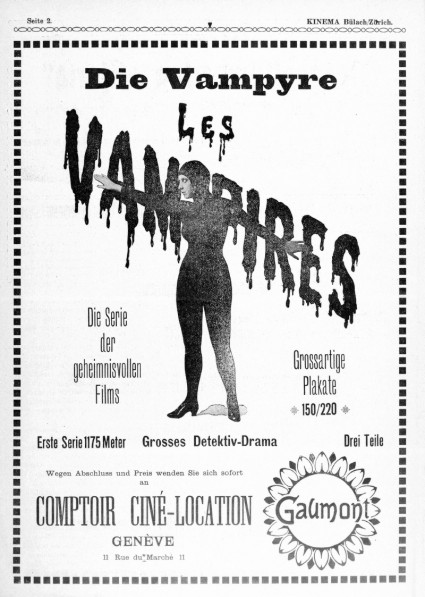
Advertisement for the Gaumont serial Les Vampires, from an edition of Kinema in 1916

Could it be that there is starting to be a bit of international competition in the digitising early film journals stakes? It would be wonderful if this were so, and maybe the appearance of the journals around the world that we are trying to document is in part encouraging other such initatives. Already we have excellent representation for Italy, France, the USA and Brazil, with isolated examples for countries such as Austria, Germany, Sweden and the UK. Now we can add Switzerland to their number.

The Institute of Cinema Studies at the University of Zurich has recently completed a project to digitise 324 issues of the Swiss film trade journal Kinema, dating 1913-1919 (with some gaps). The journal was Switzerland’s first film journal, founded in 1911 (the first two years have not been digitised as yet as many issues from this period are missing), written in German though with some articles in French. It covers the small amount of native film production that took place in Switzerland this time, but also covers films from many other countries which were exhibited in Swiss cinemas. So, for anyone with an interesting in early cinema this is an important new resource.

Using the Kinema website is easy. Click on the ‘Blättern’ link and you will be taken to the relevant section of the retro.seals.ch online project, of which this digitisation forms but a part. Instructions are in English. You can search across the entire digitised set, of else selected a volume or year, then narrow this down to issue level, which takes you to individual pages which you can browse through or see in enlarger form with a zoom viewer. Complete issues can be downloaded as PDFs (rather large – a typical issue comes to over 100MB, but they are word-capturable, so it is possible for non-German or French reader to copy and paste text into Google Translate to get at least an approximate sense of what is being said). It is possible to download individual pages as PDFS as well.

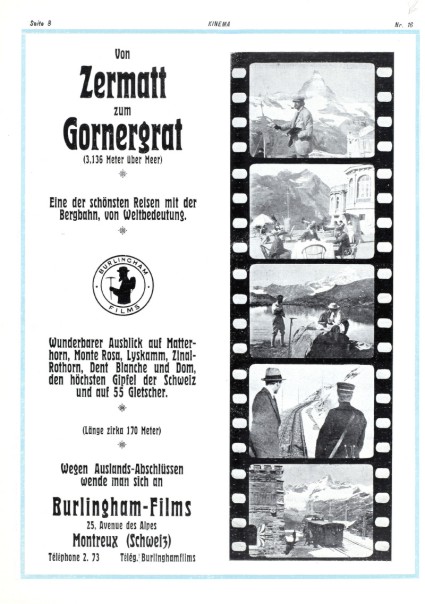
Advertisement for Burlingham Films, from Kinema in 1917

You can also search for a word within a single issue. Searching on various terms brought up 168 hits for ‘Chaplin’, 371 for ‘cinematograph’, 12 for ‘Vitagraph’, 30 for ‘burlingham’ (Frederick Burlingham was a mountaineering filmmaker who made a number of films in Switzerland), 7 for ‘bioscope’ and 3 for ‘Kinemacolor’ (the searches appear to be across the entire retro.seals.ch database – I haven’t worked out how to search within the one journal title, as opposed to browsing through it). The journal is heavy on the Gothic text for the earlier issues, but later isues have more illustrations, particularly among the many advertisements.

This looks like a model digitisation. I am grateful to Dr. Wolfgang Fuhrmann of the University of Zurich for bringing the site to my attention. He invites anyone interested to get in touch with him at wolfgang.fuhrmann [at] fiwi.uzh.ch or else Adrian Gerber, who was the supervisior of this particular project, adrian.gerber [at] fiwi.uzh.ch. They are particularly keen to hear from collectors who may be able to contribute otherwise lost copies, so that they can make the digitised run complete. They note in particular the contribution to the project of the great German early film filmographer Herbert Birett, who has helped identify some elusive copies. These are the missing issues:

1911 / all Issues
1912 / all Issues
1913 / 1-9
1914 / 15 (Issue was probably not published)
1915 / 35, p. 6f.
1915 / 38
1916 / 2
1917 / 36, cover c?
1917 / 42, cover b, c, d
1917 / 51, cover b, S. 1
1918 / 21 (Issue was probably not published)

There is much to discover here, illuminating not only the exporting of films from other countries into Switzerland, but increasing awareness of the importance of a country whose early film history (production, distriubtion and exhibition) remains too litle known by most film scholars. Having Kinema online must change things. Go explore.

750,000 and rising

It is the special privilege of all bloggers to bore / regale / fascinate (delete as appropriate) their readers with statistics. Every blog comes with a content management system that reports the daily, weekly and monthly figures, encouraging to write ever more so that you may attain the next milestone in pursuit of a truly satisfactory popularity. The urge to report such figures to your readership is a great one, though one doubts that the readers care much at all.

Here at New Bioscope Towers we are not entirely immune to such temptations, but as the viewing figures climb steadily if unspectacularly upwards, we are less distracted by them than used to be the case (oh that happy day when we first hit 10,000 views). Nevertheless, three-quarters-of-a-million visits since 2007 feels like a modest achievement, and that’s where we are. Feel free to celebrate in whatever way you find fitting.

For myself, I shall celebrate by presenting the trailer for The Artist, Michel Hazanavicius’ modern silent feature film which was such a great hit at Cannes and is about to go on general release (in October, it seems). It looks to be just the sort of fun that the best silent films can be – and a film for everyone. The Bioscope salutes it, and all those who revere a medium which clearly has much more life in it yet.