Crazy Cinématographe

Travelling Cinema – Crazy Cinématographe – a prestigious European Project

In 2007, Luxembourg will be European Capital of Culture. As part of a series of events celebrating our shared European culture, the Cinémathèque Luxembourg will be exhibiting a travelling cinema show at five major fairs in Luxembourg and the Greater Region: Luxembourg, Trier (Germany), Saarbrücken (Germany), Thionville (France) and Liège (Belgium)

This early cinema show (publicity title: «Crazy Cinématographe») will be a touring spectacle celebrating the films produced in Europe during the first decade of the twentieth century. The films will be projected in a purpose built tent completed with a cast of performers animating and advertising the shows in the tradition of the pioneering days of the fairground cinématographes. The show will celebrate the work of the European film archives by producing a prestigious and entertaining showcase for those little known wonders only known to archivists, historians and festival goers, but not to the general public.

Call for contributions from European Film Archives

Every archive has wondrous treasures from the early 1900s. In order to help your selection, we ask that each archive proposes a list of titles from their collection adequate to the general spirit of the project, with a special focus on the program sections mentioned below. The proposed titles should date from the period 1895 to 1914 and consist of films between 1 to 5 minutes in duration.

Program sections (provisional titles)

1. Comedy and burlesque: slapstick, performance titles or acts

2. Cabinet of the bizarre: freak shows, exotic bodies, weird animals

3. Magical Mystery Tour: fairyland films (French: «féeries»), fantastic
films, science-fiction, etc.

4. The sexual life of Grandma and Grandpa: erotics soft (striptease, etc.) and erotics hard (pornography).

5. Local films for Local People: views of Luxembourg and the Greater Region, especially from Trier, Saarbrücken, Thionville and Liège.

6. General show: any thrilling material that does not fall into the above subjects or is a particular favourite of the Archive

Anyone requiring further information on the project, please contact Dr Vanessa Toulmin of the National Fairground Archive or Nicole Dahlen from the Cinémathèque Luxembourg.

Travelling Cinema in Europe

CALL FOR PAPERS

International Conference – Travelling Cinema in Europe

Under the auspices of Luxembourg and Greater Region European Capital of Culture, 2007. Hosted by Cinémathèque Municipale de Luxembourg and Trier University. Curated by Martin Loiperdinger in cooperation with KINtop

Before and during the emergence of permanent film venues, a variety of travelling enterprises offered film shows in different places of public entertainment all over Europe. The big ‘Picture Palaces’ of renowned showman families were among the main attractions of the fairgrounds before the First World War. Smaller companies performed their film shows in town-halls, music-halls, hotels and cafes, or gave even benefit shows in hospitals and asylums. Since film trade had established itself as a free international business from the beginning, and thanks to the well-developed European railway system, covering wide distances and crossing borders was not a problem for travelling cinemas at all. This was a prerequisite for travelling cinemas to become an important branch of European entertainment business between 1896 and the Great War, and thus prepared the ground for the success story of cinema as the new mass medium of the century.

In contrast to its formative potential and importance before the First World War, the phenomenon of the travelling cinema still is one of the dark areas in media history. In terms of archival material, nothing more seems to have survived than letters of application to city administrations, a few programme sheets, sometimes adverts and reports in the local press. Only recently has research on travelling cinema made an enormous step forward, in Britain, through the restoration and exploration of the Mitchell and Kenyon collection by the British Film Institute and the National Fairground Archive. It became clear that travelling cinemas played an important part in communicating the local, besides attracting audiences with fantastic films and views from abroad. Local films and other local and regional extravaganzas of the show (as lecturing in local vernacular etc.)

Encouraged by this splendid research done in Britain, we would like to know much more on travelling cinemas and the culture of the travelling cinema in other European countries. Papers may focus on the regional or local aspects and the impact of travelling film shows, on the geographical range and transnational significance of itinerary ‘Picture Palaces’, on showman families who ran travelling enterprises, on film programming, on live performances, on business strategies etc.

The proceedings of the conference will be published, in English, in KINtop Schriften. Abstracts of 1 – 2 pages should be submitted to: Martin Loiperdinger.

Deadline – 1 March 2007

The London Project

The London Project is a major study of the film business in London, 1894-1914, organised by the AHRB Centre for British Film and Television Studies. The project ran 2004-05, but written outputs are in preparation and will be seen later this year; and there the main project output, a searchable database, which is available online. This documents nearly 1,000 cinemas and other film venues, and just as many film businesses located in London before the First World War. The researchers on the project were Simon Brown and Luke McKernan, with Professor Ian Christie of Birkbeck, University of London, overseeing the work.

The database is designed to attract not only early film specialists, but a general audience interested in London history. To this end there is a map of the boroughs of London, from which users can call up database results for the part of the city they are interested in. Because the database entries can be found through Google searches, it has generated quite a public response. The current web address is http://londonfilm.bbk.ac.uk, though there is talk of this changing soon. As the person responsible for the cinema records, I have to say that Simon’s film business records are better.

A view of life

Why call this site The Bioscope? Well, the Bioscope was the name of a camera and a projector (both a brand name and generic), it was the name for fairground film shows and for early cinemas (it still is the name for a cinema in South Africa), and it was the name of a British film trade journal. So it covers the taking, projecting, exhibiting and documentation of early film. There are several other uses of the word, and I’m starting up a Bioscope category to trace the etymology, usage and meanings of the word.

So, to begin at the beginning: Bioscope. The word is constructed from the Greek (bios, life; skopeein, to look at), and the Oxford English Dictionary gives its traditional definition as ‘a view of life or survey of life’. The word was coined by Granville Penn in his 1812 Christian tract The Bioscope, or Dial of Life. Penn’s book included a separate card on which was illustrated a dial marked from nought to seventy, marking the ages of man from childhood to decay in decades, with eternity waiting before and after. A pointer was attached for the reader to mark out his current age, and hence to contemplate the lessons in Penn’s book on the allotted span of human life and to avoid the belief ‘that life is a continuous now’. This dial was the Bioscope, and just as a horoscope was a measure of the heavens at the hour of birth, so the Bioscope was the ‘general measure of human life’.

Meanings a-plenty already.

Electric Edwardians

You’ve seen the television series, you may have seen a live show, you’ve bought the DVD, you’ve bought the book, now it’s time to buy another book. The BFI has just published Electric Edwardians: The Films of Mitchell and Kenyon, by Vanessa Toulmin. This is a detailed single history of the films of Sagar Mitchell and James Kenyon, lovingly illustrated with sumptuous frame stills from the extraordinary film collection of actuality films produced by the Blackburn firm before the First World War. It feels like the last word to be said on the collection, but it shouldn’t be. The book gives every encouragement for us all to take the subject further, both as film history and as a means to inform social history.

Only the screen was silent

I was pleased to find a copy of Harry Blacker’s Just Like it Was: Memoirs of the Mittel East (London: Vallentine, Mitchell, 1974) in a second-hand bookshop recently. This memoir of a childhood spent in London’s East End in the early years of the twentieth century has a marvellously evocative section on going to the cinema before the First World War. Here’s an extract:

On the diminutive screen, the ‘big picture’ had already started. Under it, curtained off from the main audience, Miss Daniels, a heavily made up brunette, played a piano accompaniment to the tragic drama that flickered overhead. The heat was terrific. A perpetual buzz of conversation mingled with the crackle of peanut shells that littered the floor like snow in winter. Every step in any direction crunched … Nearby, children were reading the titles out loud for the benefit of their foreign parents. Some even translated the words directly into Yiddish. Babies cried, kids were slapped, and an endless procession to the ‘ladies and gents’ was greeted by outraged cries of ‘Siddown’. Only the screen was silent.

Americanizing the movies

Americanizing the Movies

http://www.amazon.co.uk

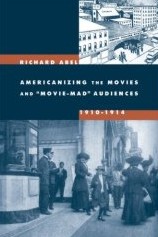
Richard Abel’s latest look is Americanizing the Movies and “Movie-Mad” Audiences, 1910-1914. Its subject is the relationship between early cinema and the construction of a national identity. Abel analyses film distribution and exhibition practices to reconstruct a context for understanding moviegoing at a time when American cities were coming to grips with new groups of immigrants and women working outside the home. It makes use of a hugely impressive range of archival sources archive prints, the trade press, fan magazines, newspaper advertising, reviews, and syndicated columns.

Crime and deviancy

The British Silent Cinema Festival is now in its 10th year. The festival is held at the Broadway, Nottingham, and is a ‘celebration’ of British cinema before 1930, organised in collaboration with the British Film Institute. The Festival aims to showcase the vast collection of films, fiction and non fiction, produced in Britain before the advent of sound. This year’s theme is Underworld: Crime and Deviancy in the British Silent Film. The call for papers is now closed. The Festival is taking place 26-29 April 2007.