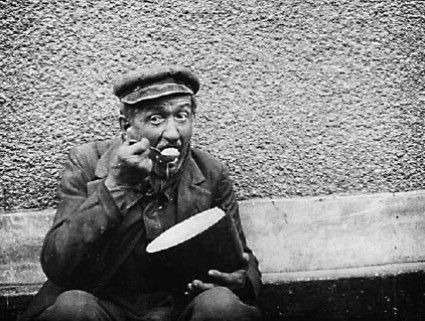
Poverty on screen 1880-1914

Comment les pauvres mangent à Paris / How the Poor Dine in Paris (Pathé 1910), from the Screening the Poor DVD

Recently we reviewed the the double-DVD release from Edition Filmmuseum, Screening the Poor 1888-1914, which innovatively brings together early films and magic lantern sets on the theme of poverty. Now the DVD release and the Screen1900 Project at the University of Trier which encouraged it have led to a conference taking place 1-3 December at the German Historical Institute in London. The title of the conference is ‘Screen Culture and the Social Question: Poverty on Screen 1880-1914’, and the convenors are Professor Dr. Andreas Gestrich (GHIL) and Dr Ludwig Vogl-Bienek (University of Trier). Here are the descriptive blurb and preliminary programme:

This conference will bring together different international research approaches looking at how the optical lantern (‘art of projection’) and cinematography were used in the context of the Social Question around 1900. The media history relevance of the Social Question to the establishment of these new visual media has hardly so far been examined. Nor have these media been critically investigated as social history sources. The conference aims to make a fundamental contribution towards establishing an innovative field of research in the area where social history and media history overlap.

The rapid success of ‘cinematography’ at the beginning of the twentieth century owed much to what was known as the ‘art of projection’. The screen became firmly established as a part of international cultural life in the second half of the nineteenth century by the ‘art of projection’. The enormous creative potential of these new visual media in public performances was used not only for commercial purposes, but also for events in areas such as education, religion, and social policy.

The interdisciplinary comparison will discuss the state of research on the motifs, production, dissemination, and reception of the projection media in the field of poor relief and social policy. Different methodological concepts will be introduced for researching the performative potential of existing scripts and artefacts (glass slides, films, projectors). In addition, projects editing sources will be presented, and new processes for digitally reproducing and documenting historical sources and artefacts will be discussed.

Preliminary Conference Programme

Thursday, 1 December 2011:

13:00
Registration

14:00
Welcome and Introduction
Andreas Gestrich (German Historical Institute London) and Ludwig Vogl-Bienek (University of Trier)

14:30 – 17:00
Panel 1: Screen Culture and the Public Sphere – Historic Context and Social Impact 1880 – 1914
Chair: Ian Christie (London)
Martin Loiperdinger (Trier): The Social Impact of Screen Culture 1880 – 1914.
Stephen Bottomore (Bangkok): The Lantern and Early Film for Social and Political Uses.

15:30 – 16:00 Coffee Break

16:00 – 17:00 Comment and Discussion Panel 1
Comment by Andreas Gestrich (London)

17:15 – 19:00
Road Show: Approaches to the Hidden History of Screen Culture
Frank Gray (Brighton): The Lucerna Network for the History of Projection.
Ine van Dooren (Brighton): Archiving and preserving lantern slides and related resources.
Richard Crangle (Exeter): Digitizing the History of Screen Culture: The Lucerna Database.

Friday, 2 December 2011:

09:30 – 12:30
Panel 2: Raising Public Awareness for the Living Conditions in Slums and Tenements
Chair: Clemens Zimmermann (Saarbrücken)
Ludwig Vogl-Bienek (Trier): Slum Life and Living Conditions of the Poor in Fictional and Documentary Lantern Slide Sets.
Joss Marsh (Bloomington) / David Francis (Bloomington): “Poetry of Poverty” – The Magic Lantern and the Ballads of George R. Sims.
Bonnie Yochelson (New York): Jacob Riis, His Photographs, and Poverty in New York, 1888-1914.

11:00 – 11:30 Coffee Break

11:30 – 12:30
Comment and Discussion Panel 2
Comment by tbc

12:30 – 14:00 Lunch Break

14:00 – 17:00
Panel 3 – Education and Entertainment for the Poor – the Use of Lantern Shows and Early Films by Charity Organisations
Chair: Ine van Dooren (Brighton)
Karen Eifler (Trier): Free Meals and Lantern Shows: Charitable Events in Great Britain and Germany.
Judith Thissen (Utrecht): Educating Moyshe: Jewish Socialists, Gentile Entertainments, and the Future of the Jewish Immigrant Masses in America.
Caroline Henkes (Trier): Early Christmas Films in the Tradition of the Magic Lantern.

15:30 – 16:00 Coffee Break

16:00 – 17:00 Comment and Discussion Panel 3
Comment by Frank Gray (Brighton)

19:00 tbc

Evening Programme at The Foundling Museum:
“TIDINGS OF COMFORT AND JOY
A festive and true-made Victorian Magic Lantern Show for the deserving poor of London”
by Mervyn Heard with Juliette Harcourt (recitation and song) and Stephen Horne (piano)

Saturday, 3 December 2011:

09:00 – 12:00
Panel 4 – Social Prevention with the Aid of the Screen and Exhibitions
Chair: Richard Crangle (Exeter)
Annemarie McAllister (Preston): The Promotion of Temperance by means of the Magic Lantern.
Marina Dahlquist (Göteborg): Health Entrepreneurs: American Screen Practices in the 1910s.
Michelle Lamuniere (Harvard University): From Jacob Riis’s Lantern Slide Presentations to Harvard University’s Social Museum.

10:30 – 11:00 Coffee Break

11:00 – 12:00 Comment and Discussion Panel 4
Comment by Scott Curtis (Evanston)
12:00 – 13:00
Closing Remarks and General Discussion
Chair: Andreas Gestrich
Closing Remarks by Ian Christie (London) and Clemens Zimmermann (Saarbrücken)

Spaces are limited (with all those speakers they can’t have much space left) and those interested to register should contact the organisers via this link.

Bioscope Newsreel no. 32

Carla Laemmle and Gary Busey, from Hollywood Reporter

Here in the scriptorium at New Bioscope Towers we’re setting the staff to transcribing our scarcely decipherable notes made in the dark (of course) at the Pordenone Silent Film Festival, in readiness for the first of our diary reports – we hope not to keep you waiting too long. Meanwhile, other events have been taking place in the world of silent film. These are five of them.

Carla’s second century
Carla Laemmle, niece of Universal Pictures founder Carl Laemmle, has will be 102 on October 20th, and is not just one of the few silent film performers still alive, but very probably the only one still acting. She appeared as a prima ballerina in The Phantom of the Opera (1925) and plays alongsde Gary Busey in the forthcoming feature Mansion of Blood. Read more.

A dog’s life
The silent star of the moment, however, has four legs. Susan Orlean’s cultural history Rin Tin Tin: The Life and the Legend has gained much acclaim and aroused new interest in silent cinema’s leading canine star. The book tells a “powerfully moving story of Rin Tin Tin’s journey from orphaned puppy to movie star and international icon”, telling a history that is as much about American entertainment and society as it is about the dog. Read more.

Silent cinema and the secrets of London
The Daily Telegraph site has a thoughtful article by Neil Brand on his experience of London through the medium of silent film and his music accompaniments, from Siege of Sidney Street newsreels, to Alfred Hitchcock’s The Lodger, to his own orchestral score for Anthony Asquith’s Underground (premiered on October 5th at the Barbican). Read more.

Louis Louis
Louis, Dan Pritzker’s modern silent film on the childhood of Louis Armstrong, with Wynton Marsalis’ jazz score, has its European debut on 13 November, as part of the London Jazz Festival, at the Barbican (again). Marsalis himself won’t be there, but the eight-piece group, led by trombonist Wycliffe Gordon, includes saxophonist Wes Anderson, and drummer Herlin Riley. Tickets are now on sale. Read more.

La Parade est passée
One of the quite essential silent film books, Kevin Brownlow’s 1968 The Parade’s Gone By, is to be published in French for the first time. Its translator is Christine Leteux, the knowledgeable soul behind the highly commendable Ann Harding’s Treasures blog. It is to be published by Acte Sud/Institut Lumière on 19 October (according to Amazon.fr). Brownlow himself is a guest of honour at the Lumière 2011 film festival in Lyon this week, marking the publication of his book. Read more.

‘Til next time!

New site for Domitor / Nouveau site Web pour Domitor

http://www.domitor.org

Well, we’re back from Pordenone, sadly before the silent film festival itself is over, but pressing matters called us back. But there is plenty to report on, starting with the news of a new website for Domitor, the international association dedicated to the study of early cinema.

This is very welcome because Domitor, while being an organisation notable for its dedication towards the early part of the twentieth century, has been slower to grasp the opportunities – indeed necessities – of the twenty-first. The old website suffered from an antiquated look and a severe lack of updating, indeed a severe lack of any reason for anyone interested in early cinema to visit it. Hopefully the new site is indication of a change of policy, bringing news, resources and exchange of knowledge online.

Domitor (the names comes from that suggested by the father of the Lumière brothers for their projector) was founded in 1985 at the Pordenone festival, where it holds a meeting each year. It organises a biennial conference on aspects of early cinema, the first having taken place in Quebec in 1990 and the next to be held in Brighton in June 2012, on the theme ‘Performing new media, 1890-1915‘. Most of the papers presented at its conferences have been published in anthologies or special-issue volumes, details of which can be found on the site. They are essential for following trends in early cinema scholarship. There are some 300 members from over 30 countries, and all business is conducted in English and French.

The website tells you about the organisation, its conferences and publications, information on how to become a member, with a resources page covering recent publications and bibliography of members’ writings, a DVD Database, a news page, and an archive all promised for later. There is also a list of links. Sadly for the bilingualists, the French section of the site is not up yet (it’s expected in April 2012). Let’s hope the site grows as it has the potential to grow.

Pordenone pause

We have a small problem. I’m here in very sunny Pordenone, regular faces and new faces abound, familiar haunts are all inviting, silent films from around the world are unspooling before our lucky eyes. One thing is missing however. A catalogue. The immensely detailed, informative and authoritative catalogue that the silent film festival produces each year is not ready yet. Indeed we hear that it may not be completed, printed and handed to us until Wednesday, but which time this festival-goer will have gone home.

This rather spoils the plan of having daily reports for you, because I’m not always going to know what it is that I’ve seen. In particular some of the Soviet and Georgian films lined up are not going to make much sense without explanatory notes. I don’t want to write reports giving general impressions of films for which I can only give titles, date and director. A little bit of background knowledge is essential. So unless a miracle occurs, we’re going to have to abandon the on-the-spot diary plans. Which is a shame. But when you have a day like today, when you have not one but two films with scenes featuring someone trying to poison others by placing match-heads (with sulphur) into their drinks, then you want the world to know who did such deeds, and to say so with authority. At the moment all I can tell you is that, as a strategy, it doesn’t work too well. And a 1912 Italian film with translated title Worse than Death, with striking compositions, lateral camera movement and a denouement that startlingly lived up to the promise of its title. We must report all this, but report it well. Which will be on our return.

Update: I’ve learned the catalogue is now online. Managing all this through my phone is going to be a bit tricky, however, so I’ll keep to reports when I get back.

Pordenone bound

It’s that time of year again, when the Bioscope heads off for its home-from-home, Pordenone, northern Italy, for the Giornate del Cinema Muto. As always, we will be producing a diary of the eight-day silent film festival. However, w’re going to experiment a little this year. Your scribe is there for the first four days, during which we hope to produce daily on-the-spot reports in the style of the conference reports we provided earlier in the year. Then I head home, but our regular, anonymised Pordenone reporter, the Mysterious X, will be taking over. X will be producing a more considered report on the second four days, to be recollected in tranquility and replayed to you in the traditional style, some time after the festival is over.

Meanwhile, to give you a taste of the festival (and demonstrate that it’s not all about sitting through exhaustive retrospectives of Georgian silents), the video above shows one time silent child star Jean Darling (of ‘Our Gang’ fame) giving a showstopping performance of ‘The Cinema Kiss’ (1929) from a programme of movie-related songs at the 2009 Giornate, with Donald Sosin at the piano.

Hope to see some of you there quite soon.

Thought waves

Is it, perhaps, that all films are really silent films? Isn’t cinema just about conjuring up moving pictures in our heads, matching what we see to the world that we know? Aren’t sound and speech mere decorations, means simply to guide us what we want to see? Isn’t everything that we want to find in cinema to be found in silent cinema, when the medium was new and trying to discover all that it could do? And what, fundamentally, has it done that is new since the silent era? And might that be because, perhaps, all films are really silent films?

I offer up these thoughts by way of reaction to the above video, which I present to you as a silent film, simply because it is silent. Sometimes when I point out modern films without soundtracks I wonder whether the connection with silent cinema is purely tokenistic. But now I don’t think so. Films that have lost their sound have returned to some sort of pure state. After all, a story that isn’t told in pictures can’t really be thought of at all cinema, can it?

The video illustrates work undertaken by neuroscientists at the University of California, Berkeley, who have been scanning the brain activity of volunteers who have been watching films. A computer was then able to produce rough reconstructions of what they had viewed, with reference to an archive of 18 million one-second clips taken from YouTube not previously seen by the participants. The computer then matched the clips to the brain activity it had recorded.

The results are peculiarly haunting, indeed dreamlike – ghostly distortions of images that look like a combination of Francis Bacon and Odilon Redon in motion. They are silent, of course, and a form of moving image previously unseen, unimagined. As an Associated Press report says,

Scientists … speculated such an approach might be able to reveal dreams and hallucinations someday. In the future, it might help stroke victims or others who have no other way to communicate, said Jack Gallant, a neuroscientist at the University of California, Berkeley, and co-author of the paper.

He believes such a technique could eventually reconstruct a dream or other made-up mental movie well enough to be recognizable. But the experiment dealt with scenes being viewed through the eyes at the time of scanning, and it’s not clear how much of the approach would apply to scenes generated by the brain instead, he said.

Greater results could be achieved by greater access to a moving image archive (there was no equivalent clip for an elephant, for example), which makes you think how the whole of YouTube might be viewed as the collective dreams of us all.

This second video demonstrates the range of clips from which the computer selected its composite moving image (shown in the top left-hand corner):

The dream videos have gone viral, with over a million views in just a few days. Clearly something speaks deeply to people about the idea of these films, if not necessarily the images themselves. It’s not just that we might, hypothetically, one day be able to recover an entire movie from our brains, or indeed visualise our dreams. It’s that all these pictures are playing in our heads, and that this experiment opens a small window upon them. It’s an idea of the mind as pure cinema.

The paper on which the research is based is ‘Reconstructing Visual Experiences from Brain Activity Evoked by Natural Movies‘, by Shinji Nishimoto1, An T. Vu, Thomas Naselaris1, Yuval Benjamini, Bin Yu and Jack L. Gallant. Further information on the project is available from http://gallantlab.org.

Going underground

OK, here’s a test for you – who’s in this picture? It’s a frame still from a newsreel of an aviation demonstration held in Britain for the parliamentary aerial defence committee at Hendon in May 1911. It shows two parents and their 9-year-old son. Recognise him at all? Well, it may help to know that the father is Herbert Asquith, prime minister of Britain at the time, with his wife Margot. And so yes the little boy is indeed Anthony Asquith, making his first appearance on a medium where a dozen or so years later he would shine as one of Britain’s leading film directors and go on to enjoy a notable career in film spanning four decades.

Asquith is back in vogue. Most who know their film history will associate him with elegant if (apparently) bloodless society dramas, typically adaptations of Terence Rattigan plays, peaking with a peerless version of Oscar Wilde’s The Importance of Being Earnest. But now more and more we are being encouraged to look at Asquith the young man, who took a very different approach to the camera. In common with a number of the British intelligensia of the early 1920s Anthony Asquith became fascinated by film while at university. He spent some time in Hollywood as a guest of Douglas Fairbanks and Mary Pickford, joined H. Bruce Woolfe’s British Instructional Films to learn about filmmaking from the gound up, and was a founder member of the Film Society, the London-based body formed to screen films of articis worth or historical interest which did so much to establish an intellctual film culture in Britain.

Asquith first served as a general assistant on Sinclair Hill’s Boadicea (1926), before writing the script for Shooting Stars (1927), a film for which he was also described as assistant director, with industry old hand A.V. Bramble being named director. But the opinion of posterity (and even opinion at the time) is this is an Asquith film. It is one of the most astonishing of film debuts: a witty deconstruction of filmmaking (the story is set in a film studio) and a stylistic grand feast. It is crying out for restoration with new score, and all of promotional works that we now expect to come with high-level silents brought back to public attention. Doubtless all that will happen in the fullness of time, but before Shooting Stars becomes the talk of the town we have the film of the town, and that is Underground.

Underground (1928) was the first film for which Asquith received full director credit, and it shows quite definitely that Shooting Stars was no fluke (or astonishing late career flourish from Bramble). It is a work of someone who had seen a lot of German and Soviet films at the Film Society and who wanted to bring the exciting techniques of expressionism and Soviet montage, coupled with psychological penetration, to a British setting. Underground achieves this about as well as you could hope. There is something slightly ridiculous about looming shadows, vertiginous camera angles and doom-laden characters placed among the mundanities of a London setting. Eisenstein showed a people impelled towards revolution; Asquith shows them catching the Undergound train everyday. There is a melodramatic love story to follow, with an absolutely splendid fight climax (some of which you can see in the trailer above), but the real story is the ebb and flow of London life, which doesn’t really fit in with the tempestuous technique. The revolution was not going to happen in London – Asquith was interested in what the camera could do, not what society might do, and the two do not really connect in Underground.

But what the heck – it’s a great film to watch, and now the BFI restoration is getting the full new orchestral score treatment courtesy of Neil Brand and the BBC Symphony Orchestra. It’s worth noting how extraordinary this is, in terms of British silent films. Brand’s score for Blackmail, shown at Bologna and at the Barbican in London last year, was the first full orchestral score for a British silent fiction film since the days of the silents themselves (Laura Rossi produced an orchestral score for the documentary The Battle of the Somme in 2006). Underground is the second. It shows how the critical and commercial reputation for British silents has risen in recent years – or at least the small coterie of British silents that are likely to please a modern audience. Asquith’s A Cottage on Dartmoor has entered many people’s favourite lists after its DVD release and Stephen Horne‘s great work in accompanying it, and one expects that preconceptions will be shifted once again once word gets round about Underground‘s particular thrills.

Underground is being shown with the BBC Symphony Orchestra conducted by Timothy Brock at the Barbican, London, on 5 October 2011. The Barbican web page has full booking details, plus a podcast with Neil Brand giving his thoughts on scoring for silent films. It will be good to be there if you can.

Anthony Asquith made four silent features. The third among them, The Runaway Princess (1929), I’ve not seen but has a reputation of being a bit on the lightweight side. It was an Anglo-German production, for which Asquith was encouraged or obliged to rein in the arty stuff, and there’s unlikely to be much there to excite an audience today. But Shooting Stars – now there is treat for you in the future, I hope.

Media History Digital Library

http://mediahistoryproject.org

The Media History Digital Library, of which you will have read much if you are a regular here, now has a proper website. The MHDL is a non-profit initiative established by film archivist and historian David Pierce to digitise classic film and media-related journals and directories that are in the public domain, making them freely available for public access online. The journals come from variety of personal and institutional collections, with the donors including Robert S. Birchard, Eileen Bowser, Dino Everett, Richard Koszarski, Bruce Long, Nancy Goldman/Pacific Film Archive Library and Film Study Center, David Pierce, Rick Prelinger and Karl Thiede. Pierce is the director of the MHDL, Eric Hoyt of the School of Cinematic Arts, University of Southern California the Digitization Co-ordinator, and Wendy Hagenmaier of University of Texas Information School the Digital Archivist. All scanning and hosting is undertaken by the Internet Archive.

There are already over 200,000 pages digitised, and much more to follow. The journals for which there are extensive runs available are:

Business Screen (1938-1973)
The Film Daily (1918-1936)
International Photographer (1929-1941)
Journal of the Society of Motion Picture Engineers (1930-1949)
Journal of the Society of Motion Picture and Television Engineers (1950-1954)
The Educational Screen (1922-1962)
Moving Picture World (1912-1918)
Photoplay (1917-1940)
Radio Age: Research, Manufacturing, Communications, Broadcasting, Television (1942-1957)
Radio Broadcast (1922-1930)

while those for which there are select holdings, and the directories available, are:

Educational Film Magazine (1920-1922)
Exhibitors Trade Review (1921-1922)
Film Spectator (1928)
Harrison’s Reports (1948)
Hollywood Reporter (1934)
Hollywood Reporter Production Encyclopedia (1948-1952)
Home Movies & Home Talkies (1932-1934)
International Motion Picture Almanac (1938)
Kinematograph Year Book (1931-1954)
Motion Picture Classic (1920)
Motion Picture Daily (1931-1934)
Motion Picture News Blue Book (1930)
Motion Picture News Booking Guide (1929)
Motion Picture Story Magazine (1913)
Motion Picture Studio Directory and Trade Annual (1921)
Motography (1915)
Non-Theatrical Film Catalogues (1936)
Picture Stories Magazine (1914-1915)
See and Hear: The Journal on Audio-Visual Learning (1945-1953)
Television Programming Catalogues (1957)
The Film Daily Year Book of Motion Pictures (1923-1963)
The Annals of the American Academy of Political and Social Science: thee Motion Picture in Its Economic and Social Aspects (1926)
The Film Daily Presents the Product Guide and Director’s Annual (1937)
The Motion Picture Almanac (1929)
The Optical Lantern and Cinematograph Journal (1904-1905)
The World Film Encyclopedia (1933)
Who’s Who on the Screen (1920)

Many of these we have already described and championed at the Bioscope, and there’s no need to go through the details once again. The new website describes the collections, admirably, most helpfully dividing them up into curated section with useful background histories, under the themes of Hollywood Studio System Collection (1918-1948), Fan Magazines (1914-1940), Early Cinema Collection (1904-1918), Year Book Collection (1922-1963), Broadcasting Collection (1922-1957), Non-Theatrical Film Collection (1920-1973) and Technical Journals Collection (1929-1954).

This is not just a website to promote the existence of the project, but a properly functioning online library in itself. It presents the works and their contexts. There is a particularly informative and well-illustrated blog, written by Pierce, focussing on aspects of the collections; a forum awaiting new members, FAQs, a promised links section, and an invitation to asist in sponsoring further digitisation. A $1,000 contribution will support the scanning of 10,000 magazine pages, which is around a year for most of these publications. Among the titles awaiting sponsorship are The Film Daily, Motion Picture Daily, Motion Picture Herald, Radio Daily, Cine-Mundial, Broadcasting, Exhibitors Trade Review, Motion Picture News, Moving Picture World and The Hollywood Reporter. Some of these have been particually digitised, as indicated, but the full run remains to be completed.

More is promised from the site, aside from further digitised content. They intend to develop an Advanced Search to allow customisable searvches across multiple publications, volumes and years, which is going to be a huge boon to researchers. More on that when it appears. Meanwhile, individual journals and volumes are already word-searchable.

As Pierce’s blog shows, there is huge quantity of precious information to be mined. The Media History Digital Library represents a real tipping point for film research. We’ve gone beyond the point when it was quite fun to find a few texts available online, to supplement our visits to research libraries and perusing through microfilms. This is the new research library. This is where the bread-and-butter research documentation upon which we all depend is going to be found from now on. This is where we will now make our discoveries, and new kinds of discoveries too, as online research tools leads to new forms of analysis, new associations, and new conclusions. And we’ve only just started.

Pordenone line-up

Teaser trailer for The Force That Through The Green Fire Fuels The Flower, by Otto Kylmälä, receiving its international premiere at the Giornate del Cinema Muto

The upcoming Pordenone silent film festival, or Gionate del Cinema Muto (1-8 October), has the look of a real classic about it. After last year’s interesting but slightly thin offering, the festival organisers look to have gone town, impressing us with an amazing array of silent treasures both famous and obscure, from across the globe, and with a number of restorations and discoveries which have been the talk of the silent world featuring during what is the 30th Giornate.

The festival puts up all the information that it can about the programme, when it can, and there is now quite extensive programme information, including a provisional daily schedule. Details of the programme are given below, but before we get there, I’d like to draw your attention to one film receiving its international premiere at the festival which I think is going to be a bit special. The festival programmers have always tried to give the modern silent film its due, and there are usually a few modern shorts dotted about the programme, of variable quality it has to be said. The bar is probably about to be raised for the modern silent quite substantially by The Force That Through The Green Fire Fuels The Flower (2011), directed by Otto Kylmälä. The Bioscope has had a sneak preview of this, and I can promise you that it is really quite something. Not least it will be screened with live score by Pordenone regular Stephen Horne. To quote my own words from the filmmaker’s Vimeo page:

You couldn’t imagine the film with dialogue; it’s about words unspoken. Stands head and shoulders above most of the modern silent shorts.

The teaser trailer above should whet the appetite.

As for the rest of the programme, there are Italian classics, more robust works from the USSR, a special focus on Georgian silents, more revisiting of films from the silent canon (including films some of us will have heard of, which is reassuring), Michael Curtiz before he was Michael Curtiz, lots of polar exploration films which won’t be to everyone’s taste but will certainly entrance me, an appearance by the annual and eternal Baby Peggy, and headline discoveries such as The White Shadow (1923), The Soldier’s Courtship (1896), Georges Méliès’ Voyage Dans la Lune in colour and a fragment from the mostly lost The Divine Woman (1928), with Greta Garbo. It’s going to be the only place to be.

EVENTI MUSICALI/MUSICAL EVENTS
– 01.10.2011 | 20.30 | Serata inaugurale/Opening event
NOVYI VAVILON [La nuova Babilonia /New Babylon] (Grigori Kozintsev & Leonid
Trauberg, USSR 1929). Partitura di/Score by Dmitri Shostakovich diretta da/
conducted by Mark Fitz-Gerald; esegue/performed by FVG Mitteleuropa Orchestra

– 02.10.2011 | A colpi di note/Striking a New Note
OH, TEACHER (Oswald the Lucky Rabbit; Walt Disney, US 1927)
Orchestra della Scuola primaria “Carlo Collodi” di Pordenone
THE ELECTRIC HOUSE (Buster Keaton Productions, US 1922)
Orchestra della Scuola Media Centro Storico di Pordenone

– 02.10.2011 | 20.30 | Chaplin à la Spilimbrass
EASY STREET (Charles Chaplin, Mutual, US 1917)
THE ADVENTURER (Charles Chaplin, Mutual, US 1917)
Accompagnamento musicale/Musical accompaniment: SpilimBrass

– 04.10.2011 | 20.30
SHINEL [Il cappotto/The Overcoat] (Grigori Kozintsev, Leonid Trauberg, USSR 1926)
Partitura di/Score by Maud Nelissen; eseguono/performed by: Lucio Degani (violino/
violin), Francesco Ferrarini (violoncello), Fábian Pérez Tedesco (percussioni/ percussion), Maud Nelissen (piano).

– 05.10.2011 | 20.30
THE CIRCUS (Charles Chaplin, US 1928)
Partitura di/Score by Charles Chaplin diretta da/conducted by
Günter A. Buchwald; esegue/performed by Orchestra San Marco, Pordenone
Replica/Repeat Show: 9.10.2011 | 17.00 | Teatro Zancanaro, Sacile

– 08.10.2011 | 20.30 | Serata finale/Closing event
THE WIND (Victor Sjöström, cast: Lillian Gish, Lars Hanson; MGM, US 1928)
Partitura scritta e diretta da/Score composed and conducted by Carl Davis
Esegue/performed by FVG Mitteleuropa Orchestra

– 09.10.2011 | 17.00 | Teatro Zancanaro, Sacile (replica/repeat show)
THE CIRCUS (Charles Chaplin, US 1928)
Partitura di/Score by Charles Chaplin diretta da/conducted by
Günter A. Buchwald; esegue/performed by Orchestra San Marco, Pordenone

CINEMA ITALIANO: 30 ANNI DI RISCOPERTE / ITALY’S GOLDEN AGE: 30 YEARS OF REDISCOVERY
– UN AMORE SELVAGGIO (Cines, 1912)
– PADRE (Itala, 1912)
– PIÙ CHE LA MORTE (Cines, 1912)
– SANTARELLINA (Ambrosio, 1912)
– TRA LE PINETE DI RODI (Savoia, 1012)
– LA RUPE DEL MALCONSIGLIO (Cines, 1913)
– UNA TRAGEDIA AL CINEMATOGRAFO (Cines, 1913
– IL VELENO DELLE PAROLE (Celio Film, 1913)
– LE ACQUE MIRACOLOSE (Ambrosio, 1914)
– LA MOGLIE DI CLAUDIO (Itala, 1918)
– LA SERPE (Caesar Film/Bertini, 1920)
– MADDALENA FERAT (Caesar Film/Bertini, 1921)
– LA GRAZIA (A.D.I.A., 1929)
+ comiche con/comedies with Cretinetti, Fringuelli, Robinet, Polidor, Kri Kri

SHOSTAKOVICH & FEKS (Elenco incompleto/Incomplete listing)
– CHYORTOVO KOLESO (Moryak c “Avrorvrii”) [La grande ruota; Il marinaio
dell'”Aurora”/The Devil’s Wheel; The Sailor from the “Aurora”]
(Grigori Kozintsev, Leonid Trauberg; USSR 1926)
– ODNA [Sola/Alone] (Grigori Kozintsev, Leonid Trauberg; USSR 1931)
– SHINEL [Il cappotto/The Overcoat] (Grigori Kozintsev, Leonid Trauberg, USSR 1926)
– SKAZKA O POPE I EGO RABOTNIKE BALDE [La storia del prete e del suo servo
Balda/The Story of the Priest and His Servant Balda] (frammento/fragment)
(Mikhail Tsekhanovsky, 1934)
– S.V.D. – SOYUZ VELIGOVO DELA [L’Unione per la Grande causa/The Club of the
Great Deed] (Grigori Kozintsev, Leonid Trauberg; USSR 1927)
– NOVYI VAVILON [La nuova Babilonia /New Babylon]
(Grigori Kozintsev, Leonid Trauberg; USSR 1929)

GEORGIA
– TARIEL MKLAVADZIS MKVLELOBIS SAQME (Delo Tariela Mklavadze) [L’affare Tariel Mklavadze / The Case of Tariel Mklavadze ] (Ivan Perestini; Georgia SSR, 1925)
– AMERIKANKA [L’americana/The Jobbing Press] (Leonard Esakya, Georgia SSR, 1930)
– ELISO (Nikoloz [Nikolai] Shengelay, Georgia SSR, 1928)
– MZAGO DA GELA [Mzago and Gela] (Shalva Khuskivadze, Lev Push; Georgia SSR,
1930; data uscita/rel. 1934)
– GANTSIRULNI (Obrechennye/Russkie vo Frantsii) [I condannati/The Doomed; Russi
in Francia/Russians in France] (Lev Push, Georgia SSR, 1930)
– KHABARDA [Chabardà / Khabarda] (Mikheil Chiaureli; Georgia SSR, 1931)

IL CANONE RIVISITATO/THE CANON REVISITED – 3
– ASPHALT (Joe May, DE 1929)
– BORDERLINE (Kenneth Macpherson, UK 1930)
– THE CIRCUS (Charles Chaplin, US 1928)
– EL DORADO (Marcel L’Herbier, FR 1921)
– DIE HINTERTREPPE (Leopold Jessner, Paul Leni, DE 1921)
– KLOSTRET I SENDOMIR (Victor Sjöström, SE 1920)
– OBLOMOK IMPERII [Un frammento d’impero/Fragment of an Empire]
(Fridrikh Ermler, USSR 1929)

MIHÁLY KERTESZ
– A TOLONC (HU 1914)
– AZ UTOLSÓ HAJNAL (HU 1917)
– JÖN AZ ÖCSÉM [My Brother Is Coming] (HU, 1919)
– DER JUNGE MEDARDOS (AT 1923)
– EINSPÄNNER NR 13 (AT 1925)
– DIE SKLAVENKÖNIGIN (AT 1924)
– DAS SPIELZEUG VON PARIS (AT 1925)

NFPF TREASURES 5: THE WEST
– SALOMY JANE (Lucius Henderson, William NighCalifornia, US 1914)
– THE BETTER MAN (Rollin S. Sturgeon; Vitagraph, US 1912)
– MANTRAP (Victor Fleming, US 1926)
– DESCHUTES DRIFTWOOD (Robert C. Bruce, US 1916)
– LADY OF THE DUGOUT (W.S. Van Dyke, US 1918)

LA CORSA AL POLO/THE RACE TO THE POLE
– THE SCOTTISH ANTARCTIC EXPEDITION (GB, 1902-04)
– DEPARTURE OF THE BRITISH ANTARCTIC EXPEDITION FROM
LYTTELTON N.Z. 1ST JAN. 1908 (NZ 1908)
– ROALD AMUNDSENS SYDPOLSFERD 1910-12
(Roald Amundsen’s South Pole Expedition) (NO 1912)
– PATHE’S ANIMATED GAZETTE NO. 14 (GB 1911)
Esquimaux dogs with Dr. Mawson’s Australian Antarctic Expedition on the deck
of the SS Aldenham, Sydney, November 1911
– CAPTAIN SCOTT AND DR. WILSON WITH “NOBBY” THE PONY (Gaumont, GB 1912)
– CARDIFF: THE SHIP “TERRA NOVA” LEAVING HARBOUR TOWARDS THE SOUTH POLE (Pathé Animated Gazette, GB 1912)
– NIHON NANKYOKU TANKEN (The Japanese Expedition to Antarctica)
(M. Pathé Shokai, JP 1912)
– [THE FILM OF THE MAWSON AUSTRALASIAN ANTARCTIC EXPEDITION]
(AU, 1911-1912) (1914-1916 lecture version)
– SOUTH – SIR ERNEST SHACKLETON’S GLORIOUS EPIC OF THE ANTARCTI
(Regia/dir., f./ph: Frank Hurley; Imperial Trans-Antarctic Film Syndicate, GB 1919)
– EL HOMENAJE DEL URUGUAY A LOS RESTOS DE SIR ERNEST SHACKLETON
(Henry Maurice, UY 1922)
– THE GREAT WHITE SILENCE (Herbert Ponting, GB 1924)

ANIMAZIONE/ANIMATION
– Anime delle origini: i pionieri dell’animazione giapponese
The Birth of Anime: Pioneers of Japanese Animation
– Laugh-O-grams (Walt Disney)

CINEMA DELLE ORIGINI/EARLY CINEMA
– THE SOLDIER’S COURTSHIP (Robert William Paul, GB 1896)
– VOYAGE DANS LA LUNE (George Méliè, FR 1902)
– The Corrick Collection – 5
– Thanhouser

RISCOPERTE E RESTAURI/REDISCOVERIES& RESTORATIONS
– Hitchock!
THE WHITE SHADOW (dir: Graham Cutts, asst dir: Alfred Hitchcock; GB 1924)
– Garbo!
THE DIVINE WOMAN (Victor Sjöström, US 1928) (frammento/fragment)
– Perils of the Pictures
AL CINEMATOGRAFO, GUARDATE, MA NON TOCCATE (Itala Film, IT 1912)
LOST AND WON (Selig Polyscope Company, US 1911)
AT THE HOUR OF THREE (Clarendon, GB 1912)
AMOUR ET SCIENCE (Éclair, FR 1912)
ARTHÈME OPÉRATEUR (Eclipse, FR 1913)
MUTT AND JEFF IN THE MOVIES (Bud Fisher Films Corporation, US 1920)
– ItalianAmericans
MOVIE ACTOR (Bruno Valletty; Roman Film Co., US 1932)
SANTA LUCIA LUNTANA: MEMORIES OF NAPLES (Harold Godsoe, US 1931)
– Selznick/Haghefilm Fellowship 2011
ROSALIE FAIT DU SABOTAGE (Roméo Bosetti; Pathé Frères, FR 1911)
– THE CANADIAN (William Beaudine, 1926)
– THE INDIAN WOMAN’S PLUCK (Frank Wilson; Hepworth, GB 1912)
– THE LITTLE MINISTER (Penrhyn Stanlaws; Famous Players-Lasky, US 1921)
– DAS SPREEWALDMÄDEL (Hans Steinhoff, DE 1928)
– TONAUFNAHMEN BERGLUND [Berglund sound recordings] (Ernemann AG, DE 1922)

RITRATTI/PORTRAITS
– SANTOS DUMONT PRÉ-CINEASTA? (Carlos Adriano; BR 2010)
– BABY PEGGY, THE ELEPHANT IN THE ROOM (Vera Iwerbor; NL 2011)
– JANOVICS JENÖ, A MAGYAR PATHÉ (Bálint Zágoni; Romania 2011)

MUTI DEL XXI SECOLO/21ST CENTURY SILENTS
– THE BLIND DATE (Patrick McCarthy, US 2010)
– A HOLE IN THE BUCKET (Rex Harsin; Songshine Entertainment, US 2010)
– THE FORCE THAT THROUGH THE GREEN FIRE FUELS THE FLOWER (Otto Kylmälä; Fargone Films, GB 2011)

Information on films, acommodation, travel and registration can be found on the festival site. Needless to say, for those who cannot be there we will be providing you with by now the traditional Bioscope diary.

Bioscope Newsreel no. 31

Hello folks- we’re back with the newsreel, mopping some of the latest happenings in silent films for your delectation. And it’s a varied five stories we have for you this time around. Starting off with…

Cohen buys Rohauer
The big story of the week has been the purchase of the Raymond Rohauer Film Collection by the Cohen Media Group. Legendary collector Rohauer, best known for the role he played in reviving Buster Keaton’s reputation, built up a collection of some 700 titles, many of them silents (The Birth of a Nation, Orphans of the Storm, Son of the Sheik etc). The collection has been up for sale for two or three years and much of the online debate has been about just what Cohen think they are getting for the money, when so much of it must be in the public domain and not really a financial goldmine in any case. Read more.

Yet more Photoplay
As regular readers will know, we’ve been documenting the regular onrush of digitised silent film journals that have been appearing online over the past year or so. One of the leading providers has been Bruce Long, who runs the Taylorology site (as in William Desmond Taylor, silent film director and murder victim). He has just added nine further issues of Photoplay for 1915-16 to the Internet Archive. By my calculation that makes 2 monthly issues from 1914, 15 monthly issues from 1915-16, and 8 volumes, each covering six months of the journal 1925-30 that are freely available to all online. Read more.

Who’s looking at you?
Cultures of Surveillance is an interdisplinary conference covering all aspects of surveillance, from today’s CCTV to the ways surveillance practices intersect with visual technologies and histories of culture. Waving the flag for silent film will be keynote speaker Tom Gunning, who paper is entitled “Screening out the Visible: Identity and Representation in the Early 20th-Century Detective Genre”. The conference takes place 29 September-1 October at University College London. Read more.

Film museum for India
The Indian government has announced that, to mark the centenary of Indian film, it plans to open the country`s first film musuem by 2013. 1913 saw the release of India’s first feature film Raja Harishchandra, directed by Dhundiraj Govind Phalke, whose story we have covered before now. The museum is being built in Mumbai, and, as one press report pertinently puts it, “the museum will be a window to India`s ever-expanding soft power, cinema”. Read more.

Madonna in lousy silent film spoof shock
Do you need to know this? Apparently while a small part of the world has been concerned by news of Libya, financial crisis and rogue traders, the greater part has been agog at the news that Madonna does not like hydrangeas. I don’t know how or why, I’m not interested to know how or why, but such was the world’s rage at this instance of selective anthophobia that it led to Madonna producing a mock apology in the form of a silent film. As one would expect from such a rubbish film director it’s a rubbish silent film. She doesn’t even know how intertitles work. But it exists. Read more.

‘Til next time!