Brand upon the Brain

Brand upon the Brain

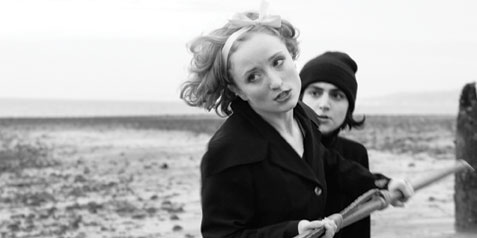
The silent film continues as a valid art form, particularly in the hands of the Canadian Guy Maddin, who has made silent film his natural mode of expression. His latest film is Brand upon the Brain, which is playing (with live music ensemble) at the San Francisco International Film Festival on May 7. The festival site describes it:

The semiautobiographical Brand upon the Brain! mines the rich territories of director Guy Maddin’s youth and spins them into a delirious fantasy of familial discontent. At the edge of the sea stands a lighthouse, once the location of an orphanage. There, some years ago, lived Guy and Sis, a brother and sister under the constant observation of their mother yet entirely ignored by their father, an ingenious inventor. When Wendy Hale, amateur harpist and half of twin detective team the Lightbulb Kids, arrives to investigate a mysterious regenerative nectar harvested from the orphans, things grow ever more complicated. A love triangle becomes a quadrangle when Wendy masquerades as her brother Chance and goes in search of clues. A fever dream of Freudian impulses and horror show theatrics, Maddin devours 100 years of film history whole and, like the ersatz Guy’s painting of the lighthouse, covers the screen with a 12-chapter outpouring of his various obsessions.

There’s a trailer for the film on the festival site which gives a good flavour of Maddin’s distinctive style and take on cinema history.

How to Run a Picture Theatre – part 5

I’m running this series taken from the 1910 [correction – probably 1912] publication How to Run a Picture Theatre, which eventually I’ll put up all together in a new Texts section. Anyway, having taken care of the exterior, foyer and auditorium, now you need to think about your projectionist. Note the fire precautions, but also the need to install a stereopticon, or lantern slide projector, for advertisements, in-house announcements and sing-a-long slides:

The Operating Chamber. The operating chamber is, of course, subject to very stringent regulations by the authorities which appear in an index to this work …

There should be three traps, one each for the projector, the stereopticon, and the look-out in preference to a larger trap permitting all three. If two machines are used, the number of traps is increased …

A bucket of sand and a wet blanket must always be kept in the operating room for fire extinguishing purposes …

Allow reasonably ample room and make the operator comfortable. A high stool with a comfortable back is a necessity rather than a luxury. If the chair induces the operator to loaf, get rid of the operator, but retain the chair …

It is best to provide two machines, using them alternately, and then if one breaks down, there is a second to run on, until the other is repaired. The assistant operator, too, is always handy in rewinding the films, because if there is only one operator who has to divide his time between projecting and rewinding, both tasks will suffer.

Next up, choosing your staff.

Gary Lucas plays The Golem


Just to show that jazz and rock musicians can come up with effective scores for silent films, here’s another great favourite of mine, jazz/experimental guitarist Gary Lucas, accompanying Der Golem (1920), which tells of a rabbi in medieval Prague creating a clay monster to save the Jews of the ghetto from annihilation. The score is by Lucas and Walter Horn, and Lucas’ interest in Jewish themes clearly informs his intense reading in this five minute extract.

Find out more about the music and the screenings that have taken place from Lucas’ website, which includes further sound extracts.

Dave Douglas and Keystone

Keystone

In 2005 the jazz trumpeter Dave Douglas released a CD, Keystone, which had music inspired by and designed to accompany the films of Roscoe ‘Fatty’ Arbuckle. The CD comes with a DVD featuring Fatty and Mabel Adrift (1916) and ‘vignettes’ from Fatty’s Tin-Type Tangle (1915), with Douglas’ scores. I’m a big fan of his music, but though it is excellent its own, to be frank I thought it was a singularly insensitive attempt at accompanying silent film. It is always encouraging when rock or jazz musicians take an interest in silents and attempt a score, but too often they think that the film is accompanying them, when they need to be subservient to the screen – as any good silent film pianist will tell you.

That said, Douglas’ music is great of itself and the effort is to be applauded. And so, starting tonight at the Iridium in New York City, Dave Douglas and his Keystone band will be touring with a programme of modern jazz and early American silent film. According to the record company website, “each set will will consist of new pieces composed since the release of their Grammy-nominated recording, Keystone, on Douglas’ own Greenleaf Music label. The band will also reprise music heard on that release and perform along with short silent film comedies from the works of Roscoe Arbuckle, unfairly maligned director and star of the early film era. This will be a passionate and humorous evening of music and film.”

These are the dates for the rest of the tour:
04-22: Geneva, Switzerland – Alhambra
04-23: Paris, France – New Morning
04-25: Brno, Czech Republic
04-26: Basel, Switzerland
04-28: Stockholm, Sweden – Fasching Club
04-30: Malmo, Sweden – Jazz in Malmo
05-01: Koln, Germany – Kolner Philharmonie
05-02: Amsterdam, Netherlands – Bimhuis
05-04: Bray, Ireland – Improvised Music Company
05-05: Liege, Belgium – ASBL Jazz a Liege
05-06: Katowice, Poland – Gornoslaskie Centrum Kultury

You can hear audio file extracts from Keystone at allmusic.com.

Edwardian hoodies

edwardians.jpg

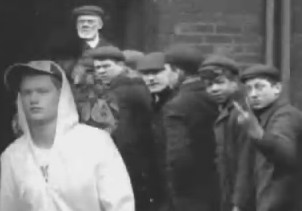
Anyone watching BBC television at the moment will have seen the trailer for the BBC4 Edwardians season. The trailer uses footage from the now renowned Mitchell and Kenyon collection of mostly actuality films of life in nothern England 1900-1914, digitially treated to mix the people of Edwardian times with such modern figures as a pizza delivery motorbike, a ‘golf sale’ signboard, rock concert fans, a policeman with a gun, and a hoodie. So of course they’re just like us and we’re just like them. You can see the trailer here (click on ‘Watch the season trail’).

Update – For all those who have been looking, the music that accompanies the trailer is Fashion Parade, by Misty’s Big Adventure. More details from the band’s MySpace site.

Minds, Bodies, Machines

This interdisciplinary conference is convened by Birkbeck’s Centre for Nineteenth-Century Studies, University of London, in partnership with the Department of English, University of Melbourne, and software developers Constraint Technologies International (CTI). It takes place 6-7 July 2007 at Birkbeck College, Malet Street, Bloomsbury.

The two-day conference will explore the relationship between minds, bodies and machines in the long nineteenth century. Its aim is “to explore the continuities and discontinuities in the imagining of the human/machine interface in the nineteenth and twenty-first centuries.” Topics include: the virtual and the real; technologies of the sublime; evolution and machines; techniques of communication; technologies of travel; medical technology; miniaturisation; self-reproduction; and spiritualism. So, not strictly about motion pictures, but much more needs to be done to introduce film into Victorian studies (after all, the Victorians invented it).

More information from the conference website.

The first edited motion picture?

chase001.jpg

Hot news from the Who’s Who of Victorian Cinema site. The researches of Eadweard Muybridge scholar Stephen Herbert have come up with evidence for Muybridge to have been the first person to present an edited motion picture, in 1881. This is long before ‘film’ as we know it, but Muybridge’s Zoopraxiscope machine projected silhouette images taken from his sequence photographs, painted around the edge of a glass disk. Anyway, here’s the news report:

It now seems confirmed that there was a screening of some newly-produced Zoopraxiscope glass plates in San Francisco in the Spring of 1881, one of which features sequential actions: perhaps the first ‘edited’ motion picture informed by the camera – meticulously painted images based closely on photographic sequences to create a succession of different ‘shots’; and for dramatic effect. A May 1881 report in the San Francisco Post described this as: “a deerhunt, where a deer, followed successfully [successively?] by dogs and horsemen, traverses over the illuminated screen”. The report says these new subjects “can now be illustrated”. Stephen Herbert thinks it is reasonable to suppose they were all shown at this time, though it is just possible that the report is taken from a written submission by Muybridge. But even if it was, it is quite likely that he started using them in his shows. Most of the subjects described in the report survive, including the little-known ‘three-shot’ motion picture Deerhunt. More details can be found on the Eadweard Muybridge Chronology (1881, May 16 entry).

So maybe the first ‘movie’ was an animated scene of a deer hunt made in 1881, when the Lumiere brothers were still in short trousers (practically). Or perhaps we need to be very careful about our terminology and not describe such a phenomenon with the language of a later medium. ‘Pre-cinema’ (unfortunate term) was not about anticipating cinema, as such, but existed of itself. Nevertheless, it is fun to make the comparison…

Remembrance of bioscopes past

Every now and again I trace the etymology and use of the word ‘bioscope‘. Here ‘s a passage from Marcel Proust’s A la recherche du temps perdu, from the Overture to the first book, Swann’s Way:

These shifting and confused gusts of memory never lasted for more than a few seconds; it often happened that, in my spell of uncertainty as to where I was, I did not distinguish the successive theories of which that uncertainty was composed any more than, when we watch a horse running, we isolate the successive positions of its body as they appear upon a bioscope.

That’s the C.K. Scott Moncrieff translation, though the Terence Kilmartin one is much the same. It’s interesting to view this with knowledge of Muybridge‘s sequence photographs of a horse galloping (which Proust must have known about) which broke up motion into isolated images, whereas Proust sees the way that film captures motion as now hiding the same mystery. Has anyone written about Muybridge and Proust?

While we’re here, just a little further down the chapter, there is this renowned passage on the magic lantern, a little lengthy, but worth quoting in full (again, from the Scott Moncrieff translation):

At Combray, as every afternoon ended, long before the time when I should have to go up to bed, and to lie there, unsleeping, far from my mother and grandmother, my bedroom became the fixed point on which my melancholy and anxious thoughts were centred. Some one had had the happy idea of giving me, to distract me on evenings when I seemed abnormally wretched, a magic lantern, which used to be set on top of my lamp while we waited for dinner-time to come: in the manner of the master-builders and glass-painters of gothic days it substituted for the opaqueness of my walls an impalpable iridescence, supernatural phenomena of many colours, in which legends were depicted, as on a shifting and transitory window. But my sorrows were only increased, because this change of lighting destroyed, as nothing else could have done, the customary impression I had formed of my room, thanks to which the room itself, but for the torture of having to go to bed in it, had become quite endurable. For now I no longer recognised it, and I became uneasy, as though I were in a room in some hotel or furnished lodging, in a place where I had just arrived, by train, for the first time.

Riding at a jerky trot, Golo, his mind filled with an infamous design, issued from the little three-cornered forest which dyed dark-green the slope of a convenient hill, and advanced by leaps and bounds towards the castle of poor Geneviève de Brabant. This castle was cut off short by a curved line which was in fact the circumference of one of the transparent ovals in the slides which were pushed into position through a slot in the lantern. It was only the wing of a castle, and in front of it stretched a moor on which Geneviève stood, lost in contemplation, wearing a blue girdle. The castle and the moor were yellow, but I could tell their colour without waiting to see them, for before the slides made their appearance the old-gold sonorous name of Brabant had given me an unmistakable clue. Golo stopped for a moment and listened sadly to the little speech read aloud by my great-aunt, which he seemed perfectly to understand, for he modified his attitude with a docility not devoid of a degree of majesty, so as to conform to the indications given in the text; then he rode away at the same jerky trot. And nothing could arrest his slow progress. If the lantern were moved I could still distinguish Golo’s horse advancing across the window-curtains, swelling out with their curves and diving into their folds. The body of Golo himself, being of the same supernatural substance as his steed’s, overcame all material obstacles—everything that seemed to bar his way—by taking each as it might be a skeleton and embodying it in himself: the door-handle, for instance, over which, adapting itself at once, would float invincibly his red cloak or his pale face, never losing its nobility or its melancholy, never shewing any sign of trouble at such a transubstantiation.

And, indeed, I found plenty of charm in these bright projections, which seemed to have come straight out of a Merovingian past, and to shed around me the reflections of such ancient history. But I cannot express the discomfort I felt at such an intrusion of mystery and beauty into a room which I had succeeded in filling with my own personality until I thought no more of the room than of myself. The anaesthetic effect of custom being destroyed, I would begin to think and to feel very melancholy things. The door-handle of my room, which was different to me from all the other doorhandles in the world, inasmuch as it seemed to open of its own accord and without my having to turn it, so unconscious had its manipulation become; lo and behold, it was now an astral body for Golo. And as soon as the dinner-bell rang I would run down to the dining-room, where the big hanging lamp, ignorant of Golo and Bluebeard but well acquainted with my family and the dish of stewed beef, shed the same light as on every other evening; and I would fall into the arms of my mother, whom the misfortunes of Geneviève de Brabant had made all the dearer to me, just as the crimes of Golo had driven me to a more than ordinarily scrupulous examination of my own conscience.

I know much has been written about Proust and the magic lantern, but does anyone know if he is writing about a specific set of lantern slides, and do these survive?
Award for Kevin Brownlow

The San Francisco International Film Festival is to present Kevin Brownlow with the Mel Novikoff Award. The award, named after the pioneering San Francisco film exhibitor (1922–1987), is bestowed annually on an individual or institution whose work has enhanced the filmgoing public’s knowledge and appreciation of world cinema. The award will be presented to Brownlow on Saturday 28 April at the Castro Theatre, together with a screening of his restoration of The Man in the Iron Mask (1929 d. Allan Dwan), starring Douglas Fairbanks.

The festival website has a fine tribute to Brownlow, ‘The Silent Spokesman’, giving an overview of his achievements in the promotion of the art of silent film, written by Dennis Doros of Milestone Films.