Publisher’s blurb

http://easyweb.easynet.co.uk/~s-herbert/ProjectionBox.htm

Small publishers producing works on film and film-related subjects are a rare breed, and it is good to be able to report the return of The Projection Box, the enterprising Hastings business run by Stephen Herbert and Mo Heard. After “a period of slumber”, as their site puts it, they have returned with a new title, The Dickens Daguerreotype Portraits, by Herbert himself, and a new publishing strategy. They are using Blurb, the online print-on-demand service which is attracting a lot of interest from self-publishers and those just looking for alternative publishing options.

The first three titles to be available in this way are The Dickens Daguerreotype Portraits, a history of the very few daguerreotype portraits of Charles Dickens, and the single known daguerreotype portrait of his wife Catherine, well-timed for the bicentenary celebrations next year; the previously published The Kinora: motion pictures for the home, 1896-1914, by Barry Anthony, in a new extended version which includes a reprint of the Bond’s Ltd. 1911 Catalogue of Living Pictures that your may show in your own home; and also previously published, a facsimile of 1890 account of a famous Victorian optical illusion, The True History of the Ghost by ‘Professor’ John Henry Pepper, with an introduction by Mervyn Heard.

Other titles from The Projection Box back catalogue will be made available in this way in due course. These can still be ordered direct from The Projection Box in the traditional away, along with their CD publications and The Magic Lantern Society (UK) titles. The full list is (with prices):

  • Eadweard Muybridge: the Kingston Museum Bequest, eds. Ann McCormack and Stephen Herbert
    GB Pounds: 30.00 p&p 4.50
    US dollars: 48.00, shipping US dollars 19.00
  • The Encyclopaedia of the Magic Lantern, eds: Richard Crangle, Stephen Herbert, David Robinson
    GB Pounds: 45.00 p&p 9.50
    US dollars: 70.00, shipping US dollars 40.00
  • For Ladies Only? Eve’s Film Review: Pathe Cinemagazine 1921-33, by Jenny Hammerton
    GB Pounds: 9.00 p&p 2.50
    US dollars: 14.00, shipping US dollars 10.00
  • From Frontiersman to Film-maker. The Biography of Film Pioneer Birt Acres, by Alan Birt Acres
    [details of CD-ROM to follow]
  • The Illustrated Bamforth Slide Catalogue – DVD-ROM
    GB Pounds: 25.00 p&p 1.50
    US dollars: 40.00, shipping US dollars 7.00
  • The Incomparable Testot! Selections from a 19th Century Magician’s Paragraph Boo – Introduced by Edwin A. Dawes
    GB Pounds: 9.00 p&p 2.00
    US dollars: 14.00, shipping US dollars 6.00
  • Industry, Liberty and a Vision: Wordsworth Donisthorpe’s Kinesigraph, by Stephen Herbert
    GB Pounds: 25.00 p&p 1.50
    US dollars: 40.00, shipping US dollars 7.00
  • The Lantern Image: Supplement No. 1, compiled by David Robinson
    GB Pounds: 4.00 p&p 2.50
    US dollars: 7.00, shipping US dollars 7.00
  • New Magic Lantern Journal – Volume 6
    GB Pounds: 25.00 p&p 1.50
    US dollars: 40.00, shipping US dollars 7.00
  • New Magic Lantern Journal – Volume 7
    GB Pounds: 25.00 p&p 1.50
    US dollars: 40.00, shipping US dollars 7.00
  • Phantasmagoria: the secret life of the magic lantern, by Mervyn Heard
    GB Pounds: 25.00 p&p 4.50
    US dollars: 40.00, shipping US dollars 7.00
  • Realms of Light: Uses and Perceptions of the Magic Lantern from the 17th to the 21st Century, edited by Richard Crangle, Mervyn Heard and Ine van Dooren
    GB Pounds: 35.00 p&p 9.50
    US dollars: 62.00, shipping US dollars 28.00
  • Servants of Light, ed. Richard Franklin and Stephen Herbert
    GB Pounds: 20.00 p&p 3.50
    US dollars: 30.00, shipping US dollars 16.00
  • Theodore Brown’s Magic Pictures: the art and inventions of a multi-media pioneer, by Stephen Herbert
    GB Pounds: 25.00 p&p 1.50
    US dollars: 40.00, shipping US dollars 7.00
  • The Titanic and Silent Cinema, by Stephen Bottomore
    GB Pounds: 11.00 p&p 3.00
    US dollars: 18.00, shipping US dollars 10.00
  • Victorian Film Catalogues, ed. Stephen Herbert
    GB Pounds: 5.00 p&p 2.00
    US dollars: 8.00, shipping US dollars 6.00
  • When the Movies Began: a chronology of the world’s first film shows, by Stephen Herbert
    GB Pounds: 3.00 p&p 1.00
    US dollars: 40.00, shipping US dollars 7.00
  • A Yank in Britain: The Lost Memoirs of Charles Urban, Film Pioneer, ed. by Luke McKernan
    GB Pounds: 25.00 p&p 1.50
    US dollars: 40.00, shipping US dollars 7.00

Further details of all titles are available on The Projection Box website. And welcome back.

Pordenone diary 2011 – day five

The Film Fair at the Giornate del Cinema Muto, Pordenone

I left for home at the start of the fifth day of the Giornate del Cinema Muto, but happily Bioscope coverage of the rest of the silent film festival was ensured by our regular co-reporter on these occasions, the Mysterious X. Despite our pleas, X prefers to stay anonymous, but though X may be hidden in the shadows, they are – I think you will agree – as observant and informative as always. Take it away, mysterious one …


In at 9.00 am – that’s my strategy, start early and watch ’til I drop – for Das Spreewaldmädel (The Girl From The Spree Woods) from the long-term Steinhoff Project, bringing Hans Steinhoff’s silent work back from obscurity. This year’s instalment was a rather delightful rural comedy, about a farmer’s fiancée being distracted by a handsome young officer billetted with them in 1910s Germany. It did suffer from mid-film longeuers, but elsewhere, and in the final sequences in particular, with the farmer rushing through the wedding ceremony before the expected arrival of the Officer, the action was slickly handled, and with a light comic touch. I found it fascinating, but not entirely surprising, that Germany too in the 1920s had a pre-lapsarian view of pre-war rural life, just as was reflected in British culture of the time, and since.

The second Corrick Collection programme was preceded by a rerun of The Soldier’s Courtship (UK 1896) and then started with a fine series of Niagara Falls travelogue shorts from 1906. Le Piege A Loup (The Wolf Trap) (France 1906) was a comedy featuring a man caught in a wolf (think bear) trap while his son, supposedly summoning help, plays with his friends instead.San Francisco and San Francisco Disaster (USA 1906) were two actuality films effectively acting as before-and-after scenes of the earthquake-hit city. Still dramatic and thought provoking after all this time. Great Steeple-Chase (France 1905) seems to be a rather fine film record of the 1905 running of the Grande Steeple-Chase de Paris, at Auteuil Hippodrome. Using a framing device of a family attending the racing, seeing (through a binocular-shaped camera mask) and being seen, thus making the social status of the event obvious. They place a bet at the Pari-Mutuel (French Tote) windows before watching the race and awaiting the posting of the result. The race coverage itself is of excellent technical quality – I lost count of the number of different camera positions used, stationed at the more spectacular jumps at the eye-level of the spectators, and right on the edge of the course; indeed a nasty- looking multiple fall threatens the camera at one point, the camera continues to film as the horses regain their feet and continue, remounted. The immediacy is striking, as is its modernity. I have not seen better film footage of horseracing prior to the 1980s. A real document.

The Watermelon Patch (USA 1905) – as seen a couple of years previously in a different context – remains controversial, and uncomfortable viewing. Yes, it does feature pioneering editing techniques, and a delicious sequence of celebratory dancing from the black cast – but otherwise it’s a compendium of racial slurs and stereotypes, so while it can be filed under “Historically Interesting” I don’t particularly want to see it a third time. La Course a la Perroque (The Wig Hunt) (France 1906) is the sister film to Le Coup De Vent seen in the first programme; in that, the chase is that of a man after his hat; in this, an old woman (well, a man in drag) is trying to retrieve his/her wig after boys have attached balloons to it.

Jeux Olympiques d’Athènes (Fr 1906) was coverage from the 1906 non-canonical event, on the tenth anniversary of the revival of the Olympic Games. The film is disappointingly ambivalent as to whether we are watching actual competition or display events for the opening ceremony; it may be a mix of both, of course; the film is framed by the arrival and departure of the Greek royal family; there is a display of mass gymnastics as seen in most opening ceremonies; but the high hurdles race looked competitive enough, as did the tug of war. Which leaves us to wonder; were there medals awarded in 1906 for Synchronised Penny-Farthing Riding? Six gentleman, in a pseudo-military team uniform, conducting a routine reminiscent of the Horse Artillery at the Royal Tattoo. Or Busby Berkely. It was their total dignity that made it hilarious … call Lord Coe, it may not be too late for next year …

Voleurs de Bijoux Mystifés (Jewel Robbers Mystified) (France 1905) was a nice semi-comic crime film, with a jewel theft going wrong and unofficial retribution being meted out. As an added bonus a close-up of the opened jewel box is hand coloured for extra spectacle. [Travel Scenes] and [Procession of Boats on River, Burma?] (UK c.1905) are tentatively-identified as Charles Urban films of river events in the Far East. Views of The Empire in full swing are always interesting, if uncomfortable viewing; here Europeans on a palatial pontoon are towed along a major river by a giant catamaran powered by dozens of natives. (Procession of Boats on River., Burma was shown as part of last year’s Pordenone Corrick programme – ed.)

Ohé! Ohé! Remouler (Hey, Hey, Grinder) (France 1906) was another French chase comedy, but a bit different and rather fun. A housewife wants her rather large carving knife sharpened by a passing travelling knifegrinder; her neighbours misinterpret her shouting and knifewaving as something more sinister, and try to chase her down and disarm her before she kills someone … Finally, La Fée aux Fleurs (The Flower Fairy) (France 1905) was a particularly good example of the coloured-flowers-and -pretty-girls-tableaux genre so popular at this date … Segundo Chomón for Pathé in this case.

Henny Porten in Hintertreppe (Germany 1921), from MOMA.org

But enough of this fun and beauty; time for Hintertreppe (Backstairs) (Germany 1921), part of The Canon Revisited. An expressionist take on intimate drama, Henny Porten stars in (and produced) this vehicle designed to broaden her career into Art and out of the typecasting she was already subject to. She plays an ordinary housemaid embarking on an affair while being obsessed over by the local postman. The lover disappears; she writes, gets no reply – apparently, according to the catalogue notes, the postman had intercepted her outgoing post, though that was not obvious onscreen. When eventually she despairs, the postman forges loving replies, which surely makes no sense, but hey … it doesn’t end well for anyone, which may be no surprise, and the film was no success either. Henny went back to her lucrative and popular Hausfrau roles and left Expressionism to the cast and crew – Kortner, Leni and Mayer. Frankly, I can’t blame her; it must have been as much fun to play as it was to watch, and she was essentially paying the bills. Incidentally, this was restored from an English print, with added intertitles for plot clarification (which didn’t help much) and possibly the most condescending introduction in silent film history; “Remember, these people are not like us; their bodies are adult but their emotions and behaviour are as those of children” or words to that effect.

After lunch, more from Soviet Russia’s FEKS studio group, and S.V.D. – Soyuz Veligovo Dela (The Club of the Great Deed) (USSR 1927), a costume drama celebrating the 1820s Decembrist uprising fomented by a cadre of young army officers. A story of idealism, betrayal and mystery, it was highly atmospheric with large sequences set in blizzard-whipped forests at night, gambling dens and circuses. Far more accessible than The Overcoat, possibly because the expressionism had been turned down a couple of notches, and what remained worked with, rather than against, the tale it was telling.

Eric Lange (left) and Serge Bromberg (with David Robinson between them) introducing La Voyage dans la lune on day four

Over to the smaller, and therefore packed Auditorium Regionale while the night’s orchestra rehearsed in the Verdi, for this year’s Jonathan Dennis Lecture, presented by Serge Bromberg and Eric Lange of Lobster Films, on the subject of the Voyage dans la lune restoration.

Serge is a natural showman, always engaging and witty, but for once Eric emerged from his self-imposed (relative) silence; he speaks English! He too has a great sense of humour! Needless to say, the documentary Lobster are making on the restoration will not be entirely serious in tone – it was used as a source of illustrative material for the lecture, it is not yet finished – and Serge and Eric took us through the painstaking process of rescuing this unique print from the brink of death, and the ethical/philosophical choices made regarding the balance between restoration and recreation in that rescue. And also best guesses as to how the print came into being; on Edison format so prior to 1905/6; made for the Spanish market (not just that it turned up in the Catalunya Archive, but it had been given a Spanish rather than French tricolor); but the quality of the hand colouring suggests that it could only have been achieved at a top-quality French atelier, made for export. A fascinating hour-and-a-half, and I look forward to the documentary/film package when it is finished and released.

The evening show will be long remembered; the longest queue in Giornate history I suspect, trailing all the way back to the Banco Friuladria on the other side of the town square, and which must have started forming a good hour before the doors opening time. The event was ticket only, but with unallocated seating, and standing room only at that. I know the logistics are tricky, and that Mr Urbanora has expressed his opinion on allocated seating, but there has to be a better way … So, who was the queue honouring? That chap with the bowler and cane, still packing ’em in, 90 years on.

So, no pressure then on the 21st Century silent that preceded it (the rediscovered 60 seconds of Greta Garbo kissing an unimpressed-looking Lars Hanson in The Divine Woman (USA 1928) looked after itself) … We had sat through a couple of 21st Century Silents earlier in the week; both had a couple of nice ideas in them, and they were competently filmed, but I’m thinking of drafting legislation along the lines that, unless you’ve spent your years since childhood honing your physical comedy skills onstage, you will not be allowed to homage/imitate/try to be Chaplin or Keaton in front of a video camera on pain of death. And it’s cruel to the filmmakers too … you could see the silent tumbleweed rolling across the Verdi stage …

Fortunately, in a masterpiece of programming, on this packed and prestigious night, the choice was not a physical comedy from a film student, but The Force That Through The Green Fire Fuels The Flower (UK 2011), a fully mature, bittersweet portrait of warm love grown cool, with a hint of redemption at the end. 8 minutes of beautifully composed images, in monochrome but set in today’s world, cleverly placed words in the film in lieu of traditional intertitles, telling a simple story with great sensitivity. A true 21st Century silent, and an instant classic modern short. Take a bow Otto Kylmälä , a British-based Finn who attended the Collegium last year. Kudos too to Stephen Horne’s live rendition of the score he recorded for the film’s soundtrack, and to Mr Urbanora who flagged the film here some time ago.

Charlie Chaplin and Merna Kennedy in The Circus (USA 1928), from mubi.com

And so to the main event, The Circus (USA 1928); Chaplin’s score, but played live by the Orchestra San Marco Pordenone, conducted by Günter Buchwald. Both did an outstanding job, once we had allowed Sir Charles to sing his theme song at the beginning. I won’t go on, as it should be a familiar enough film to you readers, but to say that, again, on a big screen with a live orchestra, and a large public audience, it still wins new converts, reiterates our admiration and just gives us a nudge that, yes, silent films still engage with the general public when the public are given the right opportunity. The reception was tremendous.

The late film – follow that!! – was Khabarda (Out of The Way) (Georgia SSR, 1931) and it pulled it off, with Donald Sosin’s fine assistance. Unlike other entries from the Georgian strand I saw, this was deeply satirical and utterly surreal at times – if culturally and politically deeply suspect.

The film tells of a poor, ramshackle Georgian city neighbourhood physically endangered by, and its development hampered by, the presence of an ancient-looking, crumbling church. A heroic member of the proletariat starts to demolish it by hand, while religious, elderly peasantry and bourgeouis intellectuals unite to stop him. They appeal to the authorities, but they were planning a redevelopment anyway; so a campaign along regional historical/cultural lines start … and the satire starts as successive pleas take the campaigners to a venerable man celebrating forty years as a social reformer – though when pressed, he cannot answer what precisely he had achieved. As successive historians are brought in the church gets progressively more ancient until a date of 300 AD is reached; a funeral ceremony is held for the old man (he isn’t actually dead) which includes cakewalking and shimmying patriarchs, and shades of Entr’Acte and much laughter. Eventually the church is revealed as being a Victorian fake …

Although the idea of demolishing the old to make way for the new is intrinsically anathema to fans of old films, and this film was at the vanguard of Stalin’s take on the Cultural Revolution, the film can be enjoyed in isolation if you temporarily ignore the message and the context. It’s technically well-made propaganda, a message delivered with skill, craft and with real verve and energy. Pity about the baggage it carries.

All told, the day of the festival thus far.


Stay tuned for the Mysterious X’s view of day six, when we shall encounter the Antarctic wastes (again), swordfighting Chechens, the wheatfields of Alberta, and the sounds of Denmark.

Pordenone diary 2011 – day one
Pordenone diary 2011 – day two
Pordenone diary 2011 – day three
Pordenone diary 2011 – day four
Pordenone diary 2011 – day six
Pordenone diary 2011 – day seven
Pordenone diary 2011 – day eight

Pordenone diary 2011 – day four

Audience in the Teatro Verdi awaiting the screening of Le Voyage dans la lune in colour, David Robinson (far right) introducing

The days go by, as they tend to do, and here I am on my last day in Pordenone, with the Giornate del Cinema Muto only halfway through. Never fear, there is cover organised, and for the four remaining days you will be getting reports from the Bioscope’s anonymous but observant and eloquent co-reporter, the Mysterious X. But it is Tuesday 4 October, and I am up with the lark once more, ready as soon as the doors of the Verdi opening for our first films films of the day – and what a marvellous start it is.

We begin, as we have each day, with a Disney Laugh-o-Gram. Puss in Boots (USA 1922) is great fun, never more so than when Puss goes to the cinema to see ‘Rudolph Vaselino’. It is filmed with zip and zest and a gag in every shot, though somebody should have told Walt that he had used the joke about eight of a cat’s lives floating up from its prone body a few times too often – it’s the third time we’ve seen it this week.

Next, two films in the Treasures of the West strand, both of them gems. Deschutes Driftwood (USA 1916) is an Educational Films production from the time when they made educational film, not the comedies for which they later became famous. The film follows a hobo (‘Walter’) as he travels along the Deschutes river, Oregon, hoping from train to train as a succession of authorities move him on. It is half a scenic (a phantom ride from a tramp’s point of view) and half a melancholy disquisition on a rootless life. It seems informed by a sensibility years ahead of its time, even if it is not strictly sympathetic towards its stubborn hero. Stephen Horne gives a sensitive accompaniment on piano an accordion, and this wistful, unexpected 11-minute film is for me the hit of the festival so far.

Or at least until the next film to be shown. Now, if you are introducing someone to the delights of the silent cinema for the first time, what would you encourage them to see? Metropolis, maybe? Pandora’s Box or The General probably. Well it’s always good to see a classic, but somehow classics stand alone and tell you more about themselves than they do about the medium to which they belong. If I were introducing someone to silents, I might prefer a film of more modest ambition, but one which nevertheless demonstrates through subtle artistry a particular understanding of human things, one that shows off the medium to its greater advantage. A film such as The Lady of the Dugout (USA 1918).

The Lady of the Dugout, with (L-R) Frank Jennings, Al Jennings, Corinne Grant and Ben Alexander, from http://www.filmpreservation.org

The Lady of the Dugout was produced, co-written by and stars Al Jennings, a sometime small-town lawyer, turned outlaw, turned evangelist (after a spell in prison and a presidential pardon). The film documents a tale from his time as an outlaw, heading the Jennings gang alongside his brother Frank (who like Al plays himself in the film) in the late 1890s. It’s a Robin Hood-style story, in which the Jennings brothers come across a deserted wife and child in a wretched dugout home (literally a hole in the ground with a roof over it), living in the middle of nowhere and without food. They come to her rescue (using money from one of their robberies), then when her brutal husband returns they take her to her middle-class family home, where her once unforgiving father now takes her back.

The story is engrossing, and the insight it gives into a frontier life where dreams have turned sour is a special one. There is an authenticity in locale, in the weatherbeaten looks of the Jennings brothers, in the action (a particularly convincing, almost matter-of-fact bank robbery), in manner and in human feeling. The film develops not out of the demands of story but out of circumstance, character and a true moral sense. The director was W.S. Van Dyke, and I can’t think of a better-handled silent film. It’s low-key, it doesn’t touch on any grand themes (though forgiveness, which is what it is ultimately about, is a noble theme), but it is about things that matter and people that we care for. You feel that nothing stood in the way of the filmmakers being able to tell the story exactly in the way that they wanted to (its sympathetic view of the outlaw life is extraordinary). It’s hard to believe that a film of such easy naturalism was made only four years after The Birth of a Nation. Only an over-cute child, and for this screening a poor quality DVD-R after the DigiBeta wouldn’t play, let things down. It’s on the new Treasures of the West DVD – please see it.

We return to The Canon Revisited, the strand of silent classics that the Giornate feels we need to see again to see how well they stand up in modern times, but which many of us are not too sure we’d ever heard of. Certainly one senses few in the audience could tell you much about director Fridrikh Ermler and would have to confess that they are seeing Oblomok Imperii (Fragment of an Empire) (USSR 1929) for the first time. Few would deny its position of greatness by the end of it, however. This is quite an extraordinary film. Its subject is a shell-shocked soldier, Filimonov (mesmerisingly played with wide-eyed puzzlement by Fedor Nikitin), who loses his memory at the end of the First World War, gradually regaining it four years later, when he discovers a very different country to the one he thought he knew. The buildings have changed, manners have changed, most significantly there are now no masters – he, like everyone else, is the master now.

Except that things are not quite like that, and this is where the film’s startling satirical power lies. Filimonov embraces socialism, but finds that many in this so-called new society have not given up on the old, bad ways, in particular the party apparatchik who has married Filimonov’s wife. Ermler recognises the private face of the USSR behind the public facade, and that all is not yet well, or as some would have things be, because people will be people. Ultimately the film is conflicted in the lessons it wants to draw from Filimonov’s experience, the eye for truth coming up against idealism and ideology. It is dispiriting when Filimonov, whom we have come to like greatly, turns to the camera at the end of the film and says (through intertitles), “No, it is not the end – there’s a great deal yet to be done, comrades”. Of course it is the only ending that could be expected, given the political climate, but the film has shown a much more interesting and plausible world, and it is remarkable that he was allowed to do so as much as he did. A few years later, there would have been no chance of anyone making such a questioning piece of cinema.

The film is technically dazzling, particularly some hallucinatory flashbacks, including a war scene where Filimonov encounters a German soldier played by the same actor. The opening is particularly arresting – a soldier lying close to death amid typhoid-ridden corpses, desperate to quench his thirst, sees a nearby dog with her puppies, is suckled by the dog, then someone comes up and shoots the dog, before Filimonov rescues the soldier (whom he meets later in the film). This traumatic scenario is recalled throughout the film. It is impressions like these of the past that continue to haunt the USSR, Ermler seems to be suggesting. Society may think of utopias, but the mind has other ideas.

Praise, by the way, is due to John Sweeney for his spirited accompaniment, in particular a moment of sheer genius when a balaika band appeared on screen (John not having seen the film beforehand) and he instantly produces the sounds of balaikas on the piano. We really are blessed at Pordenone by some outstandingly skilled, imaginative musicians.

Collegium audience learning about The Soldier’s Courtship

I head to join the Collegium, a sort of school for budding film archivists and scholars which the festival hosts. In practice this means a series of presentations relating to films and themes from the festival. I’m here to see the presentation by the Cineteca Nazionale and restoration specilaists Omnimago on The Soldier’s Courtship, the 1896 British film we saw yesterday. this is a fascinating mixture of historical investigation and technical exposition. The film has been held by the Cineteca for many years under a generic title and was only identified recently. At 80ft it is double the legnth of a standard Robert Paul film of the period, and Paul had problems showing it initially as his projector could not cope. Paul’s catalogue offers the film in two parts, though it is hard to say where the join could have been. As well as the 35mm film they held, the restorers also made use of the fragment from the film held by the National Media Museum in Bradford and a Filoscope flipbook of the film. There were signs of retouching in the print, possibly done in 1900, and there was further retouching done for the digital restoration, where damaged sections were papered over by clean sections from other frames (they wonder out loud whether they have over-restored to some degree – the purists might have been reassured by the sight of more blotches). One wishes Paul could have seen the extraordinary lengths to which we can now go to return a one-minute film to pristine state – electron microscope analysis, Diamant software, SCANITY film processing, Photoshop treatment of individual frames. We can make the past look so much better, the further in time we retreat from it.

I miss the afternoon’s screenings of Thanhouser films, being preoccupied by work matters (from which there is never any real escape) but fortunately I have notes from The Mysterious X, who was there, and reports thus:

First up post-lunch was a session of Thanhouser films, curated and presented by Ned Thanhouser, starting with four one-reelers: Uncle’s Namesakes (USA 1913) was a blast; a father of twin girls deceives their rich British-based uncle, who wanted the offspring to carry his name, into thinking they were twin boys; an inheritance is at stake. But Uncle rumbles the situation and decides to pay a visit … Petticoat Camp (USA 1912) was a delightful proto-feminist comedy over job demarcation on a camping holiday, and the strike and walkout that follows. An Elusive Diamond (USA 1914) was the tale of jewel thieves outwitted by the quick thinking of the young lady they target. Their One Love (USA 1915) was a US Civil War tale of twin girls whose childhood playmate grows up to go to war. David Copperfield (USA 1911) was a three-reel adaptation; based visually, as so many adaptations are, on the Phiz illustrations. It rolled along nicely, but suffered a little in comparisom to the slightly later, more energetic one-reelers.

I don’t know enough to say if these films are entirely representative of the Thanhouser output, or if Ned Thanhouser has (understandably) cherry-picked the very best of what survives; but if they are, or even close to it, what a studio that must have been. All the films featured excellent staging and use of locations, some finely sensitive acting – only slightly broad in the comedy; and notably good, involving roles for the women to get their teeth into. Their One Love featured a charming passage-of-time device; a calendar on a desk is not unusual … having a miniature becloaked Father Time walk onto the desk to rip pages off the calendar is a tad more ambitious. And the lighting and special effects used during the battle sequence were exceptional; not the epic spread of Griffith’s cast of thousands, but intelligent use of less generous resources to great result. Playing the piano for these was the always excellent Phil Carli, but here seeming absolutely in his element with these cracking little films. As always happens somewhen during the Giornate, I really feel the need to explore further; to the Thanhouser website on my return home.

Serge Bromberg of Lobster Films interviewed about the colour restoration of Georges Méliès’ Le Voyage dans la lune (“The Avatar of its day”), with clips from the film itself (without the Air soundtrack)

The evening show commences, and the theatre, with all four tiers full, is a-buzz with excitement. It is not the main feature that is causing such fervour, but the short that precedes it – the colour restoration of Georges Méliès’ La Voyage dans la lune (1902), undoubtedly the most familiar of all early films, now to be seen as none of us has seen it in a hundred years. Festival director David Robinson introduces Serge Bromberg and Eric Lange from Lobster Films, who have restored the film. Their plan is to make prints available in each of the major film archives around the world, while popularising their discovery by making it accessible to new audiences – people who “don’t know anything about anything”, in Bromberg’s somewhat unfortunate phrase. A significant element of the popularisation has been the decision to give the film a soundtrack written by vogue-ish French group Air, about which they seem a little ashamed and which Robinson introduces with apprehension, telling the audience (which is trembling in its seats in fear at this rude intrusion of the 21st century) that maybe they can screen the film later in the festival with traditional piano, which won’t upset anyone.

And then the film screening, and a pounding beat from the start probably comfirms the audience’s worst fears. Well, all I can say is that if silent films can’t stand up to 21st century treatment then there may be no good reason for continuing with them at all. And the Air soundtrack is a triumph. I don’t think I have heard a better modern accompaniment to a silent film. It is electro-pop with occasional diversions into odd noises, even background talk, with each scene given a different musical treatment, the musicians having noticeably picked up on various visual cues, such as the hammering of workmen when the rocket is being constructed. There is great variety, yet each element combines to make the harmonious whole, with a rousing stomp for the film’s triumphal finish that continues over the credits. The colour definition varies quite a bit throughout the film, but what comes over with great clarity is that this was always a film meant to be shown in colour – in truth, we haven’t seen Le Voyage dans la lune properly until now. Colour and music combine naturally to accentuate the film’s huge inventiveness. And David Robinson did have the good grace to say afterwards that he thought they’d actually made quite a good job of the music. Indeed they have. I hope it is enough to give the film the theatrical screenings that have been talked about (maybe accompanying Martin Scorsese’s Hugo, which features Méliès as a character?). It is a triumph in every degree.

OK, follow that. Well, what could? We do have Shinel (The Overcoat) (USSR 1926), another FEKS production from Grigori Kosintsev and Leonid Trauberg, a classic of sorts, though instead of Shostakovich’s music we get Maud Nelissen and trio playing her score to the film. I would happily listen to the music again, but not see the film again. Indeed for quite some time I listen only to the music and ignore the film entirely. Based on Gogol’s short story and avant garde in treatment, it goes on and on, seemingly without purpose. Why do people move and gesture with such meaningless slowness? What is the point of it all? When will anything happen of any significance? Why should we care? An old print does not help matters, and all in all this was a very odd choice for one of the prestige evening screening. Shinel feels lost to another age; Le Voyage dans la lune feels like it belongs to today.

The last film of the evening is Az utolsó hajnal (The Last Dawn) (Hungary 1917), directed by Michael Curtiz (as he would become). This was a pleasant surprise. I have been expecting something far cruder in technique and performance than that which we get. The film is sophisticated in performance and polished in technique, if wordy and frankly at times a bit above itself. It concerns a world-weary upper class man who decides to commit suicide, after insuring his life, to help a friend escape debts. The film makes something of a misjudgement when it moves to India (not an easy place to recreate in Hungary on a limited budget), then becomes intriguing when the man does indeed kill himself with the help of a mysterious Indian friend. This takes us greatly by surprise, but not nearly as much as when the Indian whips off his beard and reveals himself to be a relative of the man who appeared earlier in the film and who has actually ensured that the poison he has taken will not kill him. Much applause from the audience at a corny trick well executed. An enjoyable film, if a long long way away from Casablanca.

And that is Pordenone for me this year. I must return to London to deal with assorted pressing matters. I have enjoyed the Giornate, particularly the screenings today, though the feeling is (and others seem to share this) that it hasn’t quite hit the heights too often. Perhaps the Mysterious X, who takes over this diary for day five, will see things differently. We shall see.

Pordenone diary 2011 – day one
Pordenone diary 2011 – day two
Pordenone diary 2011 – day three
Pordenone diary 2011 – day five
Pordenone diary 2011 – day six
Pordenone diary 2011 – day seven
Pordenone diary 2011 – day eight

Somme on tour

The Philharmonia Orchestra playing to The Battle of the Somme at the Queen Elizabeth’s Hall, London, in 2006

Silent films going on tour with live orchestral accompaniment is not something that happens too often. So it is particularly pleasing to be able to report the forthcoming tour of The Battle of the Somme (1916), the iconic First World War documentary filmed by J.B. MacDowell and Geoffrey Malins, with orchestral score by Laura Rossi. Rossi’s exceptional music (the first scored for a British feature-length silent since the silent era itself) was first heard at the Queen Elizabeth’s Hall in London in 2006, and can now be found on the Imperial War Museum’s DVD release (the background to film and DVD can be explored further on this Bioscope post).

The tour dates are:

The music has been scored for (to quote from Rossi’s site) 2 Flute (2nd doubling Piccolo), 2 Oboe, 2 Clarinet in Bb, 2 Bassoon (2nd doubling Contra Bassoon), 4 Horns in F, 3 Trumpets in Bb, 3 Trombone, 1 Tuba, 1 Timpani/Percussion, 2 Percussion, Harp, Piano, Strings. You can listen to sound clips, view video clips, see a sample page from the score, purchase/download the CD or purchase the DVD, and more, all from this link on Rossi’s site.

Rossi’s press release says this about the film:

The Battle of the Somme remains one of the most successful British films ever made. It is estimated over 20 million tickets were sold in Great Britain in the first two months of release, and the film was distributed world-wide to demonstrate to allies and neutrals Britain’s commitment to the First World War … The Battle of the Somme gave its 1916 audience an unprecedented insight into the realities of trench warfare, controversially including the depiction of dead and wounded soldiers. It shows scenes of the build-up to the infantry offensive including the massive preliminary bombardment, coverage of the first day of the battle (the bloodiest single day in Britain’s military history) and depictions of the small gains and massive costs of the attack.

while the Bioscope has this to say about the film:

The Battle of the Somme captures the point of loss, the ghosts on the screen, the living pictures of the dead. Of course it is a deeply partial record. It shows no real fighting beyond shellfire, no serious injuries, no pain, little hatred (look for the shove that one British soldier gives to a captured German who stumbles past him). And of course it shows only the Allied point of view (the Germans would respond with their own film, Bei unseren Helden an der Somme, in 1917). But we recognise it for what it is able to show, not for what it leaves out. It is a profoundly memorably expression of the hopes and fears of its age.

This is a bold venture indeed (particularly with four different orchestras) and hopefully further such screenings will follow, especially as we are getting that little bit closer to the war’s centenary. Rossi has more recently composed a score for the film’s follow-up feature, The Battle of the Ancre (1917), sound clips for which can also be found on her site, as well as her earlier work composing for the British Film Institute’s acclaimed Silent Shakespeare DVD.

Pordenone diary 2011 – day three

The Teatro Verdi, Pordenone

Day three of the Giornate del Cinema Muto, and things kick off with another Disney Laugh-o-Gram, The Four Musicians of Bremen (USA 1922). Though still quite basic in style and reliant on repetitive action, this is a big step up from yesterday’s Little Red Riding Hood. It has little to do with the original Grimm brothers story, instead being an excuse for jazz-inspired invention (notably a dancing fish lured out of the water by the musicians’ playing), delighting in the self-contained world of nonsense that the animation medium permits, where any object can take a life of its own, and where dream logic rules.

Our Georgian film for the day is Amerikanka (Georgia SSR 1930), which sounds like it is going to be fun just from the title. However it is not some sort of satire on things American, which I am expecting, but rather the dramatic and true tale of how a printing press was set-up in a Moscow shop basement in 1905 by Bolsheviks during the first Russian revolution – ‘Amerikanka’, or ‘American Lady’, turns out to be a name for a type of small Russian printing press. This is almost a great film; with better handling from director Leo Esakya it would have been one. It has a startlingly dramatic beginning, with two escaped prisoners in the snow, one of whom is shot dead, while the other is chained to him. How does he escape? We’re not told; he just does, and it is dramatic slips like this that confuse the audience and hamper the film. But anyway we follow the escapee to Moscow, where he and colleagues set up the printing press to produce revolutionary pamphlets which are secretly read all over the city. The authorities eventually track down the printing press and a battle ensues, but the narrative is not as important as the dyanamic style, in which the text/images generated by the press take over the screen, serving as sloganeering intertitles, turning the film itself into a revolutionary broadside. Form and intent merge as one, though one still wants a stronger grip on the story if we are to be moved and not just impressed. But a remarkable film all told.

The Soldier’s Courtship (1896), from Cineteca Nazionale

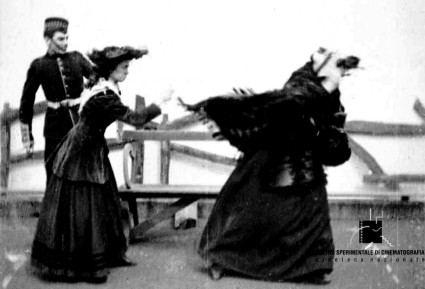
We have already written at length about The Soldier’s Courtship (UK 1896), the earliest British fiction film made for projection (I choose my words with care), recently discovered in the Cineteca Nazionale in Rome, where they have held the film for years but only recently established its identity. I will discuss the film in more depth in Day Four (a presentation is to be given on the film’s restoration), but just to say here that the film is a fleeting delight. The soldier and his sweetheart sit down on a bench and enthusiastically embrace; a woman of mature years sits down on the bench beside them and refuses to budge; his sweetheart remonstrates with him and encourages him to take action; he tips the woman off the bench and she leaves in a huff; the couple are triumphant, kiss, and share a cigar. The couple are played by variety theatre stalwarts Fred Storey and Julie Seale, and it is Seale’s bright, enthusiastic performance that stay in the memory. OK, it’s just a silly gag, but the Pordenone audience laughs at it – and then laughs all the more at the huge list of credits that follow the one-minute film (credits for its restoration, of course). More on The Soldier’s Courtship on the morrow.

We are in the Early Cinema programme, but before we have the main body of films, there is another British discovery, this time from the EYE Film Institute in the Netherlands. The Indian Woman’s Pluck (UK 1912) is a Cecil Hepworth production employing the classical Rescued by Rover formula. A baby is kidnapped and the thieves are tracked down my the family’s faithful Indian wet nurse (played by Ruby Belasco). It’s rather well paced and shot by director Frank Wilson, with the nurse tracing her prey by following drops of blood down the garden path, until the child is returned too hurriedly and the nurse explains her actions with a bit too much gesturing.

The main part of this programme is another collection of one-reelers from the extraordinary Corrick collection from the National Film and Sound Archive of Australia. We have been treated to gems from this collection at Pordenone for a number of years now. The Corrick family of Australian travelling entertainers included films in their early 1900s shows, and they chose with care, because the quality of the titles in the archive they have handed down to us is consistently high. It is not going to be possible to go through them all here (the memory fades and the notes written in the dark have become all the more indecipherable). Stand-out titles include an awe-inspiring view of British battleships in a line at sea in Charles Urban’s Torpedo Attack on H.M.S. ‘Dreadnought’ (UK 1907); a spirited Pathé film on tobogganing down the Cresta Run, Sports d’Hiver: Le Tobogan (France 1905), so edited to make it look like the toboggan come down the ice in close succession when in fact one does not start until another has finished, a real sports film in its cutting and dynamism; [Sailor and Cop in Carpet?] (c.1904), an unidentified comedy, clearly British, in which a policeman and sailor argue, the former hides behind a carpet hanging on a line, then the sailor and a maid roll up the carpet and beat the policeman; a fascinating Edison proto-Western, On the Western Frontier (USA 1909) in which the use of painted backdrops for interiors and exteriors give a strong sense of the Western’s stage origins – the story is inpenetrable, but we can see cinematic ideas dimly evolve, though it would be more impressive if this were a 1904 film rather than 1909; an impressive Elephants Working in a Burmese Forest (Australia 1908), filmed by the Corricks themselves, which is notably absorbing; The Fakir and the Footpads (UK 1906), a Robert Paul trick film most engaging for including a Finchley road sign (a local signification from the filmmaker); and Personal (USA 1904), the famous Edison film which introduced the comedy chase genre (sixty years ahead of Benny Hill).

We head out for coffee and an agreeable discussion about early aviation films, then start the afternoon with a trio of films from the Shostakovich & FEKS strand. FEKS stands for the Factory of the Eccentric Actor, the avant garde acting troupe established by directors Grigori Koszintsev, Leonid Trauberg and others and dedicated to bringing together popular dramatic forms (music hall, Chaplin, circus, commedia dell’arte, Keystone etc) in an exuberant kind of performance that naturally had a manifesto and an -ism to its name – Eccentricism. They put on stage productions and they made films, and Shostakovich wrotes scores for a number of those films.

An early film production, before Shostakovich joined them, was Chyortovo Koleso (The Devil’s Wheel) (USSR 1926). Many greatly admired this tale (with reel three missing) of a sailor on shore leave who becomes mixed up with a Petrograd underworld gang, led by a stage magician called ‘The Question Man’. So I wish I could report more enthusiastically about it. It has some bravura fairground sequences (including the ‘devil’s wheel’ itself), and it all ends with an exciting battle, but looking beyond the style I find little to engage me (I even doze off for a while in the middle), and curiously I find more impressive a collection of fragments from the film which follows after, which may be outtakes or tinting tests. Divorced from narative, the fragments somehow highlight the directors’ vision more effectively; indeed the way in which they hide any story makes the connections between them seem all the more mysterious and inviting.

But what a treat now follows. We have a screen test for Novyi Vavilon (New Babylon) (USSR 1927). The subject is Raisa Garshnek, who was a 17-year-old Sovkino laboratory employee. She didn’t get the lead part (they gave her a bit part instead), and seeing the screen test we can see why, but what is wonderful is that she is still with us, and we see a video interview with her, now aged 101. She has kept hold of the screen test all these years (the only surviving screen test from the Soviet silent film era), and brightly tells us of her time at Sovkino, casually mentioning that it was she who painted the famous red flag at the end of Battleship Potemkin. You don’t expect there still to be a human connection between today and a film which is now so iconic you cannot really believe that real people actually worked on it.

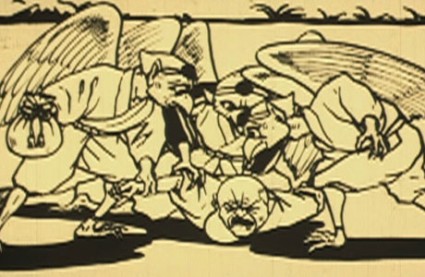
Kobutori (which translates as His Snatched-Off Lump), from http://www.digital-meme.com

Next up is the first of two programmes of Japanese animation. Of course, these days everyone knows something about Japanese animation, and Studio Ghibli is one of the best-known film production companies anywhere. This programme takes us to the roots of anime and the scarcely-known early history of Japanese animation. The earliest surviving Japanese animation film dates from 1917, though in 2005 a hand-drawn fragment dating from before 1912 was found (not thought to have been released commercially). The Japanese animation films of the silent era are both familiar, in that they adopt basic techniques employed by American animation studios of the period, and strange, in that they take their films in entirely different directions – in theme, narrative, design and emphasis. They don’t look like later anime films (no large round eyes), but their very difference to the Western view gives them an affinity with the present-day work of Miyazaki and co.

I must refer you to the excellent notes by Alexander Jacoby and Johan Nordström in the Pordenone 2011 catalogue, as without the context they provide the films you will only have my impressionistic, sometimes puzzled notes, because I cannot say that I always enjoyed the films that much. So we start with Namakura Gatana (Japan 1917), a mixture of rudimentary cut-out and silhouette animation about a samurai with a blunt sword, and Urashima Taro (Japan 1918), based on a folktale about a fisherman visiting the undersea domain of the Emperor of the Sea after rescuing a turtle, characterised by some elegant line, both of which were rediscovered in 2008 (something we reported at the time). The use of traditional stories and historical themes recur in what follows and distinguish Japanese early animation from what was being produced elsewhere. Kanimanji Engi (Japan 1924) is a rather creepy, unworldly fable about crabs who rescue a girl from a snake, made with silhouette animation. Some of the crabs die, indication of a bleaker attitude to life that characterises some of these films, certainly a long way off from Disney’s peppy, positive Laugh-o-Grams.

Ubasateyama (Japan 1925) tells of an old woman whose great widom enables her to solve riddles; Chappurin to Kugan (c.1921-25) is an artless oddity about which little is known. It has a cartoon Jackie Coogan visiting Japan (Chaplin appears only briefly), and in common with a number of these films it seems hard to judge for whom it was made – it seems to be equally lacking in appeal for children and adults. Sanbiki no Koguma-san (Japan 1931), or Three Little Bears, promises a more Disney-like theme, but though it has a similar combination of animals and travel through surreal adventures, it has a lot less sugar to it (my notes refer to children weeping when the bears melt a snowman – or was it the bears themselves that melted?).

Kobutori (Japan 1929) pretty much sums things up for me – who else who have considered even for a moment making an animation film about two old men disfigured by lumps on their faces? It’s a moral tale of two men who dance before odd bird-like creatures in the hope of losing their lumps; the good man is rewarded, the bad man ends up with two lumps. The artwork is fine and the narrative well-handled, but its sheer oddness I find bewildering. Another animation, another moral fable: Futatsu no Sekai (Japan 1929) was produced by the Ministry of Education and is based on the familiar Grasshopper and the Ant story. It contrasts the industry of those insects who work in summer with bourgeois idlers who, unprepared for winter time, fall into hardship, misery and even disfigurement. We are again reminded how life is unkind; Uncle Walt’s fables only tell us to have happy dreams. We finish off with Oira No Yakyu (Japan 1930), a spoof on the Japanese passion for baseball in a game played between rabbits and badgers (who look more like beavers to me). It starts off like an American animation (albiet technically inferior by far), then drifts off into more characteristic vein when the ball is knocked out into the countryside to be devoured by a frog.

An interesting evening’s programme awaits, but I head off for supper and engrossing discussion, which touches on film archive politics, Creative England, the British Film Institute, the Lumière brothers, visual sociology, the BBC, the Digital Public Space, home movies, federated databases, the Delhi Durbar, the challenges presented to translators by rapid-talking film academics, YouTube, programming early cinema, the British Library, magic lanterns, showmanship, film lecturers, scholarship, CCTV, film lecturers, digitising film journals, and much else besides. And all that takes up five hours, and so the day ends.

Please return soon for our report on day four, when we shall have offer you train travel with a hobo, a man suckled by a dog, a woman living underground, and an entire theatre quivering in horror at the sounds of the 21st century.

Pordenone diary 2011 – day one
Pordenone diary 2011 – day two
Pordenone diary 2011 – day four
Pordenone diary 2011 – day five
Pordenone diary 2011 – day six
Pordenone diary 2011 – day seven
Pordenone diary 2011 – day eight

The Turconi project

Ali Baba et les 40 voleurs (1907), Amleto (1910) and Au pays de l’or (1908), stencil coloured film clippings from from www.progettoturconi.it

Just over one hundred years ago, a Swiss priest had an unusual idea. Abbé Joseph Joye was a Jesuit and taught children at a Basle school. Around 1902-03 he had the idea that one way to capture the attention of his charges would be to show them films. He was not particularly unusual in this alone. A number of clerics around the world about this time decided to add moving images to the magic lantern shows and lectures, noticing how much the young were attracted to the visual, and simply adding another element to their evangelical armoury.

What was remarkable about Joye (pronounced Jwa, by the way) was the scale of his endeavour. While others ordered a few films from an exchange and then returned them, Joye bought his films, kept them, and built up an archive of over a thousand titles over the period 1905-1914. He purchased them second-hand, and as he lived in the German-speaking quarter of Switzerland, the films (some of which he smuggled over the German border, according to legend by hiding them in the folds of his cassock) all had German titles, though they came from countries all over the film-producing world. Joye showed the films to child and adult audiences, and though his interest was educational, he was broad (not to say catholic) in his tastes, selecting dramas, comedies, fantasies, travelogues, newsfilms, industrials, trick films, science films, animation films – the whole rich panoply of early cinema.

Joye died in 1919, but his film collection remained at the Basle school (the Borromäum – which still exists). It was in the 1960s that Italian film historian Davide Turconi (1911-2005) came across the collection in Zurich, where it had been moved by Jesuit Father Stefan Bamberger to better storage conditions. Turconi recgonised the huge historical importance of the collection, but could find no institution locally able to take on a collection of such a size, and fearing that the films would be entirely through deterioration, he decided to clip a few frames from each print and save these at least, as a record of what once had been.

Turconi’s fears were, happily, misplaced. In 1976 the British filmmaker David Mingay came acros the Joye collection, and through him the collection was taken in by David Francis, Curator at the National Film Archive in London, which had the resources necessary to manage such a large nitrate collection. Around 1,200 prints were copied, catalogued and preserved, and today form one of the most important of all early film collections.

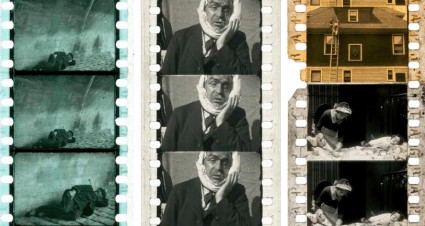
Frames from three unidentified films in the Turconi collection: images 4999, 6925 and 4955

But meanwhile, what of Turconi’s frames? Progressively he handed these over to film archives, archivists and historians: to Paolo Cherchi Usai, to the Cineteca del Friuli, to the Arts and Culture Department at the Province of Pavia, to the Cineteca di Bologna, and to Italian film historians Aldo Bernardini and Riccardo Redi. In 2004, Cherchi Usai was at George Eastman House and donated his frame stills to GEH for long-term safekeeping; Bernardini, Redi and the Cineteca del Friuli later followed suit (the frames in Pavia and Bologna are now held by the laboratory La Camera Ottica at the University of Udine and the Cineteca di Bologna). In 2000 the Giornate del Cinema Muto and the L. Jeffrey Selznick School of Film Preservation at George Eastman House initiated a project to conserve, catalogue and digitise the entire Turconi collection. Undertaken by various Selznick students and now managed by Joshua Yumibe in collaboration with Paolo Cherchi Uai, the results of the project have just been published.

The Turconi Project is a database of 23,491 film clippings taken chiefly from the Joye collection (c.1897-1915), though some later clippings from unidentified sources date up to 1944. Each image has been digitally scanned and data added to an online database, given (where known) title, country, date, production company and technical details. The entire collection has been made freely available in this way, hosted by the Cineteca del Friuli, and searchable either in its entirety or by the fields named above, including items showing hand-colouring, stencil colouring, tinting, toning, intertitles, splices, and image deterioration.

Though there is something a little odd about a collection of clippings taken from a fully preserved collection of the films themselves being offered as a resource in its own right, this is nevertheless a marvellous offering. There are any number of combinations of fields that you can come up with, though take note not to fill into too many fields when searching, because not every field has been filled in for every record – there are many unidentified films, and many without country or date records. But what most are going to want to do is to browse through the database as a whole and savour the Aladdin’s cave of rich images. There is no easier way of getting a sense of the look and vaeitry of early film than by browsing through the collection, and there will be interest here not just from film historians but students of design, culture, art history, photography and much more. There are also copious cataloguing notes (under ‘details’) which note everything the cataloguer has found out about the images, both technical and filmographic. For the specialist, these will be engrossing reading. The project naturally invites any corrections that those knowledgeable in the subject can supply (email them at turconi.collection@gmail.com).

What one senses, however, is that a great many of these films have been identified by the BFI National Archive, which had the advantage of cataloguing from entire films (or rather films entire except for a few frames missing). How much work has been done to marry up the two collections? The website does not say. How wonderful it would be if there could be a bringing together of clips, data, catalogue records and films into a single online resource. It’s the sort of project that forward-thinking educationalist Joseph Joye would take today if he could. Let’s hope that the Turconi Project is a first step towards something even greater.

Pordenone diary 2011 – day two

The top of the Teatro Verdi, Pordenone

Domenica. Dawn. The sun is already beating down warmly as we head out after breakfast for a long’s day’s viewing. It may be like high summer outside, but we are scheduled to spent most of it in a darkened theatre, absorbed in the extraordinarily various worlds of silent cinema revealed in day two of the Giornate del Cinema Muto. So let the adventure begin.

Some years ago the festival put on a notable programme of silent Walt Disney films, starting with the Alice comedies. In 2011 we go back further, to Uncle Walt’s first-ever films, the Laugh-o-Grams series. In 1920 Disney was a 19-year-old commercial artist working for an advertising company in Kansas City. He approached a local exhibitor, Frank Newman, with the idea of producing a cartoon filler for Newman’s cinema chain. This first film, Newman Laugh-o-Gram (USA 1921), is a rudimentary but spirited local newsreel, starting with live film of Disney himself at his desk, then turning to comic comments on local issues (crime, fashions, the state of the roads), done as lightning sketches except for a final item when there is genuine animation – one of the few examples in his entire oeuvre done by Disney alone. The Laugh-o-Gram series would continue for another two years, but Disney shifted from newsreel to modernised fables, and these are what we are to see throughout the Giornate.

Next up, The Race to the Pole. The Giornate’s Antarctic exploration strand is to give us two programmes of short films and two documentary features over the week, covering Man’s urgent quest to explore Antarctica and to become the first to reach the South Pole. I am reminded of Raymond Durgnat’s withering four-word assessment of the 1953 documentary The Conquest of Everest – “as if it mattered”. Well, of course it didn’t really matter, and despite much insistence (some of it sincere) that they were heading south for the best of scientific purposes, so much of this activity was vaingorious, driven by national pride and a quest for personal glory by some of exploration’s most stubborn – but also most interesting – men.

We will be seeing the two most stubborn and most interesting of them all, Robert Falcon Scott and Ernest Shackleton, later in the week. This morning we have a collection of shorts which shows just how much polar activity there was worldwide, and how popular films were of such expeditions (the films often having been made in the hope that their commercial success would help offset expedition expenses). First up is The Scottish Antarctic Expedition (GB 1902-04), briefly documenting William Spiers Bruce’s scrupulously scientific expedition to Antarctica. Bruce captured ice floating by and a penguin rookery before his camera jammed – just enough to give us two emblematic shots which will now recur in all the other Antarctic films we are to see.

Ernest Shackleton appears, albeit only as a dot on the horizon, in Depature of the British Antarctic Expedition from Lyttleton N.Z. 1st Jan. 1908 (New Zealand 1908). This newsreel shows Shackleton’s ship Nimrod sailing south, waved goodbye by excited crowds and followed by a flotilla of ships. Shackleton would get to within 97 miles of the Pole before being forced to return.

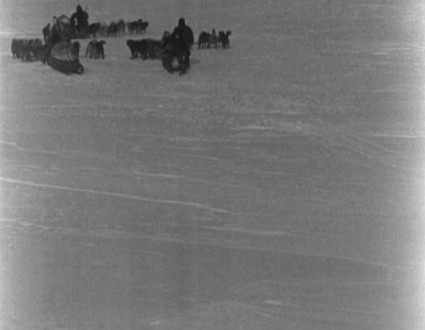
Sledging into the distance, from Roald Amundsens Sydpolsferd 1910-12

The explorer who first made it furthest south was of course Roald Amundsen. Thanks to its recent DVD release and recognition by UNESCO’s Memory of the World Register, Roald Amundsens Sydpolsferd 1910-12 (Roald Amundsen’s South Pole Expedition) (Norway 1912) has become not only familiar but iconic, after years when the only familiar Anatarctic exploration images were those taken of Scott and Shackleton. Filmed by Amundsen himself and Kristan Prestrud, the sixteen-minute film does not reached the aesthetic heights achieved by Herbert Ponting (for Scott) or Frank Hurley (for Shackleton), but its matter-of-factness echoes the clear-headed, sensible – and of course successful – approach undertaken by the Norwegians. On two occasions the images haunt us – where a silhouetted Norwegian with pipe comically confronts an emperor penguin, and towards the end when their sledges pulled by dogs disappear into the white dstance, heading away from us as they move to the top of the frame and the camera remains fixed.

However, though the print was poor, the film of the programme for me is Nihon Nankyoku Tanken (Japan 1912). It was crowded in Antarctica around 1910-1912. There were expeditions from Britain, Australian, Norway and Japan. The latter, led by Lieutenant Nobu Shirase mostly explored the coastal areas and did not make any attempt on the Pole, but they were excitedly acclaimed as heroes on their return, and the film is constructed as a paean to noble endeavour, with a strong nationalist tone, glorifying what were really relatively humble achievements. “Japan has left its imprint on the Antarctic continent”, it boasts. It is also interesting for the opening scenes where we are shown the equipment, and then each of the members of the expedition, with their names. No other polar exploration film of the period does this, amazingly enough, given the huge human interest in such adventures. It even names the ship’s accountant. The footage on the ice, shot by Yasunao Taizumi, is not particularly impressively, but fascinatingly the catalogue notes by leading polar film authority Jan Anders Diesen reveal that some of the footage, showing four men pulling a sledge and pitching a tent, does not feature the type of sledge used by Shirase’s expedition. There is a possibility that these shots could come from the otherwise lost film of Shackleton’s 1907-09 Nimrod expedition, which was being sold by Gaumont in 1909. It would be wonderful if this could be confirmed.

A newsreel follows, Pathé’s Animated Gazette no. 140 (UK 1911) which has a brief item of the dogs used in Douglas Mawson’s expedition, included among such delightful newsreel mundanities as ship launches, parades, and Kingston regatta. Mawson, who led Australian’s Antarctic expedition (previously described on the Bioscope), took with him the photographer Frank Hurley, who was still learning his craft as a polar filmmaker and would go on to greater things working with Ernest Shackleton. Nevertheless, the two sequences from Mawson’s surviving films, shown as [The Film of the Mawson Australasian Expedition] (Australia 1911-12), demonstrate great skill and enterprise from Hurley, particularly in a sequence where the explorers venture out into a fierce wind yet Hurley’s camera remains steady throughout, his sense of composition acute. Mawson’s films were presented in lecture format over 1914-16 and lecture scripts survive. The National Film and Sound Archive of Australia are reconstructing the films in their lecture format, and we see the films intercut with slides (which do indeed slide in an out as they would have been shown at the time) and commentary (recorded by Quentin Tournor) and no music. It is instrutive and effective, and there needs to be more of this sort of archaeological reconstruction of the lecture films of the period, because some of the most popular ‘films’ of our period were actually multimedia amalgamations – films, slides, music, commentary – in a form which we could say was more televisual than cinematic. Neil Brand and I had a stab at it recreating part of With Allenby in Egypt and Lawrence in Arabia (1919), but the Mawson’s scripts seem to have the crucial details of what film clip and what slide goes where. And so do any other such lecture film scripts survive?

Anyway, the polar film programme part 1 has been excellent, and it is interesting to see it watched by a full and attentive audience. Only a few years ago a programme of non-fiction films might be guaranteed to empty the Verdi, but good programming and supporting information is paying off.

Betty Amman in Asphalt, from http://www.film-daily.com

The Giornate’s Canon Revisited strand brings back classics for re-evaluation. There are times when the majority of us are left scratching our heads because we have not heard of said classics, it being a long time since we last read The Film Till Now. But we have all heard of Joe May’s Asphalt (Germany 1929) and we sit back in expectation of a treat. And we are not disappointed. It is as classic as they come. It sets up the city street setting with polished skill, gradually leading us into the life of a young traffic policeman with doting parents who captures a woman jewel thief only to be seduced by her. Her lover then returns, the young man kills him by accident in a fight, but (somewhat improbably) he avoids imprisonment when she turns honest for the first time and says that the killing was self-defence, and that she is guilty of the jewel theft. But the story is not the point – it is the truthfulness to the way people act out their lives before one another, the truthfulness of the policeman’s spoken and unspoken understanding of things in the scenes with his parents. It is a film that finds out all the shades of grey between good and bad. An exceptional film, given an appropriately nuanced piano accompaniment by Gabriel Thibaudeau which was much applauded.

And then it is back to Georgia for Mzago da Gela (Georgia SSR 1934, though made in 1930), another film directed by Lev Push, this time in collaboration with Shalva Khuskivadze. This shows the remote Khevsur people, whose exotic mountainside lives are interrupted by visting tourists who bring with them a magical invention, radio. A young couple, recently married, react differently to this insight into modernity. She leaves for the big city of Tiblisi; he stays behind and broods, before going to look for her. The scenes of the two of them in traditional costume wandering lost through the modern town with everyone staring at them turn the film from drama into documentary. Then, alas, the propaganda takes over, because they have to be seen to both embrace the forward-looking Soviet Union, so she runs a dairy and he becomes a radio engineer. A free film would have been able to explore the tensions between the traditional and the modern with greater richness.

Goodness, it is only midday. We break for lunch, rejoicing in the warmth, then return for two Italian dramas. Il Veleno delle Parole (Italy 1913) is a tale of slander and innocence, quite competently done, but La Serpe (Italy 1920) is an over-wrought bore, with Francesca Bertini putting on the diva mannerisms when that style of performance was some years out of date. Italian films sadly lost their way in the 1920s; they try so hard and achieve so little.

The Giornate has been encouraging local schools to contribute music scores to silents and then perform them to us, so we get American comedies with recorders, percussion, sound effects and the teacher playing the piano and it all works rather well. Disney’s Oh Teacher! (USA 1927), featuring Oswald the Lucky Rabbit was nicely done, and Buster Keaton’s The Electric House (USA 1922) was fun, once they’d got the DVD working (a really indistinct image, alas). It’s a curious film, not quite understanding what this new phenomenon of electricity is (by mistake Buster gets to wire up someone’s home electrically and all of the gadgets go haywire when a real electrical engineer takes his revenge), not sufficiently consistent in the gags it draws from the situation.

Then we get SpilimBrass, a five-piece brass ensemble playing to Chalie Chaplin’s The Adventurer (USA 1917) and Easy Street (USA 1917). They are excellent – spiritied, witty, and perfectly attuned to the needs of the films. The Adventurer must be the perfect comedy; Easy Street is not so funny (what film so honest about violence, poverty and degradation could be?) but it packs in more human observation in twenty minutes than some social historians have achieved in a lifetime.

We decide to forgo a modern documentary on Hungarian cinema and stumble out into the early evening for supper. The third and final screening session of this long day begins at 8.30, and the Verdi is full as everyone eagerly awaits the headline attraction. Firstly we get another Disney Laugh-o-Gram, Little Red Riding Hood (USA 19220, a rudimentary but nevertheless delightful modernisation of the fairy tale. There are quite a lot of repeated actions and other such animation short-cuts, but we can see Walt and his team learning their craft and enjoying doing so. A Hole in the Bucket (USA 2010) is one of the modern silent shorts that the Giornate generously finds space for, though the results tend to be mixed. American film student Rex Harsin has developed a Chaplin-like character he calls Purdie. Alas he does not have Chaplin’s years of experience on the variety stage before he ever stepped in front of a camera. No one laughs.

The Better Man (USA 1912) is a routine Vitagraph Western, most interesting for being one of the horde of American films repatriated from New Zealand and for having the money for its restoration provided by the For the Love of Film blogathon, which gets a welcome mention in the credits.
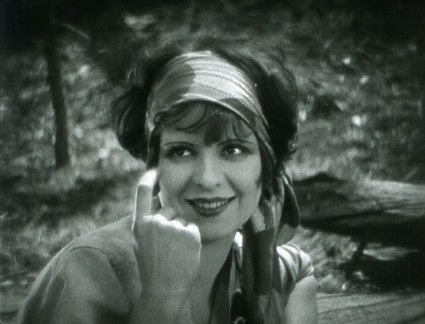
Clara Bow says come hither, in Mantrap

And then the crowd get what they having been looking forward to all day, Mantrap (USA 1926), starring Clara Blow. It is being shown as part of the Treasures of the West strand, marking the recent 5-DVD set release of films on Western themes by the National Film Preservation Foundation. Mantrap is probably Clara Bow’s best film, despite the silly story and unlikely setting (she marries dull hulk Ernest Torrence and joins in the Canadian wilderness with no one to talk to except Percy Marmont). The camera loves her, and she loves the camera, never more so than for the iconic shot where she beckons Marmont (and by implication all of us watching) with her curled finger. It’s not much of a film, to be honest; a good cast is given too little to do, wisecracking intertitles becomes wearisome after a while, and its teasing attempt at challenging conventional morality when Clara cheerfully ditches her husband for Marmont is squashed when she returns to Torrence as the dutiful wife, after a breezy spell in Minneapolis. It could have been a proto-feminist film, but it’s Victor Fleming directing, and it isn’t.

The parting of the Red Sea in Die Sklavenkönigin, a screengrab from Nitrateville

Phew, it’s been a long day. Nineteen films, three of them features, and now here’s a fourth to round off the day. Another strand at the Giornate is Before Curtiz, the films the great Michael Curtiz made before he went to Hollywood, when he was Mihály Kertész from Hungary. I’ve long wanted to see Die Sklavenkönigin (Moon of Israel) (Austria 1924), not least for its British connection since it was part-funded by British company Stoll Film Studios, with H. Rider Haggard writing the intertitles for what was an adaptation of his novel Moon of Israel. Alas, the old saying ‘A Stoll film is a dull film’ never rang truer. It’s a tale of the Israelites in slavery in Egypt being led to freedom by Moses, though the lead figure is an Israelite slave girl with Mosaic-like authority who falls in love with an Egyptian prince.

Because it says so in the film histories then I have to accept it must be partially true, but I really do find it hard to credit that Maria Corda was ever popular. Plain, heavily-built, and as lacking in star quality as she is in any acting ability, she kills the film stone dead. Yet it apparently was designed as a star vehicle on acount of her great popularity with German and Austrian auiences following the films she had made with husband Alexander Korda. Her co-star, the Chilean Adelqui Millar, is no less wooden, though having seen the ludicrous hairstyle devised for him by the wardrobe department, perhaps he just gave up from the start and was merely grateful for the cheque at the end of it. There is some interest in how the Jews are presented not entirely sympathetically, with their tendency to violence contrasting with the gentle Egyptian prince who becomes Pharoah, and the parting of the Red Sea is genuinely impressive – achieved, the catalogue tells us, “by combining double exposure of the negative with an ingenious mechanical device that launched 50 cubic metres of water over a scale model”. In the end Corda has to die to avoid the a-historical embarassment of a Jew married to an Egyptian pharoah. A film more endured than enjoyed.

It’s been a long day; it’s been a long post. Look out for the report from day three, when we shall encounter an underground printing press, bourgeois Japanese insects, a kiss on the roof of the Alhambra, and the woman who painted a famous red flag.

Pordenone diary 2011 – day one
Pordenone diary 2011 – day three
Pordenone diary 2011 – day four
Pordenone diary 2011 – day five
Pordenone diary 2011 – day six
Pordenone diary 2011 – day seven
Pordenone diary 2011 – day eight

Bioscope Newsreel no. 33

While we continue to compile the Pordenone diaries (which is no light task), here’s the latest edition of our regular newsreel, which today has a special publications theme this time around, noting some of the new books on silent film published recently.

Early cinema today
Early Cinema Today: The Art of Programming and Live Performance, edited by Martin Loiperdinger, published by John Libbeyis the first in a series of studies in early cinema issued by KINtop. KINtop’s publications to date have been predominantly in German, so this marks an interesting and welcome depature. The volume reviews recent work in programming early cinema, from the Crazy Cinématographe shows to Mariann Lewinsky’s A Hundred Years Ago programmes at Bologna. Read more.

Stummfilmdramaturgie
But let’s not overlook German language works. Claus Tieber’s Stummfilmdramaturgie: Erzählweisen des amerikanischen Feature Films 1917-1927, published by LIt Verlag, is a study of modes of narration in American silent cinema 1917-1927, and sets out to challenge accepted notions of classical Hollywood cinema. Read more.

Emerald illusions
Gary D. Rhodes’s Emerald Illusions: The Irish in Early American Cinema, published by Irish Academic Press, is based on his doctoral thesis and provides what he calls the first history of pre-cinema and the Irish in America. So its subject is not Irish film as commonly studied but rather the rich theme of the portrayal of the Irish in American film and pre-film stagings, as he looks back to the magic lantern and the variety stage, and covers non-fiction films as well as fiction. Read more.

Cinema audiences and modernity
Cinema Audiences and Modernity: An Introduction is edited by Daniel Biltereyst, Richard Maltby and Philippe Meers, and published by Routledge. It brings together papers on cinema-going in Europe first given at the 2007 ‘Glow in their Eyes‘ conference. This is the second volume of papers to be published from the conference, the first (by the same editors), Explorations in New Cinema History: Approaches and Case Studies having been published earlier this year. Read more.

‘Til next time!

Staging illusions

http://www.sussex.ac.uk/sccs/activities/stagingillusion

Staging Illusion: Digital and Cultural Fantasy is a two-day conference taking place 8-9 December 2011 at the University of Sussex, whose themes, while not directly referencing silent cinema, are highly relevant to it. So here’s the conference blurb:

Staging Illusion: Digital and Cultural Fantasy,
December 8th and 9th, University of Sussex

Keynote speakers: Professor Vanessa Toulmin (Director of the National Fairground Archive), Dr Sarah Kember (Goldsmiths) and Professor Sally R Munt (Director of the Sussex Centre for Cultural Studies).

Plenary speakers: Dr Astrid Ensslin (Bangor), Dr Melanie Chan (Leeds Met), Professor Nicholas Till (Sussex), and Dr Jo Machon (Brunel).

Sussex Centre for Cultural Studies & the Centre for Material Digital Culture present:

From magicians and mediums to immersive media, and from the circus to cyborgs, the celebration and/or mistrust of illusion has been a central theme across a range of cultures. Notions of fakery and deception remind us that our identities that are performative. The figure of the ‘mark’ of the fairground scam remains culturally ubiquitous, perhaps more so than ever, in an era of (post) mechanical reproduction. Is new technology a flight from the real or merely a continuation of older cultural forms? Is it necessary, or even possible, to define reality in relation to the illusory? What realms of ‘otherness’ remain to be embraced? This international conference will discuss staged illusions across a spectrum of historical, geographical and cultural contexts, featuring original and exciting papers and performances.

Panels interrogate staging illusion from diverse perspectives, including: 3D cinema, the paranormal, the music hall, digital trickery, the fairground, magicians and illusionists, theatre, science, the museum, the magic of cinema, the gothic, digital gaming, social networking, the circus, advertising, illusory bodies and genders, theme parks and digital animation. Over two days the conference will also showcase illusory performance pieces, installations and magic.

Panel speakers so far confirmed: Jon Armstrong, Adam Bee, Victoria Byard, Diane Carr, Eleanor Dare, Cristina Miranda de Almeida with Matteo Ciastellardi, Lane DeNicola, Yael Friedman, Aristea Fotopoulou, Kate Genevieve, Jonathan Gilhooly, Dr Rachael Grew, Birgitta Hosea, Jacqueline Hylkema, Jane Insley, Lewis Johnson, Laura Ellen Joyce, Frances A. Kamm, Ewan Kirkland, Chara Lewis with Kristin Mojsiewicz & Anneke Pettican, Liang-Wen Lin, Joe Marshall, John Carter McKnight, Jenny Munro, Constantino Oliva, Professor Deborah Philips, Burcu Yasemin Şeyben, Jayne Sheridan, Peter Sillett, Frances Smith, Marian St. Laurent, Nozomi Uematsu, Owen Weetch, John Wills.

No programme as yet, but registration is now open, with the cost £190 (£85 for students). There’s a downloadable booking form on the conference site, and you can follow developments on the conference blog or via its Twitter feed.

Pordenone diary 2011 – day one

Festival-goers in the foyer of the Verdi theatre for the Giornate del Cinema Muto

Here we are again in Pordenone. It’s a pleasing, unostentatious town on the Venetian plain, to the north-west of Italy, population around 50,000, and not to be found in many guidebooks. There’s just the one scenic street likely to attract the day-tripper, the Corso Vittorio Emanuele II, but it’s a place whose quiet pleasures become all the more apparent if you stay for a while. Say, at a silent film festival.

So we are at the thirtieth Giornate del Cinema Muto, and if you think it’s a wonder that after thirty years they still have something new to show, well we learn in the festival catalogue that there are some 50,000 silent films held in FIAF archives and Pordenone has so far shown 6,658 of them, so we’ve a way to go yet, and the Giornate is right to pursue its policies of comprehensiveness, discovery and pushing back the boundaries. At Pordenone, silent films are always going forward, never standing still.

So we fly in via Trieste (such glorious, glorious views over Venice), a route taken by surprisingly few festival-goers, so that the three of us on the flight headed for the Giornate are treated to a festival car. For a moment, when I see my name held up on a card in the airport I think that perhaps the festival is so in awe of these Pordenone diaries that we produce each year that they have laid on a courtesy car for our special benefit. But the car is for the rather more deserving pianist John Sweeney, and thus we arrive in Pordenone in comfort and warm sunshine at four in the afternoon.

We register, and discover to our dismay that the festival catalogue has been delayed and will not be available until Tuesday. Much wailing and gnashing of teeth (inwardly at least), and we abandon plans to blog daily from the festival because the catalogue’s detailed background information is essential if we are to provide you with a solid reference work as opposed to mere impressionism. We check in at the ever-reliable Park Hotel, then head back to the centre of town and into the Verdi theatre to catch our first films (which have been screening since 14:30). A slight contretemps occurs when the Verdi staff refuse to let us into the upper floor where we prefer to sit (because the ground floor seats are not yet filled up), but we are philosophical about this, eventually.

Into the auditorium, and our first film is not one for the frivolous. The Doomed (Gantsirluni) (Georgia SSR 1930) is directed by the Georgian Lev Push, one of last year’s festival’s discoveries. The feature-length film concerns a mutiny among Russian troops in France following the October 1917 revolution. It starts with Kino-Pravda-style newsreel intercut with sloganeering, then turns into drama, with the pained faces of the mutinous soldiers in their barracks, their faces shown in the uncompromising, epic light that so characterises Soviet filmmaking of the period. I struggle to resolve the dehumanized presentation with the human fellow feeling it strives to evoke, but others find the film technically impressive.

Luisella and Raffaele Viviani (centre) in Un Amore Selvaggio (1912), from http://archiviteatro.napolibeniculturali.it/teatroViviani.html

More to my taste is Un Amore Selvaggio (Italy 1912), part of the festival’s Italy: Restrospect and Discovery strand. This is a hoot. It stars what are clearly a stage duo, bringing their larger-than-life stage personas to the screen. The duo are brother and sister Luisella and Raffaele Viviani, Neapolitan stage actors who specialise in native dramas of grimy realism and high passion, usally directed by Raffaele. It is the only one of their three films to survive. Here they play a Sicilian brother and sister in a drama of intense revenge, where she asks her brother to kill a farm owner who has rejected her advances because she is his social inferior, only preventing him from doing so when she changes her mind. Never have eyes rolled so much, arms waved so passionately, nor hair been pulled back so constantly. Yet it is not comical; rather it jolts the audience out of complacency, showing an edgier form of early cinema than we usually experience out of the comparatively milder stage traditions of northern Europe and America. When Raffaele looks like he wants to fight, he sems more than ready to deal in real blows; when Luisella wants you killed, the audience starts worrying for you.

One fascinating minor detail. The sister in Un Amore Viaggio tries to poison a female rival by dipping sulphur matches into her drink. We learn that a Hungarian film shown earlier in the day (presumably A Tolonc) features exactly the same strategy. It doesn’t work for Luisella – her would-be victim merely puts down the drink because it tastes funny. Did poisoning by matches ever work? Was it common?

More high passion follows. The title of Più che la morte (Italy 1912) translates as ‘worse than death’ (all of the films at Pordenone come with titles projected beneath the screen translated into English and Italian). The name of the director of this Cines historical drama is not known, which is a great shame, because he demonstrates eye-catching technical skill, with dramatic foregrounding of characters and striking use of lateral camera movement. Our hero (in some nineteenth-century setting) betrays some friends to save his wife from torture by the police. His friends are his friends no longer. They tie him to a post, and through two sets of windows he sees his wife and child trapped in a room which is then set on fire. Nice framing of the inset background action we tell ourselves, while shivering at the horror and wondering at the mind who made such an entertainment.

Più che la morte is one of a number of films shown at the Giornate from the Desmet collection of the Netherlands EYE Film Institute. The collection of Dutch cinema owner and film distributor Jean Desmet was recently inscribed on the UNESCO Memory of the World Register, one of the few films or film collections on the prestigious register, and an interesting example of one country championing the preservation of the cultural artefacts of others, since few of the Desmet films are Dutch.

The evening’s festival treat is Novi Vavilon (New Babylon) (USSR 1929), part of the Shostakovich & FEKS strand, of which more in a later diary. The film is screened to Shostakovich’s score played by the FVG Mitteleuropa Orchestra, but these grand occasions (and the demand that you take a particular seat) are not to our taste, so we retire for the evening.

This year’s Giornate is seeing greater coverage online than seems to have been the case before. There is the Giornate’s Twitter account, finally leaping into life, and a wide selection of photographs on its Flickr account, from which photographs of day one are here. There are also videos from their YouTube channel, some of which we shall embed here for the days where they belong.

Stay tuned for the Bioscope’s Pordenone diary day two, when we shall bring you the earliest Disney cartoon, Japanese polar explorers, the parting of the Red Sea, and Georgian peasant radio enthusiasts.

Pordenone diary 2011 – day two
Pordenone diary 2011 – day three
Pordenone diary 2011 – day four
Pordenone diary 2011 – day five
Pordenone diary 2011 – day six
Pordenone diary 2011 – day seven
Pordenone diary 2011 – day eight