Fflics festival

The Life Story of David Lloyd George

Advance notice of a festival of silent and sound film in Wales. The Fflics Festival (what a great name) will be held in Aberystwyth, 25-28 October. It advertises itself as “showcasing the history of both Welsh cinema and the Welsh on the big screen; from the earliest cinematic pioneers until the end of the nitrate film era.” Full programme details have yet to be published, but on 27 October it will feature the extraordinay bio-epic The Life Story of David Lloyd George (1918), with piano accompaniment by Neil Brand.

This life of the then prime minister was made with official co-operation, or at least blessing, by the Ideal company, with Maurice Elvey directing, but it was never shown to the public. The exact reasons why it was withdrawn from release remain a mystery, but it was thought that the film was lost until a print was rediscovered by the Wales Film and Television Archive (now the National Screen and Sound Archive of Wales) in 1994. At the time, we were delighted that the film had been found again, but did not hold much hopes for it as a work of art. To our amazement and delight, the film turned out to be a masterpiece, an extraordinary mix of contemporary political biography and Griffith-inspired epic. It has many marvellous scenes – a riot outside a hall where Lloyd George gave a speech criticising the conduct of the Boer War has remarkable newsreel authenticity, and the scene where the poor, who have been released from penury by Lloyd George’s introduction of old age pensions, materialise through the walls of the workhouse is incredibly moving. It’s real living history, and there isn’t any other film quite like it. Let’s hope the Archive is eventually successful in its efforts to get this genuinely great film released on DVD.
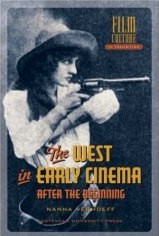
The West in Early Cinema

The West in Early Cinema

Amazon.co.uk

The Bioscope returns from Amsterdam, and will regale you with a report on the Iamhist conference tomorrow. Meanwhile, thinking of that city, there’s a new publication from Amsterdam University Press which looks interesting. Nanna Verheoff’s The West in Early Cinema: After the Beginning is an investigation of the emergence of the Western as a genre in the first two decades of cinema (i.e. to 1915). The author analyses Western films, many of them little known, from archives across the world, tracing the relationships between films about the American West, and other popular media such as photography, painting, popular literature, Wild West shows and popular ethnography, as well as other popular films. Great cover too. As Jean-Luc Godard said, “All you need for a movie is a girl and a gun”.

Clonic Mutations

Just time to let you know about Clonic Mutations, another silent film event taking place at Tate Modern as part of its Dali & Film strand, on Friday 20 July. Here’s the blurb:

Clonic Mutations features the world premiere of live new music scores created for a range of experimental films made between 1904 and 1952 with strong ties to surrealism. Composed for twelve musicians and clockwork toys by Sergio López Figueroa, a Spanish composer and specialist in silent film, the scores examine new contextual relationships between music, historical experimental film and art. The screening will feature the newly restored version of Un Chien andalou by Filmoteca Española.

Programme duration approx 60′

The Strength and Agility of Insects, F. Percy Smith, 1911, 3’58, DVD

A Phantasy, Norman McLaren, 1952, 7’15, 16mm

El Hotel eléctrico, Segundo de Chomón, 1904, 4′, digiBeta

Tusalava, Len Lye, 1929, 9′, 35mm

L’Étoile de mer, Man Ray, 1928, 18′, 35mm

Un Chien Andalou, Luis Buñuel and Salvador Dalí, 1929, 17′, 35mm

Full details from the Tate Modern site.

Bordwell on Bologna

Talking of festivals, David Bordwell’s blog has a detailed report on this year’s Il Cinema Ritrovato in Bologna, lavishly illustrated with assorted familiar faces from the silent film festival circuit. Not that Bologna is all about silent film – as he says, “Where else can you see films from 1907, Richard Fleischer’s Violent Saturday (1955), and a tribute to Ben Gazzara in a single week?” It’s a marvellous report, enthusiastic, wise and entertaining all at the same time, from what must be the very best of all film blogs.

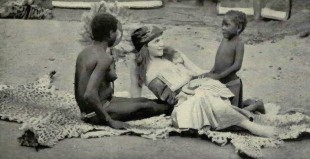
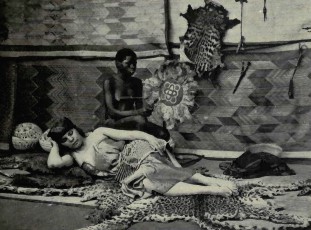
A Camera Actress in the Wilds of Togoland

The White Goddess of the Wangora

There was a curious sub-genre of silent films which combined exploration with drama. The enthusiasm that there was at the time for exploration films from Africa, South America, Australasia etc, led a number of these ‘explorer’s to make dramatic films, often with ‘native’ performers, which sought to sugar the pill of discovery and anthropology with human interest for the general cinema audience.

Frank Hurley, peerless cinematographer of the Douglas Mawson and Ernest Shackleton expeditions to Antarctica, in the 1920s made dramatised films of life in the Southern seas, The Hound of the Deep aka Pearl of the South Seas (1926) and The Jungle Woman (1926), set in New Guinea. British director M.A. Wetherell made Livingstone (1923) in Africa and Robinson Crusoe (1927) in Tobago. Geofrey Barkas made Palaver (1926) in Nigeria. And of course the Americans Merian C. Cooper and Ernest B. Shoedsack made Chang (1927) in Siam and Robert Flaherty made Moana (1925) in Samoa. All were curious mixes of idealism and colonialism, documentary and drama.

One of the earliest such examples must be The White Goddess of the Wangora (Die weiße Göttin der Wangora). This was made in Togo in 1913/14 by the German explorer and sometime big game hunter Major Hans Schomburgk, and starred his future wife, Meg Gehrts. The reason for this post is that her book on the experience of making this film, along with other dramas and a number of documentaries, is available from the Internet Archive. It has the grand title, A Camera Actress in the Wilds of Togoland (1915).

The White Goddess of the Wangora

Schomburgk, famed for having discovered and captured the pygmy hippopotamus, had made an earlier filming trip to Liberia and Togo, where his negative stock was ruined and the cameraman let him down. A little wiser the second time around, he returned with the intention of making a series of dramas and documentaries of life in Togo, with a white actress in tow to act as the main draw for Western audiences. Obviously he hoped for profits which would offset the expense of the expedition. The White Goddess of Wangora told of a white child washed up on the shore of Togoland, and brought up by the local peoples as a kind of goddess. Years pass. A white hunter (Schomburgk) is captured by the tribe and sentenced to be put to death, but she has fallen in love with him. They escape, an exciting chase ensues, they get away, they live happily ever after.

The book is fascinating in detail, patronising towards the ‘savages’ they work with, but also filled with sympathetic observations, particularly on the drudgery experienced by the Togo women. It also tells us much about the indignities and privations the filmmakers suffered. Four dramatic films were produced in all: The White Goddess of the Wangora, Odd Man Out, The Outlaw of the Sudu Mountains and The Heroes of Paratau. They also made travel and industrial films. All, so far as I am aware, are now lost. It is an observant text, with plenty of interest if you can steer around the period attitudes, and it is well illustrated.

You can find a list of film credits for Hans Schomburgk on the excellent German film encyclopedia www.filmportal.de and, unexpectedly, on Stanford University’s Infolab.

The British cameraman who went with them was James S. Hodgson, who went on to enjoy a long and notable career in newsreels, eventually ending up working for The March of Time in the 1930s. You can read his biography on the British Universities Newsreel Database.

Hyperactive

It’s all Chaplin at the moment. This evening, on BBC Radio 3, there is a 90-minute concert of music by Benedict Mason to accompany three Chaplin films: Easy Street, The Adventurer and The Immigrant. They are billed as ‘Chaplin Operas’, and the Radio 3 site describes the programme as featuring “three hyperactive scores written by Benedict Mason to accompany Chaplin films. Mason’s surreal brand of humour creates a post-modern commentary on Chaplin’s slapstick routines and bathos.” Hmm, we’ll see. The concert was originally given on 27 April at The Anvil, Basingstoke, and features Hilary Summers (mezzo), Omar Ebrahim (baritone) and the London Sinfonietta, with Franck Ollu, conductor. It’s broadcast at 20.30 this evening as part of the Hear and Now strand.

The programme will be available via the Listen Again service for a week after the broadcast.

Motion picture cameras

Chaplin's camera

You may remember the news a while ago about Charlie Chaplin’s camera coming up for auction. This will be at Christie’s in London on 25 July, which is part of a large sale of vintage motion picture camera equipment. Some enjoy this sort of stuff more than others, but the online catalogue is displaying some remakable rarities, including an Urban Bioscope from 1903 (estimate £300-500), a Kinemacolor camera (£1,000-1,500), and a 60mm Demeny-Gaumont camera (£10,000-15,000), while the Chaplin Bell & Howell will set you back £70,000-90,000. There are viewings from 21 July up to the day of the auction.

Rumour has it this will be the last Christie’s camera sale. There don’t seem to be the collectors around for cameras and projectors like these as there used to be, and Christie’s (so I am told) will be using space and resources for other, presumably more profitable things. What’ll happen to the market for vintage cinema technology, I don’t know, but Christie’s scholarly and reliable descriptions of some often extremely rare objects are going to be lost – if the rumours are true.

Carl Davis and the Chaplin Mutuals

The Cadogan Hall in London is presenting all twelve of Charlie Chaplin’s Mutual films over four programmes, with scores composed and conducted by Carl Davis and performed live by the Royal Philharmonic Orchestra. The screenings are taking place 15-18 August, and will be introduced by Paul Ross, Richard Briers, David Robinson (Chaplin’s biographer), and Michael Chaplin (Chaplin’s son). The Cadogan Hall site has an excellently designed Chaplin section, with photographs and clips, well worth visiting. And it has all the booking information, of course.

Programmes
Wednesday 15 August, 7.30pm
Easy Street, One A.M., The Immigrant (introduced by Paul Ross)

Thursday 16 August, 7.30pm
Behind the Screen, The Fireman, The Rink (introduced by Richard Briers)

Friday 17 August, 7.30pm
The Pawn Shop, The Vagabond, The Cure (introduced by David Robinson)

Saturday 18 August, 7.30pm
The Count, The Floor Walker, The Adventurer (introduced by Michael Chaplin, with question and answer session with Carl Davis)