Queen Victoria comes to Canterbury

Queen Victoria’s Diamond Jubilee

General bookings opened today for Queen Victoria’s Diamond Jubilee at the Canterbury Festival. This is a show I’ve devised which recreates the tour around London taken by Queen Victoria on 22 June 1897, to mark the sixtieth year of her reign. In taking the audience around London, the show integrates photographs, eye-witness testimony and original films (from the BFI National Archive) of the procession, shown in correct sequence. The eye-witness testimony, including the words of Kier Hardie, Edward Burne-Jones, Molly Hughes, Beatrice Webb, Mark Twain and Queen Victoria herself, is read by Neil Brand (an actor as well as our most celebrated silent film accompanist) and Mo Heard, with Stephen Horne playing the piano. And I’m the presenter.

The show is taking place Friday 19th October, 8.00pm, at the International Study Centre, which is in the precincts of Canterbury Cathedral. Tickets are an entirely reasonable £12, and full details of how to book are on the Festival website.

The Origins of Asian Cinema

Silent cinema was, of course, a worldwide phenomenon, and some good work has been done in recent years to move early film historiography away from Western Europe and America to reach each corner of the globe that the medium touched.

The Bioscope will endeavour to follow suit, so it is a pleasure to have this conference report from Stephen Bottomore on the recent Origins of Asian Cinema conference, held at Osian’s, New Delhi, 21-22 July.

The conference began with welcome remarks by Aruna Vasudev, Festival President. Nick Deocampo, Conference Convener then laid down the conference theme, discussing its concerns and introducing the panel discussants. The themes of what followed included: the arrival of motion pictures and early film conditions in Asia; early filmic practices; Western and native film
pioneers; Asian cinema’s ‘founding fathers’; early cinema’s resonance in Asia and the relevance of its history and practices to Asians; the role of archives and festivals in writing film history; and how Asians indigenised the foreign medium.

The list of participants included the following:

Session 1: WEST MEETS EAST: EARLY CINEMA AND ASIA

Charles Musser (USA); Stephen Bottomore (UK); Nick Deocampo (Philippines); Kim So-Young (South Korea); there was also a presentation on early Turkish cinema.

Session 2: BUILDING HISTORIES/CREATING IDENTITIES: ARCHIVES AND FESTIVALS

Bel Capul (Philippines); Tan Bee Thiam (Singapore); Ashley Ratnavibhushana (Sri Lanka).

Session 3: COLONIAL ORIGINS: EARLY FILM CONDITIONS IN ASIA

Peggy Chiao (Taiwan); P.K. Nair (India); Tadao Sato (Japan); Earl Jackson (Korea); Budi Irawanto (Indonesia).

Session 4. FILM AND THE PUBLIC SPHERE: THE RISE OF NATIONAL CINEMAS

Hassan Abd. Muthalib (Malaysia); Anchalee Chaiworaporn (Thailand); Ngo Phuong Lan (Vietnam); Houshang Golmakani (Iran); Zakir Hussain Raju (Bangladesh).

Perhaps the single most useful paper was Deocampo’s which offered an overview of the origins of cinema in Asia, stressing the colonial context in many countries at the time. Most other presentations, if they were of a historical nature, consisted of a general introduction to that country’s early film history. Exceptions included Bottomore on the early travelogue maker, Burton Holmes; Musser on the importance of national filmmaking in the Philippines, notably in 1912; and Chaiworaporn on the importance of royalty in the origins of Thai cinema. The session on archives and festivals included some of the most dynamic presentations, and this suggested that there is new life in film archiving in Asia and a desire to celebrate the region’s moving image history.

Particularly interesting moments for me included:

  • the description of a socially-critical article published in Korea in 1901, in which the author used cinema as an example of vibrancy, in contrast to the sloth of real people;
  • a description by the Thai monarch of a Kinetoscope film seen in one of Edison’s machines in Singapore in 1896: of a cockfight. This would be one of the first appearances of these peepshow machines in Asia (the very first was probably in Calcutta in the winter of 1895/96);
  • the chance to hear veteran scholars, P.K. Nair and Tadao Sato, give succinct summaries of their countries’ early film history.

This was the second meeting on this theme of early cinema in Asia: a previous conference was held a couple of years ago in the Philippines. It is planned to publish a volume of essays on this theme, some of which will be based on these conference presentations.

Grateful thanks to Stephen for the report, which gives evidence of vital and enthusiastic activity in the writing of Asian early film history, and I certainly look forward to seeing the volume of essays. Osian’s, by the way, is a new arts institution in Delhi, which combines auction house, film centre, art fund and a Centre for Archiving, Research & Documentation.

Broken Blossoms

This has already got a mention in the comments to the post on the upcoming Lillian Gish Film Festival, but it’s well worth highlighting. It’s an extract from D.W. Griffith’s Broken Blossoms (1919) with a radical score from Brian Traylor, which featured at the festival. The use of electronica, noise, and the absence of anything melodic might prove to be a bit of a challenge over a period of time, but I find something quite hypnotic about it in this extract form at least. Others may beg to differ?

There are two other clips posted by Traylor on YouTube:

Swirling noises represent the assorted miserable options in life available to Lillian Gish.

Look out here for the electronic growls representing Donald Crisp’s speech.

Interview with Carl Davis

In anticipation of the screenings of the Chaplin Mutuals at the Cadogan Hall next week (as reported earlier), there’s a short interview with composer Carl Davis on the BBC News Online site:

“There’s a unity about the whole thing, some of it is very autobiographical. I wondered if I could put together a story if I wasn’t locked into doing them in the order in which he made them.”

The result is that the films will not be performed in chronological order but in an order “suggestive of Chaplin’s own life, like a miniature biography”.

Now that is intriguing. For those who want to test out Davis’ thesis, the order in which the films will be shown is: Easy Street, One A.M., The Immigrant, Behind the Screen, The Fireman, The Rink, The Pawn Shop, The Vagabond, The Cure, The Count, The Floor Walker, and The Adventurer.

Read the rest of the interview here.

Still crazy

The final programme of the Travelling Cinema in Europe has been released, and can be found on the conference website or on the Conferences page of The Bioscope. The theme is travelling cinemas of the early film period and the culture of the travelling cinema in European countries. It’s being held in Luxembourg, 6-8 September, hosted by Cinémathèque Municipale de Luxembourg and Trier University, and curated by Martin Loiperdinger in co-operation with the early cinema journal KINtop.

Friendly shadows

Teleshadow

The Teleshadow, from http://www.bbc.co.uk/news

Shadow puppets were an ancient precursor of our motion pictures on a screen, The Chinese word for cinema, ‘Dianying’, translates as ‘Electric Shadows’, and the word ‘shadows’ is common as a metaphor for film.

So there is something rather pleasing and appropriate about the BBC News Online report on the Teleshadow, a Japanese invention which sends video images of your friends to you in shadow form, so you can keep up with what they are doing in a ‘non-intrusive’ way. The idea is based both on the paper walls that once characterised Japanese interiors, and the lamp with rotating shadows which can be found in Western stores.

There is a projector at the base of the lamp which takes in a feed from a projector, which is trained on the person with whom you wish to stay in visual contact. It is also stressed that the Teleshadow preserves privacy by keeping details of whatever the subject may be doing on the indistinct side.

Hard to say if might catch on, but it is a charming creation, and a step back from the world of social networking through video to the graceful creations of a pre-cinema age.

Slapstick Blog-a-Thon

Slapstick

The Film of the Year blog has announced a Slapstick Blog-a-Thon for 7-10 September. A blog-a-thon, as I understand it, is where one blogger starts off a topic and as many bloggers who want to chime in on the same theme. And here the theme is slapstick – but let Film of the Year‘s Thom Ryan explain what’s going on:

Charlie Chaplin and Buster Keaton! Roscoe “Fatty” Arbuckle and Mabel Normand! Hal Roach and Mack Sennett! Laurel and Hardy and The Three Stooges! Daffy and Donald! Slip-and-fall and the ol’ pie-in-the-face! The Cook (1918), The General (1927), The Gold Rush (1925), Safety Last (1923)… Possibly no other genre gives us more reasons to bust a gut or split our sides with laughter than slipping, tripping, and gripping slapstick. Recent discussions convinced me that there’s a huge pile of slap-films that I need to see. Then I thought, why keep ’em all to myself? So, I’m inviting the entire blogosphere to join together September 7-10 and let the world know why slapstick is so flippin’ funny!

Here’s how it works:

1) Leave a comment or e-mail me if you’d like to join the blog-a-thon.

2) On September 7-10 post something slapstick related on your blog. Then leave a comment here or e-mail me that you’ve posted and I’ll link to all of the posts from here.

3) Read each other’s posts, share comments, and have fun!

Film of the Year is well worth checking out for itself. It’s a week-by-week chronological survey through the history of cinema 1895-2009, with one film chosen to represent each year. The assessments are engaging, discursive and knowledgeable, and it’s just a really good idea for a blog (it’ll take him two years to complete, hence the 2009 end date).

Anyway, find out more about the Slapstick Blog-a-Thon from Film of the Year, which supplies these suggestions for possible themes:

Charlie Chaplin, Buster Keaton, Charley Chase, Dangerous Stunts, Roscoe “Fatty” Arbuckle, Mabel Normand, Harold Lloyd, How/Why does it make us laugh?, Max Davidson, The Three Stooges, Slapstick awards, Joe E. Brown, Fay Tincher, W.C. Fields, History and slapstick, Leo McCarey, The art of pie throwing, Jerry Lewis, John Bunny, Our Gang, Origin of the word, Monty Banks, Seltzer bottles, Mel Brooks, Max Linder, Slapstick and violence, Snub Pollard, Slapstick style, Harry Langdon, Ben Turpin, Avant-garde slapstick, André Deed, Things fall apart, Hal Roach, Mack Sennett, The Keystone Company, Make your own slapstick short, The Keystone Kops, Slapstick Animation, Stan Laurel, slapstick and dance, Oliver Hardy, Abbott and Costello, The Marx Brothers…

The Bioscope will be contributing something.

Alas, poor Bunny

John Bunny

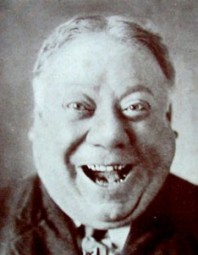
A few years ago, I was sent a catalogue by the photographic agency, Corbis. Among its many images denoting emotions, there was one of a portly, middle-aged man with bright beaming face, categorised under something like ‘surprise’ or ‘happiness’. The person had no further identification. The photograph was of John Bunny, once arguably the most popular and recognised person worldwide, now reduced to complete anonymity.

I can’t find the photograph now on the Corbis web site (which does have one picture of Bunny identified as him). So maybe someone discovered the injustice. I hope so. For John Bunny really was the most popular of silent stars in his day, and the way in which his popularity has so dramatically faded ought to be a lesson to anyone whose head gets turned by the notion of celebrity.

John Bunny (1863?-1915) was the son of a British naval officer who settled in New York, where his son ran away from home to join a minstrel show and then became a stage actor and director. In 1910 he turned to the movies, joining the Vitagraph Company, and almost instantly became a star. He portrayed a rotund, merry, earthy figure, whose genial manner and aptitude for comic characterisation, sometimes touched with pathos, endeared him to millions. He appeared in over 200 shorts between 1910-1914, with such titles as Bunny Buys a Harem, And His Wife Came Back and Bunny’s Honeymoon. He was often teamed with the comically angular Flora Finch. He made some films in Britain in 1913, including Pickwick Papers (he was a natural Mr Pickwick), scenes from which were filmed just around the corner from where I am typing this now. His death in 1915 made headlines around the world.

Why mention Bunny now? Simply because of yesterday’s post with the Vachel Lindsay poems, for there is one last poem by Lindsay on the film stars of the early cinema period which I haven’t given you as yet. It’s the second part of a two-part sequence, the first of which commememorates the actor Edwin Booth, renowned for his performance as Hamlet. For the second part, Lindsay laments the death of John Bunny as if he were Yorick, Hamlet’s fool:

John Bunny, Motion Picture Comedian

In which he is remembered in similitude, by reference to Yorick, the king’s jester, who died when Hamlet and Ophelia were children

Yorick is dead. Boy Hamlet walks forlorn
Beneath the battlements of Elsinore.
Where are those oddities and capers now
That used to “set the table on a roar”?

And do his bauble-bells beyond the clouds
Ring out, and shake with mirth the planets bright?
No doubt he brings the blessed dead good cheer,
But silence broods on Elsinore tonight.

That little elf, Ophelia, eight years old,
Upon her battered doll’s staunch bosom weeps.
(“O best of men, that wove glad fairy-tales.”)
With tear-burned face, at last the darling sleeps.

Hamlet himself could not give cheer or help,
Though firm and brave, with his boy-face controlled.
For every game they started out to play
Yorick invented, in the days of old.

The times are out of joint! O cursed spite!
The noble jester Yorick comes no more.
And Hamlet hides his tears in boyish pride
By some lone turret-stair of Elsinore.

Bunny died of liver failure on 26 April 1915. Today, only a handful of his films survive: A Cure for Pokeritis, Bunny at the Derby, The Pickwick Papers, Bunny all at Sea, Her Crowning Glory, The Wooing of Winifred, and a few more. In truth, his real comic appeal died with him, and it is worth seeing Bunny at Sea for its scenes taken on board a ship where real life passengers laugh delightedly at Bunny’s antics, giving us some indications of the roots of his popular appeal.

Vachel Lindsay wrote evocatively of the first Bunny picture that he saw:

It is a story of high life below stairs. The hero is the butler at a governor’s reception. John Bunny’s work as this man is a delightful piece of acting. The servants are growing tipsier downstairs, but the more afraid of the chief functionary every time he appears, frozen into sobriety by his glance. At the last moment this god of the basement catches them at their worst and gives them a condescending but forgiving smile. The lid comes off completely. He himself has been imbibing. His surviving dignity in waiting on the governor’s guests is worthy of Goldsmith and Sheridan. The film should be reissued in time as a Bunny memoiral.

Whichever title it might be, it’s a lost film now…

Poems by Vachel Lindsay

It’s been a while since we had poetry on The Bioscope. So, to make up, here are three poems by Vachel Lindsay (1879-1931), who if not quite the poet laureate of the silent cinema was undoubtedly the poet at the time most drawn to the medium. For film historians, he may be best known as the author of The Art of the Motion Picture, a somewhat high-flown early stab at film theory, published in 1915 and still in print.

But Lindsay is best known for his poetry, with its jazz-inflected rhythms and contemporary themes. He wrote three poems on actresses who appeared in Biograph films before the First World War: Blanche Sweet, Mae Marsh and Mary Pickford. “I am the one poet”, he wrote, “who wrote them songs when they were Biograph heroines, before their names were put on the screen, or the name of their director”. That’s probably not strictly true, since he had to know their names to be able to put them in the titles of the poems, but nevertheless the poems are at one with his treatment of the moving picture as an art form.

Anyway, here they are: one interesting, one quite good, and one a little nauseating.

Blanche Sweet

Blanche Sweet: Moving-Picture Actress
(After seeing the reel called “Oil and Water”)

Beauty has a throne-room
In our humorous town,
Spoiling its hob-goblins,
Laughing shadows down.
Rank musicians torture
Ragtime ballads vile,
But we walk serenely
Down the odorous aisle.
We forgive the squalor
And the boom and squeal
For the Great Queen flashes
From the moving reel.

Just a prim blonde stranger
In her early day,
Hiding brilliant weapons,
Too averse to play,
Then she burst upon us
Dancing through the night.
Oh, her maiden radiance,
Veils and roses white.
With new powers, yet cautious,
Not too smart or skilled,
That first flash of dancing
Wrought the thing she willed:-
Mobs of us made noble
By her strong desire,
By her white, uplifting,
Royal romance-fire.

Though the tin piano
Snarls its tango rude,
Though the chairs are shaky
And the dramas crude,
Solemn are her motions,
Stately are her wiles,
Filling oafs with wisdom,
Saving souls with smiles;
‘Mid the restless actors
She is rich and slow.
She will stand like marble,
She will pause and glow,
Though the film is twitching,
Keep a peaceful reign,
Ruler of her passion,
Ruler of our pain!

Mae Marsh

Mae Marsh, Motion Picture Actress

I

The arts are old, old as the stones
From which man carved the sphinx austere.
Deep are the days the old arts bring:
Ten thousand years of yesteryear.

II

She is madonna in an art
As wild and young as her sweet eyes:
A frail dew flower from this hot lamp
That is today’s divine surprise.

Despite raw lights and gloating mobs
She is not seared: a picture still:
Rare silk the fine director’s hand
May weave for magic if he will.

When ancient films have crumbled like
Papyrus rolls of Egypt’s day,
Let the dust speak: “Her pride was high,
All but the artist hid away:

“Kin to the myriad artist clan
Since time began, whose work is dear.”
The deep new ages come with her,
Tomorrow’s years of yesteryear.
Mary Pickford

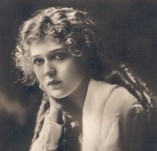
To Mary Pickford: Moving-Picture Actress
(On hearing she was leaving the moving-pictures for the stage)

Mary Pickford, doll divine,
Year by year, and every day
At the moving-picture play,
You have been my valentine.

Once a free-limbed page in hose,
Baby-Rosalind in flower,
Cloakless, shrinking, in that hour
How our reverent passion rose,
How our fine desire you won.
Kitchen-wench another day,
Shapeless, wooden every way.
Next, a fairy from the sun.

Once you walked a grown-up strand
Fish-wife siren, full of lure,
Snaring with devices sure
Lads who murdered on the sand.
But on most days just a child
Dimpled as no grown-folk are,
Cold of kiss as some north star,
Violet from the valleys wild.
Snared as innocence must be,
Fleeing, prisoned, chained, half-dead –
At the end of tortures dread
Roaring Cowboys set you free.

Fly, O song, to her to-day,
Like a cowboy cross the land.
Snatch her from Belasco’s hand
And that prison called Broadway.

All the village swains await
One dear lily-girl demure,
Saucy, dancing, cold and pure,
Elf who must return in state.

To Mary Pickford and Blanche Sweet were first published in The Congo and Other Poems (1914). Mae Marsh was first published in The Chinese Nightingale and Other Poems (1917). The film Oil and Water was made in 1913. David Belasco was the theatre impresario who discovered Gladys Smith and gave her the stage name Mary Pickford.