20,000

The Bioscope has just received its 20,000th visit! It’s been just under eight months in existence, and took the first five to reach the 10,000 mark, so we’re on the up-and-up. Thank you to everyone who reads the outpourings, and do keep on sending me ideas, news and comments.

I thought that to mark the occasion I should point out some of the past posts which have useful reference information, and which have got buried now in the achives, as not everyone may be aware of them:

By far and away the most visited post on The Bioscope has been Searching for Albert Kahn. This is a guide to Autochromes (colour photographs) and the collection of Albert Kahn which featured in the BBC4 series The Wonderful World of Albert Kahn.

There are two posts on the digitisation of newspaper collections worldwide which have materials of value for the study of silent film, Times Past and More Times Past.

There is the eight-part series extracted from a 1912 guide, How to Run a Picture Theatre. Look out for other such series in the future.

There’s the two-part guide to the huge collection of downloadable newsreels, non-fiction and fiction films to be found on the British Pathe site, in British Pathe – part one (the fiction) and British Pathe – part two (the rest). Look out also for Movietone and Henderson, another freely-available newsreel collection – although Movietone was a sound newsreel, the site has a significant early film presence through the remarkable Henderson collection.

There’s a guide to good books on silent cinema, in A Good Read or Two; and a guide to Researching patents, demonstrating what can be found online for free.

Then there are some of my favourite posts: The Silent Worker, on silent films and the deaf; the spectacular Hollywood stage production of Julius Caesar in 1916, described in Shakespeare in the Canyon; the several posts on digitised books such as the 1917 National Council of Public Morals report The Cinema, the Paul McCartney video which uses the Pepper’s Ghost trick, explained in It’s all done with mirrors (well, glass actually); the intrepid war reporter Jessica Borthwick, in A Girl Cinematographer at the Balkan War; thoughts on Martin Scorsese’s wish to save lost films, in Nine out of Ten; discussions of optics coming out of Simon Ing’s book The Eye, in Land and Kinemacolor (the colour experimenter Edwin Land, that is) and The Persistence of Vision; the story of James Joyce’s brief career as a cinema manager, in Visiting the Volta; and the unlikely Croydon pioneer of film achiving, Louis Stanley Jast, whose work is described in Croydon and film archives and The camera as historian.

Plus there’s the Library, FAQs, the latest information on upcoming conferences and festivals, and a Calendar of events. And there are lots of new ideas lined up for the future.
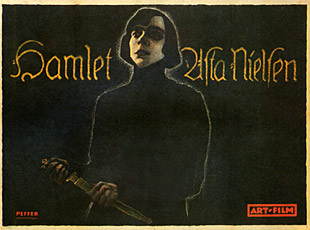
Asta Nielsen’s Hamlet

Hamlet

Asta Nielsen

Just back from the British Shakespeare Association conference, where I was able to tell them about the International Database of Shakespeare on Film, Television and Radio project that I’m supervising. This is an attempt at a ‘complete’ database of all Shakespeare-related titles ever produced in those three media, and so it will of course included all silent Shakespeare films. The ‘interim’ version of the database currently available doesn’t include any silents as yet, and you’ll have to wait for the proper release of the database in summer 2008 to see the full resource in all its glory.

The conference saw the first British presentation (on DVD) of the new restoration of the 1921 German Hamlet, starring Asta Nielsen. A tinted distribution print was discovered recently and has been restored by the Deutsche Filminstitut, using supplementary footage from the French distribution version in the Centre National de la Cinématographie. The film has long been available in black-and-white, but this the first time since the film’s original release that it has been possible to see it in its original colours, the processing work having been done by those acknowledged experts in silent film colour restoration, Haghefilm. The restoration then received its premiere at the Berlin Film Festival.

Hamlet was made for Nielsen’s eponymous production company, directed by Sven Gade and Heinz Schall. It is the best-known of silent Shakespeare films, if not quite (to my mind) the best of those that survive. The extraordinary aspect of the film is, of course, that Hamlet is played by a woman. For this they found academic justification, basing their interpretation on the scholarly endeavours of one Edward P. Vining, whose 1881 book The Mystery of Hamlet posited that the oddities of Hamlet’s behaviour might be explained by the fact that he was a woman in disguise. There had been (and continues to be) a tradition of female Hamlets, including Sarah Bernhardt, a glimpse of whose interpretation was filmed in 1900 (with accompanying sound effects).

Vining’s odd thesis helped legitimise Nielsen’s decision to play the part on film, but it is her luminous, intense performance that justifies it. She is extraordinary in the film, seeking to convey Hamlet’s agonising through diva-like dumbshow alone. The film has its dull patches, plus some unfortunate moments guaranteed to bring out the giggles in a modern audience, since a key aspect of the revisionist plot is that Hamlet is in love with Horatio (cue hoots of laughter when the astonished Horatio discovers, by manual examination, that the dying Hamlet is a woman). Shakespeareans may also be intrigued to find that Claudius dies in a fire, while it is Gertrude who administers the poison which she then drinks by accident – so all of those lying dead at the end of the film are women. The direction seldom rises above the routine, but there is a keen sense of palace life going on while the central figures progressively, and madly, destroy one another. It also gives no sense of a forced conversion from stage to screen – this is a wholly, and successfully reimagined work.

The best thing about the new restoration is its score by Michael Riessler. This blends conventional musical instrumentation with ‘archaic natural sounds’ and electronica. I found it extraordinarily haunting, and sympathetic to the film’s style and performances. The colour is colourful.

I don’t know when the restoration may get further UK screenings, but in the meanwhile, why not take a look at Tony Howard’s newly-published Women as Hamlet: Performance and Interpretation in Theatre, Film and Fiction, which tells the history of women playing Hamlet is a most entertainining and informative way. It has much to say on the film, and has Nielsen on the cover.

Potemkin restored

Battleship Potemkin

http://www.kino.com

Kino International have announced the release, on 23 October, of a two-DVD boxed set of Sergei Eisenstein’s Battleship Potemkin, with the original Edmund Meisel score, played by the Deutches Filmorchestra. This is from a new restoration of the film by the Deutsche Kinematek, and it’s a deluxe presentation, as the Kino blurb indicates:

Odessa – 1905. Enraged with the deplorable conditions on board the armored cruiser Potemkin, the ship’s loyal crew contemplates the unthinkable – mutiny. Seizing control of the Potemkin and raising the red flag of revolution, the sailors’ revolt becomes the rallying point for a Russian populace ground under the boot heels of the Czar’s Cossacks. When ruthless White Russian cavalry arrives to crush the rebellion on the sandstone Odessa Steps, the most famous and most quoted film sequence in cinema history is born.

For eight decades, Sergei Eisenstein’s 1925 masterpiece has remained the most influential silent film of all time. Yet each successive generation has seen BATTLESHIP POTEMKIN subjected to censorship and recutting, its unforgettable power diluted in unauthorized public domain editions from dubious sources. Until now. Kino is proud to join the Deutsche Kinematek in association with Russia’s Goskinofilm, the British Film Institute, Bundesfilm Archive Berlin, and the Munich Film Museum in presenting this all new restoration of BATTLESHIP POTEMKIN. Dozens of missing shots have been replaced, and all 146 title cards restored to Eisenstein’s specifications. Edmund Meisel’s definitive 1926 score, magnificently rendered by the 55-piece Deutches Filmorchestra in 5.1 Stereo Surround, returns Eisenstein’s masterwork to a form as close to its creator’s bold vision as has been seen since the film’s triumphant 1925 Moscow premiere.

BATTLESHIP POTEMKIN
From the Series “The Year 1905”
Russia 1925 B&W/Color 69 Min. Full-frame (1.33:1)
Directed by Sergei M. Eisenstein
Screenplay by N.F. Agadzhanova-Shutko
Head Cinematographer: Eduard Tisse
Music by Edmund Meisel (1926)
Courtesy of Ries & Erler, Berlin
Adaptation and Instrumentation by Helmut Imig
Performed by the Deutsches Filmorchestra (2005)
Restored under the direction of Enno Patalas in collaboration with Anna Bohn
Presented in association with Deutsche Kinemathek – Museum für Film und Fernsehen
supported by Bundesarchiv, Berlin; British Film Institute, London; Gosfilmofond, Moscow; Film Museum, Munich
Licensed by Transit Film
Copyright 2007 Stiftung Deutsche Kinemathek

The extras are Tracing Battleship Potemkin, a 42-minute documentary on the making and restoration of the film, the restored film either with newly-translated English intertitles or with original Russian intertitles (and optional English subtitles), the Meisel score presented in 5.1 Stereo Surround, and a photo gallery. There’s pre-ordering from September. The DVD set is, of course, Region 1.

The Theatre of Science

The Theatre of Science – hard to imagine a general guide to the cinema having such a title nowadays. But Robert Grau’s The Theatre of Science: A Volume of Progress and Achievement in the Motion Picture Industry was published in 1914, when cinema was seen as a home of knowledge as much as place of entertainment (at least among commentators), a product of science and a technical achievement par excellence.

Grau’s book, published in a limited edition of 3,000, has become a standard reference source for the early cinema period. It provides an extraordinary amount of detail on the history and development of motion pictures in America to 1914 – their technological, economic, social and artistic changes, and the key events and personalities involved. Grau (a theatrical agent) was witness to much of the history he describes, and if his understanding of the development of the pictures towards the ideal of the theatre, he was a keen observer who provides hugely useful factual information on histories such as the rise of the nickelodeons and the emergence of a film trade press which scarcely exist elsewhere. He champions the names of pioneers of the industry who would otherwise be forgotten, the run-of-the-mill performers as well as the stars, and the book is rich in portrait photographs. It has much information on the leading and not so leading film companies of the period, and is at all points particularly interested in the business of making pictures. It is thrilled with how motion pictures were made, sold and exhibited, and for that enthusiasm alone it is strongly recommended.

It’s available from the Internet Archive in DjVu (21MB), PDF (66MB), b/w PDF (23MB) and TXT (711KB) formats, and it’s been added to the Bioscope Library.

Licensing Charlie

http://www.simplychaplin.com

There’s a new Charlie Chaplin site that’s just appeared, Simply Chaplin. It’s been set up by the Carlini Group, whose business is usually managing music artists. It does all the usual stuff in giving you the potted history, then ample opportunity to buy DVDs, books, music etc. Video clips and a forum are promised, but the news page is simply items from other sites which have been harvested automatically. You can send an electronic Simply Chaplin postcard, should you so wish. It also has a singularly naff cartoon image of Chaplin on its front page. It’s not the only such site out there with license to sell official Chaplin merchandise – see, for example, www.discoverchaplin.com – quite apart from the official site, www.charliechaplin.com. Presumably the little fellow is still reaching corners of the global market that other silent stars can’t touch.

Kansas Silent Film Festival

Kansas Silent Film Festival

Summer is not yet o’er, and yet there is already news of the silent film festivals coming up for 2008. The Kansas Silent Film Festival, for instance, takes place 22-23 February 2008, at Washburn University, Topeka, and a provisional programme has been announced:

Fri. Feb. 22, 2008, starts at 7 p.m.

A Harem Knight (20 min.) (1926) with Ben Turpin
Only Me (15 min.) (1929) with Lupino Lane
The Kid Brother (84 min.) (1927) with Harold Lloyd
—music by the Mont Alto Motion Picture Orchestra

Sat. Feb. 23, 2008, starts at 10 a.m.

Jack the Kisser (10 min.) (1913) a film by Porter/Edison
Bad Boy (20 min.) (1925) with Charley Chase
Clash of the Wolves (78 min.) (1925) with Rin Tin Tin
—music by Greg Foreman, organ
Coney Island (20 min.) (1917) with Buster Keaton/Roscoe “Fatty” Arbuckle
Leap Year (56 min.) (1921) with Roscoe “Fatty” Arbuckle
—music by the Mont Alto Motion Picture Orchestra
The Mothering Heart (20 min.) (1912) directed by D.W. Griffith, with Blanche Sweet
Dancing Mothers (66 min.) (1926) with Clara Bow
—music by Marvin Faulwell, organ
The Bond (5 min.) (1918) with Charlie Chaplin
The Sinking of the Lusitania (10 min.)(1918) by Winsor McKay
The Big Parade (140 min.) (1925) with John Gilbert/Renée Adorée
—music by Marvin Faulwell, organ, & Bob Keckeisen, percussion

There will be a short break within the final feature film to include a tribute in memory of the 90th Anniversary of the end of WWI

More information, and updates, on the festival website. The festival is free and open to the public.

A little bird tells me…

…that the BBC4 series The Wonderful World of Albert Kahn is due for a repeat soon on BBC2, though this time in half-hour episodes (presumably BBC2 viewers have less of an attention span than the sturdy folk who patronise BBC4). I also hear that there isn’t going to be a DVD release of the series, presumably owing to licensing issues, but that the Albert Kahn Museum in Paris is planning to produce some DVDs of its Autochrome colour photographs (and its films?) which will be available from the museum itself next year… More news as and when I hear it.

Lost and Found no. 2 – Dawson City

Number two in our occasional series of heartening tales about early film collections that have been found against the odds. Lost films have been uncovered in many peculiar places, but none so odd as in a Canadian swimming pool, close to the Arctic Circle.

The now famous Dawson City collection was uncovered in 1978 when a new recreation centre was being built. A bulldozer was working its way through a parking lot when a horde of film cans was dug up. The films had been stored in a disused swimming pool, which had been paved over. The films dated largely from before the First World War, when Dawson City was still a gold rush town, and the final distribution centre for films sent out to the cinemas attended by the ten of thousands of prospectors in the area. Film historian Sam Kula tells us that touring showmen first brought film to Dawson in 1898, while the former Orpheum Theatre re-opeened as the town’s first cinema in 1910, while films could also be seen at the Arctic Brotherhood Hall. Films took a long time to get to Dawson (the newsreels were always hopelessly out of date), but got there they did – but, it seems, they tended not to make the journey back.

Films therefore built up in Dawson, and were eventually stored in the basement of the local library. In 1929, the decision was made dispose of the inflammable nitrate films, which no one wanted to see any longer. It is easier said than done to get rid of nitrate film, and eventually it was decided to place them safely underground. Hence the burial in the swimming pool, where the permafrost ensured their survival in what were, in principal, ideal archival conditions (basically the thing to do with nitrate films is to keep them very cold) until their rediscovery fifty years later.

There were over 500 films in the collection. While none was a most masterpiece as such, they formed a marvellous selection of common cinema fare of the period – titles from studios such as Essanay, Rex, Thanhouser and Selig; obscure titles starring Harold Lloyd, Douglas Fairbanks and Lon Chaney; and many newsreels (including rare Canadian examples). The collection is particularly storng on serials with women heroines: Pearl White in Pearl of the Army (1916-17), Helen Holmes in Hazards of Helen (1915), Marie Walcamp in The Red Ace (1917-18), and Grace Cunard in Lucille Love (1914), The Girl of Mystery (1914) and The Purple Mask (1917), which she also directed.

The Dawson City films have been preserved by Library and Archives Canada and the Library of Congress.

There’s an entertaining essay on their discovery and preservation by Sam Kula, ‘Up from the Permafrost: The Dawson City Collection’, in the excellent book This Film is Dangerous: A Celebration of Nitrate Film (2002), edited by Roger Smither.

Pandora’s Box

Pandora’s Box

Die Büchse der Pandora, from http://www.watershed.co.uk

That excellent venue the Watershed in Bristol is marking its twenty-fifth anniversary with a screening of G.W. Pabst’s quintessential silent Pandora’s Box (Die Büchse der Pandora), starring Louise Brooks. The screening sees the premiere of a new orchestral score by Paul Lewis, and will be held at Colston Hall, and hosted by actor Paul McGann. The score will performed by twenty-five members of the Royal Ballet Sinfonia, and conducted by Lewis himself. The show takes place on 25 September, and is a joint collaboration between the Watershed, Bristol Silents and the Pordenone Silent Film Festival. Further details are available from the Watershed site. Print and score will then feature the following month at Pordenone.

Prakash Travelling Cinema

Part one

Prakash Travelling Cinema is a delightful short film, posted on YouTube by the filmmaker, Megha B. Lakhani. She made the 14-minute film while at the National Institute of Design, India, and it has gone on to win festival awards.

The film documents two friends who maintain a travelling bioscope show on the streets of Ahmedabad. The ramshackle outfit, which they take around on a hand-cart, comprises a genuine c.1910 Pathé projector, adapted for sound, with peep-holes all around the mobile ‘cinema’ itself (which they call their ‘lorry’), through which children watch snippets plucked from popular Bollywood titles. One of the amazing sights of the film is either of the two men hand-cranking their sound projector at exhausting speed.

Part two

Although they are not showing silent films, the whole enterprise is imbued with the spirit of the original travelling bioscope operators of India, and of course the technology hails from the silent period. The word ‘bioscope’ still persists in places in India for cinema, as it does in South Africa. However, the film wants to do more than show a quaint operation, and it is very much about friendship, conviction, Indian society, and the persistence of a human way of doing things in the face of modern media technologies.

There are an estimated 2,000 mobile cinema shows in India today, and the travelling bioscope has been made the subject of other recent films. There is Andrej Fidyk’s 1998 documentary film Battu’s Bioscope, on a modern travelling show in rural India; Vrinda Kapoor and Nitesh Bhatia’s short film Baarah Mann Ki Dhoban (2007), on modern bioscope workers whch also touches on the history of India film exhibition; and Tim Sternberg’s film Salim Baba (2007), again about a modern travelling bioscope show, this time with an adapted 1897 Bioscope. Plus there’s Tabish Khair’s acclaimed novel Filming, published this year, which moves from a travelling bioscope show in 1929 to the Bombay cinema of the 1940s as a means to examine the rise of modern India. Clearly there’s a metaphor in the air.

Prakash Travelling Cinema was made in 2006, and there’s a full set of credits here. The film is in Hindi, with English subtitles, and on YouTube, owing to its length, it comes in two parts.