Channel 4 has had another of its engrossing list programmes; this one was Fifty Films to See Before You Die. And, guess what, there wasn’t a silent film in it. In fact there were only six black-and-white films in it (A Night at the Opera, This Sporting Life, Touch of Evil, A Bout de Souffle, The Apartment and Manhattan). Our film critics, who selected this list, evidently see very little beyond their own lifetimes. And clearly many of them do not see silent films at all – probably literally so. Do we have separate film histories here? It’s been interesting to see in some recent film histories and reference books how themes in film history often seem to start in 1930, or are divided up into the silent and sound eras. Silent cinema has become a foreign country.
Category Archives: Television and radio
Searching for Albert Kahn
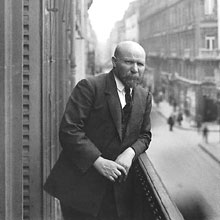
Albert Kahn, from http://www.ejumpcut.org © Albert Kahn Museum – Département of Hauts-de-Seine
A lot of people are coming to this blog in search of information on Albert Kahn, following the BBC4 series The Wonderful World of Albert Kahn. The Kahn collection is best known for its still photographs, which largely lie outside the concerns of The Bioscope, but he did employ motion picture cameramen too (as well as acquiring film from other collections), so here’s a short account of his Archives de la Planète, and some pointers on where to find out more.
Albert Kahn was a millionaire Parisian banker and philanthropist who decided to use his fortune to document the world in photographs. Between 1908 and 1931 he sent out still photographers and motion picture cameramen to create a photographic record of the globe. The project was supervised by geographer Jean Brunhes, who employed around eleven cameramen who visited forty-eight countries and brought back 72,000 Autochrome colour plates, 4,000 steroscopic views, and 600,000 feet of film. They also acquired film from commercial companies, including newsreels and scientific films. Kahn called the project the Archives de la Planète. Kahn lost his money in the Depression, bringing an end to the project, but the collection survived. It has remained remarkably little known, particularly the film component, but a steady trickle of academic interest in recent years has now been followed by the success of the BBC4 series, which has rightly startled people with the beauty of the images and the sheer extent of what they recorded.
Most of the film collection is in the form of unedited rushes of actuality subjects: everything from film taken in Mongolia in 1912-13, to the signing of the Briand-Kellogg Pact in 1928, A.J. Balfour visiting Zionist colonies in Palestine in 1925, fisheries in Newfoundland in 1922, and dancers in Cambodia in 1921. Kahn’s cameramen included Stephane Passet, Lucien Le Saint, Léon Busy, Frédéric Gadmer, Camille Sauvageot and Roger Dumas.
There is an informative and thoughtful article by Teresa Castro, ‘Les Archives de la Planète: A cinematographic atlas’, which is a good place to start, and has some beautiful Autochrome illustrations.
There is no Les Archives de la Planète or Albert Kahn website with a collection of the images on show (update: the BBC has now created www.albertkahn.co.uk). The Hauts-de-Seine.net site has some pages on the Musée Albert Kahn giving basic information and access details, in French. [Another update: the link is now www.albert-kahn.fr]
The Museum is located in the Paris suburb of Boulogne-Billancourt, and is renowned for its beautiful gardens. There is a plain official web page describing these, but you are better off reading the evocative New York Times article, ‘Philosophy in Bloom’, by Jacqueline McGrath, which describes a visit to the gardens (which are apparently not to easy to find).
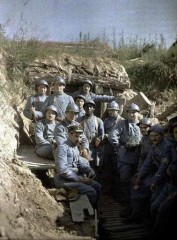
Autochrome of French troops during First World War, from http://www.worldwaronecolorphotos.com
If you are entranced by Autochromes, there are several good sites to visit. This year (2007) sees the centenary of the Autochrome, recognised by www.autochrome.com [link now dead]. The highly recommended Luminous Lint photography site has an explanation of the ingenious Autochrome photographic process, involving the use of dyed potato starch grains acting as colour filters, which helped give them their particular ‘impressionist’ effect.
The site World War I Color Photos has some astonishing images from a conflict we generally only imagine in monochrome. Australian and French First World War Autochromes are reproduced on the Captured in Colour site (which also displays the Paget plate colour system). And there are more First World War Autochromes on the Heritage of the Great War site (though do note this site mixes these up with other coloured images, including artifically-coloured postcards).
The Library of Congress has a page on the restoration of Autochromes. There is an exhibition of the expressive Autochrome work of Gabriel Veyre at www.gabrielveyre-collection.org (Veyre did not work for Kahn but was previously a film cameraman with the Lumière brothers, inventors of the Autochrome). George Eastman House has an online exhibit of eighty Autochromes from the Charles Zoller collection, reproduced in high resolution. The Galerie-Photo site has an exhibition of Autochromes (originally stereoscopic i.e. 3D), with some interesting technical observations.
American academic Paula Amad has written “Cinema’s ‘sanctuary’: From pre-documentary to documentary film in Albert Kahn’s Archives de la Planète (1908-1931)” for the journal Film History, the best single source for information on Kahn’s project, and is writing a book on the collection.
The site www.autochrome.org [link now dead] doesn’t have that much information, but it does tell you in detail how to make your own Autochromes the original way (it’s not easy). If you don’t want to try the original potato starch method, why not use Photoshop? PhotoshopSupport.com will show you how.
Pioneering scientific filmmaker Dr Jean Comandon was one of those who worked for Kahn, late on in the project, as the Institut Pasteur explains (in French).
Definitely the book on Autochromes to buy is John Wood’s The Art of the Autochrome. There will be no more beautiful title on your bookshelves.
Lastly, look out for the National Media Museum’s forthcoming exhibition The Dawn of Colour: Celebrating the Centenary of the Autochrome, which opens on May 25th.
Update (April 2008): The BBC has now produced an Albert Kahn website, www.albertkahn.co.uk, which has information on Kahn, the autochromes and the Albert Kahn museum, as well as promoting the new BBC book The Wonderful World of Albert Kahn: Colour Photographs from a Lost Age. No plans have been announced for a DVD release of the BBC series, presumably owing to licensing issues. However, the Kahn museum section of the new BBC site refers to some DVDs, without going into further details. It has been rumoured that the museum was planning to produce some DVDs of its own, showcasing its Autochrome colour photographs (and its films?). This may be a reference to these, which do not seem to have been published as yet.
Another update (March 2009): There are faint rumours of a possible DVD release, in some form. However, the original The Wonderful World of Albert Kahn series is now available on DVD from the BBC, but only from its educational service, BBC Active, where it is priced at an eye-watering £1,125 for 9x50mins DVDs – the intended market is institutions only. This existence (and price) of this would suggest that any subsequent commercial release to the public will be highlights in some form.
And another update (September 2009): There is now a proper website for the Musée Albert Kahn, at www.albert-kahn.fr. It’s all in French, but includes several examples of the autochromes, photographs of the museum and gardens, a biography of Kahn, and news of exhibitions etc.
Final (?) update (September 2009)
Good news – the BBC has brought out the series on DVD. The Wonderful World of Albert Kahn is a 3-disc set (PAL, region 2), divided into nine parts, running 462mins. It’s released by 2 entertain, which is part-owned by BBC Worldwide.
The Wonderful World of Albert Kahn

Autochrome of a fringe-maker in Galway, Ireland during May 1913 © Musée Albert Kahn
The BBC4 Edwardians season has just shown part one of a nine-part series on the remarkable Albert Kahn collection of early colour photographs and actuality films, taken from Kahn’s Archives de la Planete. Kahn was a millionaire Parisian banker who decided to create a visual record of the world in the early twentieth century using the new Autochrome photograph process invited by the Lumière brothers (also inventors of the Cinématographe, of course). He sent photographers to over 50 countries. They took more than 72,000 colour pictures and around 100 hours of (monochrome) film footage, recording sights and scenes across the world in an unprecedented documentary exercise.
The first four parts are being shown under the slightly misleading title of The Edwardians in Colour. The remaining five parts will feature in a future set of programmes on the 1920s.
Update: For background information on Albert Kahn, and links to various sources, see the Seaching for Albert Kahn post on this blog.
Edwardian hoodies
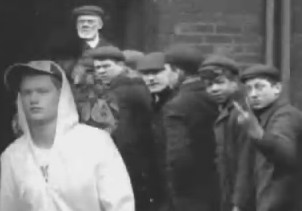
Anyone watching BBC television at the moment will have seen the trailer for the BBC4 Edwardians season. The trailer uses footage from the now renowned Mitchell and Kenyon collection of mostly actuality films of life in nothern England 1900-1914, digitially treated to mix the people of Edwardian times with such modern figures as a pizza delivery motorbike, a ‘golf sale’ signboard, rock concert fans, a policeman with a gun, and a hoodie. So of course they’re just like us and we’re just like them. You can see the trailer here (click on ‘Watch the season trail’).
Update – For all those who have been looking, the music that accompanies the trailer is Fashion Parade, by Misty’s Big Adventure. More details from the band’s MySpace site.
Chaplin – listen again
Charlie Chaplin
The Mark Kermode Radio 3 programme Chaplin, Celebrity and Modernism was excellent. It pursued the thesis of Chaplin as subversive everyman, beloved by not just by cinema audiences, but by modernists, Dadaists, surrealists, politicians, writers and fellow filmmakers. Kermode admitted that, in common with many modern critics, he had dismissed Chaplin as a sentimentalist, inferior as a film artist to Buster Keaton. Instead, he discovered Chaplin’s essential role as a figure (there was much emphasis on his body) of modernism. You got a real sense of a need to rediscover Chaplin as one of the key figures of the twentieth-century, given all that he meant to society and the worldwide broadcasting of images and ideas. That said, Chaplin is an everyman figure no more, despite his image being used in advertising around the world. So our everymen change, and that is part of his significance too.
Contributions from David Robinson, Mike Hammond, Tom Gunning, David Thomson, Michael Chaplin, Geraldine Chaplin and comedian Mark Steel. It will remain available online for the next week through the Listen Again service. Don’t miss it.
Chaplin, celebrity and modernism
There a programme in the Sunday Feature slot on BBC Radio 3 tonight (21.30 GMT), called Chaplin, Celebrity and Modernism. Thirty years after Chaplin’s death, Mark Kermode investigates the great comedian’s celebrity role and influence on world culture from the modernists and Dadaists to the Russian avant-garde and imitators in Bombay. The 45-minute programme makes use of privileged access to Chaplin’s private archive to reveal remarkable letters from Truman Capote, Winston Churchill and James Agee. As usual with BBC radio programmes, it can be listened to worldwide online, and will remain available for a week thereafter through the Listen Again service.
Chaplin saved
Despite Ian Hislop’s best efforts, Charlie Chaplin was saved from Room 101 because Paul Merton refused to put him there (see previous post). Hislop railed against not only Chaplin but “all silent films”. Merton called on pianist Neil Brand to accompany Chaplin clips on the big screen, followed by ‘silent’ film of Hislop himself. The audience seemed to lap it up, but Hislop remained stonily unconvinced.
Room 101

Look out on British TV for the comedy programme Room 101 on Friday 9 February at 22.00. The guest is Private Eye editor Ian Hislop nominating his pet hates for consigning to Room 101, and they include Charlie Chaplin. The doyen of silent film pianists, Neil Brand, will be accompanying a Chaplin clip with the hope of saving Chaplin’s reputation. the programme is hosted by silent film comedy enthusiast Paul Merton, who will hopefully put up some form of defence. We’ll have to see.
 The Bioscope