Treasures from Europe

Bucking Broadway

John Ford’s Bucking Broadway (1917), from Europa Film Treasures

It’s here at last folks, Europa Film Treasures, the long-awaited online archive of assorted gems and oddities from film archives across Europe, created by the continually wonderful Lobster Films of Paris.

It’s a collection of truly disparate material, fiction and non-fiction, live action and animation, short and feature-length, ranging from 1898 to 1999. There are films from Austria, Denmark, Finland, Great Britain, the Netherlands, the USA and more. Participating archives include the Deutsche Kinemathek, Det Danske Filminstitut, GosFilmoFond, Filmarchiv Austria, the Scottish Screen Archive, the Imperial War Museum Film and Video Archive, Lobster Films itself, and many more, though several archives only contribute the one title (and some, such as the BFI, which had previously announced that they would be contributing, have not done so – yet).

And what will you find there? Well, there are early actualities by Danish cinematographer Peter Elfelt, pornography from Austria, Biblical lands film from 1906 (these are some of the films shown at Pordenone in 2007 when they were thought to be of an earlier date – see this post – clearly more identification work has been done since then), dance films, a Russian fish processing factory documentary, comedies (including Max Linder), trick films, science fiction (Walter Booth’s The Airship Destroyer from 1909, an important film listed here under a German title, Der Luftkrieg der Zukunft), Spanish newsfilm, Russian Yiddish drama, one of John Ford’s first Westerns Bucking Broadway (1917) – the only non-European title on view, the extraordinary Der Magische Gürtel (1917) – tracking the trail of destruction wreaked by a German U-Boat, French public health films, abstract animation from Viking Eggling, Soviet puppet animation, and more, much more.

This is a wonderful treasure trove, certainly highly eclectic. Some may be disappointed not to find a greater range or more familiar material, but they should be encouraged to explore. They will be amazed and delighted, I hope. Each film comes with credits, background description (in somewhat quaint English, clearly translated none too comfortably from French), and the films are all shown in Flash. A library of documentation and teaching resources are promised soon. There are a number of search options, allowing you to search by archive (the search option says Films), time period, country, genre etc, but finding an individual title (especially as few are in English) is a little laborious. And it’s available in English, French, Spanish, German and Italian.

There’s background information on the European-funded project in an earlier post. Up to 500 titles are promised eventually (there’s around fifty up so far), so clearly it’s a site to visit again and again. There were reports that the funding would only support the site for a year – and then what? I’ll try to find out. Meanwhile, go explore.

Times for free

http://archive.timesonline.co.uk

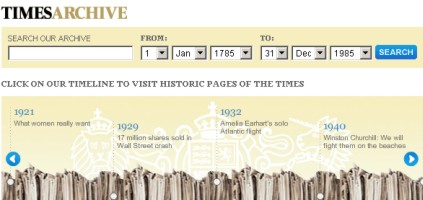
Regular readers will know how we try to track the availability of digitised newspaper online, highlighting the great opportunities they provide for researching silent cinema subjects. Now, seemingly out of the blue, The Times has made its archive freely available online. Previously available only to institutions by subscription, the Archive of 20 million articles dating 1785 to 1985 has been opened up to everyone.

To make use of the service you have to register with Times Online, during which process it is revealed that the archive is being made available for free for a limited period only, so grasp the opportunity while you can. But presumably an individual user subscription service will eventually follow (as employed by The Guardian Archive), which will be a boon long-term for the researcher not attached to an academic institution.

Those who have used the Times Archive before now (i.e. via Gale) will notice small differences in searching (only a basic search option – keyword and date) and results, but there is one major new feature. User are now provided with the OCR text i.e. the underlying, scanned text, which isn’t available with the Gale version. The option is called Full Text. This is great for copying and pasting, but do note it’s uncorrected text (the OCR software reads what it can, but sometimes struggles with unclear type). Here, for example, is the uncorrected text of The Times‘ report on the debut of the Kinetoscope in Britain, from its issue of 18 October 1894:

The latest, and not the least remarkable, of Mr. Edison’s inventions is the kinetoscone, of wnhich a private demonstration vas given last evening at 70, Oxford-street. This instrument isv,o the eye what Edison’s phonograph is to the ear,1An that it reproduces living movements of the most complex and rapid character. To clearly understand the effect it is necessary to explain the cause, but to appreciate the result the working of the invenzion m3ust be wit- nessed. The moving and, apparently, living figures in the kinctoseope rre produced iii the following manner :-3r. Edison has a stage upon which the per- fcrmances he reproduces are enacted. These perform- ances are recotded by taking a series of 43 photographs in rapid succession, the time occupied in tal.ing them hu-ing one second only. Thus every grogressive phase oa every single action is secured, an the photographs are successively reproduced on a film or celluloid of the length required for recording a gircn scene. When this film is passed before the eye at the same rate of speed as that at which the photographs were tae1cn the photographically disjoiuted parts of a given action are united in one comDlete whole. Tus, hsu posing a per-on to be photogranhed tlkng off his cat -as is done in one case-the successive views repre- senting the phase of action at every 4Zrd part of a second are joined up, and the complete operation of talking off the coat is presented to tLe eve as it would appear in reality In other words, the kinetoscope is aperfect reproduction of living action without sound. The apparatus in which ihis reproduction takes place is a cabinet about 4ft. high, 2ft. wide, and lIt. Oin. deep. It contains the celluloid film band, the apparatus for reconstructing the disjointed views and a small electric motor for driving the apparatus. The chief detail of the mechanism is a flat metal ring havingo a slot in it, ;hich makes about 2,000 revolutions per mitnute. The film pusses rapddl over the ring, beneath which is a light. The spectator looks tnrough a lens on to the film, and every action recorded on it pasSe under his view. Ten machines here shown in ohich the most rapid and compler actions wrere faithfullly reproduced. One scen,e repre- sentS a blacksmith’s shop in full ope.-ation, with tbree mnen hammering iron on an anvil, and wvho stop in their work to take a drink. Eiach drinks in turn and passes the pot of beer to the other. The smoke Frmm trhe fon.Te is seen to rise most perfectly. In another view a Spanish dancer is showvn going through her graceful evolutions, as is also Amna Belli in her serpentine dance. There is likewise a wrestling scene and a cock fight, in which the feathers are seen to fly in all directions. All the featnres of an original stage productioa are given, of course on a small scale, but possibly only for the vresent on a smaU scale, for 21r Edison promises to add the phono- graph to the kinetoscope and to reproduco. plays. Then by amplifying the ph nu”rapl and throwing the pictures on a screen, ma’fg them life size, he will give the world a startling reproduction of iluman life. THE KIATUTOSCORE.

So, in need of a little editing, and also a warning that any keyword you type in will not yield every instance of that word across the whole of the Archive (and if you type in the word KIATUTOSCORE, sure enough you get the above article).

The Times Archive has already become a standard academic reference source, an online journal of record to match the paper’s print pretensions, and the exciting route to countless new research avenues. Free or paid for, this is going to open up the resource still further. How truly lucky we are.

There’s more information on using the Times Archive and other digitised newspaper collections for searching silent cinema subjects in an earlier Bioscope post, but it’s high time we have a round-up report that covers all the resources that have appeared over the past year (with more promised soon). I’m working on it.

Update: The free offer ends on 18 September 2008. Thereafter there is to be a charge for viewing search results, with three ways of charging: Day pass: £4.95, Monthly membership: £14.95, or Annual membership: £74.95.

Moving Image Source

New York’s Museum of the Moving Image had just published Moving Image Source, a combination of online journal and directory of information. The latter, called Research Guide, provides “a gateway to the best online resources related to film, television, and digital media.” There are several familiar sites listed but also an interesting sprinkling of unfamiliar sites on silent cinema, which I shall explore and pass on the fruits of my discoveries where appropriate. It’s all helpfully laid out and each site is described in a succinct line or two. And it would be even better if only they had thought to provide a search function…

Cartoon capers

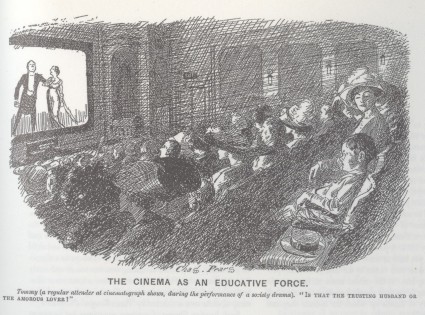
‘The Cinema as an Educative Force. Tommy (a regular attender at cinematograph shows, during the performance of a society drama). “Is that the trusting husband or the amorous lover?”‘ Charles Pears cartoon in Punch, 7 August 1912, from I Want to See This Annie Mattygraph

One of the most interesting ways to examine contemporary perceptions of the silent cinema is through cartoons – newspaper cartoons, that is, rather than animated cartoons. Cartoons in the popular newspapers, comics and magazines of the day provide a marvellous measure of how the new phenomenon of cinema was commonly understood, since cartoons had to tap into a general feeling about the subject. Everyone had to be in on the joke for it to work. And more than simply recording popular sensibility, cartoons of the era pick up on changes in such aspects as technology and film-going habits, providing a valuable documentary record as well as a social history one.
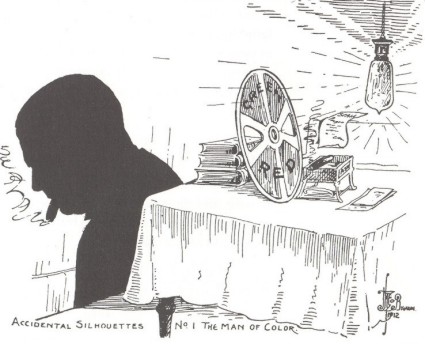
‘Accidental Silhouettes no. 1: The Man of Color’, a cartoon of Charles Urban by Theodore Brown, from The Bioscope 22 February 1912

The film trade papers of the day are another source of cartoons and caricatures, not always so polished or so funny, but often picking up on minutiae of film business concerns which are of value to the specialists, or simply providing the only portraits we have of some of the film personalities (i.e. those behind the camera) that we have. Theodore Brown, editor of the British journal The Kinematograph and Lantern Weekly, unusually was also an occasional cartoonist (and a filmmaker, and an inventor), and provided the above cartoon of film producer Charles Urban, shown silhouetted via a Kinemacolor filter, which regulars will recognise provides my avatar in the comments to posts on this blog.
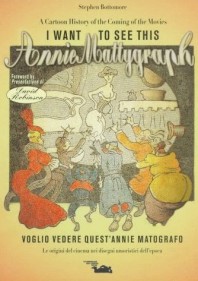
Cartoons on silent cinema are scattered all over the place, and tracking them down can be a laborious business – more often than not the research stumbles across them by chance, or else works their way through the well-thumbed pages of Punch, which never fails to come up with the goods of some sort. There is, however, one book – and a very good book – on the subject, Stephen Bottomore’s I Want to See This Annie Mattygraph: A Cartoon History of the Coming of the Movies (1995). It must be said that the mixture of ungainly title and bi-lingual text (English/Italian) has not helped the book’s acceptance outside the hardy band of early film buffs. (The phrase that gives the book its title comes from a cartoon where a man asks at a box office if he can see what he assumes is an actress but of course the Animatograph projector – how they laughed in 1897). But within lies a rich selection of contemporary cartoons from across Europe and America, arranged around such themes as ‘Going to the Pictures’, ‘Opposition and Rgulation’ and ‘Film Genres’, providing a history of the cinema to 1915 through the pictures that made people at the time laugh about it. It is scholarly, observant and great to look at. I particularly value it for the cartoons of cinema-going, where you find evidence of exhibition practice and audience habits that really aren’t recorded elsewhere. Its opening essay also provides a valuable history of the cartoon over and above its relationship to film history.

But what can you find online? Not a lot, unfortunately, but one worthwhile source to direct you to is the British Cartoon Archive. This is based at the University of Kent at Canterbury, and is effectively the national collection of cartoons. Navigation on the site is a little unclear, but persevere and you’ll eventually find its database, which provides access to 120,000 cartoons, each illustrated with thumbnail image (click on the image for a larger view) and accompanied by exemplary cataloguing information, including an exhaustive array of thesaurus terms, the names of all real people featured in the cartoon, and transcriptions of the text.
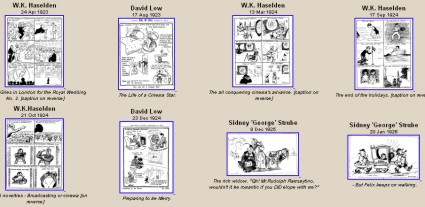
Sample database search result with cartoons by W.K. Haselden, Sidney ‘George’ Strube and David Low

The Archive is rightly particular about protecting copyright images, so no reproductions here bar the web page picture grab above. But type in terms like ‘film’, ‘cinema’ etc and you’ll find such telling cartoons as W.K. Haselden’s ‘The all-conquering cinema’s advance’ (1924), where cinema screens crop up everywhere you look (even at Stonehenge), or David Low’s ‘Continuous show now on’ (1926) which comments on the beleaguered state of the mediocre British film industry, unable to compete against the block-booking Americans, while the overpowering attractions of an American vamp obscure those of the ‘pure but dull British film heroine’.

There are only so many cartoons there on the silent era, but more than enough to pick up on the social perceptions of the time. Look out too for David Low’s ‘Topical Budget’, a cartoon news commentary series which took its name from a popular newsreel of the silent era. There’s a lot more to explore on the British Cartoon Archive site, in particular a collection of biographies of the cartoonists.

There are other, far smaller sites out there marketing mostly Punch cartoons, but nothing that I can see that provides the opportunity to look at early cinema subjects. The various newspapers that have been digitised tend to be of the broadsheet variety, which did not stoop to such things at this time. The British Library provides a useful overview of comics from the era, such as Ally Sloper’s Half-Holiday and Comic Cuts, as well as titles like Film Fun, which began in 1920 and was entirely given over to comic strips featuring popular film stars. Other sites and databases offer just an image or two, provide descriptive lists of what they have but no images, or else a subscription is required. Or they don’t cover early cinema, of course. For a good listing of sites worldwide, go to the Intute: Art and Humanities site (an excellent UK academic service describing online scholarly resources) and type in ‘cartoons’.

Finally, it’s worth noting that a number of cartoonists of the era went on to become filmmakers. Among the best-known are Emile Cohl, Winsor McCay (‘Little Nemo’) and Harry Furniss. Cartoonists were filmed by the early filmmakers, often doing ‘lightning sketches’ (speedy drawings over a preparatory sketch), such as Tom Merry, J. Stuart Blackton and several British artists who contributed political sketches to proto-cartoon films during the First World War. The Library of Congress’ American Memory site includes Origins of American Animation, which demonstrates the interrelationship between paper and screen cartoons 1900-1921.

If anyone knows of other online sources for newspaper and comic journal cartoons which cover our period, do say.

Live searching

The British Library (the noble institution where I happen to work) has been engaged for some time in a major project with Microsoft digitising some 100,000 books from the nineteenth century. Around 30,000 of these have now been made public available through Microsoft’s Live Search facility (to UK users only). I haven’t investigated this collection to see what possible texts on moving images it might contain, but the news has drawn my attention to Live Search as research source, which I’d quite overlooked.

You will find many digitised historical texts there, as well as current texts where there is limited access (e.g. to 10% of the content), much as you do with Google Books. In truth, the two resources offer much the same results and extras, but I find Live Search superior for the clarity of layout, ease of navigation, the linkages offered, and the word searching. Click in a search term such as ‘cinematograph’ – 1,860 hits – and for each title you get the book record, publication information, hyperlinks to where the search term appears in the digitised text, links to World Cat (if you want to find it in a library somewhere), and where available the opportunity to download the book from the Internet Archive. It is this latter option that particularly appeals, because it offers a far better means to search through texts on the Internet Archive than the Internet Archive provides itself (there you can only search titles and a limited synopsis). Hence many more titles turn up with relevant material for early film studies, including texts not directly about the movies but which have handy incidental information. I’ll be bringing you the results of some of these in future posts.

Update (May 2008): Microsoft has just announced that it has withdrawn Live Search Books, as well as winding down its book digitisation programme. More information here. Sorry.

In the dock

Cinematograph theatre in Lordship Lane, London, in 1913, from http://commons.wikimedia.org

Let us celebrate the Bioscope’s imminent passing of the significant milestone of its 100,000th visitor (hurrah) by looking at a major new research resource for British historical studies in general which offers some minor but intriguing opportunities for the early film historian.

The Proceedings of the Old Bailey Online is just that – a fully searchable edition of digitised texts from London’s central criminal court, with details of 197,745 criminal trials. These are trial reports originally published for general consumption. Previously this remarkable resource (a collaboration between the Open University, and the Universities of Hertfordshire and Sheffield, funded by the Arts and Humanities Research Council and the Big Lottery Fund) covered the years 1674-1834. Now the collection has been augmented by texts of trials going up to April 1913 (when the printed Proceedings ceased publication). This makes it an obvious boon for historians of the nineteenth and early twentieth centuries, with a wealth of social detail alongside the intrinsic interest of the trials themselves. It is also a source of huge interest to family historians, who are exploring with nervous/eager anticipation to see if any of their forbears ended up in the dock (I’ve found one such forbear, but happily he was merely a witness to a crime). It is easy and helpful to use, and utterly engrossing to read.

So, given that the records go up to 1913, what is there for the film historian? Well, not a huge amount, but enough to merit further exploration by somebody. There are both cases which involve motion pictures, and cases where the accused or witnesses attended film shows which are recorded as part of the evidence.

For example, consider the case of Manuel Goldberg, alleged user of counterfeit coinage, from 8 January 1907. We get this evidence from one of the witnesses:

LOUISE VALLERS, wife of Henry Vallers, 129, Whitechapel Road, E. We keep a Bioscope Exhibition. I was there on the evening of December 22 last, between five and six, when prisoner came in on see the exhibition. The charge for admission was one penny. He tendered a half-crown. The people pay at the door as they enter. This is the coin marked by myself. I took it and gave him two separate shillings and fivepence change. He said to me, “Are there no tickets?” I said, “No,” and he went to the door again and beckoned to another man to come in. The other man came up, and he also gave me a half-crown for his admission, for which I gave him two and fivepence change. This is the one. I looked at them, being two half-crowns looked suspicious. I tested both of them with acid, and found they were bad. The second-man kept by the doorway, but the prisoner walked right to the end of the shop and sat down and waited for the exhibition. When the second man noticed that I saw the coins were no good, he took to his heels and ran away. I then closed my shop door and sent for a constable. I went up to prisoner, and said, “This half-crown ie no good to me,” and detained him till the other people in the shop had left. I gave him the coin back again. He simply said, “Not” and gave me a two shilling piece and ten halfpennies for his half-crown. A constable came in and I gave him in charge.

This is incidental evidence of a very early cinema in London, from which we learn its location, ownership, the price of admission, the ticketing policy, and the fact that, interestingly, the owner refers to the business as a shop (many early cinemas in London were simple shop conversions). He was found not guilty, by the way.

Next, this simple case report from 20 April 1909:

THOMPSON, William (31, operator), pleaded guilty of stealing two spools and four cinematograph films, the goods of Herbert Crow; also to stealing two spools and six cinematograph films, the goods of Horace Liver and another; also to stealing three cinematograph films, the goods of Frederick Weisker and another.

He confessed to a conviction for felony in 1906 in the name of Albert Storer. Several other convictions were proved, dating back to 1891. It being stated that another charge against him was pending, he also pleaded guilty to that in order that the Court might deal with all matters against him up to date.

Sentence, Two years’ hard labour on each indictment, to run concurrently.

And so on. It is necessary to use a variety of search terms to find relevant material. I’ve found evidence (as it were) using Bioscope, Cinematograph, Cinema, Biograph, Film (though look out for errors in the optical character recognition – a lot of ‘films’ should actually be ‘firms’) and Picture Palace. With the latter you get many glimpses of the regular habit of cinema-going at this time. Use the term Living Pictures, and you find the trial of the renowned anachist group behind the ‘Houndsditch Murders’ and the Siege of Sidney Street, as in this testimony from Luba Millstein :

When I got back to No. 59 Dubof was there; I cannot remember what time he left. Later that night Trassjonsky and I went to see some living pictures. On returning she and I were staying in the back room; Fritz and Trassjonsky lived there together. About midnight I heard two people coming upstairs. On my going to the front room door and knocking Fritz told me I must not come in. A little later the men left and I went with Trassjonsky into the front room and there saw the body of Gardstein lying on the bed. I heard a conversation between Fritz and Trossjonsky. Fritz told her that Morountzeff was wounded…

The only name from the British film industry that I’ve come across is J. Brooke Wilkinson, the future head of the British Board of Film Censors, who in December 1911 was a witness in a case of forgery.

As someone who is researching cinema-going in London at this period, the Proceedings of the Old Bailey Online is an absolute treasure trove to me. But there are other aspects there well worth pursuing, particularly relating to bankruptcy and fraud. Or maybe you’ll just what to find out if those rumours about great-grandfather’s criminal past are really true or not…

Now with added movies

Film medical realizat de profesor G. Marinescu (1898-1901)

Some you will know that as well as keeping the Bioscope bubbling along I manage other sites, including Who’s Who of Victorian Cinema, which I co-edit with Stephen Herbert. The site is based on our 1996 BFI book, Who’s Who of Victorian Cinema: A Worldwide Survey, and documents the lives of 200 or more people who were active in motion pictures before 1901. We keep the information up-to-date, add new names and resources, and the reason for this notice is that we’ve just added a new feature: links to Victorian films online. We haven’t got into hosting our own films (yet), but where there are freely available films, on YouTube, American Memory and such like, we’ve added links to the relevant individual’s entry on the Who’s Who.

We’ve also created a Films Online page in our Resources section, which offers a selection of films (all from YouTube so far), demonstrating the great variety of the form. For example, not everyone considering films of the late nineteenth century would think to include the works of the Romanian Gheorge Marinescu, whose studies of the movements of patients suffering from severe nervous diseases you can see included in the above compilation film (itself clearly post-1901).

We’ve tried to keep to legitmately available titles only, so there’s nothing from the Lumières (all still in copyright) or Georges Méliès (the only stuff available online has all been ripped from commercial DVDs). But we’ll add more where we can. One last point – all of the films that we show or link to relate to the individuals’ career pre-1901, so we don’t show anyone’s work from a later period. Do take a look.

Kansas Board of Review Movie Index

Following the item a couple of months back on the New York State Archives’ film censorship records, let’s now turn our attention to the Kansas Board of Review Movie Index.

The index covers all films assessed by the Kansas Board of Review, 1910-1966, for which some change was demanded prior to public screening – ranging from from cutting of brief scenes to the banning of entire films. The original index, held on 3×5 index cards, lists the date, number of reels, title, film company and whether accepted, rejected or to be accepted only with specified eliminations to be made. Cards for films with such eliminations contain a detailed description of the portions to be censored, and it is these that make the online version of this index so fascinating.

The Movie Index site explains the procedure:

In its earliest existence, the board was required to “Approve such film reels, including subtitles, spoken dialogue, songs, other words or sounds, folders, posters and advertising materials which are moral and proper” and to censor films that were “cruel, obscene, indecent or immoral, or such as tend to debase and corrupt morals.” The board accomplished this daunting task by requiring that all films to be shown in the state first be passed by a board of three censors. This board had the power to remove any scenes that it felt met the aforementioned criteria. The board also could ban films in toto (as it did with D.W. Griffith’s Birth of a Nation from 1915 to 1923 for “inciting racial hatred and sectional bias”). After being reviewed and edited, the film was then tagged with a unique serial number that identified the film as having been reviewed and passed.

Although Birth of a Nation was accepted for public exhibition in Kansas, it could only be so following eliminations made, as the Index record demonstrates:

The Birth Of A Nation
Date of Review: 1923-11-27
Company Name: States Rights
Starring: Not Stated
Notes: Film was approved with elimination. Sam Silverman submitted a sound version on 3/23/31 which was examined and disapproved 11/12/31 because of tendency to debase & corrupt morals.
Contains Smoking? Not Stated
Eliminations: Reel 2: Reduce to flash mulatto woman on floor with bare shoulders. Reel 2: Eliminate scene of Stone embracing mulatto woman. Reel 4: Eliminate scene of soldier piercing body of fallen man with bayonet. Reel 5: Eliminate scene mulatto woman fondling arm of Stone. Reel 9: Eliminate closeup of negro’s face looking through trees. Reel 9: Reduce scenes of negro chasing girl. Reel 11: Reduce scenes of Lynch holding Elsie and looking sensually at her.
Box Number: 35-06-05-12

You can search by film title, company name, performer, specific elimination (the term “negro” brings up thirty-two hits) and date range – just searching on 1910-1929 alone brings up 4,638 hits. A first rate resource, compiled by volunteers it seems, to whom all praise.

So far as I know there aren’t any other American state censorship records available online, apart from New York and Kansas, but I’d be very interested to hear from anyone who can tell me otherwise.

Where the wild things are

Percy Smith

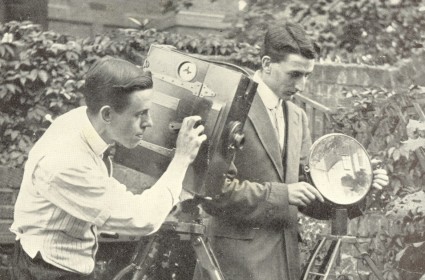
Percy Smith (left), from F.A. Talbot’s Moving Pictures: How They are Made and Worked (1912)

It’s been a long time in coming, but it’s been well worth the wait. Today saw the launch of WildFilmHistory, a site dedicated to recognising 100 years (so they say) of wildlife filmmaking. Produced by the Wildscreen Trust and supported by Lottery funding, this is a multimedia guide to one hundred years of natural history filmmaking, from the pioneering days when stop-motion films of flowers opening wowed them in the music halls to the age of Attenborough and beyond.

The site is biographical in focus, and at its centre are ninety-one (so far) mini-biographies of wildlife filmmakers, twenty-nine of them with accompanying oral history recordings, which very usefully come with PDF transcripts. So you get interviews with the likes of David Attenborough, Hans and Lotte Haas, Desmond Morris, Tony Soper and the late Gerald Thompson, but also the academic Derek Bousé, whose excellent history Wildlife Films investigates our period – more of which below. There’s also a very useful timeline.

But of greatest value for our purposes are the film clips of early wildlife films. There are thirteen of them (many from the British Film Institute collection):

  • Das Boxende Känguruh (1895) – Max Skladanowsky’s film of a boxing kangaroo and its trainer Mr Delaware.
  • Rough Sea at Dover (1895) – Something of a surprise choice, Birt Acres’ self-explanatory film which they argue is “considered by some to be the first natural history orientated film”.
  • Pelicans at the Zoo (1898) – Pelicans at Regent’s Park Zoo, made by the British Mutoscope and Biograph Company, a breathtakingly beautiful film if seen on 35mm (it was originally shot on 70mm), a little more prosiac in Flash.
  • Spiders on a Web (1900) – A new one on me. This was apparently made by G.A. Smith and features two spiders in close-up, viewed through a circular mask (but no web to be seen). Clearly an extract from a longer film.
  • St. Kilda, Its People and Birds (1908) – Made by Oliver Pike, this shows both human and animal life on St kilda, off Scotland, at a time when it was still inhabited by people.
  • The Birth of a Flower (1910) – Exquisite stop-motion photography of flowers opening, complete with stencil colouring, made by the great Percy Smith for Charles Urban.
  • The History of a Butterfly – A Romance of Insect Life (1910) – A fully-fledged natural history film, made by James Williamson, with a fair bit of nitrate damage to remind us of the precious state in which some of these films survive.
  • The Strength and Agility of Insects (1911) – Eye-popping pyrotechnics performed by flies, who juggle corks, twirl matchsticks etc. This is actually a re-issue of an earlier film, The Balancing Bluebottle (1908), filmed by our hero of the era, Percy Smith, for Charles Urban once again. No animals was injured during the making of this film (honest).
  • Secrets of Nature: The Sparrow-Hawk (1922) – One of the famous British Instructional Films series of educational films from the 1920s/30s, this was made by Captain C.W. R. Knight (the site’s synopsis mistakenly says in one place that Percy Smith made the film, though he was associated with many Secrets of Nature productions) (Captain Knight turns up twenty years later as the eagle-tamer in Powell and Pressburger’s I Know Where I’m Going, trivia fans).
  • Secrets of Nature: The Cuckoo’s Secret (1922) – Another title from The Secrets of Nature, this time filmed by Oliver Pike and produced by ornithologist Edgar Chance
  • With Cherry Kearton in the Jungle (1926) – Cherry Kearton was the most celebrated naturalist of the era, and with his brother Richard more or less pioneered the art of wildlife photography and then cinematography. This is a ‘greatest hits’ compilation of some of his African natural history films.
  • Simba (1928) – An African travelogue (extracts only) made by the enterprising American couple Martin and Osa Johnson, blending actuality with staged scenes, and alarmingly also blending shooting with both camera and gun.
  • Dassan: An Adventure in Search of Laughter Featuring Nature’s Greatest Little Comedians (1930) – Cherry Kearton anticipates The March of the Penguins by several decades.

And so it continues up to the present day, with many marvellous clips which both amaze and cause a sigh of happy nostalgia (Zoo Quest, Jacques Cousteau). A little oddly, the site includes pages for films that they haven’t tracked down yet – these include Oliver Pike’s In Birdland (1907), which they argue was the first true wildlife film (hence the centenary), but unfortunately no copy is known to exist.

This is a very well produced site, on which a huge amount of effort has been expended on clearing and producing the clips, esearching the history, and presenting the interviews. The early film clips are wonderful to see, even if I miss one or two titles that I think should have been there (e.g. Herbert Ponting’s fine penguin footage from his films of Captain Scott’s Antarctic expedition). The site opens up the history of wildlife film, demonstrating an interconnected heritage, championing excellence, and encouraging us all to find out more.

Wildlife Films

So, if you are interested in finding out more, where should you go? Well, as mentioned, I strongly recomennd Derek Bousé’s Wildlife Films (2000). This is a first-rate history of wildlife filmmaking and television production, good not only on the plain history but on the mysteries of the genre, which ever since its earliest days has had to adopt assorted entertainment strategies, particularly storytelling, to make its work palatable to a mass public. It is thoughtful and informative. Also recommended is the similarly thought-provoking Animals in Film (2002) by Jonathan Burt. There’s also the recent BBC publication, Michael Bright’s 100 Years of Wildlife (2007), which is aimed at the popular end of the market, but does at least name check people such as Kearton, Smith and Urban.

WildFilmHistory is a wonderful resource, which promises to grow and welcomes any information on new material that they might use. In the spirit of the great filmmakers it champions, go explore.

19th Century UK periodicals

Here at the Bioscope, when highlighting digitised resources, we tend to go for those that are freely available to all. However, it is worth pointing out some of those which are restricted to subscribers, institutions or educational users, either because you the reader may fall into such categories, or they may be resources that you can find (or request that they be subscribed to) at your local library.

Which leads us to 19th Century UK Periodicals. This new resource describes itself as “a major new multi-part series which covers the events, lives, values and themes that shaped the 19th century world.” It’s being published in stages, and Series 1, on New Readerships, provides access to close to 100 periodicals, mainly based on the collections of the British Library and the National Library of Scotland. Five series are planned, across 600 journals, the others being Empire, Culture, Working Life and Knowledge.

New Readerships is dedicated to the changes and influences in political and rural life, children’s literature and leisure, and includes such varied journals as The Northern Star, The Satirist, British Women’s Temperance Journal, The Boy’s Own Paper, Country Gentlemen, Pick-Me-Up, Little Wide Awake, Fun, Ladies Fashionable Repository, Bailey’s Monthly Magazine of Sport, and Punch.

And there is plenty there for the early film researcher. Using our trustworthy test search term of Kinetoscope, we get 115 hits, starting with The Sporting Times facetiously noting the appearance of “Mr Edison’s latest little toy” in its edition of 20 October 1894, through to The Turf, on 13 October 1900, noting that the racehorse Kinetoscope would be running at the two mile Handicap Hurlde Race at Sandown on Saturday. I’m sure there’s an interesting paper to be written on the undistinguished racing career of Kinetoscope, whose naming after a contemporary technology anticipates Sanyo Music Centre and others of that ilk by several decades.

Other terms such as Cinematograph (215 hits), American Biograph (175 hits), Mutoscope (31 hits), Animatograph (11 hits) or Bioscope (6 hits) bring up results that are fascinating not only for the incidental bits of concrete information they provide (particularly through advertisements), but also for they way they demonstrate how the idea of the medium swiftly became pervasive. You knew about the moving pictures through your light reading, before you might have had any chance to see them.

As an example of what can be find, he’s an intriguing little insight into perceptions and expectations of the medium. The Country Gentleman (27 January 1900, p. 103) is commenting on films at the time of the Anglo-Boer War:

Though several of our variety theatres announce exhibitions of war pictures, they are in reality nothing of the sort, but merely cinematograph pictures of the combatants preparing for the fight, or places of special interest at the present time, such as Pretoria, Kimberley, Mafeking, etc. Sightseers who believe they are going to witness an actual battle have hitherto been disappointed. But in the future this is likely to be altered, for the Warwick Trading Company, through their assistants at the front, have just received a consignment of films representing actual battles, skirmishes, etc., and these photographs are now being rapidly developed. Within a few days, therefore, all of us will doubtless have an opportunity of seeing what an actual battle looks like, and gain some idea of the horrors of warfare.

Fascinating to see that desire for the horrors of warfare to be served up as entertainment in the variety theatres, and the use of term ‘sightseers’ to describe proto-cinemagoers.

You can find out more about 19th Century UK Periodicals from the publishers, Gale. It’s not freely available, and do note these sorts of resources are aimed at (and priced at) institutions, not individuals. So go seek out your local institution.